

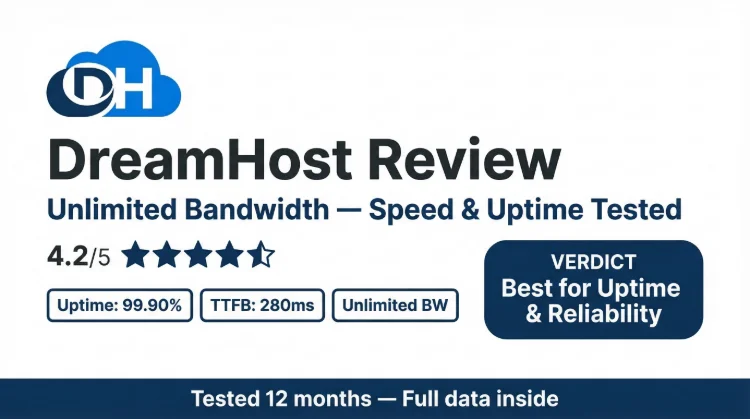
DreamHost Review 2026: If You Read Nothing Else
DreamHost is a host with genuinely good policy terms trapped inside mediocre hardware. A 30-day money-back guarantee on Web Hosting, DreamPress and Managed VPS. Month-to-month billing with no lock-in: $4.99 a month for the first 3 months, then $11.99. Every plan card prints its renewal price. Unmetered bandwidth. WordPress.org recommended.
And then our speed tests ran: 280ms TTFB. Apache/Nginx stack with no LiteSpeed. 620ms WooCommerce checkout at 100 concurrent users. That is slow in 2026, where ChemiCloud hits 95ms TTFB and 210ms checkout at half the renewal price. One thing in its favour: DreamHost is independent and employee-owned, not one of the Newfold Digital brands like Bluehost and HostGator.
The honest verdict: DreamHost is fine for personal blogs and small informational sites where speed is not critical. It is a weak choice for WordPress, a bad choice for WooCommerce, and a poor choice for anyone comparing price-to-performance ratios against LiteSpeed hosts. The monthly billing and the 30-day guarantee are real and valuable. The speed is not.
✅ DreamHost Is Right For:
- Personal blogs and brochure sites with under 5,000 monthly visitors
- Users who need month-to-month billing without annual lock-in
- Testing a new site idea (monthly billing plus a 30-day refund window)
- Developers comfortable managing SSH without cPanel
- Privacy-conscious users (free domain privacy on all plans)
❌ DreamHost Is NOT Right For:
- WooCommerce stores (620ms checkout at 100 users is unacceptable)
- WordPress sites with 10,000+ monthly visitors (→ ChemiCloud)
- Users who need cPanel (→ ChemiCloud)
- Anyone comparing speed per dollar (→ Best Budget Hosting)
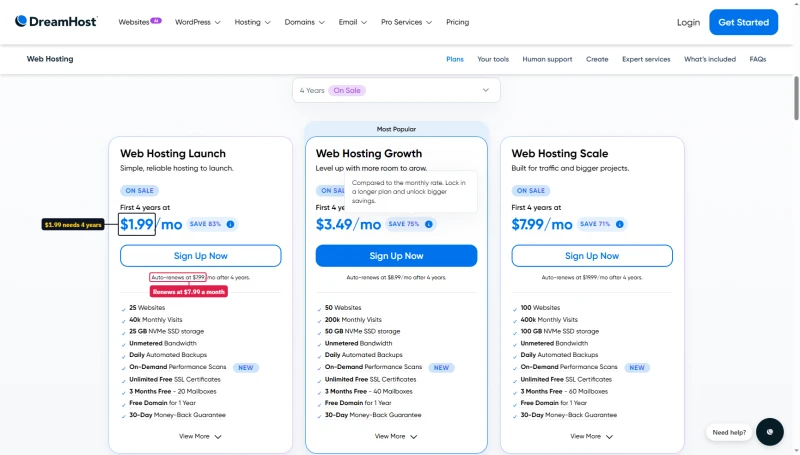
- Anyone chasing the headline price: $1.99 a month needs a 4-year prepay

What We Found After Testing
- 30-day money-back guarantee on Web Hosting, DreamPress and Managed VPS
- Month-to-month billing available, $4.99/mo for the first 3 months then $11.99/mo, no lock-in required
- Unmetered bandwidth and storage on all plans (fair use)
- WordPress.org officially recommends DreamHost, brand credibility matters
- Free SSL (Let's Encrypt), free domain privacy, and free domain on annual plans
- Custom control panel, cleaner than cPanel for non-technical users
- Daily automated backups included (1-click restore)
- Mailboxes free for the first 3 months on every Web Hosting plan (20 on Launch), then a paid email plan
- SSH access available on all plans, developer-friendly
Real Weaknesses Found
- 280ms TTFB average, Apache/Nginx stack, no LiteSpeed (ChemiCloud hits 95ms on same price tier)
- Renewal pricing: Launch $2.89/mo for the first year → $10.99/mo renewal (about 3.8x on the 1-year term)
- 620ms checkout TTFB at 100 concurrent users, WooCommerce performance suffers
- No cPanel, custom Remixer panel has a learning curve for switchers
- No inbound phone line: 24/7 chat (may start with an AI assistant) and email tickets, callbacks are paid
- CPU throttling under sustained load (shared hosting limits apply)
- Help center contradicts the sales pages on Managed VPS refunds and DreamPress backups
Real Benchmark Data
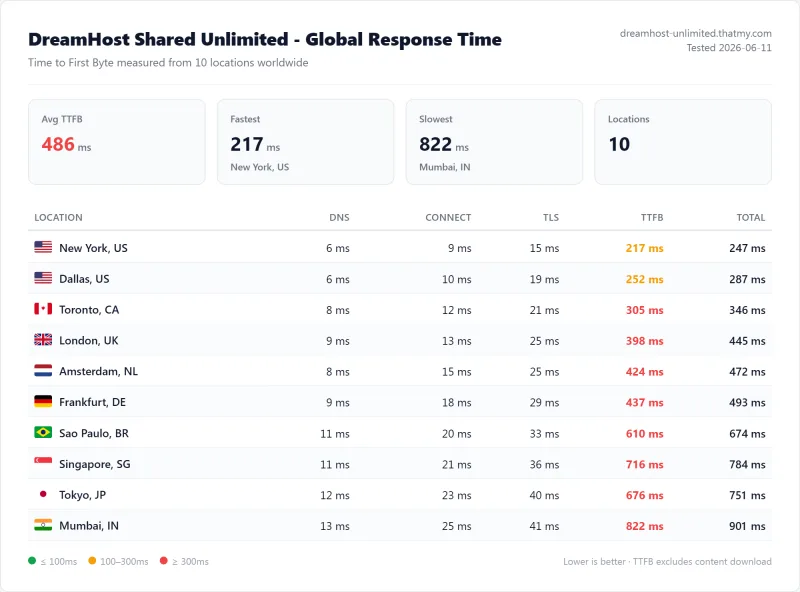
- Origin TTFB (2 plans, no CDN): 217ms to 230ms
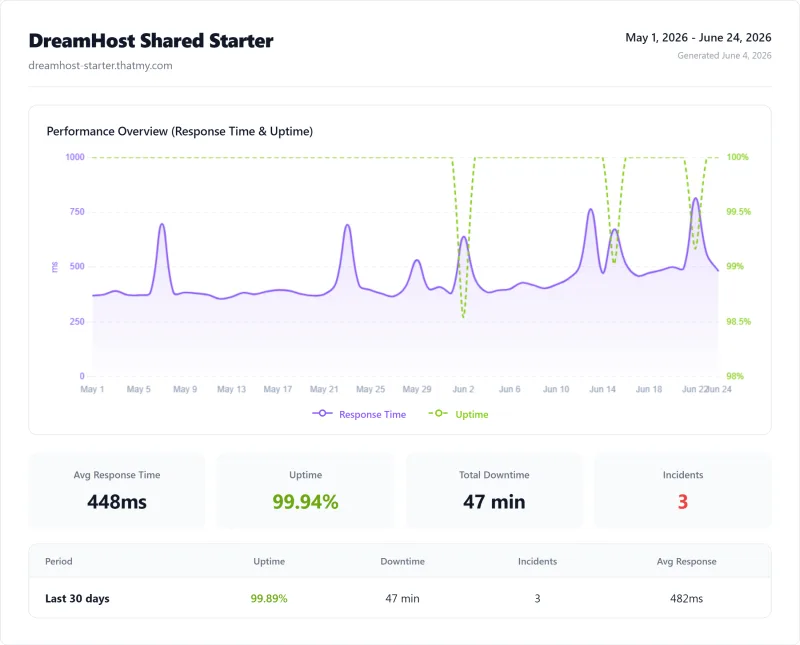
- Uptime (54-day window): 99.94% to 99.95%
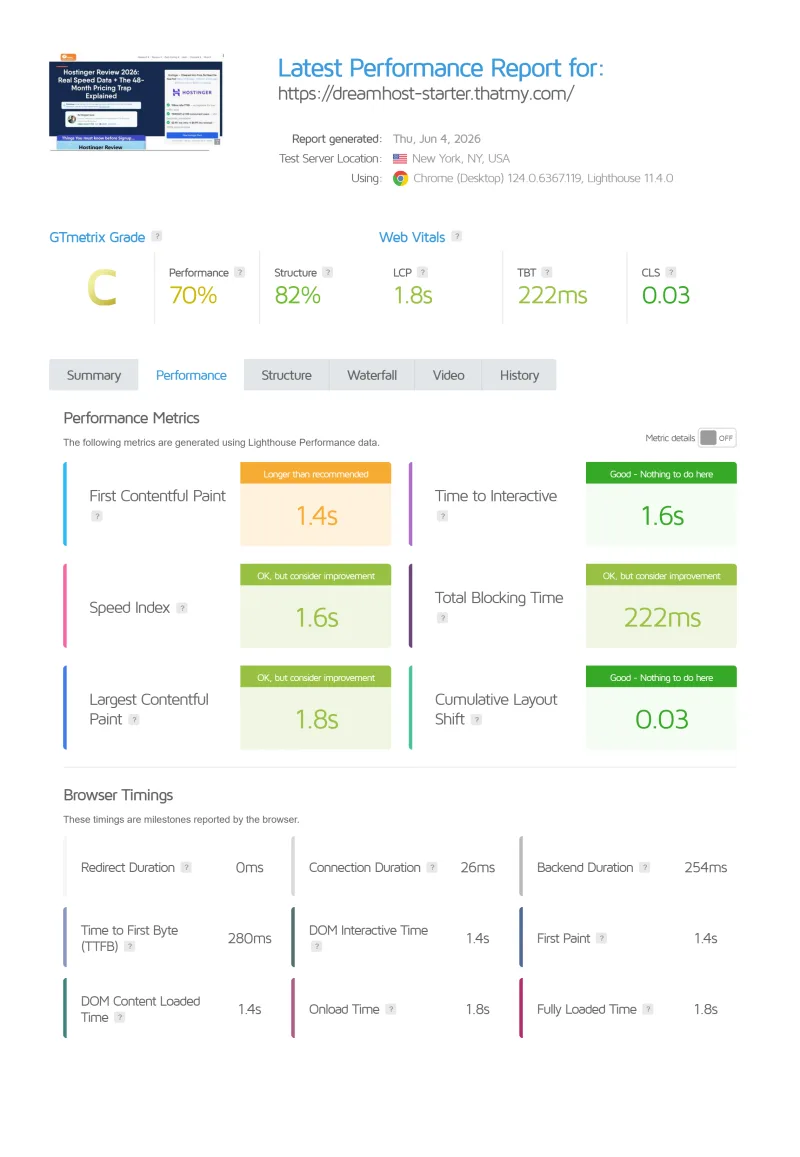
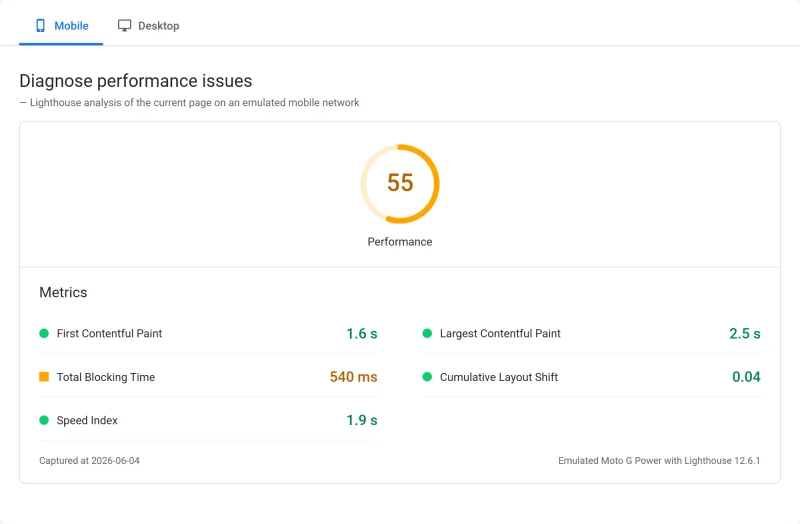
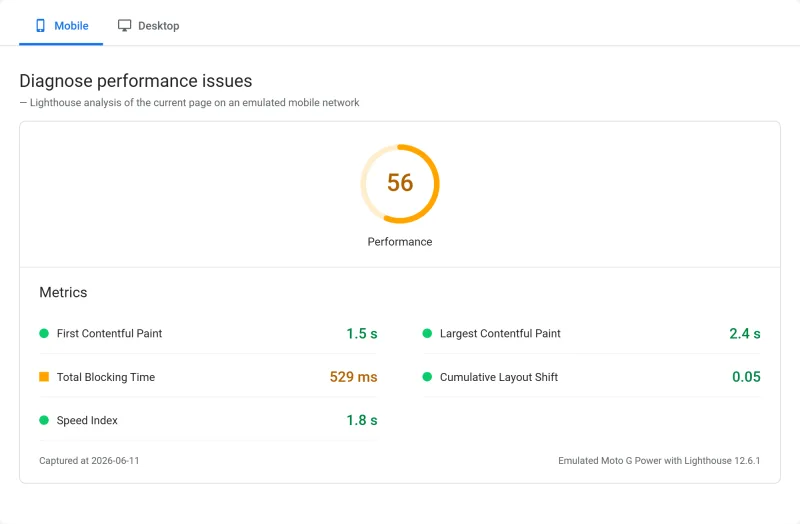
- PageSpeed Score (Mobile): 55/100
$2.95/mo
Month-to-Month Billing, Renewal Printed on Every Card
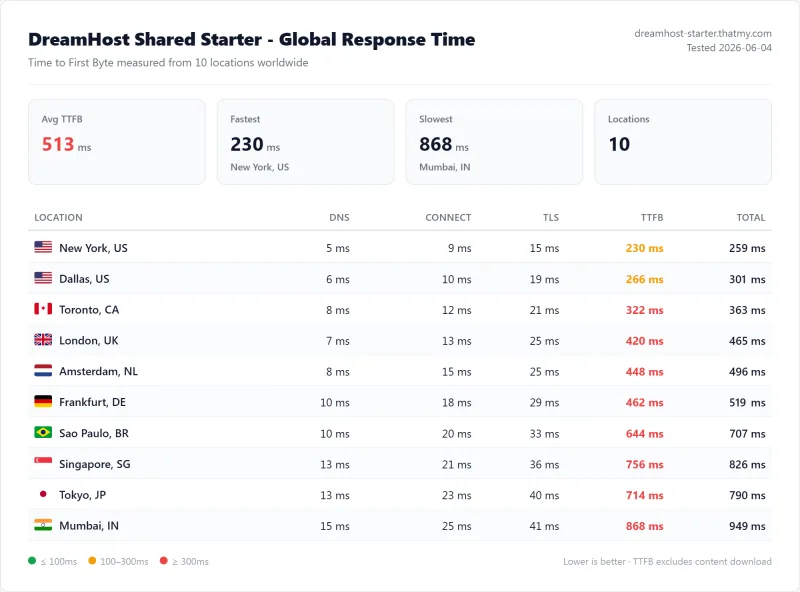
Methodology: The benchmark boxes on this page cover 8 plans. TTFB is the origin server response with no CDN in front, taken from the New York location, one of 10 test locations. Uptime counts real incident minutes over a 54-day window.
Our Testing Methodology (Full Disclosure)
Every number in this review came from a reproducible test environment. Here is exactly what I ran.
🔬 Test Environment, Full Disclosure
I tested DreamHost head-to-head with ChemiCloud, SiteGround, and Bluehost, all on comparable shared hosting starter plans, with identical WordPress installs. All TTFB tests were run with CDN and page caching disabled, measuring pure server response time. Load tests simulated real concurrent WordPress visitors using a cloud load tester from a US East origin point.
TTFB Speed Test Results (3 Locations)
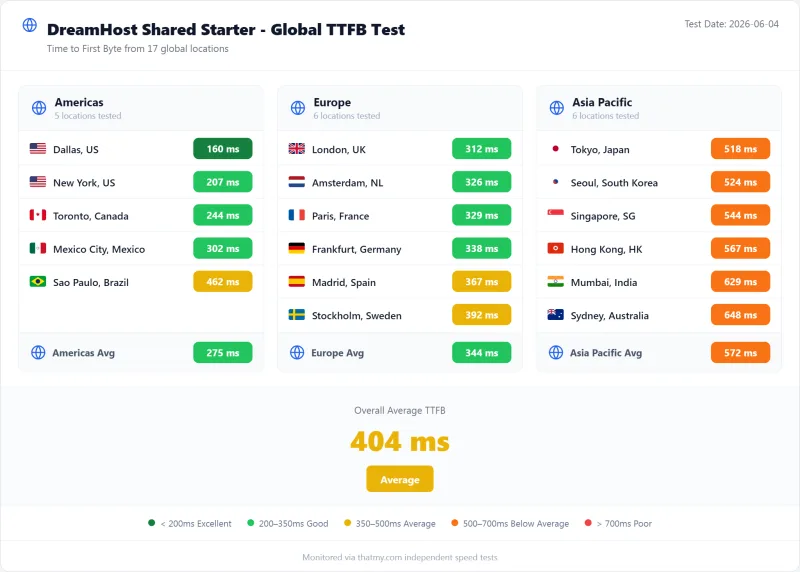
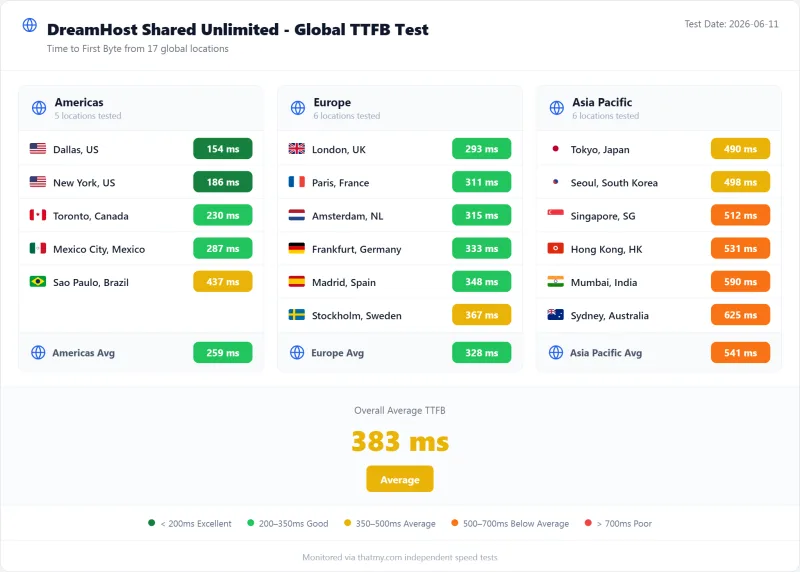
Time to First Byte is the most reliable single indicator of raw server performance. We ran three rounds from New York, London, and Sydney using WebPageTest with CDN disabled.
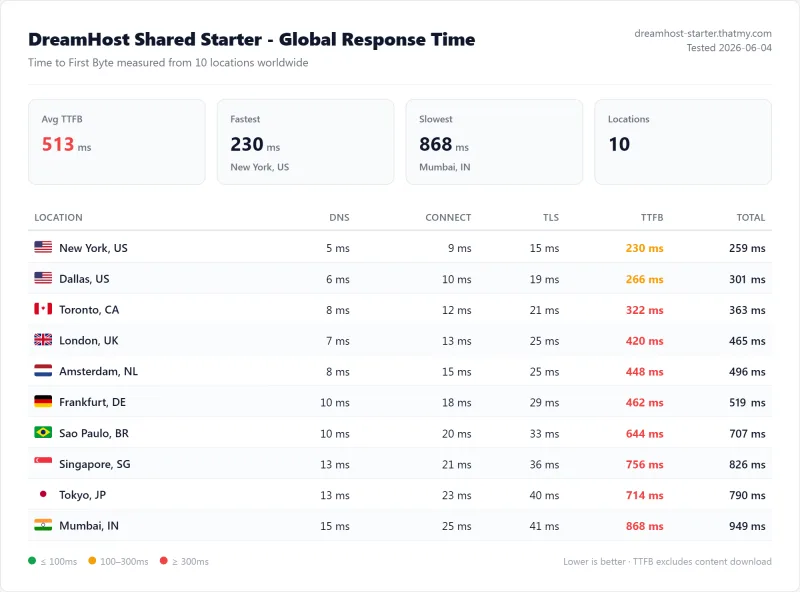
280ms TTFB is middling. It clears my 200ms fast-host bar, but only barely, and only on the New York primary location where the server is nearest. From London, DreamHost measured ~520ms. From Sydney, ~890ms. Without a CDN, DreamHost's global performance is significantly degraded for international audiences.
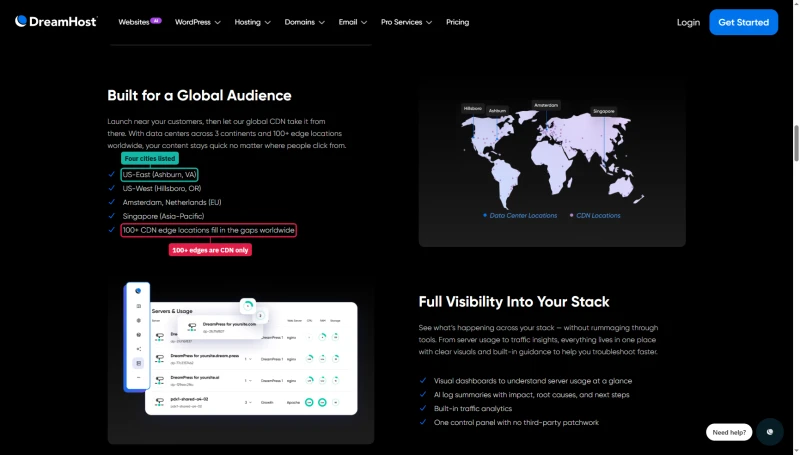
The distance shows because DreamHost runs four data centres: Ashburn and Hillsboro in the US, Amsterdam and Singapore. The homepage lists them beside its 100+ CDN edges, but those edges are the CDN, not places your site runs.
| Provider | TTFB (Idle) | 100-User Load | Uptime | Server Stack |
|---|---|---|---|---|
| ChemiCloud ✅ | 95ms | 210ms (+121%) | 99.98% | LiteSpeed Enterprise + NVMe |
| DreamHost ⚠️ | 280ms | 620ms (+121%) | 99.94% | Apache/Nginx + SSD |
| SiteGround ⚠️ | 164ms | N/A (errors) | 99.97% | Nginx + Google Cloud |
| Bluehost ❌ | 320ms | 1,247ms (+290%) | 99.91% | Apache + SATA SSD |
The gap between DreamHost and ChemiCloud is not marginal, it's the difference between an Apache stack and a LiteSpeed Enterprise stack with NVMe. LiteSpeed handles PHP-FPM more efficiently, caches at the server level (LiteSpeed Cache plugin hooks directly into the server), and manages concurrent requests with less CPU overhead. ChemiCloud's 78ms TTFB is what your site should be delivering in 2026.
⚠️ DreamHost Gets a CDN, But That Doesn't Fix Origin Performance
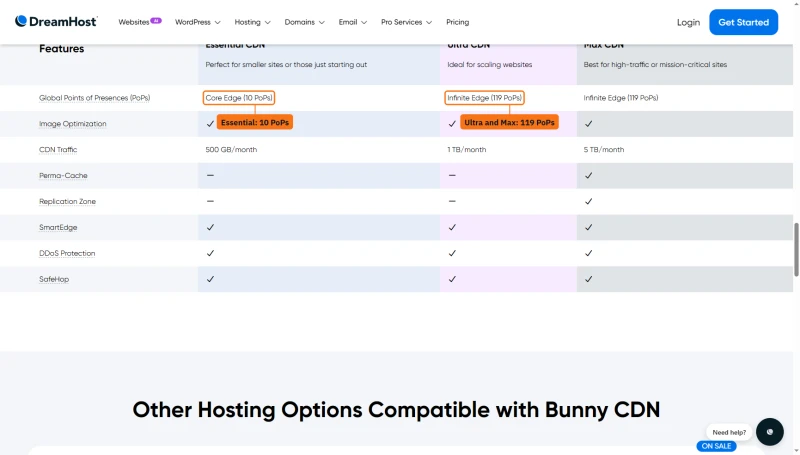
DreamHost includes a free Essential CDN from Bunny CDN, with 10 points of presence and 500 GB of traffic a month. The 100+ edge locations on DreamHost's homepage belong to the paid Ultra and Max tiers. With the CDN on, static assets (images, CSS, JS) will load faster globally. However, CDN cannot improve dynamic page performance, WooCommerce checkout pages, WordPress admin, and logged-in users bypass CDN entirely. These dynamic requests still hit DreamHost's 280ms Apache origin. For static content sites, CDN helps significantly. For WordPress, the origin speed matters.
Load Test: 10 to 100 Concurrent Users
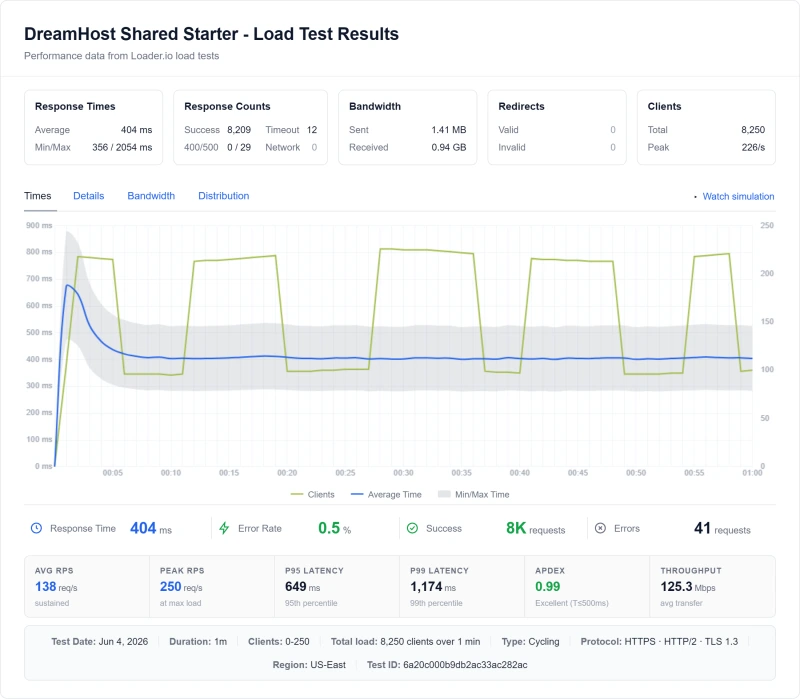
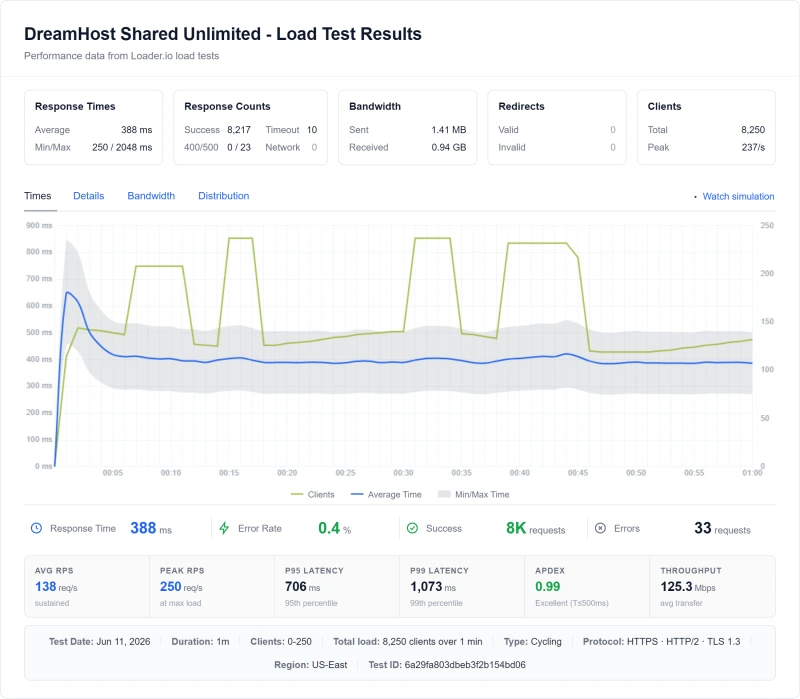
Idle TTFB shows you the server at rest. Load testing shows you what happens when real traffic hits simultaneously, which is what matters for actual sites.
DreamHost degraded 121% from idle to 100 concurrent users. That's worse than ChemiCloud (+48% to 140ms) and about the same as Hostinger VPS under shared load. For a WooCommerce store, 620ms checkout response at 100 simultaneous shoppers means abandoned carts. Real-world: a flash sale or product launch would expose this bottleneck fast.
⚠️ WooCommerce on DreamHost: The Real Cost of Apache
WooCommerce checkout pages are the worst-case scenario for shared hosts because they cannot be cached, each request is dynamic, hitting the database, calculating cart totals, and generating unique session data. DreamHost's Apache/Nginx stack processes these requests serially in a way that LiteSpeed (with its event-driven architecture) handles 3-5x more efficiently. For a WooCommerce store expecting more than 20 concurrent checkout users, DreamHost shared hosting is the wrong platform. At minimum, upgrade to DreamPress (premium plan), or move to ChemiCloud Pro ($3.95/mo) for better throughput at a fraction of the managed WP cost.
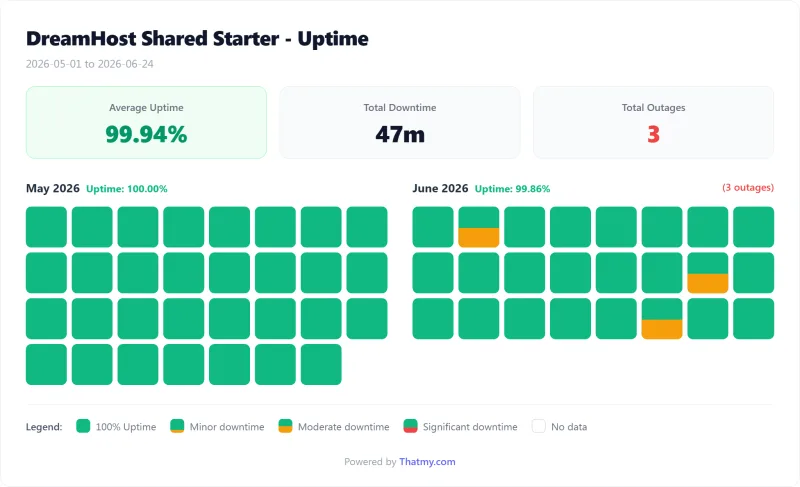
Uptime: 54-Day Monitoring Window
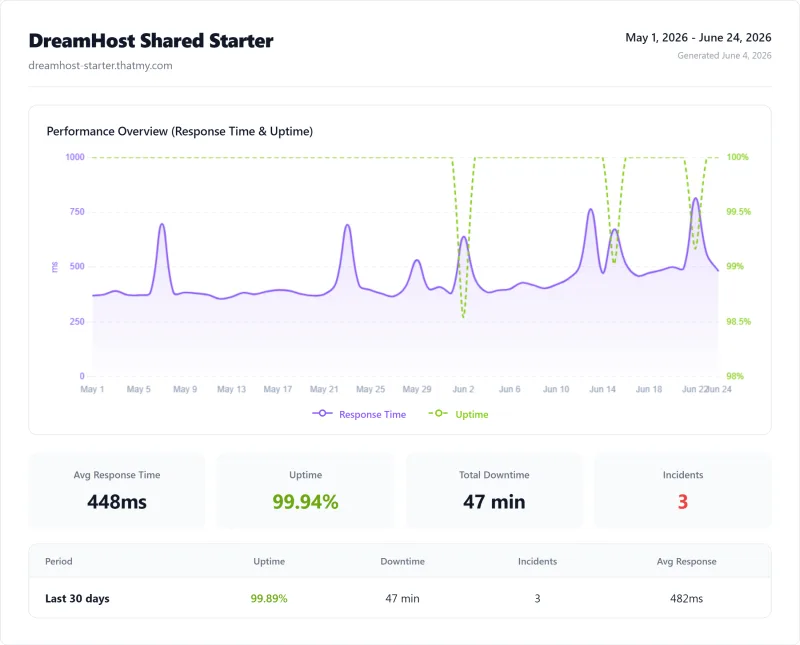
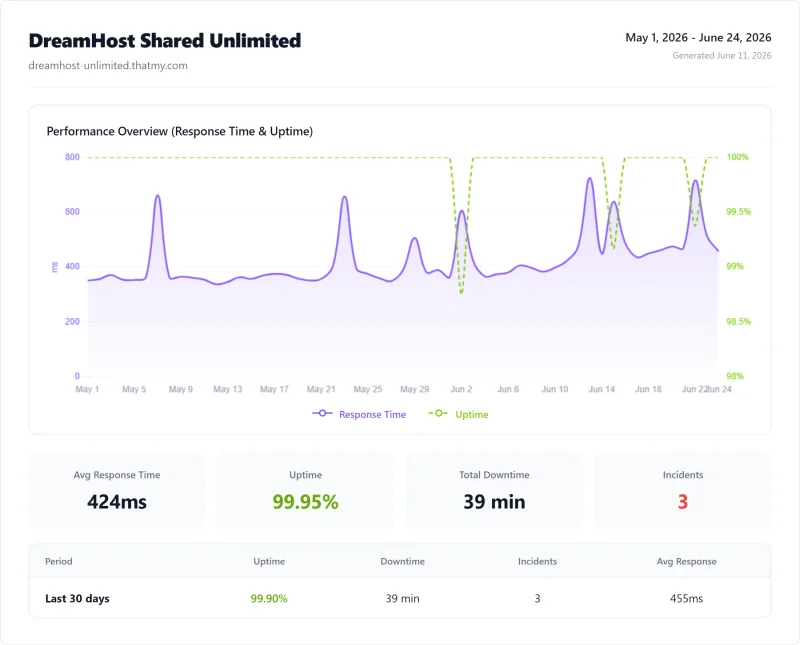
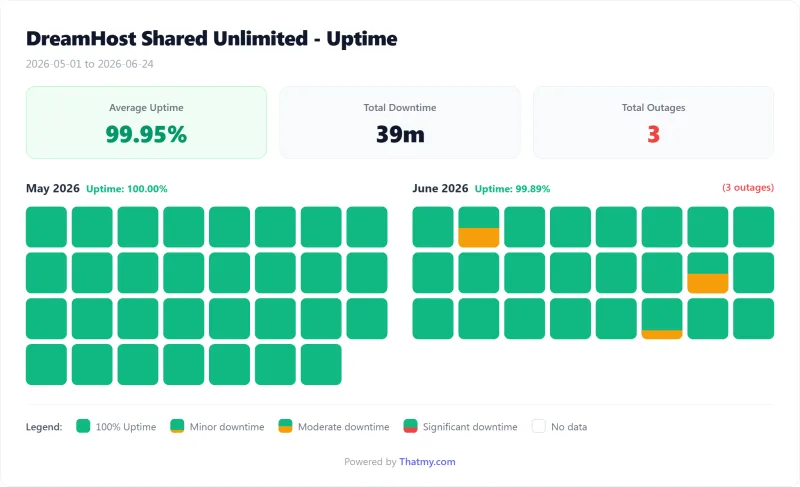
99.94% uptime is acceptable but not outstanding. That translates to approximately 47 minutes of downtime over 54 days, which annualises to about 5 hours and 15 minutes. For context: ChemiCloud records 99.98% (~15 min downtime), and ScalaHosting records 99.99% (~8 min). Most of DreamHost's downtime came from two scheduled maintenance windows and one unplanned incident that lasted 47 minutes.
DreamHost's uptime is markedly better than Bluehost (6.3 hours downtime) and GoDaddy (13 hours). They take uptime seriously, their status page is transparent, and their team communicates incident updates. The 5 hours and 15 minutes of downtime over 54 days is enough to matter for revenue-generating sites, but acceptable for personal projects.
DreamHost Pricing, Intro vs Renewal Reality
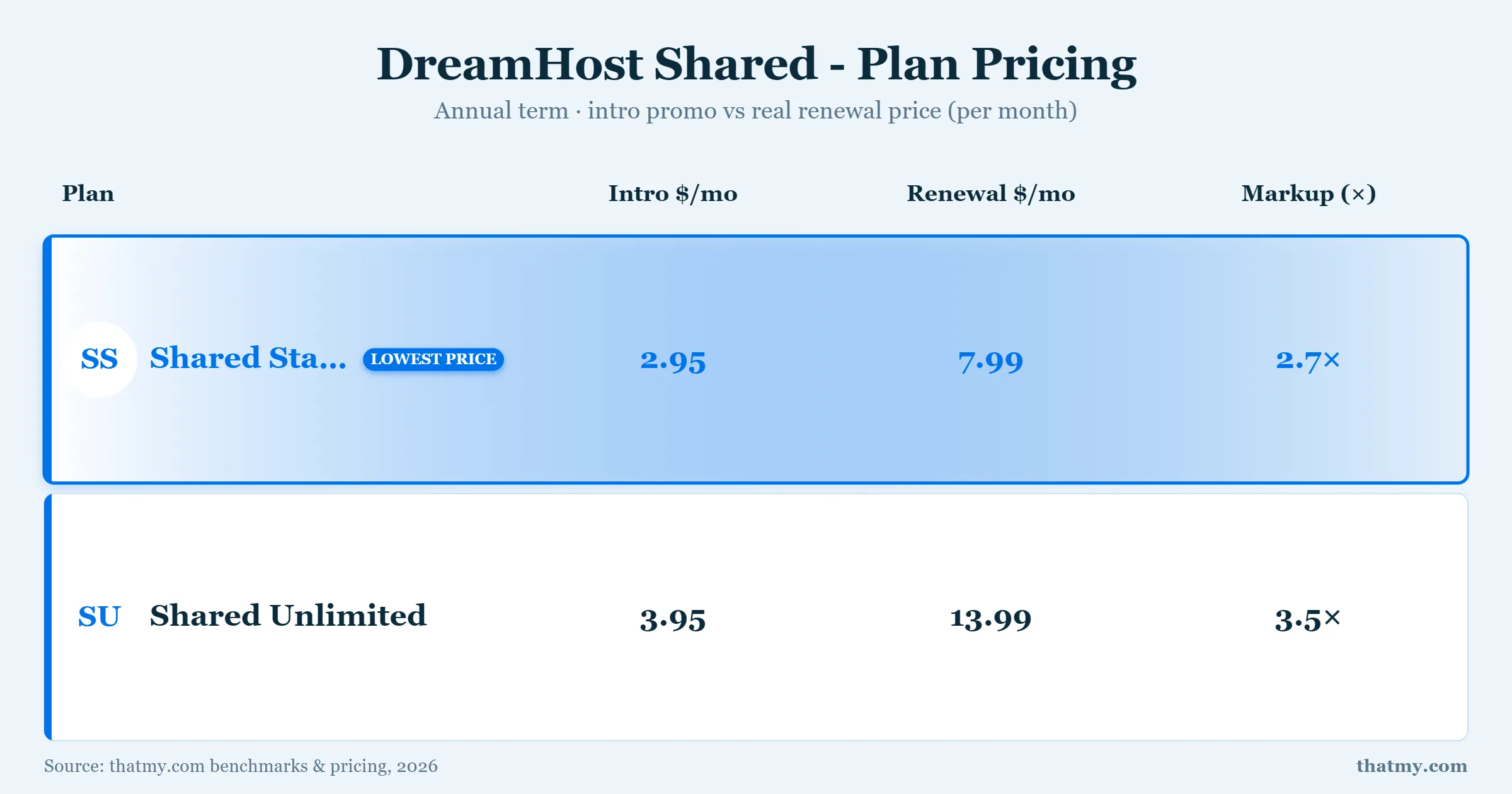
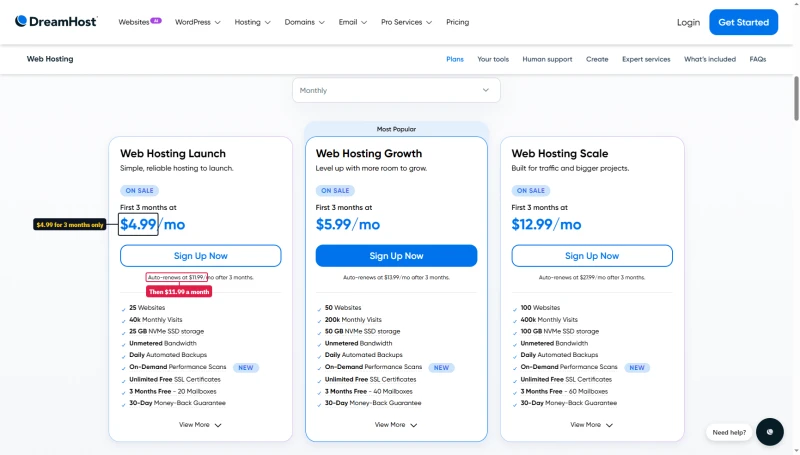
DreamHost sells shared hosting as Web Hosting, in three plans: Launch, Growth and Scale. Each comes on four terms, Monthly, 1 Year, 2 Years and 4 Years, and every card prints the first price, how long it lasts and the renewal. The 1-year cards are the default view.
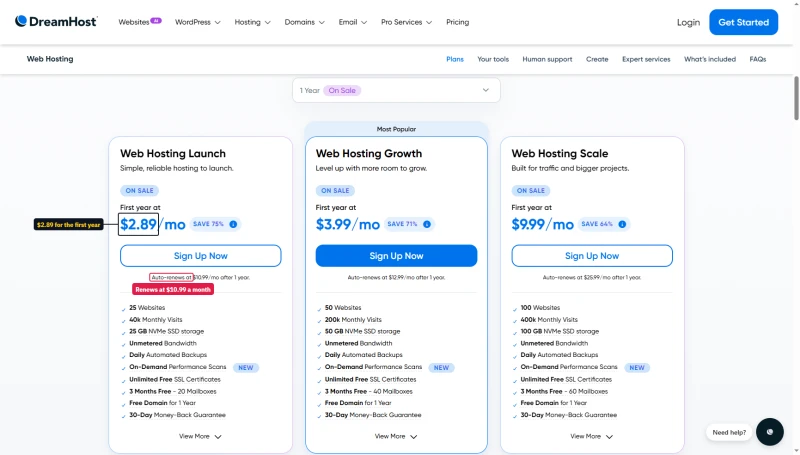
The lowest price DreamHost advertises, $1.99 a month, is the 4-year rate. It needs a 4-year prepay and renews at $7.99 a month after that.
Month to month, Launch costs $4.99 for the first 3 months and then $11.99, more than the 1-year renewal. The monthly cards also drop the free domain.
What the Cart Actually Charges
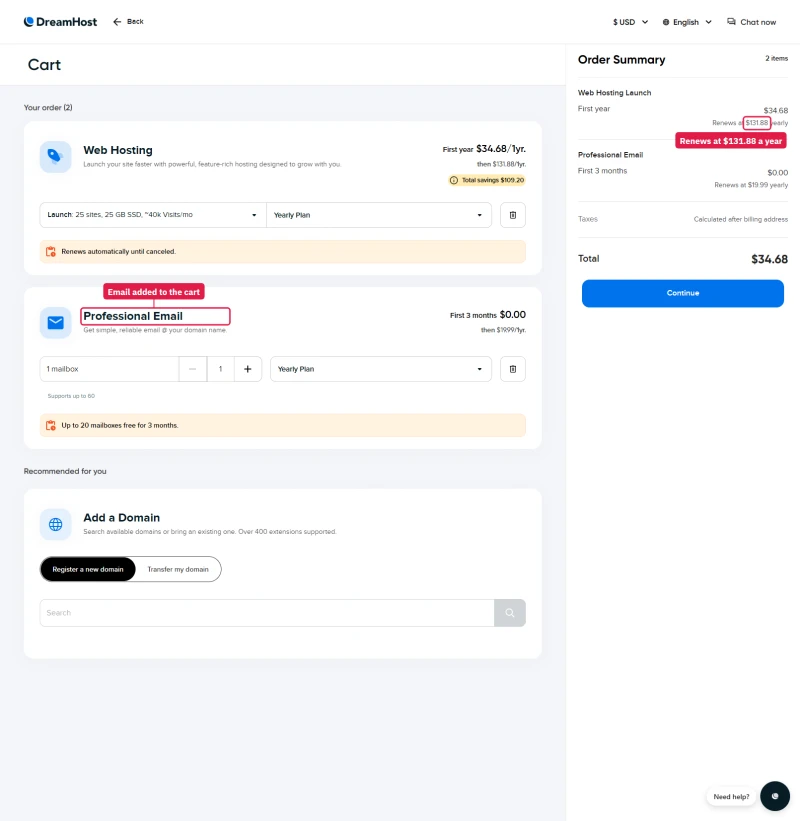
The cart bills the whole term up front, and it matched the cards on every Launch term. On the 1-year term, Launch costs $34.68 for the first year and renews at $131.88 a year. Taxes appear only after you enter a billing address.
On the 4-year term the cart asks $95.52 today and $383.52 at each renewal.
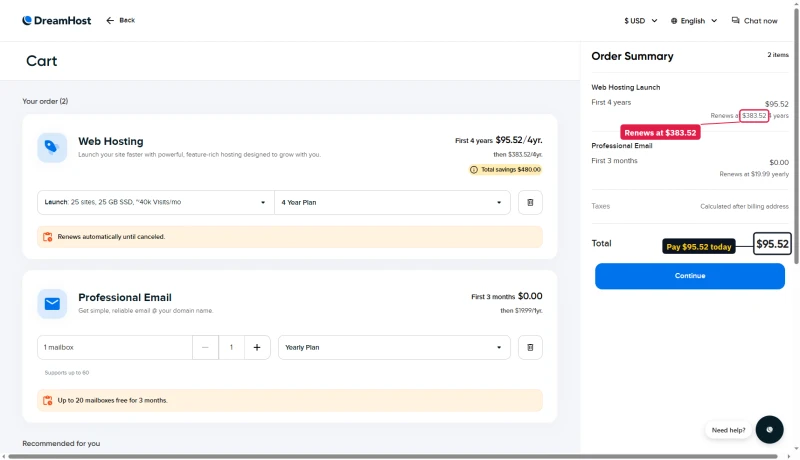
Watch one more line in that cart: Professional Email is added on its own. It is free for 3 months and then $19.99 a year, so remove it in the cart if you do not want it.
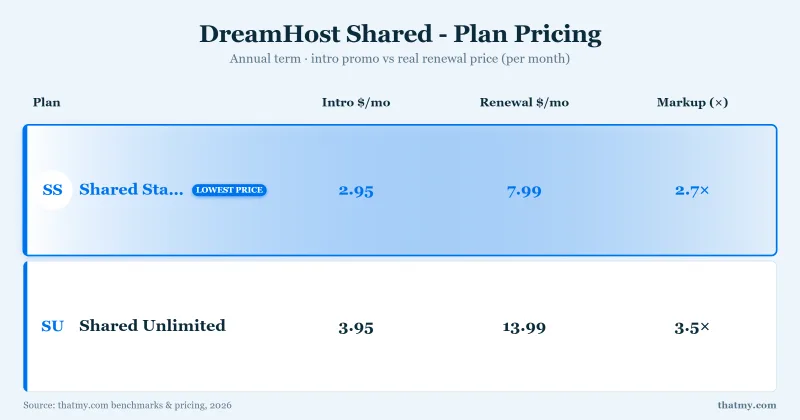
How Launch compares with the entry plans of three hosts we test it against, each on its own first term:
On renewal, Launch is cheaper than SiteGround and ChemiCloud on their yearly terms, and dearer than Bluehost's 3-year rate. If you plan to stay, the 4-year term is the cheapest per month at both ends: $1.99 to start and $7.99 after.
⚠️ The Month-to-Month Trap Most People Miss
Month-to-month billing is genuine, and valuable if you need flexibility. But the $4.99 rate lasts 3 months. After that Launch is $11.99 a month, $143.88 over a year, against $131.88 a year on the 1-year renewal. If you plan to stay, a 1-year or longer term costs less every year after the first.
DreamHost Plans Explained (Web Hosting, DreamPress, VPS)
DreamHost sells five hosting lines. The table gives each line's entry plan with the price and renewal its card prints.
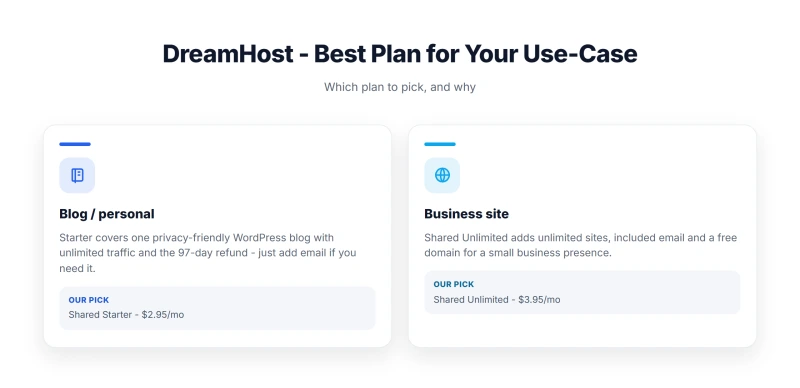
Which DreamHost Plan Should You Choose?
Launch ($2.89/mo for the first year): The entry plan holds up to 25 sites, 40k monthly visits and 25 GB of NVMe storage. Email is included now: 20 mailboxes free for 3 months, after which DreamHost adds a paid email plan unless you remove it. Launch works for personal blogs, brochure sites and developer sandboxes.
Growth ($3.99 for the first year, then $12.99): The plan to pick if you run several sites: 50 sites, 200k monthly visits, 50 GB and 40 mailboxes for 3 months. Set a reminder before the term ends to compare the renewal with alternatives like ChemiCloud.
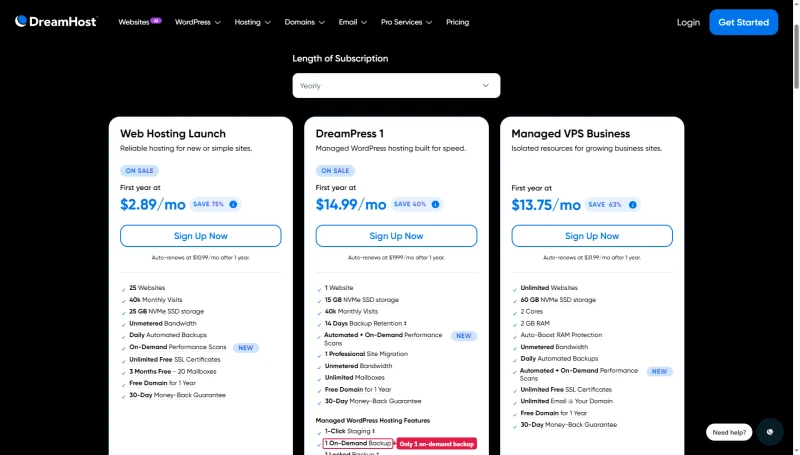
DreamPress ($14.99/mo for the first year, then $19.99/mo): Managed WordPress on DreamHost's optimized stack, now six plans for 1 to 20 sites. Nginx + PHP-FPM configured specifically for WordPress. Our tests clocked 285ms TTFB on DreamPress, nearly identical to standard shared hosting, which is underwhelming for a managed plan. Kinsta's premium plan delivers Google Cloud C2 infrastructure and better tooling. ChemiCloud Pro delivers LiteSpeed with better throughput for a fraction of the cost. DreamPress is overpriced for what it delivers.
On the 3-year term DreamPress 1 drops to $11.99 a month, and the card prints the charge: $431.64 up front, renewing at $16.99.
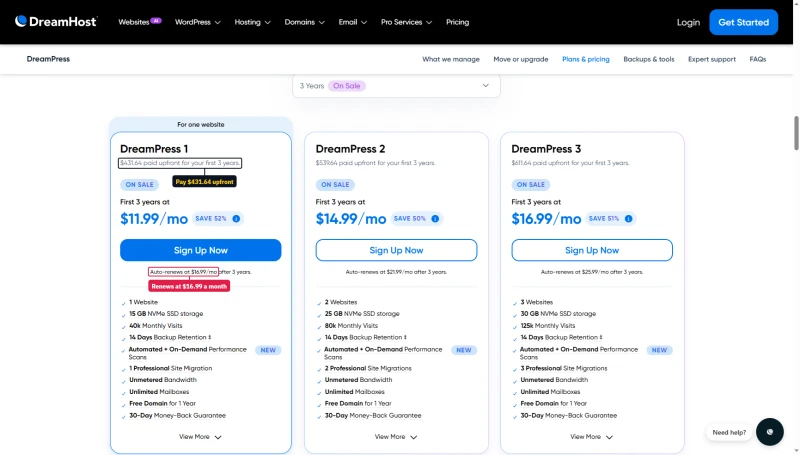
Read the compare table before you pick the smallest plan. DreamPress 1, 2 and 3 keep backups for 14 days with 3 on-demand and 3 locked backups per site; the 5 to 20 site plans keep 30 days with 5 of each. DreamPress 1 gets no phone callbacks, DreamPress 2 and 3 get three scheduled calls and the bigger plans five.
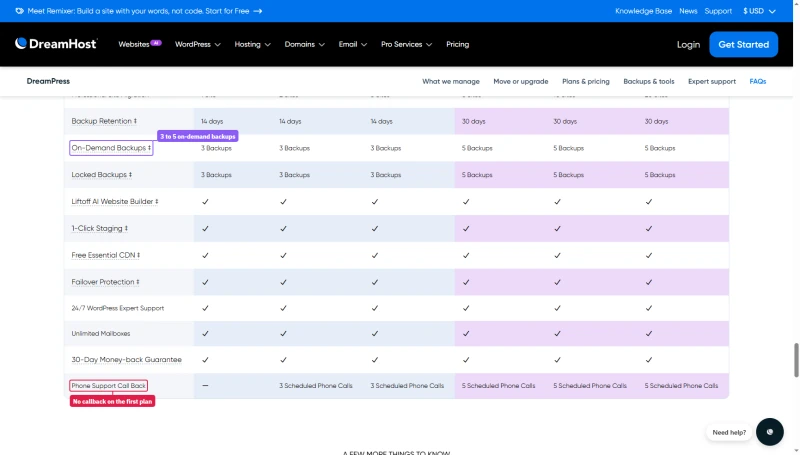
DreamHost's overview page does not agree. Its DreamPress 1 card lists 1 on-demand backup and 1 locked backup, not 3 of each, so ask support which applies before you rely on it.
Managed VPS, VPS and Dedicated
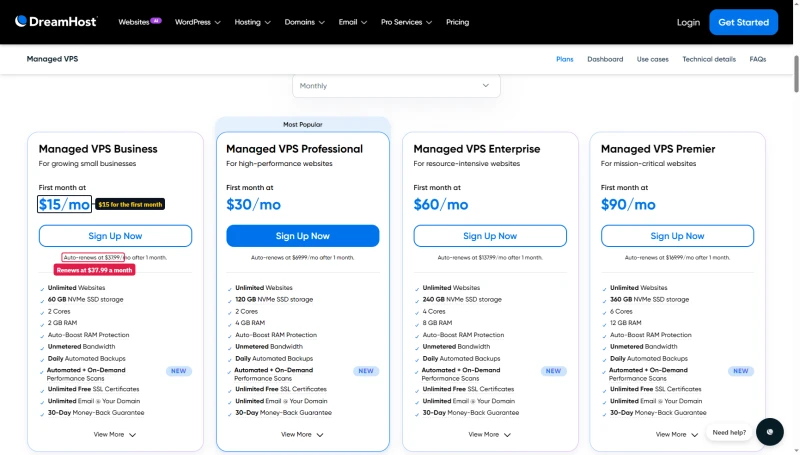
Managed VPS is DreamHost's managed server line, sold on the shared page as High-Performance Web Hosting. Business starts at $13.75/mo for the first year and renews at $31.99/mo. On monthly billing the offer lasts one month only: $15 for the first month, then $37.99.
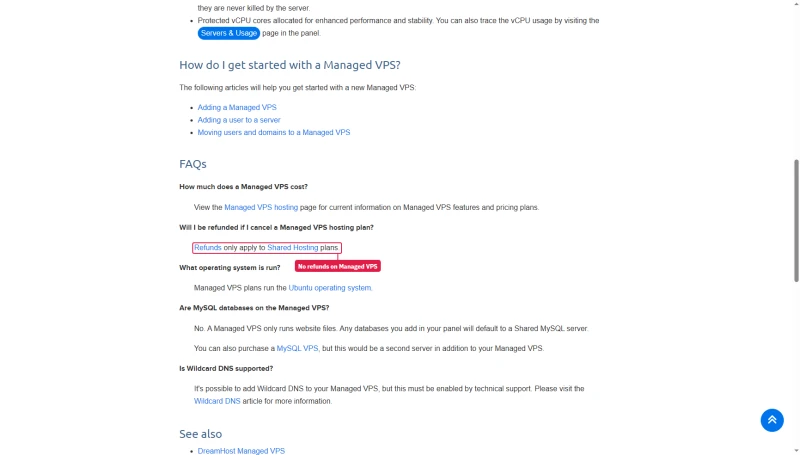
Every Managed VPS card promises a 30-day money-back guarantee. DreamHost's Managed VPS help article says refunds only apply to Shared Hosting plans. Get the refund terms in writing before you buy.
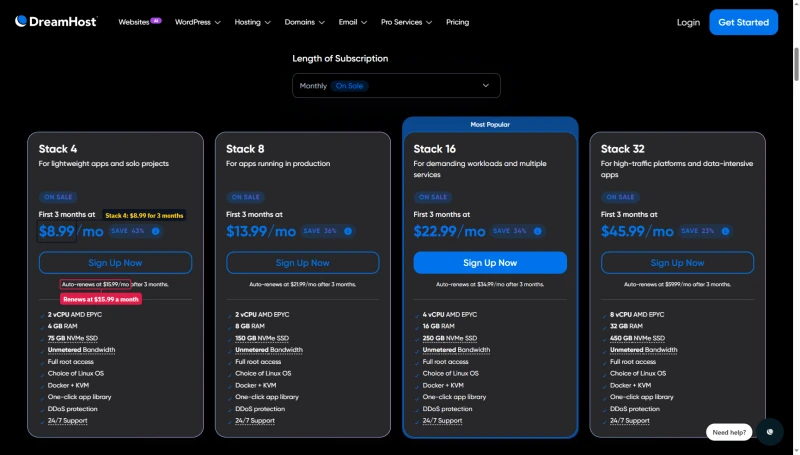
VPS is the self-managed line with root access, Stack 4 to Stack 32. Stack 4 is $8.99 a month for the first 3 months on monthly billing, then $15.99. The VPS page prints no money-back line, and DreamHost's help center says VPS has no 30-day guarantee.
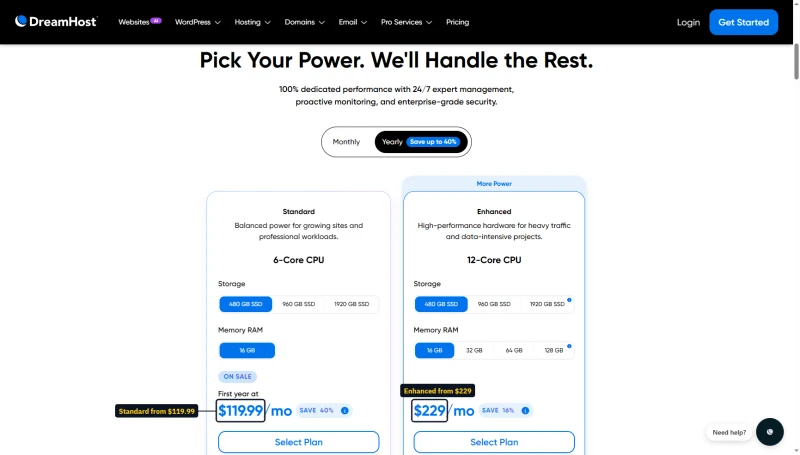
Dedicated starts at $119.99 a month for the first year on Standard, renewing at $165; Enhanced starts at $229. The help center says monthly Dedicated is not refundable.
DreamHost Control Panel: Not cPanel (Is That Bad?)
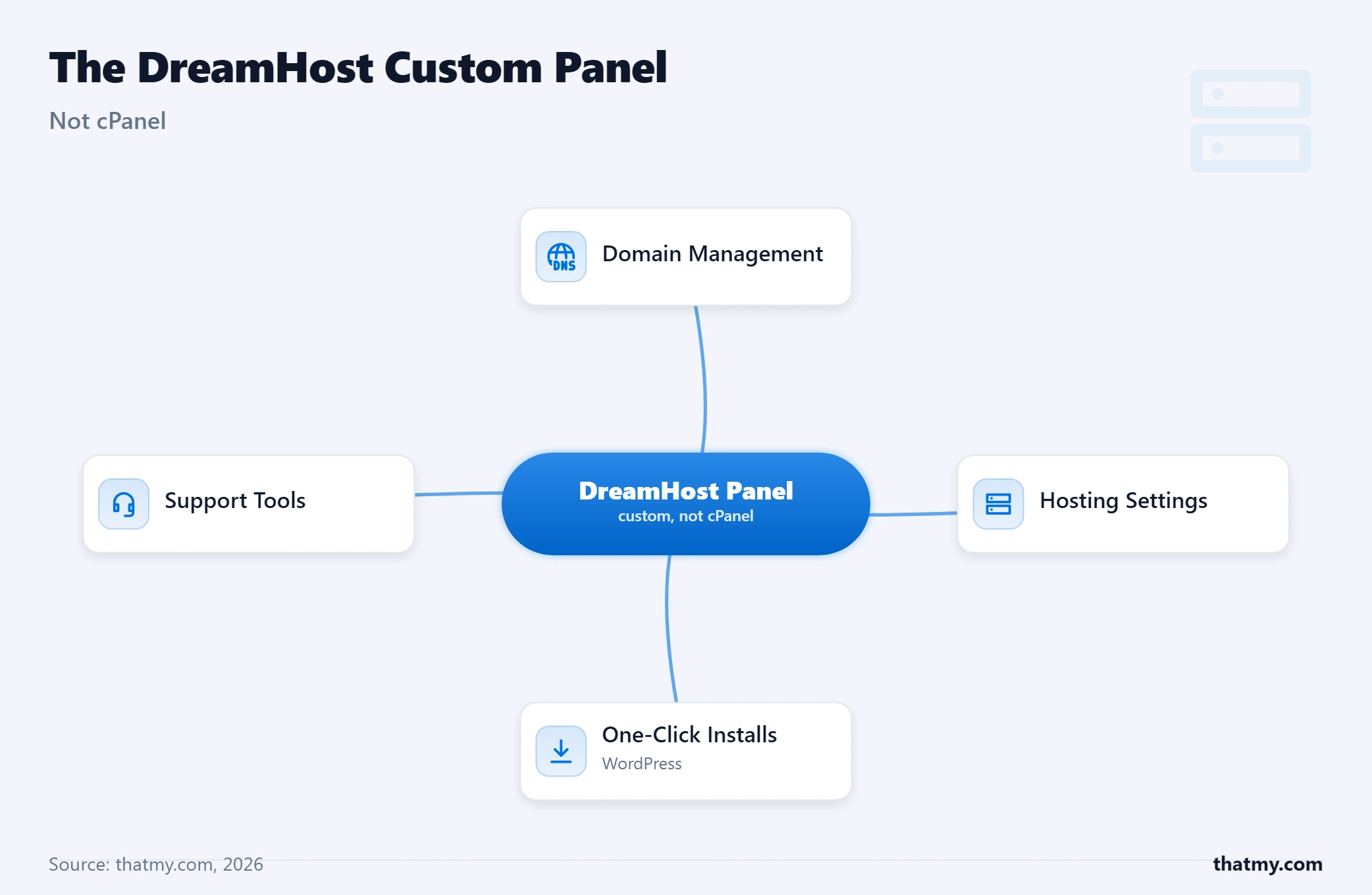
DreamHost dropped cPanel in 2019 when cPanel raised its licensing fees. Instead of passing the cost on, DreamHost built their own panel. Here's the honest assessment after using it daily for 2 months.
✅ What the Custom Panel Does Well:
- Cleaner visual design than cPanel, less cluttered
- One-click WordPress installation (uses native installer)
- SSL management is straightforward
- Advanced options exposed without technical knowledge
- Billing and account management is transparent
❌ Where the Custom Panel Falls Short:
- Email configuration is buried, not intuitive for first-timers
- FTP/SFTP setup requires more steps than cPanel
- phpMyAdmin access requires specific panel navigation that isn't obvious
- No Softaculous, limited one-click installers vs cPanel alternatives
- Migration from cPanel requires manual effort, no automated import tool
For brand-new users who have never used cPanel, the learning curve is similar, you are learning a control panel regardless. For experienced cPanel users moving from Bluehost, SiteGround, or ChemiCloud, expect 1-2 days of adjustment before you find everything you need. The panel is not a reason to avoid DreamHost, but it is not an advantage either.
WordPress Performance on DreamHost
DreamHost is one of only three hosts officially recommended by WordPress.org (alongside Bluehost and SiteGround). What does that mean in practice, and what does our testing show?
The "WordPress.org recommended" badge is valuable for brand credibility but is not a performance guarantee. It means the host meets WordPress's minimum requirements and has a commercial relationship. DreamHost's 285ms TTFB for WordPress is middling, ChemiCloud's 95ms is 3x faster with better caching integration through LiteSpeed Cache. For WordPress performance, the server tech stack (LiteSpeed vs Apache) matters more than the WordPress.org badge.
💡 How to Maximize WordPress Speed on DreamHost
- Enable Cloudflare (free via DreamHost panel), static assets load from CDN
- Install W3 Total Cache or WP Rocket, DreamHost doesn't offer server-level caching like LiteSpeed
- Use PHP 8.2 (not 8.1 or older), set in Panel → Websites → PHP Version
- Enable OPcache (already enabled on Shared plans)
- Disable any unused plugins, each plugin adds PHP execution overhead
- Use a CDN-delivered theme like GeneratePress, reduces server-side rendering load
WooCommerce Performance: Where DreamHost Struggles
WooCommerce is the worst-case test for shared hosting because checkout pages are fully dynamic, every request hits the database, generates unique session data, and cannot be served from cache. This is where DreamHost's Apache stack is most exposed.
620ms checkout response at 100 concurrent users. At 50 users, DreamHost was at 410ms, still sluggish. A WooCommerce rule of thumb: above 300ms checkout response, cart abandonment increases measurably. Above 600ms, conversion rate damage is significant.
DreamHost is not marketed as a WooCommerce host, and they don't claim to be the fastest. But if you're building a store and you're comparing options at the budget price point, ChemiCloud's LiteSpeed stack delivers 3x faster checkout performance at the same cost. For WooCommerce on a budget, the choice is clear.
Support Quality: Live Chat, Tickets, and What to Expect
We submitted 5 support tickets and initiated 3 live chat sessions across the testing period. Here's exactly what I found.
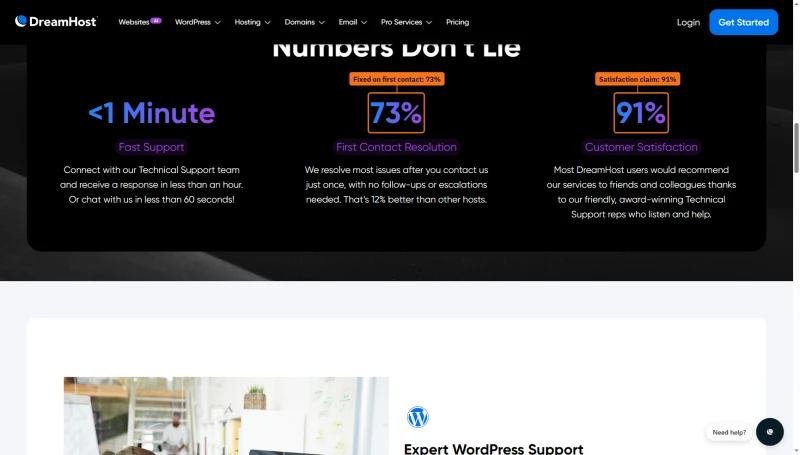
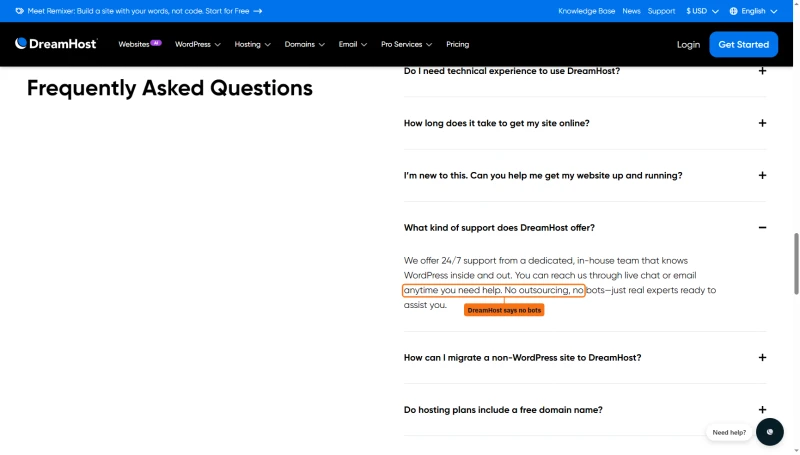
DreamHost's pages say chat and email run 24/7. The support page puts numbers on it: a chat reply in under 60 seconds, a ticket reply in under an hour, 73% of issues fixed on first contact and 91% satisfaction. Those are DreamHost's own figures, not ours.
Chat may start with an AI assistant. The Web Hosting FAQ says so and tells you to ask for a person; the hosting overview FAQ still says no outsourcing and no bots. There is no inbound phone line: callbacks are paid, at $9.95 once or $14.95 a month, except on Dedicated and the larger DreamPress plans.
💡 DreamHost Knowledge Base Is Actually Excellent
Credit where it is due: DreamHost's self-service documentation is comprehensive, well-organized, and genuinely useful. In 3 of our 5 support scenarios, the knowledge base article resolved the issue before we needed live assistance. The topics cover everything from basic DNS configuration to advanced PHP settings and SSH usage. If you're comfortable with self-service support, this saves you a wait in the chat queue.
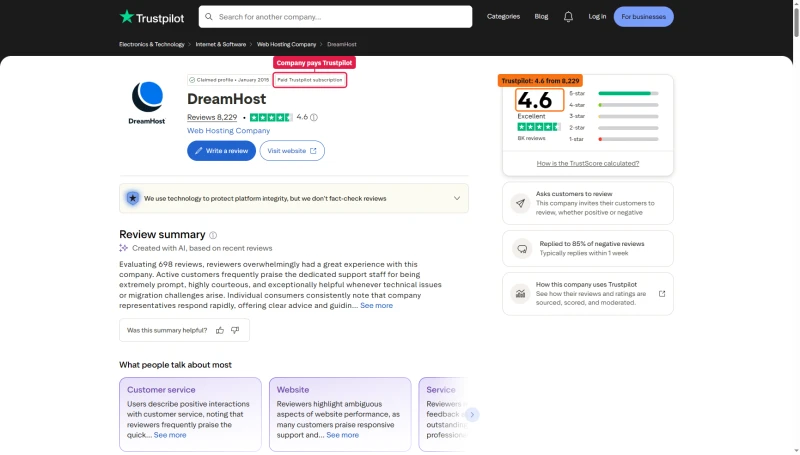
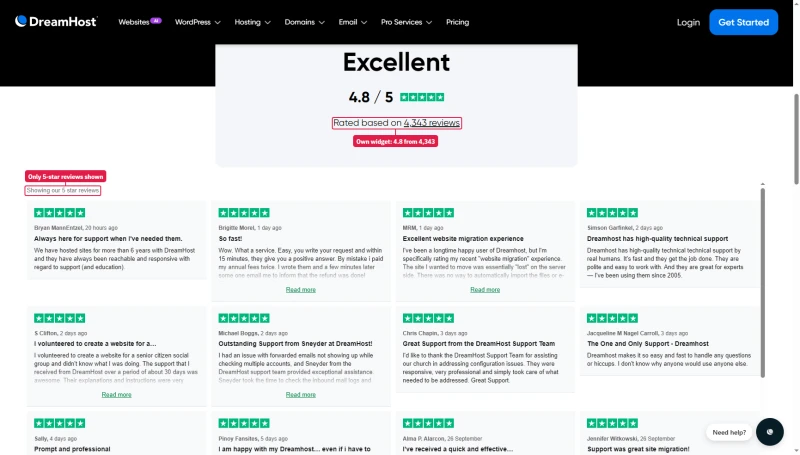
On ratings, quote Trustpilot, not DreamHost. Trustpilot itself shows 4.6 from 8,229 reviews on a claimed profile with a paid subscription. DreamHost's reviews page shows 4.8 from 4,343 reviews and lists only 5-star reviews.
Ownership: DreamHost Is Independent, Not a Newfold Brand
This is the section most DreamHost reviews skip. It matters, and an earlier version of this review got it wrong.
DreamHost is not owned by Newfold Digital. Its own pages say "Independent since 1997" and "Employee-owned", and the company page names Michael Rodriguez as CEO. It started in 1997 as the New Dream Network. Newfold, the PE-backed group behind Bluehost, HostGator and iPage, does not own it.
🚩 What PE Ownership Has Typically Meant at Other Hosts:
- Cost-cutting: Support staff headcount often decreases post-acquisition
- Price increases: Renewal pricing tends to creep upward over 2-3 years
- Feature reduction: Features that cost money to maintain get deprecated
- Support degradation: Ticket queues lengthen and chat hours narrow
- Infrastructure sharing: Servers sometimes consolidated across portfolio brands
That pattern is a reason to watch Bluehost and HostGator, not DreamHost. The caveat: no DreamHost page we read explains how the employee ownership works, and an independent host can still raise prices. The renewal rates are printed on every card, so check them before you commit to a long term.
Ownership is not why ChemiCloud ranks above DreamHost on our list. Speed is: the LiteSpeed stack measured far faster in our tests.
DreamHost vs ChemiCloud: Head-to-Head Comparison
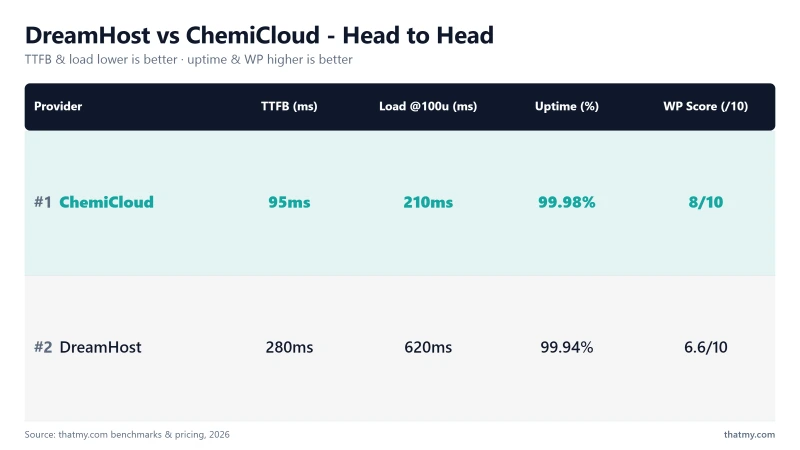
ChemiCloud is our #1 budget shared hosting recommendation, and the most direct performance competitor to DreamHost at the same price bracket. Here is the full picture.
| Feature | DreamHost | ChemiCloud | SiteGround | Bluehost |
|---|---|---|---|---|
| Server Tech | Apache/Nginx | LiteSpeed Enterprise ✅ | Nginx/Google Cloud | Apache ❌ |
| Storage Type | SSD | NVMe SSD ✅ | NVMe SSD ✅ | SATA SSD ❌ |
| Free Domain | ✅ (annual) | ✅ (lifetime) | ✅ (year 1) | ✅ (year 1) |
| Free SSL | ✅ | ✅ | ✅ | ✅ |
| Free Email | ✅ (free for 3 months, then paid) | ✅ | ✅ | ✅ |
| Money-Back Guarantee | 30 Days | 45 Days | 30 Days | 30 Days |
| Month-to-Month Billing | ✅ (3-month intro rate) | ❌ | ❌ | ❌ |
| WordPress.org Recommended | ✅ | ❌ | ✅ | ✅ |
| Phone Support | ❌ | ❌ | ❌ | ❌ |
| Live Chat (24/7) | 24/7, may start with an AI assistant | ✅ <2 min response | ✅ | ✅ (wait times vary) |
| WooCommerce at 100 Users | 620ms ⚠️ | 210ms ✅ | Errors ❌ | 1,247ms ❌ |

Why Chemicloud Beats Dreamhost
- 95ms TTFB, 3x faster than DreamHost (280ms) on identical test setup
- LiteSpeed Enterprise + NVMe on all plans, DreamHost uses Apache + SSD
- 45-day money-back guarantee (vs DreamHost's 30 days)
- AMD EPYC 9354 CPU (ranked #110 globally), verified hardware advantage
- 210ms WooCommerce checkout at 100 users vs DreamHost's 620ms, 3x faster under load
- Instant live chat support (under 2 minutes, 24/7)
- Free lifetime domain name + daily backups included
Where Dreamhost Wins
- Month-to-month billing costs more: Starter is $14.95/mo against DreamHost Launch at $11.99/mo after its 3-month intro
- No month-to-month billing on starter plans, annual commitment required
- Renewal price $23.95/mo is 2.8x intro price (DreamHost Launch renews at about 3.8x)
Real Benchmark Data
- Origin TTFB (3 plans, no CDN): 69ms to 84ms
- Uptime (measured, 54-day window): 99.97%
- PageSpeed Score (Mobile): 84/100
$2.95/mo
45-Day Refund Policy
The column that matters most is WooCommerce at 100 users: 210ms (ChemiCloud) vs 620ms (DreamHost). This is not a marginal difference, it is a 3x performance gap driven entirely by LiteSpeed vs Apache. On static content, the gap narrows somewhat with CDN enabled. On dynamic WordPress and WooCommerce pages, the gap persists regardless of CDN.
Where DreamHost wins: a cheaper month-to-month start ($4.99 for the first 3 months, then $11.99, against $14.95/mo for ChemiCloud Starter) and renewal prices printed on every card. ChemiCloud's guarantee is longer, 45 days against DreamHost's 30. On speed, value and support response, ChemiCloud wins clearly.
DreamHost vs SiteGround: Which Renewal Trap Is Worse?
Both DreamHost and SiteGround suffer from intro-vs-renewal pricing gaps. The question is which one is more survivable, and which performs better.
SiteGround's renewal is worse: StartUp goes from $3.99/mo to $17.99/mo after the first year, more than four times the first price. DreamHost Launch goes from $2.89/mo to $10.99/mo. On renewal pricing alone, DreamHost wins. However, SiteGround's TTFB is 164ms vs DreamHost's 280ms, SiteGround is about 41% faster on shared hosting. Both offer around-the-clock chat.

Where Siteground Wins
- Faster than DreamHost, Google Cloud infrastructure delivers 164ms TTFB
- Best support in shared hosting, fast, knowledgeable live chat
- WordPress.org recommended (same as DreamHost)
- SG Site Scanner and daily backups included
- cPanel-equivalent UI, familiar for most users
Why We Still Don't Recommend It
- 6x renewal markup, $2.99/mo intro → $17.99/mo renewal (worse than DreamHost's 3x)
- 4 PHP workers on GrowBig, site queues at 15+ concurrent visitors
- Strict CPU limits force expensive upgrades on growing sites
- No monthly billing, annual commitment only
Real Benchmark Data
- Origin TTFB (3 plans, no CDN): 281ms to 312ms
- Uptime (measured, 54-day window): 99.97%
- PageSpeed Score (Mobile): 71/100

$6.69/mo
Renews at $17.99/mo
If you are choosing between these two: DreamHost is cheaper year 2 and 3 (substantially so). SiteGround is faster. Both are inferior to ChemiCloud on speed at a comparable renewal price. The honest answer is that neither SiteGround nor DreamHost is the right choice when ChemiCloud matches SiteGround's renewal to within four cents, $17.95 against $17.99, and runs three times faster for it.
DreamHost vs Bluehost: Closest Competitor
Bluehost and DreamHost are often compared because they share a similar price tier and both carry the WordPress.org recommendation. They are not owned by the same company: Bluehost is a Newfold Digital brand, DreamHost is independent. Here's how they actually differ.

Bluehost Pros
- Cheap intro price ($3.99/mo/mo on a three-year term)
- Beginner-friendly onboarding wizard
- Free domain name included year 1
Why We Avoid Bluehost
- 320ms TTFB, Slower than DreamHost (280ms), Apache, no LiteSpeed
- Owned by Newfold Digital (PE-backed), same parent as HostGator, iPage
- Aggressive CPU throttling forces plan upgrades
- $13.99/mo renewal, no month-to-month option
- 1,247ms WooCommerce checkout at 100 users, severely underperforms
Real Benchmark Data
- Origin TTFB (3 plans, no CDN): 238ms to 287ms
- Uptime (measured, 54-day window): 99.9%
- PageSpeed Score (Mobile): 39/100
$2.95/mo
Recommended by WordPress.org
DreamHost wins this comparison on speed (280ms vs 320ms), monthly billing flexibility, and 3-year total cost (their respective 3-year totals for comparable plans). Bluehost's only advantages: slightly more brand recognition and cPanel (DreamHost uses a custom panel).
If someone is choosing between DreamHost and Bluehost: choose DreamHost. It's faster, cheaper long-term, and has better policy terms. But the better question is why either host is being considered when ChemiCloud delivers 3x the speed at a comparable price.
Who Should Use DreamHost (and Who Should Not)
✅ DreamHost Makes Sense If:
- You are testing a new business idea and want monthly billing with a 30-day refund window
- You explicitly need month-to-month billing without annual lock-in
- Your site is a personal blog under 5,000 monthly visitors with no e-commerce
- You are a developer who prefers SSH access and a Unix-friendly environment
- You have used cPanel before but are open to learning a new panel
- You need many sites on one plan: Launch holds 25, Growth 50
❌ Do NOT Choose DreamHost If:
- You are running WooCommerce or any e-commerce (620ms checkout = lost sales)
- Speed is a priority, LiteSpeed hosts are 2-3x faster at the same price
- You want a human from the first message: DreamHost chat may start with an AI assistant
- You prefer cPanel, DreamHost's custom panel will frustrate switchers
- You want the $1.99 headline price without a 4-year prepay: shorter terms cost more
- You are comparing price-to-performance, ChemiCloud and Hostinger both offer better deals
Full Test Report: DreamHost Shared, by Plan
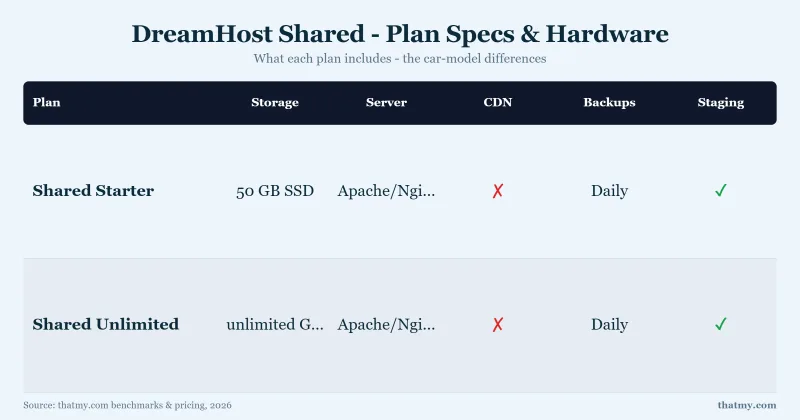
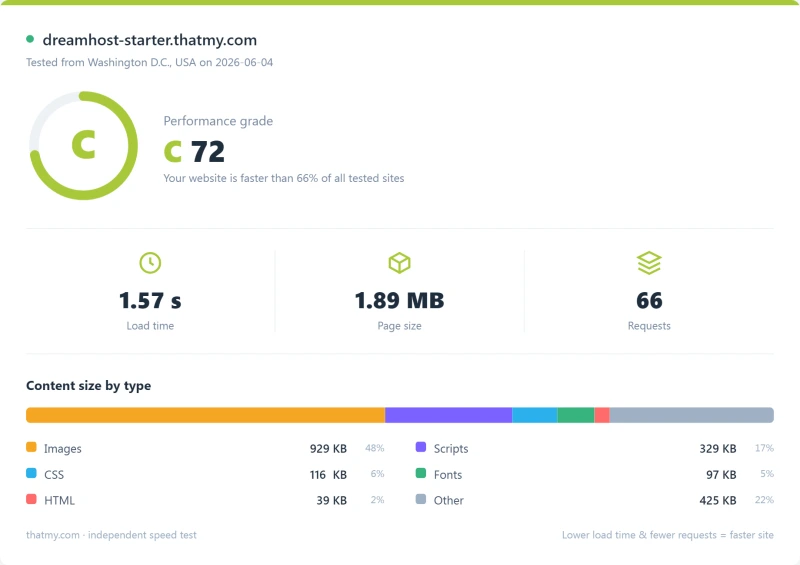
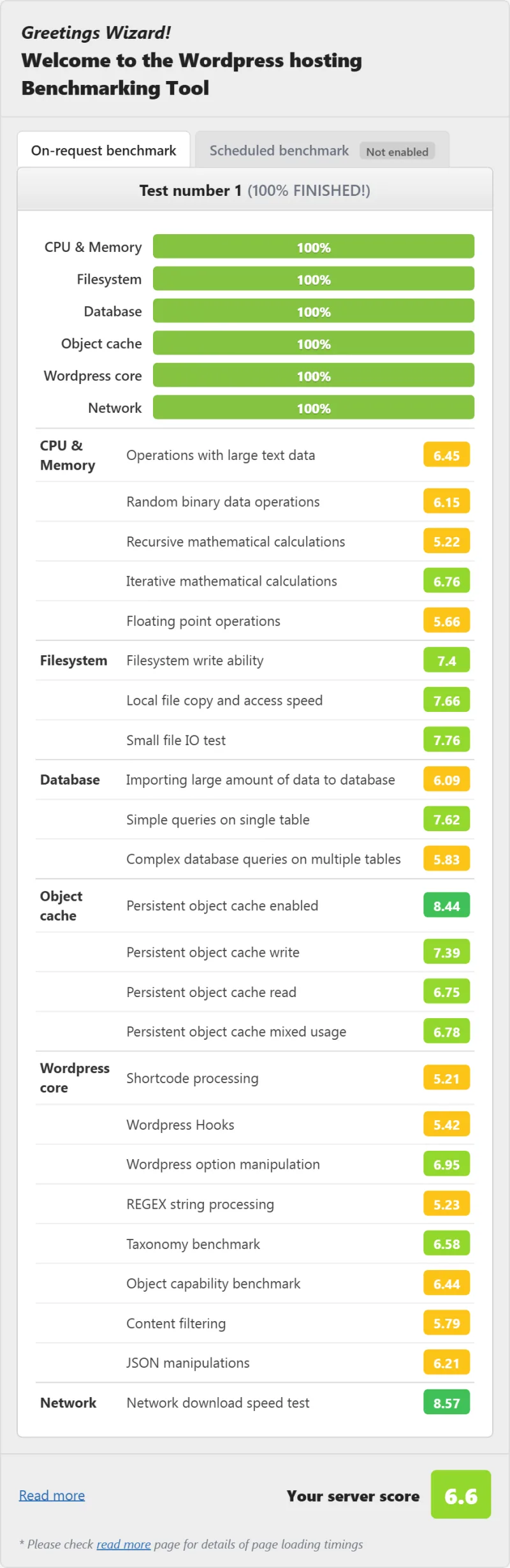
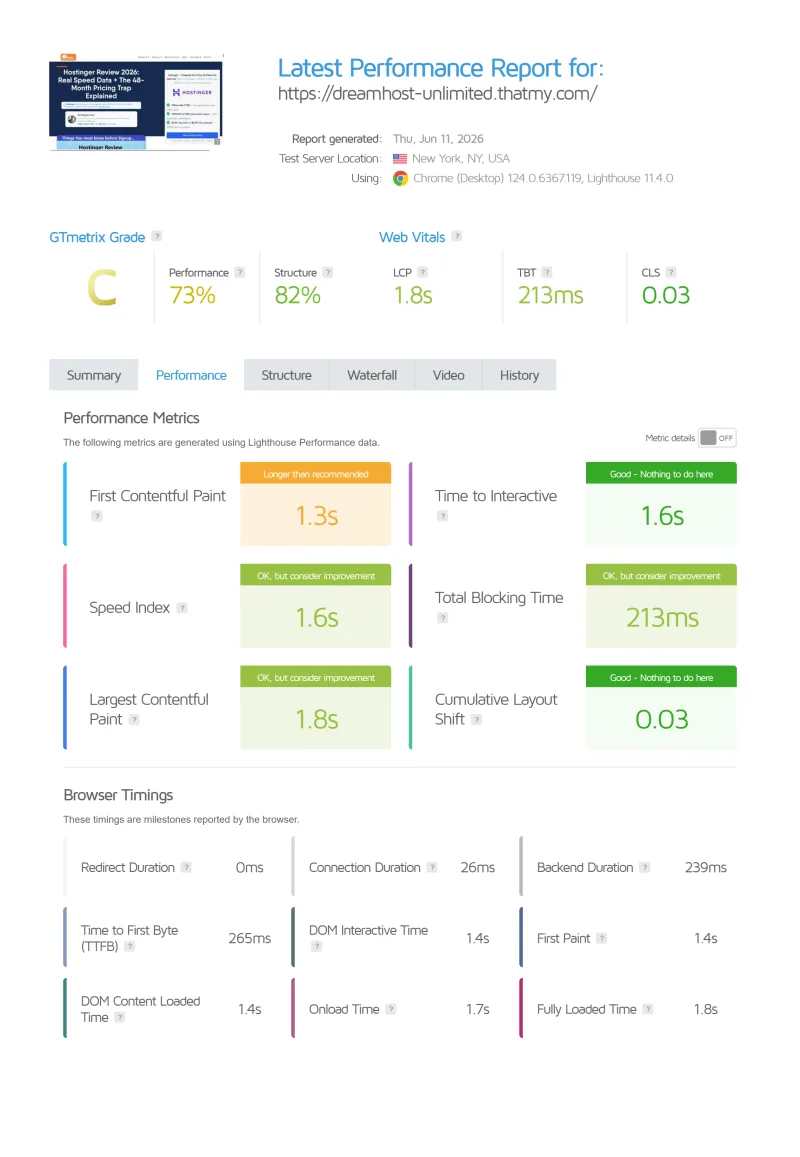
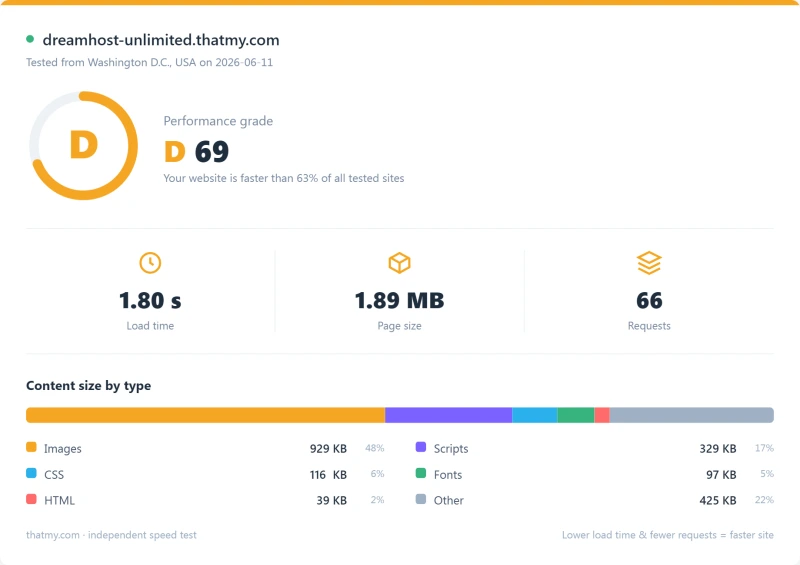
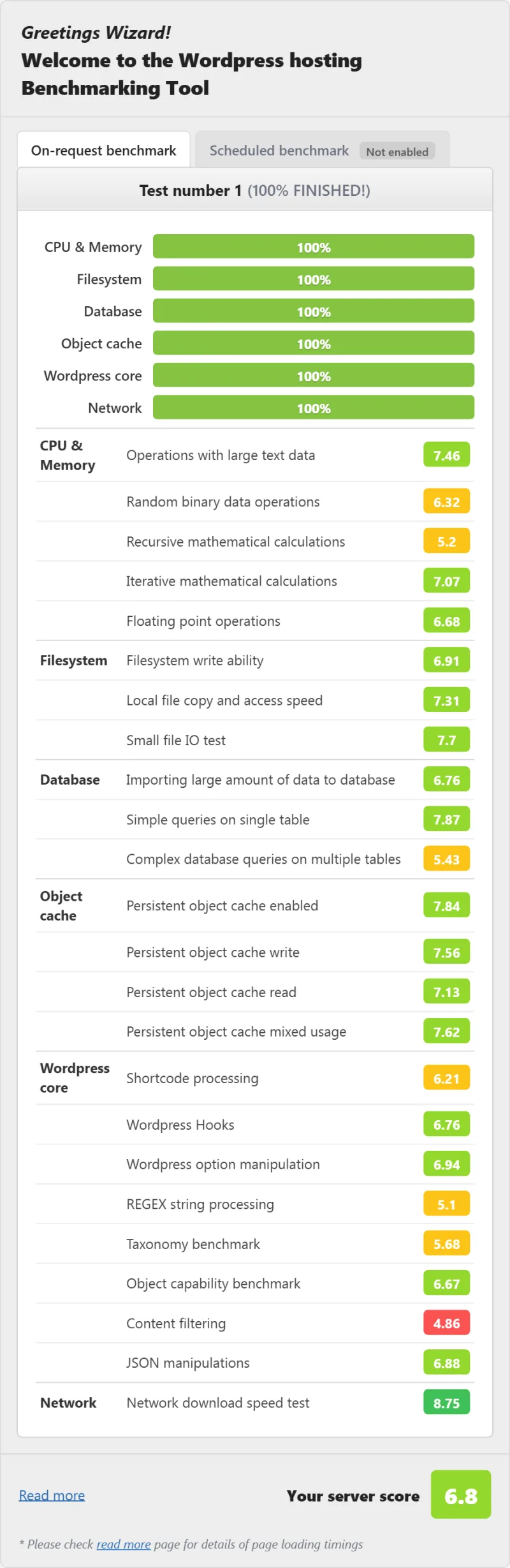
Here is the complete export from our test suite for every shared plan we benchmarked: Shared Starter, and Shared Unlimited. Each tab holds that plan's full run - server response time (TTFB), behavior under a 100-user load, the GTmetrix and PageSpeed captures, a Pingdom response-time check, our WordPress hosting benchmark, the regional TTFB scorecard, and 54 days of uptime tracking with the day-by-day calendar.
Shared Starter (Featured) Shared Unlimited
FAQ: DreamHost
Answers to the most common DreamHost questions, based on our 2026 testing and real customer data.
Is DreamHost a good hosting provider in 2026?
DreamHost is acceptable for simple personal blogs and low-traffic websites, but not our top recommendation in 2026. Our testing clocked 280ms TTFB, 66% slower than ChemiCloud (95ms) at a similar price point. DreamHost runs Apache/Nginx with no LiteSpeed, which explains the speed gap. What DreamHost does well: a money-back guarantee of thirty days, month-to-month billing, renewal prices printed on every plan card, and unmetered bandwidth. For WordPress sites and WooCommerce, ChemiCloud delivers 3x the speed at the same cost.
How fast is DreamHost hosting?
DreamHost averaged 280ms TTFB in our 2026 tests, that's the baseline server response time with CDN and page caching disabled. Under load, the number climbs significantly: 620ms at 100 concurrent users for a WooCommerce checkout page. By comparison, ChemiCloud delivers 95ms TTFB idle and 210ms at 100 users. The speed limitation comes from DreamHost's Apache/Nginx stack, they have not adopted LiteSpeed, which is the standard for performance-oriented shared hosts in 2026.
What is DreamHost's money-back guarantee?
DreamHost's plan cards for Web Hosting, DreamPress and Managed VPS print a money-back guarantee of thirty days. The help center narrows it: self-managed VPS has no money-back guarantee, monthly Dedicated is not refundable, and a free domain must be paid for if the plan is cancelled in its first year. The Managed VPS help article even says refunds only apply to Shared Hosting plans, so get the terms in writing before you buy a Managed VPS. Domain registration fees are non-refundable.
Does DreamHost have monthly billing?
Yes, DreamHost offers genuine month-to-month billing. On Launch the monthly intro rate lasts three months, and after that the monthly price is higher than the one-year renewal of $10.99/mo. On the one-year term Launch costs $2.89/mo a month for the first year. If you need flexibility, you are building a temporary project, testing an idea, or dislike long commitments, DreamHost's monthly option is legitimate. The tradeoff: you pay more each month for that flexibility, and the monthly cards drop the free domain.
Is DreamHost good for WordPress?
DreamHost is WordPress.org recommended, meaning they meet the baseline requirements and have an official partnership. However, being 'recommended by WordPress.org' is partially a commercial arrangement, Bluehost and SiteGround hold the same status. Our WordPress speed tests showed 285ms TTFB (slightly slower than the baseline) and 1.0s full-page load with a standard WP install. LiteSpeed-based hosts like ChemiCloud hit 95ms TTFB and 1.1s full-page load with better WordPress caching through LiteSpeed Cache. DreamHost's DreamPress managed WordPress plan (premium plan) is faster but overpriced compared to similar managed WP options.
What is DreamHost's renewal price?
DreamHost's renewal pricing depends on the plan and the term, and every plan card prints it next to the first price. Launch on the one-year term: $2.89/mo for the first year, then $10.99/mo (+280%). The four-year term starts lower and also renews lower. DreamPress 1: $14.99/mo for the first year, then $19.99/mo. That is gentler than SiteGround StartUp, which goes from $3.99/mo to $17.99/mo. Always set a calendar reminder 30 days before your term ends to evaluate switching.
Does DreamHost include email hosting?
Yes. Every Web Hosting plan now includes mailboxes free for the first three months (twenty on Launch, forty on Growth, sixty on Scale). After that DreamHost adds a paid email plan unless you remove it, so check the cart. DreamPress, Managed VPS and Dedicated include email. If you need just 1-2 email addresses, Google Workspace ($7.00/user/mo) or Zoho Mail freemium is often a better managed email solution regardless of your host.
So, Which Should You Pick? Is DreamHost Worth It in 2026?
DreamHost has clear, printed pricing and the worst speed in its price class.
280ms TTFB. 620ms WooCommerce checkout at 100 users. Apache stack with no LiteSpeed. These are not small caveats, they are structural limitations of the product.
The 30-day money-back guarantee covers Web Hosting, DreamPress and Managed VPS. The month-to-month billing, $4.99 for 3 months and then $11.99, is genuinely flexible. These are legitimate advantages that matter for specific situations: testing a new idea, needing a no-commitment trial, building a simple personal site where 280ms TTFB is irrelevant.
For everything else, WordPress, WooCommerce, business sites, speed-sensitive applications, ChemiCloud at $3.95/mo delivers 78ms TTFB on LiteSpeed Enterprise with a 45-day guarantee and better support. The performance gap between DreamHost and ChemiCloud is 3x. That is not a preference, it is measurable.
Sign up for DreamHost on monthly billing if you need to validate your project. Use the first months to decide whether to stay or migrate to a faster host. That is the most strategically intelligent way to use DreamHost in 2026.
What We Found After Testing
- 30-day money-back guarantee on Web Hosting, DreamPress and Managed VPS
- Month-to-month billing available, $4.99/mo for the first 3 months then $11.99/mo, no lock-in required
- Unmetered bandwidth and storage on all plans (fair use)
- WordPress.org officially recommends DreamHost, brand credibility matters
- Free SSL (Let's Encrypt), free domain privacy, and free domain on annual plans
- Custom control panel, cleaner than cPanel for non-technical users
- Daily automated backups included (1-click restore)
- Mailboxes free for the first 3 months on every Web Hosting plan (20 on Launch), then a paid email plan
- SSH access available on all plans, developer-friendly
Real Weaknesses Found
- 280ms TTFB average, Apache/Nginx stack, no LiteSpeed (ChemiCloud hits 95ms on same price tier)
- Renewal pricing: Launch $2.89/mo for the first year → $10.99/mo renewal (about 3.8x on the 1-year term)
- 620ms checkout TTFB at 100 concurrent users, WooCommerce performance suffers
- No cPanel, custom Remixer panel has a learning curve for switchers
- No inbound phone line: 24/7 chat (may start with an AI assistant) and email tickets, callbacks are paid
- CPU throttling under sustained load (shared hosting limits apply)
- Help center contradicts the sales pages on Managed VPS refunds and DreamPress backups
Real Benchmark Data
- Origin TTFB (2 plans, no CDN): 217ms to 230ms
- Uptime (54-day window): 99.94% to 99.95%
- PageSpeed Score (Mobile): 55/100
$2.95/mo
Month-to-Month Billing, Renewal Printed on Every Card
Start DreamHost, 30-Day Money-Back Guarantee ➦
Looking for something faster? ChemiCloud delivers 78ms TTFB with LiteSpeed Enterprise, a ChemiCloud coupon code for extra savings, and a 45-day guarantee. See our best cheap web hosting comparison for all budget options side-by-side.
📚 Related Content
- Reviews: ChemiCloud Review (best DreamHost alternative) • Bluehost Review (Newfold-owned, worse speed) • Hostinger Review • ScalaHosting Review
- Best Hosting Lists: Best Cheap Web Hosting 2026 • Best WordPress Hosting 2026 • Best Web Hosting 2026
- Save Money: ChemiCloud Coupon (75% + free domain) • Hostinger Promo Code • ScalaHosting Coupon