
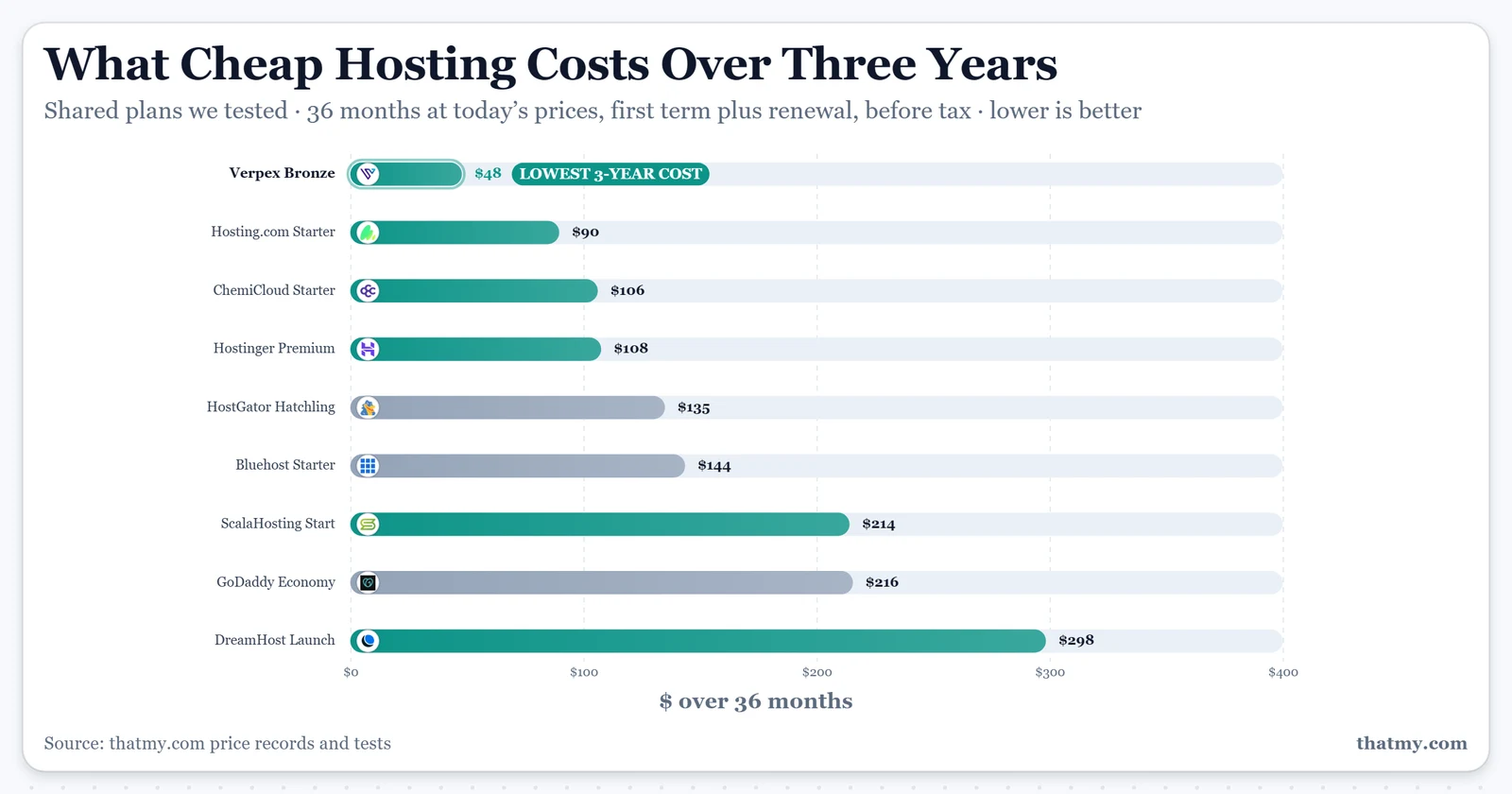
ChemiCloud is the best cheap web hosting we have tested, and Verpex is the cheapest to keep once the first term ends. I put the same WordPress test site on ten budget plans and measured each the same way: response time from 10 locations, a load ramp up to 250 clients at once, and uptime over 54 days. Then I added up what each plan costs over three years, first term plus renewal, from our price records. ChemiCloud Starter answered in 84ms from New York and 240ms with 100 concurrent users without a single failed request, for $106.20 over three years.
Cheap plans differ far more than their prices suggest. Three of the best-known budget brands, Bluehost, HostGator and GoDaddy, failed more than a third of requests once the load climbed, and still cost more over three years than ChemiCloud or Verpex. The advertised price also needs a long prepaid term, and renewals run several times higher, so this guide shows both.
Our Picks at a Glance
ChemiCloud Starter
- 240ms with 100 concurrent users, 0 failed requests
- $2.95/mo on 36 months
- $106.20 over three years
cPanel on LiteSpeed Enterprise, AMD EPYC 9354
See ChemiCloudVerpex Bronze
- 590ms with 100 concurrent users
- $2.69/mo on 36 months, renews at $5.99/mo
- $96.84 over three years
cPanel on LiteSpeed; month to month from $0.60/mo
See VerpexScalaHosting Start
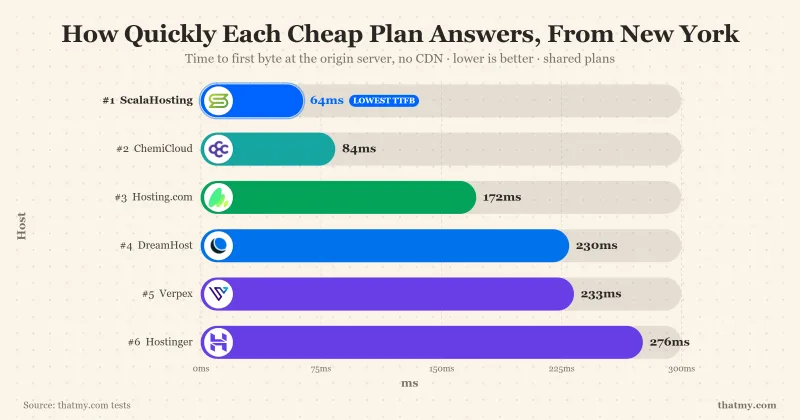
- 64ms TTFB from New York
- 112ms with 100 concurrent users, 0 failed requests
- $5.95/mo on 36 months, $214.20 over three years
SPanel on OpenLiteSpeed with NVMe storage
See ScalaHosting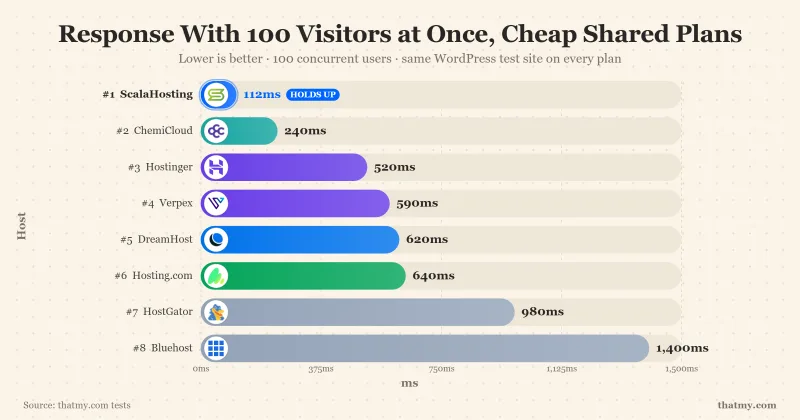
How We Tested Cheap Hosting
- One plan per host, one test site. The same WordPress site on each host's budget plan, with the host's own caching left as it ships.
- Response time (TTFB) from 10 locations, measured at the origin server with no CDN in front, so the figure is the server's own.
- Load: a ramp from 0 to 250 clients at once, 8,250 requests per plan. We report the response at the 100-user step and the share of requests that failed over the whole ramp.
- Uptime checked every minute for 54 days.
- Three-year cost: the first term at the intro price and the rest of the 36 months at the renewal price, from our price records, before tax.
Prices come from each host's own pricing page and are re-read from our price records every time this page is built, so the totals below move when a host changes its prices. Full method and re-test rules: How We Test. The same benchmark, with more hosts, is in our WordPress hosting guide.
Ten Cheap Plans Tested, Compared
| Host and plan | TTFB, New York | Average of 10 locations | 100 concurrent users | Failed requests, full ramp | Uptime, 54 days | 3-year cost |
|---|---|---|---|---|---|---|
| ChemiCloud Starter | 84ms | 187ms | 240ms | 0% | 99.97% | $106.20 |
| Verpex Bronze | 233ms | 520ms | 590ms | 0.38% | 99.92% | $96.84 |
| ScalaHosting Start | 64ms | 143ms | 112ms | 0% | 99.99% | $214.20 |
| Hostinger Premium | 276ms | 252ms | 520ms | 0.8% | 99.95% | $107.64 |
| Hosting.com Startup, now Starter | 172ms | 385ms | 640ms | 0.38% | 99.91% | $89.64 |
| Cloudways DigitalOcean 1GB, monthly | 59ms | 132ms | 98ms | 0% | 99.981% | $396.00 |
| DreamHost Shared Starter | 230ms | 513ms | 620ms | 0.5% | 99.94% | $298.44 |
| Bluehost Basic, now Starter | 287ms | 641ms | 1400ms | 42.84% | 99.9% | $143.64 |
| HostGator Hatchling | 332ms | 742ms | 980ms | 35.78% | 99.87% | $135.00 |
| GoDaddy Economy | 369ms | 825ms | not measured | 39.42% | 99.83% | $215.64 |
Lower is better for response times and cost. Three-year cost uses the 36-month term where the host offers it; DreamHost is 12 months then renewal, Cloudways is billed monthly at a flat price. Hostinger's test server answered fastest from Frankfurt, 109ms; the New York column is the same location for every host. Hosting.com's tested Startup package is no longer sold, so its cost is today's Starter plan; DreamHost's cost is today's Launch plan.
#1. ChemiCloud Starter: Best Cheap Web Hosting
- 84ms TTFB from New York, 187ms averaged over 10 locations
- 240ms with 100 concurrent users, 0 failed requests
- 99.97% uptime, 23 minutes down in 54 days
- AMD EPYC 9354, PassMark #110 of 5,999
ChemiCloud runs standard cPanel on LiteSpeed Enterprise with NVMe storage, on AMD EPYC 9354 processors. Among the shared plans we tested, only ScalaHosting answered faster, and ChemiCloud was one of three that failed no requests on the whole load ramp. It does all that at one of the lowest three-year costs on this page, which is why it is our first pick.
The low price needs the long term. Starter is $2.95/mo a month on 36 months and renews at $11.95/mo; on 12 months it is $3.49/mo and renews at $14.95/mo; month to month it is $14.95/mo. Current discounts are on our ChemiCloud coupon page.
#2. Verpex Bronze: The Lowest Renewal
- 233ms TTFB from New York, 520ms averaged over 10 locations
- 590ms with 100 concurrent users, 0.38% failed over the ramp
- 99.92% uptime, 62 minutes down in 54 days
- cPanel with WP Toolkit on LiteSpeed and NVMe; the plan lists 1 vCPU and 1 GB RAM
Verpex is the answer if the bill matters most. Three years on Bronze cost $96.84 at today's prices, a little below ChemiCloud, and the renewal of $5.99/mo is the lowest of every plan we benchmarked, so from the fourth year Verpex is the cheapest plan on this page. Verpex also sells Bronze month to month: $0.60/mo for the first month, then $6.00/mo.
What you give up is speed. Verpex was mid-table on our benchmark: 590ms with 100 concurrent users and 31 failed requests out of 8,250, about the same as Hostinger and hosting.com, and it had more downtime than ChemiCloud, 62 minutes in 54 days. For a blog, a portfolio or a small business site, that is plenty.
#3. ScalaHosting Start: The Fastest Shared Plan We Tested
- 64ms TTFB from New York, 143ms averaged over 10 locations
- 112ms with 100 concurrent users, 0 failed requests
- 99.99% uptime, 8 minutes down in 54 days
- SPanel, ScalaHosting's own control panel, on OpenLiteSpeed with NVMe storage
ScalaHosting Start was the fastest shared plan on our whole benchmark: 64ms for one visitor and 112ms with 100 at once, about twice as fast as ChemiCloud under load, with no failed requests and the best uptime of the cheap plans. It runs SPanel instead of cPanel; SPanel covers files, email, databases, DNS, SSL and WordPress installs, but only runs at ScalaHosting.
It is third here because it is not really a budget price. Start is $5.95/mo a month on a 36-month term, $214.20 over three years, twice ChemiCloud's total. ScalaHosting also sells a smaller Mini plan at $2.95/mo, renewing at $11.95/mo; we have not benchmarked Mini, so we cannot tell you whether it keeps Start's speed.
#4. Hostinger Premium: Cheap, With Tight Limits Under Load
- 109ms TTFB from Frankfurt, 252ms averaged over 10 locations
- 520ms with 100 concurrent users, 0.8% failed over the ramp
- 99.95% uptime, 39 minutes down in 54 days
- LiteSpeed on CloudLinux with NVMe storage
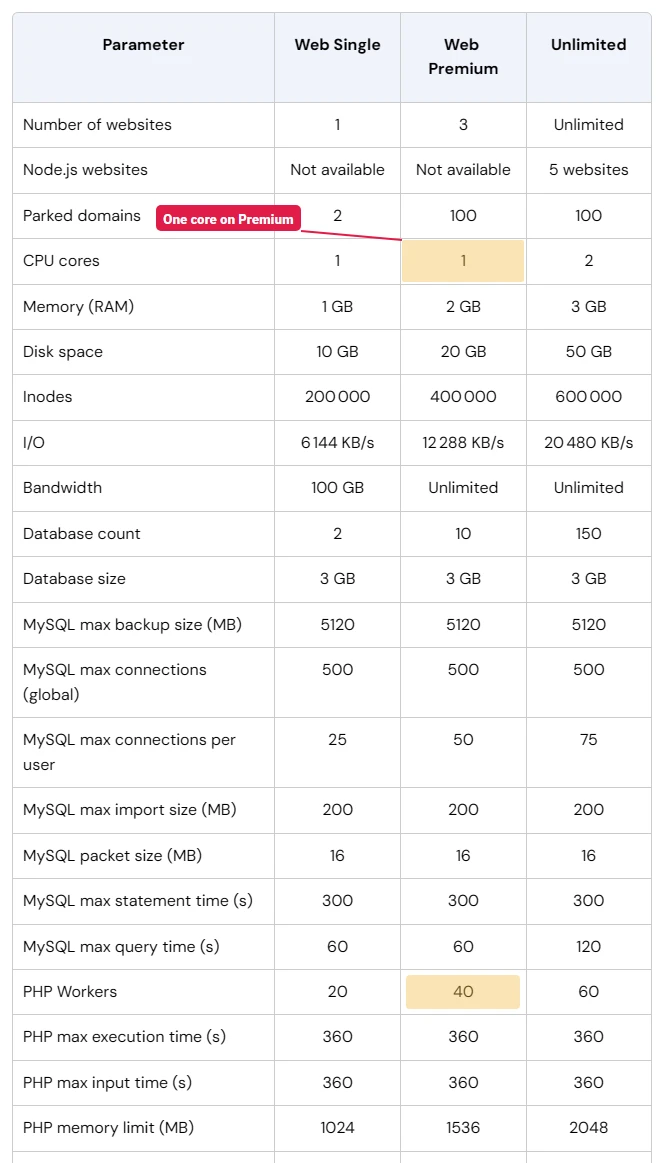
Hostinger is the cheap host most people have heard of, and it runs its own dashboard rather than cPanel. On our benchmark it was quick for a single visitor near its server, 109ms from Frankfurt, and middling under load: 520ms with 100 concurrent users and 66 failed requests out of 8,250. The plan's limits explain much of that: Premium runs 40 PHP workers on a single CPU core, so a burst of uncached requests queues for that one core.
Premium is $2.99/mo a month on a 36 or 48-month term and $3.99/mo on 12 months, and every term renews at $10.99/mo. Three years cost $107.64, almost exactly ChemiCloud's total, for a plan that was slower under load. Mailboxes are included free for the first year. The real CPU, memory and process limits for every Hostinger plan are in Hostinger resource limits explained.
#5. Hosting.com Starter (Formerly A2 Hosting): Low Price, Steep Renewal
- 172ms TTFB from New York, 385ms averaged over 10 locations
- 640ms with 100 concurrent users, 0.38% failed over the ramp
- 99.91% uptime, 70 minutes down in 54 days
- Today's Starter: 5 websites on hosting.com's own panel (1 on cPanel), 15 GB NVMe, 2 vCPU, 2 GB RAM
We benchmarked the Startup plan hosting.com inherited when it took over A2 Hosting; today's entry plan is Starter. Startup was mid-table: 640ms with 100 concurrent users and the most downtime of our six picks, 70 minutes in 54 days. Starter's three-year cost is the lowest here, $89.64, but it renews at $13.99/mo, the biggest jump from the first price of the plans we recommend.
#6. Cloudways: Monthly Billing on a Server of Your Own
- 59ms TTFB from New York, 132ms averaged over 10 locations
- 98ms with 100 concurrent users, 0 failed requests
- 99.981% uptime, 15 minutes down in 54 days
- 1 GB RAM, 1 vCPU, 25 GB SSD and 1 TB bandwidth on a DigitalOcean server
Cloudways is not shared hosting: it sets up and manages a small cloud server that is yours alone, billed by the month with no long contract. That server was faster under load than every shared plan we tested, 98ms with 100 concurrent users and no failed requests. It is here for readers who would rather pay a little more each month than prepay three years.
Over three years the monthly price adds up to $396.00, more than any shared plan on this page, and email and malware scanning are extras: Rackspace email is $1.50 per mailbox a month and Malware Protection starts at $4 per application a month. Current offers are on our Cloudways promo code page.
Also Tested: DreamHost, Bluehost, HostGator and GoDaddy
We benchmarked these four budget plans the same way. None made the ranking: DreamHost costs the most over three years of the shared plans we tested, and the other three failed more than a third of requests under load.
DreamHost: steady, but only cheap for the first year
DreamHost's Shared Starter held up reasonably under load: 620ms with 100 concurrent users, 0.5% failed over the ramp and 99.94% uptime. The price is the catch. Today's entry plan, Launch, is $2.89/mo a month for the first year, billed yearly, then $10.99/mo, so three years cost $298.44, nearly three times ChemiCloud. DreamHost runs its own control panel rather than cPanel.
Bluehost: low renewal, weakest under load
Bluehost's Basic plan, sold today as Starter, answered a single visitor in 287ms from New York, but with 100 at once it took 1400ms, the slowest of every plan here, and over the full ramp it failed 3,534 of 8,250 requests. It runs cPanel on Apache on an Intel Xeon E5-2680 v3. Starter is $3.99/mo on a 36-month term and renews at $9.99/mo; three years cost $143.64. Watch the checkout: CodeGuard backups are $3.99 a month after the first year and SiteLock Essentials is $95.88 a year.
HostGator: old hardware
HostGator Hatchling answered in 332ms from New York and 980ms with 100 concurrent users, failed 35.78% of requests over the ramp and was down 101 minutes in 54 days. It runs Apache on an Intel Xeon E5-2690 v4, PassMark #1,069 of 5,999. Hatchling is one website for $3.75/mo on 36 months, renewing at $10.99/mo.
GoDaddy: slowest single response, most downtime
GoDaddy Economy was the slowest plan we tested for a single visitor, 369ms from New York and 825ms averaged over 10 locations. It failed 39.42% of requests over the load ramp and had the most downtime, 132 minutes in 54 days. At $5.99/mo on a 36-month term it is not even cheap: $215.64 over three years, twice ChemiCloud. Domain privacy is included; website security is an extra from $6.99 a month.
Also Compared, Not Tested Yet: Namecheap, HostPapa and ScalaHosting Mini
These plans often appear on cheap-hosting lists. We have not benchmarked them yet, so they are not ranked, and the prices below are the only figures we can stand behind.
Namecheap Stellar
Stellar has the lowest renewal of any plan on this page: $2.28/mo a month for the first year, billed yearly, then $4.66/mo. Three years cost $139.20, and the low price needs only a one-year term. Stellar Plus is $2.98/mo for the first year.
HostPapa Start
HostPapa aims at small businesses, with cPanel and a site builder. Start is $2.95/mo a month on a 36-month term and renews at $11.99/mo, the same three-year cost as ChemiCloud, $106.20.
ScalaHosting Mini
Mini is ScalaHosting's smallest shared plan, $2.95/mo a month on 36 months and $11.95/mo at renewal. We benchmarked the bigger Start plan, ranked above; Mini has not been tested.
What Cheap Hosting Costs Over Three Years
First-term prices hide most of the bill. This table adds up three years on each plan, the first term at the intro price and the rest at the renewal price, from our price records.
| Host and plan | First term | Renewal | 3-year total | Tested |
|---|---|---|---|---|
| Verpex Bronze, 36-month term | $2.69/mo 36 months prepaid | $5.99/mo | $97 | Yes: 590ms with 100 users |
| Hosting.com Starter, 36-month term | $2.49/mo 36 months prepaid | $13.99/mo | $90 | Startup tested: 640ms |
| ChemiCloud Starter, 36-month term | $2.95/mo 36 months prepaid | $11.95/mo | $106 | Yes: 240ms with 100 users |
| HostPapa Start | $2.95/mo 36 months prepaid | $11.99/mo | $106 | not yet |
| ScalaHosting Mini | $2.95/mo 36 months prepaid | $11.95/mo | $106 | not yet |
| Hostinger Premium, 36-month term | $2.99/mo 36 months prepaid | $10.99/mo | $108 | Yes: 520ms with 100 users |
| Namecheap Stellar | $2.28/mo billed yearly | $4.66/mo | $139 | not yet |
| HostGator Hatchling | $3.75/mo 36 months prepaid | $10.99/mo | $135 | Yes: 980ms with 100 users |
| Bluehost Starter | $3.99/mo 36 months prepaid | $9.99/mo | $144 | Yes: 1400ms with 100 users |
| ScalaHosting Start | $5.95/mo 36 months prepaid | $14.95/mo | $214 | Yes: 112ms with 100 users |
| GoDaddy Economy, 36-month term | $5.99/mo 36 months prepaid | $11.99/mo | $216 | Yes: 39.42% failed |
| DreamHost Launch | $2.89/mo first year, billed yearly | $10.99/mo | $298 | Shared Starter tested: 620ms |
| Cloudways DigitalOcean 1GB | $11.00/mo monthly, flat | $11.00/mo | $396 | Yes: 98ms with 100 users |
Prices before tax. A 36-month prepayment keeps the first price for the whole three years, then renews at the rate shown. On a shorter term the first price is usually higher and the renewal arrives sooner.
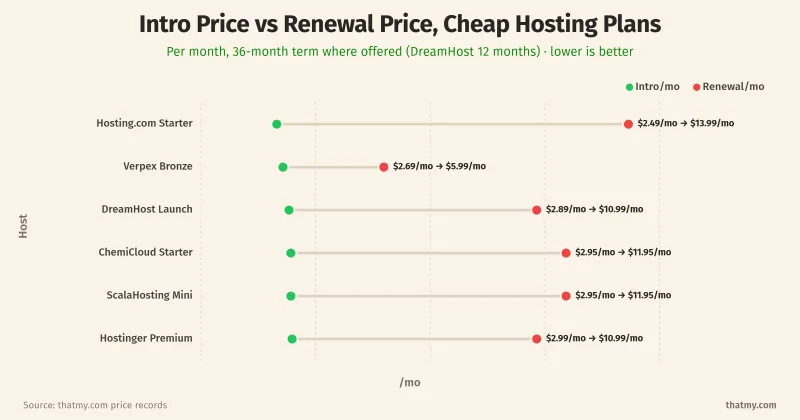
Two habits keep a cheap plan cheap. Buy the longest term you are comfortable with, because the renewal price is where the bill grows; and put a reminder in your calendar a month before renewal, when switching to a new host's intro price is often cheaper than staying. Our guide to hidden hosting fees lists the add-ons that raise the bill after checkout.
Add-Ons That Raise the Bill
A cheap plan can stop being cheap at checkout. These are the extras we recorded on the hosts' own pricing and help pages:
| Host | Add-on | Price |
|---|---|---|
| Bluehost | CodeGuard Basic backups (free in year one) | $3.99/mo or $47.88/yr |
| Bluehost | SiteLock Essentials security | $95.88/yr |
| Bluehost | .com domain renewal, plus privacy | $23.99/yr + $15/yr |
| GoDaddy | Website Security Standard | $6.99/mo |
| GoDaddy | Microsoft 365 email, first year then list | $1.99/mo, then $8.99/mo |
| Cloudways | Rackspace email | $1.50 per mailbox/mo |
| Cloudways | Malware Protection | from $4 per app/mo |
| Hostinger | Email on Premium | free for the first year |
For comparison, a .com domain costs $11.08 a year at Porkbun, with free privacy. Registering the domain away from the host also makes a later move easier.
Shared-Hosting Limits That Matter More Than Storage
Cheap plans advertise storage and bandwidth. What decides how a site behaves when visitors arrive together is a set of limits most hosts show only inside the account:
- CPU cores. The cheap shared plans we checked give an account one or two CPU cores. WordPress builds an uncached page on one core, so a burst of uncached requests waits its turn.
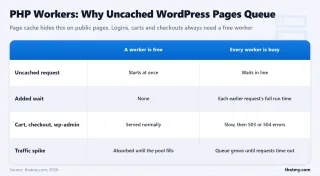
- PHP workers. The processes that run WordPress for uncached pages. More workers do not help if they all share one core, as the Hostinger capture above shows: 40 workers, one core.
- Entry processes. How many requests can be inside PHP at once. When the limit is reached, extra visitors get an error rather than a slow page.
- Memory. Usually 1 to 2 GB per account on these plans. A page builder, a store or a backup job can reach it, and the result looks like a code error.
- Inodes. A cap on the number of files. Caches, image sizes and email all count, and backups can fail near the limit.
On CloudLinux servers, cPanel's Resource Usage page shows how often your account hits each limit. If it shows frequent hits during your busy hours, caching helps for pages that can be cached, but carts, checkouts and logged-in pages always run PHP. That is when to move up a plan or to a server of your own. Hostinger's limits are broken down plan by plan in Hostinger resource limits explained.
Shared, Cloud or VPS on a Budget
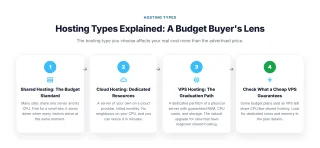
Shared hosting puts many accounts on one server, which is why it is cheap. Five of our six picks are shared plans, and for a blog, a portfolio or a small business site one of them is enough. The risk is the busy hour: when many visitors arrive at once, a shared plan's CPU limit is reached first.
Managed cloud hosting, like Cloudways, gives you a small server of your own on a cloud provider, billed monthly. It costs more over three years than a prepaid shared plan, but there is no long contract and no renewal step, and on our benchmark it was faster under load than any shared plan.
A VPS is the step after shared hosting: guaranteed CPU cores and memory. Check what a cheap VPS guarantees before you buy, because some budget plans sold as VPS still share CPU. Our VPS hosting guide compares the plans we have tested.
Cheapest and right for a business are different questions. Once a site takes bookings, quotes or payments, email that arrives, backups you can restore and support matter more than the last dollar. We rank against those separately in the best web hosting for small business.
Which Cheap Host Fits Your Site
| Your site | Our pick | Why, from the tests | Price |
|---|---|---|---|
| Most small sites | ChemiCloud Starter | 240ms with 100 users, 0 failed requests | $2.95/mo on 36 months |
| The lowest total bill | Verpex Bronze | $96.84 for three years, lowest renewal we tested | $2.69/mo on 36 months |
| No long prepayment | Verpex monthly or Cloudways | Month-to-month billing; Cloudways was the fastest under load | $0.60/mo or $11.00/mo |
| Traffic in bursts, small shop | ScalaHosting Start | 112ms with 100 users, fastest shared plan | $5.95/mo on 36 months |
| Visitors mostly in Europe | Hostinger Premium | 109ms from Frankfurt; tighter under load | $2.99/mo on 36 months |
What We Have Not Tested Yet
- Namecheap, HostPapa and ScalaHosting Mini. Compared here on price only; candidates for the next benchmark round.
- Hosting.com's and DreamHost's current entry plans. We benchmarked the plans they sold before, Startup and Shared Starter; Starter and Launch have not been benchmarked.
- Support and refunds. This page measures servers and prices, not how quickly each host answers a ticket or pays back a refund.
What I Would Choose
On a budget today I would buy ChemiCloud Starter on a 36-month term: it was the second-fastest shared plan we tested, it never failed a request under load, and three years cost $106.20. If every dollar counts, Verpex Bronze does the job for less than half that, and it is the one I would pick to pay month to month. If the site gets traffic in bursts, ScalaHosting Start is worth its higher price. The plans I would avoid are the ones with the biggest names: Bluehost, HostGator and GoDaddy were the slowest we tested and cost more over three years than the hosts that beat them.

Cheap Web Hosting FAQ
What is the best cheap web hosting?
ChemiCloud Starter. On our benchmark it answered in 84ms from New York and 240ms with 100 concurrent users, and failed no requests on the whole load ramp. On the 36-month term it is $2.95/mo, $106.20 for the three years.
What is the cheapest web hosting that is still good?
Verpex Bronze is the cheapest plan we tested to keep: $2.69/mo on a 36-month term, $96.84 for three years, and it renews at $5.99/mo, the lowest renewal of any plan we benchmarked. It answered in 590ms with 100 concurrent users and failed 0.38% of requests over the full ramp: slower than ChemiCloud, but steady.
Is there good hosting without a long contract?
Two options. Verpex sells Bronze month to month at $0.60/mo, renewing at $6.00/mo. Cloudways bills a small cloud server monthly from $11.00/mo with the same price every month, and that server was faster under load than any shared plan we tested. Most shared hosts only reach their advertised price on a 12 to 48 month prepayment.
Are Bluehost, HostGator and GoDaddy good cheap hosts?
Not on our tests. Over the full load ramp, 42.84% of requests to Bluehost failed, 35.78% to HostGator and 39.42% to GoDaddy, against none on ChemiCloud. They were also the slowest to answer a single visitor. For a small site that rarely gets many visitors at once they work, but they cost more over three years than ChemiCloud or Verpex.
Why does cheap hosting cost more at renewal?
The advertised price is a discount for the first term only. Almost every shared plan on this page renews at several times its first price: ChemiCloud Starter goes from $2.95/mo to $11.95/mo, Hostinger Premium from $2.99/mo to $10.99/mo. Buying the longest term you are comfortable with keeps the low price for longer; compare the renewal before you buy.
Is cheap shared hosting fast enough for WordPress?
For most small sites, yes, if you pick the right host. The gap between cheap plans is large: with 100 concurrent users ScalaHosting Start answered in 112ms and ChemiCloud Starter in 240ms, while Bluehost took 1400ms on a plan with a similar price.
When should I move from cheap shared hosting to a VPS?
When your busiest hour, not your monthly total, outgrows the plan: pages slow down or fail when many visitors arrive together, or the host's resource page shows you hitting CPU or process limits. A store's cart and checkout are usually the first pages to suffer. Our VPS hosting guide compares the next step up.
When is this page tested again?
When a host changes the plan we tested or we run a new test round. Prices are re-read from our price records every time the page is built. The changelog at the end of the page lists every update.