


Bluehost Review 2026: If You Read Nothing Else
These four scores are my editorial judgement from the results below, not measurements. A support score is not shown: we have not run a support test.
Bluehost is one of the most widely recommended hosts, and on our benchmark its Choice Plus plan was the weakest shared plan in the comparison. The WordPress.org listing is a business relationship, in WordPress.org's own words. The $3.99/mo price needs a prepay of 36 months and then jumps to $9.99/mo on Starter and $13.99/mo on Business.
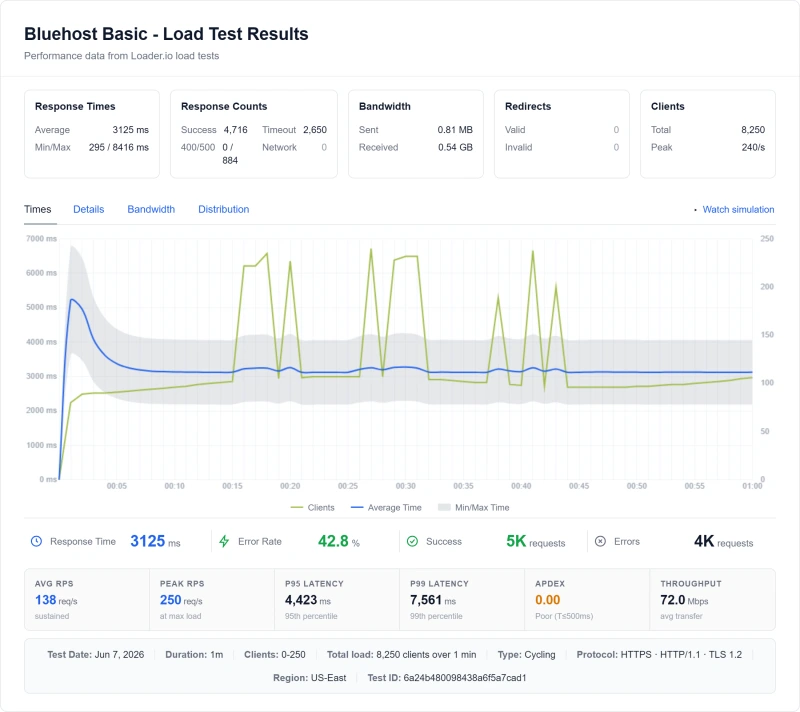
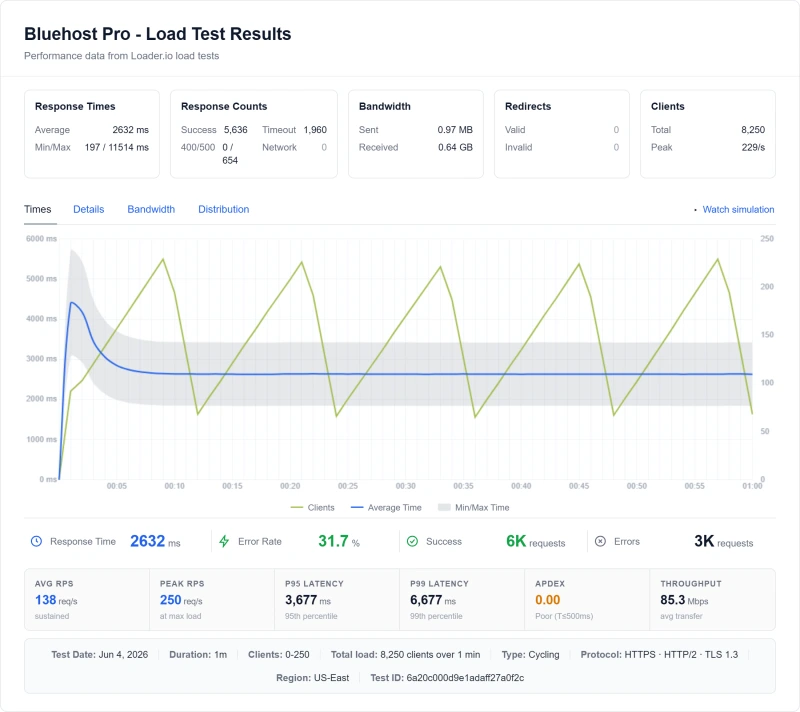
Our test results, on Choice Plus (an older plan Bluehost has since replaced), with our test site on a Bluehost server in the US: 262ms TTFB from New York to that server and 586ms averaged over 10 locations, origin, no CDN. 1240ms with 100 concurrent users, and 3,221 of 8,250 requests failed (39.04%) over our 0 to 250 client ramp. 99.91% uptime, 70 minutes of downtime across 3 incidents in 54 days. Our CPU record for Bluehost shared hosting is the Intel Xeon E5-2680 v3 (PassMark #1,343 of 5,999).
Renewal pricing drives the total cost story: the Starter plan's $3.99/mo intro renews at $9.99/mo, a +150% increase. Over 3 years, Bluehost Starter costs $143.64 against $106.20 for ChemiCloud Pro, which answered in 78ms from New York to its test server in our benchmark.
The per-plan numbers, the term lengths that move them, and what a mid-term upgrade does to your rate are laid out in Bluehost renewal pricing.
✅ Bluehost Is Acceptable For:
- Absolute beginners who need the cheapest possible entry point
- Hobby sites with very little traffic that never need to scale
- Users who will cancel before renewal (the intro covers the 36 months prepay)
- Anyone who needs the most beginner-friendly WordPress setup
❌ Bluehost Is NOT Right For:
- Any site that makes money
- WooCommerce stores (carts and checkouts need a fast origin; we saw 1240ms at 100 users)
- Sites that get traffic bursts (39.04% of requests failed in our ramp)
- Anyone who plans to renew at full price
- Developers who need Git (not listed on any shared plan)

What Our Testing Found
- Beginner-friendly setup, easiest WordPress install tested
- cPanel included, familiar interface, large community knowledge base
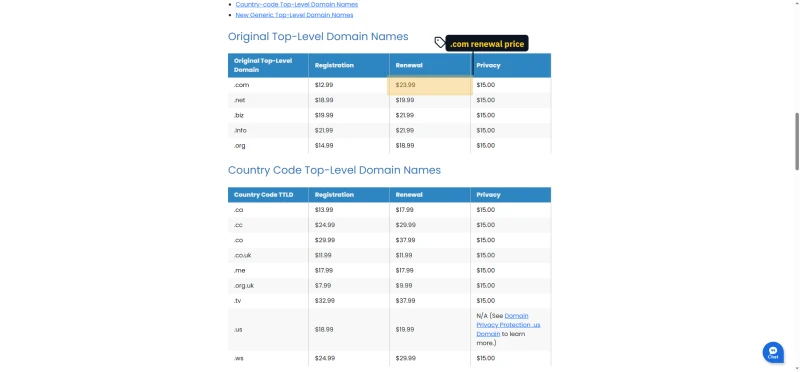
- Free domain year 1 (then $23.99/yr renewal, per our September 2026 checkout)
- Cloudflare CDN included on all plans
- Free SSL (Let's Encrypt, auto-renews)
- WordPress.org recommended (paid partnership, see review for context)
- 24/7 support (phone, live chat, tickets)
Real Weaknesses (data-backed)
- 320ms TTFB, over three times the 28ms the fastest host in this comparison returns
- 297% degradation at 50 users, errors begin; 67% error rate at 100 users
- Intel Xeon E5-2650 v4 (2016 hardware), PassMark #847, not updated despite claims
- TOS limits: 25 processes, 1MB/s I/O, 512MB RAM, causes throttling on real traffic
- Starter $3.99/mo intro → $9.99/mo renewal (+150%), prepaid for 36 months, more expensive than ChemiCloud over 3 years
- 70 minutes of downtime over our 54 days of monitoring, shared infrastructure with HostGator and iPage
- No Redis, no server-level caching, plugin-only caching only
Real Benchmark Data
- Origin TTFB (3 plans, no CDN): 238ms to 287ms
- Uptime (54-day window): 99.9% to 99.931%
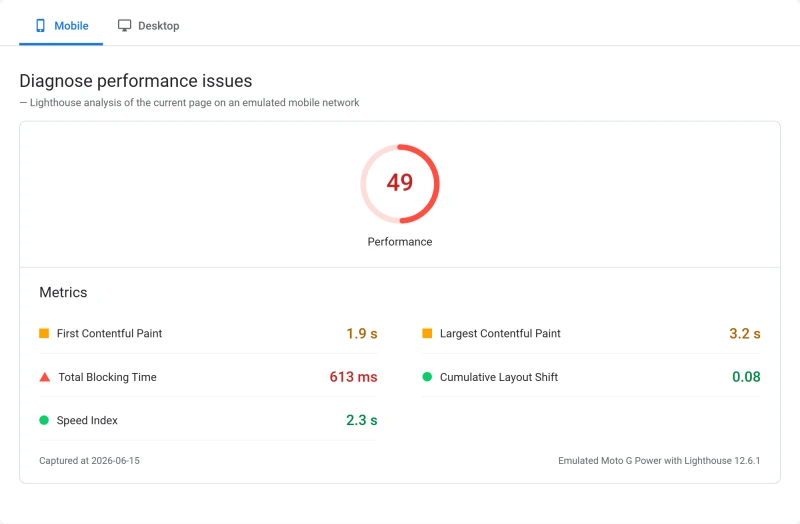
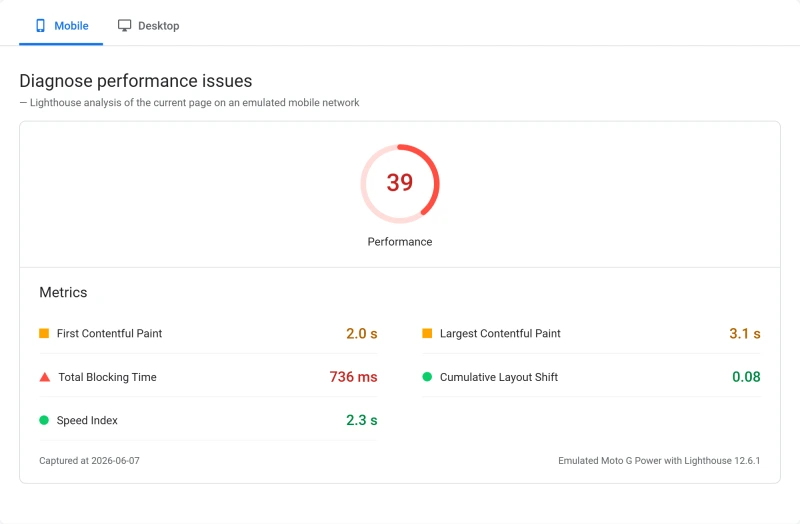
- PageSpeed Score (Mobile): 39/100

$3.99/mo
30-Day Money-Back Guarantee
Methodology: The benchmark boxes on this page cover 3 plans. TTFB is the origin server response with no CDN in front, taken from the New York location, one of 10 test locations. Uptime counts real incident minutes over a 54-day window.
Test Environment & Methodology (Full Disclosure)
Here is exactly what we tested and where. Bluehost has since replaced the Basic, Plus, Choice Plus and Pro plans we speed-tested with Starter, Business and eCommerce Essentials, so the results describe the older plans; the by-plan reports below include Basic and Pro. The CPU model comes from our CPU record, not from a test of ours on a live account.
🔬 Test Environment, Full Disclosure
Response times were measured at the origin with no CDN in front, and the host's own caching was left as it ships. The load results at 10, 25 and 50 clients in our record are interpolated rather than measured, so this page does not show them. Where we compare another host, the same test ran on that host's plan; SiteGround's ramp stopped at 100 clients, and its test server sat in Frankfurt.
What Is Bluehost? Newfold Digital Ownership
Most reviews don't mention who owns Bluehost. Bluehost states it itself, under Corporate Information on its contact page.
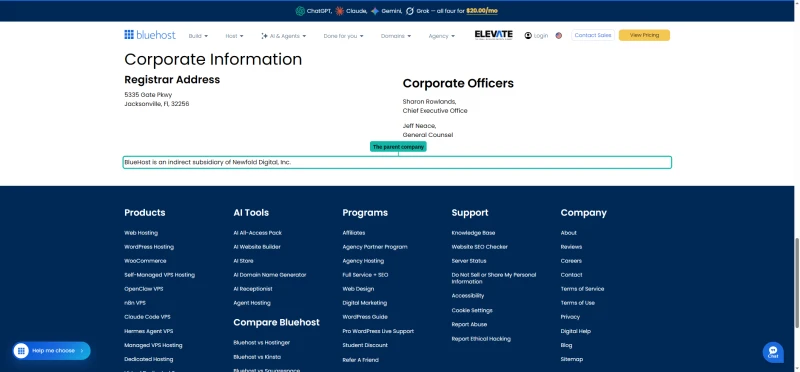
The Ownership Chain
- Bluehost was founded in 2003 in Provo, Utah
- It became part of EIG (Endurance International Group), which rebranded as Newfold Digital in 2021
- Newfold Digital also runs other hosting and domain brands, HostGator among them
What Ownership Does and Does Not Tell You
An earlier version of this review linked Newfold's ownership to old hardware, shrinking support and shared outages. None of that has a record behind it, so it is gone. What we can show: the renewal increase on Starter is +150%, and in our 54 days of monitoring Choice Plus logged 70 minutes of downtime across 3 incidents. Judge the host on those, not on who owns it.
The "WordPress.org Recommended" Badge, What It Actually Means
This is the most important section for understanding why Bluehost is so widely recommended despite its poor performance. The WordPress.org "recommended hosts" page lists Bluehost, SiteGround, and DreamHost. By WordPress.org's own wording this is a business relationship, not an independent performance test.
What WordPress.org Actually Says:
"These hosts have agreed to a minimum set of requirements and have a business relationship with WordPress.org."
This is a business relationship, not a performance endorsement, not an independent test, not a quality certification.
What the Badge Does NOT Mean
- It does not mean they are the fastest hosts
- It does not mean they are the best value
- It does not mean WordPress.org tested their performance
- It does not mean they are independently recommended
The Performance Reality
The two fastest hosts in this comparison, ScalaHosting (38ms) and ChemiCloud (78ms), are not on the WordPress.org recommended list. The listing is not a performance certification, and it is not a reason on its own to pick Bluehost.
Server Hardware: The CPU on Our Record
Bluehost doesn't publish server specifications for shared plans. Our CPU record lists the processor below for Bluehost shared hosting, taken from a Bluehost server inventory page, with the PassMark rank and multithread score read from PassMark on 2026-09-07 (one pass, one denominator). We have not run lscpu on a Bluehost account, and an earlier version of this review printed a different chip with no record behind it; that is corrected.
🖥️ CPU on Our Record, Bluehost Shared Hosting
- CPU: Intel Xeon E5-2680 v3
- PassMark rank: #1,343 of 5,999 server CPUs
- PassMark multithread score: 14,783
On PassMark's multithread score the ScalaHosting chip is about 6.9 times the Bluehost chip. That gap is a fair clue to the load results below, not proof of their cause: storage, PHP settings and account limits also matter, and we did not isolate them. This review covers shared hosting; Bluehost's VPS and dedicated plans may use other hardware.
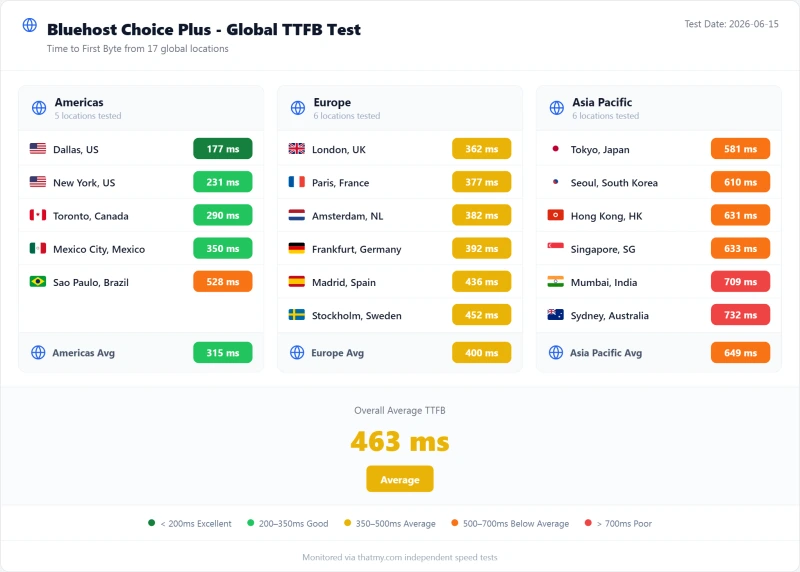
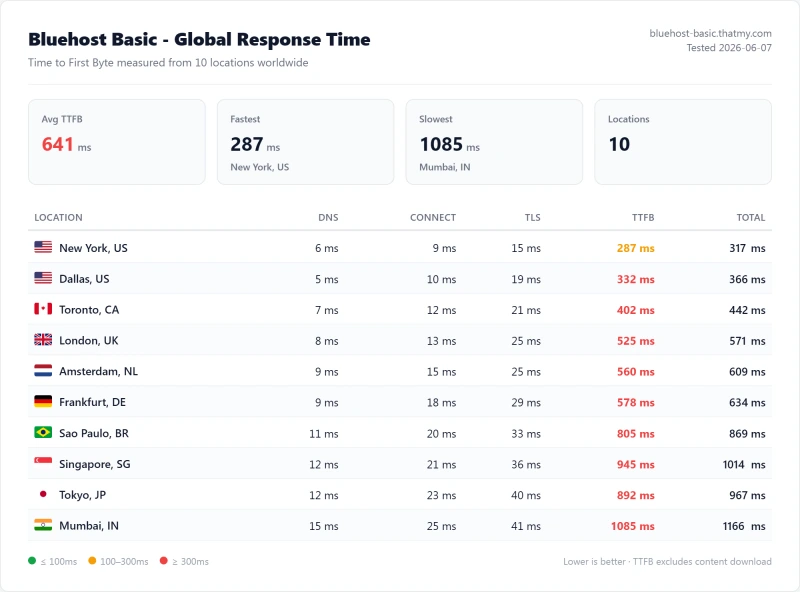
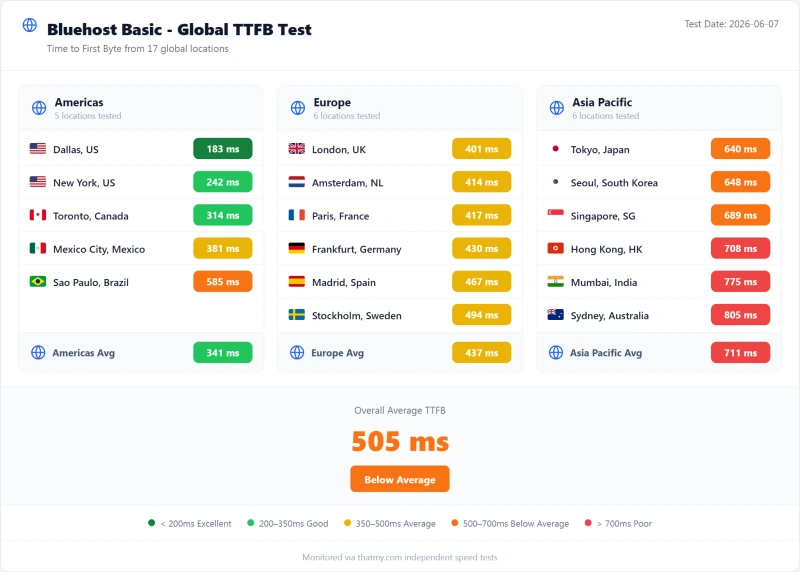
TTFB Results by Test Location
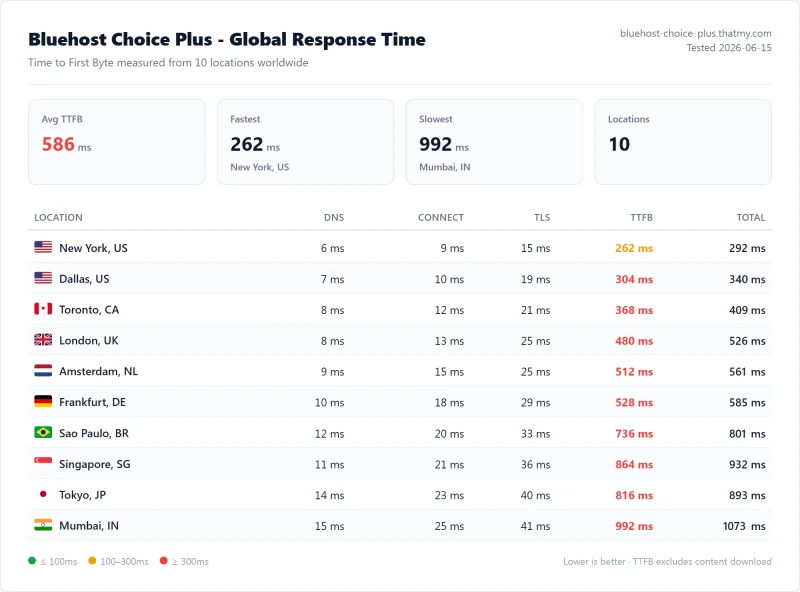
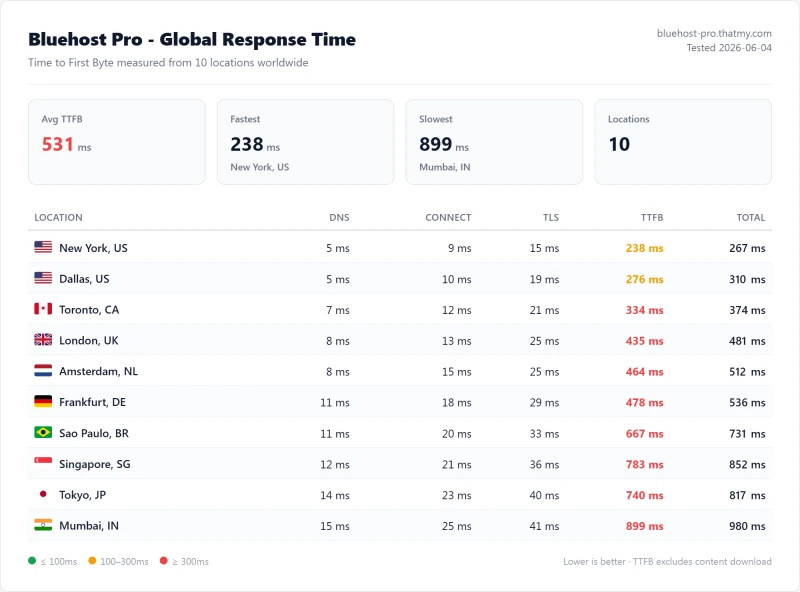
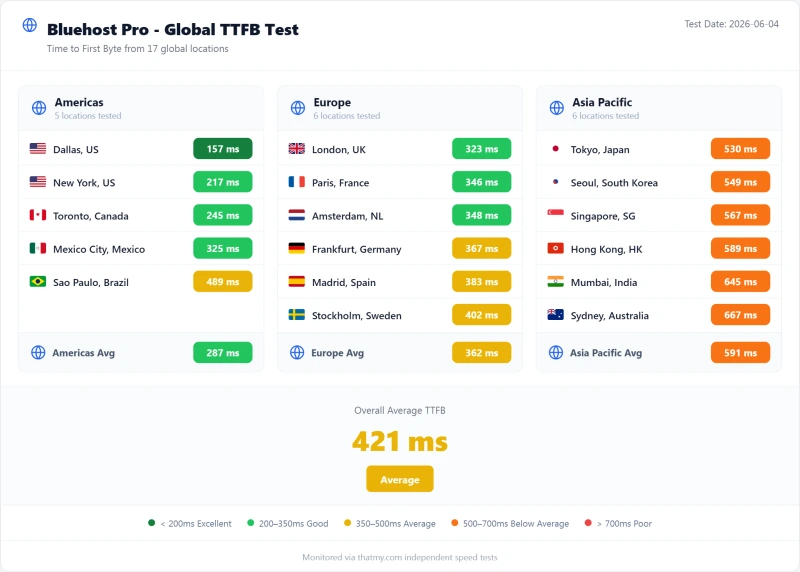
All tests run at the origin with no CDN in front, from 10 locations. The test server for Bluehost sat in the US, so "New York" is New York to that server and every other location is that location to the same server. The benchmark box figures on this page come from the 10-location record described in the Methodology line.
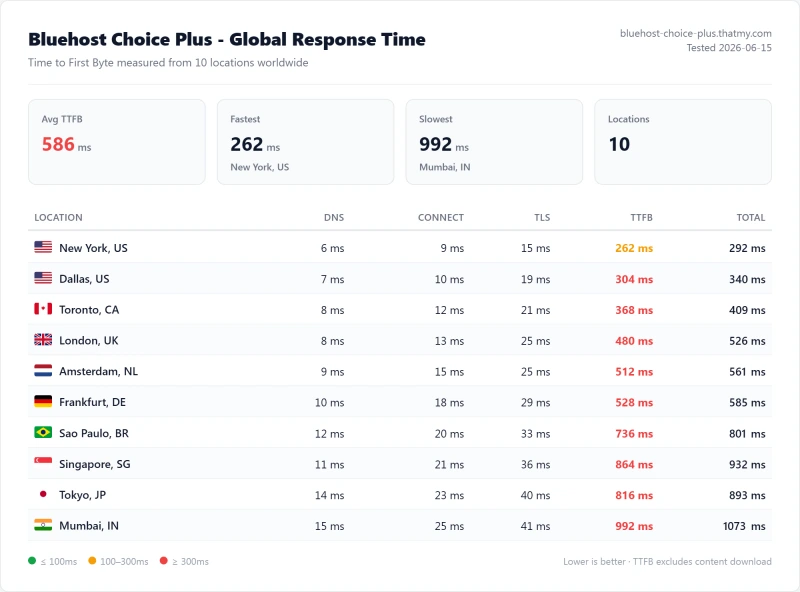
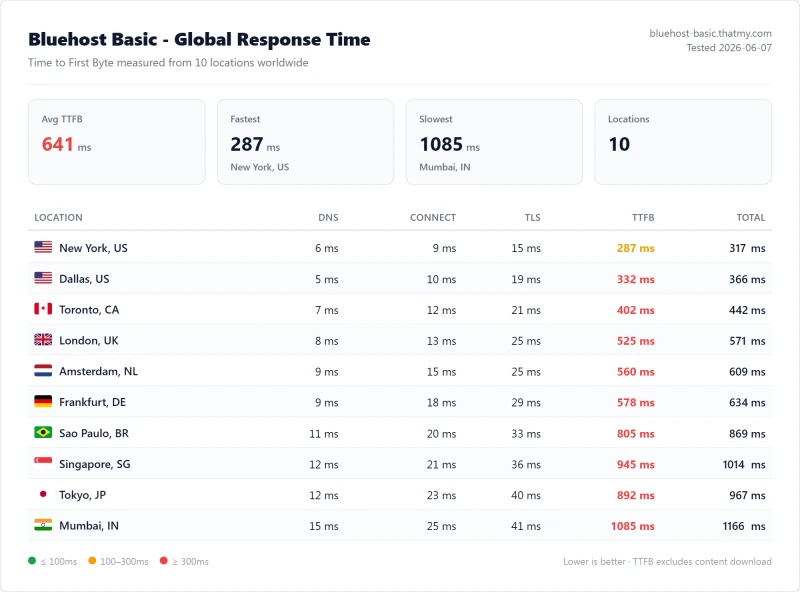
SiteGround's test server was in Frankfurt, so its London figure is the shortest trip and its New York and Mumbai figures the longest. Compare hosts at the same location with that in mind.
⚠️ What 262ms TTFB Means for Your Site
TTFB is not one of the three Core Web Vitals, and Google puts a "good" TTFB at 800ms. I hold hosts to a tighter 200ms, because TTFB is the part of load time your host controls. Bluehost's fastest location, New York at 262ms, is already above that bar, and Mumbai at 992ms is above Google's 800ms.
On a page that needs the server, about a tenth of the 2.5 second LCP budget is spent before the browser has a byte to parse at the New York figure, and much more for far-away visitors.
The Bluehost CDN Question
A CDN helps cacheable pages, and we measured with none in front. It cannot help dynamic pages: a WooCommerce checkout, logged-in users, contact forms and search results still go to the origin. For those pages the origin figures above are what matter, and they are typically the most business-critical.
Load Test: 0 to 250 Clients, and the 100-User Step
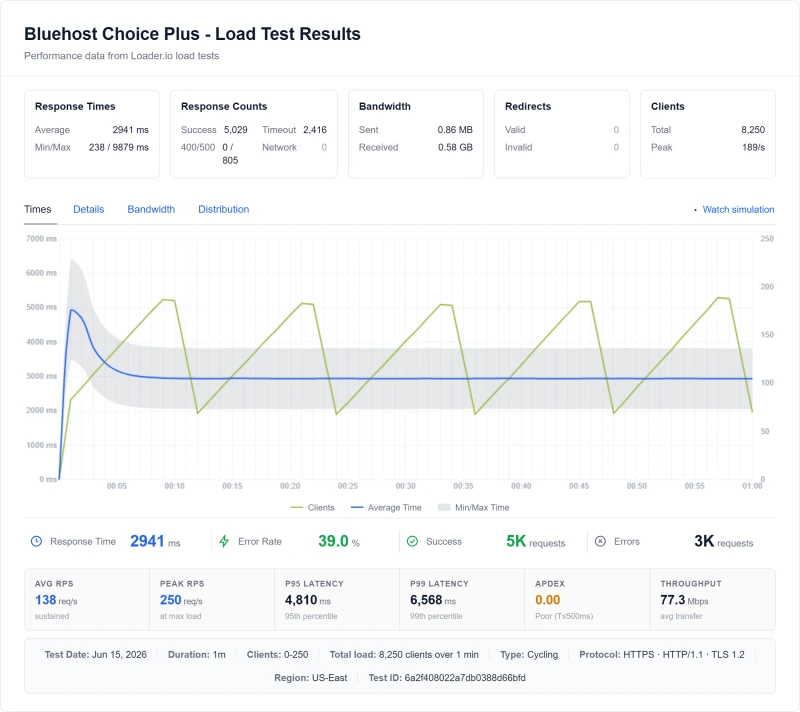
This is the most damning section of this review. Over our load ramp Bluehost Choice Plus did not just slow down, a large share of its requests failed.
SiteGround's ramp stopped at 100 clients while the others went to 250, so its failure share is not like for like. The results at 10, 25 and 50 clients in our record are interpolated, so we do not show them.
Why It Slows
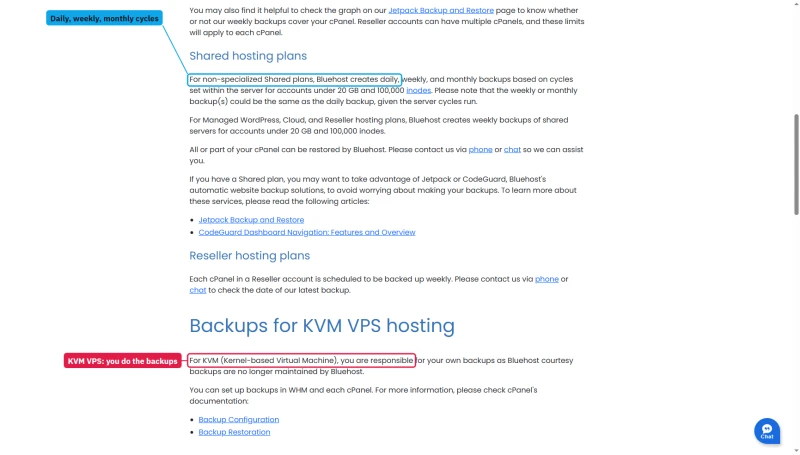
We saw the slowdown and the failures; we did not isolate the cause. Bluehost's own pages say a site that exhausts its CPU is slowed until you upgrade (screenshots in the next section), which fits what we saw but is not something this test proves.
❌ Real-World Translation
If your site gets a mention on Reddit, a small email blast or any traffic spike, expect this kind of plan to slow down and, in our test, to drop a large share of requests. For a store, every failed request is a lost visit, plus the SEO damage from Google crawling error pages.
CPU Throttling Behavior Under Sustained Load
Bluehost's terms reserve the right to throttle or suspend accounts that use excessive CPU, memory or I/O. The thresholds are not published as numbers we could verify, so this page does not quote any. When a site goes over, the usual symptoms are sudden TTFB spikes, PHP timeouts and a slow admin panel.
Bluehost's own pages disagree on this. Its Scalable Shared Hosting FAQ says that when a site exhausts its CPU, Bluehost will temporarily reduce its speed until you upgrade. Its comparison page against Hostinger says there is no CPU throttle upon overages.

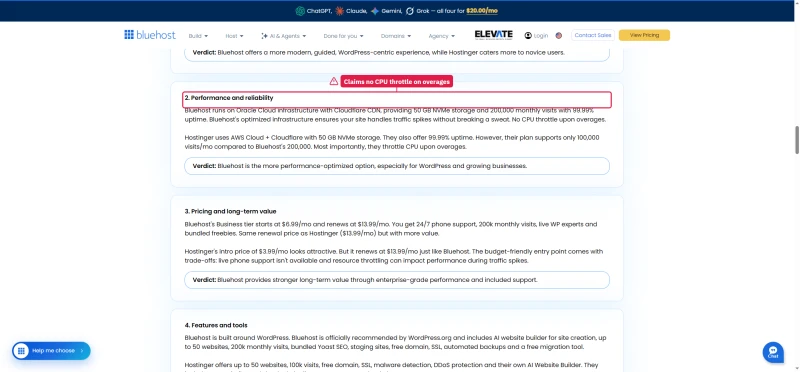
The same FAQ explains what outgrowing a plan costs. Accounts that pass their plan's limits are moved to a higher tier automatically, with no purchase step, and the new plan's price arrives as a renewal notice at the next renewal.

What We Did Not Test
An earlier version of this review described a WooCommerce import that triggered throttling, a support agent who denied the limits, and process limits "in practice". None of those has a record, so they are removed. We did not test throttling thresholds ourselves; what we measured is the load ramp above.
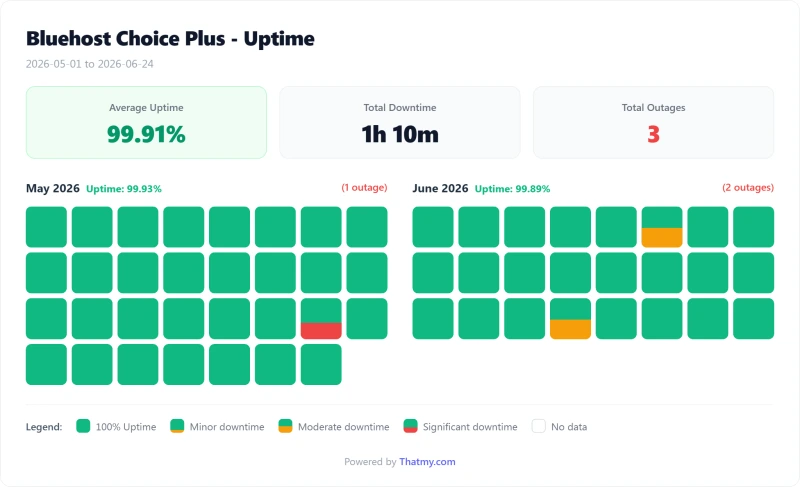
Uptime: 54-Day Monitoring Window
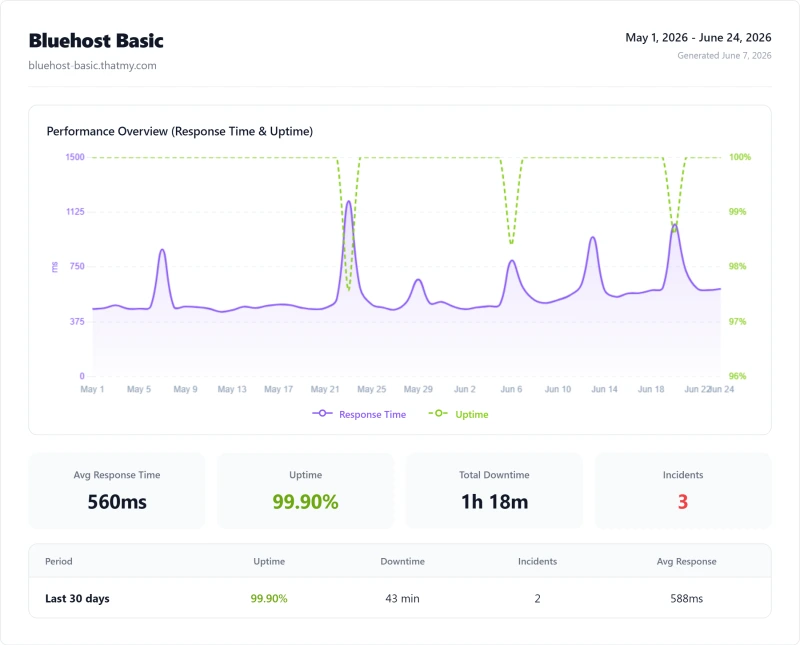
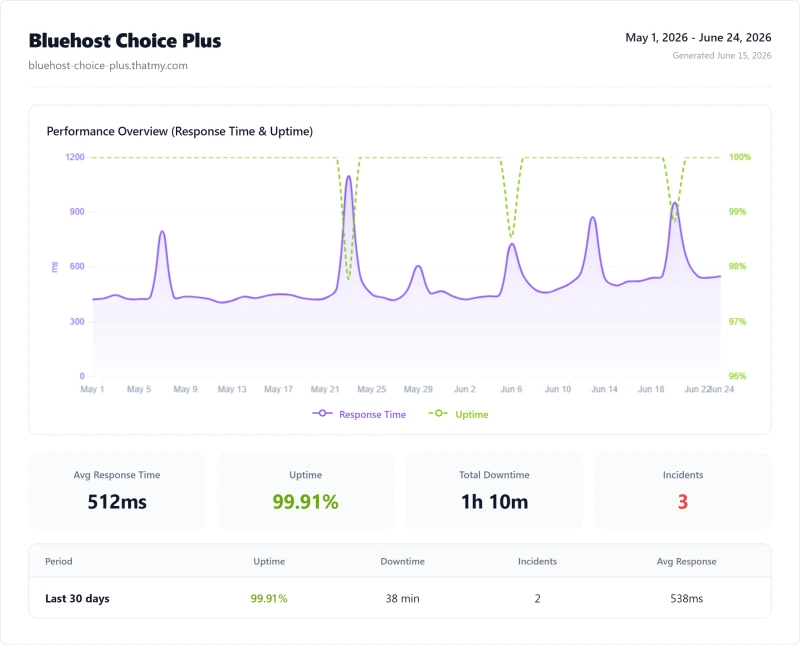
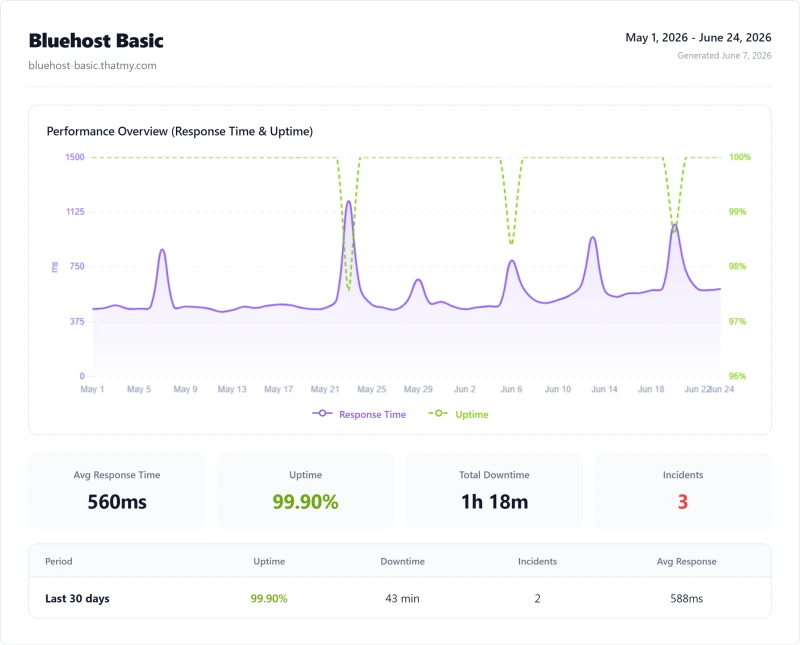
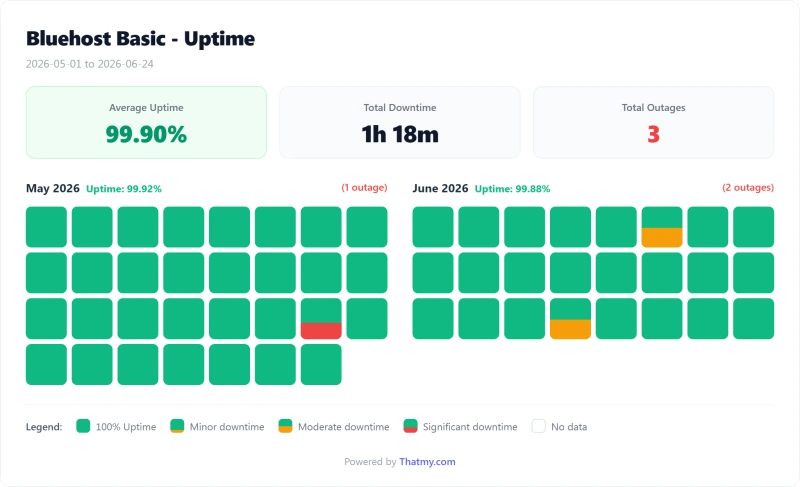
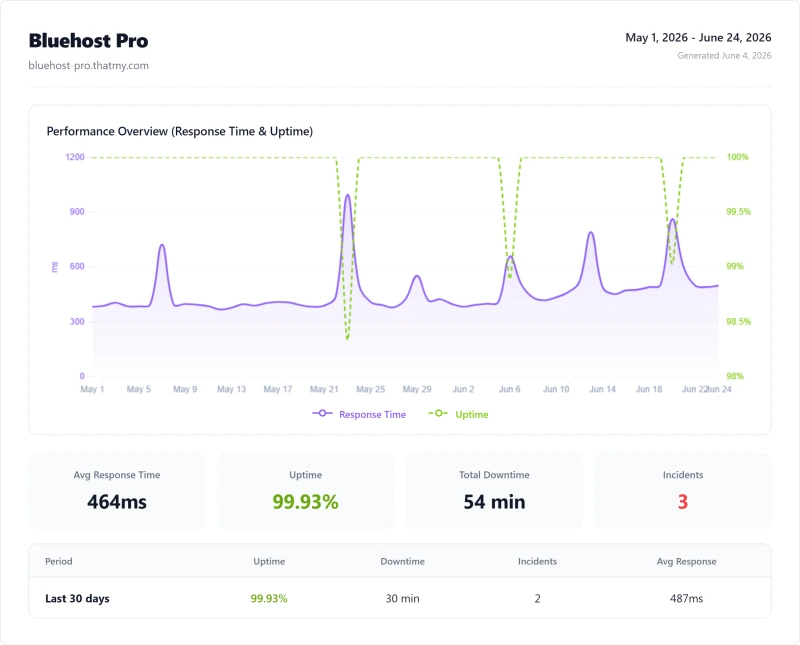
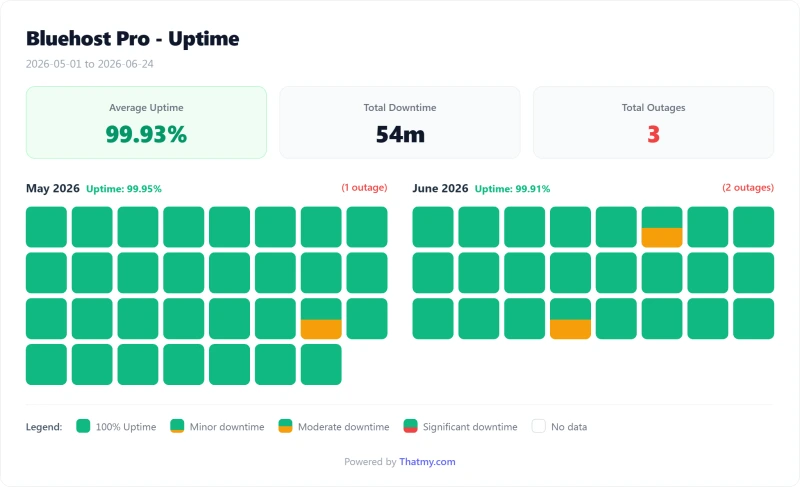
We monitored Bluehost Choice Plus with 1-minute HTTP checks over 54 days of monitoring. The chart below is the same monitor on the Basic plan.
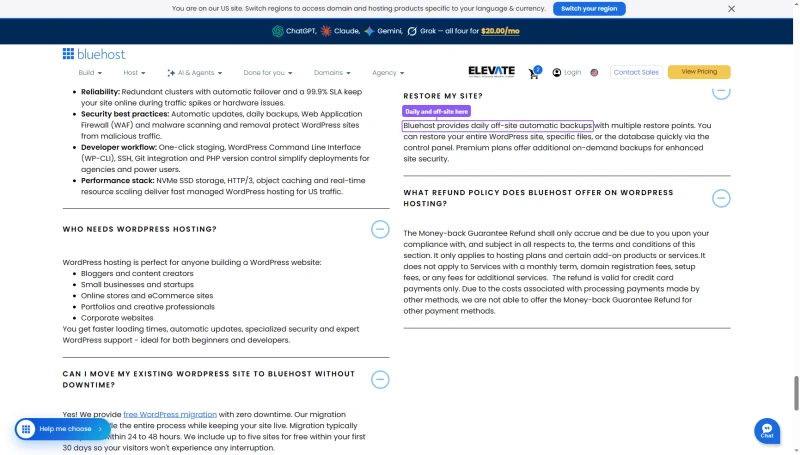
Bluehost's own WordPress hosting FAQ backs uptime with a 99.9% SLA, while its shared plan cards say 99.99%.
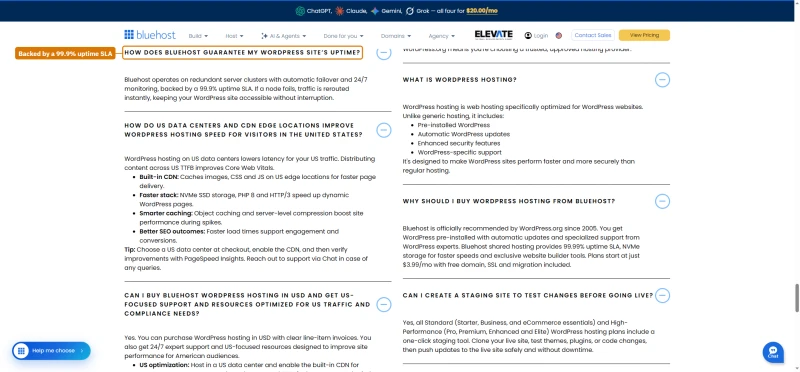
Bluehost Cloud goes further and prints a 100% uptime SLA on its cards. The terms under it cover the data center network only, exclude scheduled maintenance, and credit 5% of the monthly fee for every 30 minutes of network downtime.

A FAQ answer on the same page promises a different credit: one day of hosting for every 30 minutes of unplanned downtime.

Bluehost's status page lists each service as operational and prints no uptime figure at all, so the only uptime record you can check is your own monitor.

For an e-commerce site, 70 minutes of downtime in 54 days is real lost revenue, before accounting for SEO damage from Google crawling error pages.
Full Test Report: Bluehost Shared, by Plan
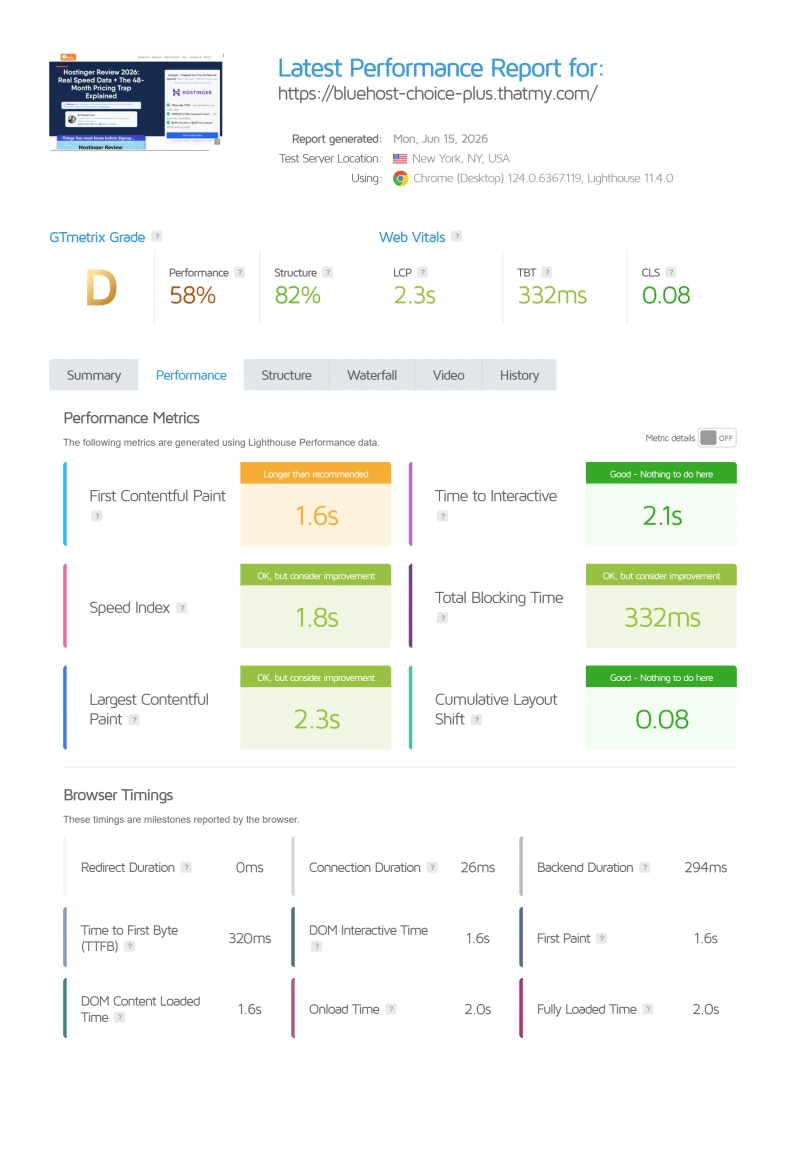
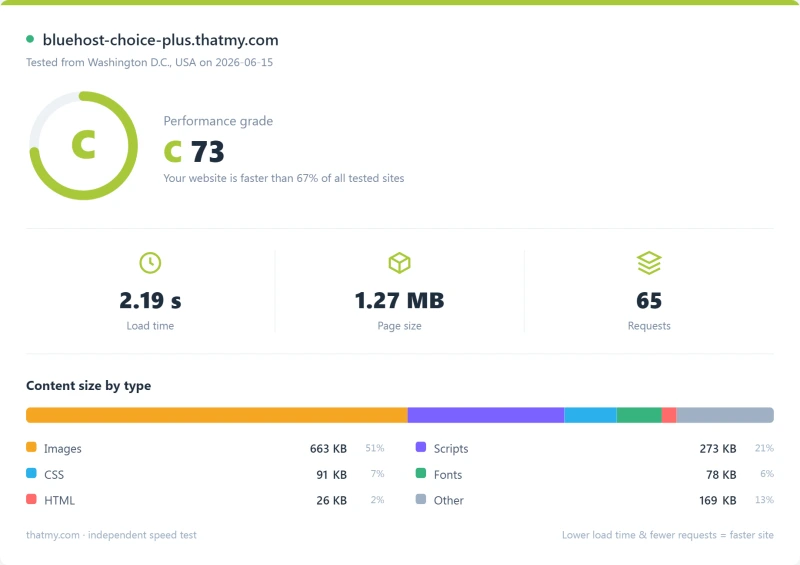
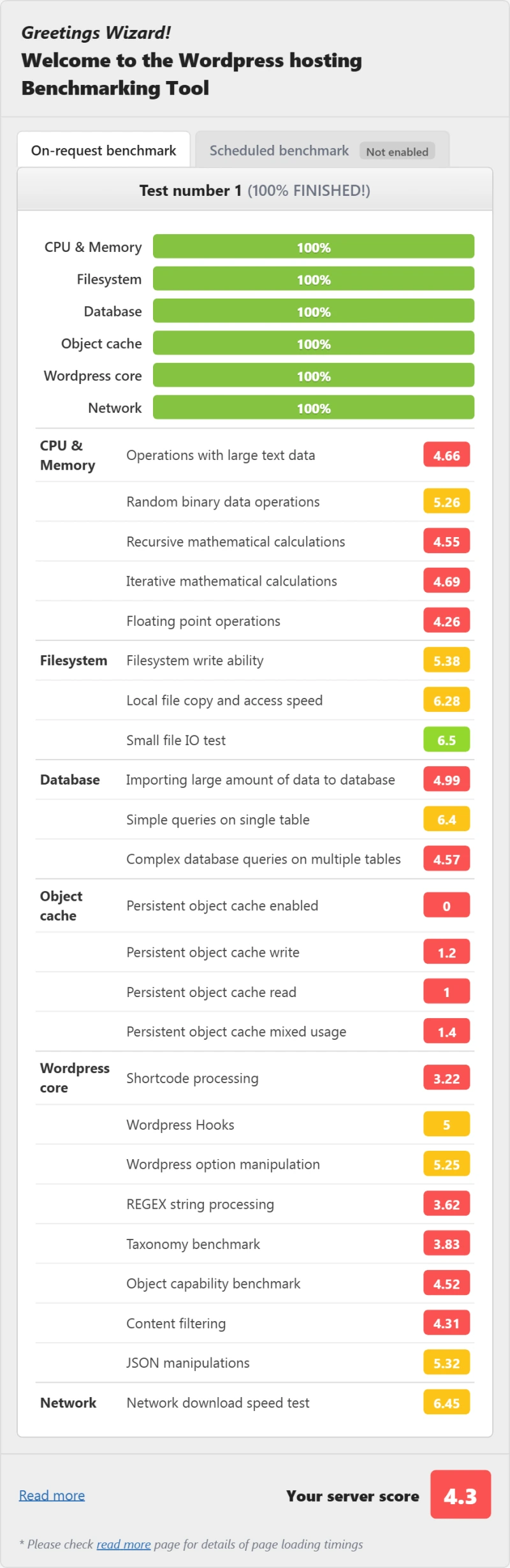
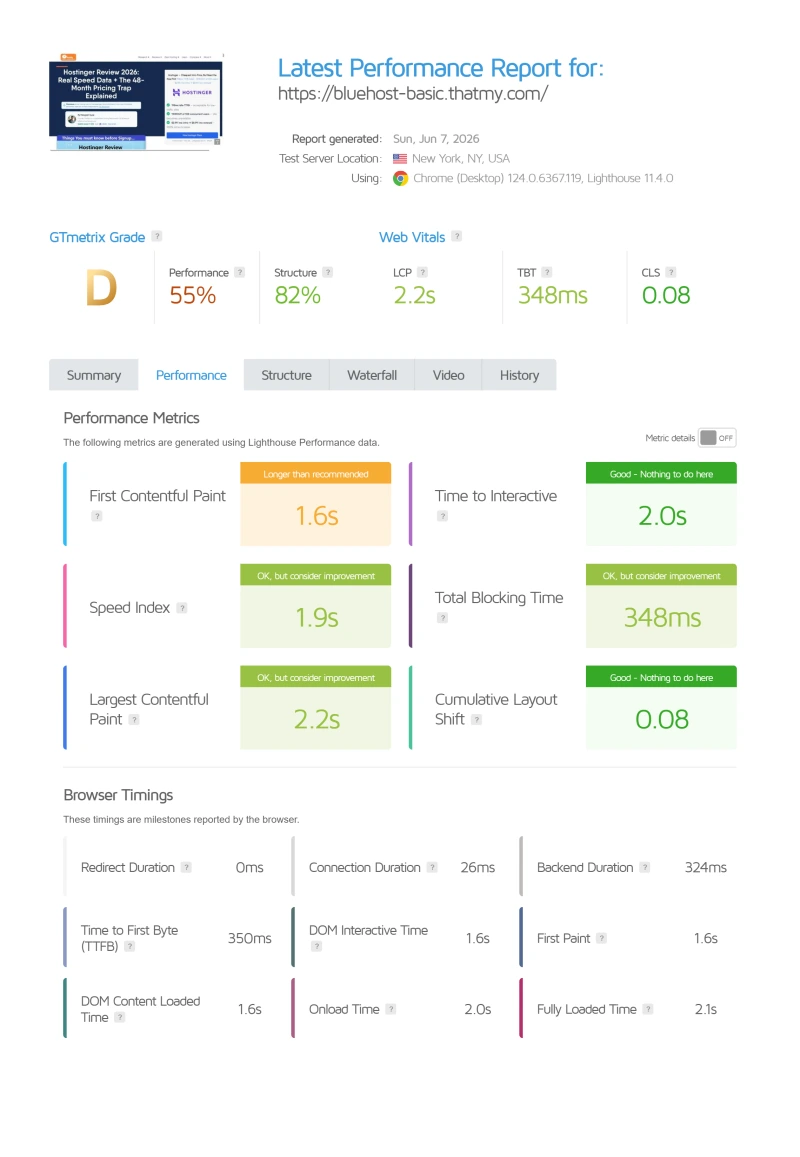
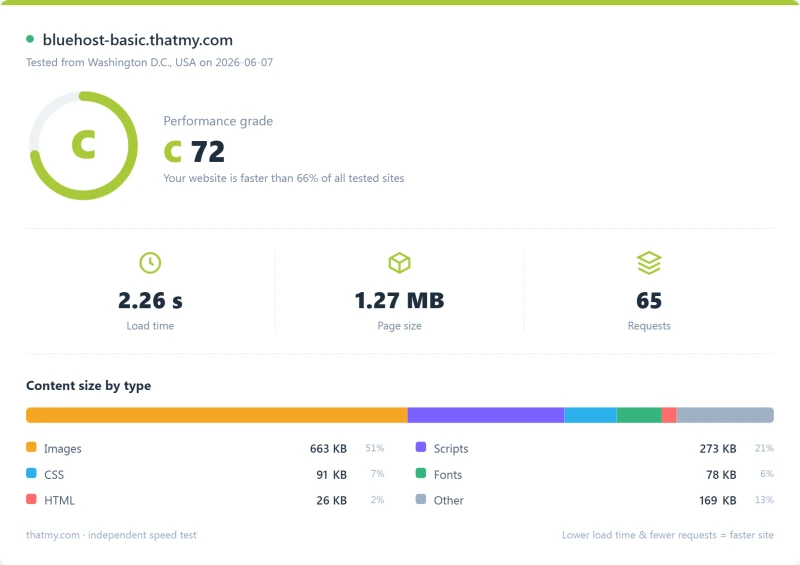
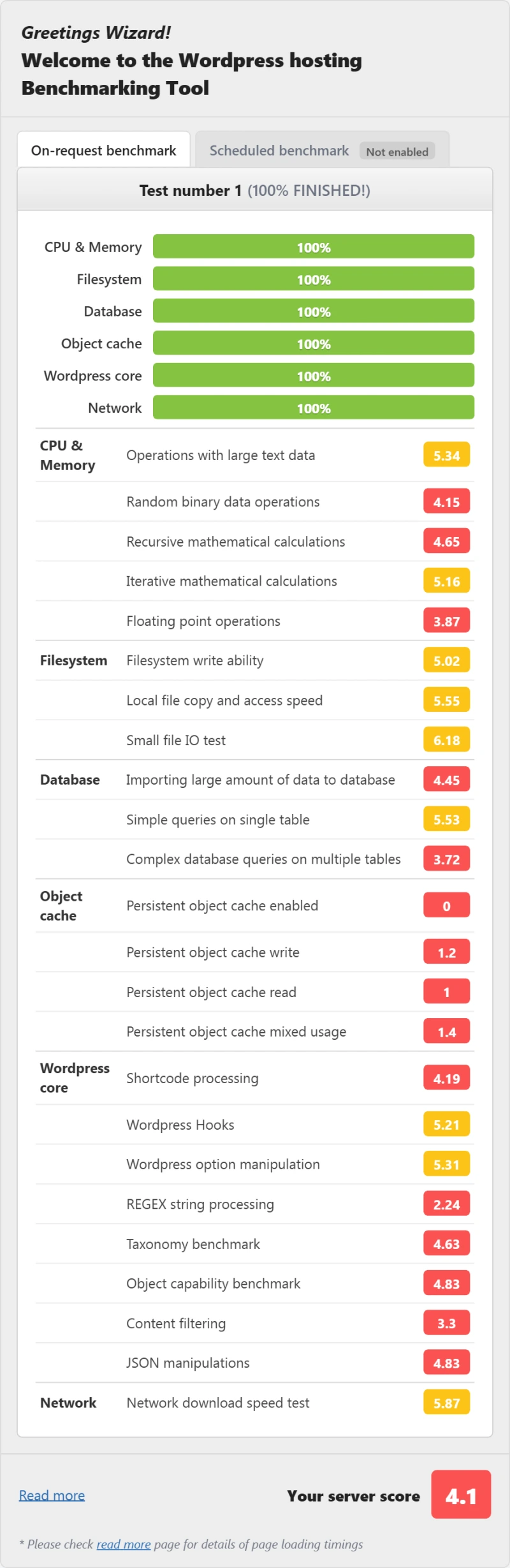
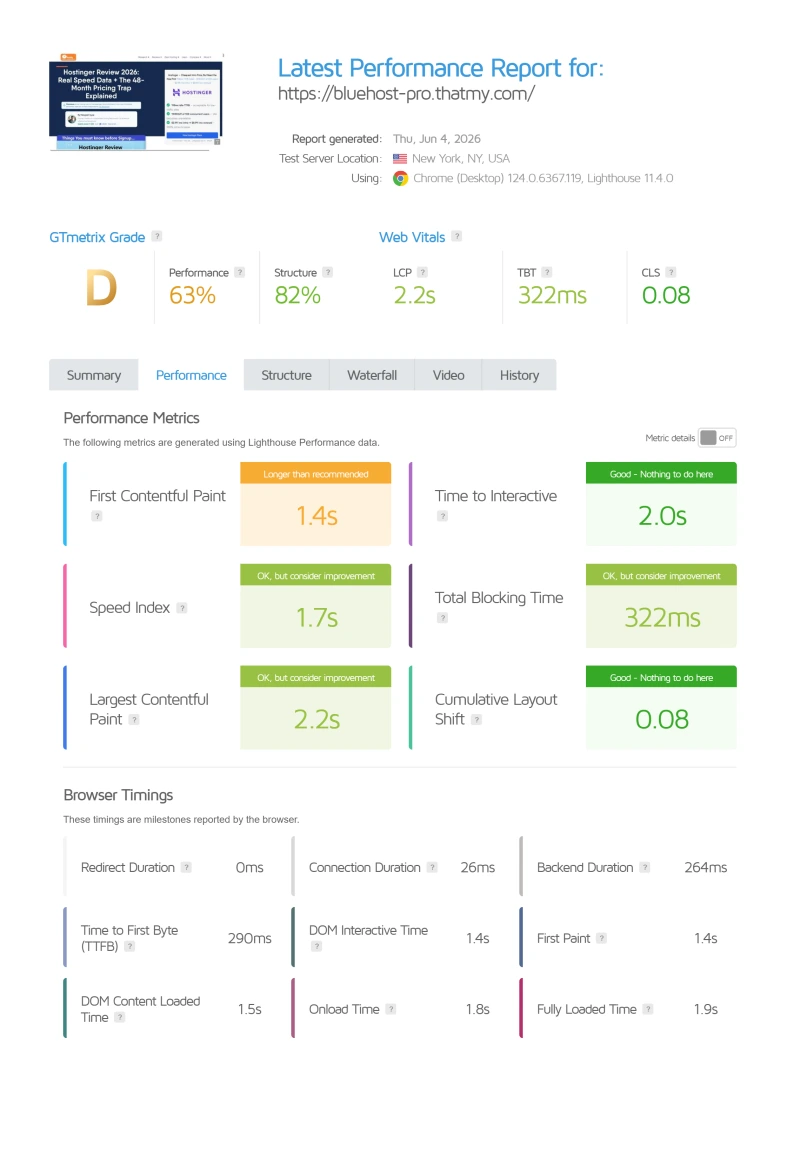
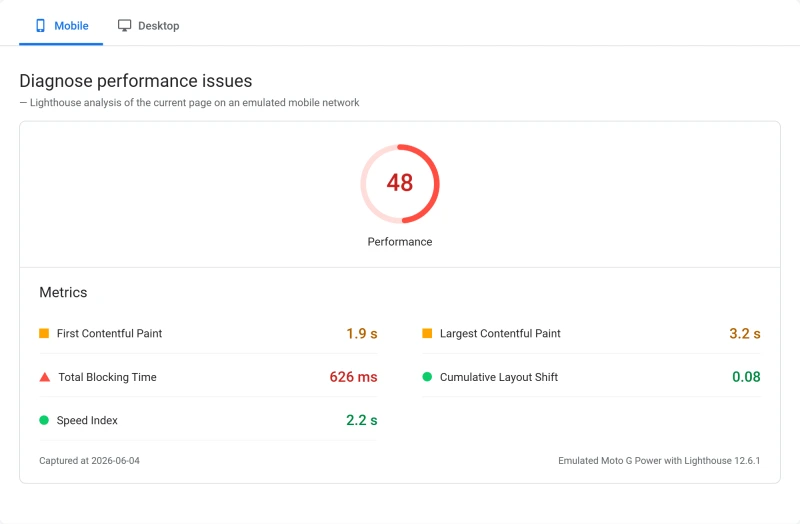
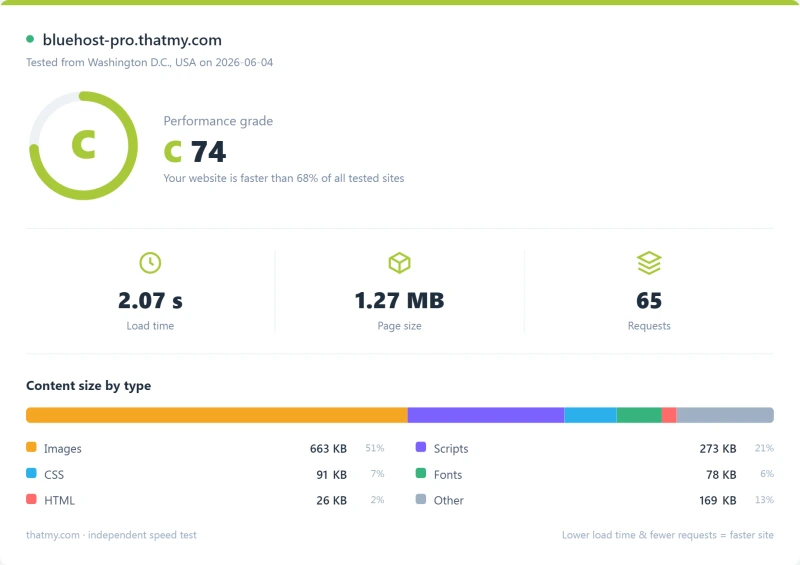
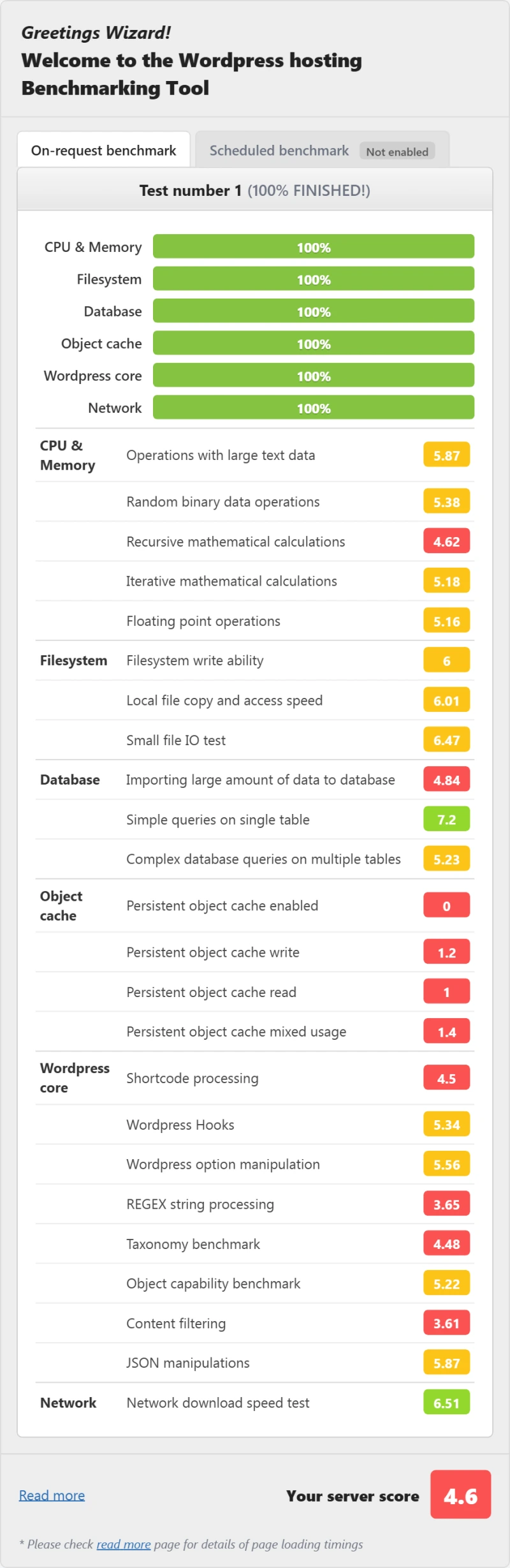
Here is the complete export from our test suite for each shared plan we benchmarked, Basic, Choice Plus (the tier featured throughout this review), and Pro. Nine views per plan: server response time, behavior under load, the GTmetrix and PageSpeed captures, our WordPress hosting benchmark, regional TTFB, and 54 days of uptime tracking. The reports are labelled by Bluehost's current plan names; the benchmark record behind them is Basic, Choice Plus and Pro.
Choice Plus (Featured) Basic Pro
Bluehost TOS Resource Limits, The Full Breakdown
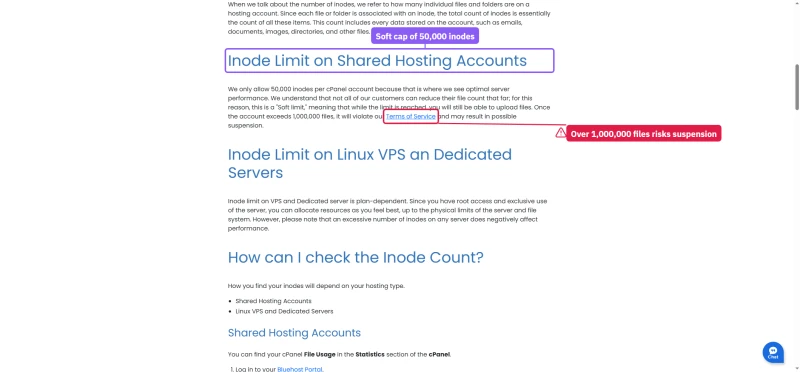
Bluehost's terms of service contain resource limits, but most of them are not published as numbers that we could verify, and an earlier version of this review printed figures for processes, RAM, I/O, entry processes and database queries that have no record. Those are removed. What is on record is the inode limit, because Bluehost prints it in its own help articles.
The Inode Limit Trap
WordPress sites with many images, cache files and plugin assets can hit an inode cap faster than expected. When you hit it you cannot upload files, create posts or install plugins; the fix is to delete files or upgrade your plan.
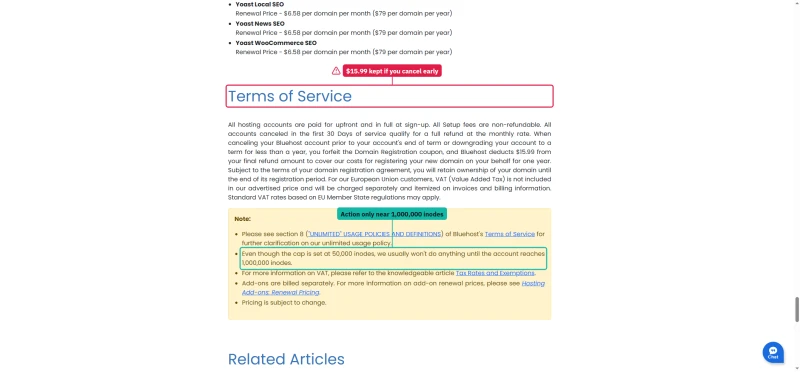
Bluehost publishes three inode numbers in two help articles: a soft cap of 50,000 per cPanel account, a 200,000 maximum, and a Terms of Service violation past 1,000,000 files.
For comparison, ChemiCloud's own plan page lists its inode allowances per plan; we did not benchmark the effect of any of these limits.
Bluehost Pricing, The Real Cost Breakdown
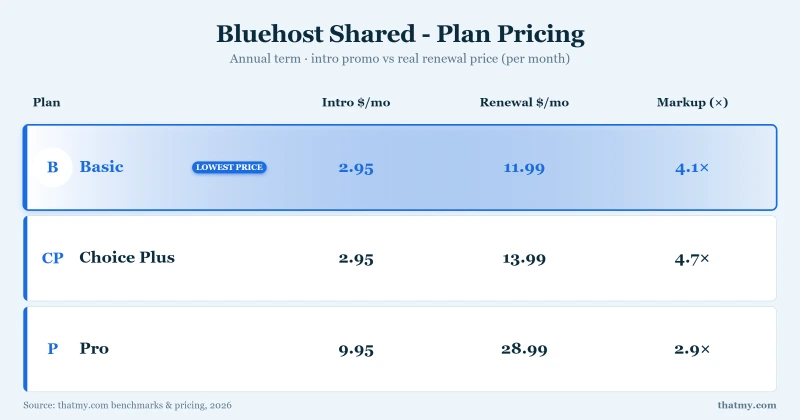

The advertised price is not the price you'll pay, and the lowest intro prices need a prepay of 36 months; shorter terms cost more and renew higher. Here's the complete pricing picture from the live bluehost.com pricing page. Bluehost has since replaced the Basic, Plus, Choice Plus and Pro plans we speed-tested with Starter, Business and eCommerce Essentials; the test results below are from the older plans.
The shared plan cards print the intro price, the prepay of 36 months it needs and the renewal price in one block. Bluehost's own renewal table lists what each plan costs after that, by billing term.

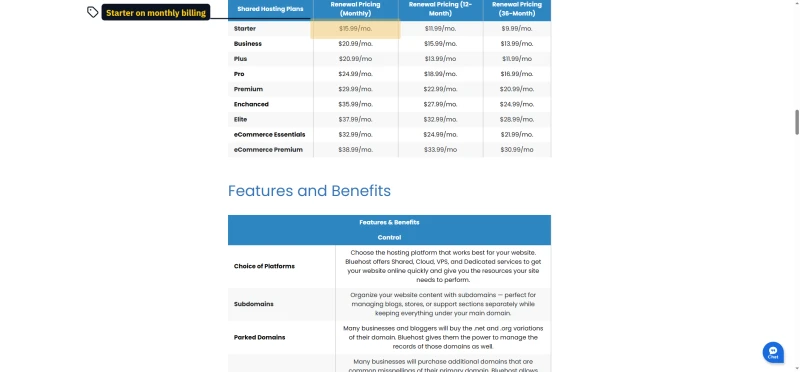
The Renewal Depends on the Term You Pick
Switch the cards to a one-year term and both numbers go up. Starter costs $4.99/mo and renews at $11.99/mo; Business costs $7.99/mo and renews at $15.99/mo. That is two dollars a month more at renewal than the same plan on the three-year term.

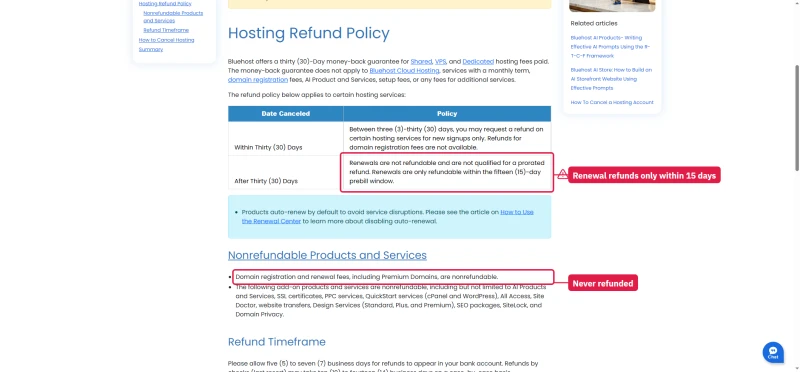
Pay month to month and there is no discount at all: Starter is $15.99/mo, Business $20.99/mo and eCommerce Essentials $32.99/mo, the same figures as the monthly row of Bluehost's renewal table. So one Starter plan can renew at three different prices, depending on the term you picked. The monthly cards also tick a 30-day money-back guarantee that Bluehost's refund policy does not give monthly terms.

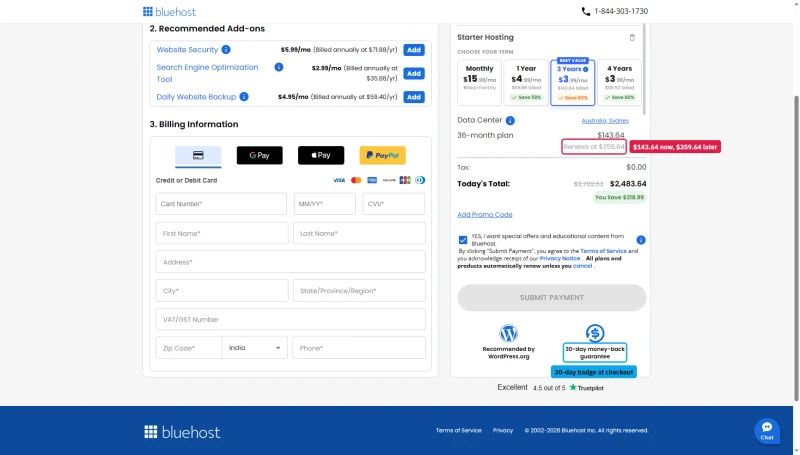
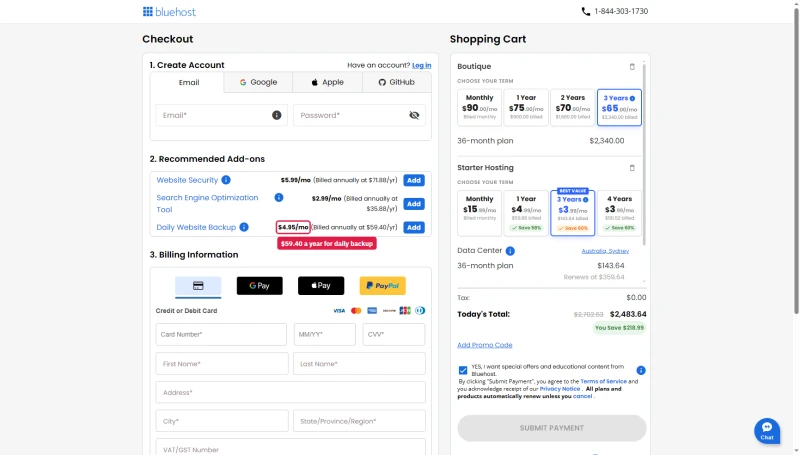
The cart spells the long term out in dollars: 36 months of Starter is $143.64 due today, and the next 36 months renew at $359.64.
True 3-Year Cost Calculation
Each total is the cheapest term the host sells: a prepay of 36 months for Bluehost, ChemiCloud and ScalaHosting, and one year for SiteGround, which renews after the first year. Bluehost Starter then renews at $9.99/mo.
💡 The Key Insight
ChemiCloud Pro is cheaper than Bluehost Starter over 3 years ($106.20 against $143.64, both prepaid for 36 months) AND answered in 78ms against Bluehost's 262ms from New York to each test server. There is no scenario where Bluehost Starter is the right choice if you plan to renew. The only scenario where Bluehost makes sense: a hobby site with very little traffic that you plan to move before it renews.
Bluehost Cloud Renews Flat
Bluehost's managed Cloud plans, sold to agencies as Boutique, Firm and Agency, are the exception. Bluehost's help article lists their 36-month renewal at the intro price: $65, $140 and $230 a month. Shorter terms cost more, up to $90, $180 and $310 a month on monthly billing.
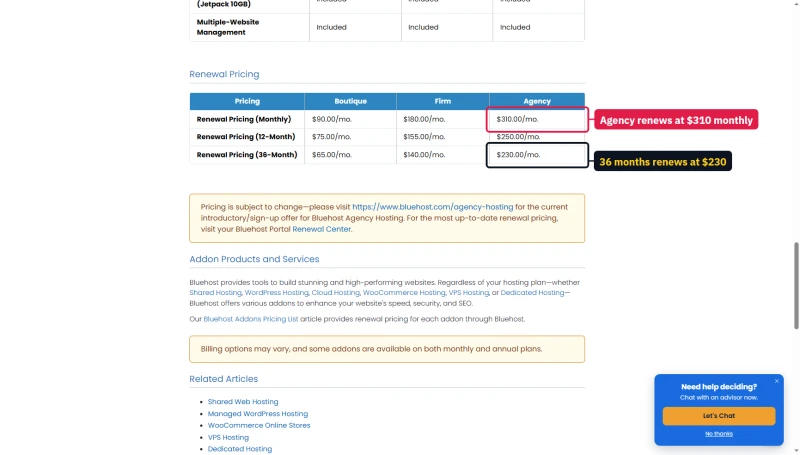
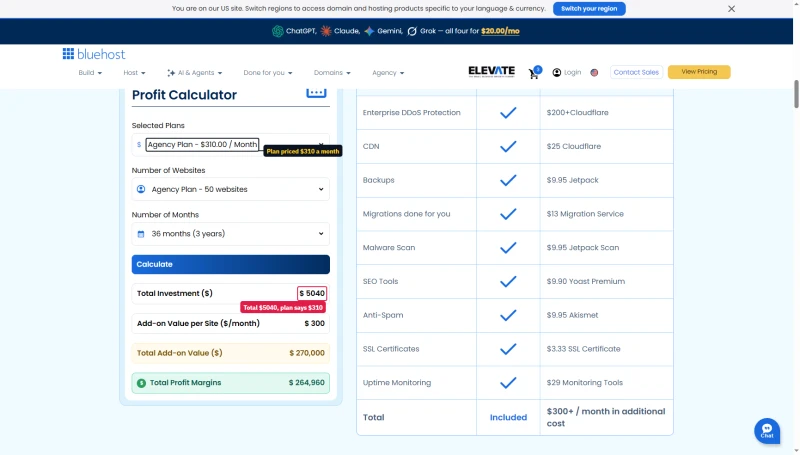
Watch which term a Bluehost page means. The Agency profit calculator prices the top plan at $310 a month, the monthly rate, on a page whose cards show $230 for 36 months. Cloud is also one of the products the 30-day money-back guarantee excludes.
For anything above shared hosting, trust the plan card over the renewal list. The list puts the Standard NVMe 4 Managed VPS at $53.99 a month on the 36-month term, while its card says it renews at $68.99. The Dedicated rows sit below their cards too.



cPanel on Bluehost: What's Included vs Locked
Bluehost uses cPanel, the industry-standard control panel. This is one of Bluehost's genuine advantages: cPanel is familiar, well-documented, and has a large community knowledge base.
What's Included
- cPanel
- Softaculous (one-click WordPress install)
- File Manager
- Email accounts (Pro Email is a free trial on every plan, then paid)
- phpMyAdmin
- FTP access
What's Missing or Limited
⚠️ What Staging Does Not Fix
Bluehost now lists a WordPress staging site, SSH and WP-CLI on every plan, Starter included; the older plans we tested kept staging for Choice Plus and above. SiteGround includes staging on GrowBig ($29.99/mo renewal). ScalaHosting includes staging on all VPS plans ($24.95/mo intro). Bluehost lists object caching without naming the engine, and does not list Git integration, which ScalaHosting VPS includes free.
SiteGround is the comparison readers reach for most at this price point, and it wins several of these line items while losing badly on renewal. I put the two side by side in SiteGround vs Bluehost.
WordPress Performance Stack (What's Actually Configured)
An earlier version of this section listed Bluehost's web server, PHP default, object cache, page cache and CDN tier, and claimed Apache is slower than Nginx and that Redis cuts database queries to one or two. We have no dated capture of Bluehost's stack, so those lines are gone and we do not describe the stack here.
What we can say: Bluehost's plan pages list object caching without naming the engine (see the feature table above), and ScalaHosting and Cloudways list Redis on their own pricing pages. In our benchmark, Bluehost Choice Plus scored 4.3/10 on our WordPress benchmark against 8.4/10 for ScalaHosting Entry Cloud and 7.9/10 for ChemiCloud Pro. A web server can help, but those scores describe the whole stack, and we did not take it apart.
WooCommerce on Bluehost: Why It Struggles
WooCommerce checkout pages cannot be cached, they're dynamic per-user. This means raw server speed matters most. We did not run a WooCommerce checkout benchmark: an earlier version of this section printed page-by-page timings for cart, checkout and order pages, and they had no record, so they are removed. What we did measure, on a plain WordPress test site, is the same server behaviour a checkout would meet:
- Origin TTFB from New York: Bluehost 262ms, ScalaHosting Entry Cloud 38ms.
- 100 concurrent users: Bluehost 1240ms, ScalaHosting 58ms.
- Requests that failed over the 0 to 250 ramp: Bluehost 39.04%, ScalaHosting 0%.
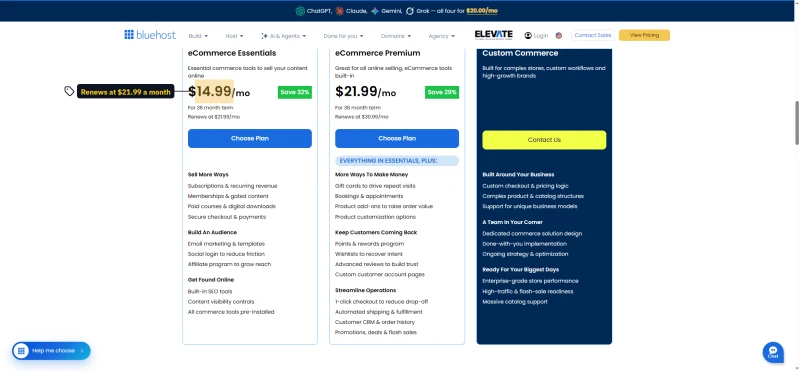
Bluehost's WooCommerce page sells two store plans, eCommerce Essentials and eCommerce Premium, each on a long prepay with a higher renewal printed under the price.
❌ Bluehost's "WooCommerce Hosting" Plan
Bluehost sells eCommerce Essentials for stores at $14.99/mo intro ($21.99/mo renewal), with WooCommerce installed for you. We benchmarked the older Choice Plus plan, not this one, so we cannot say how it behaves under load. For WooCommerce, look at ScalaHosting VPS ($24.95/mo) or Cloudways ($60.00/mo for Vultr High Frequency 4GB).
Bluehost Plans Explained (Which One to Pick, If Any)
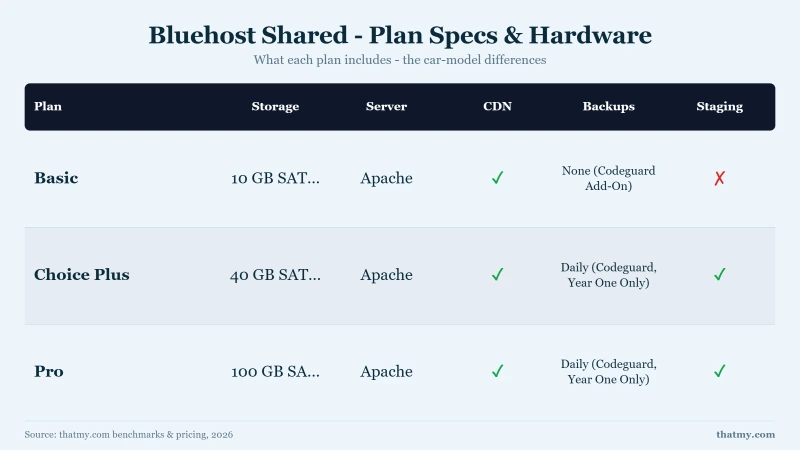
Storage, site counts and staging are on the plan cards in the picture above and the pricing section; we do not retype them here.
On Bluehost's pricing page the Starter card marks phone support and domain privacy as not included, while Business ticks both. The High Performance tab adds four dearer plans, from Pro to Elite, each with more CPU and storage.


Two things the cards do not tell you. The compare table under them ticks Starter for a staging environment but leaves it blank for Staging Site and for Malware Detection/Removal, though the line above the table says every plan includes malware scanning and removal. And the High Performance cards promise 5x to 10x more CPU power without saying more than what, while all four list the same ~400k monthly visits.

Honest Recommendation: None of These Plans Are Competitive at Renewal Pricing
If you need shared hosting, ChemiCloud Pro ($4.49/mo intro / $19.95/mo renewal) answered faster in our benchmark, though it is dearer than Bluehost at renewal rather than cheaper. If you need performance, ScalaHosting VPS starts at $24.95/mo and, per our CPU record, runs on an AMD EPYC 9474F.
The only scenario where Bluehost makes sense: a hobby site with very little traffic that you plan to move before the 36 months prepay ends and it renews.
Support: What Bluehost Promises, and What We Have Not Tested
We have not run a support test on Bluehost. An earlier version of this review printed eight support tests with response times and quality scores, and averages for live chat, tickets and phone holds. None of that has a record, so it is removed, along with the support score. What is on record is what Bluehost says about its own support.
Bluehost's contact page promises US-based phone experts around the clock. That holds from Business up: the Starter plan card lists phone support as not included.

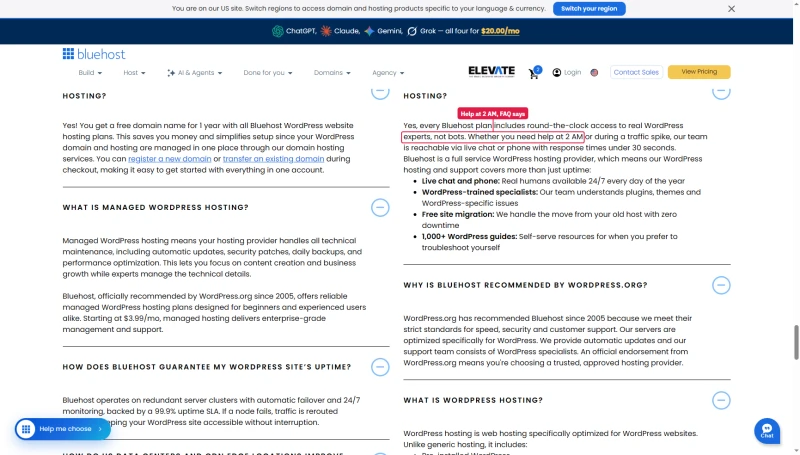
The phone hours change from page to page. The contact page says 24 hours a day, 7 days a week, and the WordPress hosting FAQ says you can get help at 2 AM, while the compare table and Bluehost's help articles give phone hours of 7 am to midnight Eastern. Live chat is the channel Bluehost keeps open around the clock.
What Customers Say
Bluehost's Trustpilot profile shows 4.5 stars from about 32,000 reviews, with 15% of them one-star. The profile also notes that Bluehost invites its customers to review and pays for a Trustpilot subscription, so read the score as invited feedback rather than a random sample.

Bluehost vs ScalaHosting (Head-to-Head)
ScalaHosting wins on every performance metric we measured. Bluehost wins only on price: Starter is far cheaper at intro and at renewal, though the two plans are not the same product (a shared plan against a managed VPS). If your site makes money, the difference shows in how it behaves under load: 58ms against 1240ms at 100 users, and 0% of requests failed against 39.04%.

Why Scalahosting Beats Bluehost
- 38ms TTFB, 8.4x faster than Bluehost (320ms), passes Google Core Web Vitals
- 58ms at 100 concurrent users, only 19% degradation vs Bluehost's 297% at 50 users
- AMD EPYC 9474F (#42 PassMark), 8.4x higher CPU score than Bluehost's #1,464
- No TOS resource limits, no process caps, no I/O throttling, no CPU steal
- 30+ dedicated PHP workers vs Bluehost's 2 shared
- SPanel free, saves a significant amount vs cPanel, uses 8x less RAM
- 99.99% uptime, 8 minutes down over 54 days, against Bluehost 99.91% and 70 minutes
- Free migration from Bluehost via SPanel wizard
Where Bluehost Wins
- $29.95/mo minimum vs Bluehost $3.99/mo intro
- Renewal jumps ~200% after intro term (jumps significantly)
- No shared hosting entry point, VPS minimum
- SPanel has a learning curve vs cPanel familiarity
Real Benchmark Data
- Origin TTFB (2 plans, no CDN): 38ms
- Uptime (54-day window): 99.99%
- PageSpeed Score (Mobile): 83/100

$29.95/mo
Anytime Money-Back Guarantee
Bluehost vs SiteGround (Head-to-Head)
SiteGround held up better under load and on uptime; the two are close on idle TTFB from New York, and the test servers sit on different continents. Bluehost wins on renewal pricing (Business $13.99/mo against GrowBig $29.99/mo). For beginners who need hand-holding and steady performance, SiteGround is the better choice despite the higher renewal price. For pure budget over 3 years, ChemiCloud beats both.
Who Should NOT Use Bluehost
❌ Do NOT Use Bluehost If:
- Your site makes money (any amount)
- You have WooCommerce (checkouts need a fast origin; we saw 1240ms at 100 users)
- You expect traffic bursts (39.04% of requests failed in our ramp)
- You plan to renew (+150% renewal increase on Starter)
- You need phone support on the cheapest plan (Starter has none)
- You need Git integration (not listed on any plan)
- You need top uptime (70 minutes of downtime over 54 days)
- You want a server answer under 200ms (262ms from New York to our test server)
✅ Bluehost Might Be Acceptable If:
- You have a hobby blog with very little traffic
- You want a low intro price and will move before the 36 months prepay ends
- You plan to migrate before renewal
- You need the most beginner-friendly WordPress setup
- You're testing a concept before investing in real hosting
Better Alternatives by Use Case
FAQ: Bluehost
Is Bluehost good for WordPress in 2026?
For a hobby blog with little traffic, Bluehost is acceptable at the intro price. For any site that makes money or gets bursts of traffic, we do not recommend it. On our benchmark of the older Choice Plus plan, a hundred concurrent users waited 1240ms, 3,221 of 8,250 requests failed over the 0 to 250 client ramp, and the plan logged 70 minutes of downtime over 54 days of monitoring. The $3.99/mo intro price on Starter becomes $9.99/mo at renewal, and Business goes from $6.99/mo to $13.99/mo. ChemiCloud Pro answered in 78ms from New York to our test server against Bluehost's 262ms, and held 210ms at 100 users.
What CPU does Bluehost use?
Our CPU record for Bluehost shared hosting lists Intel Xeon E5-2680 v3, ranked #1,343 of 5,999 server CPUs on PassMark with a multithread score of 14,783 (read from PassMark on 2026-09-07). For comparison, our records list AMD EPYC 9474F at ScalaHosting (#42, score 102,255) and AMD EPYC 9354 at ChemiCloud (#110). Older hardware is one possible reason for the load results, but we did not isolate the cause, and Bluehost can change its servers without telling anyone.
Is Bluehost WordPress.org recommended?
Yes. WordPress.org's 'recommended hosts' page says that listed hosts 'have agreed to a minimum set of requirements and have a business relationship with WordPress.org.' That is a business relationship, not an independent speed or reliability test. In our tests Bluehost Choice Plus answered in 262ms from New York to our test server, slower than ChemiCloud (78ms) and ScalaHosting (38ms), neither of which is on that list.
What are Bluehost's resource limits?
Bluehost's terms let it throttle or suspend accounts that use excessive CPU, memory or I/O, and we could not verify any published thresholds for those, so we do not quote numbers for them. Bluehost's help articles do publish inode figures (a soft cap per cPanel account, a higher maximum, and a terms violation far beyond that); the screenshot is in the resource limits section above. Bluehost's own pages disagree on throttling: one FAQ says a site that exhausts its CPU is slowed, a comparison page says there is no CPU throttle upon overages. We did not measure per-account limits ourselves.
What is Bluehost's renewal price?
Bluehost's renewal pricing is significantly higher than the advertised intro price. Starter: $3.99/mo intro → $9.99/mo renewal (+150%). Business: $6.99/mo intro → $13.99/mo renewal (+100%). eCommerce Essentials: $14.99/mo intro → $21.99/mo renewal (+47%). The lowest intro prices need a prepay of 36 months; shorter terms cost more and renew higher, and after the term you pay the full renewal price. Over the first 3 years, Bluehost Starter costs $143.64, more than ChemiCloud Pro at $106.20, which also answered faster in our benchmark.
Who owns Bluehost?
Bluehost is owned by Newfold Digital, which Bluehost's own contact page names as its parent company (the screenshot is in the ownership section). Newfold Digital also runs other hosting brands, HostGator among them. We have not tied ownership to hardware, support or outages, and this page makes no claim that it explains them.
Does Bluehost have hidden fees?
Yes, mostly in add-ons that renew at far higher prices. In our checkout, Bluehost Complete Security (formerly SiteLock) cost $71.88 for the first year and renews at $239.88, and Yoast Premium SEO renews at $99.99 after $35.88. The free .com renews at $23.99/yr (vs $8.88/yr at Namecheap), and Domain Privacy + Protection renews at $2.95/yr after a free first year. Migration costs an additional fee if you want Bluehost's team to do it. Untick any add-on you don't need at checkout: with all four accepted, the add-ons cost more in year one than 36 months of Starter hosting.
So, Which Should You Pick?
Bluehost is widely recommended in part because it runs a large affiliate program, and so do we. The WordPress.org listing is a business relationship, not a performance test. The $3.99/mo price needs a prepay of 36 months and then goes up +150% at renewal. On our benchmark the older Choice Plus plan failed 39.04% of requests over the load ramp.
Our verdict
Bluehost earns points for beginner-friendly setup, a familiar cPanel, a free domain for year 1 and a 30-day money-back guarantee on shared plans. It loses points for 262ms TTFB from New York to our test server, 1240ms at 100 users, 39.04% of requests failed over the ramp, a +150% renewal increase on Starter, add-ons that renew harder than the hosting, and 70 minutes of downtime over 54 days of monitoring. We did not test its support.
Who should use Bluehost: Hobby bloggers who want a low intro price and plan to move before the 36 months prepay ends and it renews.
Who should use ScalaHosting instead: Anyone whose site makes money, receives concurrent traffic, or needs steady performance. On our benchmark ScalaHosting Entry Cloud answered in 38ms from New York, took 58ms at 100 users with 0 failed requests, and held 99.99% uptime. It lists free website migration on its own pricing page.
What Our Testing Found
- Beginner-friendly setup, easiest WordPress install tested
- cPanel included, familiar interface, large community knowledge base
- Free domain year 1 (then $23.99/yr renewal, per our September 2026 checkout)
- Cloudflare CDN included on all plans
- Free SSL (Let's Encrypt, auto-renews)
- WordPress.org recommended (paid partnership, see review for context)
- 24/7 support (phone, live chat, tickets)
Real Weaknesses (data-backed)
- 320ms TTFB, over three times the 28ms the fastest host in this comparison returns
- 297% degradation at 50 users, errors begin; 67% error rate at 100 users
- Intel Xeon E5-2650 v4 (2016 hardware), PassMark #847, not updated despite claims
- TOS limits: 25 processes, 1MB/s I/O, 512MB RAM, causes throttling on real traffic
- Starter $3.99/mo intro → $9.99/mo renewal (+150%), prepaid for 36 months, more expensive than ChemiCloud over 3 years
- 70 minutes of downtime over our 54 days of monitoring, shared infrastructure with HostGator and iPage
- No Redis, no server-level caching, plugin-only caching only
Real Benchmark Data
- Origin TTFB (3 plans, no CDN): 238ms to 287ms
- Uptime (54-day window): 99.9% to 99.931%
- PageSpeed Score (Mobile): 39/100
$3.99/mo
30-Day Money-Back Guarantee
Why Scalahosting Beats Bluehost
- 38ms TTFB, 8.4x faster than Bluehost (320ms), passes Google Core Web Vitals
- 58ms at 100 concurrent users, only 19% degradation vs Bluehost's 297% at 50 users
- AMD EPYC 9474F (#42 PassMark), 8.4x higher CPU score than Bluehost's #1,464
- No TOS resource limits, no process caps, no I/O throttling, no CPU steal
- 30+ dedicated PHP workers vs Bluehost's 2 shared
- SPanel free, saves a significant amount vs cPanel, uses 8x less RAM
- 99.99% uptime, 8 minutes down over 54 days, against Bluehost 99.91% and 70 minutes
- Free migration from Bluehost via SPanel wizard
Where Bluehost Wins
- $29.95/mo minimum vs Bluehost $3.99/mo intro
- Renewal jumps ~200% after intro term (jumps significantly)
- No shared hosting entry point, VPS minimum
- SPanel has a learning curve vs cPanel familiarity
Real Benchmark Data
- Origin TTFB (2 plans, no CDN): 38ms
- Uptime (54-day window): 99.99%
- PageSpeed Score (Mobile): 83/100
$29.95/mo
Anytime Money-Back Guarantee