

ScalaHosting Entry Cloud is the best managed VPS we tested, Hostinger is the low-cost way in, and Hetzner, Kamatera, Vultr, DigitalOcean and Linode are the unmanaged clouds that held up well. I put one plan from each of eight hosts through the same test site and the same load ramp. InterServer and IONOS are on the list as well, but we have not benchmarked them, so they carry no speed figures here.
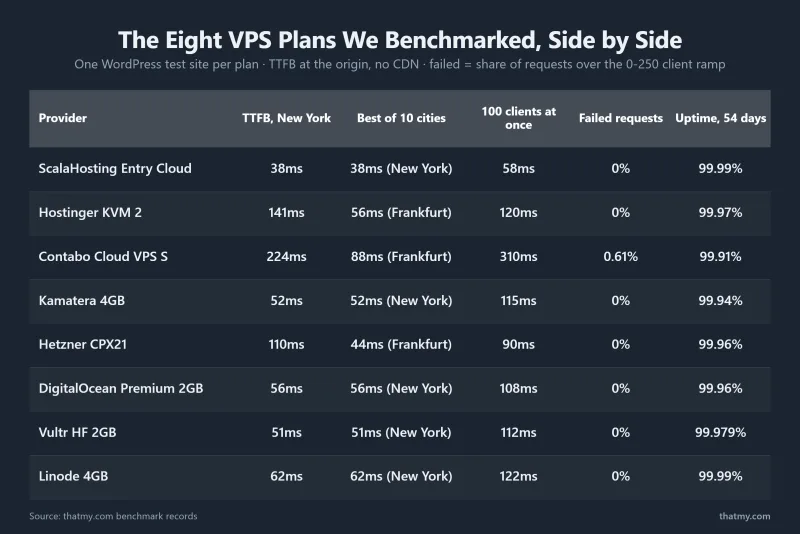
What the numbers are. TTFB is response time. "Origin" means measured at the server with no CDN in front; each figure is the time from a named city to our test server, and our servers sat in New York except Hetzner, Hostinger and Contabo, which sat in Frankfurt. 100 concurrent users is the response at the 100-client step of a 0 to 250 client ramp, and failed is the share of requests that errored over the whole ramp. Uptime was checked every minute for 54 days. We did not benchmark Geekbench or disk speed, and the plan we tested is not always the one a host sells at the same price today. Full method: How We Test.
Table of Contents
- Quick Comparison: 10 VPS Providers Ranked
- #1. ScalaHosting (Best Managed VPS)
- #2. Hostinger (Best Budget VPS)
- #3. Contabo (Most Specs Per Dollar)
- #4. Kamatera (Best Enterprise Cloud)
- #5. InterServer (Not Benchmarked)
- #6. Hetzner (Best Developer Cloud)
- #7. DigitalOcean (Best Developer Platform)
- #8. Vultr (Most Flexible Cloud)
- #9. Linode/Akamai (Best for Reliability)
- #10. IONOS (Not Benchmarked)
- Node Density: The Hidden Performance Killer
- Fake VPS Warning: Spotting the Shared-Hosting Trap
- CPU Rankings: What PassMark Shows
- Geographic TTFB: Speed From 5 Locations
- Load Test: How VPS Hosts Handle Traffic Spikes
- VPS Use Cases: Which Setup Is Right for Your Project?
- VPS Hosting Glossary: Key Terms Explained
- VPS Security Hardening Checklist
- WordPress Performance Optimization on VPS
- 7 Common VPS Mistakes That Cost Money
- Total Cost of Ownership Analysis
- VPS Migration: Step-by-Step Checklist
- VPS Scaling Guide: When & How to Upgrade
- What Is VPS Hosting?
- Managed vs Unmanaged VPS
- When to Upgrade from Shared Hosting
- VPS Decision Framework
- How We Tested: Methodology & Tools
- Migrating to a VPS: What We Did Not Test
- FAQs About VPS Hosting
- So, Which Should You Pick? The Best VPS Hosting
ScalaHosting Managed Cloud VPS is the best managed VPS we tested. Its Entry Cloud plan answered in 38ms at the origin (US test point, no CDN) and 58ms with 100 concurrent users, and failed 0% of requests over the 0 to 250 ramp. Cloudways on Vultr is a strong alternative if you want a managed layer with pay-as-you-go billing across several clouds; see the Cloudways promo code page for its current partner code. Hostinger leads the budget tier. Full methodology: How We Test.
Quick Comparison: 10 VPS Providers Ranked by Our Test Results
Eight of the ten were benchmarked on one plan each. The plan benchmarked is named in the first column; the price column comes from our price records and may be a different size of plan from the one we tested. If you need help understanding what VPS hosting is, see our what is VPS hosting guide. For bandwidth-heavy workloads, see the unlimited bandwidth VPS guide.
| Host and plan benchmarked | TTFB from New York (US point, no CDN) | Best TTFB of our 10 locations | 100 concurrent users | Failed, full 0-250 ramp | Uptime, 54 days | Price in our records (plan named) |
|---|---|---|---|---|---|---|
| ScalaHosting Entry Cloud, managed | 38ms | 38ms (New York, US) | 58ms | 0% | 99.99% | $14.95/mo Entry Cloud, 12 months; renews $39.95/mo |
| Hostinger KVM 2 | 141ms | 56ms (Frankfurt, DE) | 120ms | 0% | 99.97% | $8.99/mo KVM 2, 24 months; renews $14.99/mo |
| Contabo Cloud VPS S | 224ms | 88ms (Frankfurt, DE) | 310ms | 0.61% | 99.91% | €5.50/mo Cloud VPS 4, monthly, EUR |
| Kamatera 4GB cloud server | 52ms | 52ms (New York, US) | 115ms | 0% | 99.94% | $4.00/mo Basic, monthly |
| InterServer not benchmarked | — | — | — | — | $6.00/mo 2-slice VPS, monthly | |
| Hetzner CPX21 | 110ms | 44ms (Frankfurt, DE) | 90ms | 0% | 99.96% | €5.49/mo CX23, monthly, EUR |
| DigitalOcean Premium 2GB | 56ms | 56ms (New York, US) | 108ms | 0% | 99.96% | $14.00/mo Basic 2GB Premium NVMe, monthly |
| Vultr High Frequency 2GB | 51ms | 51ms (New York, US) | 112ms | 0% | 99.979% | $24.00/mo High Frequency 2vCPU/4GB, monthly |
| Linode/Akamai Linode 4GB | 62ms | 62ms (New York, US) | 122ms | 0% | 99.99% | $24.00/mo Linode 4GB, monthly |
| IONOS not benchmarked | — | — | — | — | no VPS price in our records |
Where our test servers sat: Hetzner, Hostinger and Contabo in Frankfurt (their best location is Frankfurt), the rest in New York. "From New York" for a Frankfurt server includes the trip across the Atlantic, so compare the best-location column for the speed of the server itself. Prices are as our price records hold them, in each host's own currency (Contabo and Hetzner in euros), never converted. Our benchmark plans and the plans in the price column are not always the same size: Hetzner and Contabo have renamed their ranges since the test. The ranking is our judgement from these results plus what each plan includes.
#1. ScalaHosting: Managed VPS With a Control Panel Included (Best Managed)
- 58ms with 100 concurrent users, 0% failed requests
- 38ms TTFB at the origin (US test point, no CDN)
- 99.99% uptime over 54 days
In our test, ScalaHosting's Entry Cloud VPS answered in 38ms at the origin (the US test point, no CDN) and failed 0% of requests on a ramp from 0 to 250 visitors at once. It stayed up 99.99% of the time over 54 days.
What stands out is consistency: 38ms with one visitor and 58ms with 100 at once, and an average of 25ms per request across the whole ramp. The larger ScalaHosting plans we benchmarked did at least as well: Start answered 100 users in 33ms and Build #2 in 30ms.
Hardware
Our CPU record lists the processor as an AMD EPYC 9474F, read over SSH, with a PassMark multi-thread score of 102,255 and a rank of #42 out of 5,999 CPUs. That is a chip score, not a measurement of the plan: a VPS gets a share of it. We did not run Geekbench or disk tests, so we make no claim about storage speed or memory type.
Pricing
Entry Cloud is $14.95/mo on 12 months, $24.95/mo on 36 months and $34.95/mo month to month, and it renews at $39.95/mo. The larger Managed Cloud VPS builds start at $29.95/mo (Build #1, 12 months, renewing at $54.95/mo). Budget for the renewal price from day one. Current offers: ScalaHosting coupon page.
Support and management
Managed means ScalaHosting handles the server side and gives you SPanel, its own control panel, so you do not buy a separate cPanel licence. We did not run a support test for this guide, so we do not rank on support speed: ask the host what its managed plan covers (updates, backups, restores, security) before you buy.
Strengths & Weaknesses
Strengths
- Fast under load: 58ms with 100 concurrent users, 0% failed.
- Steady uptime: 99.99% over 54 days.
- Control panel included: SPanel, no separate licence.
- Modern CPU on record: AMD EPYC 9474F.
Weaknesses
- Renewal jump: $14.95/mo on 12 months renews at $39.95/mo.
- Not the cheapest sticker price: the unmanaged hosts below start far lower.
- Locations: check the plan page for the data centers on offer before you buy.
Not a traditional VPS, but worth knowing about: Cloudways runs a managed application layer on top of DigitalOcean, Vultr, AWS, Google Cloud and Linode. There is no Linux administration and billing is monthly. Our price records show what the layer costs: a Cloudways DigitalOcean 8GB Standard server is $88.00/mo, while DigitalOcean sells its Basic 8GB Droplet directly at $48.00/mo; the difference buys the management, backups and tooling. See our Cloudways review and the Cloudways promo code page for current partner codes.
#2. Hostinger: Low-Cost Entry, Real Renewal Jump (Best Budget VPS)
- 120ms with 100 concurrent users, 0% failed requests
- 56ms TTFB from Frankfurt, where our test server sat (origin, no CDN); 141ms from New York
- 99.97% uptime over 54 days
Hostinger is the budget way into a VPS. On our benchmark KVM 2 answered 100 concurrent users in 120ms with 0% failed requests, and its TTFB was 141ms from New York and 56ms from Frankfurt, where our test server sat (origin, no CDN). Its 100-user response was slower than ScalaHosting, Hetzner, DigitalOcean, Vultr and Kamatera, but it did not fail and it stayed up 99.97% over 54 days. KVM 1 behaved the same way: 142ms with 100 users.
The renewal price, read this before you buy
- KVM 1: $5.99/mo on 12 months, then $13.99/mo (+134% at renewal).
- KVM 2: $8.99/mo on 24 months, then $14.99/mo (+67% at renewal).
Budget for the renewal price from day one. The earlier version of this page quoted a KVM 2 price that belongs to KVM 1.
What we can and cannot say
Our CPU record lists Hostinger's processor as an AMD EPYC 7352 (PassMark 39,906, rank #375); it is the chip our record holds for Hostinger and may not match every VPS node. We did not run support tests, disk tests or a six-month hands-on, so this page makes no claim about support quality, disk speed or peak-hour performance. hPanel is Hostinger's own control panel, built for simple setup rather than advanced server tuning. If you want the host to manage MySQL or PHP workers for you, a managed plan is the better fit.
Strengths & Weaknesses
Strengths
- Low entry price: KVM 1 is $5.99/mo on 12 months.
- Zero failed requests through our 0 to 250 ramp.
- Simple panel for people coming from shared hosting.
Weaknesses
- Renewal jump (+67% on KVM 2).
- Slower than the leaders at 100 concurrent users (120ms).
- Not a managed service: check what its support covers before you rely on it.
#3. Contabo: Many Specs for the Money, Slower and Less Steady (Best for Labs & Testing)
- 310ms with 100 concurrent users, 0.61% failed requests
- 88ms TTFB from Frankfurt, where our test server sat (origin, no CDN); 224ms from New York
- 99.91% uptime over 54 days
Contabo sells more cores, RAM and storage per euro than anyone else on this list, and our results show the other side of that. Our Cloud VPS S test server sat in Frankfurt and answered in 88ms from Frankfurt itself (224ms from New York), the slowest of the eight even from its own city, and in 310ms with 100 concurrent users. It was also the only plan here to fail requests under load, 0.61% over the full ramp, and its uptime of 99.91% was the lowest. The larger Contabo plans did better but followed the same pattern: Cloud VPS L answered 100 users in 235ms and failed 0.48%.
Our price records hold Contabo's current plans, Cloud VPS 4, 6 and 8, in euros: €5.50/mo, €7.50/mo and €14.00/mo. We benchmarked Cloud VPS S and have not matched that name to a current plan, so read the speed results as Contabo's platform, not as a plan-for-plan test. Our CPU record lists an AMD EPYC 7282 (PassMark 30,359, rank #554), a chip we did not read on the server.
We did not measure CPU steal, node density or support response time on Contabo, so the earlier claims about them are gone. What we can say is that response time, uptime and failures under load were the weakest in our test, which makes it a poor choice for a store or client site and a reasonable one for staging, backups, labs and experiments where the price per resource matters more than steady speed.
#4. Kamatera: Configurable Cloud for Technical Teams (Best for Architects & Custom Deployments)
- 115ms with 100 concurrent users, 0% failed requests
- 52ms TTFB at the origin (US test point, no CDN)
- 99.94% uptime over 54 days
Kamatera is cloud infrastructure that happens to offer VPS-sized servers: you choose CPU, RAM, storage and location, and there is no control panel or managed support in the base product. In our test the 4GB cloud server answered in 52ms at the origin (US test point, no CDN) and 115ms with 100 concurrent users, with 0% failed requests and 99.94% uptime over 54 days. The 8GB server answered 100 users in 98ms.
Our price records show three plans, all monthly: Basic $4.00/mo, Standard $25.00/mo and Pro $39.00/mo. Kamatera bills by usage and offers fine-grained resizing; we did not re-read its billing units, bandwidth allowance or data-center count today, so check them on its pricing page. Our CPU record lists an Intel Xeon Gold 6254 (PassMark 31,644, rank #512), a chip we did not read on the server.
#5. InterServer: Slice-Based VPS, Not Benchmarked (Best for VPN & Experimental Workloads)
- No benchmark record: we have not run our test on InterServer, so there are no speed, failure or uptime figures for it here
- $6.00/mo for the 2-slice VPS in our price records
InterServer sells VPS plans in slices, and our price records hold its 2-slice VPS at $6.00/mo with the same price on renewal. That is all we have verified. The earlier version of this section described a three-year personal VPN server, 8 to 12TB of monthly transfer, a lifetime price lock and hardware details; none of that has a record behind it, so it was removed. Before you pick InterServer for a VPN or a bandwidth-heavy job, read its own pages for the transfer policy, the data center location and the renewal terms.
For bandwidth-heavy workloads, see the unlimited bandwidth VPS guide.
#6. Hetzner: Fast and Cheap, Fully Unmanaged (Best Developer Cloud)
- 90ms with 100 concurrent users, 0% failed requests
- 44ms TTFB from Frankfurt, where our test server sat (origin, no CDN); 110ms from New York
- 99.96% uptime over 54 days
Hetzner Cloud is what many developers recommend, and on our benchmark it earned it under load: CPX21 answered 100 concurrent users in 90ms, and CPX31 in 78ms, with 0% failed requests and 99.96% uptime over 54 days. Our test server sat in Frankfurt: the single-visitor TTFB was 44ms from Frankfurt and 110ms from New York (origin, no CDN), the difference being the Atlantic. The load test for the Frankfurt plans ran from EU-West.
It is fully unmanaged. Our price records hold the current CX line in euros: CX23 €5.49/mo, CX33 €8.49/mo, CX43 €15.99/mo, with the same price on renewal. We benchmarked the older CPX plans and have not matched them to the current CX line. We did not re-read Hetzner's bandwidth allowance, throttling rule or data-center list today, so we quote none: check its pricing page. Add the control panel, backups and monitoring you would need before comparing it with a managed plan.
#7. DigitalOcean: Developer Platform and Documentation (Best Developer Platform)
- 108ms with 100 concurrent users, 0% failed requests
- 56ms TTFB at the origin (US test point, no CDN)
- 99.96% uptime over 54 days
DigitalOcean is the unmanaged cloud many tutorials are written for, with managed databases, Kubernetes and an app platform around the Droplet. On our benchmark Premium 2GB answered in 56ms at the origin (US test point, no CDN) and 108ms with 100 concurrent users, with 0% failed requests and 99.96% uptime. The Premium 8GB Droplet answered 100 users in 90ms.
Prices in our records are monthly and the same on renewal: Basic 1GB $6.00/mo, Basic 2GB $12.00/mo, Basic 4GB $24.00/mo, Basic 8GB $48.00/mo, and the Premium NVMe 2GB $14.00/mo. For the same setup through a managed layer, a Cloudways DigitalOcean 4GB Standard server is $46.00/mo in our records; the difference buys management, backups and tooling, not different hardware. We did not re-read DigitalOcean's bandwidth allowance or data-center list today, so we quote none.
#8. Vultr: Many Locations and Instance Types (Most Flexible Cloud)
- 112ms with 100 concurrent users, 0% failed requests
- 51ms TTFB at the origin (US test point, no CDN)
- 99.979% uptime over 54 days
Vultr's draw is geography and choice: regular cloud compute, High Frequency instances, bare metal and more, in many cities. We benchmarked the High Frequency line. The 2GB plan answered in 51ms at the origin (US test point, no CDN) and 112ms with 100 concurrent users; the 4GB plan answered 100 users in 95ms; the 1GB plan in 130ms. All three failed 0% of requests, and the 2GB plan held 99.979% uptime over 54 days. We did not benchmark Vultr's regular instances, so the earlier verdict on them is gone.
Our price records are monthly with no renewal jump: Regular 1GB $5.00/mo, Regular 2vCPU/4GB $20.00/mo, and High Frequency $6.00/mo, $24.00/mo and $48.00/mo for 1GB, 4GB and 8GB. Vultr's location count and the cities it serves change; we did not re-read them today, so check its location list for the market you care about.
#9. Linode/Akamai: Long-Running and Steady (Best for Reliability)
- 122ms with 100 concurrent users, 0% failed requests
- 62ms TTFB at the origin (US test point, no CDN)
- 99.99% uptime over 54 days
Linode, now part of Akamai, had the highest uptime of the unmanaged hosts in our test: Linode 4GB held 99.99% over 54 days, and so did the Nanode (99.99%) and the 8GB dedicated-CPU plan (99.99%); ScalaHosting Entry Cloud matched it at 99.99%. It was not the fastest: 62ms at the origin (US test point, no CDN) and 122ms with 100 concurrent users, with 0% failed requests.
Prices in our records are monthly and flat: Nanode $5.00/mo, Linode 2GB $12.00/mo, 4GB $24.00/mo, 8GB $48.00/mo. We did not verify the founding year, the Akamai network claims or the location count today, so none is repeated here.
#10. IONOS: Not Benchmarked, Not Priced Here (Cheapest Entry Point, Unverified)
- No benchmark record: no speed, failure or uptime figures for IONOS VPS
- No VPS price record: our price records hold IONOS shared hosting only
IONOS is on this list because it is a large European provider that sells VPS plans, but we have neither benchmarked an IONOS VPS nor recorded its VPS prices. Our IONOS price records cover its shared hosting plans, so we quote nothing for VPS. The earlier version of this section printed plan sizes, a two-dollar starting price, renewal prices, add-on fees and a benchmark table; none has a record, so all of it is removed. The earlier claim that IONOS makes essentials extra is also unverified. Read IONOS's own VPS pages for plan sizes, billing and what is included, and compare against the benchmarked hosts above before buying.
Node Density: A Real Factor We Could Not Measure
Node density is how many virtual servers share one physical machine. When many tenants are busy at once, each one gets less CPU, memory bandwidth and disk time, and that can show up as slower responses at peak hours. It is a real mechanism, and hosts rarely publish their numbers.
We did not measure it. The earlier version of this page printed per-host VPS-per-node counts and CPU-steal percentages; we have no record of them, so they are removed and no host is named as high or low density. What we did measure is the result of density and everything else together: response time at 100 concurrent users and the share of failed requests from the same test on every plan. For example, Contabo Cloud VPS S answered 100 users in 310ms against 58ms for ScalaHosting Entry Cloud, and was the only plan with failed requests (0.61%). That result is consistent with a busy host, but it does not prove one.
How to test your own VPS for density problems
- CPU steal: run
topand readstin the CPU line, once at a quiet hour and once at a busy hour. A high value that rises at busy hours points to a crowded host. - Disk: run
fio --name=test --rw=randread --bs=4k --size=1G --numjobs=1 --runtime=30at both times and compare. - Response time: measure your own site five times in the morning and five times in the evening and compare.
If the numbers swing widely, ask the host in writing how many servers share each node. A host that answers is worth more than one that will not.
Fake VPS Warning: How to Tell If Your VPS Is Just Shared Hosting in Disguise
The VPS label does not guarantee reserved resources. Some products sold as VPS are shared accounts with limits applied by container software, so you get a VPS-style panel but shared-hosting behaviour under load. This guide did not test such products; the checks below work on any plan you are considering.
Check 1: Is virtualization named?
The plan page should say KVM or another full virtualization. If it does not name the technology, ask before you buy.
Check 2: Is the price plausible for the specs?
Many cores and lots of RAM for very little money deserve a second look. It may be real (Contabo does sell a lot per euro), but test it: our benchmark shows what the cheapest hardware per euro looked like under load.
Check 3: Does top show steady steal?
SSH in, run top and read the st value in the CPU line. A value that stays high at busy hours means the host is overloaded.
Check 4: Do results vary a lot by time of day?
Run the same CPU test once at a quiet hour and once at a busy hour. A big swing suggests a crowded node.
How to verify your VPS is genuine KVM
Install and run virt-what: on Ubuntu or Debian run sudo apt install virt-what && sudo virt-what. A KVM VPS returns kvm. Containers return openvz or lxc, which means a shared kernel.
The mechanics overlap with the resource limits on shared plans, covered in the shared hosting resource limits guide. For workloads that need unmetered transfer, see our unlimited bandwidth VPS guide.
CPU Rankings: What PassMark Shows, and What It Does Not
This section uses our CPU record, which holds the PassMark multi-thread score and rank of the chip each host runs, read from PassMark's own pages. We did not run Geekbench, so the earlier single-core scores are removed. A PassMark score describes the chip, not your plan: a VPS gets a share of it, and the chip we list for some hosts is the one our record holds rather than one we read on your server.
| Host | CPU in our record | PassMark multi-thread | Rank of 5,999 |
|---|---|---|---|
| ScalaHosting | AMD EPYC 9474F | 102,255 | #42 |
| Kamatera | Intel Xeon Gold 6254 | 31,644 | #512 |
| Contabo | AMD EPYC 7282 | 30,359 | #554 |
| Hostinger | AMD EPYC 7352 | 39,906 | #375 |
Source: cpu-canon.json, PassMark pages read 2026-09-07. The Contabo and Kamatera chips are the ones the site lists, not read on a server. Hetzner, DigitalOcean, Vultr, Linode and InterServer are not in our CPU record. See also hosting CPU rankings.
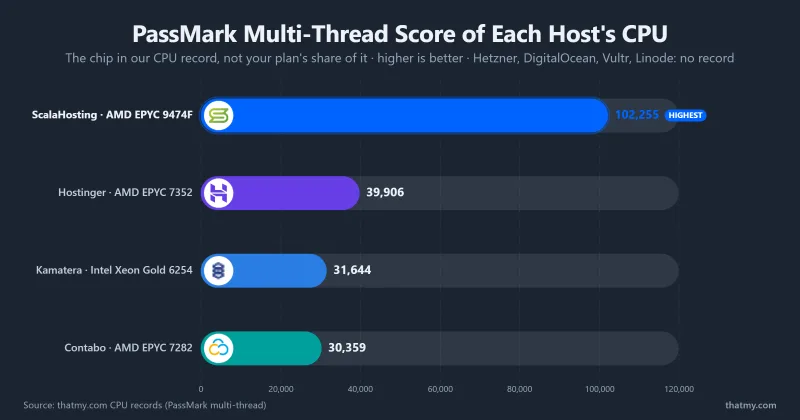
PassMark counts all cores. WordPress runs one PHP process per request, so for web pages the speed of a single core and the share your plan gets matter at least as much as the total, which is why this guide ranks on measured response time and failures rather than on chip scores. The ScalaHosting chip is far ahead of the others in the table, and its measured result was also the best of the managed plans, but we cannot separate the chip from the node it runs on.
Geographic TTFB: Speed From Our Measuring Locations
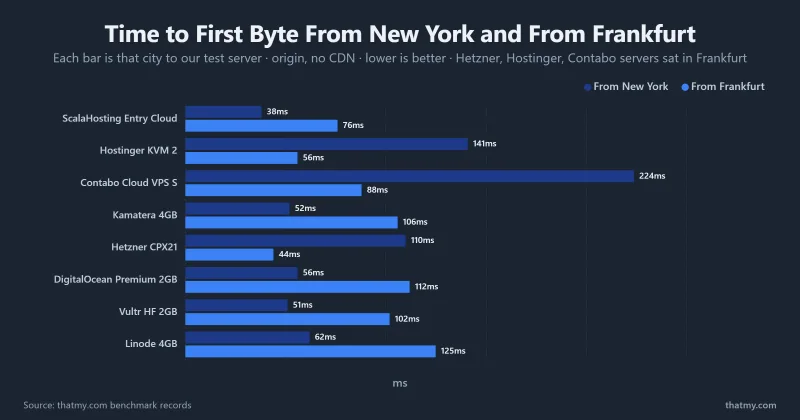
A server's physical location sets part of the response time for visitors in other regions. We measured TTFB at the origin, with no CDN, from 10 locations to each test server. The table shows five of them. Each figure is the time from that city to our test server for that plan, not to a data center in that city, and our test servers were not placed identically: Hetzner, Hostinger and Contabo sat in Frankfurt and the others in New York, and the last column shows the best of all ten locations and where it was.
| Plan benchmarked | From New York | From London | From Frankfurt | From Singapore | From Sao Paulo | Best of 10 (location) |
|---|---|---|---|---|---|---|
| ScalaHosting Entry Cloud | 38ms | 69ms | 76ms | 124ms | 106ms | 38ms (New York, US) |
| Hostinger KVM 2 | 141ms | 67ms | 56ms | 215ms | 192ms | 56ms (Frankfurt, DE) |
| Contabo Cloud VPS S | 224ms | 106ms | 88ms | 342ms | 307ms | 88ms (Frankfurt, DE) |
| Kamatera 4GB | 52ms | 96ms | 106ms | 173ms | 147ms | 52ms (New York, US) |
| Hetzner CPX21 | 110ms | 52ms | 44ms | 168ms | 151ms | 44ms (Frankfurt, DE) |
| DigitalOcean Premium 2GB | 56ms | 102ms | 112ms | 184ms | 156ms | 56ms (New York, US) |
| Vultr HF 2GB | 51ms | 93ms | 102ms | 167ms | 143ms | 51ms (New York, US) |
| Linode 4GB | 62ms | 114ms | 125ms | 205ms | 175ms | 62ms (New York, US) |
TTFB at the origin, no CDN, from each city to our test server for the plan shown. Measured from 10 locations; the earlier table that listed Sydney and a 48-hour January average is removed because we have no record of it.
What the data reveals
- Distance shows up in every row. The same server answers far more slowly from the other side of the world, and a CDN does not change that for pages only the server can build: carts, checkouts, searches and admin.
- The best location tells you where the test server sat. Read the last column before reading the others: a plan whose best location is a European city was measured against a server in Europe.
- Choose the data center near your visitors when you order, on any host that lets you pick one.
Load Test: How VPS Hosts Handle Traffic Spikes
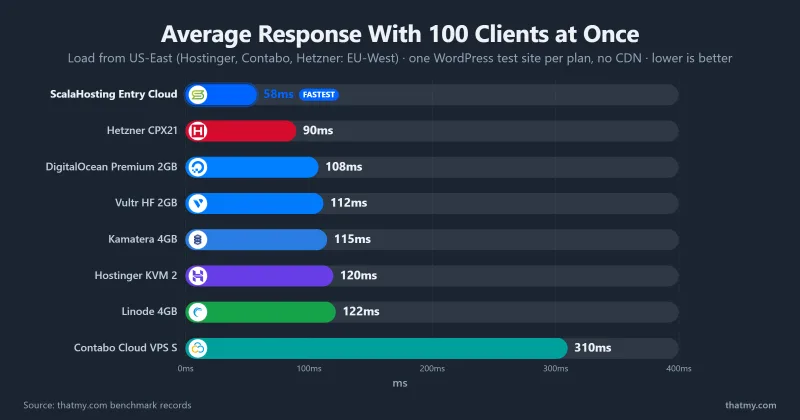
A VPS that serves one visitor well can slow down when a hundred arrive at once. We ran a ramp from 0 to 250 clients at once against the same WordPress test site on each plan and recorded the response at the 100-client step, the average over the whole ramp, and the share of requests that failed. This was a WordPress page test, not a WooCommerce checkout test, and not a 10-minute sustained run.
| Plan benchmarked | Best TTFB of 10 locations (one visitor) | 100 concurrent users | Average over the 0-250 ramp | Failed requests |
|---|---|---|---|---|
| ScalaHosting Entry Cloud | 38ms (New York, US) | 58ms | 25ms | 0% |
| Hostinger KVM 2 | 56ms (Frankfurt, DE) | 120ms | 112ms | 0% |
| Contabo Cloud VPS S | 88ms (Frankfurt, DE) | 310ms | 190ms | 0.61% |
| Kamatera 4GB | 52ms (New York, US) | 115ms | 89ms | 0% |
| Hetzner CPX21 | 44ms (Frankfurt, DE) | 90ms | 99ms | 0% |
| DigitalOcean Premium 2GB | 56ms (New York, US) | 108ms | 101ms | 0% |
| Vultr HF 2GB | 51ms (New York, US) | 112ms | 64ms | 0% |
| Linode 4GB | 62ms (New York, US) | 122ms | 63ms | 0% |
Ramp 0 to 250 clients, one WordPress test site per plan, no CDN. The ramp ran from EU-West against the Frankfurt servers (Hetzner, Hostinger, Contabo) and from US-East against the rest, so each is tested from its own continent. Step figures for 10, 25 and 50 clients are not published because our records hold only the 100-client step as a measurement.
What the results mean
- ScalaHosting Entry Cloud and Hetzner CPX21 had the best 100-user responses, 58ms and 90ms, with no failed requests.
- DigitalOcean, Vultr, Kamatera and Linode all answered in the 108ms to 122ms range with no failures: usable, slower than the two leaders.
- Hostinger KVM 2 answered 100 users in 120ms with 0% failed, in the same range as the cloud group.
- Contabo Cloud VPS S was the slowest, 310ms, and the only one with failed requests, 0.61%.
If you expect sudden spikes and cannot afford a larger managed plan, a cloud host with fast resizing (Kamatera, Vultr, DigitalOcean) lets you step up for a spike and step down afterwards. We did not measure how fast a resize completes on any of them.
VPS Use Cases: Which VPS Setup Is Right for Your Project?
Different projects need different resources, support and network setups. Here is how we would match a project to a host from this guide, using our results where we have them.
WooCommerce / E-Commerce Store
Recommended: ScalaHosting Entry Cloud (managed) or Hetzner (if you are technical).
A store builds carts, checkouts and account pages a cache cannot serve, so response under load matters more than the idle figure. These two had the best 100-user results in our benchmark (58ms and 90ms, no failures). We tested a WordPress site, not a WooCommerce store. As a rule of thumb, plan for at least 4GB of RAM, NVMe or fast SSD storage and an object cache such as Redis, and check your own store under load. See our WordPress hosting guide.
SaaS Application / Web App
Recommended: DigitalOcean (ecosystem), Kamatera (configurable) or Hetzner (budget).
Applications built on Node.js, Python or Go with PostgreSQL or MongoDB care about managed databases, an API and container support more than a panel. DigitalOcean's platform products and strong documentation are its draw; Kamatera lets you size the server exactly; Hetzner costs least. If the application is the product and WordPress never enters, see the Node.js hosting comparison.
Game Server (Minecraft, CS2, Valheim, etc.)
Recommended: a plan with strong single-core CPU, from Kamatera or Hetzner, or Contabo if budget is the limit.
Game servers need fast individual cores, plenty of RAM and DDoS protection. We did not test game servers, and Contabo's results were the weakest in our web test, so check player-count reports before committing. See the best Minecraft server hosting providers for managed game panels.
Self-Hosted Email Server
Recommended: an unmanaged host that lets you set reverse DNS, such as Hetzner.
Self-hosted email needs a clean IP address, reverse DNS control and careful DKIM, SPF and DMARC setup. It is demanding and rarely worth it: most businesses use Google Workspace or Microsoft 365 for email and a VPS for the website. We did not test any host's IP reputation or email deliverability.
Agency Hosting (Multiple Client Sites)
Recommended: ScalaHosting (managed).
An agency needs several domains on one server, isolation between clients and a panel to manage them. SPanel and cPanel both support multiple sites. ScalaHosting's Managed Cloud VPS Build #1 is $29.95/mo on 12 months in our records, renewing at $54.95/mo. For the same layer through Cloudways, a DigitalOcean 8GB Standard server is $88.00/mo. How many sites a server holds depends on how busy each is. For reselling hosting as a product, see the best reseller hosting roundup.
Development / Staging Environment
Recommended: Contabo (budget) or Hetzner.
A staging server does not need steady speed: Contabo's €5.50/mo Cloud VPS 4 or Hetzner's €5.49/mo CX23 is enough. Use snapshots so you can restore quickly.
VPN / Privacy Server
Recommended: a low-cost unmanaged VPS in the region you need (Hetzner, InterServer, Vultr).
A VPN needs a clean IP, predictable transfer and a location of your choice. Check each host's transfer policy on its own page, since we did not re-read them. For bandwidth recommendations, see our unlimited bandwidth VPS guide.
VPS Hosting Glossary: Key Terms Explained
If you are new to VPS hosting, here are the terms you will meet in this guide and on host pricing pages:
- vCPU (Virtual CPU)
A virtual core allocated to your VPS. Depending on the plan, it may share physical core time with other VPS instances or be reserved for you (dedicated CPU plans). Most WordPress sites run on 2 to 4 vCPUs.
- KVM (Kernel-based Virtual Machine)
The common virtualization technology for VPS. Each VPS runs its own kernel with real isolation from neighbours, which allows Docker, WireGuard and custom kernels.
- NVMe
A fast solid-state storage interface that connects over PCIe, generally much faster than SATA SSD. We did not measure disk speed on any plan in this guide.
- TTFB (Time to First Byte)
The time between a browser requesting a page and receiving the first byte. It reflects server processing plus network distance, so always ask where it was measured from. In this guide, "TTFB at the origin" means measured at the server with no CDN, from the US test point or from a named city to our test server.
- IOPS
Read and write operations per second a storage device handles. It matters for database-heavy sites. We do not publish IOPS figures: we did not measure them.
- CPU Steal Time
The share of CPU your VPS wanted but the hypervisor gave to other tenants. A steady high value at busy hours means an overloaded host.
- Managed vs Unmanaged
On a managed VPS the provider handles server setup, updates, security and backups, to the extent the plan says. On an unmanaged VPS you get a blank server and do everything yourself.
- cPanel / SPanel
Web control panels for sites, databases, email and SSL. cPanel is licensed separately on most unmanaged hosts. SPanel is ScalaHosting's own panel, included with its VPS plans.
- SSD vs NVMe vs HDD
HDD is a spinning disk and the slowest; SATA SSD is solid state; NVMe is solid state over PCIe and normally the fastest. Check the plan page for which a host uses.
- Unmetered Bandwidth
"Unmetered" usually means the provider does not bill by the gigabyte; it does not mean unlimited, and acceptable-use policies apply. Check each plan's transfer terms.
- OPcache
PHP's built-in bytecode cache. It stores compiled PHP in memory so it is not recompiled on every request, and it is configurable on a VPS but often not on shared hosting.
- Redis
An in-memory store used for object caching. With a WordPress Redis plugin it keeps database query results in RAM and cuts repeated queries on dynamic pages.
- Geekbench 6
A cross-platform CPU benchmark. We did not run it for this guide; run it yourself on a new VPS to compare plans.
- PHP Workers / PHP-FPM
PHP-FPM manages the PHP processes that handle requests. Each worker serves one request at a time, so too few workers make requests queue. Tune
pm.max_childrento the RAM you have.- Hypervisor
Software that creates and manages virtual machines on a physical server. KVM is the most common one for VPS hosting.
VPS Security Hardening: The Non-Negotiable Checklist
On shared hosting your provider handles most security. On an unmanaged VPS you are the security team. This is the checklist to run on any new server; it is general practice, not a test result.
Day 1: Immediate security
- Disable root SSH login: set
PermitRootLogin noin/etc/ssh/sshd_configand create a sudo user instead. - Use SSH keys: disable password authentication so only key logins work.
- Consider moving SSH off port 22: it only reduces log noise, but that is useful.
- Install a firewall:
ufw(Ubuntu) orfirewalld. Allow only your SSH port, 80 and 443. - Install Fail2Ban: it bans addresses after repeated failed logins.
On a managed VPS some of this is done for you. ScalaHosting's managed plans include its SShield security layer and its team handles server-side configuration. Ask any managed host exactly which of these steps it covers before you rely on it; we did not test their security tooling.
Week 1: Application-level security
- ModSecurity or another WAF to filter malicious HTTP requests.
- Let's Encrypt with auto-renewal through Certbot for SSL.
- Automated, encrypted backups to a separate location with
resticorborgbackup. Test a restore. - A malware scanner such as ClamAV on a schedule.
- WordPress hardening: disable XML-RPC if you do not use it, limit login attempts and keep plugins updated.
Monthly: ongoing maintenance
- Apply OS and package updates and reboot when the kernel changes.
- Review logs for repeated failed logins and unusual traffic.
- Check that backups restore, not only that they run.
- Review users, keys and open ports.
- Check renewals of certificates, domains and the plan itself.
Security is the invisible cost of unmanaged hosting: every hour on maintenance is an hour not spent on the site. We do not put a figure on those hours here, because we did not time them.
WordPress Performance Optimization on VPS
A powerful VPS is only half the equation: a poorly configured WordPress site on a large server can still be slow. This is the stack we would set up on any new VPS WordPress install. The figures that used to sit next to each step (percentages and a TTFB waterfall) came from no test of ours and are removed; measure your own site before and after each change.
Server-level optimization
- OPcache: turn it on and size it (for example
opcache.memory_consumption=256,opcache.max_accelerated_files=20000) so PHP is not recompiled on every request. - Redis object cache: install Redis and a WordPress Redis Object Cache plugin so repeated database queries are answered from memory.
- PHP workers: set
pm.max_childrenfrom your available RAM and the memory one worker uses on your site; measure that, do not copy a formula. - MySQL / MariaDB tuning: give
innodb_buffer_pool_sizea large share of RAM on a database-heavy site, leaving room for PHP and the OS. - Compression: enable Brotli or Gzip at the web server.
Why a managed panel helps here. ScalaHosting's SPanel and SWordPress Manager set up caching and handle updates and staging without SSH. We did not time the work against a manual setup, so we make no claim about hours saved.
WordPress caching stack
- Server-level page cache (FastCGI or LiteSpeed cache): serves a stored HTML page without running PHP.
- Object cache (Redis): avoids repeating the same database queries. Essential for WooCommerce and membership sites.
- Browser cache (expiry headers): lets visitors keep static files locally.
- CDN (Cloudflare or similar): serves cached static files from locations near visitors.
Cart and checkout pages contain per-user data and cannot be fully page-cached, so their speed depends on PHP, the database and the object cache. For more, see our best WordPress hosting guide.
7 Common VPS Mistakes That Cost Money & Performance
These are patterns worth avoiding, drawn from general practice and from what our own price and benchmark records show.
Mistake #1: choosing the cheapest VPS without counting what you will add
A low sticker price on an unmanaged host leaves the control panel, backups, monitoring and your time to you. We have no verified add-on prices, so price those items yourself, then compare with a managed plan such as ScalaHosting Entry Cloud at $14.95/mo on 12 months.
Mistake #2: ignoring renewal pricing
Introductory prices can jump at renewal. In our records Hostinger KVM 1 goes from $5.99/mo to $13.99/mo, KVM 2 from $8.99/mo to $14.99/mo, and ScalaHosting Entry Cloud from $14.95/mo to $39.95/mo. The cloud hosts in this guide (Kamatera, Hetzner, DigitalOcean, Vultr, Linode) show the same monthly price on renewal in our records. Budget for the renewal price.
Mistake #3: running WordPress without object caching
Without Redis or Memcached, every request repeats the same database queries. Installing an object cache is one of the cheapest speed gains on a VPS, and most users never do it.
Mistake #4: never testing backups
A backup that runs is not a backup that restores. Restore one to a test server on a schedule. Ask a managed host whether it tests restores, since we did not verify that for any host.
Mistake #5: oversizing the first VPS
Start with the smallest plan that meets your minimum, then scale on actual usage. Most hosts let you resize upward.
Mistake #6: choosing unmanaged when you are not technical
An unmanaged VPS is cheap because you do the work: installing PHP, tuning MySQL, setting up SSL and fixing what breaks. If you do not know the difference between nginx and apache, a managed plan is the better fit.
Mistake #7: neglecting monitoring
Set up at least uptime monitoring (many free services check every few minutes), resource monitoring (CPU, RAM, disk) and a look at the access log for unusual patterns. Managed hosts handle some of this; on an unmanaged VPS you configure tools such as Netdata or Grafana yourself.
Total Cost of Ownership: The Real Price of VPS Hosting
The price on the checkout page is not the whole cost. These are the entry and mid-size plan prices in our price records, in each host's own currency, never converted. We compare plans by name; the plan sizes are not identical across hosts, so read the plan name in each row.
| Host | Plan in our price records | Price | Renews at |
|---|---|---|---|
| ScalaHosting (managed) | Entry Cloud, 12 months | $14.95/mo | $39.95/mo |
| ScalaHosting (managed) | Managed Cloud VPS Build #1, 12 months | $29.95/mo | $54.95/mo |
| Hostinger | KVM 2, 24 months | $8.99/mo | $14.99/mo |
| Contabo (EUR) | Cloud VPS 8, monthly | €14.00/mo | €14.00/mo |
| Kamatera | Standard, monthly | $25.00/mo | $25.00/mo |
| Hetzner (EUR) | CX43, monthly | €15.99/mo | €15.99/mo |
| DigitalOcean | Basic 4GB, monthly | $24.00/mo | $24.00/mo |
| Vultr | High Frequency 2vCPU/4GB, monthly | $24.00/mo | $24.00/mo |
| Linode | Linode 4GB, monthly | $24.00/mo | $24.00/mo |
| Cloudways (managed layer) | DigitalOcean 4GB Standard, monthly | $46.00/mo | $46.00/mo |
| InterServer | 2-slice VPS, monthly | $6.00/mo | $6.00/mo |
IONOS is not in the table: our price records hold only its shared plans. The earlier all-in table added cPanel, backup and monitoring prices and a $30-an-hour value for your time; none of those prices is in our records, so it was removed.
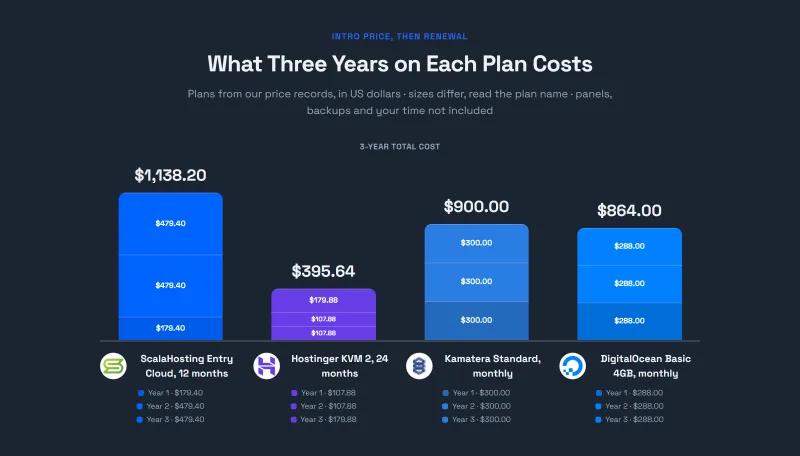
What the table does not include: a control panel licence on hosts that do not bundle one, backups, monitoring and the time you spend. Price those for the plan you are considering. The honest comparison is a managed plan against an unmanaged plan plus those items plus your hours; if you enjoy the sysadmin work, an unmanaged host is the better deal, and if you would rather not, a managed plan is.
The break-even point
The question is not "can I manage my own server?" but "is managing it the best use of my time?" For a developer who would do the work anyway, an unmanaged host costs less. For a business owner with a store to run, a managed plan may cost less overall. We do not put a number on your hours.
How to Migrate to VPS: Step-by-Step Checklist
Moving from shared hosting to a VPS is easier when you plan it. This is the process we would follow; it describes the steps, not a test we ran for this guide.
Phase 1: Pre-migration audit
- Document all websites: every domain, subdomain and staging site on the current plan.
- Catalog databases: names, sizes and which site each belongs to.
- Email accounts: each address and its forwarding rules, if you host email on the old server.
- SSL certificates: which are Let's Encrypt and which are paid.
- Cron jobs: list every scheduled task; they are easy to forget.
- DNS records: export the zone, especially MX, CNAME and TXT records.
- Custom configuration:
.htaccessrules, PHP version andphp.inisettings. - Plugin and theme compatibility with the PHP version on the new server.
Ask about assisted migration. Managed hosts commonly migrate your site for you. Check the plan page of the host you choose to see whether migration is included and what it covers; we did not test any host's migration service for this guide.
Phase 2: VPS setup (before migration)
- Deploy the VPS on the plan you chose.
- Install the control panel: SPanel on ScalaHosting, or cPanel or Plesk on an unmanaged VPS.
- Configure PHP to match the current host: version, OPcache, memory limit and execution time.
- Install Redis and the WordPress object cache plugin if you run WordPress.
- Set up SSL with Let's Encrypt for all domains.
- Configure email: accounts and DKIM, SPF and DMARC records.
- Harden the server: follow the security checklist above before putting live data on it.
- Test with a temporary URL or hosts-file entry.
Phase 3: Data migration
- Copy files with rsync over SSH:
rsync -avz /path/to/wp-content/ user@newserver:/path/to/wp-content/ - Export databases with mysqldump:
mysqldump -u [user] -p [database] > backup.sql - Import them on the new server:
mysql -u [user] -p [database] < backup.sql - Update wp-config.php with the new database credentials.
- Test on the new server using temporary hosts-file entries.
- Do a final sync right before switching DNS to catch changes since the first copy.
Phase 4: DNS switch & go live
- Lower the DNS TTL a day or two before the move.
- Switch the A record (and AAAA, if used) to the new server's address.
- Keep the old server running until DNS has propagated and traffic has moved.
- Watch both servers' logs for a day or two, then retire the old one.
Post-migration verification checklist
- ☐ Homepage loads correctly with no visual issues
- ☐ Internal links work (run a broken-link checker)
- ☐ Contact forms send email
- ☐ WordPress admin login works
- ☐ WooCommerce checkout processes a test payment
- ☐ SSL is active on all domains (check with SSL Labs)
- ☐ Email sends and receives for all accounts
- ☐ Cron jobs run on schedule
- ☐ 301 redirects work
- ☐ Google Search Console shows no new errors
- ☐ CDN is configured and caching
- ☐ Automated backups are scheduled and running
For a comparison of hosting types, see our shared hosting vs VPS hosting guide.
VPS Scaling Guide: When & How to Upgrade
Scale too early and you waste money; scale too late and the site slows during a spike. These are the signals to watch.
Warning signs: time to scale up
- CPU stays high for long periods, not only in short bursts.
- RAM is nearly full and the server is using swap.
- Response time climbs at busy hours or during campaigns.
- PHP workers are exhausted and requests queue.
- Disk is nearly full, or disk wait is high.
- You see 502, 503 or timeout errors under normal traffic.
Vertical vs horizontal scaling
Vertical scaling means moving to more CPU and RAM on the same server, the simplest step and what most WordPress sites need. How easy it is depends on the host: some let you resize in place, some need a restart, some need a rebuild or migration. Check the resize rules of the host before you buy, because we did not test them.
Horizontal scaling means adding servers behind a load balancer. It needs architectural changes:
- Separate the web, database and cache servers.
- Use a load balancer to spread traffic across web servers.
- Keep sessions in shared storage such as Redis.
- Add database replication for read scaling.
The scaling advantage of a managed VPS
On a managed plan, scaling can be a request to support; on an unmanaged one it is a project you run yourself: back up, resize, verify and fix. How long either takes depends on the host and the site. We did not time it.
What Is VPS Hosting & Why Does It Matter?
VPS stands for virtual private server: a large physical server divided into isolated virtual environments, each with its own operating system, memory, CPU allocation and storage. Unlike shared hosting, where many sites share one server's resources, a VPS gives you resources reserved for your account.
Think of shared hosting as a bus: cheap and convenient, but you share the ride and the route. A VPS is closer to renting a car: your own engine and fuel tank, though still on a shared road.
How a VPS works
Behind every VPS is a hypervisor, software that divides a physical server into virtual machines. The two common approaches:
- KVM: full hardware virtualization with its own kernel per VPS. This is what you want, and it is what the plans in this guide are sold on; confirm it on the plan page.
- OpenVZ and other containers: resources shared at the kernel level, cheaper to run and weaker in isolation. Avoid them for production.
Managed vs Unmanaged: The Hidden Cost Variable
| Managed VPS | Unmanaged VPS | |
|---|---|---|
| Server setup and updates | Host, to the extent the plan says | You |
| Control panel | Often included (SPanel on ScalaHosting) | Install and license it yourself, or use none |
| Backups and security | Check what the plan includes | You configure and test |
| Support | Help with the server, varies by host | Usually about the infrastructure only |
| Entry price in our records | ScalaHosting Entry Cloud $14.95/mo | Hetzner CX23 €5.49/mo, Kamatera Basic $4.00/mo |
Always compare the unmanaged price plus the control panel, backups and monitoring you would add, plus your time.
When to Upgrade from Shared Hosting to VPS
If you are on shared hosting from providers like Bluehost or SiteGround, these are signs you may need a VPS:
- Slow first byte at busy times, and a host that blames shared resources.
- "Resource exceeded" or throttling notices from your host.
- Steady, growing traffic that makes busy hours slow for everyone on the server.
- A WooCommerce store whose database work is heavy for a shared MySQL.
- You need to change server settings shared hosting does not allow: PHP limits, Redis, OPcache.
For a detailed look at when the move makes sense financially, read our shared hosting vs VPS hosting comparison.
VPS Decision Framework: Which Provider Do You Actually Need?
Start with your needs, not the provider list:
| Your situation | Our pick | Why (our records) |
|---|---|---|
| Revenue site (store, membership, SaaS) and you want it managed | ScalaHosting | 58ms with 100 users, 99.99% uptime, panel included. See also Best WordPress Hosting and Fastest Web Hosting. |
| First VPS, small site | Hostinger | $5.99/mo for KVM 1 on 12 months; budget for the $13.99/mo renewal. See shared hosting if a VPS is more than you need. |
| Developer lab or staging | Contabo | €5.50/mo for Cloud VPS 4; not for production given our load results |
| Configurable cloud, you have DevOps | Kamatera | 115ms with 100 users, 0% failed |
| VPN or bandwidth-heavy, you will check the policy | InterServer | Not benchmarked; $6.00/mo for 2 slices. See Unlimited Bandwidth VPS. |
| Best results per euro, you know Linux | Hetzner | 90ms with 100 users; CX23 is €5.49/mo |
| Servers in many cities | Vultr | 112ms with 100 users, 99.979% uptime |
| Steady uptime | Linode | 99.99% over 54 days |
How We Tested: Methodology & Tools
Every speed figure on this page comes from our benchmark record: one plan from each of eight hosts, the same WordPress test site on each, measured the same way. The earlier methodology section listed Geekbench, fio, k6 sustained runs and support-ticket tests; we have no records of those for these plans, so they are removed. Here is what we did measure.
- One plan per host: ScalaHosting Entry Cloud, Hostinger KVM 2, Contabo Cloud VPS S, Kamatera 4GB, Hetzner CPX21, DigitalOcean Premium 2GB, Vultr High Frequency 2GB and Linode 4GB. InterServer and IONOS were not benchmarked.
- Response time (TTFB) from 10 locations: New York, Dallas, Toronto, London, Amsterdam, Frankfurt, Sao Paulo, Singapore, Tokyo and Mumbai, at the origin with no CDN. The "from New York" figure is the US test point; city figures are that city to our test server. Our test servers sat in New York, except Hetzner, Hostinger and Contabo, which sat in Frankfurt.
- Load: a ramp from 0 to 250 clients at once against the test site. We report the 100-client step, the average over the ramp and the share of requests that failed.
- Uptime: checked every minute for 54 days.
- CPUs: from our CPU record, the PassMark score of the chip each host runs.
- Prices: from our price record, in each host's own currency, read from the host's pricing page.
Not tested for this guide: Geekbench or disk speed, CPU steal, node density, support response, migration services, WooCommerce checkout, sustained multi-minute load. Full method: How We Test.
Migrating to a VPS: What We Did and Did Not Test
An earlier version of this page told the story of migrating a client's WooCommerce store from shared hosting to a ScalaHosting VPS, with before-and-after TTFB, PageSpeed, checkout, cart abandonment and a monthly revenue figure. We have no record of that migration, so the story and its figures are removed.
What we can say is narrower and measured. On our benchmark, ScalaHosting Entry Cloud answered one visitor in 38ms at the origin (US test point, no CDN) and 100 concurrent users in 58ms. We tested shared plans on the same test site in other guides (see cheap web hosting and fastest web hosting), and the shared-hosting figures there come from the same kind of test. We have not measured a before-and-after migration, a conversion change or any revenue effect, so this page makes no claim about one. For the move itself, use the checklist in the migration section above.
Frequently Asked Questions
What is VPS hosting and who needs it?
A virtual private server (VPS) gives you a slice of a physical server with CPU, RAM and storage reserved for your account, and root access on most plans. People move to a VPS when a shared plan starts throttling them, when they need to install their own software, or when a WooCommerce or membership site needs resources a shared plan will not give. See what is VPS hosting.
What is the best VPS hosting in 2026?
On our benchmark, ScalaHosting Entry Cloud was the best managed option: 58ms with 100 concurrent users, 0% of requests failed over the full 0 to 250 ramp, and 99.99% uptime over 54 days. Among the unmanaged clouds, Hetzner CPX21 answered 100 concurrent users in 90ms and DigitalOcean, Vultr, Kamatera and Linode between 108ms and 122ms. Hostinger is the low-cost way into a VPS.
Is managed VPS worth the extra cost over unmanaged?
It depends on who does the work. A managed plan includes server setup, a control panel and help from the host; an unmanaged one gives you a blank server and leaves everything else to you. We have no record of what the add-ons cost on each unmanaged host, so we do not put a dollar figure on the gap: price the control panel, backups and monitoring you would need before comparing. Managed ScalaHosting Entry Cloud is $14.95/mo on 12 months and renews at $39.95/mo.
What is the difference between VPS and cloud hosting?
A traditional VPS lives on one physical server. Cloud VPS products such as Kamatera, DigitalOcean, Vultr and Linode run on clusters, so a failed machine can be replaced without you rebuilding the server. Several hosts sell both under the VPS name. See what is VPS hosting.
How much RAM do I need for WordPress on a VPS?
These are rules of thumb, not measurements of ours. A single WordPress site with few plugins runs on about 2GB. WooCommerce, membership sites or several installs are more comfortable at 4GB. Heavy page builders and busy stores need more. Start with the smaller size and check usage after a few weeks; most hosts let you resize upward.
Can I host multiple websites on one VPS?
Yes. With a control panel such as SPanel (included with ScalaHosting) or cPanel (a paid licence on most unmanaged hosts), one VPS can run many sites. The limit is the RAM and CPU of the plan and how busy each site is.
What is node density and why does it matter?
Node density is how many virtual servers share one physical machine. When many tenants are busy at once, each gets less CPU, which can show up as slower responses at peak hours. Hosts do not publish the number and we have not measured it, so we do not rank on it: our ranking uses response time, failed requests and uptime from the same test on every plan.
Best VPS Hosting in 2026: The 3-Tier Decision Framework
After benchmarking eight plans from eight hosts, the picture is a clear split between a leading group, a usable middle and a weaker bottom. Which tier you need depends on what your site does.
Tier 1: Revenue sites & production workloads
- ScalaHosting Entry Cloud (managed): 58ms with 100 users, 0% failed, 99.99% uptime. View plans
- Hetzner CPX21 (unmanaged): 90ms with 100 users. Only if you can run the server yourself.
- Kamatera (unmanaged): 115ms with 100 users, configurable. For teams with DevOps.
Tier 2: Specific use cases done well
- Hostinger: the lowest entry price to start, 120ms with 100 users; move up when you outgrow it.
- Vultr, DigitalOcean, Linode: 112ms, 108ms and 122ms with 100 users, no failures; pick by location, platform or uptime (99.99% for Linode).
- InterServer: a monthly-billed unmanaged VPS we have not benchmarked.
Tier 3: Approach with caution
- Contabo Cloud VPS S: 310ms with 100 users and 0.61% failed requests. Fine for labs and staging, not for a checkout.
- IONOS: not benchmarked and not priced in our records, so we cannot rank it.
The single most important decision
- You do not want to manage servers: ScalaHosting
- You have a DevOps team and need configurable cloud: Kamatera
- You love Linux and want the best result per euro: Hetzner
- You need servers in a particular city: Vultr
- You are starting small and need the lowest first-year price: Hostinger (budget for the renewal)
Whatever you choose, compare the total you will pay, including the renewal price and everything the plan does not include, and test your own site under load in the first days while a refund is still possible.
Get Started With ScalaHosting VPS ➦

Last updated: September 2026. Speed figures are from our benchmark record (load ramp and 54-day uptime window closed June 2026); prices are bound to our pricing canon and re-checked at each build. Pricing may vary, always verify on the provider's official website. For more hosting comparisons, explore our best web hosting guide.