
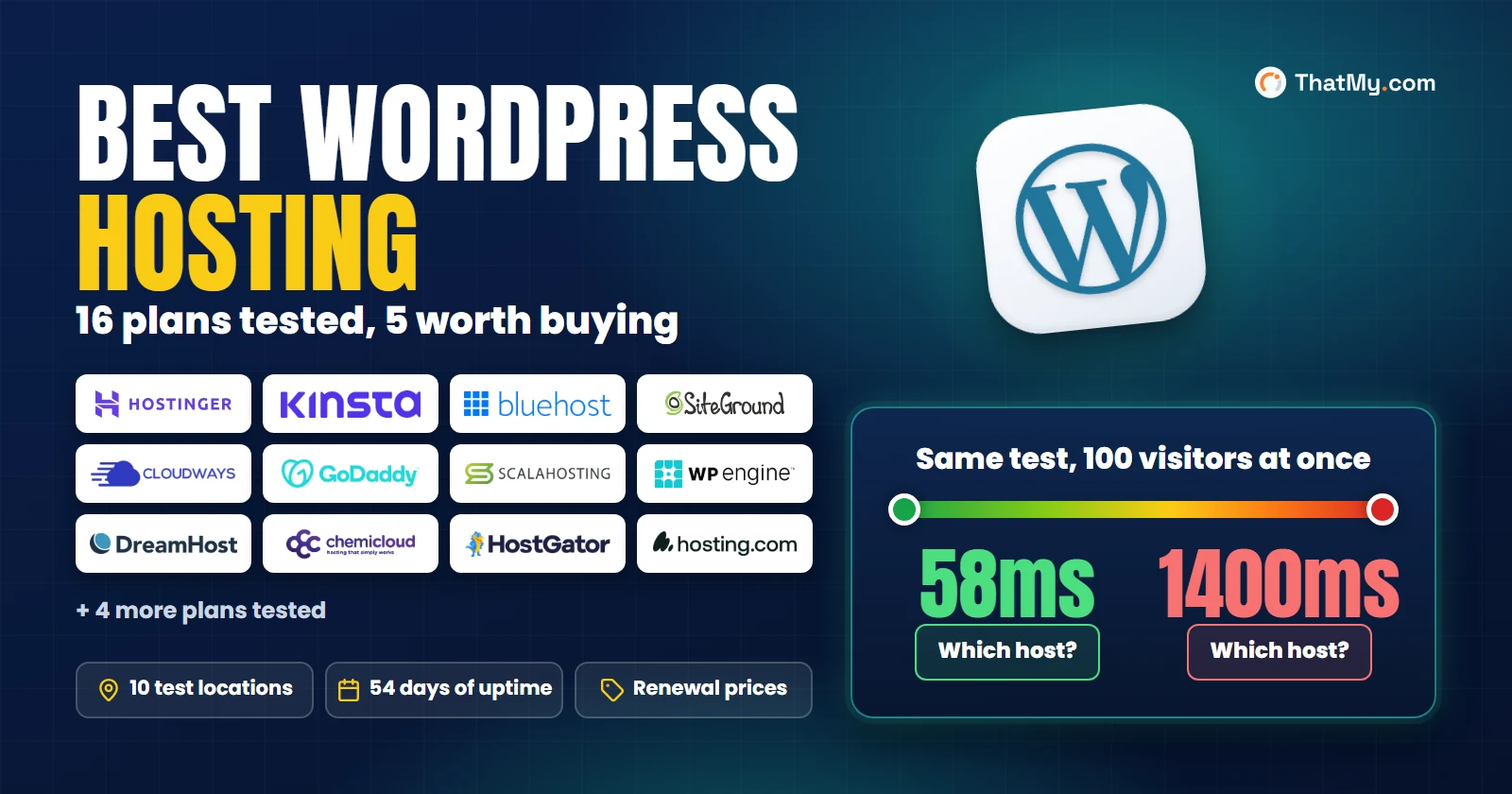
Cloudways is the best WordPress hosting on our tests. It scored 8.8/10, the highest of 15 plans, with 48ms TTFB from New York, US and 74ms with 100 visitors hitting it at once, on a cloud server you choose and pay for by the month. ScalaHosting follows at 8.5 and was the fastest plan of all under load, which makes it our pick for WooCommerce. Kinsta is the premium managed choice, ChemiCloud the best shared plan, and Levamo the pick for large stores that want a managed platform.
Starting on Cloudways? Launch a server on the 3-day free trial first: no card is needed to see the panel. When you pay, our link adds code CLOUDS2022 for $30 of credit, or use THATMY30 for 30% off your first 3 months. Which Cloudways code saves you more
Start the Free Cloudways Trial Sign up with THATMY30 instead →
WordPress builds most pages by running PHP and querying a database. Your speed depends on how fast the server's CPU runs that PHP, how many requests it handles at the same time, and how often it stays up. So that is what I measured, on one plan per host with the same WordPress test site: response time from 10 locations, response with 100 concurrent users, and uptime over 54 days.
One published formula turns those results and the price you pay over six years into a score. Below the ranking you will find what WordPress 7.1 needs from a host, how PHP workers, CPU cores and memory decide what your money buys (with screenshots of each host's own limits), what customers say, and a pick for each kind of site.
Our Five Picks, by the Site You Run

Cloudways Vultr High Frequency 4GB
- 48ms TTFB, New York, US
- 74ms with 100 concurrent users
- 99.99% uptime over 54 days
- $16.00/mo entry server, same at renewal
Same price every month, pick your cloud and region
The catch: No email hosting, and you choose the server size yourself.
Start the Free Cloudways Trial
ScalaHosting Entry Cloud (managed VPS)
- 38ms TTFB, New York, US
- 58ms with 100 concurrent users
- 99.99% uptime over 54 days
- $24.95/mo first term, $39.95/mo renewal
Fastest under load of all 15 plans
The catch: Averages $32.45/mo over six years, about twice the Cloudways entry server.
Check Entry Cloud Prices
Kinsta Single 20GB
- 64ms TTFB, New York, US
- 92ms with 100 concurrent users
- 99.99% uptime over 54 days
- $29.17/mo first term, $29.17/mo renewal
Highest PageSpeed score we measured
The catch: One WordPress install, and traffic above the plan's allowance is billed as overage.
Compare Kinsta Plans
ChemiCloud Starter (shared)
- 84ms TTFB, New York, US
- 240ms with 100 concurrent users
- 99.97% uptime over 54 days
- $3.49/mo first term, $14.95/mo renewal
Fastest shared plan, AMD EPYC servers
The catch: One CPU core and 2GB of memory, so a busy store outgrows it.
Check ChemiCloud Starter
Levamo Business and Performance
- 6.7 checkout journeys a second on Business, 19 on Performance
- Database stayed up with 200 shoppers at once
- $99.00/mo billed yearly, the same at renewal
Tested on a 10,000-product store, not on the 10-location benchmark
The catch: Starter's database stopped at 100 shoppers, so buy Business or Performance for a store.
Compare Levamo PlansHow We Scored 15 WordPress Plans
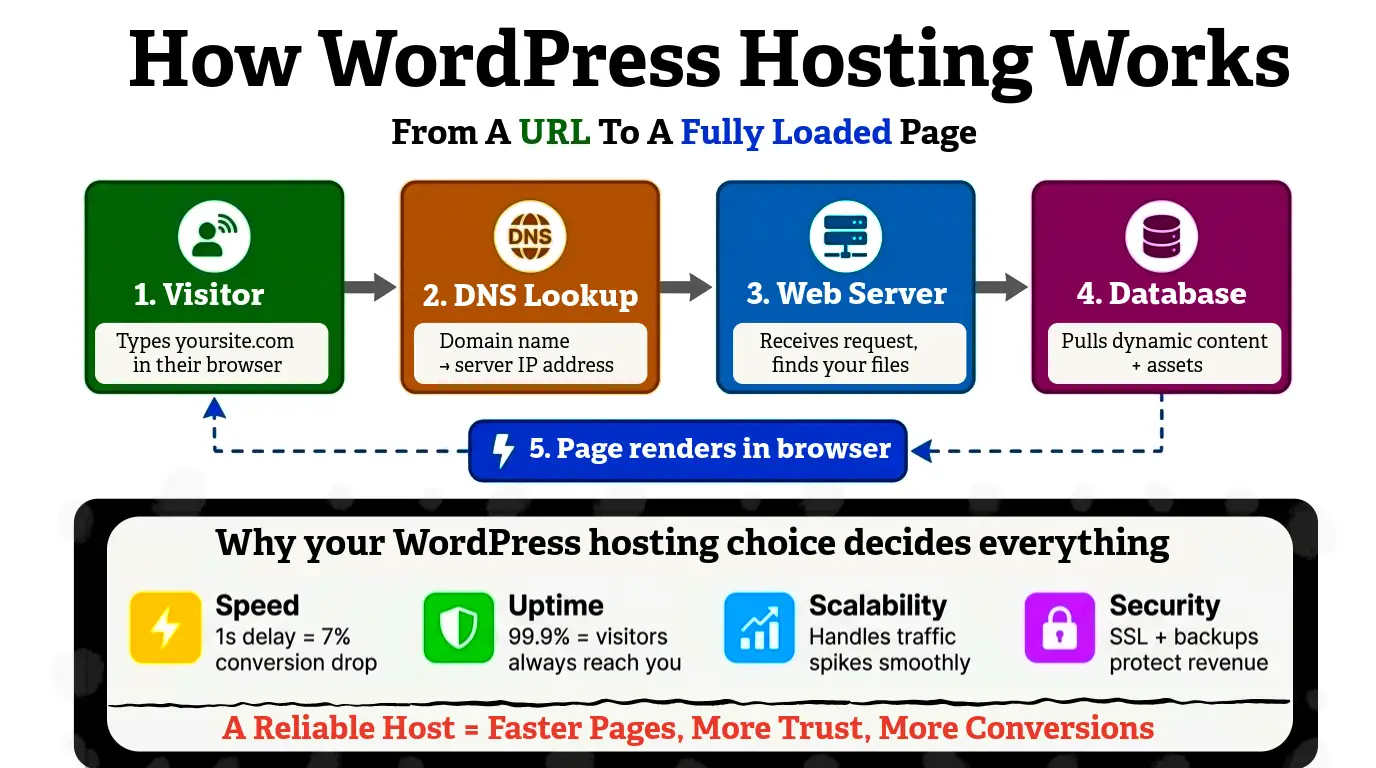
A WordPress host does the same job on every page view. The visitor's browser finds your server through DNS, the web server takes the request, PHP and the database build the page, and it comes back to the browser. Your host controls the middle of that chain, and that is where speed is won or lost.
I bought one plan from each host on my own account and installed the same WordPress test site on each. Each plan was measured three ways, then scored with one formula. The scores, the ranks and the table below are computed from those records every time this page is built, so no figure here is typed by hand.
The formula: 80% performance, 20% value
| Part | Weight | Scores 10 at | Scores 0 at |
|---|---|---|---|
| Nearest-location TTFB | 25% | 40ms or better | 500ms or worse |
| 10-location average TTFB | 15% | 90ms or better | 900ms or worse |
| Response with 100 concurrent users | 25% | 60ms or better | 1500ms or worse |
| Uptime over 54 days | 15% | 100% | 99.8% or lower |
| Average monthly cost over 6 years | 20% | $8/mo or better | $60/mo or worse |
Speed, load and cost are scored on a log scale, because going from 40ms to 80ms matters as much as going from 250ms to 500ms. Uptime is linear. Cost is the entry plan of the line we tested, so every host is priced the same way. When a part was not measured, it is left out and the other weights are scaled up to 100%; that plan's row says so.
- TTFB from 10 locations (New York, Dallas, Toronto, London, Amsterdam, Frankfurt, São Paulo, Singapore, Tokyo, Mumbai), measured at the origin server with no CDN in front. The nearest location is scored so a European server is not punished for being far from New York; the 10-location average shows what a worldwide audience gets.
- 100 concurrent users: the response time when 100 visitors hit the site at once, taken from a load ramp of 0 to 250 clients from US-East. This is the figure that separates dedicated resources from shared ones. FastComet and GoDaddy are scored on the other three parts, with the other weights scaled up, until their 100-user step is in our records.
- Uptime over 54 days, counting real incident minutes.
- Price: what you pay in the first term, what you pay at renewal, and the average over six years, from each host's own pricing page.
Full method, tools and the rules for re-testing: How We Test. Why these four measures and not storage or bandwidth is explained in how WordPress hosting works, further down.
The Ranking: Every Plan Scored
All 15 plans, sorted by score. TTFB is the nearest of 10 locations; "100 users" is the response with 100 concurrent visitors; cost is the six-year monthly average of the entry plan.
| # | Host and plan tested | Score | TTFB | 10-location avg | 100 users | Uptime | 6-year avg cost |
|---|---|---|---|---|---|---|---|
| 1 | Cloudways Vultr High Frequency 4GB | 8.8 | 48ms New York, US | 106ms | 74ms | 99.99% | $16.00/mo entry of the line |
| 2 | ScalaHosting Entry Cloud (managed VPS) | 8.5 | 38ms New York, US | 84ms | 58ms | 99.99% | $32.45/mo |
| 3 | Kinsta Single 20GB | 7.5 | 64ms New York, US | 143ms | 92ms | 99.99% | $29.17/mo |
| 4 | ChemiCloud Starter (shared) | 7 | 84ms New York, US | 187ms | 240ms | 99.97% | $13.04/mo |
| 5 | Hostinger Premium (shared) | 6.1 | 109ms Frankfurt, DE | 252ms | 520ms | 99.95% | $9.82/mo |
| 6 | FastComet FastCloud (shared) | 6 | 187ms New York, US | 418ms | not measured | 99.95% | $8.62/mo |
| 7 | SiteGround StartUp (shared) | 5.1 | 123ms Frankfurt, DE | 285ms | 900ms | 99.97% | $15.66/mo |
| 8 | DreamHost Shared Starter | 4.7 | 230ms New York, US | 513ms | 620ms | 99.94% | $9.64/mo |
| 9 | InMotion Launch (shared) | 4.4 | 210ms New York, US | 469ms | 660ms | 99.931% | $13.29/mo |
| 10 | Hosting.com Turbo Boost (shared) | 4.2 | 152ms New York, US | 339ms | 534ms | 99.931% | $31.66/mo |
| 11 | WP Engine Startup | 4.1 | 242ms New York, US | 540ms | 487ms | 99.97% | $25.00/mo |
| 12 | Bluehost Basic, now sold as Starter | 3.6 | 287ms New York, US | 641ms | 1400ms | 99.9% | $6.99/mo |
| 13 | Namecheap EasyWP Starter | 3.5 | 344ms New York, US | 769ms | 1300ms | 99.92% | $5.32/mo |
| 14 | HostGator Hatchling | 3.4 | 332ms New York, US | 742ms | 980ms | 99.87% | $7.37/mo |
| 15 | GoDaddy Economy, now sold as Basic | 3.3 | 369ms New York, US | 825ms | not measured | 99.83% | $8.99/mo |
Bands: 8 and up Excellent, 6.5 Strong, 5 Average, 3.5 Weak, below that Poor. Levamo is not in this table: its current plans launched after our last benchmark round, and it was tested with the WooCommerce store test instead (below). Rocket.net was measured but is not scored, because its figures come from the CDN edge rather than the origin server (details).
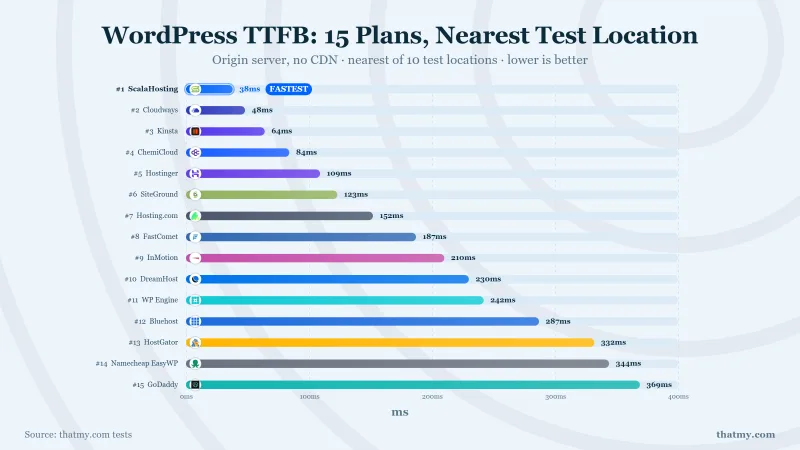
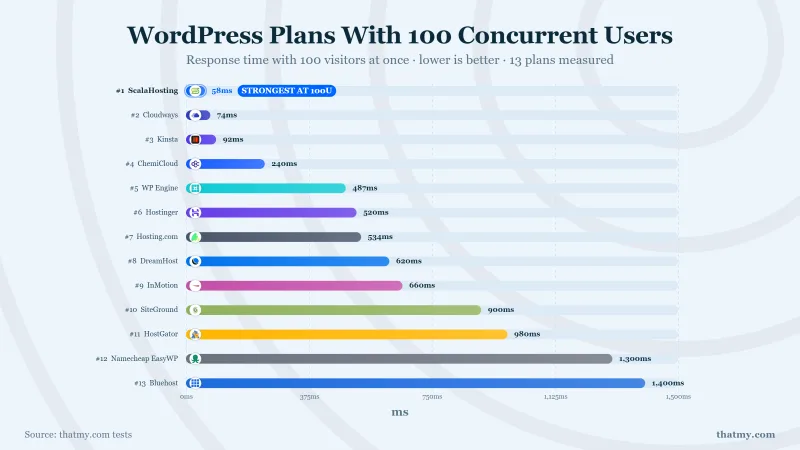
The two charts tell different stories. At idle, the top four plans are all under 100ms. With 100 visitors at once, the plans with dedicated resources (ScalaHosting, Cloudways, Kinsta) stay under 100ms, while shared plans climb to hundreds of milliseconds and the weakest pass one second. PHP workers and CPU cores, further down, explain the gap.
#1. Cloudways: Best Overall WordPress Hosting, and Best for Developers and Agencies
- Nearest-location TTFB 48ms 9.3
- 10-location average TTFB 106ms 9.3
- Response with 100 concurrent users 74ms 9.3
- Uptime over 54 days 99.99% 9.5
- Average monthly cost over 6 years $16.00/mo 6.6
Tested on the Vultr High Frequency 4GB server ($60.00/mo). The value part uses the Vultr HF 1GB entry ($16.00/mo), the entry plan of the same line, the way every other host is scored on its entry plan.
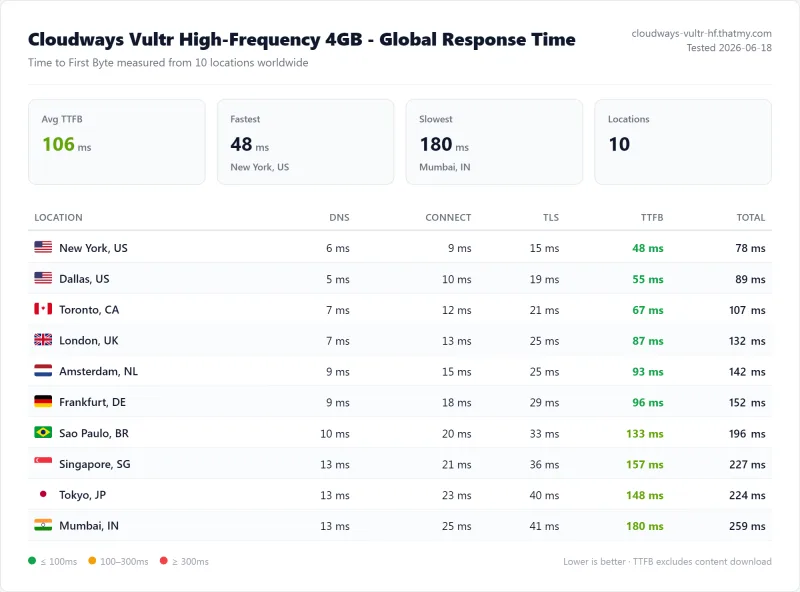
Cloudways puts a managed WordPress stack on a cloud server you choose: DigitalOcean, Vultr, Linode, AWS or Google Cloud. We tested a Vultr High Frequency 4GB server, with 2 vCPUs and NVMe storage. It answered in 48ms from New York, US, 106ms across 10 locations and 74ms with 100 concurrent users, second only to ScalaHosting under load, and it was down 8 minutes in 54 days.
It scores first because it is fast and fairly priced. The Vultr High Frequency line starts at $16.00/mo for the 1GB server, the server we tested is $60.00/mo, and DigitalOcean servers start at $11.00/mo.
You pay monthly with no contract, the price in month forty is the price in month one, and you can resize a server without moving your site. A 1GB server has a quarter of the memory we tested with, so it suits one site with modest traffic; resize when your traffic or your store grows.
Because the server is yours, its PHP workers and CPU are not shared with other customers, which is why Cloudways held up under load. Every server comes with Redis and staging, and the PHP settings are yours to change. I have used Cloudways hands-on for the Cloudways review; a new server ships with these PHP limits, all editable from the panel:
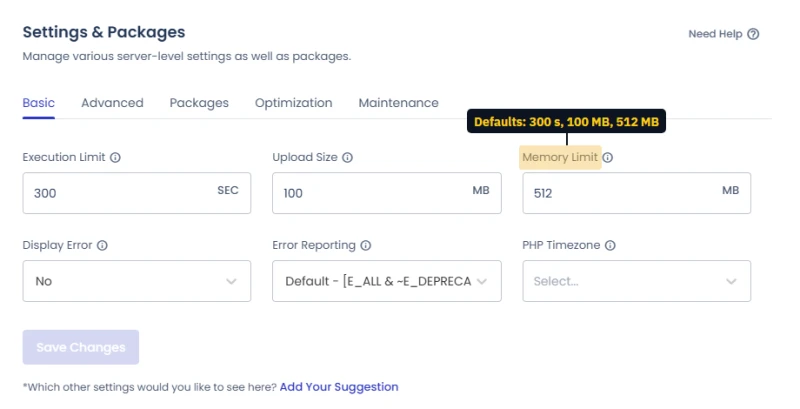
Cloudways sells servers, not a hosting account: there is no email hosting, and you decide the server size yourself. Prices exclude tax where your billing country or US state requires it.
Try it before you pay. The 3-day free trial needs no card, and our two codes cut the first bills: CLOUDS2022 adds $30 of credit through our link, THATMY30 takes 30% off your first 3 months. Pick the code that fits your server.
#2. ScalaHosting Entry Cloud: Best for WooCommerce and Membership Sites
- Nearest-location TTFB 38ms 10
- 10-location average TTFB 84ms 10
- Response with 100 concurrent users 58ms 10
- Uptime over 54 days 99.99% 9.5
- Average monthly cost over 6 years $32.45/mo 3.1
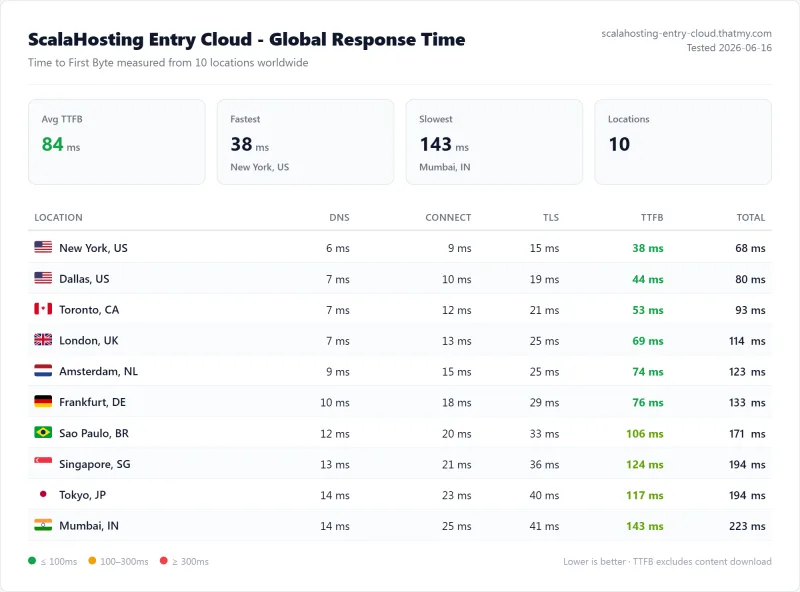
ScalaHosting was the only plan in the test that was the fastest at idle and the fastest under load. It answered in 38ms from New York, US and 84ms averaged over 10 locations, and with 100 concurrent users it answered in 58ms, the best loaded figure of all 15 plans. It was down 8 minutes in 54 days.
Hardware and plan type explain it. Entry Cloud gives you two dedicated CPU cores and 2GB of RAM, so the CPU is yours rather than shared with hundreds of other accounts. The server runs an AMD EPYC 9474F, PassMark rank #42 of 5,999 server CPUs, the fastest CPU we found under any host.
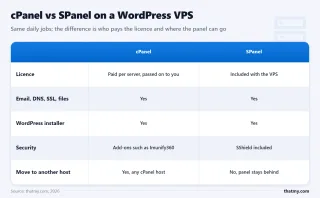
ScalaHosting manages the server and includes its own SPanel control panel, so there is no separate cPanel licence on the bill, and email for your domains is included.
The cost is why it is second and not first. The cheapest entry is $14.95/mo on a 12-month term; on the 36-month term it is $24.95/mo, and both renew at $39.95/mo. Over six years that averages $32.45/mo, twice the Cloudways entry server. For store-only picks, see our WooCommerce hosting guide.
#3. Kinsta: Best Premium Managed WordPress Hosting
- Nearest-location TTFB 64ms 8.1
- 10-location average TTFB 143ms 8
- Response with 100 concurrent users 92ms 8.7
- Uptime over 54 days 99.99% 9.5
- Average monthly cost over 6 years $29.17/mo 3.6
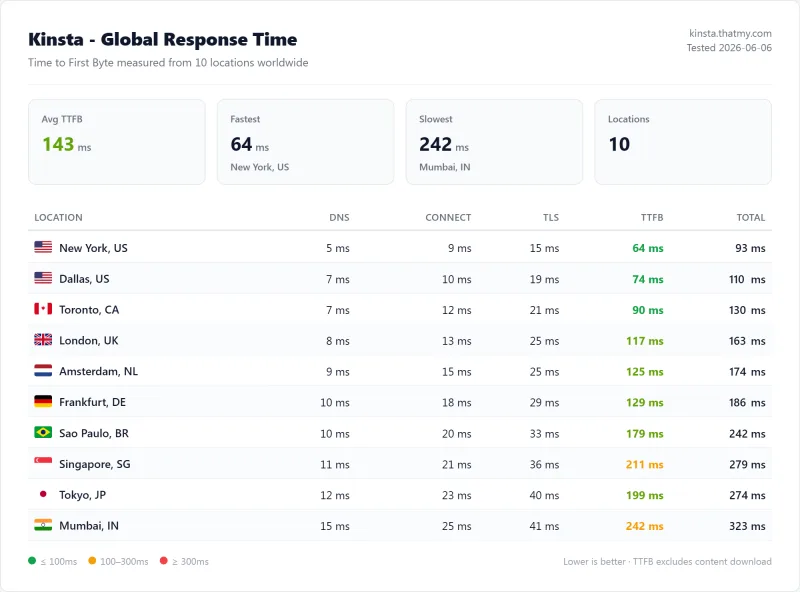
Kinsta runs on Google Cloud and handles caching, security and backups for you. The Single 20GB plan answered in 64ms from New York, US, 143ms across 10 locations and 92ms with 100 concurrent users, and it had the highest PageSpeed score of any plan we tested (93/100). Its server CPU is an AMD EPYC 7502, PassMark #248.
Kinsta charges the same at renewal: $29.17/mo billed yearly or $35.00/mo month to month. The limits to watch are usage and PHP capacity. Single 20GB is one WordPress install with 20GB of server bandwidth and 10GB of storage, and traffic above the allowance is billed as overage. More PHP capacity is an add-on: Kinsta sells extra PHP threads and memory by the month, and Redis object caching is another paid add-on.

#4. ChemiCloud: Best Budget Shared WordPress Hosting
- Nearest-location TTFB 84ms 7.1
- 10-location average TTFB 187ms 6.8
- Response with 100 concurrent users 240ms 5.7
- Uptime over 54 days 99.97% 8.5
- Average monthly cost over 6 years $13.04/mo 7.6
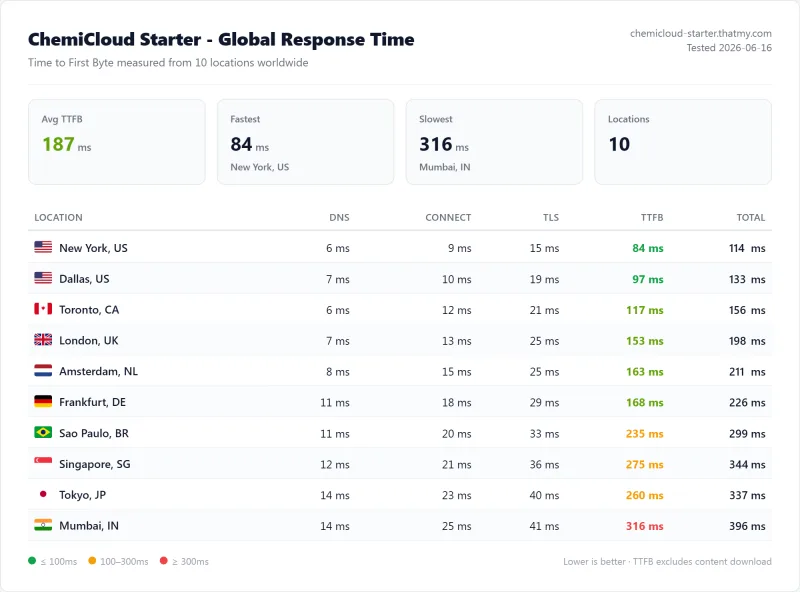
ChemiCloud Starter was the fastest shared plan in the test: 84ms from New York, US and 187ms across 10 locations, on an AMD EPYC 9354 server (PassMark #110, the second-fastest CPU we found). It runs LiteSpeed, which pairs with the free LiteSpeed Cache plugin for page caching.
It is still shared hosting, and ChemiCloud says plainly what you get: one CPU core and 2GB of memory on the WordPress Starter plan. With 100 concurrent users it answered in 240ms, several times slower than the VPS and cloud plans above. For a blog or brochure site where most pages come from cache, that rarely shows; for a store with many shoppers at once, it will.
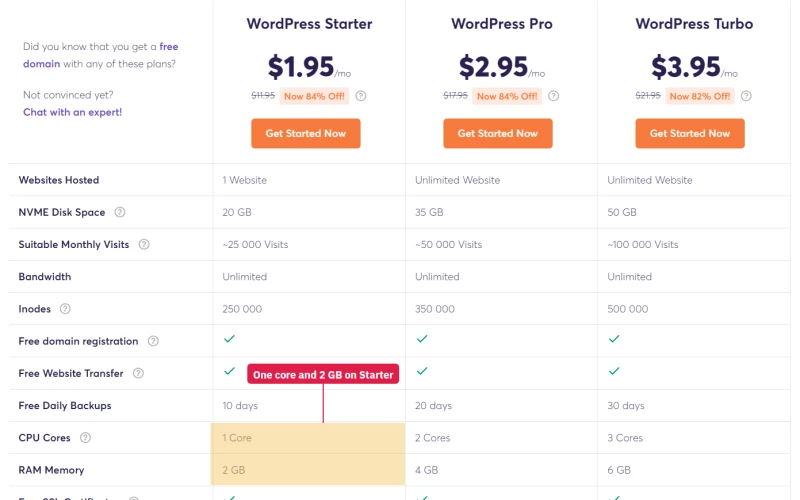
Price the renewal, not the first year: Starter is $3.49/mo for the first 12 months, then $14.95/mo. On a 36-month term it is $2.95/mo, renewing at $11.95/mo.
#5. Levamo: Best Managed Platform for Busy WooCommerce Stores
- 6.7 checkout journeys a second on Business, 19 on Performance, 1.3 on Starter
- 0.95 s cart step at 50 shoppers on Business, 0.22 s on Performance
- Business and Performance kept their database up with 200 shoppers; Starter's stopped twice at 100
Levamo (formerly Rapyd Cloud) was built by the original BuddyBoss team for the WordPress sites a page cache cannot help: stores, memberships, courses and communities. Its current plans launched after our last benchmark round, so instead of the 10-location test I gave it the harder one.
I built the same 10,000-product WooCommerce store on Levamo's Starter, Business and Performance plans, test plans Levamo provided for the review (I did not pay for them), and loaded carts, checkouts and product searches with 10 to 200 shoppers at once, beside the same store on three Cloudways servers.
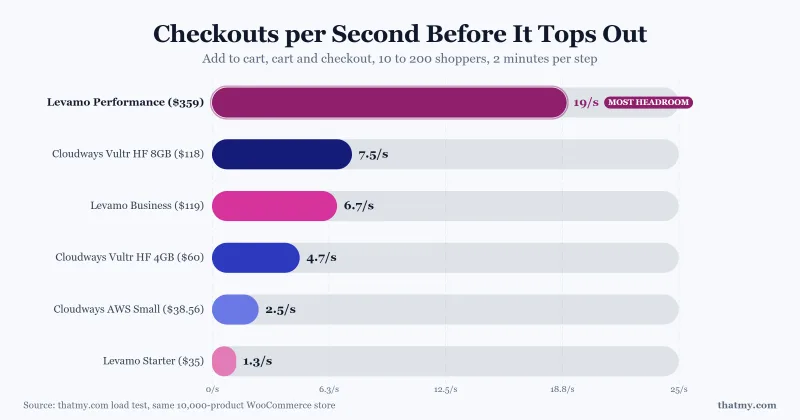
Business and Performance slowed down under the heaviest steps but never lost their database, and Performance reached 19 checkout journeys a second, the most of any server in the test. Starter did not hold: at 100 shoppers its database stopped twice, and the dashboard kept saying the site was online while every cart and checkout returned a database error.
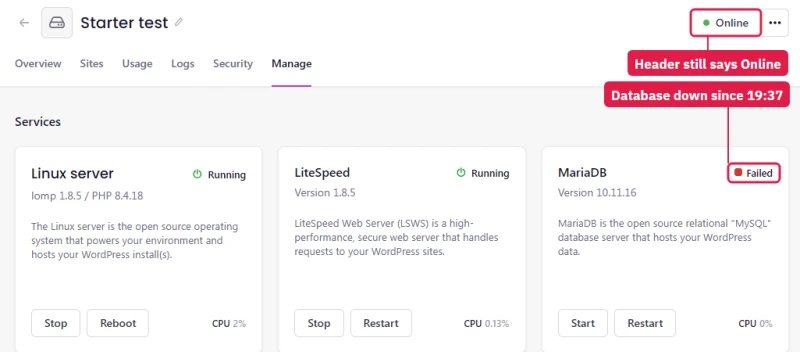
On value, Cloudways came out ahead: at the same money, a Cloudways Vultr HF 8GB server handled 7.5 checkout journeys a second against Business's 6.7. What Levamo sells instead is a managed platform with a lot of capacity in one plan, Elasticsearch on Performance and no server to size yourself. Prices stay the same at renewal.
Hostinger: Cheapest Over Six Years, Slow Under Load
- Nearest-location TTFB 109ms 6
- 10-location average TTFB 252ms 5.5
- Response with 100 concurrent users 520ms 3.3
- Uptime over 54 days 99.95% 7.5
- Average monthly cost over 6 years $9.82/mo 9
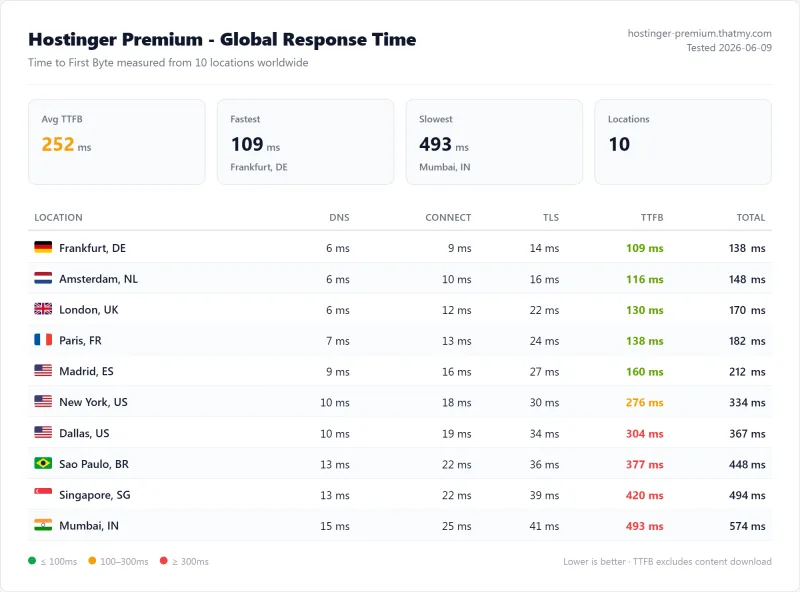
Hostinger Premium put our test site in Europe, and from Frankfurt, DE it answered in 109ms, a good idle figure on an AMD EPYC 7352 server. The problem is concurrency: with 100 users at once it took 520ms, nearly five times slower.
Hostinger is one of the few hosts that publishes its limits, and they explain the result: Premium gets 40 PHP workers but a single CPU core and 2GB of RAM, so under load the workers wait their turn on one core. The full table is in the PHP workers section.
Hostinger's WordPress limits on Premium
- 40 PHP workers on one CPU core with 2GB of RAM: the core, not the worker count, caps a busy site.
- 1,536MB PHP memory per request, inside that 2GB for the whole plan.
- 25 MySQL connections per database user and 12,288 KB/s of disk I/O.
- 400,000 inodes, the cap on files and folders, which a big media library or a cache plugin can reach.
Hostinger has the best value score of the top six plans because its six-year average is $9.82/mo. The lowest advertised price, $2.99/mo, needs a 48-month prepayment; on a 12-month term it is $3.99/mo, and both renew at $10.99/mo.
SiteGround: Good Uptime, Steep Renewal, Weak Under Load
- Nearest-location TTFB 123ms 5.6
- 10-location average TTFB 285ms 5
- Response with 100 concurrent users 900ms 1.6
- Uptime over 54 days 99.97% 8.5
- Average monthly cost over 6 years $15.66/mo 6.7
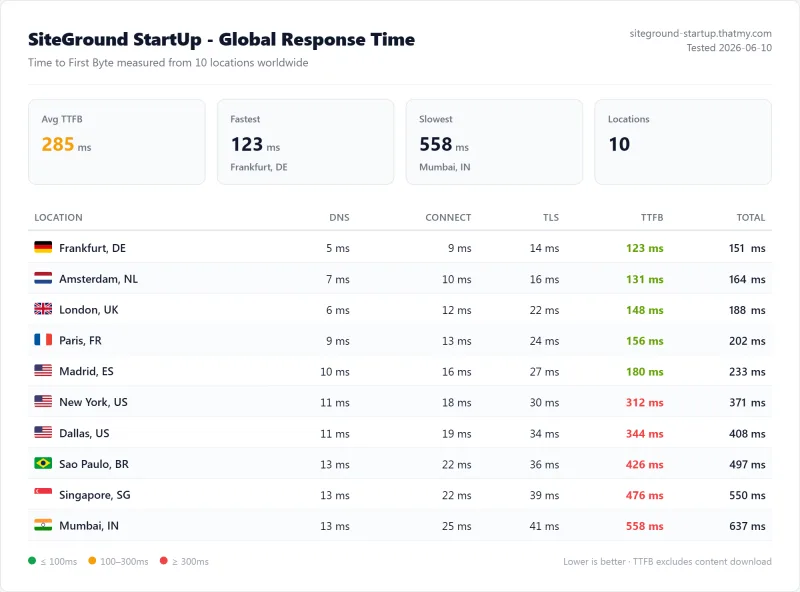
SiteGround StartUp also sat in Europe: 123ms from Frankfurt, DE and 99.97% uptime, both respectable. SiteGround switches on NGINX static caching and full-page dynamic caching for every site by default, which is why its cached pages are quick. Under load it fell away: 900ms with 100 concurrent users, one of the slowest results in the test, on an Intel Xeon Gold 6248R (PassMark #432).
The renewal is the other issue. StartUp is $3.99/mo for the first year and $17.99/mo after that, +351%, so its six-year average of $15.66/mo is more than ChemiCloud's for a slower plan.
Hosting.com (Formerly A2 Hosting): Turbo Plan, Middling Results
- Nearest-location TTFB 152ms 4.7
- 10-location average TTFB 339ms 4.2
- Response with 100 concurrent users 534ms 3.2
- Uptime over 54 days 99.931% 6.5
- Average monthly cost over 6 years $31.66/mo 3.2
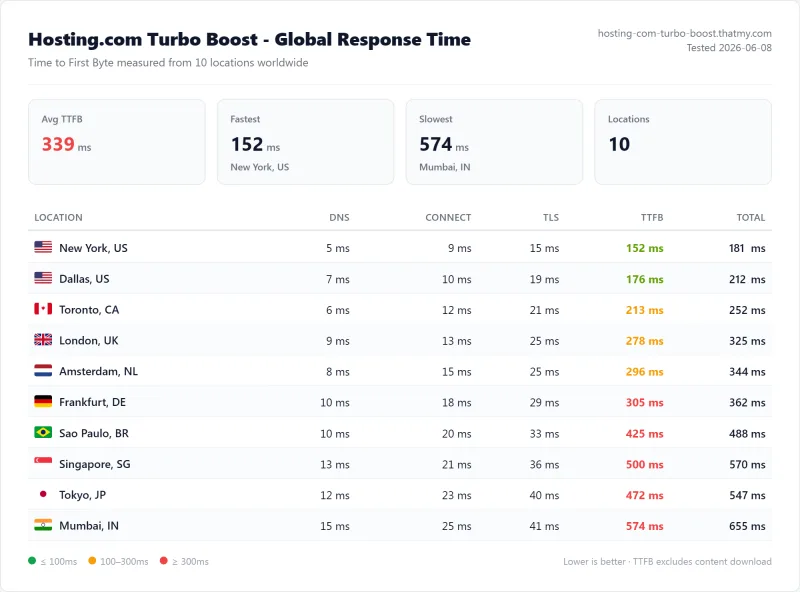
We tested A2 Hosting's Turbo Boost plan, sold today by hosting.com after World Host Group bought A2 in 2025. It answered in 152ms from New York, US, 339ms across 10 locations and 534ms with 100 users, with 99.931% uptime. That is mid-table on every measure, and the Turbo pricing puts its six-year average at $31.66/mo, which is why it scores 4.2.
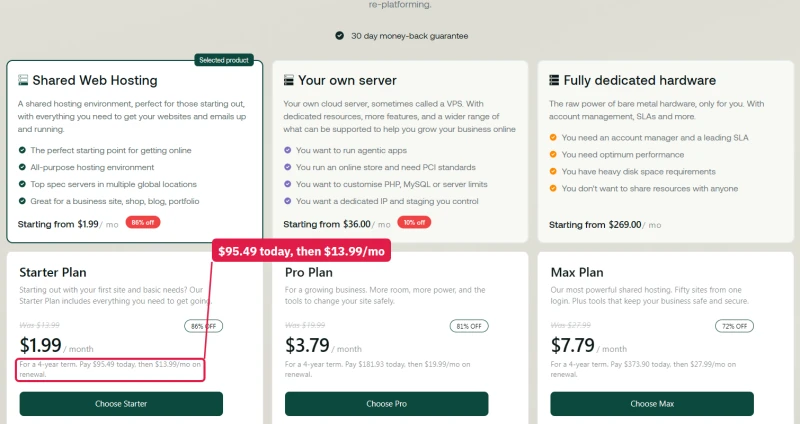
Read the terms before you buy: hosting.com's lowest shared prices need a four-year term paid up front, and the renewal price is printed in small type under each plan.
WP Engine: Managed Features, Slow Test Results
- Nearest-location TTFB 242ms 2.9
- 10-location average TTFB 540ms 2.2
- Response with 100 concurrent users 487ms 3.5
- Uptime over 54 days 99.97% 8.5
- Average monthly cost over 6 years $25.00/mo 4.3
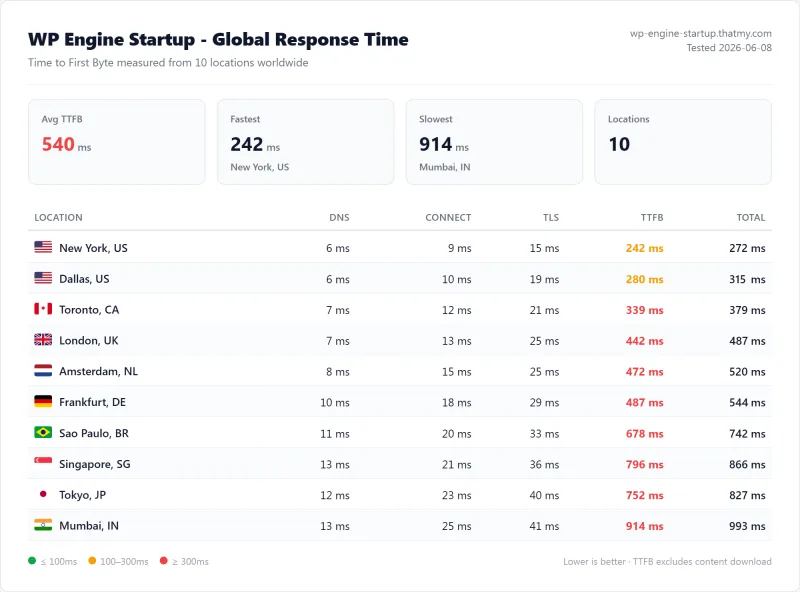
WP Engine Startup costs about what Kinsta costs, $25.00/mo billed yearly, but tested well behind it: 242ms from New York, US, 540ms across 10 locations, and 487ms with 100 users. Uptime was good at 99.97%. The Startup plan allows one site and 25,000 visits a month, with chat support only; phone support starts on the Professional plan.
WP Engine also keeps a list of disallowed plugins, mostly caching and backup plugins that overlap its own features, so check the list before you migrate a site that depends on one. And it is still in court with Automattic, the company behind WordPress.com: the case WP Engine filed in 2024 is still open (court docket). Earlier in the case a federal judge ordered Automattic to restore WP Engine's access to WordPress.org.
Bluehost: Cheap to Start, Slowest Under Load
- Nearest-location TTFB 287ms 2.2
- 10-location average TTFB 641ms 1.5
- Response with 100 concurrent users 1400ms 0.2
- Uptime over 54 days 99.9% 5
- Average monthly cost over 6 years $6.99/mo 10
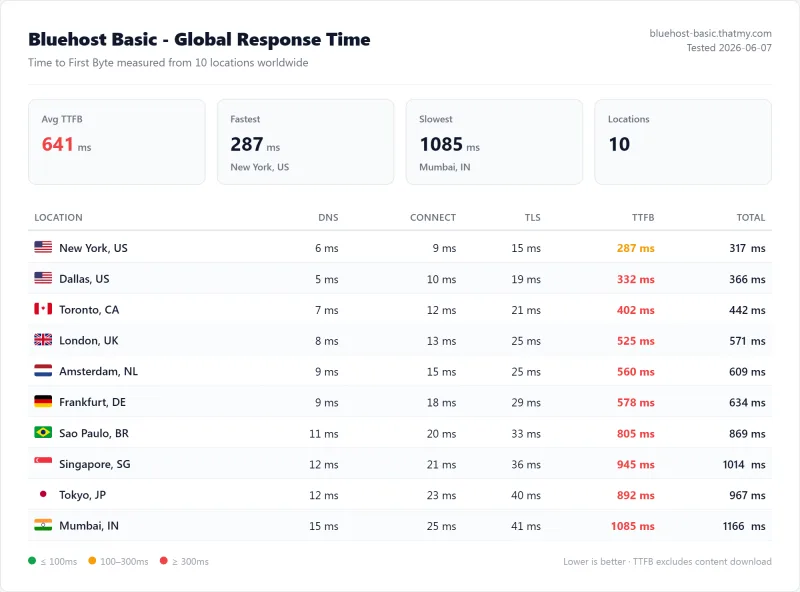
Bluehost is on WordPress.org's list of recommended hosts, and its entry plan is cheap: $3.99/mo to start, $9.99/mo at renewal. In our tests it was the slowest plan under load, 1400ms with 100 concurrent users, after 287ms at idle from New York, US. Its server CPU is an Intel Xeon E5-2680 v3, PassMark #1,343, and it was down 78 minutes in 54 days.
Customers notice: 15% of its Trustpilot reviews are one star, one of the highest shares of any host here (see what customers say). Newfold Digital owns Bluehost and HostGator.
HostGator: Older Hardware, Lowest Uptime but One
- Nearest-location TTFB 332ms 1.6
- 10-location average TTFB 742ms 0.8
- Response with 100 concurrent users 980ms 1.3
- Uptime over 54 days 99.87% 3.5
- Average monthly cost over 6 years $7.37/mo 10
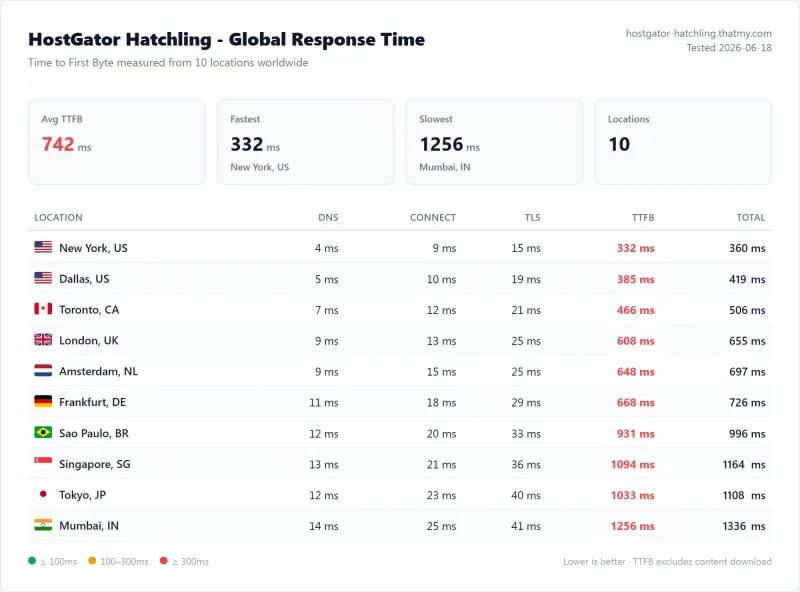
HostGator Hatchling answered in 332ms from New York, US and 742ms across 10 locations, on an Intel Xeon E5-2690 v4 (PassMark #1,069). With 100 users it took 980ms, and it was down 101 minutes in 54 days (99.87%), the second-lowest uptime we recorded. It is $3.75/mo to start and $10.99/mo at renewal.
GoDaddy: Slowest TTFB and Lowest Uptime
- Nearest-location TTFB 369ms 1.2
- 10-location average TTFB 825ms 0.4
- Response with 100 concurrent users not measured
- Uptime over 54 days 99.83% 1.5
- Average monthly cost over 6 years $8.99/mo 9.4
Not measured: Response with 100 concurrent users. The score uses the other parts, re-weighted.
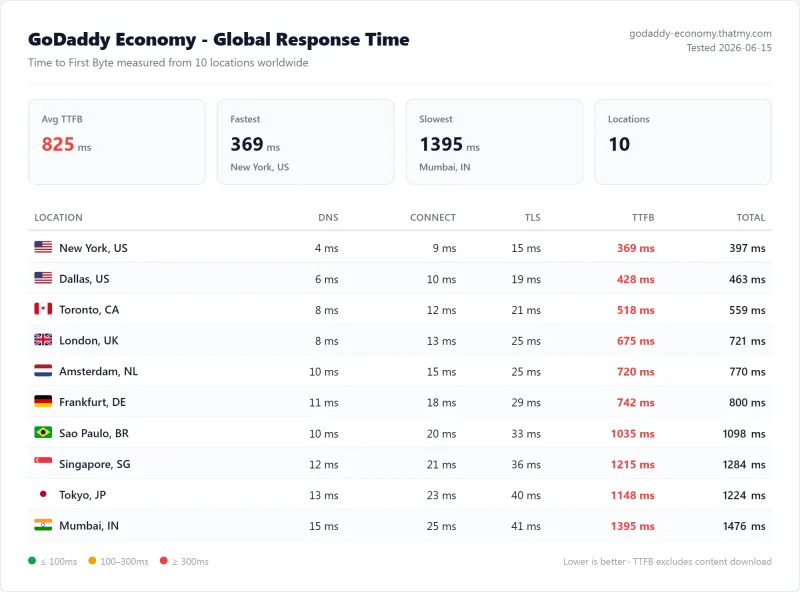
GoDaddy's entry plan (Economy when we tested it, now sold as Basic) had the slowest TTFB of the 15 plans, 369ms from New York, US and 825ms across 10 locations, and the lowest uptime: 99.83%, 132 minutes down in 54 days. Its server CPU, an Intel Xeon Silver 4114, ranks #1,468 on PassMark. It is $5.99/mo to start and $11.99/mo at renewal.
Also Tested: FastComet, DreamHost, InMotion, Namecheap EasyWP and Rocket.net
Five more plans went through the same tests. None beat the picks above on the formula, so they get a short verdict each; four have full rows in the ranking table.
| Host and plan | Score | TTFB | 100 users | Uptime | 6-year avg cost |
|---|---|---|---|---|---|
| FastComet FastCloud (shared) | 6 | 187ms | not measured | 99.95% | $8.62/mo |
| DreamHost Shared Starter | 4.7 | 230ms | 620ms | 99.94% | $9.64/mo |
| InMotion Launch (shared) | 4.4 | 210ms | 660ms | 99.931% | $13.29/mo |
| Namecheap EasyWP Starter | 3.5 | 344ms | 1300ms | 99.92% | $5.32/mo |
| Rocket.net Starter | not scored | 32ms CDN edge | not measured | 99.979% | $25.00/mo |
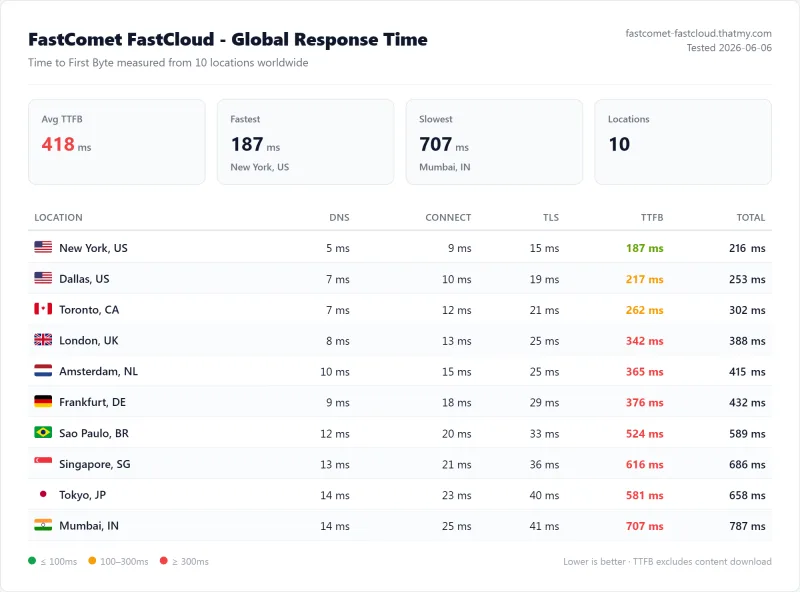
- FastComet (6): 187ms from New York, US on an Intel Xeon E5-2680 v4, and 99.95% uptime. No measured 100-user step. World Host Group bought it in 2025. FastComet review.
- DreamHost (4.7): cheap over six years ($9.64/mo) but 230ms at idle and 620ms with 100 users. DreamHost review.
- InMotion (4.4): 210ms at idle, 660ms with 100 users, 99.931% uptime. InMotion review.
- Namecheap EasyWP (3.5): the cheapest managed WordPress plan here, $3.24/mo to start, but 344ms at idle and 1300ms with 100 users. EasyWP review.
- Rocket.net (not scored): its 32ms was measured at the Cloudflare edge, which is what a cached page gets, while every other plan here was measured at its origin server. It also has no measured 100-user step, the part of the test that shows how carts, checkouts and logged-in pages behave. With nothing comparable to score, we list it rather than rank it. Rocket.net joined hosting.com, part of World Host Group, in 2025.
What WordPress Needs From a Host
WordPress 7.1 is the current major release, and 58.8% of all WordPress sites already run it. What it asks of a host is short, and WordPress.org publishes it:
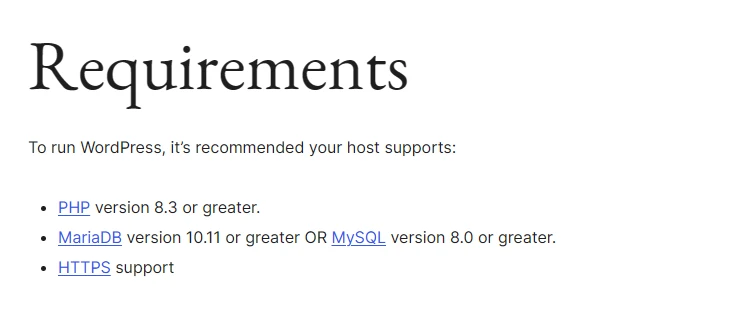
Every host on this page meets that list. Where they differ is what your site actually runs on day one. WordPress.org's own statistics show how many sites run old software:
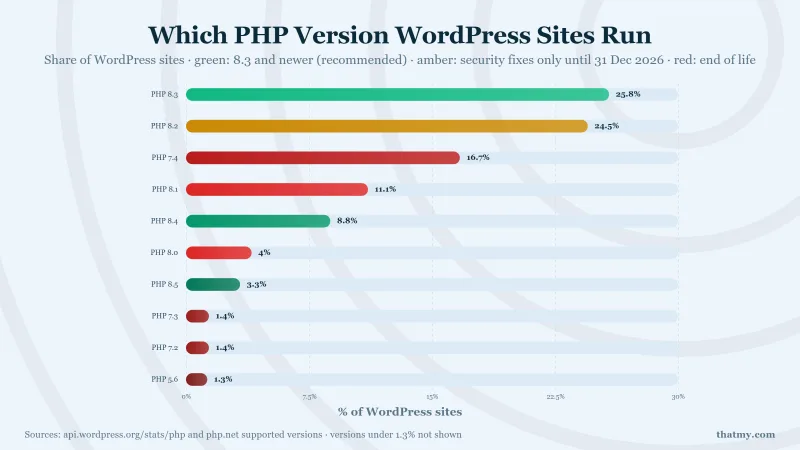
37.6% of WordPress sites run a PHP version that no longer gets security fixes, almost exactly as many as run the recommended PHP 8.3 or newer (37.9%). PHP 8.2 is still patched, but only until 31 December 2026.
Newer PHP versions also tend to run the same WordPress code in less CPU time, which on a shared plan means fewer requests queuing. The database picture is similar: 12.3% of sites still run MySQL 5.7, below WordPress's recommendation of MySQL 8.0 or MariaDB 10.11.
WordPress keeps old PHP working longer than PHP itself supports it. WordPress 7.1 still runs on PHP 7.4, and dropped only PHP 7.2 and 7.3 (in WordPress 7.0):
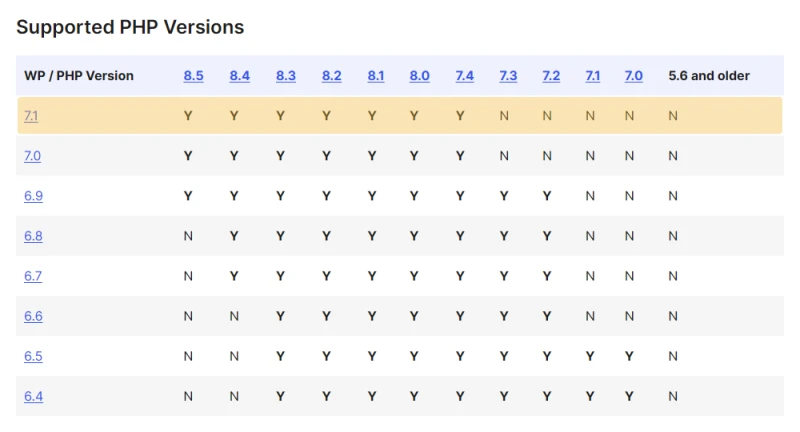
So "WordPress works" is not the test. After you sign up, open Tools, Site Health, Info, Server in your dashboard, and if the PHP version starts with 7 or with 8.0 or 8.1, switch it to 8.3 or 8.4 in your host's control panel, or ask support to do it.
WordPress 7.1 also changed how small plans handle uploads. Image compression, resizing and thumbnail generation now run in the visitor's browser rather than on your server, and hosts can set speculative loading, which prefetches the next page, through server settings:
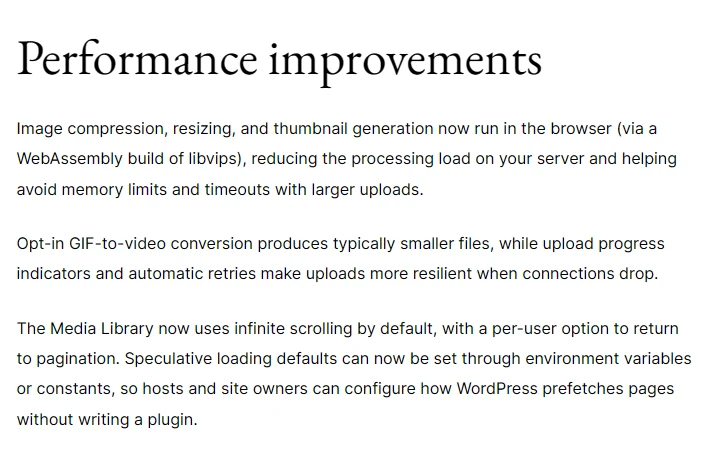
For anyone on shared hosting, the first change is a real gain: uploading a batch of large photos used to be a common way to hit a plan's PHP memory limit or time out. It is now mostly your browser's work.
How WordPress Hosting Works: PHP Workers, CPU, Memory and the Server Stack
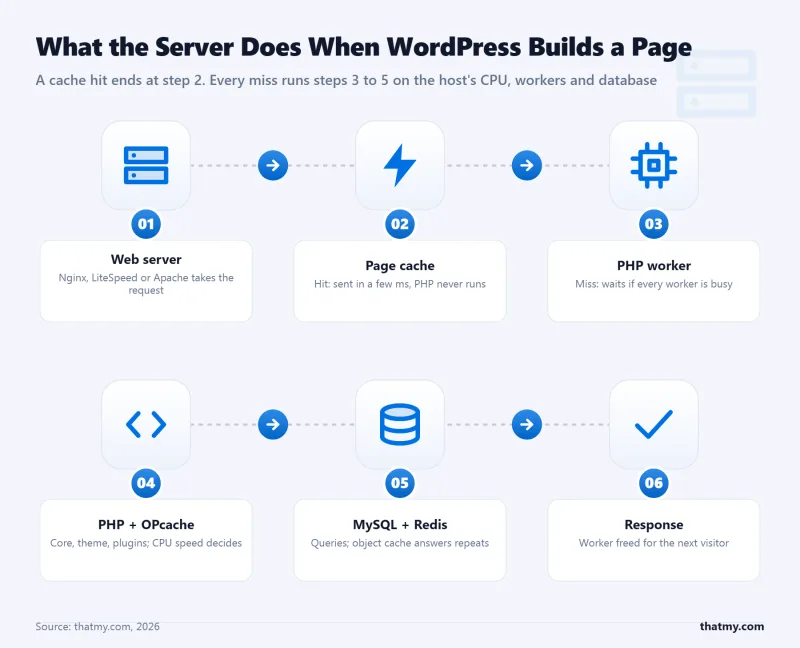
Hosting pages sell storage, bandwidth and "unlimited websites". None of those decide how fast WordPress is. This is what does, in the order a request meets it:
- The web server takes the request. Nginx, LiteSpeed or Apache. If a full-page cache holds a copy, the response leaves here in a few milliseconds and PHP never runs. This is the only step most speed tests of an empty homepage ever measure.
- A PHP worker picks it up. On a cache miss (a logged-in user, a cart, a checkout, a search, wp-admin) the request needs a free PHP worker. If every worker is busy, it waits in a queue. Nothing about the page is slow yet; the server is simply full.
- PHP runs WordPress. Core, the theme and every active plugin load. OPcache keeps the compiled PHP in memory, and the CPU's single-thread speed decides how long the rest takes.
- WordPress asks the database. A normal page runs dozens of queries and a WooCommerce page runs more. A Redis object cache answers repeat queries from memory instead of the database.
- The response goes back and the worker is free for the next visitor.
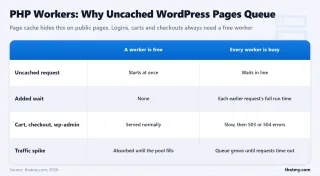
PHP workers: why uncached pages queue
A PHP worker is a process that builds one uncached page at a time. Your plan has a fixed number of them. While they are all busy, every new cart, login or checkout waits, and if the wait is long enough the visitor gets a 503 or 504 error.
You will often read that shared hosting gives you only two to four workers. Hostinger shows why that rule of thumb misleads. It is one of the few hosts that publishes every limit, and the Premium plan we tested lists 40 PHP workers, 20 on the plan below and 60 on the plan above. Look two rows further up: Premium runs on one CPU core with 2GB of RAM.
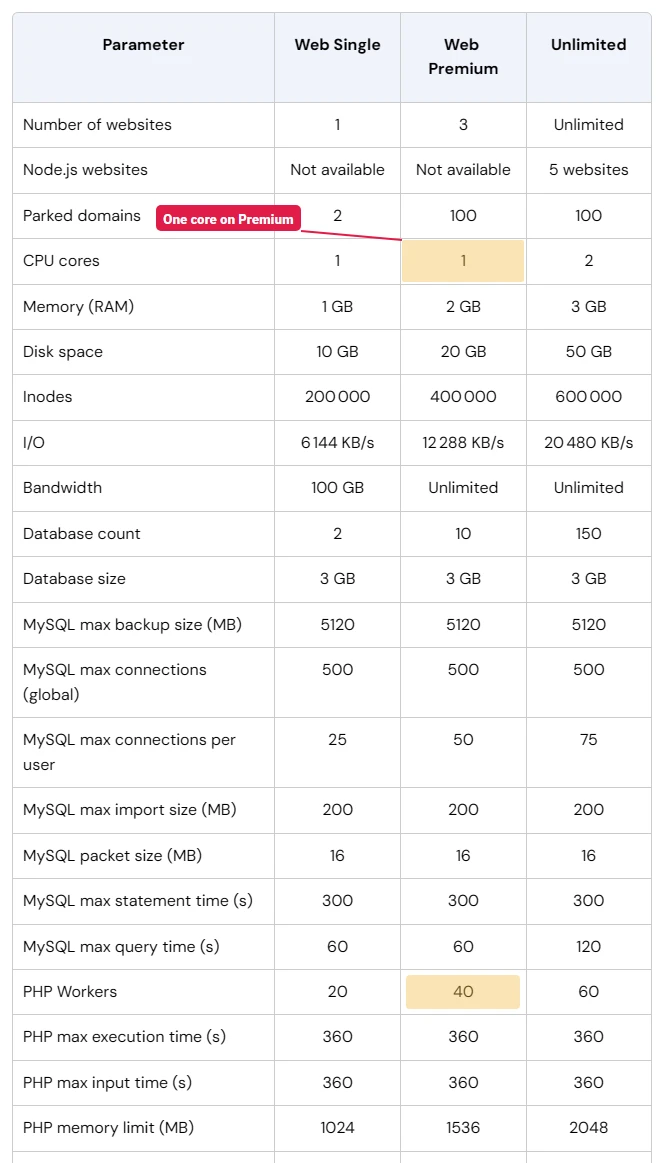
A worker needs a CPU core to run on. Forty workers on one core means that under load they take turns, which is exactly what our test measured: 109ms for one visitor, 520ms with 100. The limit that bites on shared hosting is the CPU, not the worker count.
ChemiCloud's WordPress Starter lists the same one core and 2GB; ScalaHosting's Entry Cloud gives two dedicated cores, and the Cloudways server we tested had two vCPUs of its own. That difference in cores, more than anything on a pricing page, is the gap between the shared and the dedicated plans in our load chart.
Hosts also enforce these limits. One ScalaHosting shared-hosting customer complained on Trustpilot that their account had been limited to one PHP process at a time. ScalaHosting's public reply explained why: the two sites had received more than 3.1 million requests in 24 days against about 8,800 real visitors, most of it automated traffic, and on a shared server one account's load is capped so it cannot slow everyone else's sites.
Bots use workers like real visitors do, so blocking bad bots and caching everything you can is the cheapest capacity you will ever buy.
On managed WordPress hosts, PHP capacity is metered instead. Kinsta sells extra PHP threads and memory as a monthly add-on, and describes the signs of running out as "requests queuing or timing out" and "502 or 504 errors". If your store is growing, price that in.
| Plan we tested | CPU | Memory | PHP workers | Source |
|---|---|---|---|---|
| Cloudways Vultr HF 4GB | 2 vCPU, your own server | 4GB | Your server's, not shared | Cloudways pricing |
| ScalaHosting Entry Cloud | 2 dedicated CPUs | 2GB | not published | ScalaHosting plan page |
| ChemiCloud WordPress Starter | 1 core, AMD EPYC | 2GB | not published | ChemiCloud compare table |
| Hostinger Premium | 1 core | 2GB | 40 | Hostinger limits article |
| Kinsta Single 20GB | not published | not published | Extra threads sold as an add-on | Kinsta pricing |
Most hosts do not publish CPU, memory or worker counts at all, and that is worth knowing in itself. The load test is how we see what a plan really gets.
The CPU: every uncached page runs on it
PHP runs mostly on one CPU core per request, so single-thread speed decides how long an uncached page takes to build, and the number of cores decides how many can be built at once. We identified the server CPU under each plan and looked up its PassMark rank among 5,999 server CPUs. It is not part of the score, because the load test already shows its effect, but it explains a lot of the results. ScalaHosting's AMD EPYC 9474F ranks #42; at the other end, Bluehost's Intel Xeon E5-2680 v3 ranks #1,343.
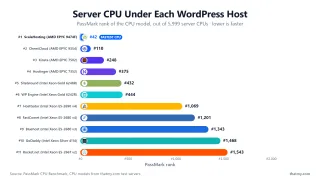
The CPU is one of six hardware factors behind WordPress speed, together with storage, the web server, how many accounts share a server, memory and the network. Software cannot fix bad hardware.
Memory: the PHP limit and the plan's RAM
Two memory numbers matter, and they are often confused. The PHP memory limit is the most one request may use; WordPress itself asks for 40MB by default on a single site and raises it to 256MB in wp-admin, and WooCommerce, page builders and large imports need more.
The plan's RAM is what all your requests, the database and any object cache share. Hostinger Premium allows a single PHP request 1,536MB, but the whole plan has 2GB, so the per-request limit is never what stops you; running out of the shared pool is. The dedicated plans pull ahead here: the memory is yours, so a busy neighbour cannot take it.
The web server and the caches
The web server decides how cheaply a host serves cached pages and static files. Apache starts a process or thread for every connection and reads .htaccess files on every request; Nginx and LiteSpeed handle thousands of connections in an event loop with little memory, and both can cache whole pages at the server level, before PHP runs at all.
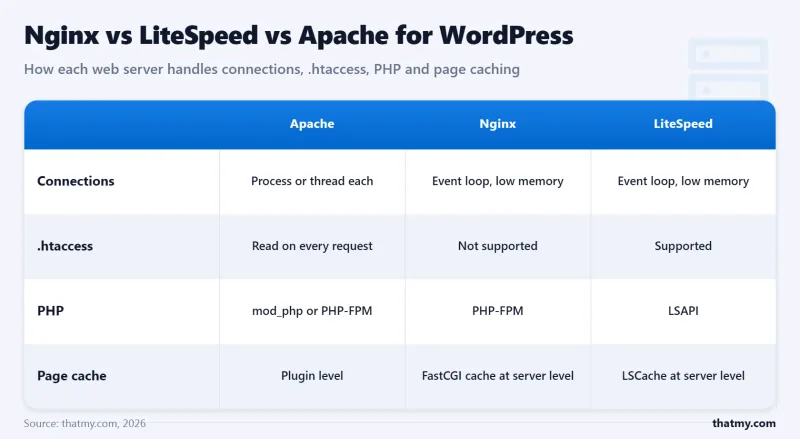
Among our picks, ChemiCloud runs LiteSpeed and pairs it with the LiteSpeed Cache plugin; SiteGround enables NGINX static caching and full-page dynamic caching on every site by default; Cloudways servers include Redis for object caching.
Three caches do three different jobs: the page cache serves whole pages to anonymous visitors, the object cache (Redis or Memcached) keeps database results in memory for logged-in and cart pages, and OPcache keeps compiled PHP in memory so it is not rebuilt on every request. A store needs all three; a blog mostly needs the first.
What Customers Say About These Hosts
Our tests measure the server. Customers judge everything else: support, billing, renewals and migrations. So I read every host's Trustpilot profile. The first thing you notice is that the averages tell you almost nothing: every host sits between 4.2 and 4.9 stars, including the slowest plans in our test. Most hosts invite their customers to leave reviews, and 11 of the 16 profiles carry Trustpilot's "Paid Trustpilot subscription" label, which means the company pays for Trustpilot's business tools.
The share of 1-star reviews tells a different story, and it lines up with our results:
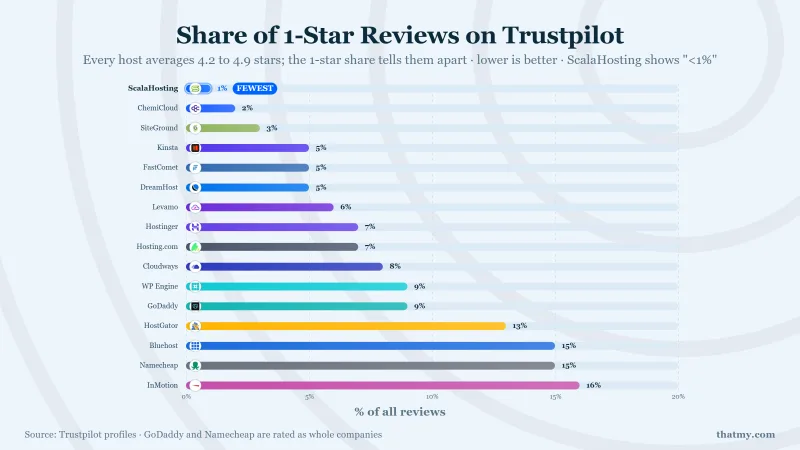
The hosts that were slowest under load in our test, Bluehost, HostGator and InMotion, carry 13 to 16% one-star reviews. The two fastest dedicated and shared plans, ScalaHosting and ChemiCloud, carry 2% or less. Here are the two ends of that range, as Trustpilot shows them:


Two cautions. GoDaddy and Namecheap are rated as whole companies, domains and all, so their numbers are not about WordPress hosting alone. And a low 1-star share can also mean a host is good at asking happy customers for reviews. So ratings sit beside our tests on this page, not inside the score.
What People Say on Reddit
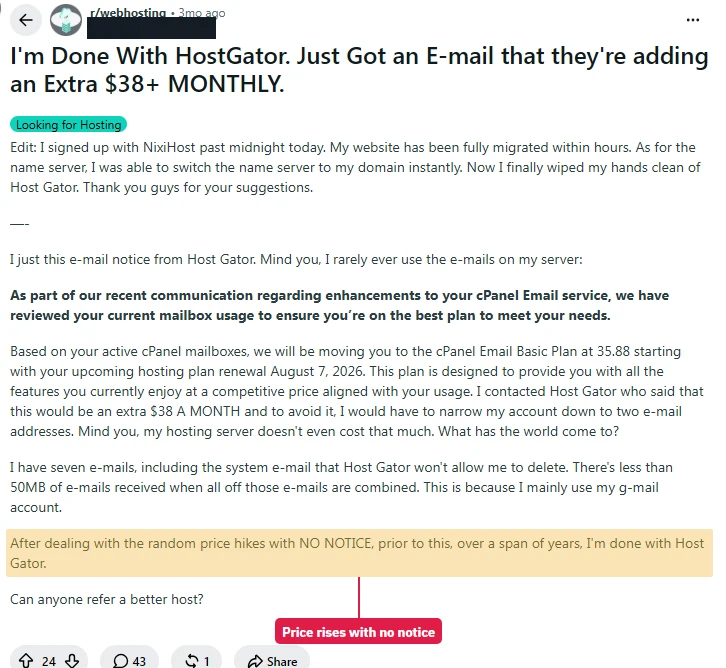
Reddit is where customers complain in their own words, so I read r/webhosting and r/Wordpress as well. The complaints that come back again and again are about renewals, not speed. In this thread a HostGator customer's renewal notice moved them onto a paid cPanel email plan, which they say costs an extra $38 a month, after years of "random price hikes with NO NOTICE". HostGator belongs to Newfold Digital, the same owner as Bluehost.
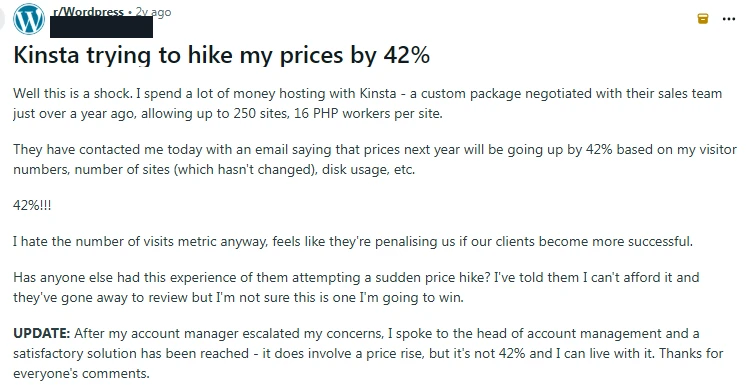
The same story repeats across hosts. A Kinsta customer on a custom 250-site plan was told prices would rise 42%, based on visitor numbers; after escalating, they settled on a smaller rise. The Single plan we tested renews at the same $29.17/mo it starts at, so on Kinsta the price moves with your traffic, not with the calendar.
Hosting.com, formerly A2 Hosting, raised one ten-year customer's yearly rate from $85.97 to $155, an 80% jump, or 69% after a one-time discount. The Turbo Boost plan we tested starts at $14.99/mo and renews at $34.99/mo.

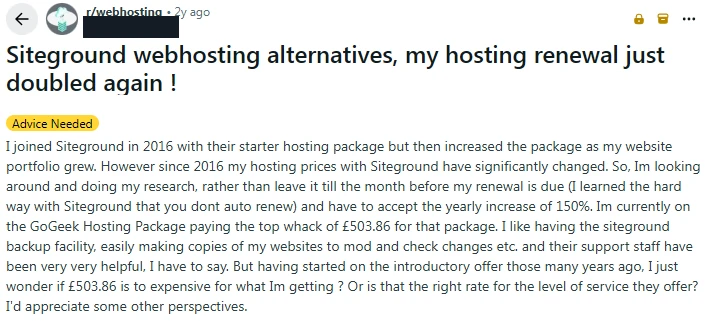
SiteGround draws the same complaint. A customer since 2016 quotes a 150% yearly increase and now pays £503.86 a year on GoGeek. The StartUp plan we tested goes from $3.99/mo to $17.99/mo at renewal.
InMotion too: a reseller plan bought for about $196 renews at $432. That is a reseller plan, not the Launch plan we tested, which goes from $4.79/mo to $14.99/mo.

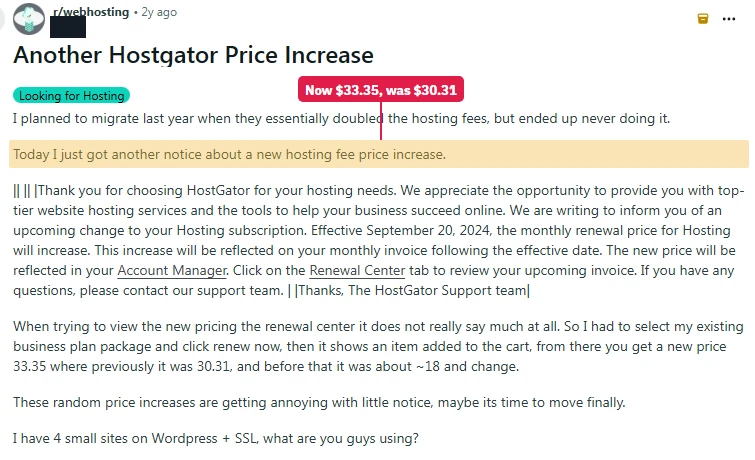
HostGator customers describe a slow creep rather than one jump: one traced their bill from about $18 to $30.31, then $33.35, with a renewal notice that never printed the new price.
Not every thread is a complaint. An agency moving over 100 sites from WP Engine to Cloudways wrote "Very happy so far", though still early in the move.

One warning is not about price. A Namecheap EasyWP customer cancelled the renewal and found the WordPress site deleted 30 days later, with no backup of their own. Whichever host you leave, download a full backup before the plan ends.

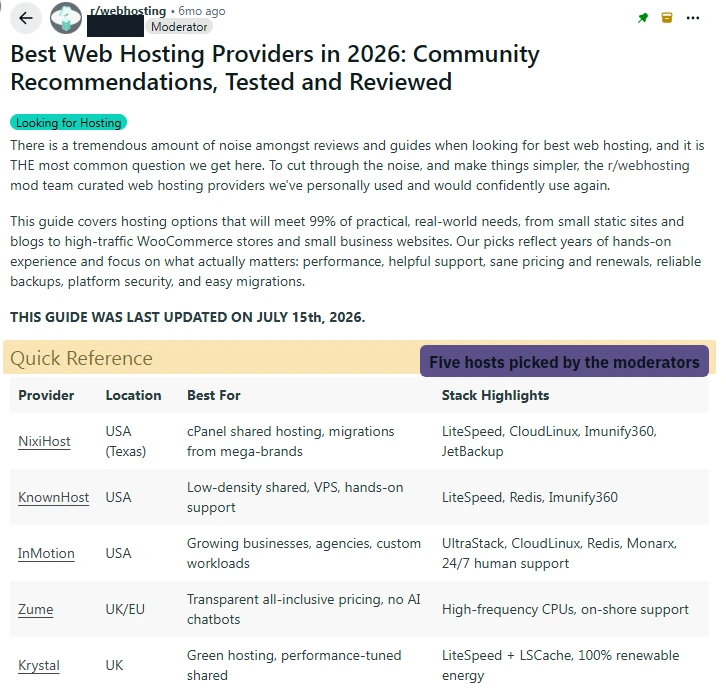
Reddit's recommendations need the same care as Trustpilot's averages. The r/webhosting moderators keep their own shortlist of five hosts, and the post says each listed host has a representative in the subreddit. Only one of the five, InMotion, is in our test: it scored 4.4 out of 10 and answered in 660ms with 100 users, so it sits in Also Tested, not in the picks. A community list is a fair place to start. Check it against measured numbers before you buy.
Which WordPress Host Fits Your Site
Decide by how much of your traffic skips the page cache. Cached pages are fast almost anywhere; logins, carts, checkouts and searches run PHP and the database on every request, and that is where the plans in this test split apart.
| Your site | Our pick | Why, from the tests | Price |
|---|---|---|---|
| New blog or small business site | ChemiCloud Starter | Fastest shared plan: 84ms TTFB | $3.49/mo, then $14.95/mo |
| Lowest total cost | Hostinger Premium | Lowest six-year cost of the top six plans | $9.82/mo over 6 years |
| Growing site, agency or developer | Cloudways | 74ms with 100 users; pick the cloud, resize any time | $16.00/mo for the entry server |
| WooCommerce, memberships, courses | ScalaHosting Entry Cloud | Best 100-user response: 58ms | $14.95/mo on 12 months |
| Large store, hands-off | Levamo Business or Performance | Database stayed up with 200 shoppers | $99.00/mo and up |
| Premium managed, one site | Kinsta Single 20GB | Highest PageSpeed score, 92ms with 100 users | $29.17/mo billed yearly |
Your first blog or business site
Start on ChemiCloud Starter: it was the fastest shared plan we measured, 84ms from New York, US, at $3.49/mo for the first year. If your readers are mostly in Europe and the total bill matters more than speed, Hostinger Premium costs less over six years.
| Host and plan | TTFB, nearest location | First term, then renewal | Six-year average | |
|---|---|---|---|---|
| Starter | 84ms, New York, US | $3.49/mo, then $14.95/mo | $13.04/mo | Check ChemiCloud Starter |
 Premium Premium | 109ms, Frankfurt, DE | $3.99/mo, then $10.99/mo | $9.82/mo | Check Hostinger Premium |
A high-traffic site
Buy dedicated CPU. With 100 visitors at once, ScalaHosting Entry Cloud answered in 58ms, Cloudways in 74ms and Kinsta in 92ms, while the shared plans took 240ms to 1400ms. A traffic spike is the 100-user test in real life: the plans that share one CPU core with the rest of the server queue the requests. More on sizing for big audiences in our high-traffic WordPress hosting guide.
| Host and plan | 100 users | Uptime | Price | |
|---|---|---|---|---|
| Entry Cloud | 58ms | 99.99% | $14.95/mo on 12 months | Check Entry Cloud Prices |
| Vultr HF | 74ms | 99.99% | $16.00/mo entry server, monthly | Start the Free Cloudways Trial |
| Single 20GB | 92ms | 99.99% | $29.17/mo billed yearly | Compare Kinsta Plans |
Cloudways or Kinsta for WordPress?
Cloudways, unless you want one site on a fully managed platform and will pay for it. Cloudways scored 8.8 to Kinsta's 7.5: faster from New York, US, faster with 100 users, and its entry server costs about half of Kinsta Single 20GB. Kinsta gives you the polished dashboard and makes the server decisions for you, on one WordPress install with a traffic allowance.
| | |
|---|---|---|
| Our score | 8.8/10 | 7.5/10 |
| TTFB, nearest location | 48ms | 64ms |
| 100 concurrent users | 74ms | 92ms |
| Entry price | $16.00/mo monthly, same at renewal | $29.17/mo billed yearly, $35.00/mo monthly |
| Sites | As many as the server holds | One WordPress install |
| Try before paying | 3-day free trial, no card | First month free on your first plan, then a 30-day money-back guarantee |
| Start the Free Cloudways Trial | Compare Kinsta Plans |
The full head-to-head, with both dashboards and the agency angle, is in Cloudways vs Kinsta.
Price against performance
Cloudways gives the most speed per dollar: its Vultr High Frequency line starts at $16.00/mo a month, close to ChemiCloud's six-year average of $13.04/mo, and the 4GB server we tested answered in 74ms with 100 users against ChemiCloud's 240ms. The shared plans cost less and slow down once many visitors arrive together; the six-year average counts their renewals.
| Plan | Six-year average | 100 users | Score |
|---|---|---|---|
| Bluehost Basic, now sold as Starter | $6.99/mo | 1400ms | 3.6 |
| Hostinger Premium (shared) | $9.82/mo | 520ms | 6.1 |
| ChemiCloud Starter (shared) | $13.04/mo | 240ms | 7 |
| SiteGround StartUp (shared) | $15.66/mo | 900ms | 5.1 |
| Cloudways Vultr High Frequency 4GB | $16.00/mo entry of the line | 74ms | 8.8 |
| Kinsta Single 20GB | $29.17/mo | 92ms | 7.5 |
| ScalaHosting Entry Cloud (managed VPS) | $32.45/mo | 58ms | 8.5 |
Bandwidth, storage and "unlimited" plans
Bandwidth and storage rarely decide how fast WordPress runs; CPU cores, PHP workers and memory do, and an "unlimited" plan still caps those. Hostinger Premium runs its 40 PHP workers on one CPU core with 2GB of memory. Kinsta Single 20GB counts 20GB of bandwidth or 35,000 visits a month and bills the traffic above that. On a shared server, an account that overloads it is limited, down to one PHP process at a time in the ScalaHosting case in the PHP workers section.
So compare plans on the CPU and the load result, then check the storage fits your site. How each of those limits works is in how WordPress hosting works.
Trying a host before you pay
Two of our picks let you run WordPress before paying: Cloudways' 3-day free trial needs no card, and Kinsta's first month is free on your first plan, with a 30-day money-back guarantee that starts after it. The shared plans on this page price their best rate on a yearly or longer term, paid at checkout, so read the renewal line before you commit.
On Cloudways, our two codes cut the first bills: CLOUDS2022 for $30 of credit and THATMY30 for 30% off your first 3 months, compared on our Cloudways promo code page.
WordPress hosting on Black Friday
Each of our top four picks has its own Black Friday page, where we track the deal, the renewal it lands on and when the sale starts. Our Black Friday hosting guide compares the WordPress deals for beginners, and lists which deals include a free domain.
| Host | Our pick for | |
|---|---|---|
| Best overall, developers and agencies | Cloudways Black Friday Deal |
| WooCommerce and membership sites | ScalaHosting Black Friday Deal |
| Premium managed WordPress | Kinsta Black Friday Deal |
| Budget shared hosting | ChemiCloud Black Friday Deal |
| Lowest six-year cost | Hostinger Black Friday Deal |
Who Owns Your WordPress Host
Two groups own several of the brands on this page. Newfold Digital owns Bluehost and HostGator. World Host Group owns hosting.com, which took over A2 Hosting in 2025 and FastComet the same year, and Rocket.net joined hosting.com in 2025. The highest-scoring shared and VPS hosts here, ScalaHosting, ChemiCloud and Kinsta, are independent, and Cloudways is part of DigitalOcean.
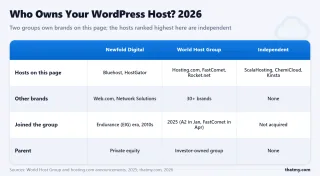
Ownership does not change a benchmark by itself, but it is worth knowing before you sign up for a multi-year term: renewal prices, support teams and data centres tend to change after an acquisition, and a change like that is when I re-test a host.
What the Next Test Round Adds
The ranking re-computes itself whenever a record changes, so each new measurement moves it on the next build. The next round adds:
- A separate database benchmark. Today the 100-user test measures the database as part of every uncached page.
- PHP worker counts and default PHP versions, read from each live account. Hostinger publishes its worker counts; the rest come from each plan's own panel.
- A 100-user step for FastComet and GoDaddy, and Rocket.net measured at its origin server. Their scores, and Rocket.net's place in the ranking, follow from those runs.
- Levamo's current plans on the 10-location benchmark, beside the store test that places them today.
- Backup restores, migrations and support response times stay in each host's own review, where they are covered on the account.

WordPress Hosting FAQ
What is the best WordPress hosting in 2026?
Cloudways scored highest of the 15 plans we scored: 8.8/10, with 48ms TTFB from New York, US and 74ms with 100 concurrent users on a Vultr High Frequency server, at $16.00/mo for the entry server of that line. ScalaHosting's Entry Cloud VPS follows at 8.5 and was the fastest plan under load (58ms), which makes it our pick for WooCommerce. ChemiCloud Starter is the best shared plan at 7.
How did you score the hosts?
80% performance and 20% value. Performance is TTFB from the nearest of 10 test locations (25%), the 10-location average (15%), response time with 100 concurrent users (25%) and uptime over 54 days (15%). Value is the average monthly price over six years, first term then renewal, of the entry plan on the line we tested (20%). Each part is scored 0 to 10 and the page computes the total from our test records at build time, so a changed measurement moves the ranking by itself.
Why is Cloudways scored at a lower price than the server you tested?
We tested Cloudways on a Vultr High Frequency 4GB server ($60.00/mo). Every other host is scored at the price of its entry plan, so Cloudways is scored at the entry of the same Vultr High Frequency line, the 1GB server at $16.00/mo. Scoring one host on a bigger server than the rest would have been unfair. The 1GB server has a quarter of the memory, so start there for one site and resize when traffic grows.
What are PHP workers and how many do I need?
A PHP worker is one process that builds one uncached page at a time. A cached page never needs one; a cart, checkout, login, search or wp-admin page always does. When every worker is busy, the next request waits. The number alone can mislead: Hostinger Premium lists 40 PHP workers, but they share one CPU core, so under load they wait for the CPU instead. A blog that serves cached pages needs few workers; a store needs workers and the CPU cores to run them.
What PHP version should my WordPress host run?
PHP 8.3 or newer, which is what WordPress.org recommends. PHP 8.2 gets security fixes only until 31 December 2026, and 8.1 and older are past end of life. 37.6% of WordPress sites still run an end-of-life PHP version, almost as many as run 8.3 or newer (37.9%). Check yours in Tools, Site Health, Info, Server, and switch it in your host's control panel.
Is managed WordPress hosting worth the extra cost?
Only if your traffic skips the page cache. A blog that serves cached pages ran fine on shared plans in our tests. Carts, checkouts, logged-in members and searches cannot be cached, and there the gap is large: with 100 concurrent users ScalaHosting's managed VPS answered in 58ms and Cloudways in 74ms, while shared plans took 240ms (ChemiCloud) to 1400ms (Bluehost).
What is the best cheap WordPress hosting?
ChemiCloud Starter: 84ms TTFB, 240ms with 100 users and 99.97% uptime, on an AMD EPYC server. It costs $3.49/mo for the first year and $14.95/mo after that, so budget for the renewal. Hostinger Premium is cheaper over six years ($9.82/mo on average) but slowed to 520ms with 100 users.
What is the best WordPress hosting for WooCommerce?
For most stores, ScalaHosting's managed VPS: two dedicated CPU cores, the fastest 100-user response we measured (58ms) and room for Redis. Cloudways is the flexible alternative and gave more checkout capacity per dollar in our store test. For a large catalogue with busy checkouts and no wish to manage a server, Levamo's Business and Performance plans kept their database up with 200 shoppers.
Cloudways or Kinsta: which is better for WordPress?
Cloudways for most sites: it scored 8.8 to Kinsta's 7.5, answered in 74ms with 100 concurrent users against Kinsta's 92ms, and its entry server costs $16.00/mo against $29.17/mo for Kinsta Single 20GB billed yearly. Kinsta suits one site whose owner wants every server decision made for them. Cloudways also lets you run a server free for 3 days with no card.
What are Hostinger's WordPress hosting limitations?
On the Premium plan we tested, Hostinger publishes 40 PHP workers on one CPU core with 2GB of RAM, a 1,536MB PHP memory limit per request, 25 MySQL connections per user and 400,000 inodes. The single core is the limit that bites: Premium answered in 109ms for one visitor and 520ms with 100 at once. It suits a small, mostly cached site, not a busy store.
Does more bandwidth or an unlimited plan make WordPress faster?
No. Speed comes from CPU cores, PHP workers and memory, and unlimited shared plans still cap those: Hostinger Premium runs its PHP workers on a single core. Compare plans on how they behave with many visitors at once, the 100-user figure in our ranking.
Which WordPress hosts have a free trial?
Cloudways gives a 3-day free trial with no card needed, then bills by the month. Kinsta makes the first month free on your first plan and adds a 30-day money-back guarantee after it. The shared hosts on this page price their best rate on a yearly or longer term paid at checkout.
Where are the best WordPress hosting Black Friday deals?
Our Black Friday hosting guide tracks every host's deal, the renewal it lands on and when the sale starts, with a section for WordPress beginners. Cloudways, ScalaHosting, Kinsta, ChemiCloud and Hostinger each have their own Black Friday page there. Check the renewal price before you buy a long term.
Why do some hosts show two different TTFB numbers?
Distance. SiteGround and Hostinger put our test sites in Europe, so their fastest location is Frankfurt, not New York. We score the nearest of 10 locations to be fair to where each server sits, and add the 10-location average because your visitors are not all next to the data centre.
Why is Rocket.net not in the ranking?
Its figures are not comparable with the rest. Rocket.net's TTFB was measured at the Cloudflare edge, which is what a cached page gets, while every other plan was measured at its origin server with no CDN in front. It also has no measured 100-user step. So it stays in our test records and in the also-tested table, but it is not scored.
Are Trustpilot ratings useful for choosing a host?
The average is not: every host we checked sits between 4.2 and 4.9, and 11 of the 16 profiles carry Trustpilot's paid subscription label. The share of 1-star reviews is more telling, and it follows our tests: under 1% for ScalaHosting and 2% for ChemiCloud, against 15% for Bluehost and 16% for InMotion.
What does WordPress hosting really cost over six years?
Much more than the first-term price suggests. On the plans we tested, the six-year monthly average is $15.66/mo for SiteGround StartUp ($3.99/mo first year), $13.04/mo for ChemiCloud Starter ($3.49/mo first year) and $9.82/mo for Hostinger Premium. Cloudways and Kinsta charge the same every month, so their six-year average equals the list price.
Does hosting affect WordPress SEO?
Through speed and uptime. Server response time is the first part of Largest Contentful Paint, one of Google's Core Web Vitals, so a slow TTFB starts every page behind. Downtime during a crawl can drop pages temporarily. Across our 54-day window, uptime ranged from 99.99% (ScalaHosting, 8 minutes down) to 99.83% (GoDaddy, 132 minutes down).
When is this page tested again?
When a host changes the plan we tested or we run a new test round. The changelog at the end of the page lists every update.