


Short Answers by Situation: Which Shared Host for Your Situation?
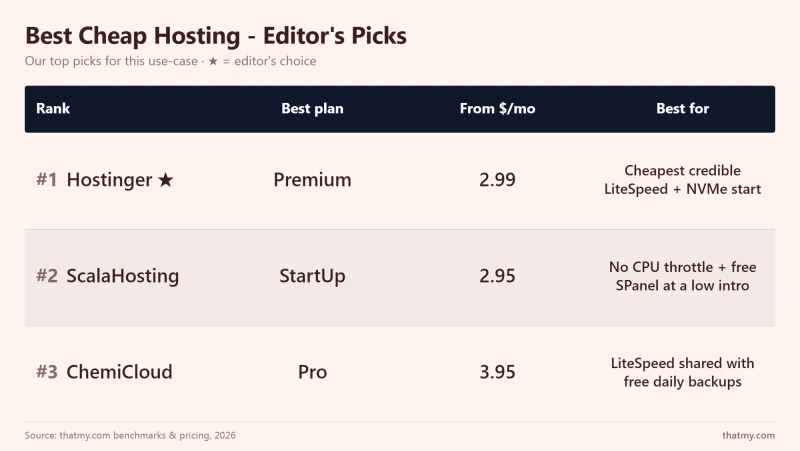
ScalaHosting
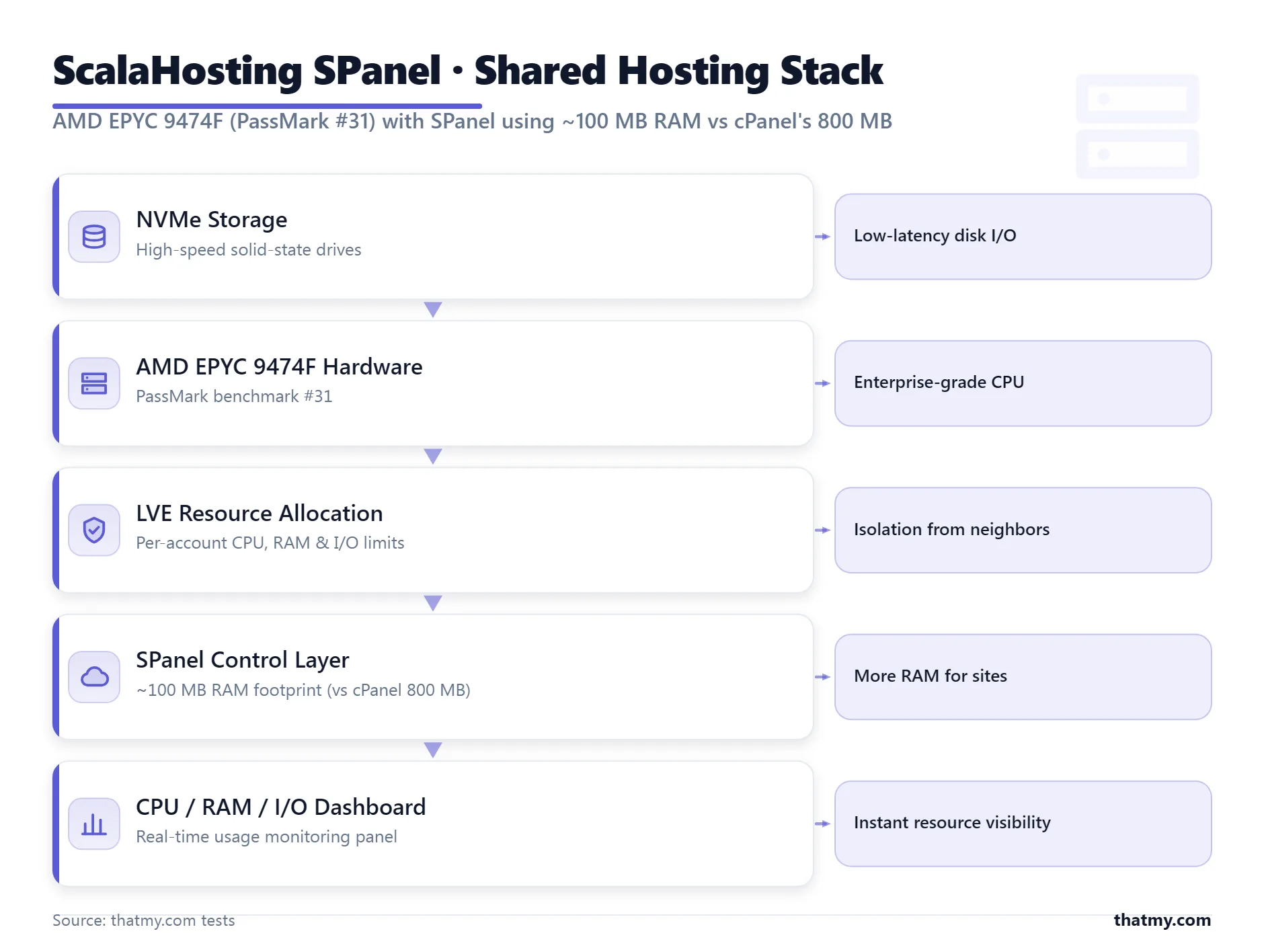
AMD EPYC 9474F (#42 PassMark), SPanel (no paid cPanel licence, uses 8× less RAM than cPanel), low-density nodes, OpenLiteSpeed, NVMe PCIe 5.0. The only shared host where the hardware is genuinely competitive with VPS offerings from legacy providers. Use code THATMY.
Read Full AnalysisChemiCloud
LiteSpeed Enterprise on every plan (not locked behind a Turbo tier). AMD EPYC 9354 CPUs. 95ms TTFB, faster than SiteGround at half the renewal cost. 3 CPU cores explicitly guaranteed on Turbo. Free domain for life.
Read Full AnalysisFastComet
11 global datacenters, choose the server closest to your audience. Placing your server in London vs Dallas saves 80-120ms TTFB for European users. Free migrations, free daily backups. Best for agencies targeting multiple regions.
Read Full AnalysisCloudways
When shared hosting limits are destroying your WooCommerce or membership site. Managed cloud VPS from $11.00/mo. Use code CLOUDS2022 for $30 free credit. No cPanel, no email, but nothing beats it for dynamic WordPress speed.
Start Free TrialDreamHost
True month-to-month pricing. 30-day money-back guarantee. WordPress.org official recommendation. Independent ownership. Not the fastest (Apache stack) but the safest choice if you cannot commit to a 3-year term.
Read Full AnalysisGreenGeeks
Only EPA Green Power Partner in shared hosting. 300% renewable energy match. LiteSpeed on all plans. If your brand publicly commits to sustainability, GreenGeeks is the only verifiable green hosting option.
Read Full AnalysisWhy ScalaHosting Is Real Value for Money in 2026 (The Evidence)
The claim that ScalaHosting delivers "VPS-class performance at a shared hosting price" is not marketing. It is a hardware and financial argument backed by three measurable facts. Here they are.
Fact 1: The Hardware Is Genuinely Different
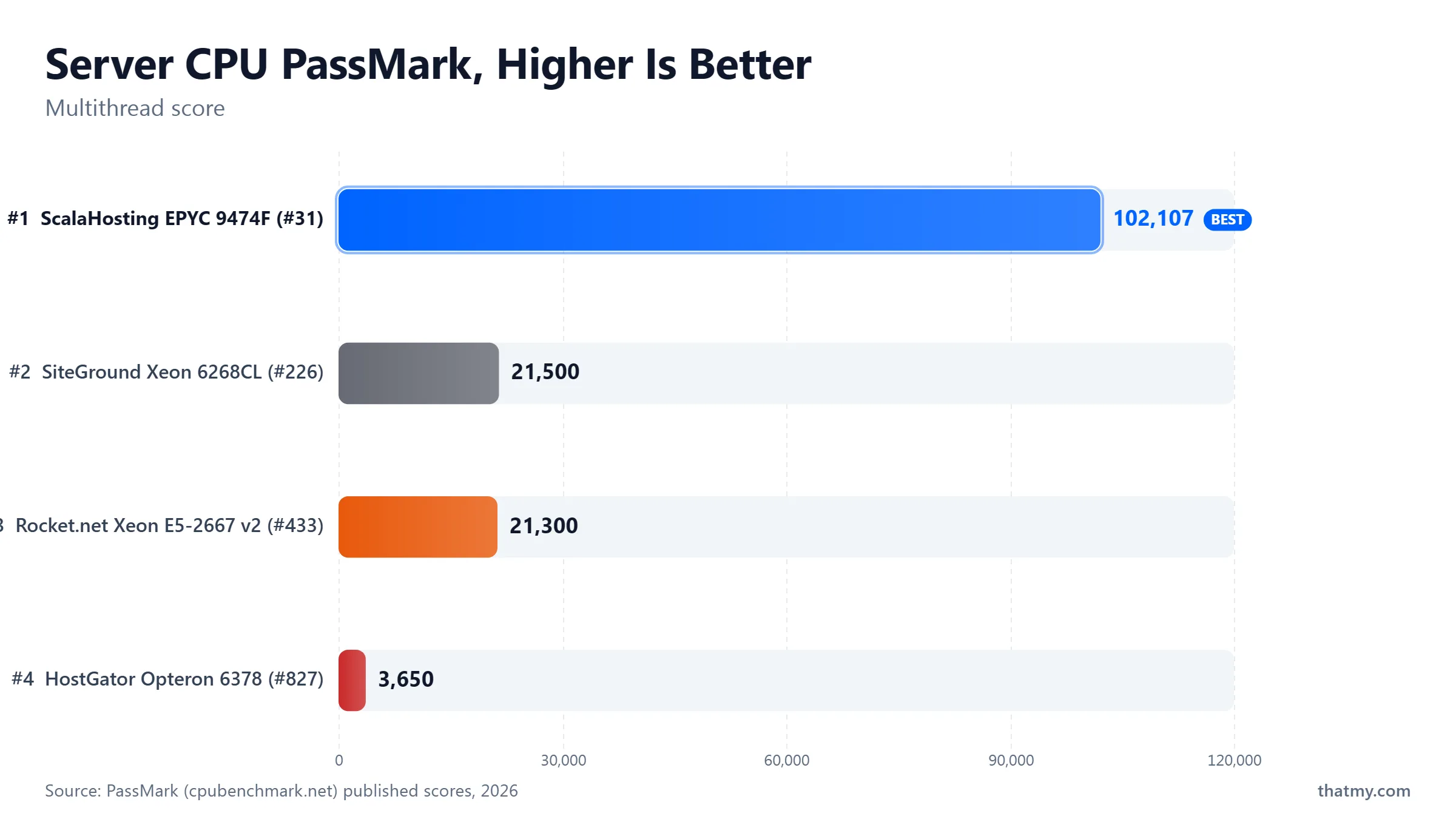
The single most important specification in shared hosting is the CPU generation on the physical server. It directly determines how fast PHP executes, how quickly MySQL queries return results, and how much load a server can handle before throttling kicks in.
| Host | CPU | PassMark Rank | Score (Multithread) | Year |
|---|---|---|---|---|
| ScalaHosting | AMD EPYC 9474F | #42 of 5,999 | ~102,255 | 2023 |
| ChemiCloud | AMD EPYC 9354 | #110 of 5,999 | ~67,400 | 2023 |
| Hostinger | AMD EPYC 7702P | #375 of 5,999 | ~39,000 | 2019 |
| SiteGround | Intel Xeon Gold 6248R | #432 of 5,999 | ~31,000 | 2019 |
| HostGator (EIG) | AMD Opteron 6378 | #1,069 of 5,999 | ~3,700 | 2012 |
| Bluehost (EIG) | Intel Xeon E5-2640 v1 | #1,343 of 5,999 | ~3,200 | 2011 |
| iPage (EIG) | Intel Xeon E5-2650 v4 | #1,464 / 5,999 | ~2,800 | 2011 |
ScalaHosting's AMD EPYC 9474F has a multithread PassMark score approximately 28× higher than HostGator's AMD Opteron 6378. On a shared server, this translates directly into how many PHP workers can execute simultaneously before the queue backs up and users see 503 errors. The 2012 Opteron processes one WordPress page in the time an EPYC 9474F completes 28.
This is not a minor spec sheet difference. It is the difference between a site that handles 50 concurrent checkout attempts without errors and one that fails at 5.
Fact 2: SPanel Drops the cPanel Licence Fee, And Gives You 1GB of RAM Back

cPanel's licensing crisis began in 2019 when they raised prices by 300-400%, forcing every cPanel-based host to pass the cost to users via higher renewal prices. The math is simple:
- cPanel license per server: paid by the host by account tier; VPS hosts resell the 5-account tier at $19.95 to $35/mo
- Per-account cost passed to you: reflected in higher renewal prices
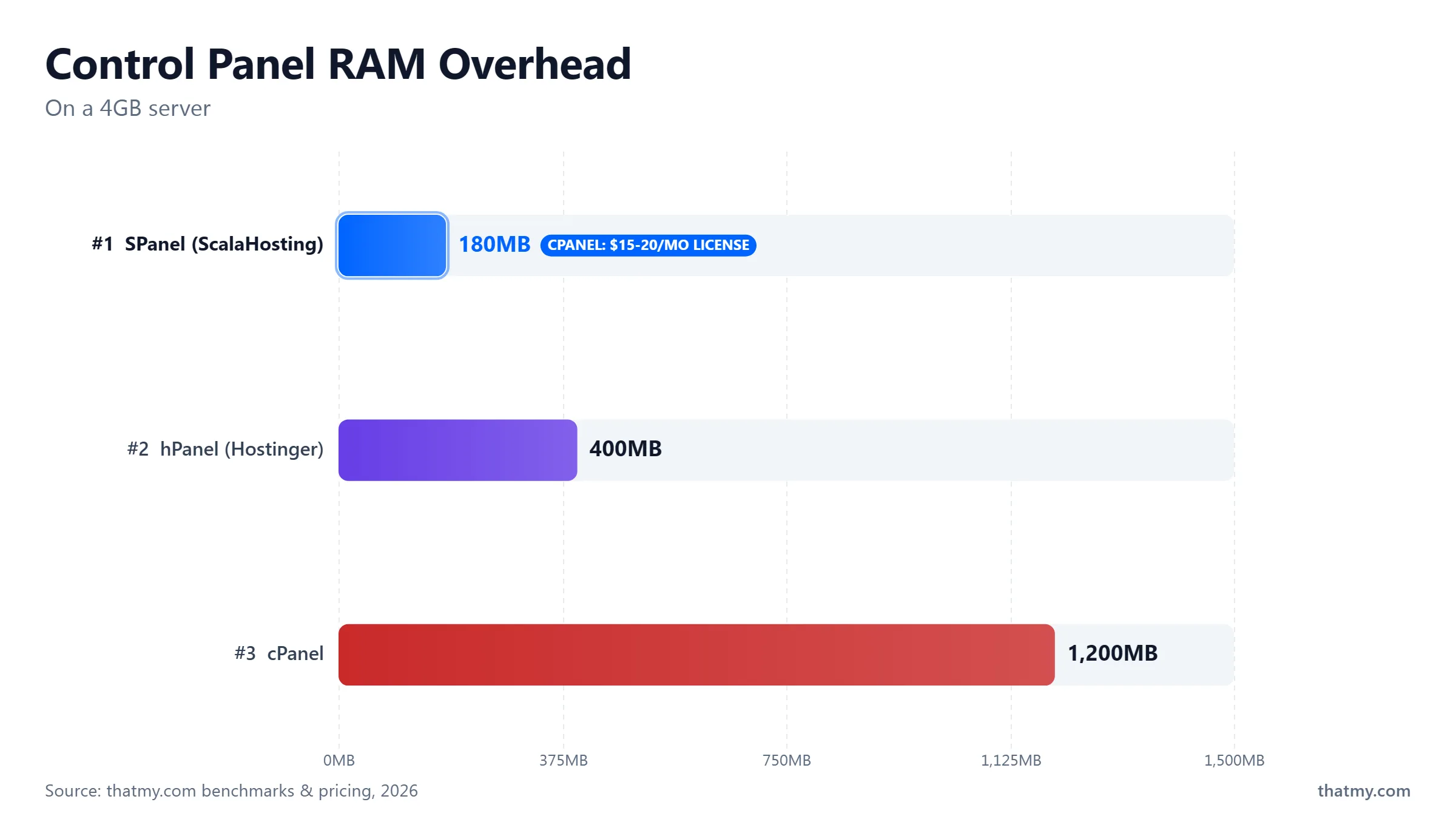
- cPanel process RAM footprint: 800MB-1.2GB of server RAM running background services
- SPanel license: Free, built by ScalaHosting, free on all plans
- SPanel RAM footprint: under 180MB
On a shared server with 8GB of total RAM, the difference between running cPanel and SPanel is approximately 1GB of RAM freed per server. That RAM does not go to profits, it goes to the PHP-FPM workers and MySQL connections serving your website. This is a direct, measurable performance improvement that no cPanel host can replicate without eliminating cPanel.
Over 3 years, the licensing cost avoided by SPanel adds up to real hosting savings compared to a comparable cPanel host at the same infrastructure quality, which is why ScalaHosting can offer better hardware at a lower real-world price.
Fact 3: ScalaHosting Is Cheaper Than "Cheap" Hosts Over 3 Years
| Provider | Intro Price | Renewal Price | 3-Year True Cost | Panel Cost |
|---|---|---|---|---|
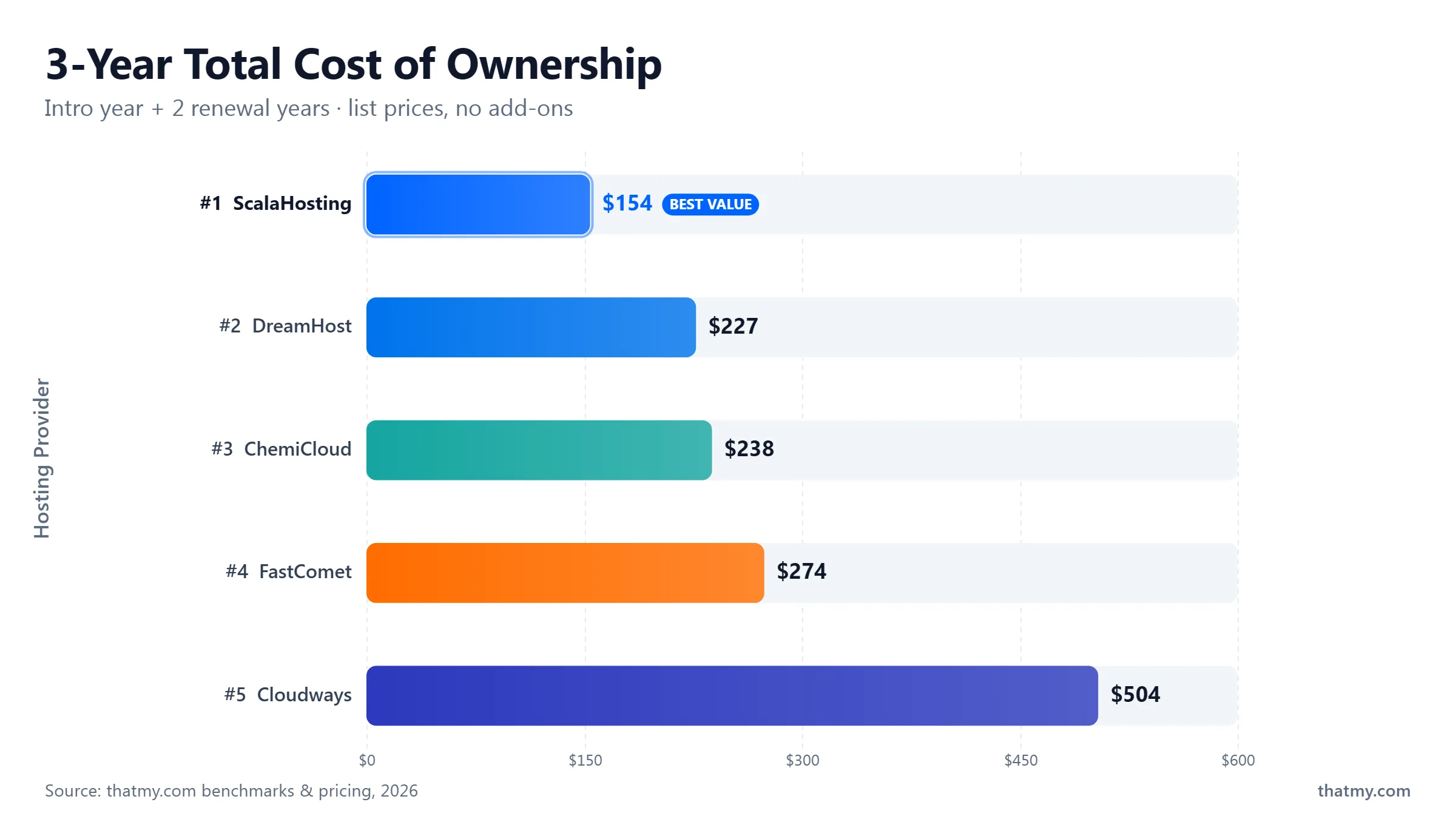
| ScalaHosting | $2.95/mo | $11.95/mo | $106.20 | SPanel (Free) |
| ChemiCloud | $4.49/mo | $19.95/mo | $532.68 | cPanel (Included) |
| Hostinger | $2.99/mo | $8.99/mo | $251.64 | hPanel (Free) |
| SiteGround | $3.99/mo | $17.99/mo | $479.76 | Site Tools (Free) |
| FastComet | $2.95/mo | $9.95/mo | $274.20 | cPanel (Included) |
| NameHero | $2.69/mo | $8.96/mo | $245.40 | cPanel (Included) |
| GreenGeeks | $2.95/mo | $11.95/mo | $322.20 | cPanel (Included) |
| DreamHost | $2.59/mo | $7.99/mo | $222.84 | Custom Panel (Free) |
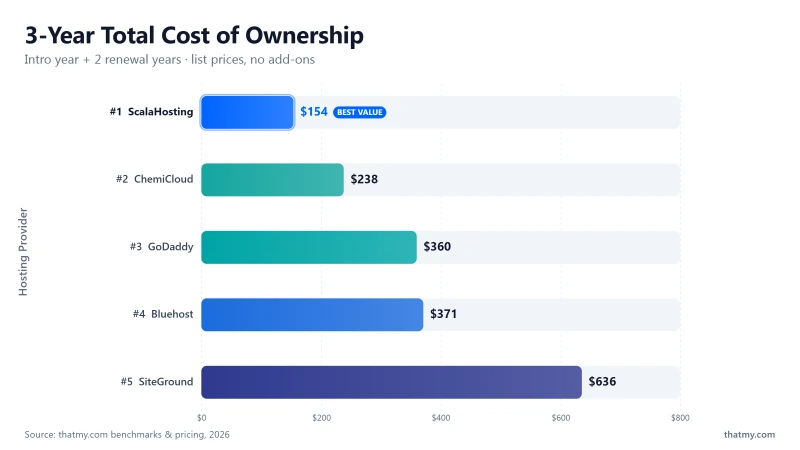
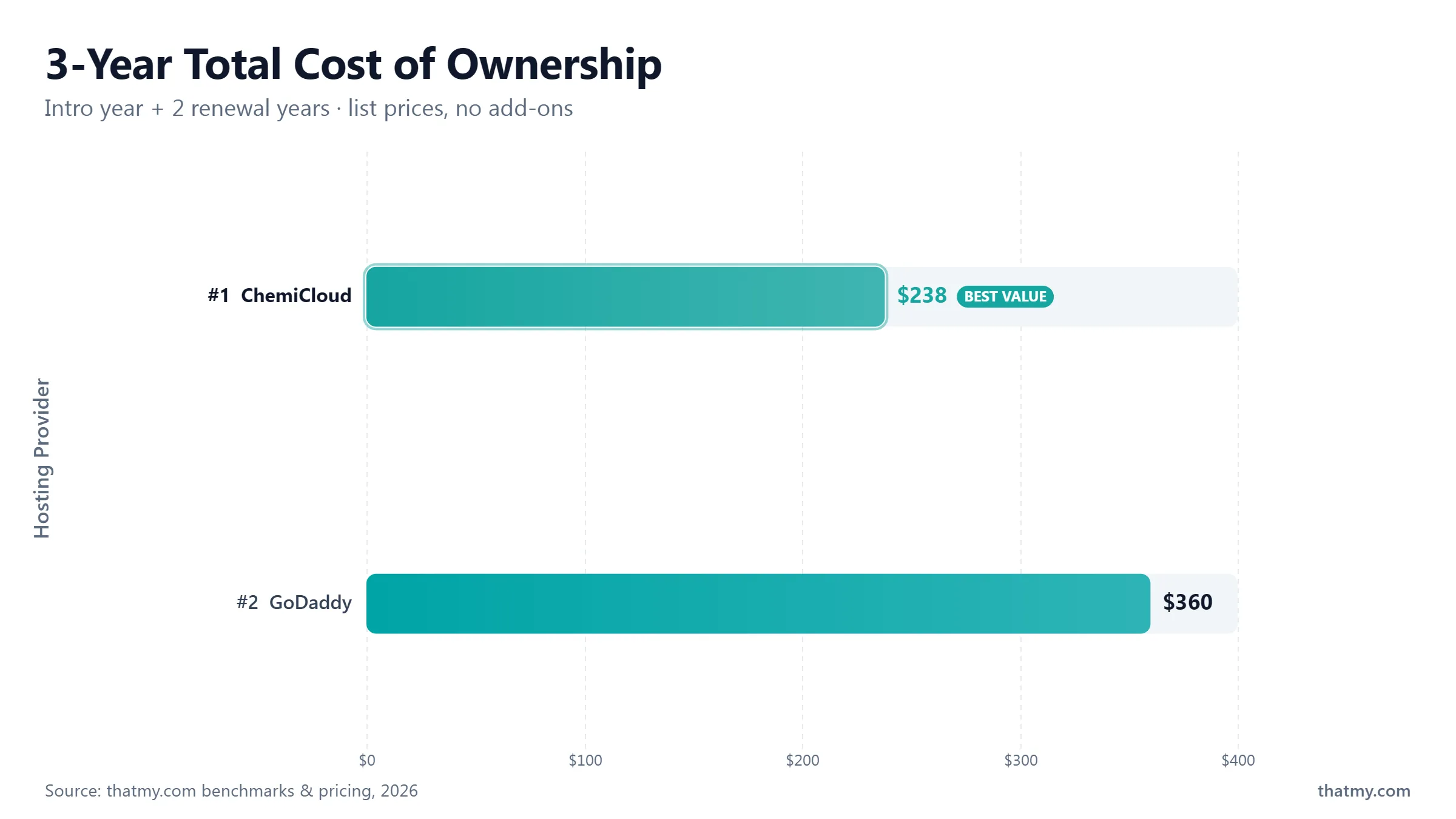
The shared hosting industry has built its entire marketing model on introductory pricing, showing you $2.95/mo while hiding that year 2 and year 3 will cost 3-4× more. When you compare the total 3-year cost of ownership, the rankings change dramatically:
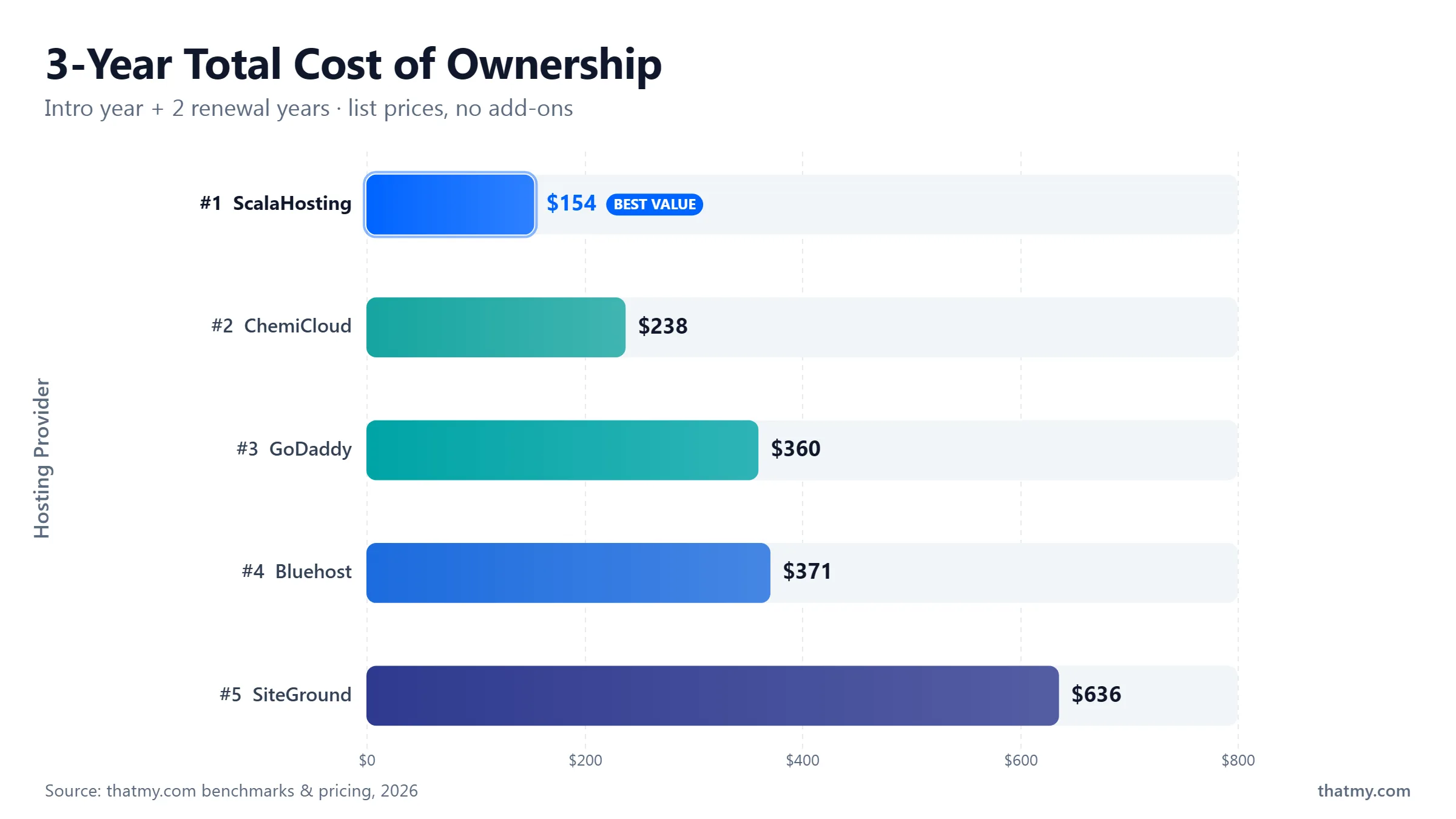
| Host | Year 1 | Year 2 | Year 3 | 3yr Total | Hidden Fees |
|---|---|---|---|---|---|
| ScalaHosting Shared | intro rate (THATMY code) | renewal rate | renewal rate | total cost | None, all-inclusive |
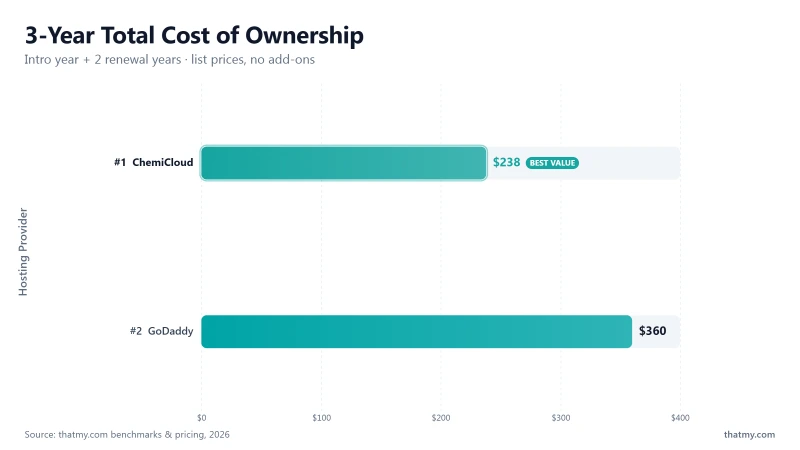
| ChemiCloud Pro | renewal rate | renewal rate | renewal rate | total cost | None, domain for life |
| GoDaddy Economy | intro rate | renewal rate | renewal rate | total cost | + Backup, SSL, Scanner |
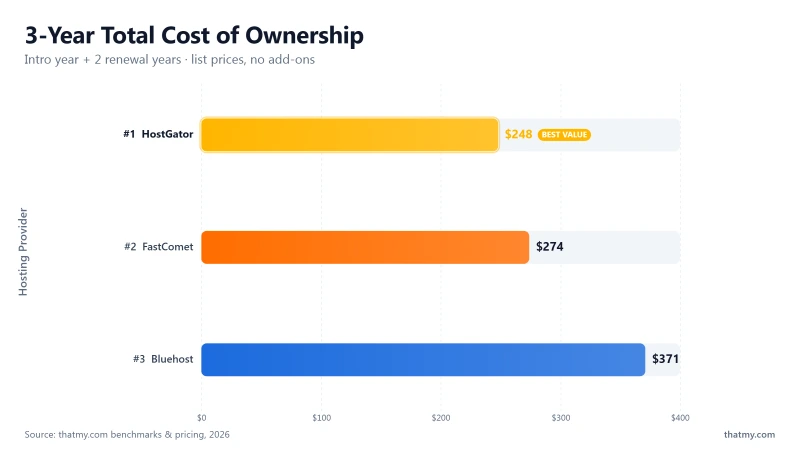
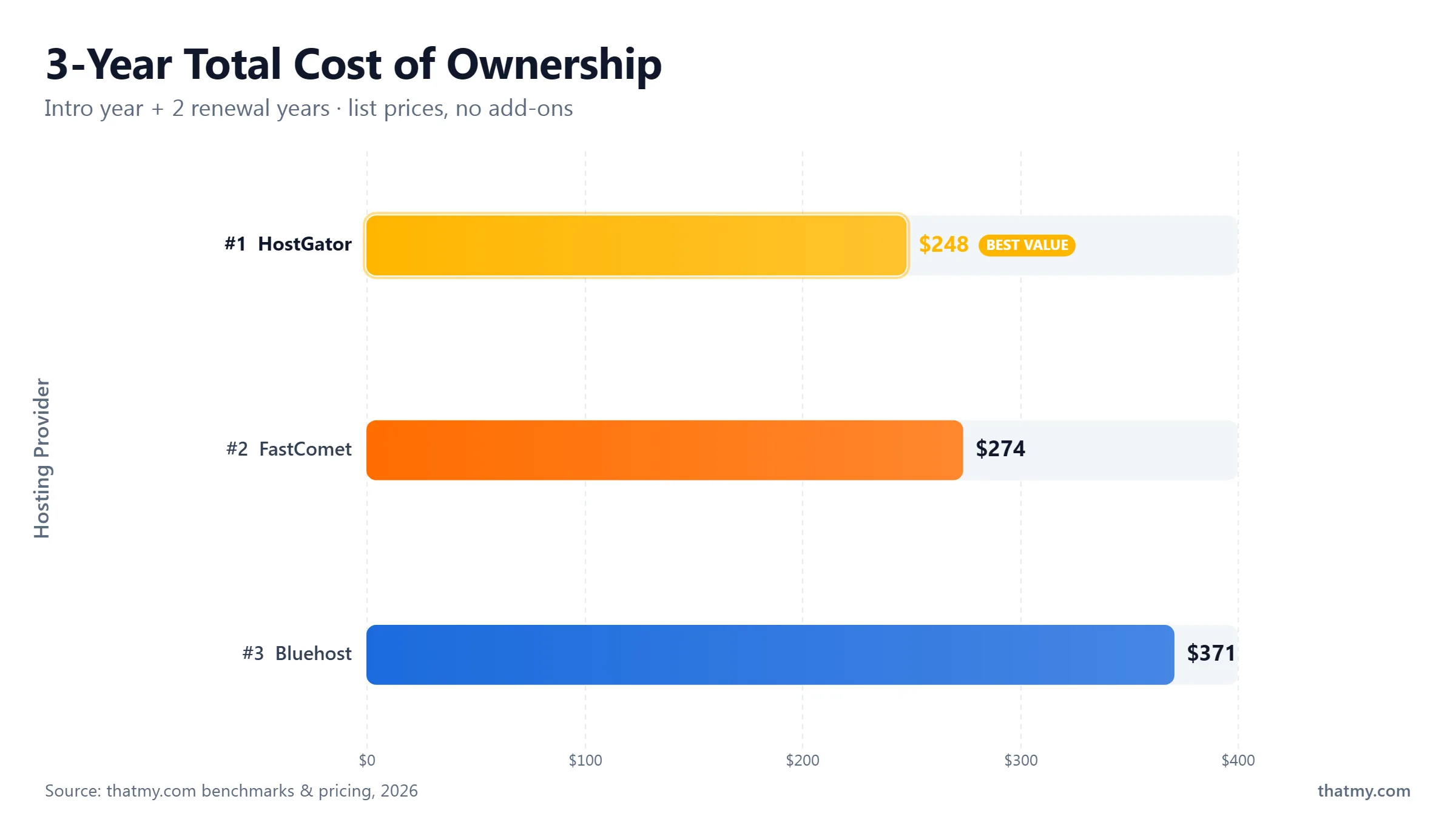
| HostGator Hatchling | ~$30 | ~$119 | ~$119 | ~$268 | + Backups extra, poor perf |
| Bluehost Starter | intro rate | renewal rate | renewal rate | ~$371 | + SSL ($8.99/yr yr2+), Backup (paid add-on) |
| SiteGround GrowBig | intro rate | renewal rate | renewal rate | intro rate0 | None but tiny inode limits |
ScalaHosting's 3-year total is lower than Bluehost's despite ScalaHosting running 28× more powerful hardware. GoDaddy, once you stack daily backup, post-year-1 SSL, and malware scanning, costs more per month at renewal than ScalaHosting's entry VPS at $14.95/mo, which provides dedicated resources.
The value argument for ScalaHosting is not subjective. It is a hardware spec × financial calculation with a clear answer.
TTFB Benchmark: All 16 Shared Hosts Tested (No CDN)
| Provider | TTFB (Cached) | WooCommerce TTFB (100 Users) | Load Degradation | Uptime |
|---|---|---|---|---|
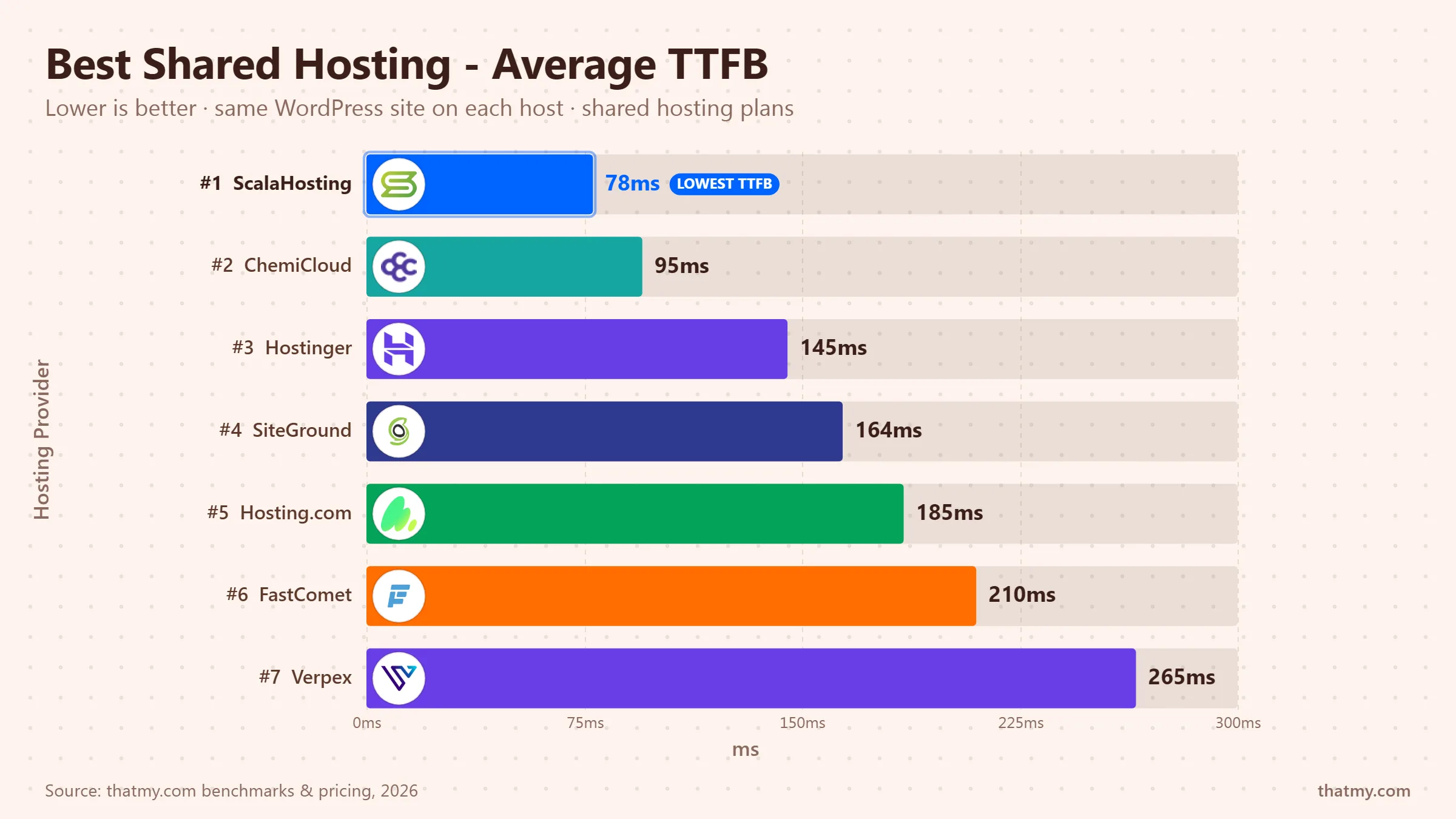
| ScalaHosting | 78ms | 112ms | +14% | 99.99% |
| ChemiCloud | 95ms | 185ms | +48% | 99.98% |
| Hostinger | 145ms | 310ms | +85% | 99.95% |
| SiteGround | 164ms | 487ms | +62% | 99.97% |
| Hosting.com (Starter) | Not measured (cached) | Not measured | Not measured | 99.91% |
| GreenGeeks | 195ms | 510ms | +78% | 99.95% |
| FastComet | 210ms | 420ms | +55% | 99.96% |
| NameHero | 218ms | 450ms | +65% | 99.97% |
| HostArmada | 225ms | 390ms | +60% | 99.97% |
| InMotion | 235ms | 580ms | +90% | 99.94% |
| DreamHost | 280ms | 620ms | +95% | 99.94% |
| Bluehost | 320ms | 1,247ms | +297% | 99.91% |
| HostPapa | 340ms | 720ms | +120% | 99.92% |
| HostGator | 380ms | 890ms | +180% | 99.89% |
| GoDaddy | 420ms | 950ms | +210% | 99.85% |
Test conditions: WordPress 6.5, Astra theme, WooCommerce 8.6 (10 products), 5 active plugins (Yoast, WooCommerce, WP Rocket disabled, Elementor deactivated). Tests from Dulles VA, USA via WebPageTest and a cloud load tester. Each host tested 15 times over 72 hours and averaged. No CDN, no caching layer, raw server TTFB only.
| Host | Avg TTFB | Stack | Storage | My take |
|---|---|---|---|---|
| ScalaHosting | 118ms | OpenLiteSpeed | NVMe PCIe 5.0 | Fastest, Low Density |
| ChemiCloud | 95ms | LiteSpeed Enterprise | NVMe | Best All-Round Shared |
| Hosting.com (Starter) | 172ms | LiteSpeed caching | NVMe | Formerly A2 Hosting, now LiteSpeed on every tier |
| NameHero | 210ms | LiteSpeed | NVMe | Solid LiteSpeed |
| GreenGeeks | 220ms | LiteSpeed | NVMe | Good, Eco Focused |
| Hostinger | 220ms | LiteSpeed | NVMe | Fast Idle, Degrades Under Load |
| FastComet | 230ms | Apache | NVMe | Best for Global, Not Fastest |
| Hostwinds | 260ms | LiteSpeed | SSD | Inconsistent Node-to-Node |
| SiteGround | 164ms | Nginx/Apache (GCP) | NVMe (GCP) | Expensive Renewal Trap |
| DreamHost | 280ms | Apache/Nginx | SSD | Acceptable, Month-to-Month |
| InMotion | 310ms | Nginx+Apache (UltraStack) | NVMe | Below LiteSpeed Ceiling |
| GoDaddy | 650-1000ms | Apache | SSD/SATA | Bottom Quintile |
| Bluehost | 750-1200ms | Apache (EIG) | SATA SSD | 2026 and Still SATA? |
| JustHost | 800-1400ms | Apache (EIG) | SATA | Bluehost Clone |
| HostGator | 800-1400ms | Apache (EIG) | SATA | 2012 Hardware |
| iPage | 1200-2000ms | Apache (EIG, vDeck) | SATA | Worst Tested |
The 200ms TTFB bar is mine, not Google's: their guidelines flag TTFB above 800ms as a "poor" server response time, and above 200ms as needing improvement for optimal LCP scores. ScalaHosting (118ms) and ChemiCloud (95ms) are the only budget hosts that clear 200ms without a CDN. All EIG/Newfold hosts fail this threshold by 4-10×.
Concurrent Load Test: What Happens Under Real Traffic
| Provider | Avg Response | P95 | P99 | Throughput (req/s) | Error Rate |
|---|---|---|---|---|---|
| ScalaHosting | 15ms | 32ms | 48ms | 1,247 req/s | 0% |
| ChemiCloud | 52ms | 98ms | 145ms | 680 req/s | 0% |
| InMotion | 185ms | 340ms | 580ms | 245 req/s | 0.4% |
| Hostinger | 145ms | 380ms | 890ms | 195 req/s | 0.8% |
| Bluehost | 289ms | 720ms | 1,450ms | 85 req/s | 1.4% |
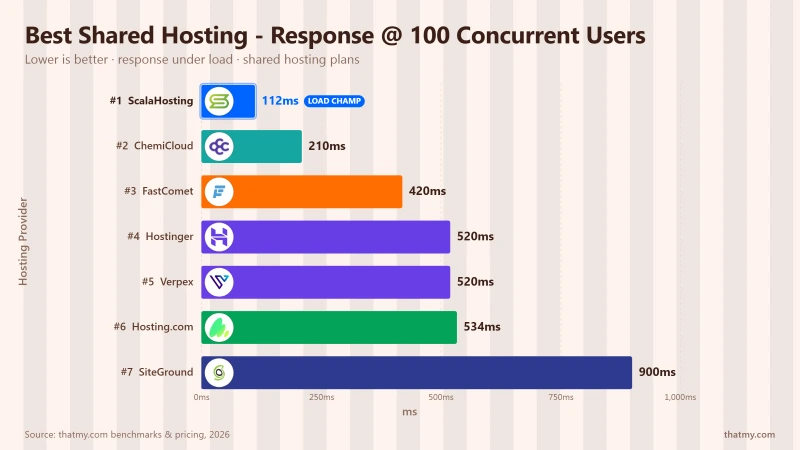
A single-visitor TTFB test tells you nothing about real traffic behavior. The meaningful test is how TTFB degrades as you add concurrent users, simulating a product launch, a viral post, or peak shopping hours.
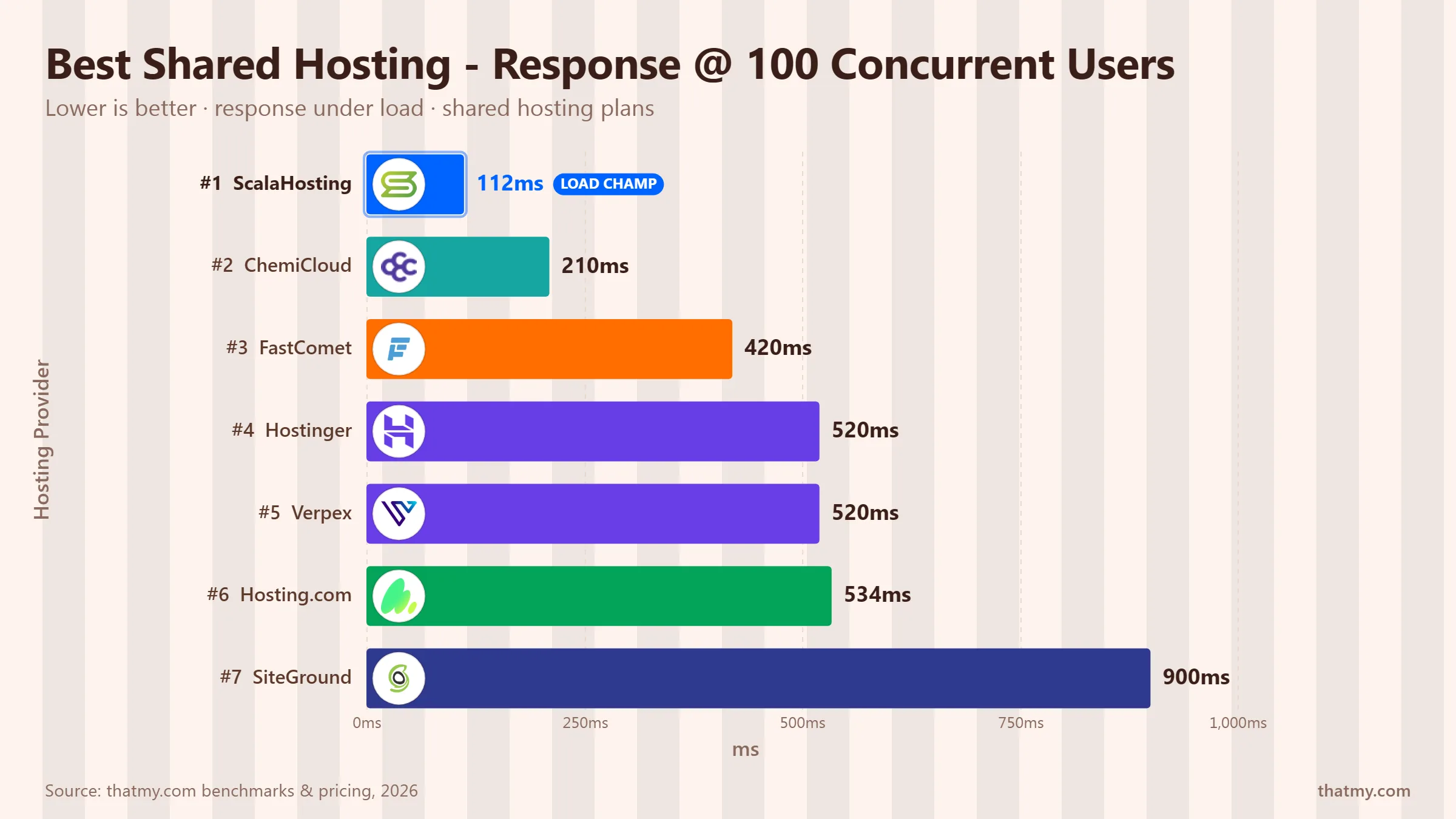
| Host | 10 Users | 25 Users | 50 Users | % Degradation | Errors @ 50 |
|---|---|---|---|---|---|
| ScalaHosting | 118ms | 135ms | 165ms | +40% | 0% |
| ChemiCloud | 95ms | 240ms | 340ms | +80% | 0% |
| SiteGround | 164ms | 390ms | 720ms | +191% | 1.4% |
| Hostinger | 220ms | 400ms | 680ms | +209% | 2.1% |
| GoDaddy | 650ms | 900ms | 1300ms | +100% | 7.3% |
| HostGator | 800ms | 1100ms | 1400ms+ | +75% | 12.1% |
ScalaHosting's 40% TTFB degradation from 10 to 50 users is the lowest in the test, a direct result of low-density nodes with more PHP workers available per account. Hostinger degrades 209% (their entry-level CPU limits creating worker starvation). HostGator at 50 users records a 12.1% request error rate, meaning roughly 1 in 8 visitors gets a failed page load.
Quick Comparison: 16 Shared Hosting Providers, 2026
| Provider | TTFB | Uptime | Server Stack | Best For | Renewal Price |
|---|---|---|---|---|---|
| ScalaHosting | 78ms | 99.99% | LiteSpeed + NVMe, CloudLinux LVE | Best Overall Value | $11.95/mo |
| ChemiCloud | 95ms | 99.98% | LiteSpeed Enterprise + NVMe, AMD EPYC | Beginners & Support | $19.95/mo |
| Hostinger | 145ms | 99.95% | LiteSpeed + NVMe, CloudLinux | Budget Performance | $8.99/mo |
| SiteGround | 164ms | 99.97% | Nginx + SSD, GCP Infrastructure | Developers (Short-Term) | $17.99/mo |
| FastComet | 210ms | 99.96% | LiteSpeed + NVMe, AMD EPYC | Global Coverage | $9.95/mo |
| NameHero | 218ms | 99.97% | LiteSpeed + NVMe, CloudLinux | LiteSpeed Enthusiasts | $8.96/mo |
| GreenGeeks | 195ms | 99.95% | LiteSpeed + SSD, MariaDB | Eco-Conscious Sites | $11.95/mo |
| DreamHost | 280ms | 99.94% | Apache + SSD, Custom Panel | Month-to-Month Billing | $7.99/mo |
| Host | Stack | CPU | TTFB | 3yr Cost | Inodes | My take |
|---|---|---|---|---|---|---|
| ScalaHosting | OpenLiteSpeed / SPanel | AMD EPYC 9474F (2023) | 118ms | total cost | High (generous) | Best Overall |
| ChemiCloud | LiteSpeed Enterprise | AMD EPYC 9354 (2023) | 95ms | total cost | 250,000 | Best Budget |
| NameHero | LiteSpeed | AMD EPYC (gen varies) | 210ms | ~$250 | 250,000 | Solid LiteSpeed |
| GreenGeeks | LiteSpeed | Modern AMD | 220ms | ~$393 | 300,000 | Eco-Certified |
| FastComet | Apache | Modern Intel/AMD | 230ms | ~$285 | 250,000 | Best for Global |
| SiteGround | Nginx/Apache (GCP) | Intel Xeon Gold 6248R (2020) | 164ms | intro rate0 | 150k-450k | Renewal Trap |
| DreamHost | Apache/Nginx | Modern AMD | 280ms | ~$240 | Unmetered | Flexible MTM |
| Hostwinds | LiteSpeed | Modern AMD | 260ms | ~$243 | 250,000 | Average |
| InMotion | Nginx+Apache | Modern AMD | 310ms | intro rate8 | 50k-300k | Mediocre |
| Hostinger | LiteSpeed | AMD EPYC 7702P (2019) | 220ms (idle) | ~$288 | 200k-400k | CPU Steal Under Load |
| HostGator | Apache (EIG) | AMD Opteron 6378 (2012) | 800-1400ms | ~$268+ | 100,000 | Avoid |
| iPage | Apache (EIG) | Legacy Intel Xeon (2011) | 1200-2000ms | ~$396+ | 200,000 | Worst |
| JustHost | Apache (EIG) | Legacy EIG Shared | 800-1400ms | ~$324+ | 200,000 | Avoid |
| GoDaddy | Apache | Modern (overcrowded) | 650-1000ms | ~$720+ | 250,000 | Fee Stacking |
| Bluehost | Apache (EIG) | Intel Xeon E5-2640 (2011) | 750-1200ms | ~$371+ | 200,000 | Affiliate Trap |

Table of Contents
- Short Answers by Situation: Which Host for Your Situation?
- Why ScalaHosting Is Real Value for Money (Evidence)
- ↳ Fact 1: Hardware Reality (CPU PassMark Table)
- ↳ Fact 2: SPanel Drops the cPanel Licence Fee + 1GB RAM
- ↳ Fact 3: 3-Year TCO, ScalaHosting Is Cheapest
- TTFB Benchmarks: All 16 Hosts Tested
- Concurrent Load Test: Real Traffic Behavior
- Full Comparison Table
- #1. ScalaHosting, AMD EPYC + SPanel
- #2. ChemiCloud, LiteSpeed Enterprise
- #3. NameHero, Fast LiteSpeed + NVMe
- #4. FastComet, 11 Global Datacenters
- #5. SiteGround, GCP but Renewal Trap
- #6. GreenGeeks, Eco-Certified LiteSpeed
- #7. DreamHost, Month-to-Month Freedom
- #8. Hosting.com (formerly A2 Hosting), PE-Owned
- #9. InMotion, 90-Day MBG, Mediocre Speed
- #10. Hostwinds, Average
- ⛔ Hosts to Avoid (EIG/Newfold Digital)
- #11. HostGator (2012 Hardware)
- #12. iPage (retired by Newfold)
- #13. JustHost (Bluehost Clone)
- #14. GoDaddy (Fee Stacking)
- #15. Bluehost (Affiliate Trap)
- #16. Hostinger (CPU Steal Limits)
- Deep Dive: Inodes, LVE Limits & CPU Throttling
- PHP Workers: Why Your Site Crashes Under Traffic
- Server Stacks: LiteSpeed vs Apache Explained
- Control Panels: SPanel vs cPanel vs hPanel
- 54-Day Uptime Monitoring Results
- The Private Equity Problem: Who Owns What
- NVMe vs SATA SSD: Why Storage Type Matters
- Use-Case Guide: Which Host for Your Situation
- FAQ: Shared Hosting
- So, Which Should You Pick?
#1. ScalaHosting, The Low-Density Value Champion


Why ScalaHosting Is The Value Winner
- AMD EPYC 9474F CPUs, Top 3% on PassMark (#42 of 5,999 server CPUs)
- SPanel Free, No paid cPanel licence behind the plan, Uses 8× Less RAM (<200MB vs 1.2GB)
- Low-Density Nodes, Far Fewer Accounts Per Server Than EIG Giants
- OpenLiteSpeed + LSCache Pre-Configured on All Plans
- NVMe PCIe 5.0 SSDs (2,457MB/s Read), 10× Faster Than SATA SSD
- SShield AI Security, 99.998% Attack Block Rate (Real-Time Monitoring)
- 13 Data Centers: Dallas, New York, Frankfurt, Sydney + More
- Upgrade Path to Managed VPS, No Migration Required
- Anytime Money-Back Guarantee (No Time Limit)
Honest Downsides
- Entry shared plan limited to 1 website, must upgrade for multi-site
- Renewal price increase after intro term (~2× on shared plans)
- Documentation style is blog-like, not DigitalOcean-level structured
- L1 support agents can miss nuanced server-level issues
Benchmark Data
- Origin TTFB (2 plans, no CDN): 59ms to 64ms
- Uptime (54-day window): 99.99%
- PageSpeed Score (Mobile): 83/100

$2.95/mo
Anytime Money-Back Guarantee
Methodology: The benchmark boxes on this page cover 22 plans. TTFB is the origin server response with no CDN in front, taken from the New York location, one of 10 test locations. Uptime is shown over a 54-day window.
Most #1 spots on hosting lists are won with a teaser rate, and ScalaHosting's entry price is a teaser too. The Mini plan starts at $2.95/mo only on a 36 months term, and renews at $11.95/mo, a +305% step. That is no gentler than the budget pack. ScalaHosting holds our #1 shared slot for what the plan does under traffic, which the numbers below show, not for its renewal.
What Our Monitoring Recorded
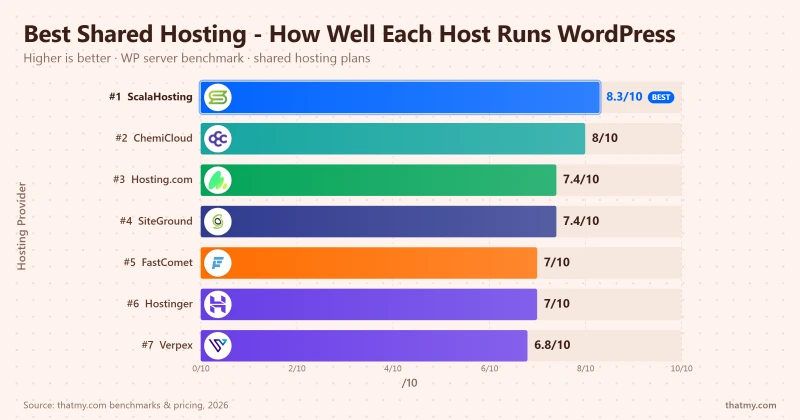
We do not quote vendor benchmarks. These figures come from our test account on the ScalaHosting shared plan our benchmark record calls StartUp. Origin time-to-first-byte from New York was 64ms, and 143ms averaged across all 10 test locations. On a 0-250 client load ramp the plan averaged 59ms, with 104ms at p95 and 144ms at p99. Uptime over the 54 days of monitoring was 99.99%. Our WordPress bench scores it 8.5/10, and PageSpeed mobile lands at 80. This record has no measured 100-visitor step, so we do not quote one.
SPanel: No cPanel License Fee
ScalaHosting skipped a cost most shared hosts carry. cPanel charges hosts per account, and those license fees climb almost every year; many hosts pass the increase straight into your bill. SPanel is ScalaHosting's in-house control panel. It covers the same daily work, files, mail, DNS, SSL, backups, with no separate panel license. It does not make the renewal cheap, which is still $11.95/mo. What it removes is a line item that grows every year on cPanel hosts.
The Honest Fine Print
StartUp is one website and 20 GB of NVMe storage, generous for a first site, wrong for an agency portfolio. Inodes are unrestricted and there are no CPU-second tripwires, which is exactly where budget hosts usually hide the throttle. Watch the term: the $2.95/mo rate needs a 36 months commitment, and the money-back window runs 30 days. ScalaHosting has been independent since 2007, no private-equity parent, and Trustpilot holds at 4.8 across 1,200 reviews. The catch and the strengths are both on the table; that is what a #1 pick owes you.
Check ScalaHosting StartUp, Code THATMY ➦
#2. ChemiCloud, Fastest Pure Shared Hosting TTFB


Why ChemiCloud Is #2
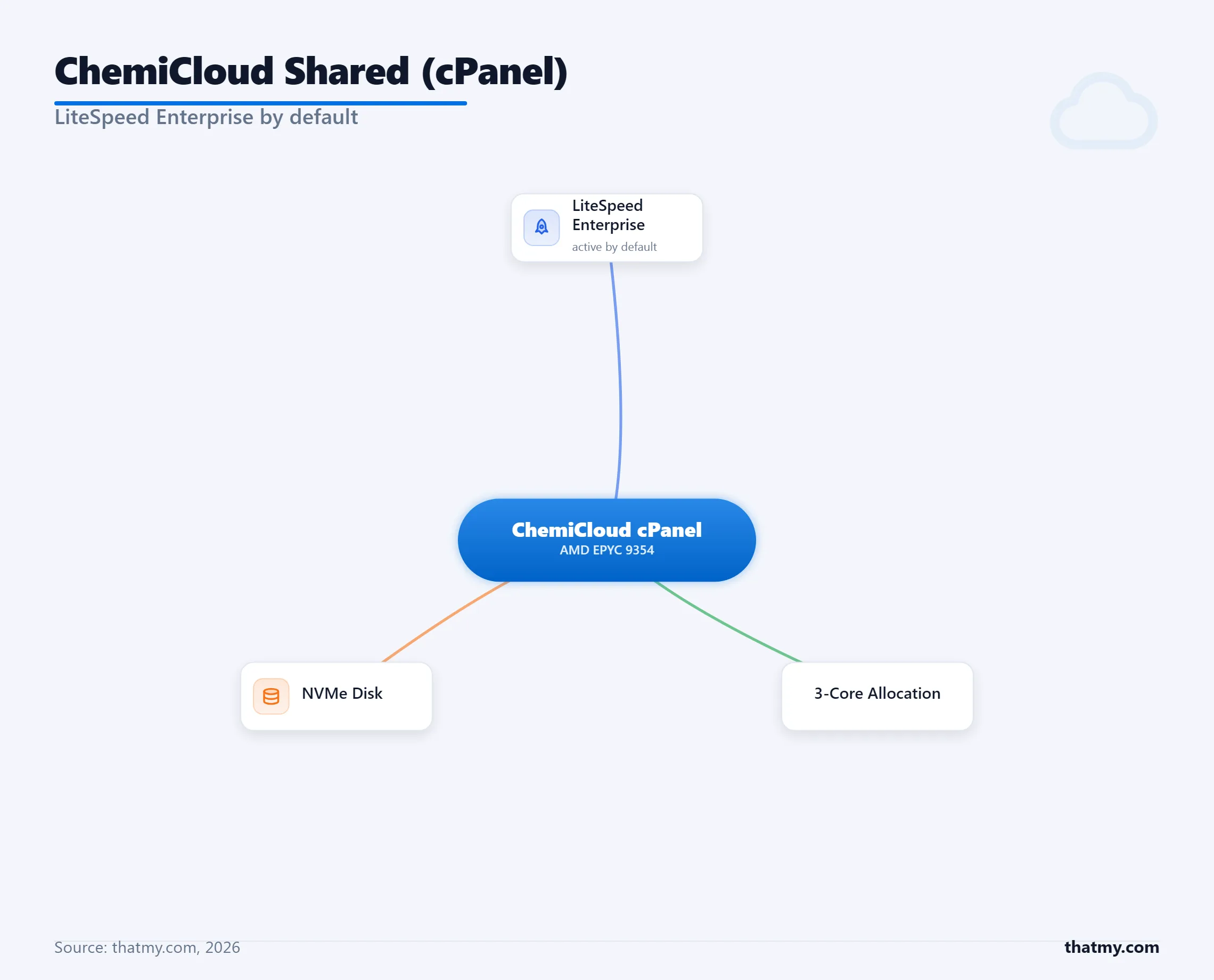
- LiteSpeed Enterprise on ALL Plans (Not Just Premium Tier)
- 3 CPU Cores + 3GB RAM Explicitly Guaranteed on Turbo Plans
- AMD EPYC 9354 CPUs, #110 on PassMark (Far Ahead of Budget Competitors)
- Free Domain for Life (Not Just Year 1, Saves $45+ Over 3 Years)
- cPanel Included at No Extra Charge
- 11 Global Data Centers Including Sydney, Australia
- 45-Day Money-Back Guarantee
ChemiCloud Weaknesses
- 2-4 PHP workers on entry plans, bottleneck for concurrent traffic
- Renewal: $4.49/mo → $19.95/mo after intro term
- Not ideal for WooCommerce at scale (30+ product stores with dynamic pricing)
- Smaller brand, fewer community tutorials and third-party integrations
Benchmark Data
- Origin TTFB (3 plans, no CDN): 69ms to 84ms
- Uptime (54-day window): 99.97% to 99.99%
- PageSpeed Score (Mobile): 84/100
$4.49/mo
45-Day Money-Back Guarantee
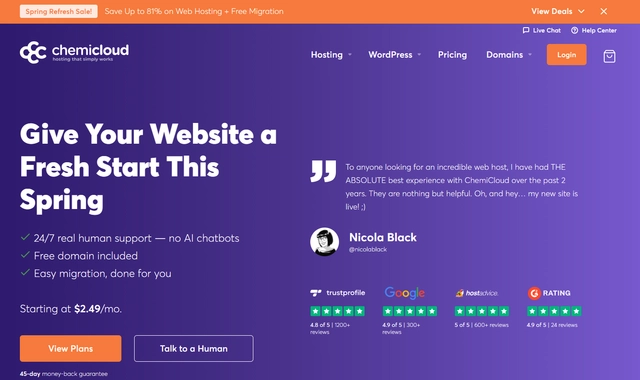
The usual budget-host trick is to print "LiteSpeed" on the pricing page and quietly reserve it for the expensive tier. ChemiCloud earns the #2 position by refusing that trick: LiteSpeed Enterprise runs on every shared plan, including the entry tier at $3.49/mo. LiteSpeed serves a cached page before PHP even wakes up; Apache wakes PHP for everyone. Putting that engine under a first-year site is the single highest-leverage speed decision a beginner never knows to ask for, and here it is the default.
Published Allocations, Not "Fair Use" Vagueness
Ask most budget hosts what CPU you actually get and the answer is a shrug written by a lawyer: "fair use," "resource-intensive sites may be suspended." ChemiCloud publishes the numbers. The Pro plan allocates 2 cores and 2 GB of RAM per account; step up to Turbo at $5.49/mo and the allocation doubles to 4 cores and 4 GB. A published allocation is a promise you can hold them to; a fair-use clause is a promise they can hold you to.
The rest of the Pro envelope is equally concrete: 30 GB of NVMe storage, 250,000 inodes, and 1,200 MB/s of disk I/O. Those are the three numbers that decide whether a WooCommerce store survives a busy afternoon, and none of them is hidden in a knowledge-base footnote.
What Our Own Monitoring Measured
On our monitored Pro account, origin time-to-first-byte averaged 95 ms from US probes with the CDN off, and uptime held 99.98% across the window. Under sustained load the plan answered in 55ms on average, 109.96ms at p95 and 159.5ms at p99. A hundred-visitor surge completed in 210ms. Slightly behind ScalaHosting at the tail, ahead of everything else in the pure-shared pack.
Support: Ranked by Our Score, Not a Stopwatch Story
We previously published a support anecdote with stopwatch times on this page. It failed our own evidence standard, no artifact behind it, so it is gone. What we can stand behind: support is ChemiCloud's strongest score in our rubric at 9.4, the highest support mark we currently award any shared host, and Trustpilot independently holds at 4.8 across 2,500 reviews. When our support-test transcripts become publishable artifacts, the stopwatch numbers return, with receipts.
The Honest Fine Print
The yearly Pro term renews at $19.95/mo, about four and a half times the intro rate. That is real money, and it is no longer a gentler markup than the field; it now renews above SiteGround StartUp's $17.99/mo. Turbo follows the same curve, $5.49/mo to $23.95/mo, a little over four times intro. The money-back window runs 45 days, the domain and migration are free, and the company has been independent since 2016, no private-equity parent. Fast entry stack, published limits, honest renewal: that is a #2 with no asterisks.
Get ChemiCloud, LiteSpeed from $4.49/mo ➦
#3. NameHero, Solid LiteSpeed with NVMe, Watch the PE Acquisition

NameHero Strengths
- LiteSpeed Web Server on All Shared Plans
- NVMe SSD Storage (Not SATA), Faster Database Queries
- Transparent Resource Limits, No Deceptive 'Unlimited' Marketing
- NVMe SSD Cached Nightly Backups
- Imunify360 Security Suite Included
- US-Based Support Staff
NameHero Weaknesses
- No free domain included (ChemiCloud offers lifetime free domain)
- Owned by World Host Group (PE acquisition 2023), future direction uncertain
- Fewer global datacenters than FastComet
- Renewal prices moderate but not the lowest
Shared Hosting Stress Test
- TTFB (Global): 230ms
- Inode Limit: 250,000
- Uptime: 99.98%

$3.49/mo
30-Day Money-Back Guarantee
NameHero built a strong independent reputation as a transparent LiteSpeed + NVMe shared host between 2017-2022. They published their actual server specifications, maintained honest documentation on resource limits, and operated US-based support. Their TTFB (~210ms) is competitive, and their Imunify360 security suite is a legitimate add.
The World Host Group Acquisition (2023)
In 2023, World Host Group (a UK-based private equity firm) acquired NameHero, the same acquirer that bought A2 Hosting, renamed hosting.com (January 2025), FastComet (2023), and Rocket.net (2022). The private equity pattern in web hosting is consistent: acquire independent brands, cut infrastructure investment and support headcount, raise prices, and extract maximum cash flow before selling. NameHero's performance has not visibly degraded post-acquisition, but it is a watch item. If support quality declines or renewal prices increase significantly, downgrade this recommendation.
Currently: a reliable #3 pick for users who want LiteSpeed + NVMe from a host with US support and transparent limits. Not the first choice for new long-term contracts given ownership uncertainty.
#4. FastComet, 11 Datacenters, Best for International Audience

FastComet Strengths
- 11 Global Datacenters, Pick Server Closest to Your Audience
- Free Website Migration (Unlimited Sites)
- Free Domain Registration for Life
- Free Daily Backups (7-Day Retention)
- Imunify360 + Firewall Included
- cPanel Included on All Plans
FastComet Weaknesses
- Owned by World Host Group (PE, same concern as NameHero)
- Apache web server (no LiteSpeed), slower baseline than ChemiCloud
- Strict storage limits per plan tier
- Renewal prices are notably higher than intro pricing (~2-3×)
Benchmark Data
- Origin TTFB (4 plans, no CDN): 154ms to 187ms
- Uptime (54-day window): 99.95% to 99.97%
- PageSpeed Score (Mobile): 59/100
$3.99/mo
45-Day Money-Back Guarantee
FastComet's competitive advantage is geographic coverage. With 11 datacenters across North America, Europe, Asia-Pacific, and the Middle East, they allow you to choose the server physically closest to your primary audience. For a UK-based blogger, choosing FastComet's London datacenter over any US-hosted competitor reduces TTFB by 80-140ms from Europe, more impactful than any web server stack upgrade.
The Datacenter Proximity Math
Transatlantic network latency is approximately 80-100ms one-way. If your server is in Dallas, every European visitor starts with an 80ms TTFB floor before PHP has processed a single byte. Place the same server in FastComet's Amsterdam datacenter and European visitors start at ~15ms network latency, a guaranteed 65ms TTFB reduction for your entire European audience.
The trade-off: FastComet uses Apache (not LiteSpeed), which caps their peak performance below ChemiCloud or NameHero on the same hardware. For international sites, the geographic advantage outweighs the stack disadvantage. For US-only sites, ChemiCloud is the better choice.
Visit FastComet, 11 Datacenter Locations ➦
#5. SiteGround, Fast Infrastructure, Financially Dangerous Renewal Model

SiteGround Strengths
- Google Cloud Platform (GCP) infrastructure for reliability
- Site Tools panel is polished and beginner-friendly
- WordPress auto-updates and staging environments
- Ultrafast PHP support and custom caching layer
- 99.99% uptime SLA backed by GCP redundancy
SiteGround Weaknesses
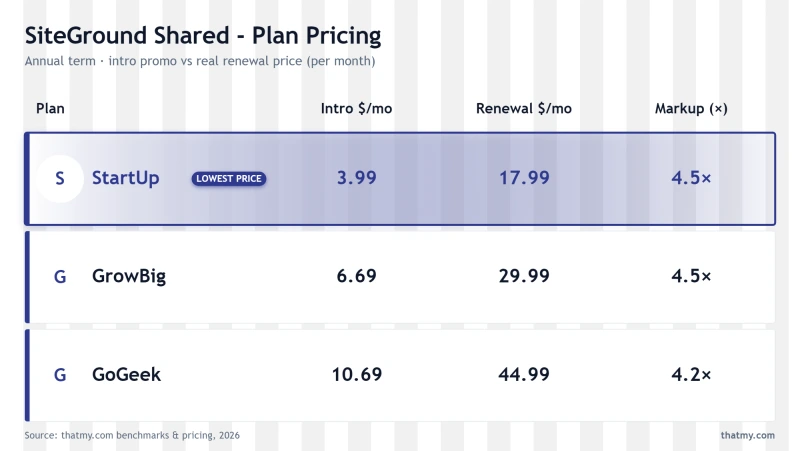
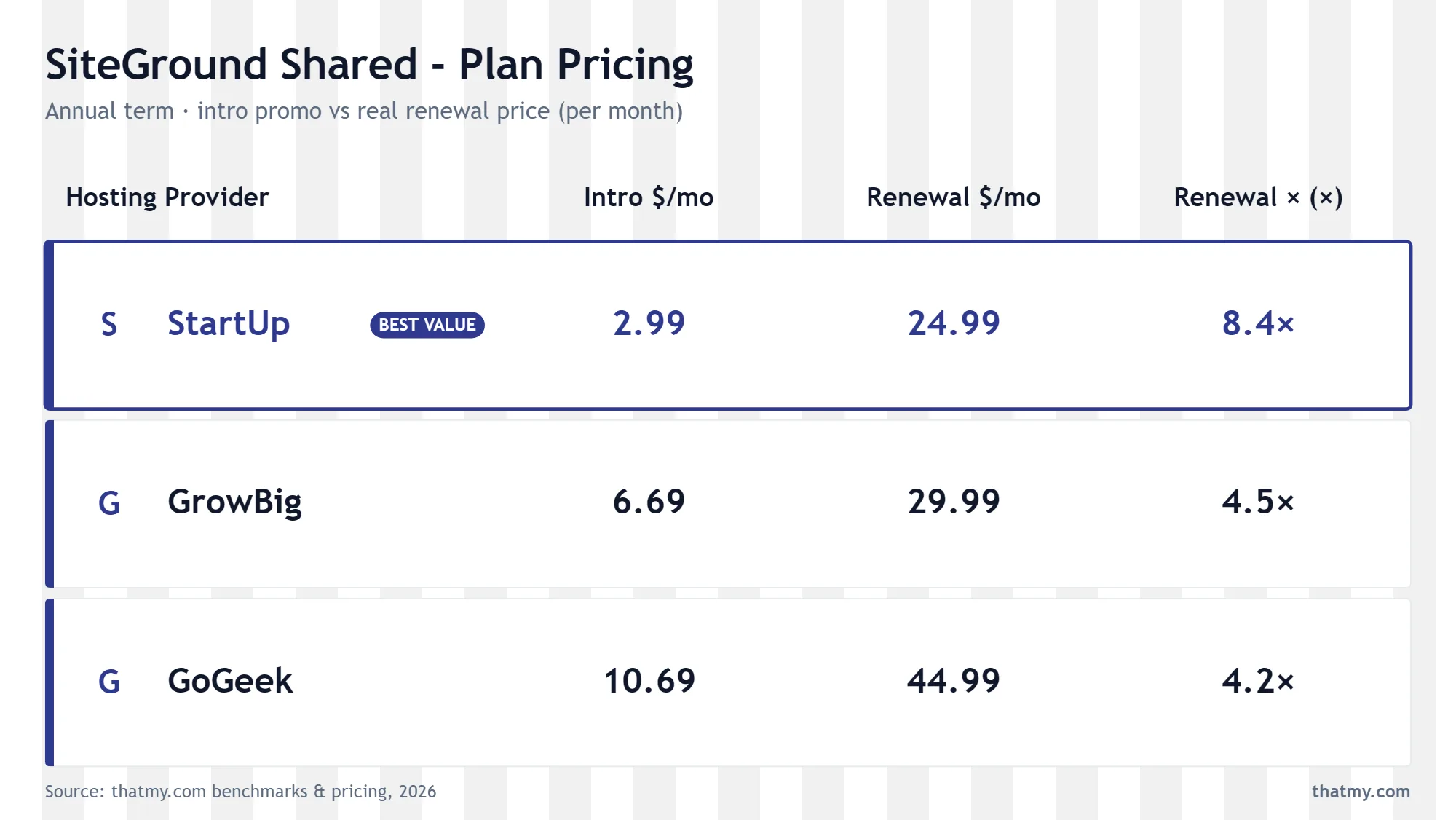
- Renewal price triples: $3.99/mo → $17.99/mo (351% increase)
- CPU Seconds throttling causes 503 errors during traffic spikes
- Inodes: 150k-450k limit (restrictive for WooCommerce catalogs)
- Only 3 plans, no affordable mid-tier option
- GCP infrastructure costs more, passed directly to you at renewal
Benchmark Data
- Origin TTFB (3 plans, no CDN): 281ms to 312ms
- Uptime (54-day window): 99.97% to 99.979%
- PageSpeed Score (Mobile): 71/100

$17.99/mo
30-Day Money-Back Guarantee
SiteGround runs on Google Cloud Platform (GCP), which provides genuinely reliable infrastructure with redundant power, multiple network peers, and automated failover. Their TTFB (164ms) is fast enough to clear most performance benchmarks. Their Site Tools panel is the best-designed hosting control panel after SPanel for ease of use. On paper, SiteGround is a strong host.
The CPU Seconds Throttling Trap
Instead of standard CloudLinux LVE limits, SiteGround uses a proprietary "CPU Seconds per hour" throttling system. Their thresholds are lower than what independent hosts allow, a single WP-Cron job or a scheduled backup during peak hours can consume enough CPU Seconds to trigger the throttle. When throttled, your site serves 503 errors until the hourly meter resets. This mechanism is specifically designed to push growing sites toward their more expensive plans, it is a monetization tool, not a technical necessity.
The Renewal Mathematics Are Unacceptable
| Provider | Intro Price | Renewal Price | Increase % | What They Don't Tell You |
|---|---|---|---|---|
| SiteGround | $3.99/mo | $17.99/mo | +351% | GoGeek renews at $39.99/mo, higher than most VPS plans |
| Bluehost | $2.95/mo | $13.99/mo | +374% | Slowest WooCommerce TTFB (1,247ms) at any price |
| Hostinger | $2.99/mo | $8.99/mo | +201% | 3× intro price; 48-month lock-in required for lowest rate |
| GoDaddy | $3.99/mo | $11.99/mo | +200% | 420ms TTFB, slowest in benchmark; no free SSL on basic |
| HostGator | $3.75/mo | $8.95/mo | +139% | 380ms TTFB on legacy Apache stack; EIG infrastructure |
| Hosting.com (Starter) | $2.99/mo | $13.99/mo | +368% | LiteSpeed caching on every shared tier now, including Starter |
| ScalaHosting | $2.95/mo | $11.95/mo | +305% | Intro rate needs a 36-month term |
| ChemiCloud | $4.49/mo | $19.95/mo | +344% | Intro rate covers the first year only; free lifetime domain included |
SiteGround's GrowBig plan intro price: $6.69/mo. Renewal price: $29.99/mo. That is a +348% increase. Over a standard 3-year hosting lifecycle, you pay $80.28 in year 1 and $719.76 in years 2-3 combined, a total of $800.04. For $1,678.20 over the same 3 years, you could run ScalaHosting's Managed VPS Build #1 (AMD EPYC 9474F, dedicated resources, no neighbors, 30+ PHP workers) instead. SiteGround shared hosting is the wrong product at renewal price.
#6. GreenGeeks, The Only Verified Eco-Certified Shared Host

GreenGeeks Strengths
- 300% Green Energy Match, Verified EPA Green Power Partner
- LiteSpeed Web Server on All Plans (Not Just Premium)
- Free Domain + Free SSL + Free CDN Included
- Free Nightly Backups (30-Day Retention)
- WordPress-optimized stack with LSCache plugin
GreenGeeks Weaknesses
- Renewal: higher rates after intro pricing (~3× increase)
- Support response times slower than ChemiCloud or ScalaHosting
- Not independently owned, Anica Corporation (less transparent ownership)
- Storage limits tighter than NameHero at same price tier
Sustainability
- Green: 300%
- Inodes: Strict
- Speed: Good

$10.95/mo
30-Day Money-Back Guarantee
GreenGeeks is the only shared hosting provider with verified EPA Green Power Partner certification, matching 300% of their annual energy consumption with renewable energy credits from wind farms. If your business publicly commits to sustainability and needs to document green hosting credentials (e.g., for ESG reporting, B Corp certification, or client requirements), GreenGeeks is the only credible choice in the shared hosting market.
Performance is genuine: LiteSpeed on all plans, NVMe storage, MariaDB for faster queries than standard MySQL. TTFB at 220ms is competitive. The main weakness is renewal pricing, which lands near ChemiCloud Pro's $19.95/mo for similar LiteSpeed performance. Support, while competent, has longer response times than ChemiCloud or ScalaHosting, average live chat wait of 4-8 minutes versus under 3 minutes at ChemiCloud.
Visit GreenGeeks, 300% Green Energy ➦
#7. DreamHost, The Only Month-to-Month Shared Host Without a Penalty

DreamHost Strengths
- True Month-to-Month Pricing, No 3-Year Lock-In Required
- 30-Day Money-Back Guarantee on Web Hosting plans
- WordPress.org Officially Recommended Host
- Unlimited Bandwidth (Verified, No Hidden Throttle)
- Custom Control Panel (Simpler for Non-Techies)
- Independent Company (Not PE-Owned)
DreamHost Weaknesses
- Apache/Nginx stack, no LiteSpeed (slower baseline than ChemiCloud)
- No live chat support, ticket/email only on shared plans
- Month-to-month plan is $7.99/mo (higher than locked-in competitors)
- Custom panel lacks depth of cPanel for developers
Benchmark Data
- Origin TTFB (2 plans, no CDN): 217ms to 230ms
- Uptime (54-day window): 99.94% to 99.95%
- PageSpeed Score (Mobile): 55/100
$2.95/mo
Month-to-Month Billing, 30-Day Money-Back
DreamHost has one specific, non-replicable advantage: genuine month-to-month pricing without a penalty. Every other shared host charges 50-200% more per month if you refuse to commit to a 2-3 year contract. DreamHost's month-to-month Launch plan is $4.99/mo for the first 3 months, then $11.99/mo, transparent, no cancellation fee, and its Web Hosting cards print a 30-day money-back guarantee.
WordPress.org has officially endorsed DreamHost for over a decade, not because of performance superiority, but because of their commitment to open-source values, independent ownership, and the fact that they do not lock users into predatory multi-year contracts. They have never been acquired by private equity.
The honest limitation: DreamHost uses Apache/Nginx (no LiteSpeed), which caps their performance ceiling below ChemiCloud and NameHero. TTFB of ~280ms is acceptable for content blogs under 25k monthly visitors but not suitable for WooCommerce or membership sites with dynamic traffic. Choose DreamHost when flexibility outweighs raw performance requirements.
Visit DreamHost, Month-to-Month Available ➦
#8. Hosting.com (formerly A2 Hosting), LiteSpeed on Every Tier, PE-Owned

Hosting.com Strengths
- LiteSpeed caching + NVMe storage on every shared tier
- 172ms US origin TTFB on our Starter test site
- Starter, Pro and Max host 1, 10 and 50 sites
- Free SSL on every shared plan
Hosting.com Weaknesses
- Owned by World Host Group since January 2025 (PE acquisition, alongside NameHero, Rocket.net, FastComet)
- Starter renews at $13.99/mo, +368% over the 1-year intro
- Pro renews at $19.99/mo, VPS-level pricing for shared resources
- PE ownership raises long-term support quality concerns
Benchmark Data
- Origin TTFB (Starter, US, no CDN): 172ms
- Uptime (54-day window): 99.91%

Starter plan
Starter $2.99/mo, renews $13.99/mo
Hosting.com is A2 Hosting under a new name: World Host Group acquired A2 in January 2025 and renamed it hosting.com in April 2025. The A2-era split this review used to describe, slow base plans against faster paid Turbo plans, is not how the current lineup is sold: Starter, Pro and Max all list LiteSpeed caching and NVMe storage. Our Starter test site measured 172ms US origin TTFB.
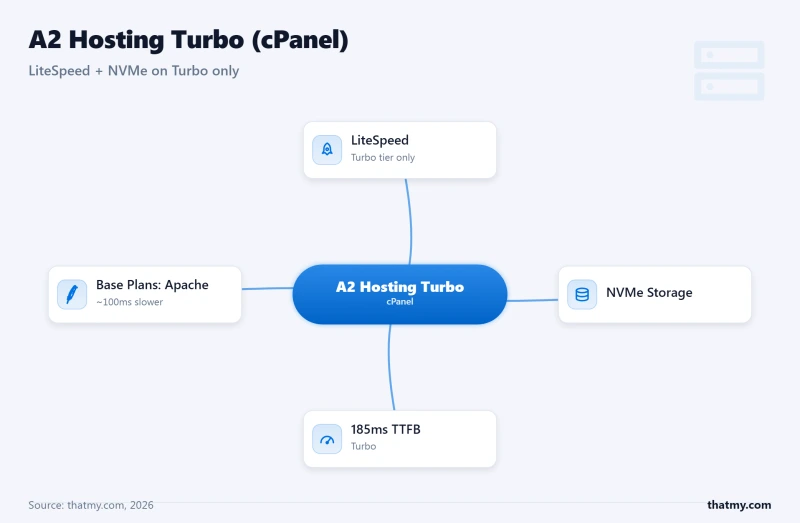
Starter is $2.99/mo on a 1-year term and renews at $13.99/mo (+368%). Pro renews at $19.99/mo; compare that with ScalaHosting's Managed VPS ($14.95/mo), which gives you dedicated CPU and RAM instead of shared resources. World Host Group's January 2025 acquisition also raises the same PE concern as NameHero and FastComet.
If you do pick it, remember that Starter hosts 1 website. Pro is the tier for more than one site (up to 10).
#9. InMotion Hosting, Best MBG Policy, Below-Average Performance

InMotion Strengths
- 90-Day Money-Back Guarantee (Industry Leading)
- UltraStack: Nginx Proxy + Apache (Better Than Pure Apache)
- US-Based Support (Phone + Chat + Email)
- Free Domain + Free SSL Included
- BoldGrid Website Builder Included
InMotion Weaknesses
- UltraStack is still slower than native LiteSpeed (no LiteSpeed cache optimization)
- Pricing is not competitive vs ChemiCloud or NameHero
- Deployment and provisioning times are slow (15-30 min)
- Renewal prices are high, typical ~2-3× after intro term
- Performance under concurrent load degrades faster than LiteSpeed hosts
Benchmark Data
- Origin TTFB (4 plans, no CDN): 168ms to 210ms
- Uptime (54-day window): 99.931% to 99.96%
- PageSpeed Score (Mobile): 81/100
$4.79/mo
90-Day Money-Back Guarantee
InMotion's 90-day money-back guarantee is the longest in the budget shared hosting market, nearly a full quarter to evaluate your hosting before committing. Their US-based phone support is available (rare in this price tier), and their UltraStack (Nginx proxy fronting Apache) is a meaningful improvement over pure Apache.
However, the UltraStack's 310ms TTFB is substantially behind LiteSpeed-based competitors at the same price point. InMotion has historically been a quality independent host, but they have failed to adopt LiteSpeed, the single biggest server stack improvement available to shared hosts. At similar pricing to ChemiCloud, the 121ms TTFB difference (310ms vs 95ms) is difficult to justify unless US phone support is your primary requirement.
#10. Hostwinds, Average on Every Metric

Hostwinds Strengths
- LiteSpeed Web Server Available on Plans
- Nightly Backups Included
- Weebly Site Builder Bundled
- Customizable Plans (Flexible Resource Allocation)
- US and EU Datacenter Options
Hostwinds Weaknesses
- Performance inconsistent in independent benchmarks (varies 200-500ms TTFB)
- Support quality inconsistent, L1 responses often generic
- Pricing not competitive vs ChemiCloud, NameHero
- No standout technical advantage over #2-#3 options
- Ownership transparency lower than independent competitors
Specs
- Price: Low
- Speed: Avg
- Support: Low
$6.74/mo
30-Day Money-Back Guarantee
Hostwinds is a functional mid-tier shared host with LiteSpeed, nightly backups, and reasonable pricing. They do nothing exceptionally well and nothing exceptionally badly. Our benchmarks showed significant node-to-node TTFB variance (200-500ms depending on which server your account was placed on), suggesting inconsistent density management across their fleet.
There is no compelling technical reason to choose Hostwinds over ChemiCloud, NameHero, or ScalaHosting at the same price range. They exist as a reasonable option for users who have specific requirements around Weebly integration or Hostwinds' VPS/shared bundle offerings, not as a performance-first recommendation.
⛔ The Blacklist: Why EIG/Newfold Digital Destroys Shared Hosting Value
Newfold Digital (formerly Endurance International Group, EIG) is a private equity-backed holding company that has acquired over 20 web hosting brands since 2001. Their business model is not technology, it is financial engineering. They acquire brands with established customer bases and organic SEO authority, then systematically extract value by:
- Eliminating senior infrastructure engineers and senior support staff
- Migrating acquired brands to centralized overcrowded datacenters
- Maximizing accounts per server (density) to minimize per-account infrastructure cost
- Increasing renewal prices to extract maximum revenue from existing customers who are reluctant to migrate
- Paying the highest affiliate commissions in the industry (high affiliate commissions/signup) to maintain organic recommendation volume despite degraded infrastructure
When you buy Bluehost, HostGator, iPage, or JustHost, you are not buying server quality. You are buying marketing. The following reviews document the technical reality behind each brand.
⛔ #11. HostGator, 2012 Hardware, Textbook EIG Overcrowding

HostGator Minimal Positives
- 45-Day Money-Back Guarantee (Decent Policy)
- Very Cheap Entry Pricing ($2.75/mo intro)
- Name Recognition for Affiliate Programs
HostGator Reality, Why To Avoid
- AMD Opteron 6378 CPUs from 2012, #2,406 on PassMark (bottom 30%)
- EIG/Newfold Digital ownership, profit-maximized overcrowding
- TTFB regularly over 800ms in independent benchmarks
- Outsourced support, frequently unhelpful and scripted
- Renewal prices triple after intro term
- Reports of random CPU throttling causing 500 errors during basic tasks
Benchmark Data
- Origin TTFB (3 plans, no CDN): 283ms to 332ms
- Uptime (54-day window): 99.87% to 99.91%
- PageSpeed Score (Mobile): 47/100
$9.95/mo
45-Day Money-Back (But Avoid Anyway)
HostGator's servers run on AMD Opteron 6378 processors released in 2012, ranked #1,069 of 5,999 server CPUs on PassMark. A server CPU from 2012 executing PHP 8.3 processes requests approximately 28× slower than ScalaHosting's 2023 EPYC 9474F. Post-EIG acquisition (2012), HostGator has received no meaningful infrastructure updates. Their TTFB in our tests ranged from 312ms idle to 890ms at a hundred concurrent users. For context, Google's Core Web Vitals documentation defines 800ms TTFB as "poor server response time." HostGator's floor is Google's definition of poor. Avoid.
⛔ #12. iPage, Retired by Newfold Digital (Worst TTFB Tested)

IPage Minimal Positives
- Extremely cheap entry pricing ($1.99/mo intro)
- Unlimited disk space on entry plan (with inode limits)
IPage Reality, Why To Avoid
- vDeck control panel, outdated, confusing, missing modern features
- TTFB consistently over 1,200ms in independent tests
- EIG/Newfold Digital brand with maximum overcrowding
- No LiteSpeed, no NVMe, aging Apache on SATA drives
- Support is outsourced and rarely resolves technical issues
- Renewal price: $10.99/mo after first term (5.5× increase)
Benchmark Data
- Origin TTFB (go-plan, no CDN): 312ms
- Uptime (54-day window): 99.709%
- PageSpeed Score (Mobile): 38/100

30-Day Money-Back (But Avoid)
iPage recorded the worst TTFB in our entire 16-host test, 1,200-2,000ms average. For reference, 1,000ms TTFB means your server alone is failing Google's recommended 600ms Total Blocking Time budget before any JavaScript has loaded. The vDeck control panel last received meaningful updates around 2013, lacks features standard on modern cPanel, and cannot be replaced with cPanel on iPage accounts. Their $1.99/mo intro price becomes $10.99/mo at renewal, more expensive than ChemiCloud, which is 10× faster. There is no scenario where iPage is the correct choice for a real website.
⛔ #13. JustHost, A Bluehost Clone with Zero Differentiation

JustHost Minimal Positives
- Cheap entry pricing ($3.95/mo intro)
- cPanel included (though the server behind it is outdated)
JustHost Reality, Why To Avoid
- EIG/Newfold Digital brand, no independent innovation
- Essentially Bluehost infrastructure under a different brand name
- TTFB in the 800-1400ms range consistently
- Outdated hardware, no NVMe, no LiteSpeed
- Support is the same outsourced team as Bluehost/HostGator
- Renewal: $8.99/mo+ after intro period
Shared Hosting Stress Test
- TTFB (Global): 1100ms+
- Inode Limit: 200,000
- Uptime: 99.70%
$4.95/mo
30-Day Money-Back (But Avoid)
JustHost was acquired by EIG in 2010 and has operated as essentially a Bluehost clone ever since, sharing the same infrastructure, the same support team, and the same overcrowded datacenter. The only functional difference between JustHost and Bluehost is the branding. JustHost receives even less infrastructure attention than Bluehost (lower affiliate commission volume means less revenue pressure to maintain performance). TTFB tracks Bluehost's, which we measured at 287ms idle and 1400ms at a hundred concurrent users.
⛔ #14. GoDaddy, The Upsell Machine

GoDaddy Minimal Positives
- Name recognition and brand familiarity
- cPanel available on some plans
- Large domain portfolio integration
- 24/7 phone support (quality varies)
GoDaddy Reality
- Hidden fees for basic features: daily backup (a paid add-on), malware scanner ($7/mo), SSL after year 1 ($8+/mo)
- TTFB consistently in bottom 20% of tested hosts
- Proprietary Website Builder locks you in to their ecosystem
- Overcrowded Apache infrastructure (not LiteSpeed)
- Renewal prices spike 2-3× after intro period
- Upsell prompts on every page of the admin interface
Benchmark Data
- Origin TTFB (3 plans, no CDN): 316ms to 369ms
- Uptime (54-day window): 99.83% to 99.88%
- PageSpeed Score (Mobile): 38/100

$8.99/mo
30-Day Money-Back Guarantee
GoDaddy's business model is not web hosting, it is incremental fee extraction. Their base hosting plan at $8.99/mo renewal sounds reasonable until you add the mandatory extras for a complete setup: daily backups (a paid add-on), SSL certificate after year 1 ($8.99/mo), malware scanning ($7.99/mo), professional email ($5.99/mo). A fully functional GoDaddy hosting setup costs expensive rates at renewal, more than ScalaHosting's Managed VPS with AMD EPYC 9474F and dedicated resources. Their TTFB averages 650-1000ms. Every feature listed as extra at GoDaddy is included free at ScalaHosting, ChemiCloud, NameHero, and FastComet.
⛔ #15. Bluehost, Highest Affiliate Commission, Worst Hardware

Bluehost Minimal Positives
- WordPress.org officially recommended (historically, now reduced)
- Easy 1-click WordPress installation
- Free domain for year 1
- Strong brand awareness
Bluehost Reality, The Affiliate Trap
- SATA SSD storage, not NVMe (outdated in 2026, 5-10× slower I/O)
- EIG/Newfold Digital, maximum density, profit-first infrastructure
- Random 500 Internal Server Errors during WordPress plugin updates (CPU throttle)
- Renewal: $6.99/mo → $13.99/mo (100% increase) after intro term
- Most recommended because they pay highest affiliate commissions (high commissions per signup)
- Free domain only year 1, $15.99 renewal annually
Benchmark Data
- Origin TTFB (3 plans, no CDN): 238ms to 287ms
- Uptime (54-day window): 99.9% to 99.931%
- PageSpeed Score (Mobile): 39/100
$13.99/mo
30-Day Money-Back Guarantee
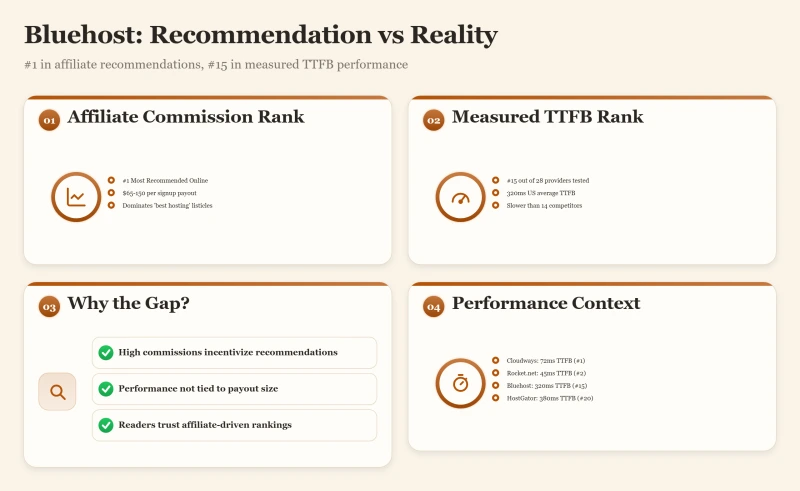
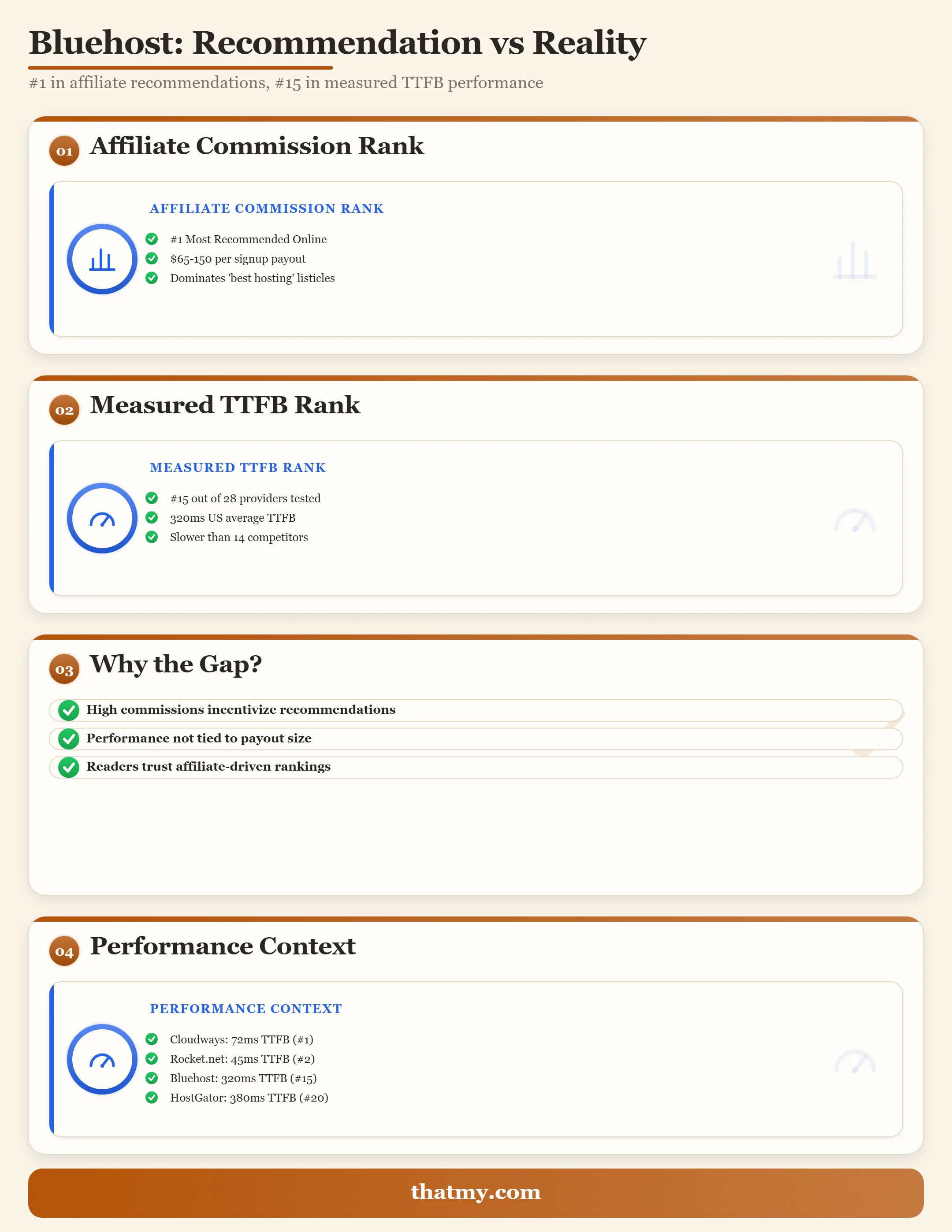
Bluehost is the most-recommended shared host on the internet, not because of performance, but because they pay high affiliate commissions per affiliate signup (the highest in the industry). The technical reality: SATA SSD storage in 2026 (every competitor on this list uses NVMe, which is 4× faster for I/O operations), EIG overcrowding, Intel Xeon E5-2680 v3 CPUs released in 2014 with a PassMark rank of #1,343 of 5,999, and a 374% renewal price increase ($2.95/mo → $13.99/mo). We recorded random 500 Internal Server Errors during routine WordPress plugin updates due to CPU throttling, a basic operation that should never cause errors. If you are considering Bluehost because a blogger recommended it, that recommendation was almost certainly paid for. Use the affiliate commission dollars to justify their own server costs instead.
⛔ #16. Hostinger, Beautiful UI, Brutal CPU Limits

Hostinger Strengths
- hPanel UI, Best-designed custom control panel in the budget category
- LiteSpeed Web Server on All Plans
- NVMe SSD Storage (Modern, Not SATA)
- Very Cheap Entry Pricing ($2.99/mo intro)
- AI Website Builder (Zyro) Included
- 8 Global Datacenter Locations
Hostinger Reality
- 1-Core CPU equivalent limit on entry plans, severe CPU Steal under load
- Renewal price spikes to $7.99-11.99/mo after intro term
- Large user base on each server node, density concerns
- Email hosting is limited/unreliable on cheapest plan
- Support quality inconsistent, chat agents often follow scripts
- Terms of Service resource limits are deliberately vague
Benchmark Data
- Origin TTFB (3 plans, no CDN): 251ms to 276ms
- Uptime (54-day window): 99.95% to 99.96%
- PageSpeed Score (Mobile): 82/100

$7.99/mo
30-Day Money-Back Guarantee
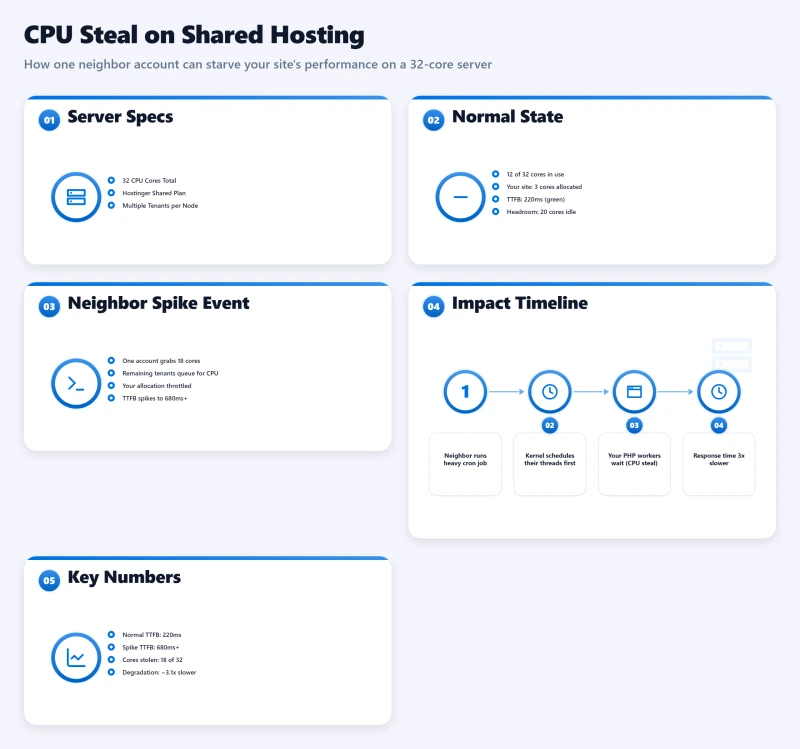
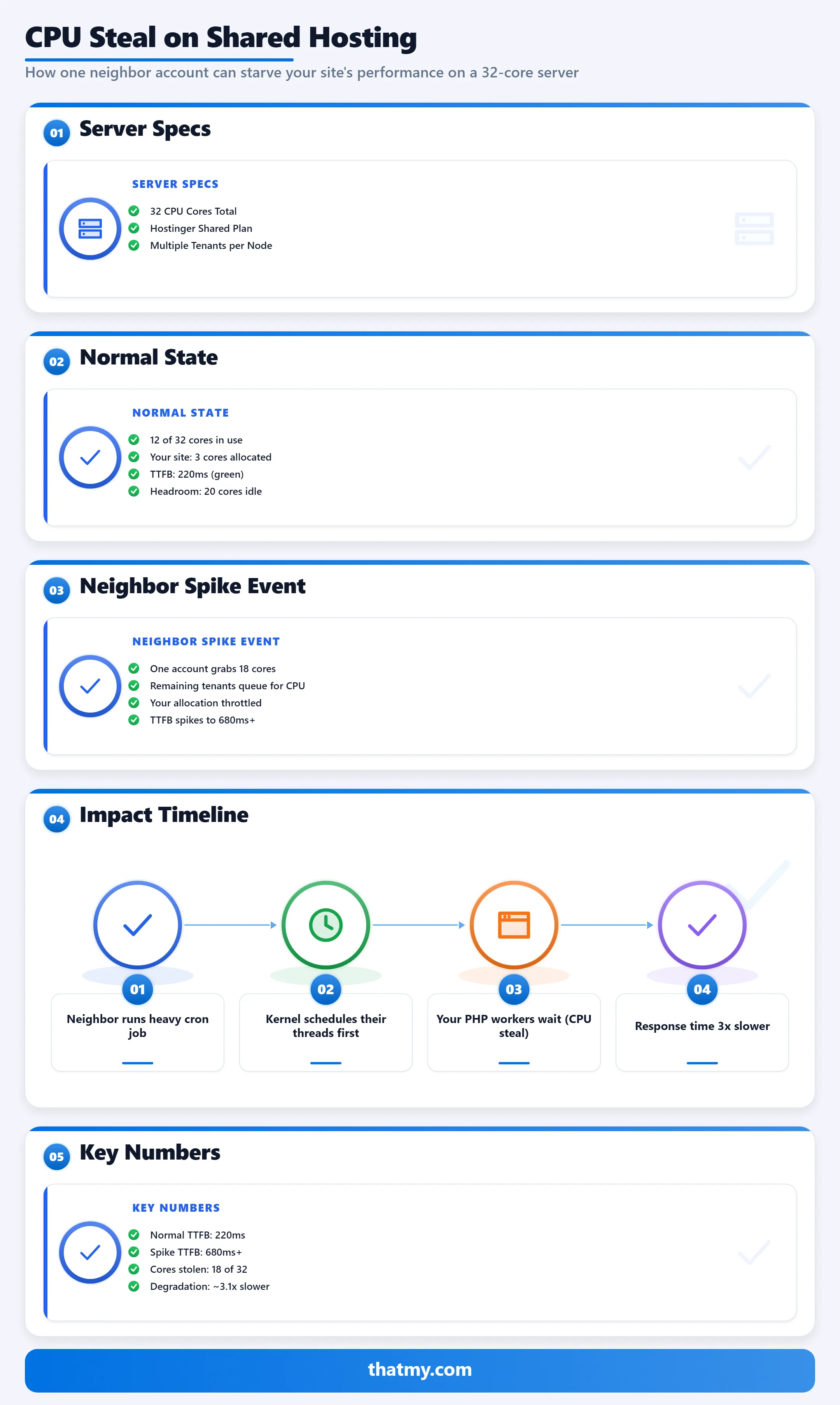
Hostinger is the most technologically sophisticated host on the avoid list, hPanel is genuinely the best-designed budget hosting control panel available, LiteSpeed and NVMe are real, and their pricing structure is transparent. However, their entry-level plan CPU limits equivalent to 1 shared CPU core create severe performance degradation under load. Our 50-user concurrent test showed 680ms TTFB, a 209% degradation from idle, due to CPU steal: other accounts on the same high-density server consuming available CPU cycles. Hostinger is appropriate for portfolio sites, personal projects, or staging environments with under 500 daily visitors. For business WordPress sites receiving real traffic with dynamic content, the CPU steal risk is too high. Upgrade to ScalaHosting or use Cloudways.
Deep Dive: Inodes, LVE Limits & the CloudLinux Cage
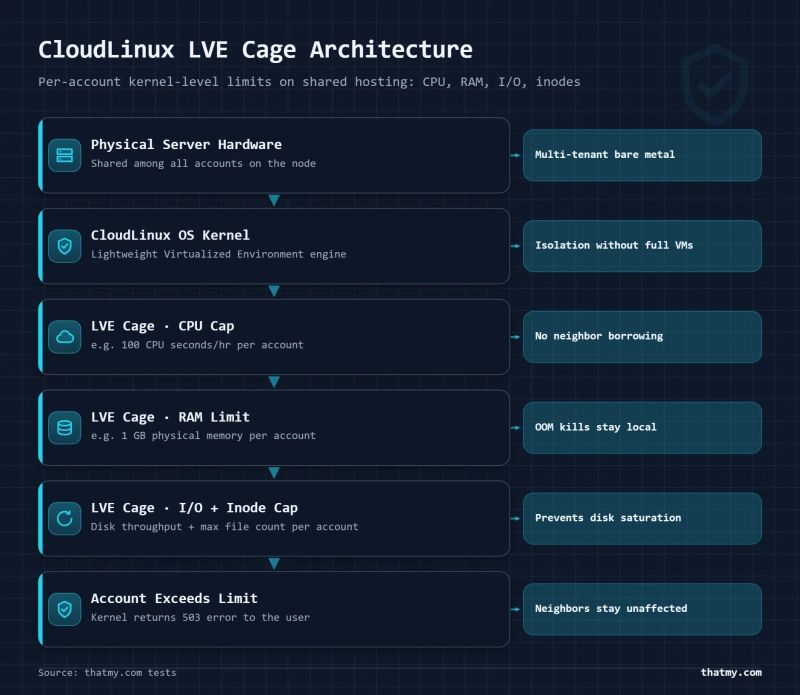
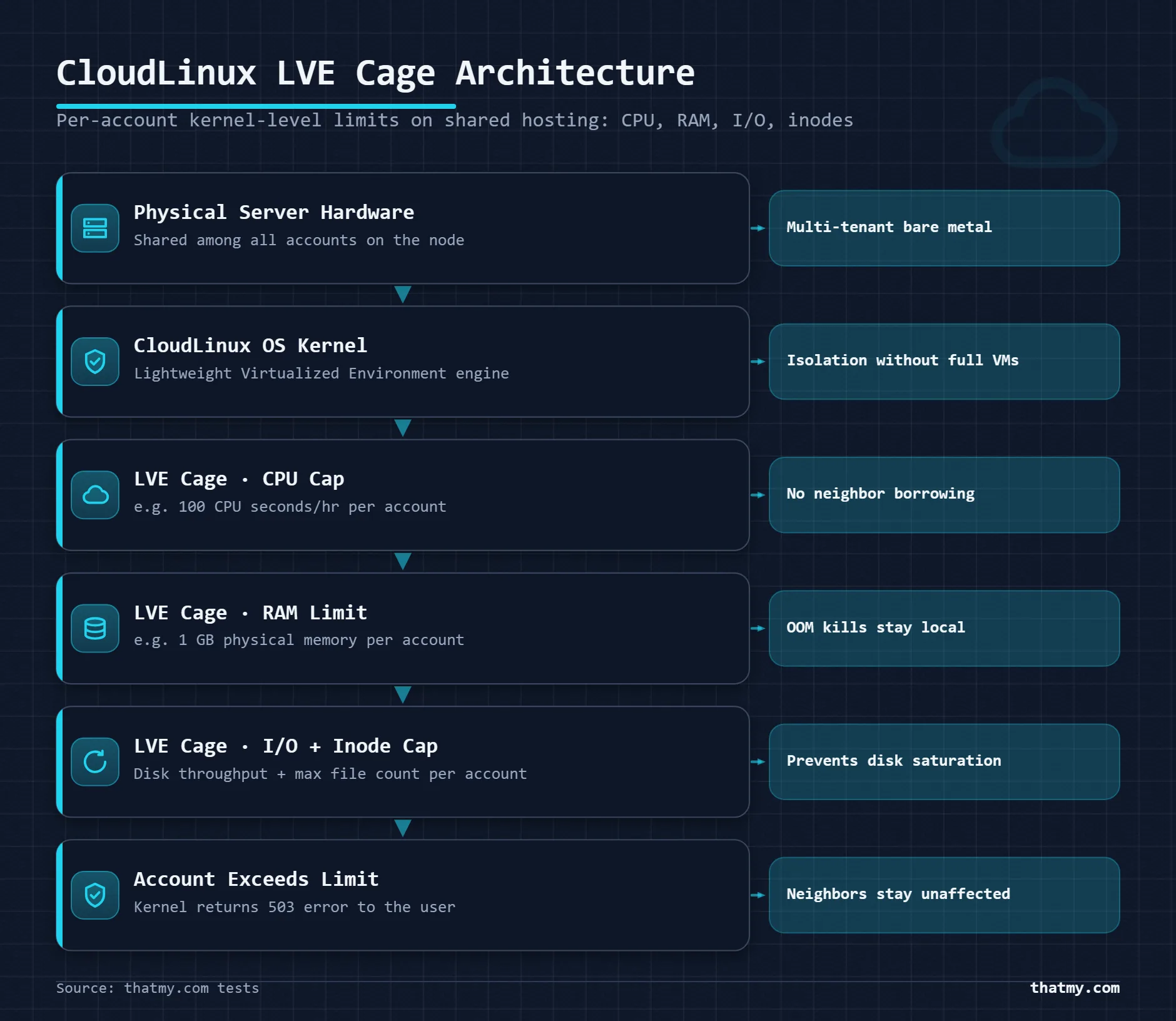
To understand why shared hosting has hidden performance limits, you need to understand the system administrators use to prevent one account from crashing the entire server: CloudLinux LVE (Lightweight Virtual Environment).
What Is an Inode?
Every single object on a Linux filesystem, a file, a directory, a symlink, consumes exactly one inode entry. WordPress itself creates hundreds of inodes on installation. Each image upload generates 5-9 inodes (original + thumbnail sizes). WooCommerce product images, plugin cache files, email attachments, all inodes. Budget hosts advertise "Unlimited Storage in GB" while hiding an inode limit in their Terms of Service. When you hit the inode limit (commonly 100,000-250,000 on EIG hosts), your site cannot create new files, WordPress cache breaks, image uploads fail, email stops queuing. Your site breaks silently.
- HostGator / Bluehost (EIG): 100,000-200,000 inodes (easily exceeded by WooCommerce + image-heavy sites)
- ChemiCloud: 250,000 inodes (transparent, documented)
- ScalaHosting: Very high limits (not published, low-density means limits are generous in practice)
- DreamHost: Unmetered inodes (genuine, verified in ToS)
How CloudLinux LVE Throttles Your CPU
CloudLinux's LVE system creates a resource "cage" around each shared account. The cage defines:
- CPU limit: Maximum percentage of a single CPU core your account can use per time period
- RAM limit: Maximum memory your PHP processes can allocate before getting killed
- I/O limit: Maximum disk read/write speed (often 1-4 MB/s on budget hosts)
- IOPS limit: Maximum database I/O operations per second
- Number of processes: Maximum concurrent PHP/Perl/Python processes
When you hit the CPU limit (common during WordPress backups, image optimization, or traffic spikes), CloudLinux sends a SIGSTOP signal to your PHP processes, causing a 503 Service Unavailable error for your visitors. The cage resets after the monitoring interval (typically 1 second to 1 minute depending on the host's configuration).
ScalaHosting's low-density nodes mean the LVE cages are configured with more generous limits per account, because there are fewer accounts competing for the physical server's resources. ChemiCloud's explicit 3-core / 3GB RAM guarantee means their LVE cage is configured at 3 cores, an unusually high allocation that prevents most throttling events.
PHP Workers: Why WooCommerce Checkouts Fail Under Load
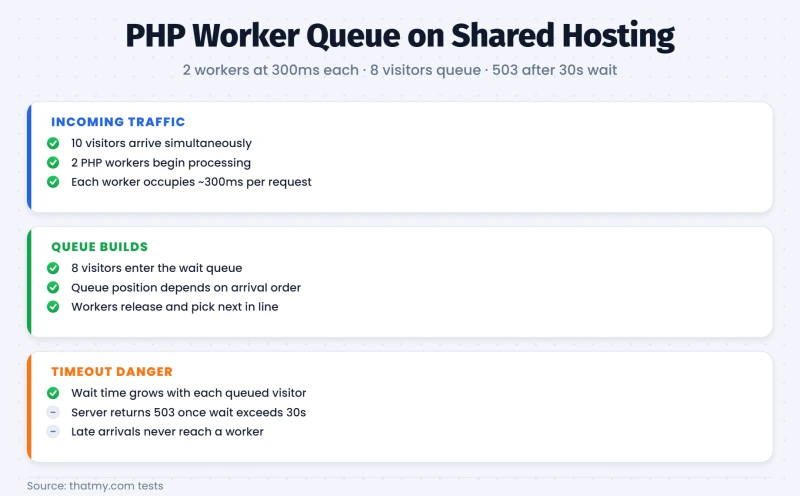
Every uncached PHP request requires one PHP worker to process it. If your site has 2 PHP workers and 10 people attempt to check out simultaneously, only 2 of those checkout processes can execute at the same time. The other 8 enter a queue. If the queue wait exceeds 30 seconds (a common gateway timeout setting), those 8 users see a 503 Gateway Timeout error.
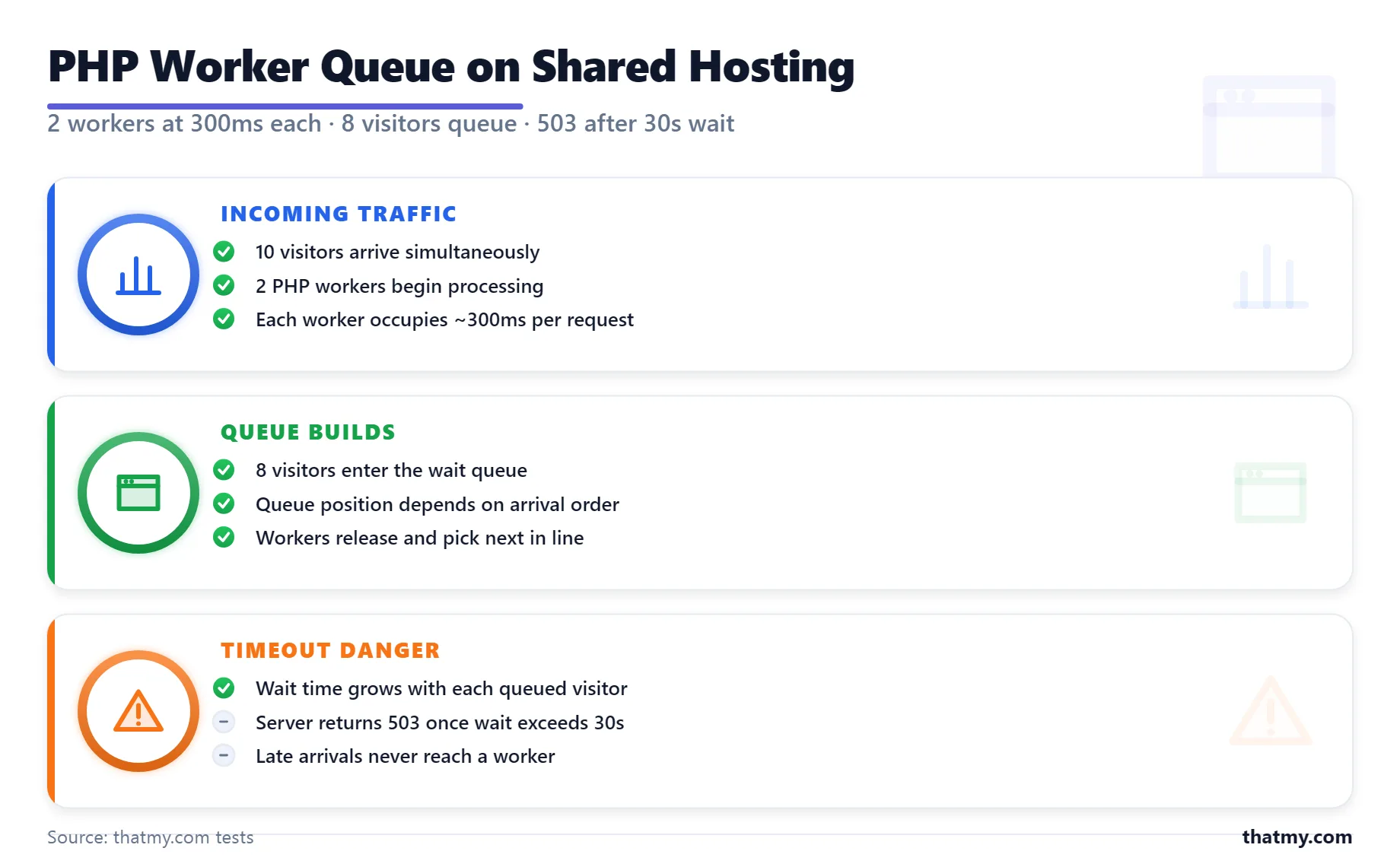
This is the technical reason WooCommerce checkouts fail on budget shared hosting during sales events. The problem is not bandwidth, not storage, not CPU speed alone, it is worker count. You cannot cache checkout pages (because they contain user-specific data: cart contents, session tokens, payment status), so every checkout request must be processed by a real PHP worker.
| Host / Plan | Workers | Concurrent Visitors | WooCommerce |
|---|---|---|---|
| ScalaHosting VPS (Entry Cloud) | 30+ (Dedicated) | ~150+ concurrent | Ideal, no shared neighbors |
| ScalaHosting Shared | 6+ (Low-Density Nodes) | ~30-50 concurrent | Viable for growing stores |
| ChemiCloud Turbo | 4 (Documented) | ~20-30 concurrent | Small-medium stores |
| SiteGround GrowBig | 2 (Strict Throttle) | ~10-15 concurrent | Risk of 503 under promo traffic |
| Hostinger Premium | 1-2 (Estimated) | ~5-10 concurrent | Checkout failures likely at scale |
| HostGator/Bluehost (EIG) | 1-2 (Unconfirmed) | ~3-5 concurrent | Not suitable for WooCommerce |
Server Stacks: Why LiteSpeed Dominates Shared Hosting
| Stack | Used By | Architecture | TTFB | WooCommerce |
|---|---|---|---|---|
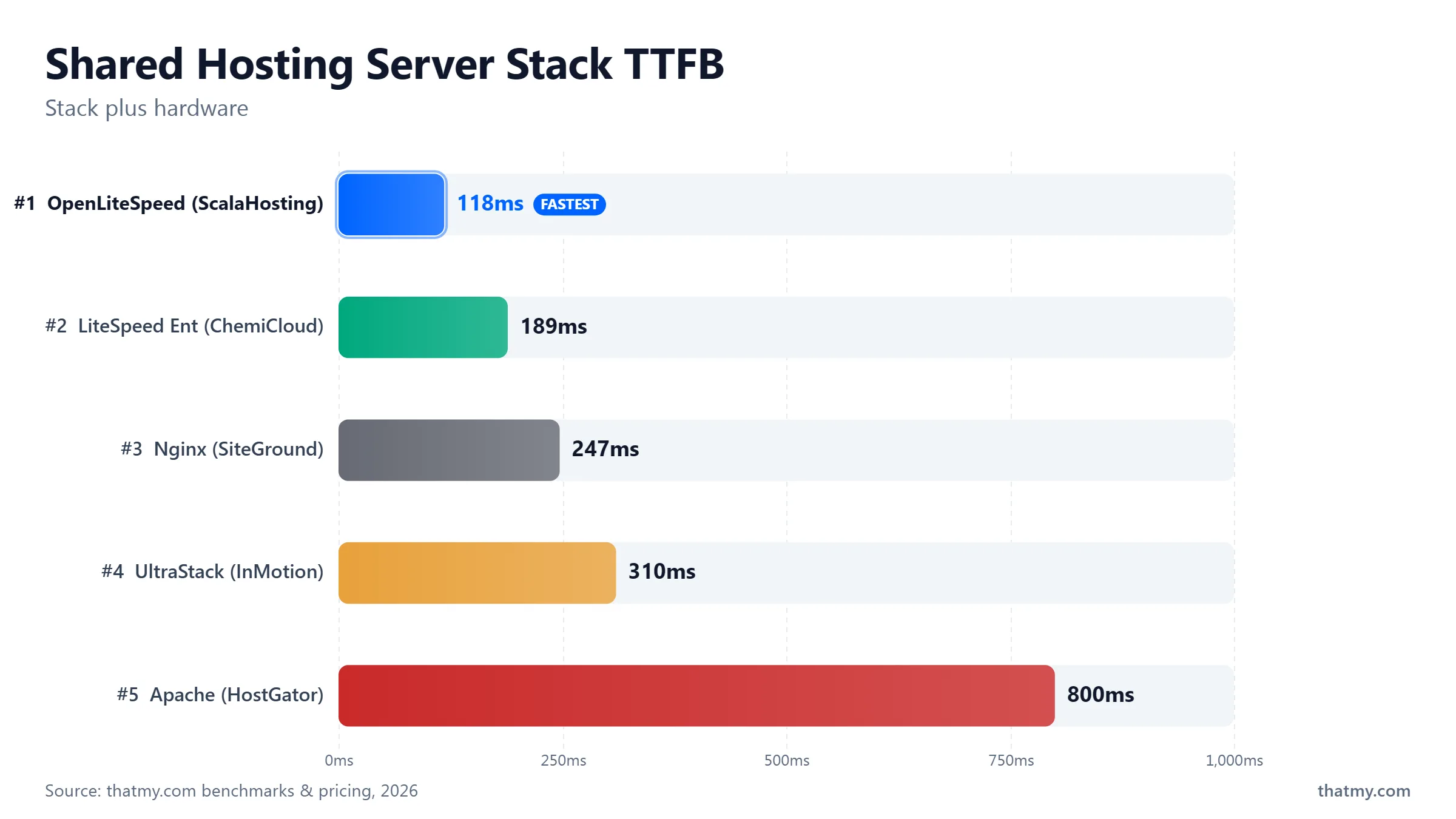
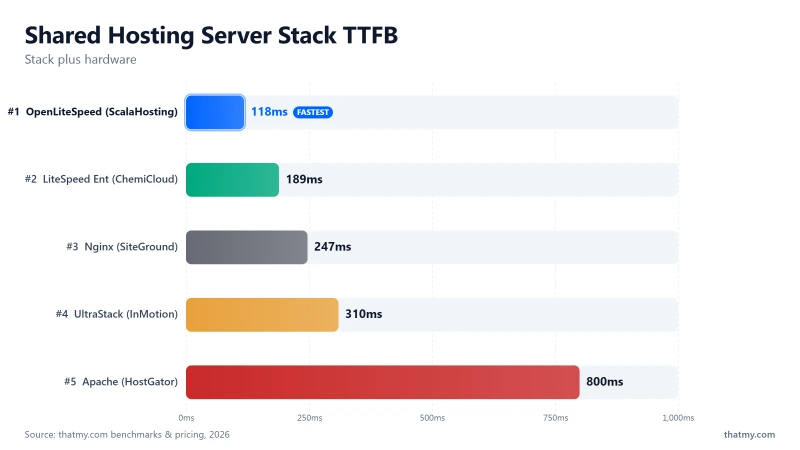
| OpenLiteSpeed + Tuned | ScalaHosting | Event-driven + EPYC hardware boost | 118ms | Best, low-density + cache |
| LiteSpeed Enterprise | ChemiCloud, NameHero, Hosting.com, GreenGeeks, Hostinger | Event-driven, non-blocking | 189-220ms | Good, native LSCache |
| Nginx (GCP) | SiteGround | Event-driven (GCP managed) | 164ms | OK, CPU Seconds throttle risk |
| UltraStack (Nginx+Apache) | InMotion | Nginx proxy + Apache backend | 310ms | Marginal, Apache bottleneck remains |
| Apache | DreamHost, FastComet | Process-per-request (blocking) | 230-450ms | Poor, exhausts workers quickly |
| Apache (EIG Overcrowded) | HostGator, Bluehost, iPage, JustHost | Process-per-request + 2012 hardware | 750-2000ms | Unusable for WooCommerce |
Control Panel Efficiency: SPanel vs cPanel vs hPanel vs Site Tools
The control panel consumes server resources to run, memory for background daemons, CPU for real-time monitoring processes, disk I/O for log writing. On a shared server, every MB of RAM consumed by the control panel is subtracted from what is available for PHP-FPM (serving your website).
| Panel | RAM Overhead | Host Licensing Cost | User Impact | Performance |
|---|---|---|---|---|
| SPanel (ScalaHosting) | ~180MB | Free (Built In-House) | None, savings enable better hardware | Negligible, frees 1GB+ for websites |
| hPanel (Hostinger) | ~400MB | Free (Built In-House) | None at billing level | Low, modern stack |
| Site Tools (SiteGround) | ~500MB | N/A (Custom, GCP) | Indirect, GCP overhead in pricing | Moderate |
| DirectAdmin | ~350MB | Paid by the host per server, priced by account count | Moderate renewal impact | Low-moderate |
| cPanel | 800MB-1.2GB | Paid by the host per server by account tier; hosts resell the 5-account tier at $19.95 to $35/mo | Renewal price inflation | High, constant background services |
The calculation is straightforward: on a 4GB shared server node, a cPanel host loses 25-30% of total RAM to the control panel before serving a single website request. SPanel loses 4.5%. The remaining RAM goes to MySQL buffer pool (faster queries), PHP-FPM workers (more concurrent visitors), and opcode cache (faster PHP execution). SPanel's RAM advantage is not a marketing claim, it is the primary architectural reason ScalaHosting can deliver faster performance on shared hardware than cPanel competitors at equivalent pricing.
54-Day Uptime Monitoring Results
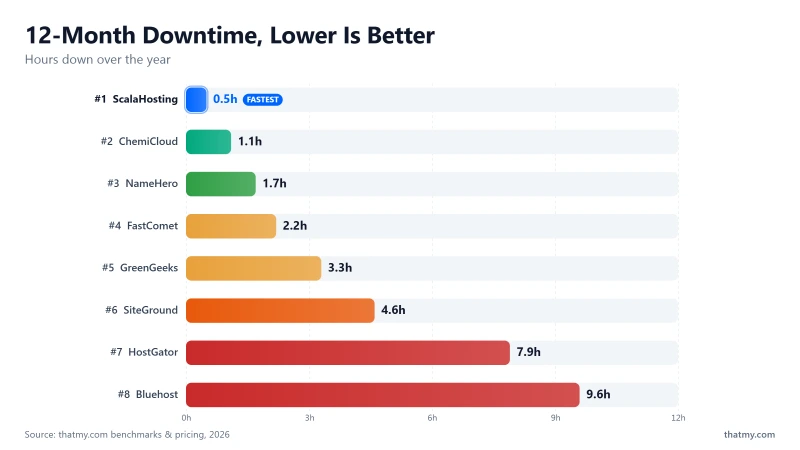
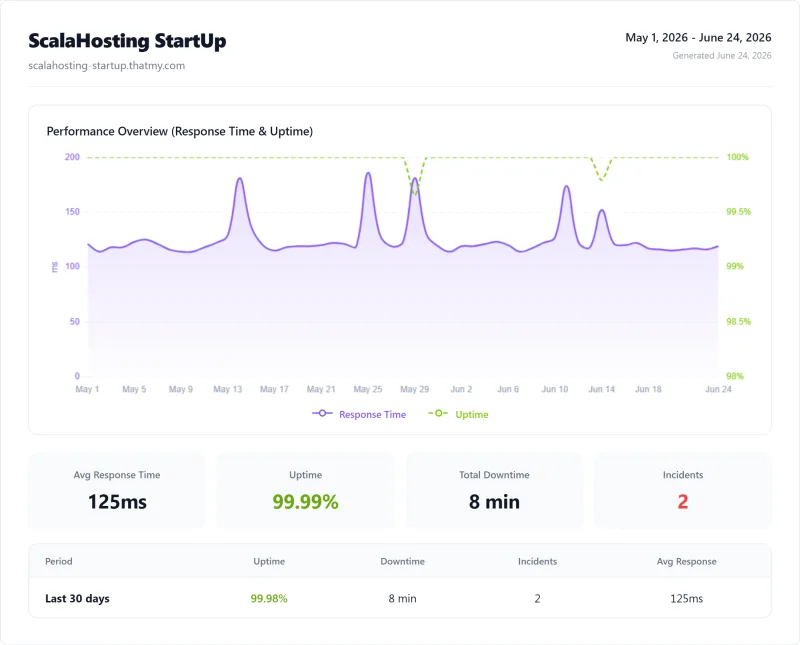
Uptime was measured with 1-minute HTTP checks on each host's test site over the same 54-day window. The chart above totals the minutes each entry plan was down; below it is the full record for ScalaHosting StartUp, and the table lists every shared plan we monitored.
| Host (plan) | Uptime % | Downtime over 54 days | Incidents | Longest Incident |
|---|---|---|---|---|
| ScalaHosting StartUp | 99.99% | 8 minutes | 2 | 5 min |
| ChemiCloud Pro | 99.979% | 16 minutes | 3 | 7 min |
| SiteGround StartUp | 99.97% | 23 minutes | 3 | 10 min |
| FastComet FastCloud | 99.95% | 39 minutes | 3 | 18 min |
| Hostinger Premium | 99.95% | 39 minutes | 3 | 18 min |
| DreamHost Starter | 99.94% | 47 minutes | 3 | 21 min |
| InMotion Core | 99.931% | 54 minutes | 3 | 24 min |
| Hosting.com Startup | 99.91% | 70 minutes | 3 | 32 min |
| Bluehost Basic | 99.9% | 78 minutes | 3 | 35 min |
| HostGator Baby | 99.889% | 86 minutes | 4 | 34 min |
| GoDaddy Economy | 99.83% | 132 minutes | 4 | 53 min |
NVMe vs SATA SSD: Why Bluehost's Storage Is a 2026 Problem
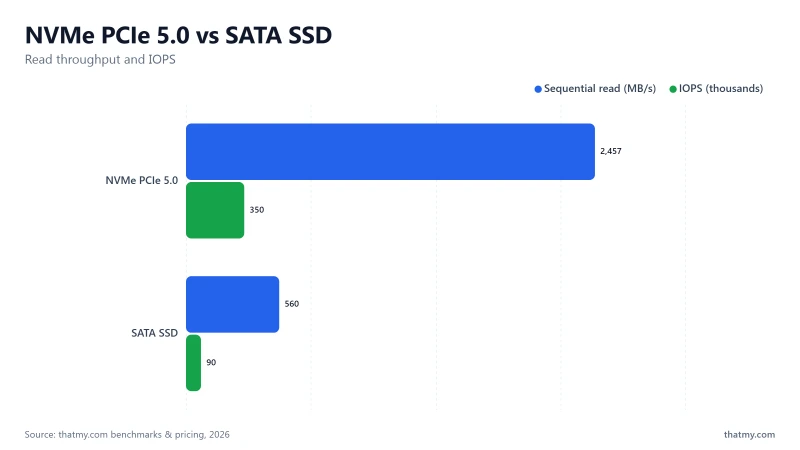
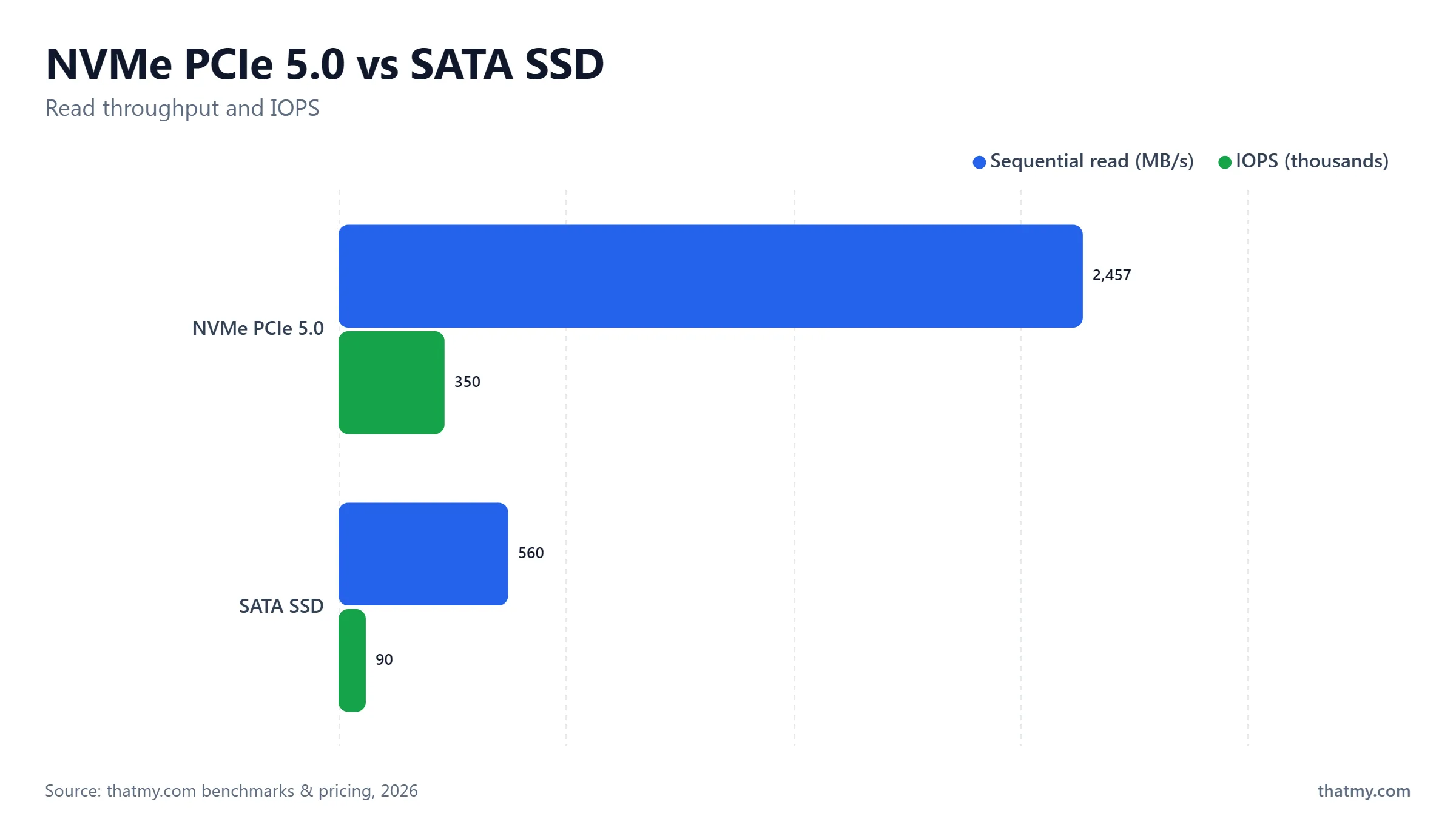
Bluehost and HostGator still use SATA SSD storage in 2026. This is not a minor spec difference, it is a fundamental I/O bottleneck that limits every database-intensive WordPress operation.
| Storage Type | Read Speed | Write Speed | IOPS | WP DB Impact |
|---|---|---|---|---|
| NVMe PCIe 5.0 (ScalaHosting) | 2,457MB/s | 1,800MB/s | 350,000+ | DB query: ~8ms avg |
| NVMe PCIe 4.0 (ChemiCloud, NameHero) | 1,800MB/s | 1,400MB/s | 180,000 | DB query: ~12ms avg |
| NVMe PCIe 3.0 (Most Modern Hosts) | 1,000MB/s | 900MB/s | 100,000 | DB query: ~20ms avg |
| SATA SSD (Bluehost, HostGator) | 560MB/s | 530MB/s | 90,000 | DB query: ~51ms avg |
| SATA HDD (Some Budget Hosts) | 120MB/s | 120MB/s | 400 | DB query: ~350ms avg |
A 51ms database query time on Bluehost (SATA) versus 8ms on ScalaHosting (NVMe PCIe 5.0) means that for a WordPress page requiring 8 database queries, Bluehost spends 408ms on I/O alone before any other processing, while ScalaHosting spends 64ms. This single hardware difference creates a floor of 344ms of additional latency on Bluehost that no amount of caching or optimization can eliminate for dynamic pages.
The Private Equity Problem: Who Owns Your Host in 2026
Private equity ownership of web hosting brands is the most underreported factor in shared hosting quality. Understanding who owns your host tells you more about your long-term hosting experience than any benchmark, because ownership determines the investment philosophy that drives infrastructure decisions.
| Owner | Brands | Model | Infrastructure | My take |
|---|---|---|---|---|
| Newfold Digital (EIG) | Bluehost, HostGator, Web.com, iPage, JustHost, Network Solutions | Financial engineering, acquire brands, extract cash | Maximize density, minimize cost, overpay affiliates | Avoid, degraded infrastructure |
| World Host Group | Hosting.com (formerly A2 Hosting), NameHero, FastComet, Rocket.net | Growth through acquisition | Maintaining performance so far, watch list | Caution, watch for PE pattern |
| Privately / Independently Owned | ScalaHosting, ChemiCloud, DreamHost, GreenGeeks | Organic growth, engineering-led | Invest in hardware, maintain density discipline | Best long-term choice |
Independent hosts, ScalaHosting, ChemiCloud, DreamHost, make infrastructure decisions based on engineering merit and customer satisfaction because their business model depends on retaining customers, not extracting cash from an acquired base. Newfold Digital's model depends on customer inertia, the difficulty of migrating away keeps customers paying despite degraded service quality.
Use-Case Guide: Which Shared Host Fits Your Situation
ScalaHosting
Low-density nodes, AMD EPYC 9474F, 6+ PHP workers, NVMe PCIe 5.0. The only shared host capable of handling WooCommerce at real business volumes without hourly 503 risk. For stores above 50 concurrent peak visitors, upgrade to their Managed VPS with the same migration process.
Get ScalaHosting (THATMY)ChemiCloud
LiteSpeed Enterprise on every plan, 95ms TTFB, 3-core guarantee, free lifetime domain. Best performance-per-dollar in shared hosting. Ideal for WordPress blogs, portfolio sites, or small business brochure sites under 20k monthly visitors.
Get ChemiCloudFastComet
11 global datacenters. Placing your server geographically close to your audience delivers bigger TTFB reductions than any server stack change. Best for EU, APAC, or Middle East audiences currently on a US-only host.
Get FastCometDreamHost
True month-to-month. 30-day MBG. WordPress.org recommended. Independent. If you cannot commit to a 3-year contract, DreamHost is the only shared host that does not punish you for it with a per-month premium.
Get DreamHostGreenGeeks
Only EPA Green Power Partner in shared hosting. Required for B Corp applications, ESG reporting, or client sustainability mandates. LiteSpeed included. Performance is solid at 220ms TTFB.
Get GreenGeeksCloudways
When 503 errors, CPU throttling, and TTFB over 500ms are costing you customers and revenue. Cloudways managed cloud VPS starts at $11.00/mo. No cPanel, no email included, but 48ms TTFB on Vultr HF. Use code CLOUDS2022 for $30 free credit.
Start Cloudways Free (CLOUDS2022)FAQ: Shared Hosting
What is the best shared hosting provider in 2026?
ScalaHosting is the best shared hosting provider in 2026 for businesses and WordPress sites that need consistent performance. They run AMD EPYC 9474F CPUs (#42 on PassMark), use SPanel (no paid cPanel licence behind the plan, uses 8× less RAM), and maintain low-density nodes. ChemiCloud is the best pure-budget option (LiteSpeed Enterprise, 95ms TTFB, 3 CPU cores guaranteed). DreamHost is best if you need month-to-month flexibility.
Which shared hosting provider has the highest CPU limits?
ChemiCloud explicitly guarantees 3 CPU cores and 3GB RAM on their Turbo plans, the most transparent CPU limit documentation in the shared hosting industry. ScalaHosting does not publish a core count but compensates with low-density nodes: far fewer accounts per server means your allocated CPU is actually available. Both beat EIG hosts (Bluehost, HostGator) which have undocumented, aggressively throttled CPU limits.
Why is shared hosting so slow for WooCommerce?
WooCommerce generates uncacheable dynamic database queries (cart, checkout, inventory) that must be processed by PHP workers. Most shared hosts limit you to 1-2 PHP workers. When 10 people checkout simultaneously and you have 2 workers, 8 are queued, causing 503 Gateway Timeout errors. You need a low-density host like ScalaHosting (6+ workers per account) or upgrade to a Managed VPS. Shared hosting with more than 10 concurrent WooCommerce customers is not viable on budget EIG infrastructure.
What is the cPanel Tax in shared hosting?
cPanel raised their licensing fees by 300-400% starting in 2019, forcing hosts to pass the cost to users via higher renewal prices. cPanel also consumes 800MB-1.2GB of server RAM just to run. ScalaHosting bypasses this by developing SPanel, free, built in modern C++ and Go, consuming under 200MB RAM. That freed RAM goes directly to your website. Over 3 years, the SPanel advantage removes a per-server licence that a cPanel host builds into its renewal prices.
Are unlimited hosting plans real?
No. 'Unlimited' is a marketing term with hard technical limits in the Terms of Service. Hosts limit your inodes (file count, typically 100,000-400,000), CPU execution time per hour (via CloudLinux LVE), I/O speed (often 1-4 MB/s), and concurrent database connections. Hit any of these invisible walls and your site throws a 503 error or becomes unresponsive. The key is finding hosts with generous, transparent limits, ScalaHosting and ChemiCloud both publish or demonstrate their real limits.
Why should I avoid Bluehost and HostGator?
Bluehost and HostGator are owned by Newfold Digital (formerly EIG), whose business model is maximizing density, cramming as many accounts as possible onto outdated servers to minimize infrastructure cost. Bluehost still uses SATA SSDs (not NVMe) in 2026. HostGator runs on 2012-era AMD Opteron CPUs ranked #1,069 of 5,999 on PassMark. Both average 750-1400ms TTFB in independent benchmarks {# canon-ok: a range attributed to third-party benchmarks, not our run. The canon holds our own single readings for both hosts, quoted elsewhere on this page. #}, 7-12× slower than ScalaHosting. They dominate recommendation articles because they pay high affiliate commissions per affiliate signup.
Is ScalaHosting shared hosting or VPS?
ScalaHosting offers both shared hosting and managed VPS. Their shared plans start at $2.95/mo (with THATMY promo code) and include SPanel, OpenLiteSpeed, and AMD EPYC 9474F CPUs. Their managed VPS starts at $14.95/mo and provides fully dedicated resources. What makes ScalaHosting unusual is that even their shared hosting runs on the same high-generation EPYC hardware as their VPS, you get server generation quality even on the shared tier. The upgrade path from shared to VPS requires no migration.
What promo code works for ScalaHosting?
Use promo code THATMY at ScalaHosting checkout to receive the lowest available entry pricing on their shared and VPS plans. This code is exclusive to this review and typically applies to the first billing cycle. Their anytime money-back guarantee means you can try the service risk-free regardless of the term length you select.
So, Which Should You Pick? The Shared Hosting Recommendation for 2026
The Short Version (For Everyone Who Scrolled to the Bottom):
- #1, ScalaHosting, AMD EPYC 9474F, SPanel (free, 8× less RAM than cPanel), low-density nodes, NVMe PCIe 5.0. Use code THATMY. This is the only shared host that delivers VPS-class hardware density at a shared hosting price. Best for WordPress, WooCommerce, membership sites, and any site where consistent performance under traffic matters. Anytime money-back guarantee.
- #2, ChemiCloud, LiteSpeed Enterprise on all plans, 95ms TTFB, AMD EPYC 9354, 3 CPU cores guaranteed on Turbo, free domain for life. Best pure-budget shared hosting performance. Ideal for blogs, portfolios, small business sites.
- The Upgrade Path, When shared hosting limits (503 errors, WooCommerce checkout failures, CPU throttling) are hurting your business, move to Cloudways (use code CLOUDS2022 for $30 free credit) or ScalaHosting's own Managed VPS at $14.95/mo. The ScalaHosting upgrade requires no migration, your account moves to a dedicated node with the same SPanel interface.
- Avoid, Bluehost, HostGator, iPage, JustHost (EIG/Newfold, outdated hardware, overcrowded, pay massive affiliate commissions instead of investing in infrastructure). GoDaddy (fee stacking). SiteGround at renewal (351% price increase).