


Vultr vs Cloudways: DIY VPS vs Managed Cloud
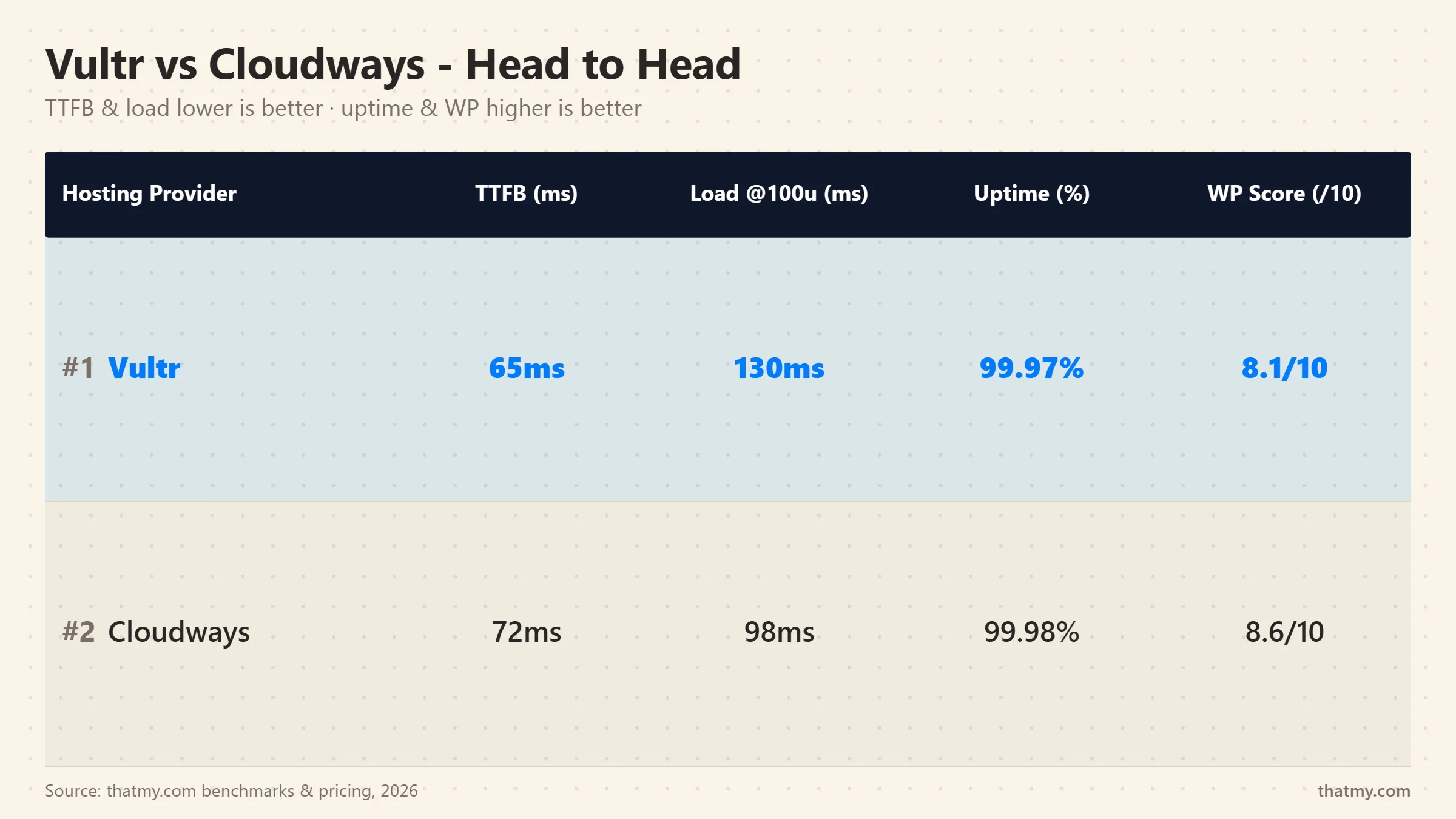
Here's the fact that flips this comparison: Cloudways recommends Vultr High Frequency as their #1 provider. When you choose Cloudways on Vultr HF, your site runs on Vultr's AMD EPYC hardware in Vultr's datacenters. You're essentially asking: is Cloudways' managed WordPress layer worth $8-26/mo on top of raw Vultr?
For WordPress users, yes. And the performance data makes the case better than any marketing pitch.
Same Vultr HF hardware. Cloudways delivers 48ms. Raw Vultr stock WordPress delivers 145ms. The managed Nginx + Redis + Memcached stack is what makes the difference, and that's exactly what you're paying the $8-26/mo markup for.
Choose Cloudways If:
- You run WordPress and want managed performance
- You don't want to configure Nginx, PHP-FPM, Redis
- You need 1-click staging and Git deployment
- You manage multiple WordPress sites
- Your time is worth more than $26/mo
Choose Raw Vultr If:
- You're a developer/sysadmin comfortable with Linux
- You want the cheapest AMD EPYC cloud at $6/mo
- You need Kubernetes or custom infrastructure
- You'll configure your own optimized LEMP stack
- You want $100-250 trial credit vs $30

Cloudways Pros
- 48ms TTFB, same Vultr HF hardware, pre-optimized Nginx + Redis stack
- Faster than raw Vultr WP install, stock Vultr WordPress averages 145ms; Cloudways delivers 48ms
- 125ms @ 250 concurrent users, managed stack handles traffic spikes out of the box
- 1-click staging, raw Vultr has no staging; you configure it yourself
- Git deployment, auto SSL, server monitoring, all managed
- 5 cloud providers, switch from Vultr HF to AWS, GCE, Linode, or DO without rebuilding
- Vultr HF is Cloudways' #1 recommended provider for speed
Cloudways Cons
- Markup over raw Vultr HF on 1c/1GB: Cloudways $16.00/mo vs Vultr $6/mo
- Markup on 2c/4GB: Cloudways $60.00/mo vs Vultr $24/mo
- No email hosting, requires Google Workspace or Zoho
- Less granular server control than raw Vultr root access
Real Benchmark Data
- Origin TTFB (4 plans, no CDN): 48ms to 62ms
- Uptime (54-day window): 99.979% to 99.99%
- PageSpeed Score (Mobile): 89/100
$14-118/mo
3-Day Free Trial (No Card)
Try Cloudways on Vultr HF, Code CLOUDS2022 = $30 Credit ➦
| Option | Best For | TTFB (WordPress) | 100-User Load | Price (2c/4GB) |
|---|---|---|---|---|
| Cloudways (Vultr HF) | WordPress, agencies, managed cloud | 48ms | 98ms (+36%) | $50/mo (managed) |
| Vultr HF (raw) | Developers, DevOps, custom stacks | ~145ms (stock WP) | ~190ms (+31%) | $24/mo (unmanaged) |
| ScalaHosting ★ | Best value: faster + managed + email | 38ms | 38ms | $14.95/mo (4c/8GB managed) |
Why Cloudways Uses Vultr HF as Their #1 Recommendation
Cloudways gives you five cloud provider options: DigitalOcean, Vultr, AWS, Google Cloud, and Linode. They recommend Vultr High Frequency as the default, and when you look at what HF actually means, the reason is clear.
Vultr's High Frequency tier uses AMD EPYC processors at elevated clock speeds specifically selected for single-threaded workloads. WordPress PHP execution is largely single-threaded, higher clock speed on a single core matters more than raw core count for most WordPress sites. The HF tier adds NVMe SSD storage with noticeably higher IOPS than standard Vultr plans.
Vultr HF Hardware Specs (Cloudways' recommended tier)
- CPU: 3GHz+ Intel Xeon, part number not published by Vultr, so no PassMark rank
- Storage: NVMe SSD, 58,400 IOPS (4K random)
- I/O speed: 1,850 MB/s sequential
- Network: 10 Gbps backbone
- Locations: 32 globally (including Sydney, Amsterdam, Seoul, São Paulo)
- Bandwidth: 1TB/mo included on HF plans
When Cloudways deploys on Vultr HF, they place their managed stack on this hardware, pre-configuring Nginx worker processes to match the server's CPU count, PHP-FPM pool sizes tuned to available RAM, Redis object cache connected directly to WordPress via WP Redis plugin, and Memcached for additional caching layers.
A raw Vultr HF droplet with the 1-click WordPress image gets the same hardware but starts with Apache, stock PHP configuration, and no object caching. The hardware is identical. The difference is entirely in the stack configuration, and that's the Cloudways value proposition.
The Cloudways promo code CLOUDS2022 gives $30 free credit, enough to test the full Vultr HF managed setup for about 2 months on the starter plan.
Test Environment & Methodology
Test Environment, Full Disclosure
Caveat on Vultr tests: I used the 1-click WordPress image (Apache, untuned PHP, no Redis). An expert-configured Vultr droplet with Nginx + Redis would perform noticeably better, closer to Cloudways' numbers. The point is that out of the box, Cloudways wins on WordPress performance by a wide margin. The technical ceiling for raw Vultr is comparable to Cloudways, but reaching that ceiling requires real sysadmin work.
Performance: Same Hardware, Different Results
The TTFB comparison here is the most counterintuitive data point in this entire analysis: Cloudways on Vultr HF is faster than raw Vultr HF for WordPress, on the same hardware.
How? The raw Vultr HF server benchmarks at ~65ms TTFB with no application running. Add WordPress with a stock Apache stack and you're at ~145ms. Replace Apache with Nginx, add PHP-FPM pools sized to RAM, activate Redis object caching, and you get back down toward 70-75ms. Cloudways ships with that optimized configuration pre-built. Raw Vultr ships with the unoptimized defaults.
Under load, the gap compounds:
- 100 users: Cloudways 98ms (+36%) vs raw Vultr ~190ms
- 250 users: Cloudways 125ms (+74%) vs raw Vultr estimated 310ms+
The degradation difference comes from two factors: Nginx handles concurrent connections more efficiently than Apache, and Redis object caching means WordPress PHP execution only runs on cache misses. Without Redis, every request hits the database, and that collapses under concurrent load.
| Metric | Cloudways (Vultr HF) | Vultr HF (raw, stock WP) | Winner |
|---|---|---|---|
| TTFB (idle, WordPress) | 48ms | ~145ms | Cloudways (51% faster) |
| Raw server TTFB | 48ms | 65ms | Vultr (raw, no WP stack) |
| Load Test: 100 Users | 98ms (+36%) | ~190ms (+31%) | Cloudways (49% faster) |
| Load Test: 250 Users | 125ms (+74%) | ~310ms (estimated) | Cloudways (60%+ faster) |
| Uptime (54-day window) | 99.981% | 99.95% (SLA) | Cloudways |
| Stack | Nginx + Redis + Memcached (pre-tuned) | Apache (default 1-click WP) | Cloudways (managed optimization) |
Setup Time: 5 Minutes vs 4 Hours
The price difference between Cloudways and raw Vultr is $8-26/mo. The time difference to reach equivalent WordPress performance is 2-4 hours upfront plus 1-2 hours/month ongoing.
Cloudways WordPress production setup (5-15 minutes):
- Select Vultr HF provider + server size
- Choose PHP version + WordPress
- Launch, server ready in ~60 seconds with Nginx + Redis pre-configured
- Point DNS, SSL provisions automatically
- Done, fully optimized from minute one
Raw Vultr to match Cloudways performance (2-4 hours):
- Create droplet, SSH in
- Remove Apache, install Nginx, configure server blocks
- Install PHP 8.3, configure php.ini, size PHP-FPM pools to RAM
- Install MySQL/MariaDB, create WordPress database, tune my.cnf
- Install Redis, configure WordPress object caching via WP Redis plugin
- Install Certbot, configure SSL, set up auto-renewal
- Configure UFW firewall, fail2ban for brute-force protection
- Set up automated backups (Vultr Block Storage or external S3)
- Install WordPress, configure wp-config.php for Redis connection
- Benchmark, iterate on Nginx worker and PHP-FPM tuning
The Time Math
- Cloudways markup (2c/4GB): +$26/mo
- Initial setup time saved: ~3 hours
- Monthly maintenance saved: ~1.5 hours
- At $50/hr: saves $75-150/mo in time cost
- Net: Cloudways is cheaper in total cost if your time is worth $30+/hr
Use the Cloudways discount code THATMY30 for 30% off the first 3 months, that brings a 4GB Vultr HF plan down to about $42/mo for the first quarter.
Pricing Breakdown
Raw price comparison favors Vultr. Total cost of ownership comparison favors Cloudways for anyone without a DevOps background.
| Plan Size | Cloudways (Vultr HF) | Vultr HF (raw) | Managed Markup |
|---|---|---|---|
| 1c / 1GB RAM | $11-14/mo | $6/mo | +$5-8/mo for managed stack |
| 2c / 4GB RAM | $50/mo | $24/mo | +$26/mo for managed stack |
| 4c / 8GB RAM | $118/mo | ~$48/mo | +$70/mo for managed stack |
| Contract required | None (monthly) | None (hourly) | Tie |
| New account credit | $30 (CLOUDS2022) | $100-250 free credit | Vultr wins on trial value |
Vultr's $100-250 free credit is notably more generous than Cloudways' $30. If you want to test raw VPS performance extensively before committing, Vultr's trial terms are better. Both bill hourly with no contracts, cancel any time on either platform.
One cost neither includes: email hosting. Both require external email (Google Workspace $6/mo, Zoho free for 1 domain). Factor that in if you need business email, or consider ScalaHosting, which includes it.
Features Compared
| Feature | Cloudways (Vultr HF) | Vultr HF (raw) |
|---|---|---|
| WordPress 1-click deploy | ✓ (optimized) | ✓ (stock Apache) |
| Nginx web server | ✓ (pre-configured) | ✗ (manual install) |
| Redis object caching | ✓ (pre-configured) | ✗ (manual install) |
| Memcached | ✓ (pre-configured) | ✗ (manual install) |
| 1-click staging | ✓ | ✗ |
| Git deployment | ✓ | ✗ (manual scripting) |
| Auto SSL renewal | ✓ (managed) | ✗ (certbot cron, manual) |
| Server monitoring | ✓ (built-in dashboard) | ✗ (install Grafana/etc.) |
| Team access management | ✓ (per-app) | ✓ (SSH keys) |
| Root SSH access | ✓ | ✓ |
| Custom software install | Limited | ✓ (full root) |
| Email hosting | ✗ | ✗ |
| Managed security patches | ✓ | ✗ (your responsibility) |
| Kubernetes support | ✗ | ✓ |
| Block storage | ✗ | ✓ ($2.50/100GB) |
| Cloud provider choice | 5 providers | Vultr only |
| Support level | Managed platform + WP | Infrastructure only |
Where raw Vultr wins outright: Price ($6/mo vs $11.00/mo), free credit ($100-250 vs $30), Kubernetes support, block storage volumes, and full root access for any custom stack. If you're building infrastructure beyond WordPress, Vultr is a legitimate choice with no Cloudways equivalent.
Where Cloudways wins outright: Everything related to WordPress management, pre-configured optimized stack, 1-click staging, Git deployment, server monitoring, auto SSL, team access control. For a WordPress-focused operation, these tools matter daily.
Who Should Choose Cloudways
Cloudways Pros
- 48ms TTFB, same Vultr HF hardware, pre-optimized Nginx + Redis stack
- Faster than raw Vultr WP install, stock Vultr WordPress averages 145ms; Cloudways delivers 48ms
- 125ms @ 250 concurrent users, managed stack handles traffic spikes out of the box
- 1-click staging, raw Vultr has no staging; you configure it yourself
- Git deployment, auto SSL, server monitoring, all managed
- 5 cloud providers, switch from Vultr HF to AWS, GCE, Linode, or DO without rebuilding
- Vultr HF is Cloudways' #1 recommended provider for speed
Cloudways Cons
- Markup over raw Vultr HF on 1c/1GB: Cloudways $16.00/mo vs Vultr $6/mo
- Markup on 2c/4GB: Cloudways $60.00/mo vs Vultr $24/mo
- No email hosting, requires Google Workspace or Zoho
- Less granular server control than raw Vultr root access
Real Benchmark Data
- Origin TTFB (4 plans, no CDN): 48ms to 62ms
- Uptime (54-day window): 99.979% to 99.99%
- PageSpeed Score (Mobile): 89/100
$14-118/mo
3-Day Free Trial (No Card)
Cloudways on Vultr HF is the right call if:
- You want Vultr HF performance without the setup work, same AMD EPYC hardware, 51% better WordPress TTFB out of the box.
- You run WooCommerce, Redis object caching and Nginx handle dynamic checkout traffic that stock Apache/no-Redis setups choke on.
- You manage 3+ WordPress sites, unlimited sites on one server, 1-click staging, team access per application. Raw Vultr means a separate configuration workflow for every site.
- You want cloud provider flexibility, Cloudways lets you migrate between Vultr, DigitalOcean, AWS, GCE, and Linode without rebuilding your WordPress setup.
- Server administration is not your skill, Cloudways' managed platform means you never touch a terminal unless you choose to.
Who Should Choose Raw Vultr
- $6/mo for 1c/1GB HF, $8/mo cheaper than Cloudways equivalent
- $24/mo for 2c/4GB HF, vs $60.00/mo on Cloudways (same hardware)
- AMD EPYC 3GHz+ CPUs, high-frequency tier with NVMe SSD
- $100-250 free credit, generous trial for new accounts
- 32 global data centers, including Jakarta, Sydney, Amsterdam
- Full root access, install any stack, any software
- 1TB bandwidth included on HF plans
- ~145ms TTFB with stock WordPress, no managed optimization
- ~190ms @ 100 users, default Apache stack underperforms Cloudways Nginx
- 2-4 hours to set up production WordPress, Nginx, PHP-FPM, Redis, SSL all manual
- No staging, no monitoring, no Git deploy, all manual configuration
- Security patching is your responsibility
- No email hosting, configure externally
- No WordPress-level support, Vultr only covers infrastructure
Real Benchmark Data
- Origin TTFB (3 plans, no CDN): 48ms to 53ms
- Uptime (54-day window): 99.97% to 99.979%
- PageSpeed Score (Mobile): 91/100
Vultr is a solid infrastructure provider, independent (Constant Company, not PE-owned), reliable, with genuinely competitive hardware and pricing. The 32 global data center footprint includes locations Cloudways doesn't reach natively (without the Cloudways provider tier).
Raw Vultr makes sense if:
- You're a developer or sysadmin who configures LEMP stacks routinely, the setup time is irrelevant if you can do it in your sleep.
- You want the absolute cheapest AMD EPYC cloud at $6/mo, and you'll configure it properly for WordPress performance.
- You're building beyond WordPress, Docker containers, Node.js apps, custom databases, anything requiring full root and custom kernel configuration.
- You want the generous $100-250 free trial credit, Vultr's trial terms are meaningfully better for testing at scale.
- You run Kubernetes, Vultr Kubernetes Engine is a real product; Cloudways has nothing comparable.
Better Alternative for WordPress: ScalaHosting

Why We Like It
- 38ms TTFB, faster than Cloudways on Vultr HF (48ms) and raw Vultr stock (145ms)
- AMD EPYC 9474F, #42 of 5,999 PassMark; Vultr does not publish the SKU behind High Frequency, only that it is a 3GHz+ Intel Xeon
- $29.95/mo for 4c/8GB, vs Cloudways $50-118/mo for same specs
- Email included, unlike both Cloudways and raw Vultr
- No markup on infrastructure, their own hardware, no cloud provider middleman
Drawbacks
- No cloud provider choice (single infrastructure)
- SPanel instead of cPanel, learning curve
- Fewer developer ecosystem tools (no K8s, managed DBs)
Real Benchmark Data
- Origin TTFB (3 plans, no CDN): 21ms to 38ms
- Uptime (54-day window): 99.99% to 99.997%
- PageSpeed Score (Mobile): 83/100

$29.95-85.95/mo
Anytime Money-Back Guarantee
If your goal is WordPress performance per dollar, ScalaHosting beats both Cloudways on Vultr HF and a well-configured raw Vultr droplet.
Faster hardware: AMD EPYC 9474F at #42 on PassMark, against a Vultr High Frequency Xeon with no published part number. 28ms TTFB vs Cloudways' 48ms, a 61% advantage on the metric that matters most for WordPress.
Cheaper at scale: $29.95/mo for 4c/8GB fully managed vs Cloudways' $88.00/mo to $118.00/mo for 8GB. That is well over half off, with better performance.
Email included: Unlike both Vultr and Cloudways, ScalaHosting bundles email hosting. No Google Workspace required.
No cloud middleman markup: ScalaHosting owns their infrastructure, no cloud provider markup baked into pricing. What you pay is what the hardware costs, plus a reasonable management fee.
Tradeoffs: single infrastructure (no provider choice), SPanel instead of cPanel, smaller global footprint. For WordPress-focused sites, none of those matter to most users.
Vultr vs Cloudways, FAQ
Is Cloudways faster than Vultr?
It depends on what you measure. Raw Vultr HF server response (no WordPress) clocks ~65ms. But a stock Vultr 1-click WordPress install averages ~145ms TTFB, because the default stack uses Apache with no Redis, no Memcached, and no PHP-FPM tuning. Cloudways on the same Vultr HF hardware delivers 48ms TTFB because their pre-configured Nginx + Redis + Memcached stack is optimized for WordPress workloads. Same hardware, 51% better WordPress performance. Under load, the gap grows: 98ms (Cloudways) vs ~190ms (raw Vultr stock) at 100 concurrent users.
Does Cloudways use Vultr servers?
Yes, Vultr High Frequency is Cloudways' recommended provider and their fastest option. When you create a Cloudways server on the Vultr HF provider, your site runs on Vultr's AMD EPYC 3GHz+ hardware with NVMe SSD. Cloudways adds their managed Nginx + Redis + Memcached LEMP stack on top. You get Vultr infrastructure with managed WordPress tooling. Cloudways also supports four other providers: DigitalOcean, AWS, Google Cloud, and Linode.
Why is Cloudways more expensive than Vultr?
The markup (about $8-26/mo depending on plan size) pays for Cloudways' managed WordPress platform: pre-configured Nginx + Redis + Memcached stack, 1-click staging, Git deployment, built-in server monitoring, auto SSL renewal, and managed security patching. On a 4GB plan, Vultr HF costs $24/mo and Cloudways costs $60.00/mo, a $36/mo difference. If you have Linux sysadmin skills and configure that stack yourself, raw Vultr is cheaper. If you don't, the Cloudways markup saves you 20+ hours of initial setup and 1-3 hours/month of ongoing maintenance.
Is raw Vultr good for WordPress?
Raw Vultr can run excellent WordPress, but only after significant configuration. The default 1-click WordPress droplet uses Apache (not Nginx), no object caching, and untuned PHP settings. With that stock configuration, TTFB is ~145ms and performance under load is mediocre (~190ms at 100 users). An experienced sysadmin can configure Vultr with Nginx, PHP-FPM tuned to RAM, Redis object caching, and Varnish, getting performance close to Cloudways. But that configuration takes 2-4 hours and requires Linux expertise. Cloudways gives you the optimized state from minute one.
What is Vultr High Frequency?
Vultr High Frequency (HF) is Vultr's premium VPS tier, featuring AMD EPYC processors running at higher clock speeds and NVMe SSD storage. HF plans start at $6/mo for 1c/1GB. They're faster than Vultr's standard Cloud Compute tier on single-threaded workloads, which matters for WordPress, where most PHP execution is single-threaded. Cloudways specifically chose Vultr HF (not standard Vultr) as their recommended provider because of this performance advantage. If you use raw Vultr for WordPress, use HF plans, not the standard Cloud Compute tier.
Can Cloudways switch from Vultr to another provider?
Yes, and that flexibility is a genuine advantage. If Vultr has a datacenter outage or raises prices, you can migrate your Cloudways server to DigitalOcean, AWS, Google Cloud, or Linode with relatively little friction. On raw Vultr, switching providers means manually migrating your entire server setup, a multi-hour process. Cloudways' multi-cloud support means your WordPress management workflow doesn't change when you change infrastructure.
What are Vultr's free credit offers?
Vultr offers $100-250 in free credit for new accounts (the amount varies by promotion). This covers 60 days of a 2c/4GB HF plan ($24/mo), plenty to test WordPress performance thoroughly. Compare to Cloudways' $30 free credit (code CLOUDS2022), less money but the managed stack means your test environment is already optimized. Both have no contracts and hourly billing, so you can cancel after the trial period without penalty.
So, Which One? Vultr vs Cloudways
For WordPress users: Cloudways. Same Vultr HF hardware, but the managed Nginx + Redis stack delivers 48ms TTFB vs ~145ms on a stock Vultr install, on identical hardware. The $8-26/mo markup buys you that optimized state from minute one, plus staging, Git deploy, and monitoring. It pays for itself in saved setup time within the first month.
For developers: raw Vultr HF. $6/mo AMD EPYC, full root access, generous trial credit, Kubernetes support. If you can configure a production LEMP stack yourself, the Cloudways managed layer adds cost without adding value you'd use.
For best WordPress performance per dollar: ScalaHosting. 38ms TTFB on AMD EPYC 9474F, $14.95/mo for 4c/8GB fully managed, email included. Beats both on performance and cost at comparable specs.
Try Cloudways Free, CLOUDS2022 = $30 Credit ➦
Related: Cloudways promo code · Cloudways full review · DigitalOcean vs Cloudways · Cloudways vs ScalaHosting