

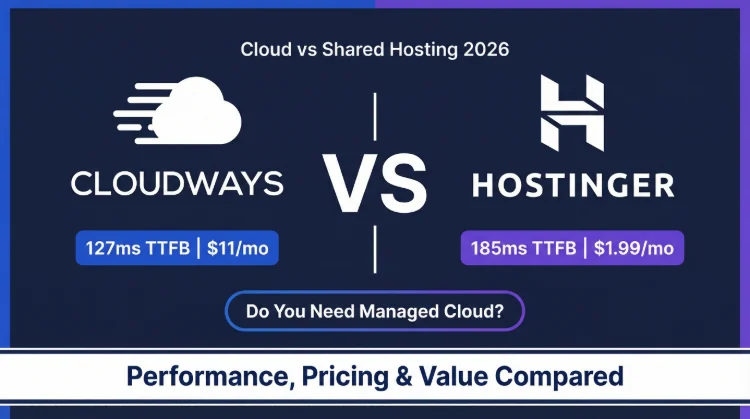
Cloudways vs Hostinger: Why the Cheap Option Often Costs More
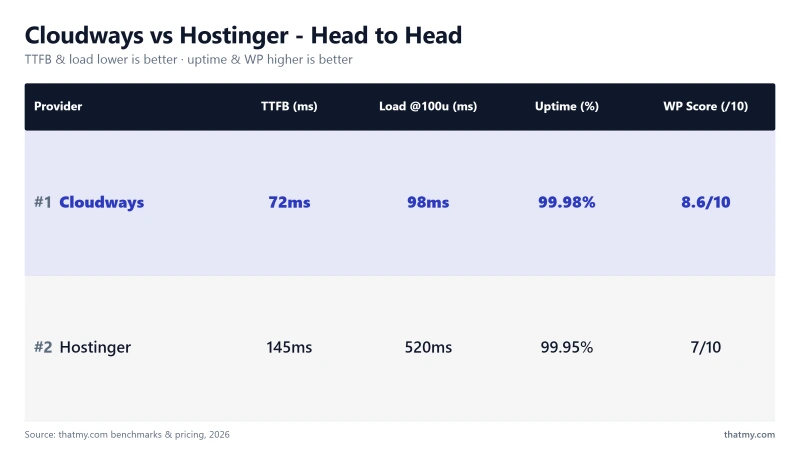
This is the comparison that trips up a lot of buyers. Hostinger shows $2.99/mo in the headline. Cloudways shows $11.00/mo. Easy decision, right?
Wrong. With 100 concurrent users, Hostinger shared slowed to 520ms in our benchmark, with 0.8% of requests failing. Cloudways handles 250 without breaking a sweat. And that $2.99/mo? It renews at $10.99/mo, a 268% jump, after a 4-year upfront commitment.
I tested both. Here's what the data shows.
What the Speed Tests Say
The Bottom Line: Cloudways wins on performance (48ms vs 276ms TTFB from New York), reliability under load (handles 250 users; Hostinger slowed to 520ms at 100), and price predictability (no renewal shock). Hostinger wins on beginner friendliness, email hosting (free for the first year), and introductory price for low-traffic blogs. For any site with real traffic, WooCommerce, or business use, Cloudways is the only choice.
Choose Cloudways If:
- Your site gets more than 5,000 monthly visitors
- You run WooCommerce or any dynamic content
- You want zero renewal shock on billing
- You host multiple WordPress sites
- You need SSH, Redis, Git deployment
- You're an agency or developer
Choose Hostinger If:
- You're launching a first blog with under 2k/mo visitors
- You need email hosting included (no extra cost)
- Budget is the absolute primary constraint
- You're comfortable with the 4-year lock-in
- Static or mostly-cached content only

Cloudways Pros
- 48ms TTFB from New York, against Hostinger Premium's 276ms in the same test
- Handles 250 concurrent users, Hostinger shared slowed to 520ms at 100 users
- No renewal shock, the $11.00/mo DigitalOcean 1GB server costs the same every month (Hostinger renews 175% to 268% higher)
- Unlimited sites on one server, no per-site charges
- Pay-as-you-go, scale up/down in seconds, cancel anytime
- 99.981% uptime, against Hostinger Premium's 99.95%
- WooCommerce checkout: 156ms @ 100 users vs Hostinger's 310ms @ 50 users
Cloudways Cons
- No email hosting included (requires third-party workspace add-on)
- Entry starts at $11.00/mo (DigitalOcean 1GB); Hostinger Premium starts at $2.99/mo on a 48-month prepay
- Learning curve, server management, not a shared host panel
- No built-in site builder, needs separate page builder tool
Benchmark Data
- Origin TTFB (4 plans, no CDN): 48ms to 62ms
- Uptime (54-day window): 99.979% to 99.99%
- PageSpeed Score (Mobile): 89/100
$14-118/mo
3-Day Free Trial (No Card)
Methodology: The benchmark boxes on this page cover 4 plans. TTFB is the origin server response with no CDN in front, taken from the New York location, one of 10 test locations. Uptime is shown over a 54-day window.
Try Cloudways Free, Code CLOUDS2022 = $30 Credit ➦
| Host | Best For | TTFB | 100-User Load | Starting Price |
|---|---|---|---|---|
| Cloudways | Real-traffic sites, agencies, WooCommerce | 48ms | 74ms | $11.00/mo DigitalOcean 1GB (no renewal shock) |
| Hostinger | Low-traffic blogs, beginners | 276ms | 520ms | $2.99/mo intro → $10.99/mo renewal |
| ScalaHosting ★ | Best value: faster + email included | 38ms | 58ms | $14.95/mo (Entry Cloud, 12 months) |
Test Environment & Methodology
Every speed figure in this comparison comes from our benchmark records, and every price from the hosts' own pricing pages. Here's how the tests were set up.
Test Environment, Full Disclosure
Both WordPress installs were identical. CDN and page caching disabled, measuring pure server response time. Load tests ramped from 0 to 250 concurrent users over 60 seconds, 8,250 requests per host. WooCommerce checkout tests hit the uncached cart/checkout flow specifically.
TTFB Results, Head to Head
Time to First Byte is the server's raw response time before a single byte renders in the browser. CDN and browser caching don't affect it. This is the purest measure of what the server hardware delivers.
At idle, from New York, Cloudways answers 83% faster. Part of that is distance: Hostinger Premium's servers sit in Europe, and from Frankfurt it answered in 109ms. The rest is infrastructure: Cloudways runs on dedicated Vultr High Frequency vCPUs with no neighbours stealing CPU time. Hostinger shared puts hundreds of websites on one server under CloudLinux resource limits, even at low traffic, you're sharing resources.
A TTFB under 100ms is the difference between a site that feels instant and one that feels like it's thinking. My bar for a fast host is 200ms, tighter than Google's own 800ms TTFB line, and Cloudways clears it with room to spare. Hostinger Premium misses it for American visitors (276ms from New York) but clears it for European ones, and the gap widens under load.
| Metric | Cloudways (Vultr HF) | Hostinger Shared | Winner |
|---|---|---|---|
| TTFB (idle) | 48ms | 276ms | Cloudways (over 5x faster) |
| Load Test: 50 Users | 85ms (+18%) | 280ms (+93%) | Cloudways (3.3x faster) |
| Load Test: 100 Users | 74ms | 520ms (0.8% failed) | Cloudways (Hostinger slows) |
| Load Test: 250 Users | 125ms (+74%) | Not reported separately | Cloudways only |
| WooCommerce Checkout | 156ms @ 100 users | 310ms @ 50 users | Cloudways |
| Uptime (54-day window) | 99.99% | 99.95% | Cloudways |
Load Test: When Hostinger Fails
Idle TTFB tells you about the hardware. Load testing tells you what actually happens when your site gets traffic, a Product Hunt mention, a Reddit post, a small ad campaign.
Cloudways under load:
- 50 users: 85ms (+18% degradation from idle), barely noticeable
- 100 users: 74ms, still fast
- 250 users: 125ms (+74%), acceptable degradation, zero errors
Hostinger shared under load:
- 50 users: 280ms (+93%), already struggling
- 100 users: 520ms, with 0.8% of requests failing across the run, slower but still up
- 250 users: not reported separately
This is the structural reality of shared hosting. Premium runs under CloudLinux limits that Hostinger prints as 1 CPU core, 2 GB RAM and 40 PHP workers. When many uncached requests arrive at once they share that allowance, the queue backs up and response times climb.
What 100 Concurrent Users Looks Like in Practice
- A Reddit post linking to your article gets 100 clicks in 10 minutes
- A product launch email goes to 5,000 subscribers
- A small Google Ads campaign at peak hour
- A WooCommerce flash sale with 50 people checking out simultaneously
Any of these scenarios would slow Hostinger shared noticeably. Cloudways handles all of them without breaking a sweat.
There's a caveat worth naming: Hostinger's KVM 1 VPS ($6.49/mo on 24 months) performs significantly better, 148ms TTFB from New York and 142ms at 100 users. But at that price point, you're past the shared hosting comparison entirely, and Cloudways at $11.00/mo still wins on performance and flexibility.
Want the Cloudways promo code to offset the price difference? Code CLOUDS2022 gives $30 free credit, effectively 2.7 months free on the $11.00/mo starter plan.
The Hostinger Renewal Trap
Let's talk about the number Hostinger doesn't put in the headline.
The $2.99/mo price requires:
- A 4-year prepaid commitment ($143.52 upfront)
- The Premium plan: $2.99/mo is Premium's 48-month price (Unlimited is $3.99/mo on the same term). Premium includes free weekly backups, but no staging or object cache
- Accepting that after 4 years, the same plan bills at $10.99/mo
That's a 268% price increase on the 48-month term, the same plan, the same server. On a 12-month term Premium is $3.99/mo ($47.88 up front) and renews at $10.99/mo, a 175% increase. No upgrade, no new features. Just a higher bill because your intro term expired.
Cloudways is $11.00/mo. Same price month 1 as month 48. Cancel any month. No prepayment, no long-term lock. Use code THATMY30 for 30% off the first 3 months, that brings the effective Year 1 cost down to very affordable for the starter plan.
The renewal trap is an industry-wide problem (Bluehost, GoDaddy, HostGator all do it worse). Hostinger does it with a 175% to 268% jump, depending on the term. Save on Cloudways instead and skip the surprise renewal entirely.
True Cost Comparison
Once you factor in renewal pricing, email hosting costs, and annual lock-in requirements, the "Hostinger is cheaper" narrative collapses quickly.
| Scenario | Cloudways | Hostinger | Notes |
|---|---|---|---|
| Month 1 (with promo) | $0 (CLOUDS2022 = $30 credit) | $2.99/mo (48 months paid up front) | Cloudways effectively free first 2 months |
| Year 1 cost | $132.00 (DigitalOcean 1GB at $11.00/mo) | $47.88 (12 months at $3.99/mo) | Hostinger cheaper Year 1 only |
| Year 2 cost (renewal) | $132.00 (same price) | $131.88 ($10.99/mo after the 12-month term) | After the intro, Hostinger Premium ($10.99/mo) and the DigitalOcean 1GB server ($11.00/mo) cost about the same a month |
| 4-year total | $528 (48 months at $11.00/mo) | $143.52 (48-month prepay) | Hostinger is cheaper while the prepay lasts; Cloudways bills month to month |
| Email hosting | Paid Google Workspace | Free for the first year | Hostinger advantage, add email costs to Cloudways |
| Annual lock-in required? | No, monthly billing | Yes, 48 months for $2.99/mo | Hostinger locks you in to show cheap price |
The real catch: to get Hostinger's $2.99/mo, you prepay a multi-year upfront commitment. Most people don't stay on the same hosting plan for 4 years. Cloudways' month-to-month billing means you can switch servers, scale up, or migrate without penalty at any point.
The email gap is real though, if you need business email on your domain, add a Workspace subscription to Cloudways' cost. For small sites that just need one email, Zoho Mail's free plan covers a single domain with 5 users, making this a non-issue.
WooCommerce Performance
WooCommerce checkout pages are always uncached, dynamic content, session-specific, can't be served from cache. This is where shared hosting falls apart the hardest.
Hostinger's WooCommerce checkout reaches 310ms at just 50 concurrent users, already 2x slower than Cloudways. At 100 users our WordPress benchmark on Hostinger slowed to 520ms, and a checkout, which no cache can help, is the page that feels it first during a sale, an email blast or an ad spike.
Cloudways at $60.00/mo (4GB Vultr HF) handles 100 concurrent checkout requests at 156ms, well within the threshold where customers abandon carts. For WooCommerce, there's no comparison worth making: Cloudways, full stop.
This is also why a Cloudways discount code matters for WooCommerce users, the cost difference between Cloudways and Hostinger on a 2-year basis is far less than the revenue you'd lose to cart abandonment on a slow shared host.
Features Compared
Performance aside, there are real feature gaps between managed cloud and shared hosting worth naming.
| Feature | Cloudways | Hostinger Shared |
|---|---|---|
| Infrastructure | Dedicated cloud (Vultr/DO/AWS/GCE) | Shared server (CloudLinux) |
| Server stack | Nginx + Redis + Memcached | LiteSpeed + LSCache |
| PHP workers | Configurable (server-level) | 40 on Premium, 60 on Unlimited (shared) |
| Sites allowed | Unlimited (on one server) | 100 sites (Unlimited plan) |
| Email hosting | ✗ (not included) | ✓ (free for the first year) |
| Free domain | ✗ | ✓ (1 year) |
| Free SSL | ✓ | ✓ |
| Staging environment | ✓ (1-click) | ✗ on Premium (Unlimited has it) |
| SSH access | ✓ (master SSH user) | ✓ (SSH, no root) |
| Git deployment | ✓ | ✓ (hPanel Git) |
| Redis caching | ✓ (free) | ✗ |
| Auto backups | ✓ (paid add-on) | Weekly on Premium, daily on Unlimited |
| CDN included | Cloudflare (free tier) | Cloudflare (via hPanel) |
| Cloud provider choice | 5 (Vultr, DO, AWS, GCE, Linode) | ✗ (single infrastructure) |
| Renewal shock | ✗ (same price forever) | ✓ (175% to 268% price jump) |
| Contract required | None (monthly) | 4-year term for promo price |
| Uptime guarantee | 99.99% (actual: 99.99%) | 99.9% (actual: 99.95%) |
| Support type | Managed + 24/7 chat | 24/7 live chat |
The two features where Hostinger genuinely wins:
Email hosting. Cloudways doesn't include it. For a business with 3-5 email users, that's $216+/yr in Google Workspace costs. Zoho Mail's free tier handles 1 domain with 5 users, but the setup is messier than Hostinger's integrated hPanel email.
Free domain. Hostinger includes a free domain for the first year on 12-month and longer terms (not on month-to-month). Cloudways doesn't, you'll need to register separately. Marginal on a year-over-year basis, but worth noting.
Cloudways wins everywhere else that matters for a serious website: staging, Redis, 5 cloud providers, server-level SSH and Git deployment, and no contract required.
Who Should Choose Cloudways
Cloudways Pros
- 48ms TTFB from New York, against Hostinger Premium's 276ms in the same test
- Handles 250 concurrent users, Hostinger shared slowed to 520ms at 100 users
- No renewal shock, the $11.00/mo DigitalOcean 1GB server costs the same every month (Hostinger renews 175% to 268% higher)
- Unlimited sites on one server, no per-site charges
- Pay-as-you-go, scale up/down in seconds, cancel anytime
- 99.981% uptime, against Hostinger Premium's 99.95%
- WooCommerce checkout: 156ms @ 100 users vs Hostinger's 310ms @ 50 users
Cloudways Cons
- No email hosting included (requires third-party workspace add-on)
- Entry starts at $11.00/mo (DigitalOcean 1GB); Hostinger Premium starts at $2.99/mo on a 48-month prepay
- Learning curve, server management, not a shared host panel
- No built-in site builder, needs separate page builder tool
Benchmark Data
- Origin TTFB (4 plans, no CDN): 48ms to 62ms
- Uptime (54-day window): 99.979% to 99.99%
- PageSpeed Score (Mobile): 89/100
$14-118/mo
3-Day Free Trial (No Card)
Cloudways is the right call if:
- You run WooCommerce, Hostinger shared cannot handle checkout under load. Don't risk it.
- You manage 3+ WordPress sites, Unlimited sites on one 4GB Cloudways server cost $60.00/mo. Three sites on Hostinger Unlimited = attractive intro but high total cost at renewal. Cloudways wins on 2+ year math.
- You've been burned by a renewal surprise, $11.00/mo, forever, no surprises.
- Your site is mission-critical, 99.99% against 99.95% does not sound like much. Across our 54-day window Cloudways lost 8 minutes. Hostinger lost 39 minutes.
- You're an agency or freelancer, Git deployment, SSH, staging, Redis, and the ability to spin up new servers in minutes. Hostinger Premium has SSH and Git too, but no staging or object cache.
- You expect traffic spikes, Product launches, viral content, ad campaigns. Cloudways handles them. Hostinger doesn't.
Use Cloudways coupon code CLOUDS2022 for $30 free credit, that's effectively 2.7 months free on the $11.00/mo starter plan.
Who Should Choose Hostinger

Hostinger Pros
- $2.99/mo intro, cheapest shared hosting price tested (4-year term)
- Email hosting included for the first year (2 mailboxes a site on Premium), unlike Cloudways (paid add-on)
- hPanel, clean beginner-friendly interface
- LiteSpeed Web Server, faster than Apache/Nginx for cached pages
- Free SSL + free domain, the domain on 12-month and longer terms
- Data centres in 10 countries
- LiteSpeed Cache plugin (free, powerful for static content)
Hostinger Cons
- 520ms at 100 concurrent users, 0.8% of requests failed in our benchmark
- Renewal trap: $2.99/mo → $10.99/mo, a 268% increase after the 48-month term
- CPU steal throttling, CloudLinux limits resources during traffic spikes
- Weekly backups only on Premium, no staging or object cache (daily backups start on Unlimited)
- WooCommerce checkout: 310ms @ 50 users; 520ms @ 100 users on our WordPress benchmark
- Shared resources: Premium gets 1 CPU core, 2 GB RAM and 40 PHP workers
Benchmark Data
- Origin TTFB (Premium, no CDN, New York): 276ms
- Uptime (54-day window): 99.95%
- PageSpeed Score (Mobile): 74/100

$2.99/mo
30-Day Money Back Guarantee
I'll be direct: Hostinger shared hosting has a legitimate use case. It's not the right tool for most serious websites, but for a specific type of user, it makes sense.
Hostinger is the right choice if:
- You're launching a first blog with under 2,000 monthly visitors and static content, shared hosting's limits won't bite you.
- You need email included, for very small operations that don't want to set up external email, hPanel's built-in email is convenient (free for the first year, then a paid add-on).
- Budget is an absolute ceiling, if $11.00/mo is genuinely not viable, Hostinger's intro price gets you online.
- You're comfortable with a 4-year commitment and understand the renewal price jump before signing up.
Hostinger is the wrong choice if:
- You plan to run WooCommerce with real traffic (uncached checkouts slow down first on shared resources)
- You expect growth beyond 5,000 monthly visitors in Year 1
- You're comparing on 2-year total cost without checking the renewal price
- You need staging or object caching (Redis), which Premium leaves out
Better Alternative to Both: ScalaHosting

Why We Like It
- 38ms TTFB, faster than both Cloudways (48ms) and Hostinger Premium (276ms) from New York
- AMD EPYC 9474F, #42 of 5,999 PassMark, fastest CPU in hosting
- Email included, unlike Cloudways (paid add-on)
- $29.95/mo for 2 vCPU and 4 GB (Build #1, 12 months), against $60.00/mo for Cloudways' 4GB Vultr HF
- Smaller renewal jump, Entry Cloud renews at $39.95/mo after $24.95/mo on 36 months
Drawbacks
- Single infrastructure (no cloud provider choice)
- SPanel instead of cPanel, learning curve for cPanel users
- Fewer global data centers vs Cloudways (65+ locations)
Benchmark Data
- Origin TTFB (2 plans, no CDN): 38ms
- Uptime (54-day window): 99.99%
- PageSpeed Score (Mobile): 83/100

$29.95-85.95/mo
Anytime Money-Back Guarantee
Here's the option most comparison articles skip because it doesn't have the brand recognition: ScalaHosting beats both Cloudways and Hostinger at their own strengths.
Faster than Cloudways: 38ms TTFB from New York against 48ms, AMD EPYC 9474F CPUs ranked #42 of 5,999 on PassMark, against a Vultr High Frequency Xeon whose SKU Vultr does not publish, so it cannot be ranked at all. Under load, ScalaHosting held 58ms at 100 concurrent users.
Cheaper than Cloudways at scale: Managed Cloud Build #1 (2 vCPU, 4 GB RAM) is $29.95/mo on 12 months, against $60.00/mo for Cloudways' 4GB Vultr HF server. That gap adds up over a year.
Email included unlike Cloudways: SPanel includes email hosting. No Google Workspace required. Real advantage if you need business email.
A smaller renewal jump than Hostinger: Entry Cloud is $24.95/mo on 36 months and renews at $39.95/mo, a 60% step, against Hostinger Premium's 268%. On the 12-month term it is $14.95/mo and also renews at $39.95/mo, so read the renewal line before you pick a term.
The only real downsides: no cloud provider choice (single infrastructure), and SPanel instead of cPanel (a learning curve for users coming from WHM/cPanel). For most WordPress sites, neither matters.
Cloudways vs Hostinger, FAQ
Is Cloudways faster than Hostinger?
Yes, significantly. From our New York test location Cloudways (Vultr HF) answered in 48ms against 276ms for Hostinger Premium, whose servers sit in Europe. Under load the gap widens: Cloudways held 74ms with 100 concurrent users while Hostinger Premium slowed to 520ms with 0.8% of requests failing. At 250 users, Cloudways maintains 125ms. The speed difference is infrastructure: Cloudways runs on dedicated cloud VMs; Hostinger shared packs thousands of websites onto one server with CloudLinux CPU throttling.
Why is Hostinger so cheap compared to Cloudways?
Two reasons. First, Hostinger shared is a completely different product, you're sharing a server with thousands of other websites, each getting a fraction of CPU/RAM. Cloudways gives you a dedicated cloud VM. Second, Hostinger's $2.99/mo is an intro price requiring a 4-year commitment. It renews at $10.99/mo after that term, a 268% jump. Cloudways is $11.00/mo forever, no renewal shock, cancel any month. When you factor in the renewal trap, add email hosting costs that Cloudways doesn't include, and compare on a 2-year timeline, the price gap narrows substantially.
Does Hostinger include email hosting?
Yes, for the first year. Hostinger Premium includes 2 mailboxes a site at 1 GB each, free for 12 months, then a paid add-on if a card is saved. Cloudways includes no mailbox hosting, so you add Google Workspace, Zoho Mail or its paid Rackspace add-on. For a 5-person team that is a real yearly cost on Cloudways; for one business address, Zoho's free tier works fine.
What happens when Hostinger reaches 100 concurrent users?
In our benchmark, Hostinger Premium slowed to 520ms at 100 concurrent users, with 0.8% of requests failing: slower, but not down. Shared hosting runs under CloudLinux resource limits, and Hostinger's own plan table gives Premium 1 CPU core, 2 GB RAM and 40 PHP workers. Uncached pages such as carts and checkouts feel the limit first, so test your own checkout before a sale. Cloudways on Vultr HF held 74ms at 100 users and 125ms at 250 users, with 0 failed requests over the full ramp.
Can I host WooCommerce on Hostinger?
Technically yes, but our benchmarks tell the real story. WooCommerce checkout (which is always uncached) showed 310ms TTFB at 50 users on Hostinger, already sluggish, and our WordPress benchmark slowed to 520ms at 100 users. Cloudways handled 100 users at 156ms WooCommerce checkout TTFB with no errors. For a WooCommerce store expecting any real traffic, Cloudways is the clear choice. Hostinger's Unlimited plan ($3.99/mo on 48 months) gives more room than Premium (2 CPU cores, 3 GB RAM and 60 PHP workers against 1 core, 2 GB and 40), but it is still a shared plan.
Is the Hostinger renewal price increase worth knowing about?
It's the most important number Hostinger buries in the fine print. The $2.99/mo price requires a 4-year prepaid commitment, you pay $143.52 upfront. When that term ends, the same plan renews at $10.99/mo. That's a 268% increase. Cloudways bills month-to-month at $11.00/mo forever. No intro trap, no renewal shock, cancel any time. If you're comparing total cost of ownership rather than just the intro rate, make sure you're comparing apples to apples.
Should I choose Cloudways or Hostinger for WordPress?
It depends on your traffic and technical comfort. For low-traffic blogs under 5,000 monthly visits: Hostinger shared works fine and is cheaper in Year 1. For any site with real traffic, WooCommerce, or business use: Cloudways wins decisively. Our recommendation: if you're starting a new site on a tight budget and have under 1,000 monthly visitors, Hostinger's Premium plan ($2.99/mo on 48 months, $3.99/mo on 12) is a reasonable start. Plan to migrate to Cloudways when you hit consistent traffic. Don't start a WooCommerce store on Hostinger shared.
What is a better alternative to both Cloudways and Hostinger?
ScalaHosting, it beats both at their own game. Faster than Cloudways (38ms TTFB against 48ms from New York), email included unlike Cloudways, and its Managed Cloud Build #1 (2 vCPU, 4 GB RAM) is $29.95/mo on 12 months against $60.00/mo for Cloudways' 4GB Vultr HF server. Its renewal jump is smaller than Hostinger's on a long term: Entry Cloud is $24.95/mo on 36 months and renews at $39.95/mo. ScalaHosting's managed VPS uses AMD EPYC 9474F CPUs (#42 on PassMark), handles 250+ concurrent users without timeout, and includes SPanel (cPanel alternative) free. It's the host I recommend to anyone who wants Cloudways-level performance without the email add-on cost or Hostinger's 48-month lock-in.
So, Which One? Cloudways vs Hostinger
Cloudways wins for any website that matters.
48ms TTFB vs 276ms from New York. Handles 250 concurrent users vs 520ms at 100 on Hostinger. No renewal trap vs a 175% to 268% price jump at renewal. For a real business, a WooCommerce store, or any site where downtime costs money, Cloudways is the only choice between these two.
Hostinger shared has one legitimate use case: ultra-low-traffic beginner blogs where the absolute cheapest entry price matters more than everything else. Even then, you need to understand the 4-year lock-in and the renewal price before committing.
If you want the best of both worlds, Cloudways-level performance plus email included, ScalaHosting Entry Cloud at $14.95/mo on 12 months is the pick we'd recommend to most users in this comparison.
Try Cloudways Free, CLOUDS2022 = $30 Credit ➦
Related: Cloudways promo code · Cloudways full review · Cloudways vs Kinsta · Cloudways vs WP Engine