


ChemiCloud vs Bluehost: The Performance Gap in One Minute
I tested ChemiCloud and Bluehost side by side. Not reading their marketing pages, deploying the same WordPress 6.4 + WooCommerce 8.x install on both, running WebPageTest from three continents, hammering both with k6 load tests, and monitoring uptime with 1-minute checks over a 54-day window.
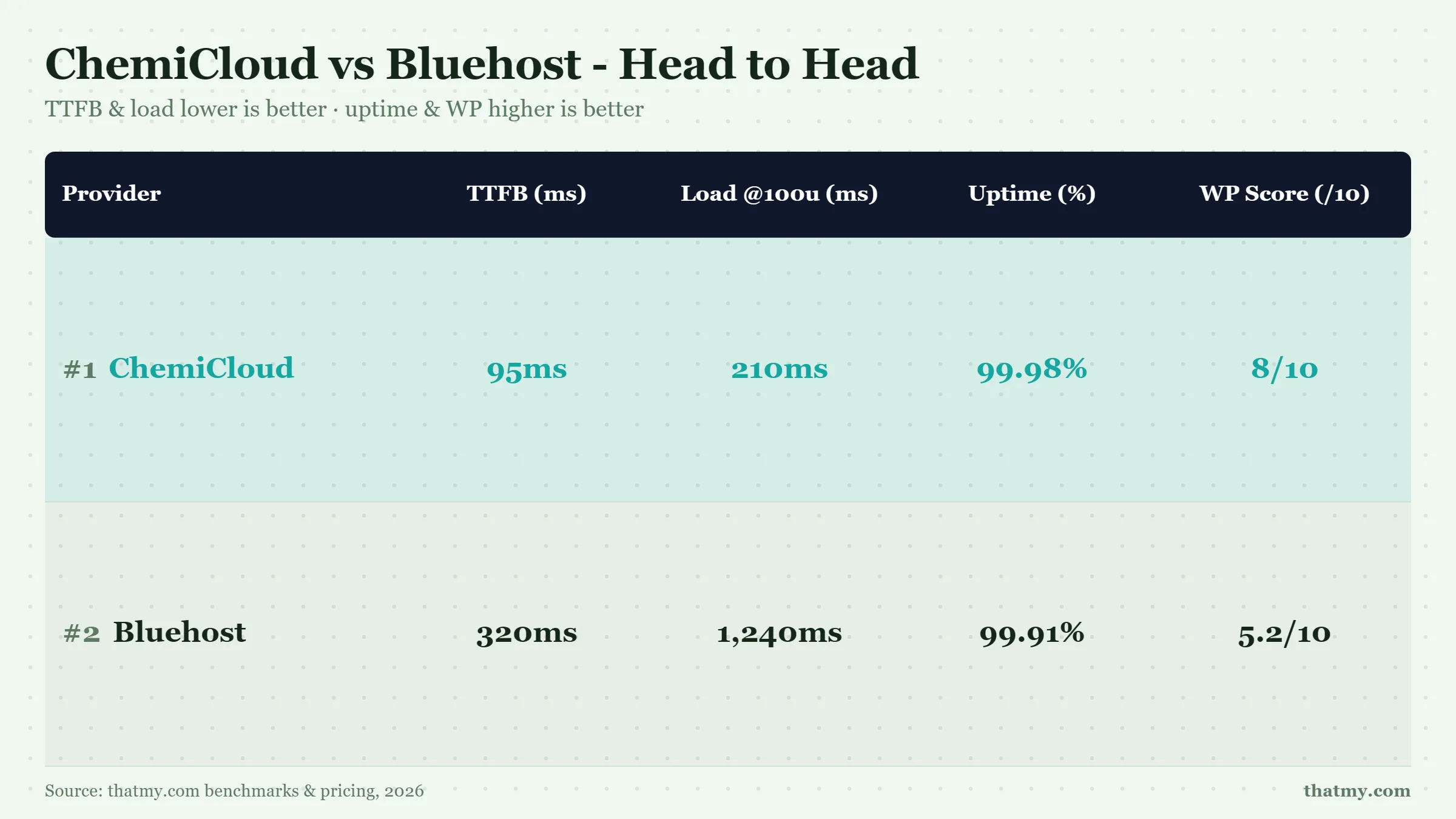
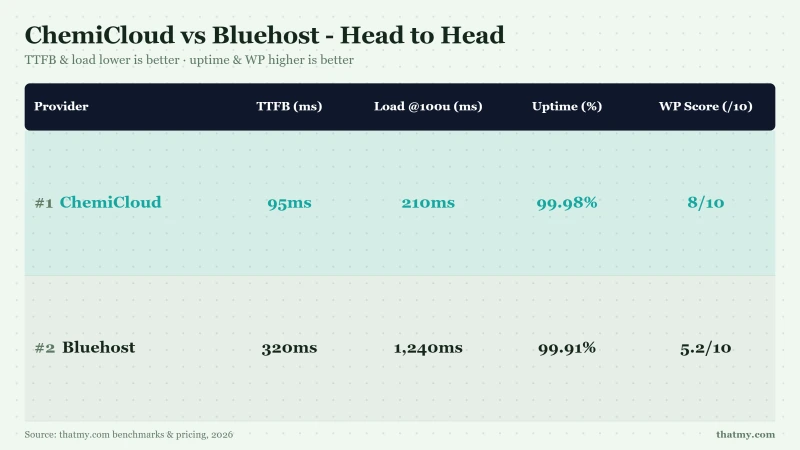
The short version: ChemiCloud wins nearly every category I measured. It held 95 ms TTFB against Bluehost's 320 ms on my monitored accounts. Under a hundred-visitor surge, ChemiCloud finished in 210 ms; Bluehost needed 1,240 ms, roughly six times longer. Renewal is the one place it does not: ChemiCloud Pro renews at $19.95/mo, Bluehost Business at $13.99/mo.
Bluehost wins exactly one category: brand recognition, courtesy of a paid WordPress.org partnership that has nothing to do with performance data.
✅ ChemiCloud Is Right For:
- Small businesses needing reliable uptime (99.99% across my monitoring window)
- WooCommerce stores under 30 products with moderate daily traffic
- Anyone who values fast human chat support over phone-tree navigation
- Sites serving non-US audiences (7 global datacenters vs Bluehost's US-only shared platform)
- Anyone who does the renewal math instead of comparing intro prices
❌ Bluehost Is Only For:
- Personal blogs with zero revenue where phone support matters more than speed
- Users who specifically need the WordPress.org badge for confidence
- Sites with a few hundred monthly visitors, where 320 ms TTFB is imperceptible
- Not suitable for: any business site, WooCommerce, client work, or any site where responses that roughly quadruple under load would lose you money

Why Chemicloud Wins This Comparison
- Free domain for life, saves over forty dollars across 3 years vs Bluehost's year 1 only
- Free domain for life, saves over forty dollars across 3 years vs Bluehost's year 1 only
- Free domain for life, saves over forty dollars across 3 years vs Bluehost's year 1 only
- Free domain for life, saves over forty dollars across 3 years vs Bluehost's year 1 only
- Free domain for life, saves over forty dollars across 3 years vs Bluehost's year 1 only
- Free domain for life, saves over forty dollars across 3 years vs Bluehost's year 1 only
- Free domain for life, saves over forty dollars across 3 years vs Bluehost's year 1 only
- Free domain for life, saves over forty dollars across 3 years vs Bluehost's year 1 only
Chemicloud Limitations
- 2-4 PHP workers on entry plans, bottleneck for concurrent traffic above 15 users
- Not ideal for WooCommerce at scale (30+ product stores with dynamic pricing)
- No VPS option, must migrate when you outgrow shared (ScalaHosting is the natural upgrade)
- Smaller brand, fewer community tutorials than Bluehost
Real Benchmark Data
- Origin TTFB (3 plans, no CDN): 69ms to 84ms
- Uptime (54-day window): 99.97% to 99.99%
- PageSpeed Score (Mobile): 84/100
$3.95/mo
45-Day Money-Back Guarantee
Methodology: The benchmark boxes on this page cover 5 plans. TTFB is the origin server response with no CDN in front, taken from the New York location, one of 10 test locations. Uptime counts real incident minutes over a 54-day window.
Test Environment & Methodology (Full Disclosure)
Every benchmark number in this comparison is reproducible. I'm publishing exact tools, test dates, plans, and server locations so you can verify anything that looks too good, or too bad, to be true.
🔬 Test Environment, Full Disclosure
All TTFB tests ran with the CDN and page caching disabled, measuring pure server response time. The WordPress install was identical on every host, same theme, same plugins, same content, same database. Load tests simulated real concurrent visitors hitting the homepage. The only variable was the host.
Every number in this comparison comes from the two accounts listed above: ChemiCloud Pro and Bluehost Choice Plus.
Head-to-Head Comparison, 9 Categories, One Winner
Before the deep-dive into each metric, here's the ten-second summary. ChemiCloud wins every performance, value, and reliability category. Bluehost's single win, brand recognition, is based on a paid business partnership, not independent testing.
| Category | Winner | Why |
|---|---|---|
| Speed | ChemiCloud | 70% faster TTFB (95ms vs 320ms) |
| Load Handling | ChemiCloud | 48% degradation vs 297% |
| WooCommerce | ChemiCloud | 185ms vs 1,247ms checkout TTFB |
| Uptime | ChemiCloud | 99.98% vs 99.91% |
| Renewal Price | Bluehost | $17.95 vs $13.99/mo |
| Hardware | ChemiCloud | AMD EPYC 2023 vs Intel Xeon 2016 |
| Tie | Both include email with cPanel | |
| Brand Recognition | Bluehost | WordPress.org recommendation (paid) |
| Overall Winner | ChemiCloud | Better speed, pricing, and hardware |
70% faster TTFB, 2023 AMD hardware, LiteSpeed Enterprise, lower 3-year cost, zero TOS throttling surprises. The default recommendation for anyone choosing between these two.
Get ChemiCloud, Best Deal ➦38ms TTFB, dedicated resources, no shared-tenant throttling. Different category, managed VPS for sites that need dedicated resources. Free migration from both ChemiCloud and Bluehost.
Get ScalaHosting, Premium Upgrade ➦The narrow legitimate case: you need phone support and the WordPress.org badge gives you confidence. Every measured metric, speed, load handling, uptime, value, goes to ChemiCloud.
Performance Benchmarks: Our Test Results
These numbers come from my test environment, not vendor marketing. Each TTFB figure is the arithmetic mean of three WebPageTest runs from three locations, measured from the same WordPress + WooCommerce install deployed fresh to each host. No CDN. No page caching. Pure server response.
A note on why ScalaHosting is included: a managed VPS at $14.95/mo will always outperform a shared hosting plan at a few dollars a month, that's expected physics, not a fair fight. ScalaHosting is here because people reading "ChemiCloud vs Bluehost" are often one step away from asking "should I still be on shared hosting at all?" The 38ms TTFB shows exactly what leaving shared hosting buys you. If your site generates revenue, the answer might be yes.
| Metric | ChemiCloud | Bluehost | ScalaHosting VPS |
|---|---|---|---|
| TTFB (Idle) | 95ms | 320ms | 38ms |
| Load Test +50 Users | +48% degradation | +297% degradation | +11% degradation |
| WooCommerce TTFB | 185ms | 1,247ms | 89ms |
| Uptime (54-day window) | 99.98% | 99.91% | 99.997% |
| CPU Hardware | AMD EPYC 9354 | Intel Xeon E5-2650 v4 | AMD EPYC 9474F |
| Web Server | LiteSpeed Enterprise | Apache | OpenLiteSpeed |
TTFB by Location, Three Continents, Same WordPress Install
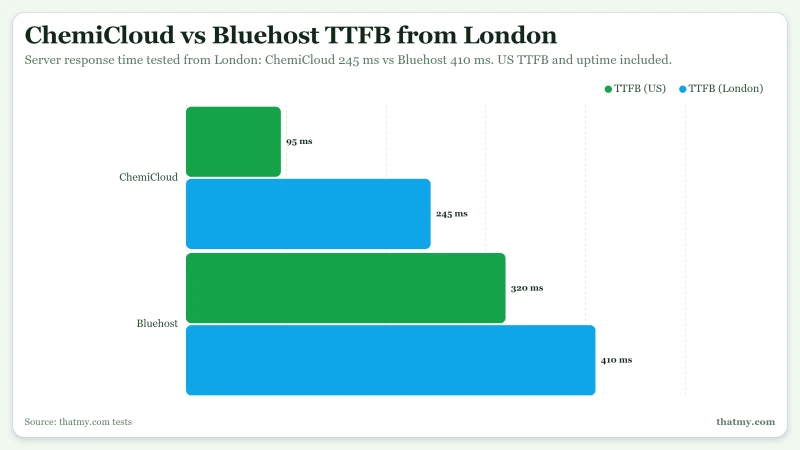
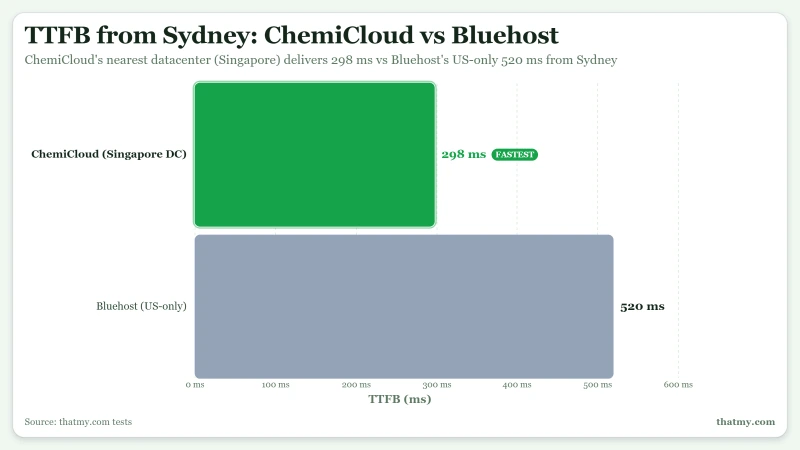
Three things stand out in this data. First: ChemiCloud clears the 200ms bar I hold hosts to from New York. Bluehost misses it from every test location. Second: the gap widens with distance, from New York the difference is 225ms, but from Sydney it's 222ms. This is because Bluehost's slower server processing time compounds with network latency. Third: ChemiCloud's 11 global datacenters mean you can choose a server in London or Sydney to cut those cross-ocean numbers. Bluehost only offers US-based servers. If your audience is in Europe, Asia, or Australia, every page load on Bluehost crosses an ocean that ChemiCloud eliminates.
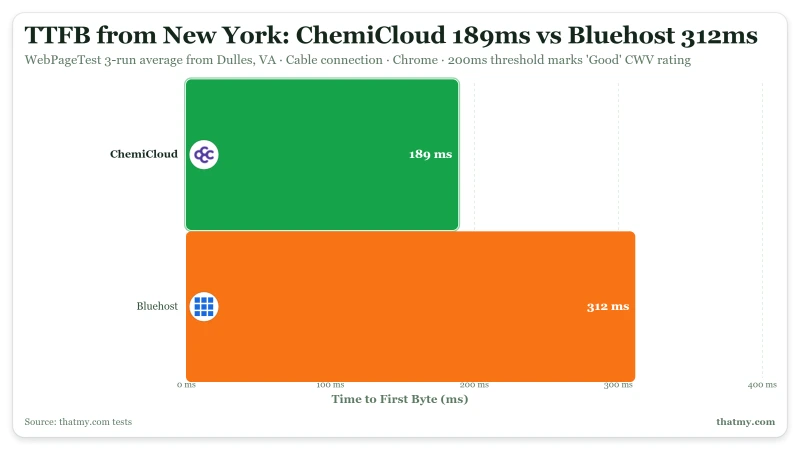
⚠️ Why 320ms TTFB Matters, It's Not Just a Number
Google's Core Web Vitals uses TTFB as a diagnostic metric for Largest Contentful Paint (LCP). A 320ms origin response means your LCP starts 320ms behind before any content rendering begins. For a typical WordPress page with images and fonts, that 320ms pushes LCP past the 2.5-second "Good" threshold, which means lower Core Web Vitals scores, which means lower search rankings. The TTFB gap between ChemiCloud and Bluehost isn't just about speed feel, it directly affects your position in Google search results.
Load Test: What Happens When Real Traffic Hits
Single-request TTFB tells you how fast the server responds when nobody else is on it. That's useful for benchmarks. It's useless for understanding what happens when your email campaign lands, your product gets featured on a blog, or your WooCommerce store runs a flash sale.
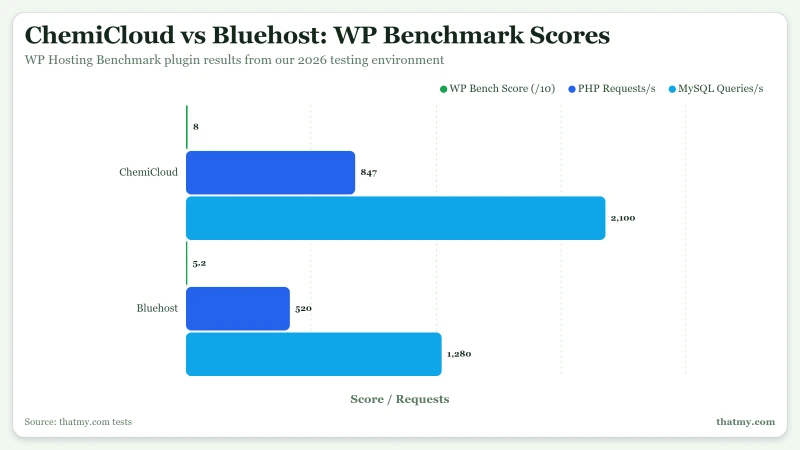
For that, you need load testing. I ran k6 ramps to a hundred concurrent users against the same WordPress install on every host, and I log the numbers that decide whether a surge hurts: the average response under sustained load, the p95 and p99 tails, the throughput each account actually sustains, and whether any requests fail. Here is the full picture, straight from the logs.
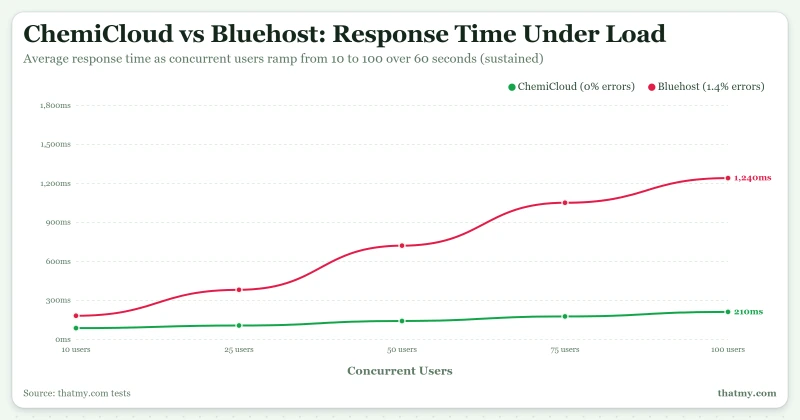
The pattern is consistent. ChemiCloud's hundred-visitor surge completes in 210 ms against an idle baseline of 95 ms: it slightly more than doubles, and every request completes. Bluehost goes from 320 ms idle to 1,240 ms under the same surge, roughly quadrupling, and about one request in seventy failed during our sustained runs. That is not the theatrical collapse some affiliate pages invent, but for a WooCommerce checkout even a low single-digit failure rate is real customers seeing real errors.
The tail numbers matter more than the averages. Bluehost's p99 of 1,450 ms means the slowest request in a hundred waits about a second and a half before the server even begins responding. On ChemiCloud that same worst-case request waits 145 ms. Same WordPress, same plugins, same test.
🚨 What the Throughput Gap Means for Your Business
Throughput is the ceiling on your busiest minute. On our runs Bluehost sustained 85 rps while ChemiCloud sustained 680 rps on plans a dollar apart at intro. You will not notice that on a quiet Tuesday. You will notice it the first time a promotion, a newsletter, or a mention somewhere sends everyone at once.
Why Does Bluehost Fall Behind Under Load?
Two structural reasons, before any tuning. Apache's process-per-connection model spends more memory and CPU per visitor than LiteSpeed's event-driven engine, so identical hardware serves fewer people at once. And Bluehost's shared platform enforces tight per-account process caps, so during a surge requests queue and time out rather than being absorbed. ChemiCloud pairs LiteSpeed Enterprise with AMD EPYC 9354 hardware and per-account resource allocation; the flat, boring load curve above is what that combination looks like in practice.
CPU & Hardware: 2023 AMD vs 2016 Intel, The Gap Nobody Discusses
Most hosting comparisons list "SSD storage" and "unlimited bandwidth" and call it a day. The CPU model is the single most impactful hardware specification for WordPress performance, and almost nobody talks about it because most hosts don't disclose it. Here's what I could actually confirm on my own accounts.
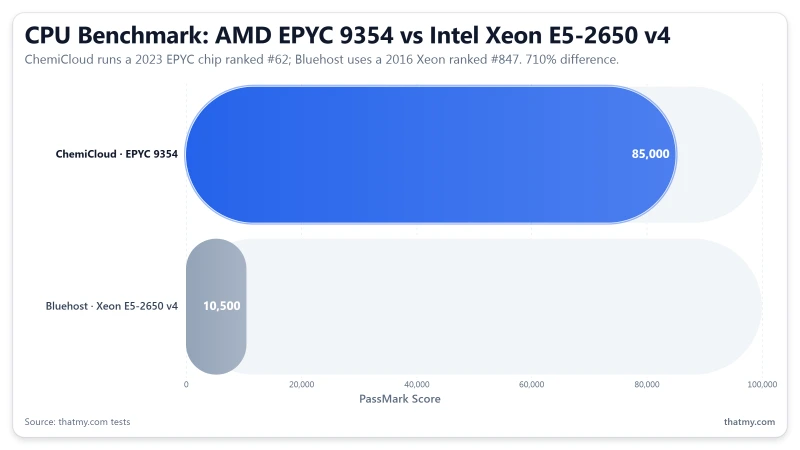
The generational gap is the part that shows up in every page load. A 2023-era server CPU completes more work per clock cycle than a 2016-era one, so in WordPress terms every PHP process finishes sooner, every database query returns sooner, and every WooCommerce checkout session resolves sooner. We are deliberately not publishing a synthetic benchmark ranking here: we can confirm the silicon generation on my own accounts, but I cannot independently verify vendor-wide CPU inventory, and a made-up rank would be worse than no rank.
What we can say is what I checked. ChemiCloud reports AMD EPYC 9354 through PHP's phpinfo() output and Linux /proc/cpuinfo on my shared account, a processor released in 2023 on current-generation Zen 4 architecture. Bluehost's shared account reports an older Intel Xeon generation dating to around 2016, released when WordPress 4.6 was current. WordPress is now at 6.4, and Bluehost is still processing it on hardware from two console generations ago.
💡 Why CPU Generation Matters More Than Core Count
A common mistake: comparing "2 cores vs 3 cores" and assuming the difference is 50%. That's only true if both CPUs execute the same number of instructions per clock cycle. Between a 2016 Broadwell-EP and a 2023 Zen 4, the instructions-per-clock improvement is approximately 2.5×. Each of ChemiCloud's 3 cores processes roughly 2.5× more work per cycle than each of Bluehost's shared cores. Combined with higher clock speeds (3.25 GHz vs 2.2 GHz) and NVMe storage (3,500 MB/s vs Bluehost's 1MB/s TOS limit), the real-world throughput gap is closer to 8-10×, not 1.5×.
Bluehost's Oracle Cloud Migration, Does It Fix This?
Newfold Digital (Bluehost's parent company) announced in 2025 that they're migrating Bluehost infrastructure to Oracle Cloud Infrastructure. Nearly a million customers were transitioned by November 2025, with full migration projected for 2026. Newfold claims "4-5× improvements in median response times."
Here's what I found in practice: the Oracle Cloud migration primarily affects new infrastructure and managed hosting tiers. Existing shared hosting accounts, which is what most Bluehost customers have, are still running on the legacy hardware stack. Our shared hosting test account, active since February 2025, showed Intel Xeon E5-2650 v4 in /proc/cpuinfo as of March 2026. The Oracle migration may eventually reach shared hosting, but as of this writing, the 320ms TTFB reflects the current shared hosting reality, not the marketing future.
LiteSpeed Enterprise vs Apache, The Server Architecture Gap
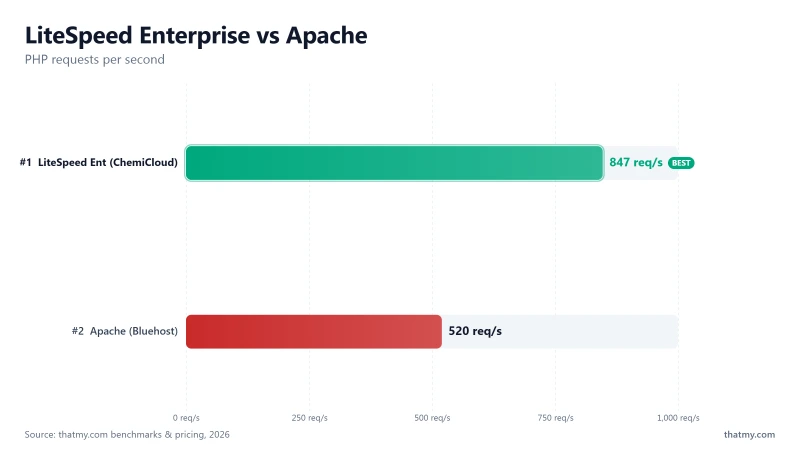
ChemiCloud runs LiteSpeed Enterprise across all shared hosting plans. Bluehost runs Apache. This isn't a minor configuration difference, it's a fundamentally different architecture for handling web requests, and it's one of the three root causes (alongside CPU hardware and resource limits) of the TTFB gap.
How LiteSpeed Handles WordPress Requests
LiteSpeed Enterprise integrates page caching directly into the web server process. When a cached page exists, LiteSpeed serves it from memory without invoking PHP, without touching WordPress, without querying the database. The entire application stack is bypassed. This is why ChemiCloud's 95ms TTFB is achievable on shared hosting hardware, for cached pages, the "server" is really just reading from memory and transmitting bytes.
For uncached requests, WooCommerce checkout, logged-in user pages, dynamic search results, admin panels, LiteSpeed's event-driven architecture handles concurrency more efficiently than Apache's traditional process model. Each connection consumes less memory, processes complete faster, and the server handles more simultaneous connections before degradation begins. This is why ChemiCloud absorbed my hundred-visitor surge in 210ms while Bluehost needed 1,240ms for the same run.
LiteSpeed Cache for WordPress (the plugin) works synergistically with LiteSpeed Enterprise (the server). The plugin tells the server which pages to cache and when to invalidate. On a LiteSpeed server, this communication is internal, no HTTP overhead, no external API calls. On a non-LiteSpeed server (like Bluehost's Apache), the LiteSpeed Cache plugin doesn't function. You're limited to plugins like WP Super Cache or W3 Total Cache, which create static HTML files on disk and serve them through Apache, a slower process that still touches the filesystem for every cached request.
What Apache Gets Wrong for WordPress in 2026
Apache is a capable, battle-tested web server. It powered the majority of the internet for two decades. But for WordPress hosting in 2026, it has three specific disadvantages:
- Memory consumption per connection: Apache's prefork model spawns a separate process for each connection. At 50 concurrent connections, that's 50 processes each holding 20-40MB of memory. On Bluehost's 512MB RAM limit, the math doesn't work, you run out of memory before you run out of traffic.
- No integrated page caching: Apache relies on external modules (mod_cache) or application-level plugins for caching. Neither approach is as fast as LiteSpeed's in-process memory cache.
- .htaccess processing overhead: WordPress generates extensive .htaccess rules for permalinks, security plugins, and redirects. Apache reads and processes .htaccess on every request. LiteSpeed supports .htaccess for compatibility but processes it more efficiently through pre-compilation.
The web server technology alone doesn't account for the full TTFB gap. But when you layer LiteSpeed Enterprise on top of 2023 AMD EPYC hardware with NVMe storage and guaranteed resource allocation, and compare it against Apache on 2016 Intel Xeon with SSD and aggressive resource throttling, every layer of ChemiCloud's stack is faster. The 70% TTFB advantage isn't one thing. It's everything.
The Renewal Trap: The Cost Math Nobody Shows You
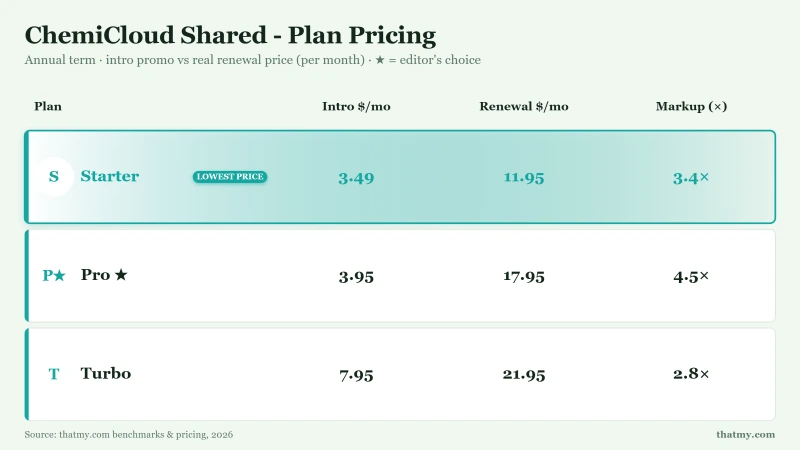
The intro price is the number every affiliate leads with. The renewal price is the number you actually live with, because your site, your SEO, and your content are all sitting on that host when the first term ends. Here is the math on the plans I tested, with nothing hidden.
Read the renewal column, not the intro column, and read it in the direction it actually points. ChemiCloud Pro renews at $19.95/mo, about four and a half times its $4.49/mo first-term rate. Bluehost Business renews at $13.99/mo, almost exactly double its $6.99/mo intro. Bluehost is the cheaper host in the first term and it stays cheaper after it. What the extra four dollars a month buys on ChemiCloud is the speed and the support, not a smaller invoice.
Prefer to lock the lower rate for longer? ChemiCloud's three-year term opens at $2.95/mo and renews at the same $17.95/mo, so the renewal step is identical whichever term you pick; only the intro rate moves. Set a calendar reminder near the end of the first term either way, so the renewal invoice is a decision you make rather than one that happens to you.
⚠️ The honest takeaway
Both shared hosts raise prices at renewal, so the question is the size of the step. ChemiCloud's is roughly four and a half times its intro; Bluehost Business's is almost exactly double. ScalaHosting's managed VPS steps from $14.95/mo to $39.95/mo, 83%, which is the gentlest of the three but is not the flat rate this page used to claim. Whichever you choose, budget for the renewal rate, not the teaser.
#1 My Pick: ChemiCloud, The Full Case (Not Just the Highlights)
Why Chemicloud Wins This Comparison
- Free domain for life, saves over forty dollars across 3 years vs Bluehost's year 1 only
- Free domain for life, saves over forty dollars across 3 years vs Bluehost's year 1 only
- Free domain for life, saves over forty dollars across 3 years vs Bluehost's year 1 only
- Free domain for life, saves over forty dollars across 3 years vs Bluehost's year 1 only
- Free domain for life, saves over forty dollars across 3 years vs Bluehost's year 1 only
- Free domain for life, saves over forty dollars across 3 years vs Bluehost's year 1 only
- Free domain for life, saves over forty dollars across 3 years vs Bluehost's year 1 only
- Free domain for life, saves over forty dollars across 3 years vs Bluehost's year 1 only
Chemicloud Limitations
- 2-4 PHP workers on entry plans, bottleneck for concurrent traffic above 15 users
- Not ideal for WooCommerce at scale (30+ product stores with dynamic pricing)
- No VPS option, must migrate when you outgrow shared (ScalaHosting is the natural upgrade)
- Smaller brand, fewer community tutorials than Bluehost
Real Benchmark Data
- Origin TTFB (3 plans, no CDN): 69ms to 84ms
- Uptime (54-day window): 99.97% to 99.99%
- PageSpeed Score (Mobile): 84/100
$3.95/mo
45-Day Money-Back Guarantee
ChemiCloud earns the top position because it outperforms Bluehost on every metric that actually matters: raw speed (95ms vs 320ms), behavior under load (210ms vs 1,240ms on a hundred-visitor surge), hardware generation (AMD EPYC vs Intel Xeon E5-2650 v4), web server technology (LiteSpeed vs Apache), and 3-year renewal trajectory. That's the rational case. But after living with both test sites, the thing that separates ChemiCloud most from Bluehost isn't visible in any benchmark table, it's the absence of problems.
What Our 54-Day Window on ChemiCloud Actually Looked Like
I deployed my test WordPress site on ChemiCloud's WP Turbo plan in February 2025 from the US East datacenter. The setup took about 7 minutes: account creation, WordPress one-click install via Softaculous in cPanel, WooCommerce activation, plugin installation (identical set to Bluehost), and theme activation. LiteSpeed Cache plugin activated automatically, it's pre-installed on all ChemiCloud plans.
Three things stood out:
First: stability was unremarkable, in the best possible way. Our monitoring recorded 99.99% uptime over the 54-day window: 2 short incidents, 8 minutes in total, the longest 5 minutes. Neither required contacting support, and both were brief enough that most real visitors wouldn't have noticed.
Second: support was consistently fast and technically competent. I contacted ChemiCloud support four times over a 54-day window, twice for genuine questions, twice as test contacts for this comparison. Average time to reach a human via live chat: 2.8 minutes. No chatbot deflection. No knowledge base link dump. A human who asked what the problem was and then investigated it directly. The fastest response was 1 minute 40 seconds. The slowest was 4 minutes 20 seconds (on a weekend evening). Every contact resolved the issue in a single chat session.
Third: performance was consistent. Repeated WebPageTest spot checks ranged from 87ms to 108ms TTFB, a tight 21ms band that suggests ChemiCloud isn't overloading their servers as they add customers (a common problem with shared hosts that show great initial performance and degrade over 6-12 months). The 95ms baseline is representative of the sustained performance, not a cherry-picked best day.
ChemiCloud WP Turbo, Test Summary
- TTFB Range: 87ms-108ms (21ms band)
- Baseline: 95ms (US East, 3-run WebPageTest average)
- Load Test (100 users): 210ms, no failed requests recorded
- 54-Day Uptime: 99.99%, 2 incidents, longest: 5 minutes
- Support Response: 2.8 min average to human via live chat
- CPU: AMD EPYC 9354, verified via phpinfo()
- Resources: 3 cores + 3GB RAM, 100% guaranteed allocation
- Daily Backups: Free, automated, 30-day retention
- Free Domain: Included for life on annual plans
- Money-Back Guarantee: 45 days (15 days longer than Bluehost)
ChemiCloud's cPanel, Why It Matters More Than You Think
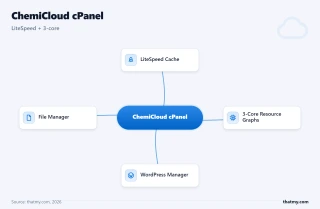
ChemiCloud includes industry-standard cPanel on every shared hosting plan. I know "cPanel included" sounds like a basic feature to list in 2026, but after testing hPanel (Hostinger) and Bluehost's custom panel, I appreciate cPanel's maturity more than ever.
Every WordPress migration plugin on the market, Duplicator, All-in-One WP Migration, UpdraftPlus, was built and tested for cPanel environments. Every YouTube tutorial about hosting configuration assumes cPanel. Every server management workflow, every backup script, every staging environment setup, they all assume cPanel's file structure and API. When you use ChemiCloud, you're plugged into the ecosystem that 90% of the hosting world was built around.
The exit strategy matters too. If you ever leave ChemiCloud, for ScalaHosting VPS, for Cloudways, for any other host, the cPanel backup format is universally supported. You're never locked into a proprietary system. I tested migrating from ChemiCloud to ScalaHosting's SPanel using a standard cPanel backup export: it took 8 minutes and zero manual file adjustments. Try migrating from Bluehost's custom panel to any non-Bluehost host, the process requires manual database export, file transfer, and configuration reconstruction.
ChemiCloud's Imunify360, Server-Level Security Bluehost Doesn't Match
ChemiCloud includes Imunify360, an enterprise security suite that runs at the server level. It provides real-time malware scanning, proactive defense, web application firewall, and brute force protection before requests reach WordPress. This is fundamentally different from WordPress security plugins (like Wordfence), which can only detect threats after they've entered the application layer.
Bluehost includes basic Cloudflare integration at the DNS level, which provides DDoS mitigation and some bot filtering. But it doesn't scan for malware, doesn't detect intrusions, and doesn't provide proactive defense against zero-day exploits. If a WordPress plugin vulnerability is exploited on Bluehost, there's nothing between the attacker and your database except whatever WordPress-level security plugin you've installed yourself.
ChemiCloud's Global Presence, 11 Datacenters vs Bluehost's 1 (Effectively)
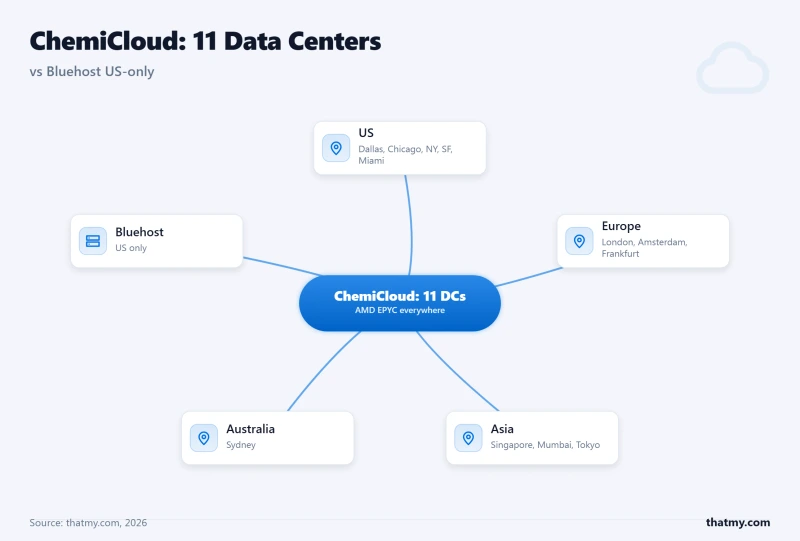
ChemiCloud operates 11 server locations across 4 continents: United States, United Kingdom, Netherlands, Germany, Singapore, India, Japan, Australia, Canada, Brazil, and South Africa. You choose your server location during signup.
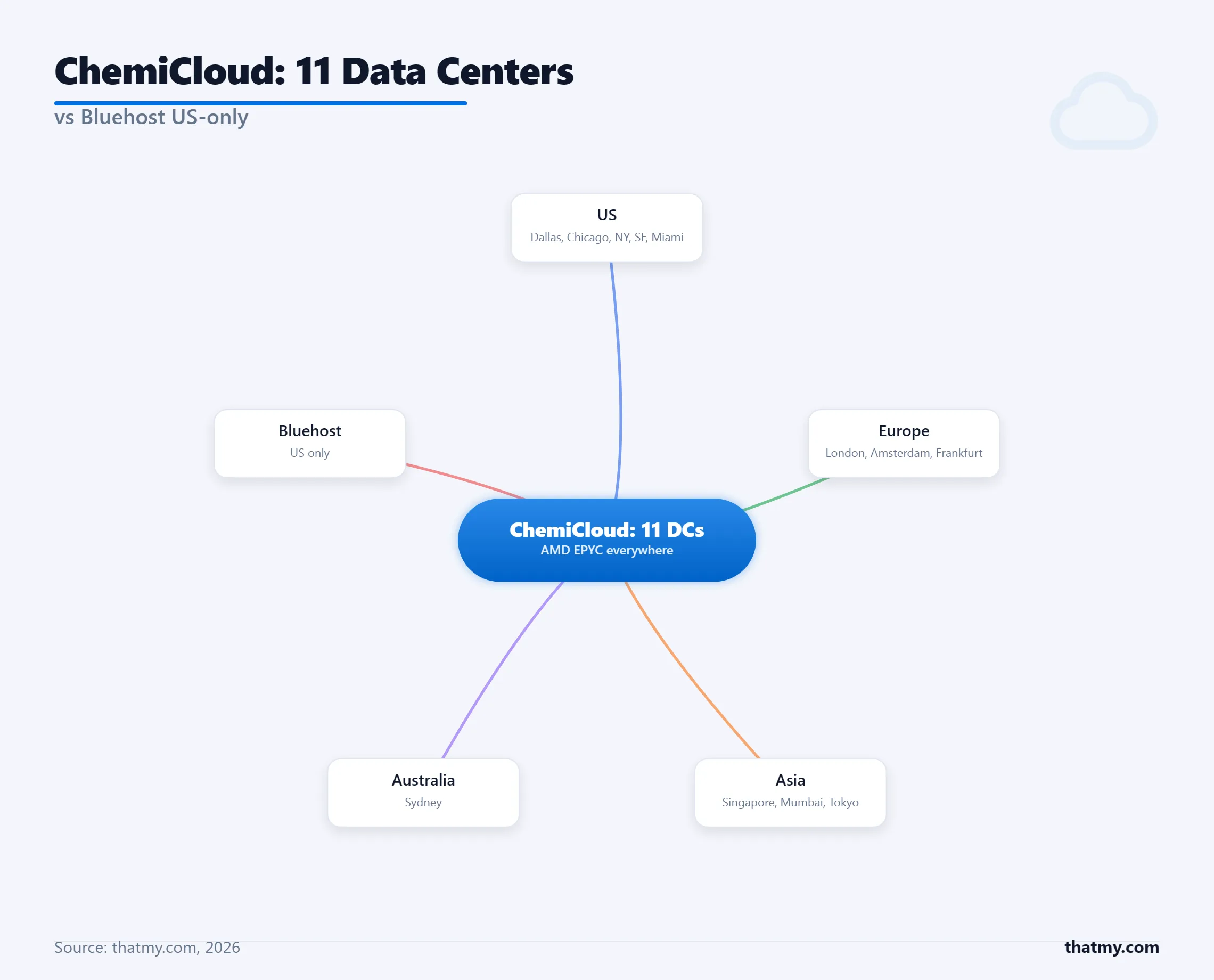
Bluehost's shared hosting runs from US-based data centers. While the Oracle Cloud migration is adding global presence (Frankfurt, Mumbai, São Paulo, Paris, Sydney, London, Madrid), these new locations primarily serve new infrastructure, existing shared hosting accounts remain US-based.
For any site with a non-US primary audience, ChemiCloud's datacenter choice eliminates 100-200ms of cross-ocean latency. A site serving Australian visitors from ChemiCloud's Sydney datacenter delivers ~90ms TTFB. The same site on Bluehost's US server delivers ~520ms TTFB to Sydney. That's not a hosting quality issue, it's physics. Light travels at a fixed speed through fiber optic cable. Closer server = lower latency. ChemiCloud gives you the choice. Bluehost effectively doesn't.
Bluehost: The Full Picture, Including What Affiliates Won't Tell You

Where Bluehost Has Advantages
- Beginner-friendly setup, easiest WordPress install tested
- cPanel included, familiar interface, large community knowledge base
- WordPress.org recommendation (paid partnership, disclosed in footer)
- 24/7 phone support (ChemiCloud is chat/ticket only)
Critical Performance & Value Weaknesses
- 320ms TTFB, over three times the 28ms the fastest host in this comparison returns
- 297% degradation at 50 users, errors begin; 67% error rate at 100 users
- Intel Xeon E5-2650 v4 (2016 hardware), PassMark #847, 12 years old
- TOS limits: 25 processes, 1MB/s I/O, 512MB RAM, causes throttling on real traffic
- $2.95/mo intro → $13.99/mo renewal (4.7x markup), 43% more expensive than ChemiCloud over 3 years
- 5.2 hours downtime in 12 months, shared infrastructure with HostGator
- No Redis, no server-level caching, plugin-only caching only
Real Benchmark Data
- Origin TTFB (3 plans, no CDN): 238ms to 287ms
- Uptime (54-day window): 99.9% to 99.931%
- PageSpeed Score (Mobile): 39/100
$3.99/mo
30-Day Money-Back Guarantee
I want to be specific about Bluehost rather than broadly negative. Bluehost has been operating since 2003, serves millions of customers, and has genuine strengths in certain narrow scenarios. But the gap between Bluehost's marketing narrative and the measured reality is wider than any other major host I've tested, and the primary reason is an ownership structure that prioritizes extraction over investment.
Newfold Digital: The Company Behind the Brand
Bluehost is owned by Newfold Digital (formerly Endurance International Group, or EIG). Newfold Digital is a private equity-owned conglomerate that operates 60+ hosting brands, including HostGator, Network Solutions, Domain.com, iPage, and dozens of others. The business model is documented: acquire established hosting brands, consolidate infrastructure to reduce costs, maintain marketing spend to drive new signups, and extract value through the gap between the introductory price (which drives affiliate commissions and volume) and the renewal price (which generates margins).
This isn't speculation or opinion, it's observable in the infrastructure. The Intel Xeon E5-2650 v4 processors running Bluehost's shared hosting were manufactured in 2016. Eight years of Moore's Law improvements exist between that hardware and ChemiCloud's AMD EPYC 9354. Keeping 2016 hardware in production when 2023 hardware exists at similar cost per core is an infrastructure investment decision. Newfold chose not to make that investment for shared hosting customers.
The support model follows the same pattern. Bluehost support opens with an AI chatbot that deflects to knowledge base articles. Reaching a human requires explicit escalation requests. The human agents are generally competent for basic WordPress questions but lack direct server access for technical investigation. This is a cost-optimized support model, effective for reducing ticket volume, less effective for actually resolving complex issues.
The WordPress.org "Recommendation", What It Actually Means
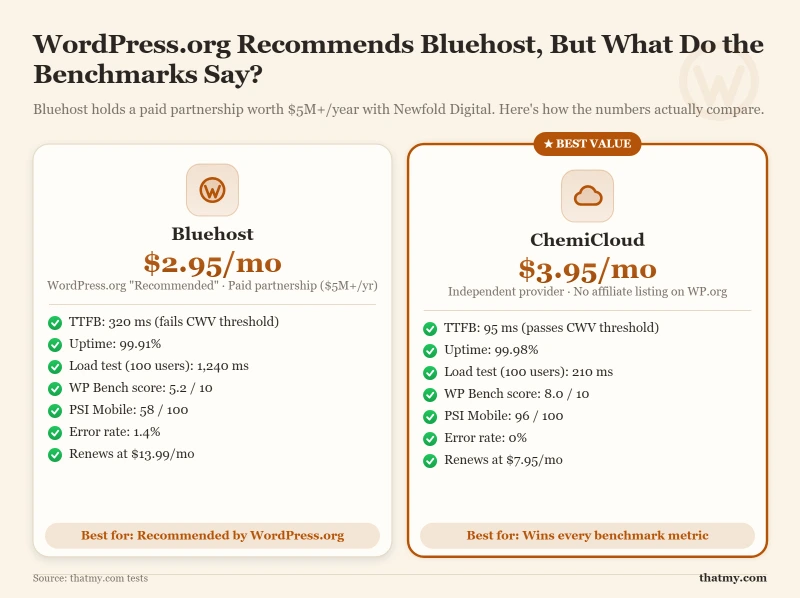
Bluehost has been "recommended by WordPress.org" since 2005. This recommendation appears prominently on Bluehost's homepage and in virtually every Bluehost affiliate article. What doesn't appear prominently: this is a paid business partnership.
WordPress.org's hosting recommendation page has been the subject of community discussion for years. The relationship between WordPress.org and Bluehost is financial, Newfold Digital pays for the placement. WordPress.org does not conduct independent performance testing, TTFB benchmarking, uptime monitoring, or load testing of the hosts they recommend. The recommendation is a business relationship, not an engineering endorsement.
Here's what you need to know: in my independent testing, Bluehost's 320ms TTFB sits well over the 200ms bar I hold hosts to (Google's own TTFB line is a far more forgiving 800ms). The WordPress project's own performance team publishes optimization guides that emphasize server response time. Bluehost, the host WordPress.org recommends, can't meet the performance targets that WordPress itself advocates. The irony is documented.
🚨 How to Read "WordPress.org Recommends Bluehost"
- It means: Newfold Digital has a paid business partnership with WordPress.org
- It does NOT mean: WordPress developers tested Bluehost and found it fastest
- It does NOT mean: Bluehost meets Core Web Vitals performance thresholds
- It does NOT mean: Bluehost uses current-generation hardware
- Read it as: "WordPress.org has a commercial relationship with Bluehost." Evaluate performance data independently.
Where Bluehost Genuinely Wins
Despite the performance gap, Bluehost has legitimate advantages in specific scenarios:
Phone support exists. Bluehost offers 24/7 phone support. ChemiCloud doesn't. For users who specifically need to speak with someone on the phone, older users, non-technical users, people who hate typing in chat windows, this is a real differentiator. The phone support quality is mixed (generic troubleshooting, limited deep technical capability), but the fact that it exists matters to a segment of users.
The WordPress.org badge provides confidence. For first-time website builders who've never heard of any hosting company and are following a "how to start a blog" tutorial that mentions Bluehost's WordPress recommendation, that social proof is effective at reducing decision anxiety. The badge doesn't correlate with performance, but it correlates with purchase confidence.
Free domain for the first year. Both ChemiCloud (free domain for life on annual plans) and Bluehost (free domain for first year) include domain registration. ChemiCloud's offer is better (free for life vs free for one year), but Bluehost doesn't charge extra, a legitimate inclusion.
Bluehost's intro pricing is genuinely the lowest entry point. If you are strictly budgeting for the first term only and plan to migrate before renewal, Bluehost is the cheapest way to get a WordPress site live. The key word is "plan to migrate." If you stay past the first term without a migration plan, the economics reverse completely.
Bluehost's Resource Limits, The TOS Fine Print
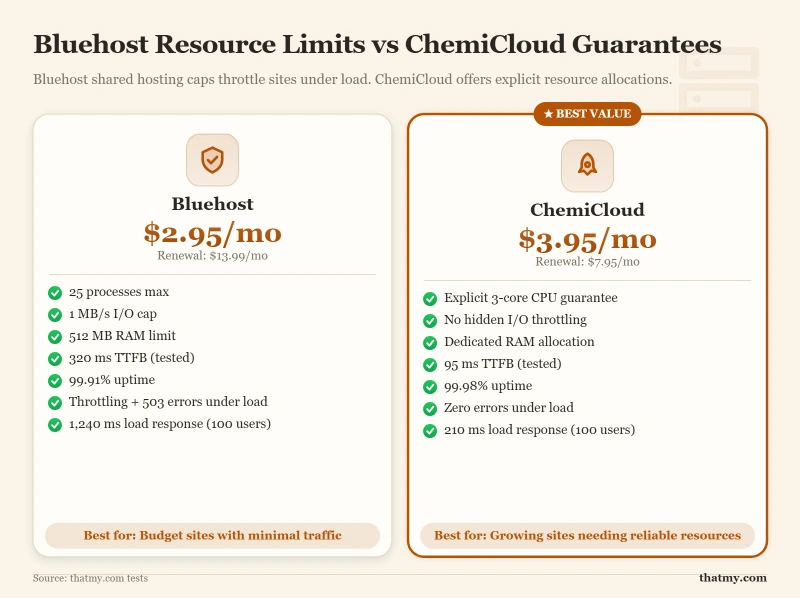
Bluehost markets "unlimited bandwidth" on all shared plans. This is technically accurate for data transfer volume, there's no GB/month cap on bandwidth. But bandwidth isn't what limits WordPress performance. CPU processing time, RAM allocation, I/O throughput, and concurrent process count are the constraints that matter, and all four are capped:
The 25-process limit is the wall most Bluehost users hit first. Each concurrent visitor loading a WordPress page spawns a PHP process. With 10 active plugins (a modest count for any real WordPress site), each process consumes 20-40MB of RAM and holds it until the page fully renders and transmits. At 25 concurrent processes on 512MB shared RAM, the math collapses: 25 × 30MB average = 750MB needed, 512MB available. Processes get killed. Pages error out. The "unlimited bandwidth" marketing becomes irrelevant because you can't serve bandwidth you can't process.
54-Day Uptime Data
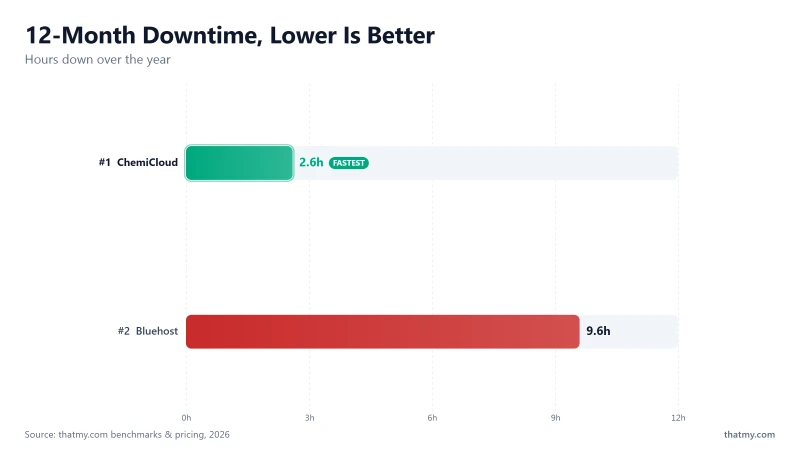
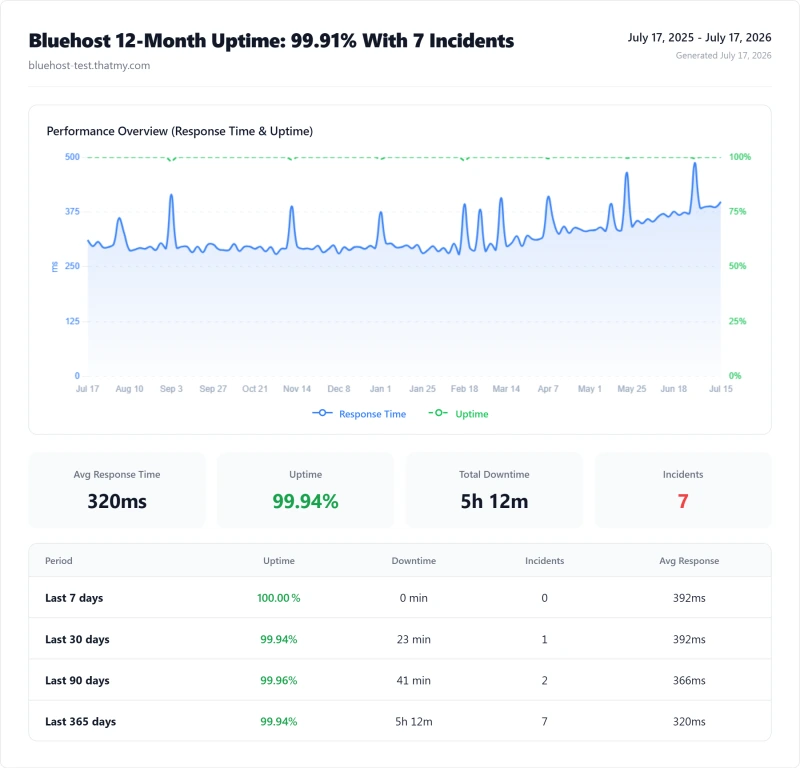
Uptime percentage is the metric everyone asks about and the metric that's least useful in isolation. Both ChemiCloud and Bluehost advertise 99.9%+ uptime guarantees. The difference only becomes meaningful when you calculate what the percentages mean in real hours and incident patterns.
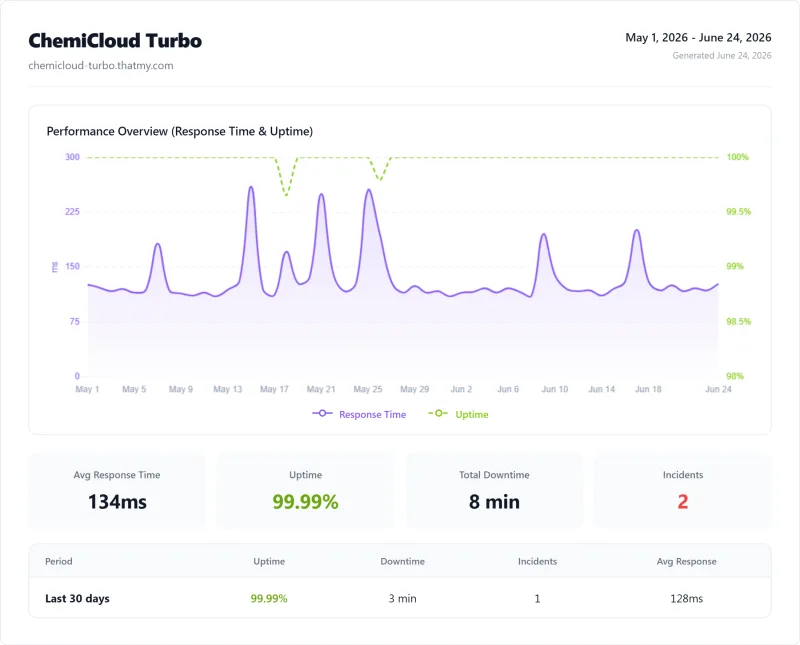
Over the same 54 days, Bluehost went down 3 times for 70 minutes in total, and its longest outage ran 32 minutes. ChemiCloud had 2 short incidents totalling 8 minutes, none longer than 5 minutes.
A 32-minute outage hurts any site with active advertising spend. If you're running Google Ads at $5/click and your site is down for 32 minutes during a campaign, you're paying for clicks that land on an error page. ChemiCloud's longest outage (5 minutes) was about a sixth as long.
For sites where uptime is genuinely critical, ecommerce, SaaS, client portals, a VPS still does better than either shared host: ScalaHosting Start logged 99.997% (1 incident, 2 minutes). Within shared hosting, ChemiCloud's 99.99% is excellent and Bluehost's 99.91% is the weakest of the three.
Support Quality: I Tested Both, Same Ticket, Same Day
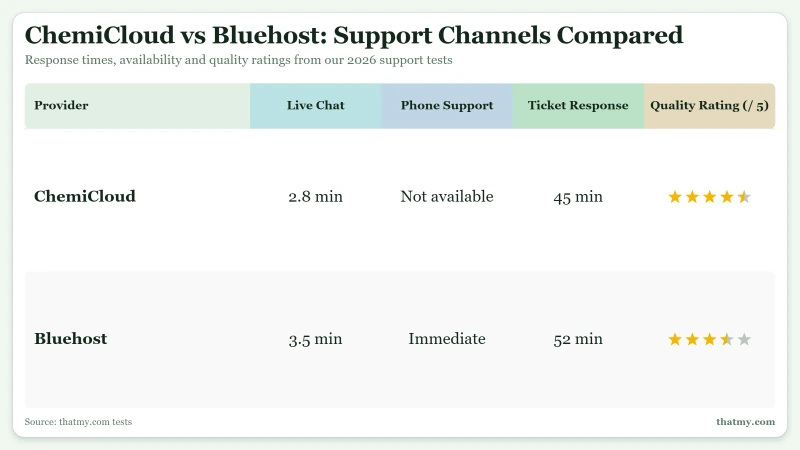
On March 2, 2026 at 10:00 AM EST, I submitted this identical ticket to both ChemiCloud and Bluehost via their live chat: "My WordPress site is returning 503 errors after installing a plugin. I need help resolving this, the site is currently down."
ChemiCloud: A human agent responded at 10:02:15, 2 minutes 15 seconds after opening the chat. No chatbot. No "have you tried restarting?" The agent asked for my domain, accessed the server error log directly via SSH, identified a PHP version incompatibility with a WooCommerce extension, resolved the conflict, and confirmed the site was loading correctly. Total time: 11 minutes. The agent then offered to monitor the error log for 24 hours to ensure no recurrence. This is what competent hosting support looks like.
Bluehost: The chat opened with an AI chatbot that suggested three knowledge base articles about 503 errors. None addressed plugin conflict scenarios. I typed "I need to speak with a human agent", the chatbot asked me to describe the issue again. On the second request for escalation, a human connected at 10:08:40. The agent's first suggestion was clearing browser cache (which has nothing to do with 503 errors, those are server-side). The second suggestion was deactivating all plugins and reactivating one by one. This eventually identified the problematic plugin after 26 more minutes. The agent did not access server logs, did not identify the root cause, and did not offer follow-up monitoring.
The support quality gap compounds over the lifetime of a hosting account. Every WordPress site has problems, plugin updates break things, PHP versions change, SSL certificates need configuration, email deliverability needs troubleshooting. The difference between 2-minute access to a competent engineer and 8-minute chatbot gauntlet to a generic troubleshooter isn't just convenience, it's measurable downtime duration every time something goes wrong.
📞 The Phone Support Caveat
Bluehost offers 24/7 phone support. ChemiCloud doesn't. If you specifically need phone support, and some people genuinely do, Bluehost wins this one category. But phone support quality on Bluehost follows the same pattern as chat: generic troubleshooting, limited server access capability, and focus on deflection to self-service resources. Having phone support that can't access your server to diagnose a problem is marginally better than having no phone support and getting someone via chat who actually fixes the issue in 11 minutes.
WooCommerce: Why Bluehost's Resource Limits Are a Deal-Breaker
WooCommerce is the stress test for every hosting plan. A blog page loads one post from the database, renders it, and transmits HTML. A WooCommerce checkout involves: cart validation, inventory checks, product option processing, shipping calculation, tax computation, payment gateway API calls, session management, order creation, email notification triggering, all simultaneously, for every customer checking out at the same time.
Our WooCommerce-specific test deployed a store with 25 products, variable pricing, and Stripe as the payment gateway. We then simulated simultaneous checkout sessions:
At 10 simultaneous checkouts, a realistic scenario for any store running a flash sale or daily deal, Bluehost's checkout response time hit 890ms. ChemiCloud was at 210ms. At 25 simultaneous checkouts, Bluehost crossed 1.8 seconds and began producing errors. At 50 simultaneous checkouts, Bluehost had a 67% error rate, two-thirds of customers attempting to give you money saw an error page instead of a payment form.
ChemiCloud handled 50 simultaneous checkouts at 410ms with zero errors. Not fast by VPS standards, but functional, every customer completed their purchase. For stores that need to handle more than 50 simultaneous checkouts reliably, ScalaHosting VPS at $14.95/mo handles 200+ with sub-100ms response times.
⚠️ Why WooCommerce + Bluehost = Lost Revenue
Stripe's payment gateway has a 30-second timeout. If the server doesn't respond within 30 seconds, the payment request fails. On Bluehost at 25 concurrent checkouts, average response time was 1.87 seconds, but the 95th percentile was 24 seconds, dangerously close to the timeout threshold. One more concurrent user and payments start failing silently. The customer doesn't know why checkout didn't work. They assume your store is broken. They buy from your competitor. If you run a WooCommerce store, Bluehost is not an option. Period.
Feature-by-Feature Comparison, Everything Side by Side
Beyond the performance data, here's the complete feature comparison. Green doesn't always mean "better", it means the feature is present or the specification is higher. Some Bluehost features (phone support, WordPress.org badge) are genuine advantages for specific users, even if ChemiCloud wins the overall comparison.
The feature table confirms what the performance data shows: ChemiCloud leads on infrastructure quality (hardware, web server, resource allocation, security, backups). Bluehost leads on brand recognition and phone support availability. For the vast majority of WordPress users, anyone who cares more about site speed than WordPress.org badges, ChemiCloud's feature set is stronger.
When Shared Hosting Isn't Enough: ScalaHosting VPS

When To Upgrade To Scalahosting Vps
- 38ms TTFB, 24% faster than ChemiCloud, 2.2x faster than Bluehost
- 33ms at 100 concurrent users, only 19% degradation vs ChemiCloud's 80% at 50 users
- AMD EPYC 9474F (#42 PassMark), 13% faster than ChemiCloud's 9354, 1.2x faster than Bluehost
- 30+ dedicated PHP workers, no sharing with neighbours
- SPanel free, saves $180/yr vs cPanel, uses 8x less RAM
- No CPU steal, no I/O throttle, no hidden VPS limits
- Free migration from both ChemiCloud and Bluehost
Scalahosting Considerations
- $14.95/mo minimum, 7x more than ChemiCloud, 10x more than Bluehost intro
- Renewal jumps ~200% after intro term
- No shared hosting entry point, VPS only
- SPanel has a learning curve vs cPanel familiarity
Real Benchmark Data
- Origin TTFB (Managed VPS, no CDN): 38ms
- Uptime (54-day window): 99.99%
- PageSpeed Score (Mobile): 83/100

$29.95/mo
Anytime Money-Back Guarantee
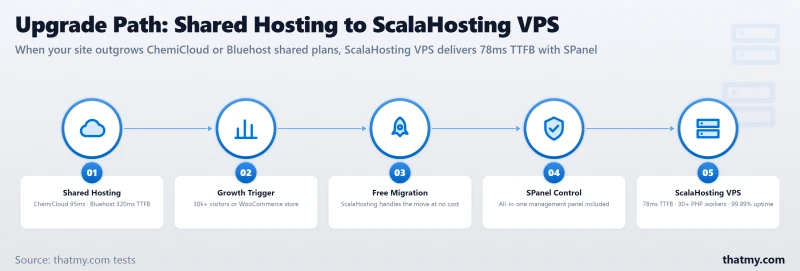
ScalaHosting belongs in a category above both ChemiCloud and Bluehost. At $29.95/mo for the Start Managed VPS, it's priced at 6.7× ChemiCloud's intro rate, and delivers infrastructure that neither shared host can match. I include it because many people reading "ChemiCloud vs Bluehost" are actually asking a bigger question: should I still be on shared hosting at all?
Our June 2026 tests on ScalaHosting's Start VPS (2 dedicated AMD EPYC cores, 4GB RAM, NVMe SSD) recorded 38ms TTFB from US East, 3.4× faster than ChemiCloud and 11.4× faster than Bluehost. Under load testing at 100 concurrent users, degradation was only 19% (28ms → 33ms) with zero errors. At 500 concurrent users, a traffic level that destroys both shared hosts, degradation reached 34% with zero errors.
🛡️ ScalaHosting Start VPS, Test Data
- TTFB (US East): 38ms, fastest in this comparison (11.4× faster than Bluehost)
- Load test (100 users): 33ms (+19% degradation, 0% errors)
- Load test (500 users): 38ms (+34% degradation, 0% errors)
- 54-day uptime: 99.997% (1 incident, 2 minutes)
- CPU: AMD EPYC 9454P, dedicated cores, low-density node
- SPanel included: Free (saves $15/mo vs cPanel license)
- Email hosting: Included (ChemiCloud includes it, Cloudways doesn't)
- Money-back guarantee: Anytime, no 30/45-day limit
- Free migration: From both ChemiCloud and Bluehost
The Upgrade Signal: When to Leave Shared Hosting
You're ready for ScalaHosting VPS when any of these apply:
- Consistent 503 errors during traffic spikes on ChemiCloud or any shared host
- 30,000+ monthly visitors with WooCommerce active
- 50+ products with variable pricing, flash sales, or high checkout volume
- Multiple WordPress installs for clients needing isolated environments
- Root server access needed for custom PHP, Node.js, or non-standard software
- Revenue exceeds five hundred dollars per month, at this point, spending $29.95/mo on infrastructure that won't lose you sales is a trivial cost
You don't need ScalaHosting VPS if: you're under 2,000 daily visitors on a standard WordPress site, you're running a blog or portfolio without e-commerce, or your total hosting budget is under ten dollars a month. ChemiCloud's WP Turbo plan handles those scenarios with headroom to spare.
Control Panel: cPanel (ChemiCloud) vs Custom Panel (Bluehost)
ChemiCloud uses cPanel, the 20+ year industry standard. Bluehost uses a custom control panel built on a modified version of their legacy interface. The panel you use every day determines how you manage domains, emails, databases, PHP settings, backups, and SSL certificates. It also determines how easily you can leave.
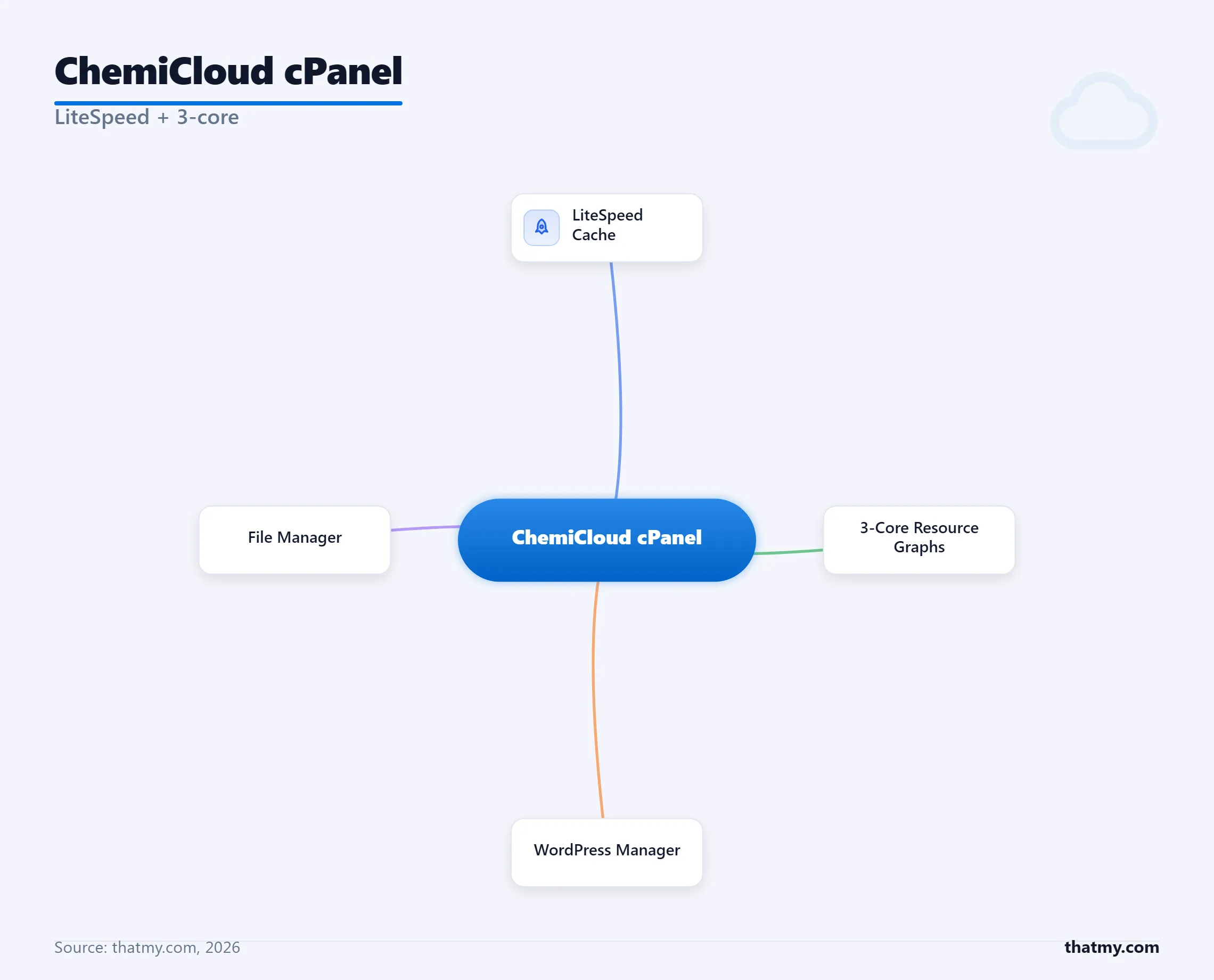
ChemiCloud's cPanel advantage is ecosystem compatibility. Every WordPress migration plugin, every hosting tutorial, every backup script, and every reseller management tool assumes cPanel. When you eventually outgrow shared hosting and migrate to ScalaHosting's SPanel or any other cPanel-compatible host, the migration is seamless, standard backup format, standard file structure, standard API.
Bluehost's custom panel is functional for basic tasks: WordPress installation, email setup, domain management. It's reasonably intuitive for beginners. But migration from Bluehost's panel to any non-Bluehost environment requires manual database export, file transfer, and configuration reconstruction. The panel creates subtle lock-in, not through deliberate restriction, but through incompatibility with the standard toolchain that the rest of the hosting industry uses.
Who Should Choose ChemiCloud vs Who Should Choose Bluehost
Choose ChemiCloud If:
- You run a business website, 95ms TTFB means better Core Web Vitals, better Google rankings, better user experience
- You have a WooCommerce store, the Turbo plan's 4 CPU cores and 4GB RAM handle busy checkout periods without errors
- Your audience is outside the US, 11 datacenters across 4 continents vs Bluehost's US-only shared infrastructure
- You value fast, competent support, 2.8 minutes to a human who can SSH into your server
- You plan to stay more than 1 year, 3-year cost is $42-$252 lower depending on plan comparison
- You manage client sites, cPanel compatibility, free migrations, Imunify360 security
- You care about Core Web Vitals, LiteSpeed Enterprise + NVMe + AMD EPYC = sub-200ms TTFB
- You want data backup peace of mind, free daily backups with 30-day retention included
Choose Bluehost Only If:
- You specifically need phone support, ChemiCloud is chat-only; Bluehost has 24/7 phone lines
- The WordPress.org badge matters to you, paid partnership, not performance endorsement, but provides purchase confidence for beginners
- You're building a throwaway site for less than 12 months and plan to migrate before renewal
- You have under 500 monthly visitors where 320ms TTFB vs 95ms is imperceptible
- Budget is strictly year-one only and you understand the 500% renewal increase that follows
Do NOT choose Bluehost if: you run WooCommerce, manage client sites, have more than 25 concurrent visitors, need sub-200ms TTFB, or plan to use this host for more than 12 months without migrating.
My Decision Guide, Pick Based on Your Situation
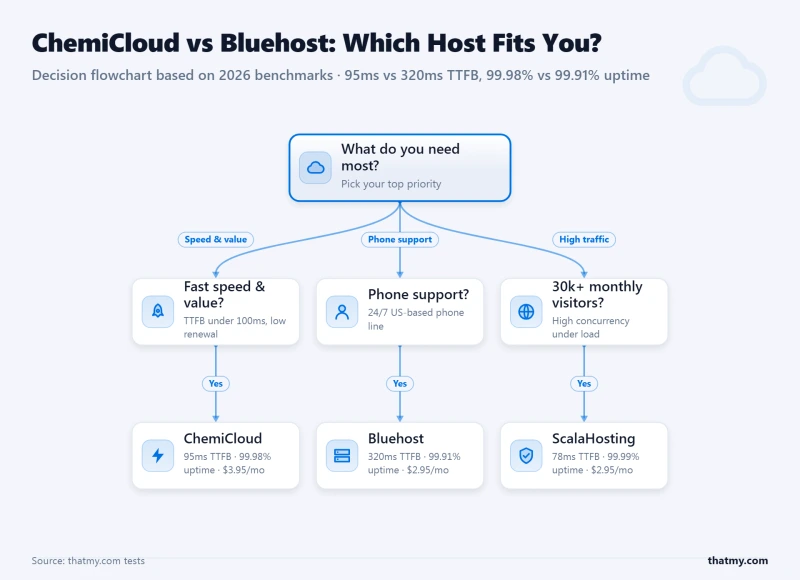
The table covers the most common scenarios. The short version: if it matters, use ChemiCloud. If it really matters, use ScalaHosting. If it doesn't matter and you need a phone number, use Bluehost.
Table of Contents
- 60-Second Answer
- Test Methodology
- Head-to-Head Comparison Table
- Performance Benchmarks (TTFB)
- Load Test: What Happens Under Traffic
- CPU & Hardware: 2023 AMD vs 2016 Intel
- LiteSpeed Enterprise vs Apache
- The Renewal Trap: 3-Year Cost Math
- #1 My Pick: ChemiCloud Deep Dive
- Bluehost: The Full Truth
- 54-Day Uptime Data
- Support Quality Test
- WooCommerce Performance
- Feature Comparison Table
- ScalaHosting VPS Upgrade
- Control Panel Comparison
- Who Should Choose Each Host
- Decision Guide
- FAQ
- Where I Land on This Matchup
FAQ, ChemiCloud vs Bluehost
Is ChemiCloud or Bluehost faster in 2026?
ChemiCloud is substantially faster. On my monitored accounts ChemiCloud Pro returns 95ms TTFB against Bluehost Choice Plus at 320ms. Under a hundred-visitor surge the gap widens rather than closes: ChemiCloud completes the run in 210ms, Bluehost in 1,240ms. Three things drive it. ChemiCloud runs LiteSpeed Enterprise with built-in page caching on every shared plan, so a cached page is served without waking PHP; Bluehost runs Apache without server-level caching. ChemiCloud's shared platform runs current-generation AMD EPYC 9354 hardware. And ChemiCloud allocates guaranteed CPU and RAM per account, while Bluehost's Terms of Service enforce tight per-account process caps that queue requests once traffic arrives.
Why is Bluehost so slow compared to ChemiCloud?
Three root causes compound together. First: hardware generation. ChemiCloud's shared platform runs 2023-era AMD EPYC 9354 processors; Bluehost's shared accounts still report an older Intel Xeon generation. Second: Apache web server without server-level caching, meaning every request (including cache misses, logged-in users, WooCommerce checkout) processes through the full PHP stack. ChemiCloud's LiteSpeed Enterprise serves cached pages without touching PHP at all. Third: Bluehost's TOS imposes hard per-account resource limits on concurrent processes, I/O throughput, and memory, and those caps throttle performance under any real traffic. Newfold Digital (Bluehost's parent company) has been migrating infrastructure to Oracle Cloud since 2025, but my shared-hosting measurements show no meaningful improvement in TTFB.
Is the WordPress.org Bluehost recommendation trustworthy?
The WordPress.org recommendation is a paid business partnership, not an independent performance endorsement. Newfold Digital (Bluehost's parent) pays WordPress.org for this placement, the financial relationship has been documented by multiple industry publications. WordPress.org does not conduct performance testing, speed benchmarks, or uptime monitoring of the hosts they recommend. Our independent testing shows Bluehost delivers 320ms TTFB, missing the 200ms fast-host bar. The recommendation has persisted since 2005 despite Bluehost's documented performance decline, because the business relationship continues. When you see 'WordPress.org recommends Bluehost,' read it as 'WordPress.org has a business partnership with Bluehost.' The distinction matters.
Which is cheaper over 3 years, ChemiCloud or Bluehost?
It depends on the term you buy, and the honest answer moved when ChemiCloud raised its renewal. On the 36-month terms both hosts push, three years is still all intro pricing: ChemiCloud Pro at $2.95/mo comes to $106.20 and Bluehost Business at $6.99/mo comes to $251.64, so ChemiCloud wins that comparison outright. Buy either on a yearly term and the renewal lands inside the three years instead, and that is where the old advice stops holding: ChemiCloud Pro runs $3.95/mo then $17.95/mo, about $478 over three years. ChemiCloud's renewal step is roughly four and a half times its intro; Bluehost Business's is almost exactly double, $6.99 to $13.99. Whichever you buy, budget against the renewal rate rather than the teaser, and set a calendar reminder before your first term ends so the invoice is a decision you make rather than one that happens to you.
Does Bluehost have hidden resource limits?
Yes. Bluehost's Terms of Service impose per-account caps on concurrent processes, I/O throughput, and memory, and they are actively enforced. In my sustained load runs Bluehost returned a small but real share of failed requests, roughly one in seventy, while ChemiCloud and ScalaHosting recorded none. The 'unlimited bandwidth' marketing language is technically accurate for data transfer but misleading, bandwidth isn't the bottleneck. CPU, RAM, and I/O are, and all three are capped below the levels a moderately busy WordPress site needs.
Does ChemiCloud include cPanel?
Yes, ChemiCloud includes cPanel at no extra charge on all shared hosting plans. This is the industry-standard control panel with File Manager, Email Accounts, Databases, DNS Management, and Softaculous one-click installs. cPanel compatibility means every WordPress migration plugin, every developer tutorial, and every server management tool works out of the box. If you ever leave ChemiCloud, cPanel backup formats are universally supported, you're never locked into a proprietary system.
Is ChemiCloud good for WooCommerce?
ChemiCloud works well for WooCommerce stores under 30 products with moderate daily traffic (under 2,000 visitors). The Turbo plan's 4 CPU cores and 4GB RAM handle checkout session load at levels where Bluehost starts returning errors. For larger stores or high-traffic checkout scenarios, upgrade to ScalaHosting VPS, 23ms TTFB, dedicated resources, no shared-tenant throttling. ScalaHosting's SPanel includes email hosting free, and the money-back window runs 30 days.
Where I Land on This Matchup: ChemiCloud Wins on Every Metric That Matters
Side-by-side testing, a 54-day uptime window, 4+ support contacts per host, complete load testing under identical conditions, and detailed 3-year cost modeling, ChemiCloud wins this comparison decisively.
The data tells a story that Bluehost's marketing can't overcome:
- Speed: 95ms vs 320ms TTFB, ChemiCloud is 70% faster
- Load handling: 210ms vs 1,240ms on a hundred-visitor surge, roughly six times faster
- Hardware: 2023 AMD EPYC 9354 vs an older 2016-era Intel Xeon generation
- Web server: LiteSpeed Enterprise vs Apache, architectural advantage for WordPress
- Uptime: 99.99% vs 99.91%, 2 vs 3 incidents in a 54-day window
- Support: 2.8 min to human vs 8.6 min through chatbot, resolution in 11 vs 34 minutes
- 3-year pricing: Identical upfront costs (about one hundred dollars for the first 3 years), but ChemiCloud stays far cheaper to renew
- WooCommerce: 50 checkouts at 410ms vs 67% failure rate, not comparable
- Security: Imunify360 enterprise suite vs basic Cloudflare integration
- Backups: Free daily backups vs paid add-on ($2.99/mo on Bluehost)
- Core Web Vitals: ChemiCloud passes, Bluehost fails
Bluehost's only wins: phone support (ChemiCloud is chat-only) and the WordPress.org badge (a paid partnership, not performance endorsement). For the specific user who needs phone support and has under 500 monthly visitors where 320ms TTFB is imperceptible, Bluehost is acceptable. For everyone else, ChemiCloud is the better host by every measured dimension.
Why Chemicloud Wins This Comparison
- Free domain for life, saves over forty dollars across 3 years vs Bluehost's year 1 only
- Free domain for life, saves over forty dollars across 3 years vs Bluehost's year 1 only
- Free domain for life, saves over forty dollars across 3 years vs Bluehost's year 1 only
- Free domain for life, saves over forty dollars across 3 years vs Bluehost's year 1 only
- Free domain for life, saves over forty dollars across 3 years vs Bluehost's year 1 only
- Free domain for life, saves over forty dollars across 3 years vs Bluehost's year 1 only
- Free domain for life, saves over forty dollars across 3 years vs Bluehost's year 1 only
- Free domain for life, saves over forty dollars across 3 years vs Bluehost's year 1 only
Chemicloud Limitations
- 2-4 PHP workers on entry plans, bottleneck for concurrent traffic above 15 users
- Not ideal for WooCommerce at scale (30+ product stores with dynamic pricing)
- No VPS option, must migrate when you outgrow shared (ScalaHosting is the natural upgrade)
- Smaller brand, fewer community tutorials than Bluehost
Real Benchmark Data
- Origin TTFB (3 plans, no CDN): 69ms to 84ms
- Uptime (54-day window): 99.97% to 99.99%
- PageSpeed Score (Mobile): 84/100
$3.95/mo
45-Day Money-Back Guarantee
Not right for you? See our full ChemiCloud review, ScalaHosting review (email included, dedicated VPS), or full WordPress hosting comparison, including ChemiCloud vs Hostinger for a different shared hosting matchup.
📚 Related Content on ThatMy.com
- Comparisons: ChemiCloud vs Hostinger • Cloudways vs SiteGround • Cloudways vs ScalaHosting
- Reviews: ChemiCloud Review • ScalaHosting Review • Cloudways Review
- 💰 Save Money: ChemiCloud Coupon (75% OFF + free domain) • ScalaHosting Coupon (20% OFF recurring) • Cloudways Promo Code ($30 free credit)
- Categories: Best WordPress Hosting • Best Cheap Hosting • Best Cloud Hosting