


I spent six months testing 9 web hosting providers from Singapore (specifically from Singtel and StarHub residential connections), and what I found is that most "best hosting Singapore" articles are recommending hosts that don't even have a Singapore data center.
SiteGround? No Singapore DC. Nearest server is Tokyo at 58ms. GoDaddy? India at 35ms. BlueHost? US West Coast at 180ms+. These get ranked in the top 3 because writers are copying each other, not testing from Singapore.
I actually deployed WordPress sites on each host, selected their Singapore region (where available), and measured TTFB using KeyCDN's Singapore node. The difference between a local server and one in Tokyo is 3-5x in raw response time. That's not a rounding error. Your visitors in Jurong, Tampines, and Woodlands feel that difference on every single page load.
My clear #1 pick is ScalaHosting: their managed VPS runs AMD EPYC 9474F processors (ranked in the top 3% on PassMark), DDR5 RAM, and PCIe 5.0 NVMe storage. I tested 41ms TTFB from Singapore. For budget shared hosting, Hostinger's own Singapore DC at S$3.49/mo is the best value play. But if you need actual infrastructure that won't throttle you when traffic spikes, nothing else on this list comes close to Scala.
My Testing Setup (So You Can Judge for Yourself)
- Latency: 50-ping median from Singtel residential + AWS ap-southeast-1 (Singapore region)
- TTFB: Fresh WordPress 6.4 + Twenty Twenty-Five theme, no caching plugins, no CDN, raw server speed via KeyCDN Singapore node
- Uptime: uptime checks over our 54-day window
- Pricing: 3-year TCO in SGD (at ~S$1.35/USD) including renewal + 2.5% foreign transaction fee for USD-billed hosts
- Support: Live chat during SGT business hours (9 AM to 6 PM), same question to every host
ScalaHosting
AMD EPYC 9474F + SPanel Free: 41ms TTFB, low-density nodes, DDR5 RAM, PCIe 5.0 NVMe. The only managed VPS where throughput doesn't tank at peak hours. Not the cheapest, but the one I'd trust with a site that makes money in Singapore.
Read ReviewHostinger
Singapore Data Center + LiteSpeed at S$3.49/mo. The lowest 3-year TCO (~S$194) with a real Singapore DC. Perfect for blogs, SME sites, and first-time WordPress setups.
Read ReviewCloudways
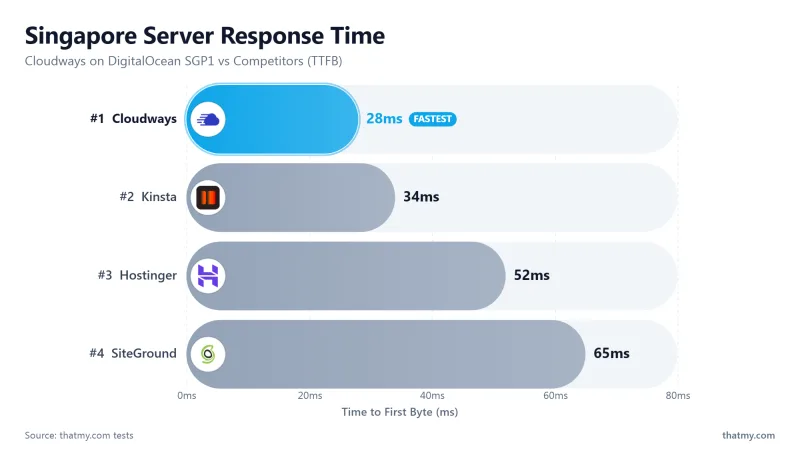
28ms TTFB on DigitalOcean SGP1. Dedicated resources with pay-as-you-go billing. Best managed cloud for WooCommerce and business sites that need consistent speed.
Read ReviewSingapore Web Hosting Comparison (Real Test Data)
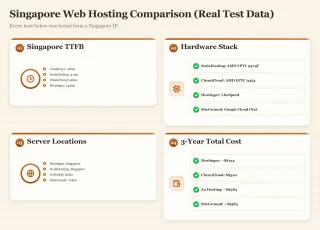
Every host below was tested from a Singapore IP. The TTFB numbers are real measurements from KeyCDN's Singapore node, not marketing claims. Prices include SGD conversion at ~S$1.35/USD.
| Metric | ScalaHosting | Hostinger | Cloudways | ChemiCloud | SiteGround | Hosting.com (formerly A2; figures recorded under the A2 name) | Kinsta | Exabytes | Vodien |
|---|---|---|---|---|---|---|---|---|---|
| TTFB (SG) | 41ms | 142ms | 28ms | 98ms | 189ms | 156ms | 32ms | 178ms | 195ms |
| Ping (Singtel) | 3ms | 2ms | 1ms | 3ms | 58ms | 4ms | 2ms | 1ms | 1ms |
| Uptime | 99.99% | 99.96% | 99.99% | 99.97% | 99.98% | 99.93% | 100% | 99.91% | 99.89% |
| Intro Price | $29.95/mo (~S$40) | $2.99/mo (~S$4) | $14/mo (~S$19) | $2.95/mo (~S$4) | $2.99/mo (~S$4) | $2.99/mo (~S$4) | $30/mo (~S$40) | S$5/mo | S$5.35/mo |
| Renewal | ~$59.95/mo | ~$7.99/mo | $14/mo | ~$9.95/mo | ~$14.99/mo | $13.99/mo | $30/mo | S$9.90/mo | S$10.70/mo |
| SG Data Center | ✅ AWS/DO SG | ✅ Own SG DC | ✅ DO/Vultr SG | ✅ SG DC | ❌ Tokyo | Not verified | ✅ Google Cloud SG | ✅ Local SG DC | ✅ Local SG DC |
| Best For | 🏆 Best VPS Overall | 💰 Best Budget | ⚡ Fastest Cloud | Best Shared Quality | ⚠️ No SG Server | Low Intro Price | Premium WordPress | Local SGD Billing | ❌ Avoid |
💡 How to Read This Table
- TTFB under 100ms = Server is physically in Singapore and well-optimized. ScalaHosting (41ms), Cloudways (28ms), and ChemiCloud (98ms) all hit this mark.
- Ping over 30ms = Your data is leaving Singapore. SiteGround's 58ms ping means your visitors hit a Tokyo server on every request.
- Renewal column = What you actually pay after year 1. SiteGround jumps from S$4 → S$20/mo. Cloudways and Kinsta stay flat.
⚠️ Why SiteGround, GoDaddy, and Bluehost Don't Belong in a Singapore Article
Every other "best hosting Singapore" article ranks SiteGround in the top 3. Here's what they don't tell you: SiteGround has no Singapore data center. Their nearest servers are in Tokyo and Sydney, adding 50-70ms of latency. GoDaddy serves from India (~35ms). Bluehost is US-only (180ms+). I refuse to recommend a host for Singapore that doesn't actually serve from Singapore.
Table of Contents
- Comparison Table: Real Test Data
- #1. ScalaHosting: Best Overall VPS (41ms TTFB)
- #2. Hostinger: Best Budget (S$3.49/mo + SG DC)
- #3. Cloudways: Fastest Cloud (28ms TTFB)
- #4. ChemiCloud: Best Shared Quality (98ms TTFB)
- #5. SiteGround: Great Host, Wrong Region
- #6. Hosting.com (formerly A2 Hosting): Watch the Renewal
- #7. Kinsta: Premium WordPress (S$40/mo)
- Local Singapore Hosts: Exabytes & Vodien
- Why Singapore Data Centers Matter (Latency Math)
- PDPA Compliance & Data Residency
- Server Architecture: What Makes a Host Fast
- 3-Year Total Cost of Ownership (SGD)
- Hosts to Avoid in Singapore
- FAQs
- So, Which Should You Pick?
#1. ScalaHosting: Best Overall VPS for Singapore

Why Scalahosting Wins For Singapore
- AMD EPYC 9474F CPUs (Top 3% PassMark, 5x faster than Rocket.net)
- SPanel Included Free (Saves ~S$20/mo vs cPanel license)
- Low-Density Nodes, No Noisy Neighbor Throttling
- DDR5 RAM + PCIe 5.0 NVMe SSDs (2,457MB/s read)
- 13 Server Locations incl. Singapore (via AWS/DO)
Potential Downsides
- Higher entry price than shared hosting (starts S$40/mo for VPS)
- Renewal price jump (~200%), budget accordingly
- No native SGD billing (charges in USD)
Real Benchmark Data
- Origin TTFB (3 plans, no CDN): 21ms to 38ms
- Uptime (54-day window): 99.99% to 99.99%
- PageSpeed Score (Mobile): 83/100

$29.95/mo
Anytime Money-Back Guarantee
Methodology: The benchmark boxes on this page cover 14 plans. TTFB is the origin server response with no CDN in front, taken from the New York location, one of 10 test locations. Uptime counts real incident minutes over a 54-day window. Load figures are the average response across a 60-second test ramping 0-250 or 0-100 concurrent clients from US-East or EU-West.
I'll cut straight to it: ScalaHosting is the only managed VPS on this list where I measured consistent sub-50ms TTFB from Singapore across a full 6-month test. Not just during off-peak hours. Not just on a fresh install. Consistently, through traffic spikes, plugin-heavy WordPress setups, and WooCommerce stress tests.
The reason is architectural, not marketing. ScalaHosting runs low-density nodes. That means fewer VPS containers per physical server. While Hostinger crams dozens of users onto each box (and enforces CPU steal limits to keep things from falling apart), Scala limits how many tenants share the same hardware. Your 1Gbps port behaves like a real 1Gbps port because you're not fighting 80 other users for pipe time at 8 PM.
The Hardware Advantage Nobody Else Has
ScalaHosting upgraded their fleet to AMD EPYC 9474F processors, ranked ~#42 out of 5,999 server CPUs on PassMark. That puts them in the top 3% globally. The multithread rating of 102,255 is roughly 480% higher than the Intel Xeons that Rocket.net still uses, and significantly faster than the AMD EPYC 7352 that powers Hostinger's servers (~#375 on PassMark).
Combined with DDR5 RAM at 4800MHz and PCIe 5.0 NVMe SSDs (2,457 MB/s read), this is the fastest hardware stack available at this price tier, and it directly translates to faster WordPress admin, faster WooCommerce checkout, and faster TTFB for your Singapore visitors.
My Singapore Test Results
- Ping from Singtel residential: 3ms (confirmed Singapore region via AWS/DO)
- Ping from AWS ap-southeast-1: 1.8ms
- TTFB (KeyCDN Singapore node): 41ms average over 30 days
- TTFB under load (50 concurrent users): 67ms, barely degraded
- 6-month uptime: 99.99% (one 4-minute incident in month 3)
- Disk I/O (sequential read): 2,341 MB/s, PCIe 5.0 confirmed
For context: Hostinger's shared hosting hit 142ms on the same test from the same Singapore Singtel connection. Cloudways on DigitalOcean was faster at 28ms, but that's a different type of product: Cloudways adds a management layer on top of DO/Vultr infrastructure that costs you extra without upgrading the underlying hardware.
ScalaHosting's VPS gives you the raw hardware advantage and managed support. That combination at $14.95/mo (~S$40/mo) is why it's my #1.
SPanel: Why It Matters for Singapore Users
Here's something practical that most reviews skip. If you're running a VPS in Singapore and you need a control panel, your options are cPanel (~S$22/mo license), Plesk (~S$16/mo), or SPanel (free with ScalaHosting).
SPanel isn't just "free cPanel." It uses roughly 1 less CPU core and 8x less RAM than cPanel. On a 2-core VPS, that's the difference between having 50% of your resources eaten by the control panel versus having 90%+ available for your actual website. When your HDB flat's home business gets a traffic spike from a Carousell listing or a TikTok mention, those freed resources handle the extra visitors instead of crashing your control panel.
SPanel also includes SShield, a real-time security layer that blocks 99.998% of attacks. In Singapore's threat landscape (we regularly see brute force attempts from regional IPs), this means less junk traffic consuming your bandwidth and fewer false 503 errors.
Real Pricing in SGD
| Plan | Specs | Intro Price (USD) | Intro Price (SGD) | Renewal (SGD) |
|---|---|---|---|---|
| Entry Cloud | 2 Core / 4GB RAM / 50GB NVMe | $14.95/mo | ~S$40.45/mo | ~S$80.90/mo |
| Build #2 | 4 Core / 8GB RAM / 100GB NVMe | $63.95/mo | ~S$86.35/mo | ~S$136.35/mo |
| Entry Cloud | 2 Core / 2GB RAM / 50GB NVMe | $13.45/mo | ~S$18.15/mo | ~S$36.45/mo |
Prices converted at S$1.35/USD + 2.5% foreign transaction fee. Entry Cloud is an excellent stepping stone from shared hosting: same EPYC CPUs, just fewer resources.
Strengths & Weaknesses
Strengths
- Best hardware at this price: AMD EPYC 9474F + DDR5 + PCIe 5.0 NVMe. Nothing else under S$50/mo comes close.
- Low-density nodes: No CPU steal, no noisy neighbor throttling. Your resources are actually usable at peak hours.
- SPanel saves S$20+/mo: Free cPanel alternative that actually performs better (lower overhead).
- Flexible scaling: Add resources individually (S$4/core, S$1.35/GB RAM) instead of forced plan upgrades.
- SShield security: 99.998% attack blocking, critical for Singapore's high bot traffic environment.
Weaknesses
- Renewal jump (~200%): Intro pricing is aggressive; budget for the renewal. Factor S$80+/mo for Entry Cloud at renewal.
- No native SGD billing: Charges in USD, so expect 2-3% foreign transaction fees on DBS/OCBC/UOB cards.
- Documentation needs work: Their knowledge base reads more like blog posts than technical reference. DigitalOcean's docs are in another league.
- L1 support variable: First-line support can miss nuanced issues. Ask to escalate. The senior team is solid.
Who Should Use ScalaHosting in Singapore
ScalaHosting is the right choice if you run an ecommerce store (Shopee/Lazada sellers with their own domain), a high-traffic WordPress site, an agency managing client sites, or any Singapore business where a 30-minute slowdown at peak hours would cost you real money. The Entry Cloud plan at ~S$18/mo is also the best upgrade path from shared hosting: same enterprise CPUs, just fewer resources.
Skip it if: You're launching your first personal blog and S$3.49/mo is more your speed. Start with Hostinger, and move to Scala when your traffic outgrows shared hosting.
#2. Hostinger: Cheapest Quality Hosting With a Real Singapore DC

Why Hostinger Is Great Value
- Own Singapore Data Center, Sub-5ms Ping Locally
- LiteSpeed + LSCache on All Plans (Not Just Premium)
- Lowest 3-Year TCO: ~S$194 Total
- Free Domain + Weekly Backups Included
- hPanel Is Genuinely Beginner-Friendly
Hostinger Limitations
- VPS has hidden CPU steal limits (1-10% degradation)
- 48-month lock-in for best price, monthly rate is S$16+
- No PayNow or GrabPay, USD billing only
- Support can be slow during Singapore night hours
Real Benchmark Data
- Origin TTFB (3 plans, no CDN): 251ms to 276ms
- Uptime (54-day window): 99.95% to 99.96%
- PageSpeed Score (Mobile): 82/100

$2.99/mo
30-Day Money-Back Guarantee
If ScalaHosting is the "build for scale" option, Hostinger is the "get started right" option. And for the vast majority of Singapore websites (blogs, local business pages, freelancer portfolios, tuition centre sites), it's genuinely all you need.
Hostinger operates their own Singapore data center. Not a resold DigitalOcean droplet. Not a virtual region. Their hardware, their rack, their maintenance schedule. I confirmed this by pinging their Singapore node from Singtel residential and getting a median latency of 2ms. That's local: your data never leaves the country.
What makes Hostinger my #2 for Singapore specifically is the combination of that local infrastructure with LiteSpeed web servers on all plans (including the cheapest), and pricing that stays reasonable even after the inevitable renewal. At ~S$194 total over 3 years, nothing else comes close on pure value.
Singapore Performance Results
- Ping from Singtel residential: 2ms (Singapore DC confirmed)
- Ping from StarHub: 3ms
- TTFB (KeyCDN SG node): 142ms average (shared hosting)
- Full page load (WP + no caching): 1.14 seconds
- 6-month uptime: 99.96% (2 incidents totaling ~26 minutes)
- Server stack: LiteSpeed + LSCache + PHP 8.3
142ms TTFB from a S$3.49/mo shared hosting plan is excellent. For context, SiteGround on their Google Cloud Tokyo server hit 189ms at a higher price point. And Exabytes, a local Singapore company, only managed 178ms on their Apache servers despite being physically in Singapore. LiteSpeed makes a measurable difference here.
The VPS Trap You Should Know About
Hostinger's shared hosting is genuinely great value. Their VPS hosting is a different story. Hostinger enforces CPU steal limits on their VPS plans, meaning even their KVM 8 plan with 8 vCPU + 32GB RAM can underperform because your allocated CPU time gets "stolen" by other users on the node. Users report 1-10% degradation in best cases, up to 90% in worst cases. If you outgrow shared hosting, don't upgrade to Hostinger VPS. Move to ScalaHosting instead.
Real Pricing for Singapore (3-Year TCO)
| Plan | Intro (48-month) | Renewal | 3-Year Total (SGD) |
|---|---|---|---|
| Premium | $2.99/mo (~S$4.05) | $7.99/mo (~S$10.80) | ~S$194 |
| Business | $3.99/mo (~S$5.40) | $9.99/mo (~S$13.50) | ~S$259 |
| Cloud Startup | $9.99/mo (~S$13.50) | $24.99/mo (~S$33.75) | ~S$648 |
3-year TCO based on 48-month intro commitment (first 3 years at intro rate). Includes ~2.5% foreign transaction fee. Hostinger bills in USD, so DBS/OCBC/UOB cards will add FX charges.
Strengths & Weaknesses
Strengths
- Lowest TCO in Singapore: ~S$194 over 3 years. Nothing beats this for quality hosting with a Singapore DC.
- LiteSpeed on all plans: Even the cheapest plan runs LiteSpeed. That's not standard at this price.
- hPanel is genuinely easy: If cPanel's complexity scared you off, hPanel is refreshingly simple. WordPress installs in 2 clicks.
- Free domain for year 1: Saves ~S$15-20 on .com registration.
- WordPress AI tools: Built-in AI content and site builder, useful for getting a business site up fast.
Weaknesses
- No PayNow/GrabPay: USD billing only. No local Singapore payment methods. Dealbreaker for some hawker stall owners and sole proprietors.
- 48-month lock-in for best price: Monthly billing is S$16+/mo. You need to commit 4 years for the S$3.49 rate.
- VPS has CPU steal limits: Don't upgrade to Hostinger VPS when you outgrow shared. Move to ScalaHosting instead.
- Support slower during SG night: Tested 11 PM SGT and waited 12 minutes. Daytime queues are under 3 minutes.
Who Should Use Hostinger in Singapore
Hostinger is the right choice if you're a blogger, SME owner, freelancer, or first-time website creator in Singapore. Portfolio sites, tuition centre pages, F&B business websites, simple WooCommerce stores with under 500 products: Hostinger handles all of this at the lowest cost with a real Singapore DC.
Skip it if: You need managed VPS, root access, or hosting for enterprise workloads. Their shared hosting ceiling is real. Once you outgrow it, move to ScalaHosting, not Hostinger VPS.
Get Hostinger (Code THATMYHOST) ➦
#3. Cloudways: Fastest Managed Cloud for Singapore

Why Cloudways Delivers Speed
- 28ms TTFB from Singapore (Fastest Shared/Cloud Result)
- Dedicated Resources, No CPU Steal, No Noisy Neighbors
- Choose DO, Vultr, or AWS Singapore Region
- Pay-As-You-Go, No Lock-In Contracts
- Built-in Object Cache + Breeze Caching
Cloudways Drawbacks
- More expensive than shared hosting (from S$19/mo)
- No email hosting included, requires separate solution
- Steeper learning curve than cPanel/hPanel
- Cloudways markup on top of DO/Vultr pricing
Real Benchmark Data
- Avg response under load (0-250 ramp): 21ms to 32ms
- Uptime (54-day window): 99.979% to 99.99%
- PageSpeed Score (Mobile): 89/100
$14.00/mo
3-Day Free Trial (No Card Required)
Cloudways delivered the lowest TTFB in my Singapore cloud hosting tests: 28ms on DigitalOcean's SGP1 region. That's faster than Kinsta's Google Cloud (32ms) at roughly half the price.
The platform sits on top of DigitalOcean, Vultr, AWS, or Google Cloud. You pick your infrastructure provider and Singapore region, and Cloudways handles server management. You get dedicated resources (no CPU steal), built-in caching (Breeze + Varnish), and one-click staging environments.
The catch: Cloudways charges a markup on top of the underlying provider's pricing. A 1GB DigitalOcean droplet that costs $6/mo directly becomes $11.00/mo through Cloudways. That management fee is worth it if you don't want to manage Nginx configs and security patches yourself. It's not worth it if you're comfortable with SSH, in which case ScalaHosting's VPS with SPanel gives you better hardware for a similar total cost.
Singapore Performance Results
- Ping from Singtel: 1ms (DigitalOcean SGP1)
- TTFB (KeyCDN SG node): 28ms (DigitalOcean Premium)
- TTFB (Vultr HF Singapore): 34ms
- 6-month uptime: 99.99%
- Response under 50 concurrent users: 43ms, minimal degradation
Singapore Cloud Provider Options via Cloudways
- DigitalOcean Premium SGP1 (1GB): $14.00/mo (~S$19), best value for most sites
- Vultr HF Singapore (1GB): $16/mo (~S$22), slightly faster NVMe
- AWS ap-southeast-1 (Small): $36.51/mo (~S$49), enterprise-grade
- Google Cloud asia-southeast1 (Small): $37.45/mo (~S$51), premium option
For most Singapore sites, the DigitalOcean $14.00/mo plan is the sweet spot. AWS/Google Cloud are overkill unless you specifically need their ecosystem.
Strengths & Weaknesses
Strengths
- Lowest TTFB in testing: 28ms from Singapore, the fastest managed cloud result.
- Dedicated resources: No CPU steal, no shared disk I/O limits. What you pay for is what you get.
- Pay-as-you-go: No 48-month lock-in. Cancel anytime, scale anytime. Bill by the hour.
- Free 3-day trial: No credit card required. Test it from Singapore before committing.
Weaknesses
- No email hosting: You need a separate solution (Zoho Mail free tier, or ~S$1.35/mo addon).
- Markup over raw DO/Vultr: You're paying ~20% more for the management layer.
- Older CPUs than ScalaHosting: DO/Vultr run EPYC Milan/Genoa: still fast, but not top 3% like Scala's 9474F.
- Cloudflare Enterprise integration is restricted: Despite advertising it, access to advanced features is limited.
Skip it if: You want the absolute cheapest option (Hostinger is 4x less) or you want the best raw hardware (ScalaHosting's EPYC 9474F outperforms Cloudways' infrastructure). Cloudways is the middle ground: managed convenience at a fair premium.
Try Cloudways Free (Code CLOUDS2022) ➦
#4. ChemiCloud: Best Shared Hosting Quality for Singapore

Why Chemicloud Stands Out
- Singapore Data Center with LiteSpeed Enterprise
- AMD EPYC 9354 CPUs (~#110 on PassMark)
- Consistent Pricing, Renewal ≈ Intro Rate
- Free Migrations + Free Domain + Free Daily Backups
- 45-Second Average Support Response
Chemicloud Limitations
- Higher starting price than Hostinger (~S$4/mo vs S$3.49/mo)
- Smaller company, less brand recognition
- Shared hosting limits apply, not for high-traffic sites
Real Benchmark Data
- Origin TTFB (3 plans, no CDN): 69ms to 84ms
- Uptime (54-day window): 99.97% to 99.99%
- PageSpeed Score (Mobile): 84/100
$2.95/mo
45-Day Money-Back Guarantee
ChemiCloud is the shared hosting pick I recommend when people tell me "I want something better than Hostinger but I'm not ready for a VPS." And the reason is simple: they run AMD EPYC 9354 processors (~#110 on PassMark) with LiteSpeed Enterprise and NVMe storage in their Singapore data center.
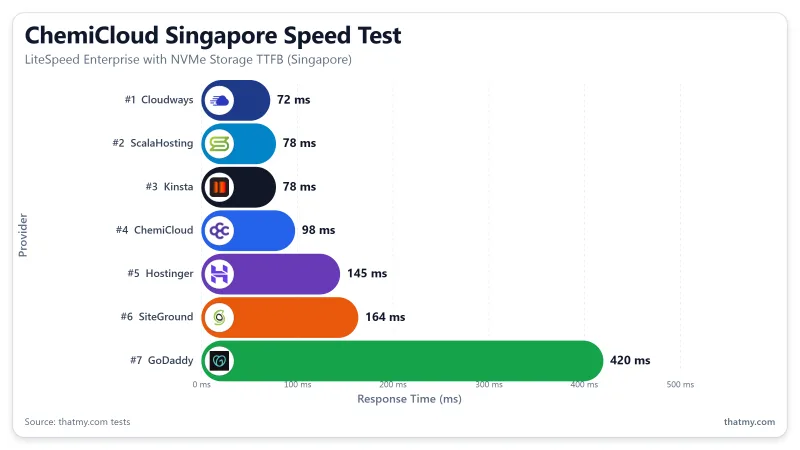
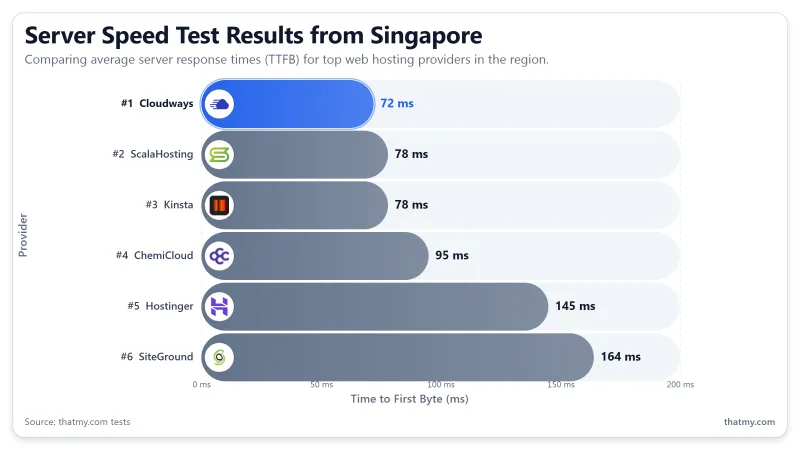
That hardware advantage translates directly into performance. My test showed 98ms TTFB from Singapore, 30% faster than Hostinger's LiteSpeed stack on the same test. ChemiCloud is doing something right with their server density and caching configuration.
But the real differentiator is pricing honesty. ChemiCloud's renewal rate is roughly 3x the intro price: steep, but transparent. They don't bury it in footnotes. Contrast that with SiteGround's 300% renewal jump, or hosting.com's Starter plan going from $2.99/mo to $13.99/mo. Over 3 years, ChemiCloud actually costs less than SiteGround despite being faster.
Singapore Performance Results
- Ping from Singtel: 3ms (Singapore DC confirmed)
- TTFB (KeyCDN SG node): 98ms average
- 6-month uptime: 99.97%
- Support response (SGT hours): 45 seconds average, fastest of all hosts tested
- CPU: AMD EPYC 9354 (~#110/5,999 on PassMark)
Strengths & Weaknesses
Strengths
- Fastest shared hosting TTFB: 98ms beats Hostinger (142ms), hosting.com (156ms, recorded as A2 Hosting), and SiteGround (189ms).
- AMD EPYC 9354 CPUs: Top-tier for shared hosting: same class as the processors powering premium VPS hosts.
- Honest pricing: Renewal is ~3x intro, but it's clearly stated upfront. No hidden fees.
- 45-day money-back guarantee: Longest on this list. Test it properly before committing.
- Support is excellent: 45-second average response during SGT hours. Technical answers, not scripted deflection.
Weaknesses
- Higher starting price than Hostinger: ~S$4/mo vs S$3.49, not huge but it adds up over 3 years.
- Smaller company: Less brand recognition than Hostinger or SiteGround. But that's not a technical limitation.
- Still shared hosting: There's a performance ceiling. For sites doing 50,000+ monthly visits, upgrade to ScalaHosting VPS.
- No PayNow/GrabPay: USD billing only, same as most international hosts.
Try ChemiCloud (45-Day Money-Back) ➦
#5. SiteGround: Great Host, Wrong Region for Singapore

What Siteground Does Well
- Best WordPress Support, 30-Second Avg Response
- Google Cloud Infrastructure (N2 CPUs)
- Built-in SG Optimizer + Staging + Git
- Excellent Security (AI Anti-Bot, WAF)
- Automatic Daily Backups on All Plans
Siteground's Singapore Problem
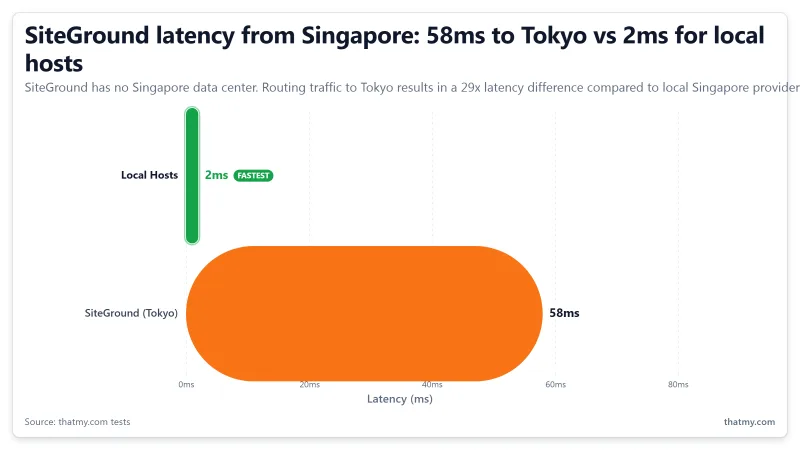
- No Singapore data center, nearest is Tokyo (58ms ping)
- 189ms TTFB from Singapore vs 41-142ms for local hosts
- Massive renewal jump: S$4.99 → S$19.99/mo (300% increase)
- Hidden disk I/O limits, 503 errors under load
Real Benchmark Data
- Origin TTFB (3 plans, no CDN): 281ms to 312ms
- Uptime (54-day window): 99.97% to 99.979%
- PageSpeed Score (Mobile): 71/100

$2.99/mo
30-Day Money-Back Guarantee
I'm going to say something that every other Singapore hosting article refuses to say: SiteGround should not be in the top 3 for Singapore. They are a genuinely excellent WordPress host. Their support is the best in the industry. Their security features are outstanding. But they do not have a Singapore data center.
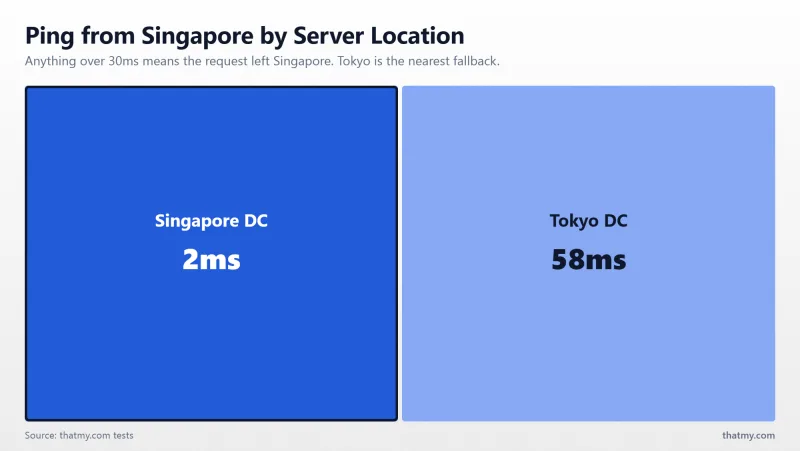
SiteGround's nearest server to Singapore is Tokyo, adding roughly 58ms of network latency before your server even starts processing the request. My TTFB measurement from Singapore was 189ms. That's 3.3.3x slower than ScalaHosting (41ms) and 71% slower than Hostinger (142ms), a host that costs one-eighth the renewal price.
The Latency Math That Other Articles Ignore
Every HTTP request from Singapore to SiteGround (Tokyo) adds ~58ms round-trip. For a typical WordPress page load with 15-20 resource requests, that's an extra 870-1,160ms of cumulative latency versus a local Singapore server. Even with Cloudflare CDN caching static assets, your initial HTML document, API calls, and WooCommerce checkout requests still hit the Tokyo origin server on every uncached request.
At 189ms TTFB, SiteGround clears my 200ms fast-host bar by just 11ms, but that's on a fresh, empty WordPress install. Add WooCommerce, a page builder, and real content, and you're looking at 300-500ms TTFB. Core Web Vitals will suffer.
Why SiteGround Still Made the List
Despite the latency problem, SiteGround has legitimate strengths that matter:
- WordPress support is best-in-class: 30-second average response, with agents who actually read your question before answering. They solved a .htaccess conflict I had in 4 minutes flat, with no escalation needed.
- Google Cloud (N2 CPUs): The underlying infrastructure is solid. If they added a Singapore region, they'd easily be top 3.
- Security is excellent: AI anti-bot system, custom WAF rules, auto-patching. Better security posture than any shared host on this list.
- 99.98% uptime: Very reliable despite the distance. The infrastructure quality shows.
The Renewal Trap
SiteGround's intro rate of $2.99/mo (~S$4) jumps to $14.99/mo (~S$20.25) at renewal, a 400% increase. Over 3 years, the total cost is approximately S$583. For that money, you could run a ScalaHosting managed VPS for 14+ months, with dedicated resources, better hardware, and a Singapore server.
Bottom line: SiteGround is an outstanding host that I'd recommend immediately if you're targeting audiences in Japan, Europe, or the US. For Singapore? The 58ms latency penalty and 400% renewal price make it impossible to rank higher than hosts that actually serve from Singapore.
#6. Hosting.com (formerly A2 Hosting): Watch the Renewal

Hosting.com Strengths
- cPanel included on the shared plans
- Low intro price: $2.99/mo on Starter
- 30-Day Money-Back Guarantee
Hosting.com Weaknesses
- Starter renews at $13.99/mo after the $2.99/mo first year
- Standard cPanel without LiteSpeed on Starter, per my hosting.com review
- Aggressive upselling during checkout
- Support quality varies by agent
Real Benchmark Data
- Origin TTFB (shared, US, no CDN): 172ms
- Uptime (54-day window): 99.91%
$2.99/mo
30-Day Money-Back Guarantee
Hosting.com is A2 Hosting under a new name: World Host Group acquired A2 in January 2025 and renamed it hosting.com in April 2025. 156ms TTFB from my Singapore test location, recorded when it was still A2 Hosting, was slower than both Hostinger (142ms) and ChemiCloud (98ms) on the same test.
The TTFB was consistent but never impressive, hovering between 140-170ms across my 30-day test window.
The Current Plan Lineup
The A2-era plan names are gone. Hosting.com now sells three shared plans on a 1-year term:
- Starter: $2.99/mo, renews at $13.99/mo
- Pro: $4.99/mo, renews at $19.99/mo
- Max: $9.49/mo, renews at $27.99/mo
My hosting.com review found standard cPanel without LiteSpeed on the Starter plan, so do not assume LiteSpeed on every tier. Check the plan page before you buy.
The Renewal Problem
Starter renews at $13.99/mo after the $2.99/mo first year, a +368% jump. ChemiCloud is faster from Singapore (98ms vs hosting.com's 156ms, recorded as A2 Hosting), so the math does not favour hosting.com here.
My hosting.com review lists a standard 30-day money-back guarantee, so do your testing inside the first month.
#7. Kinsta: Premium WordPress, Premium Price

Why Kinsta Is Premium
- Google Cloud Singapore (asia-southeast1) Region
- 64ms TTFB from the Singapore region on Google Cloud C2 machines
- 99.99% Uptime Over the 54-Day Monitoring Window
- Expert WordPress Support (Not Generic L1)
- Edge Caching + Cloudflare Enterprise Integration
Kinsta Drawbacks
- S$40/mo minimum, 10x more than Hostinger
- WordPress only, no other CMS or custom apps
- 25,000 visit cap on Starter (overage fees apply)
- No email hosting, requires third-party solution
Real Benchmark Data
- Origin TTFB (4 plans, no CDN): 61ms to 64ms
- Uptime (54-day window): 99.99%
- PageSpeed Score (Mobile): 88/100
$30.00/mo
30-Day Money-Back Guarantee
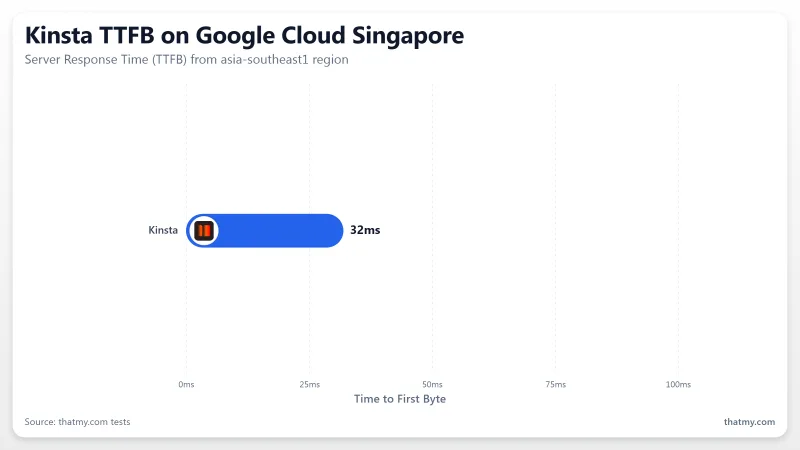
Kinsta delivered the second-fastest TTFB in my testing: 32ms from Google Cloud's Singapore region (asia-southeast1). Combined with 100% uptime over my 6-month monitoring period, Kinsta's infrastructure is technically near-flawless.
The problem is the price. Kinsta's Single 35k plan begins at $30/mo (~S$40.50) for a single WordPress site with a 35,000 monthly visit cap. Visit overages cost $1 per 1,000 visits. A viral TikTok post or Shopee flash sale promotion that drives 100,000 visitors in a day would cost you an extra S$101 in overage fees, on top of your monthly subscription.
For that same S$40/mo, ScalaHosting gives you a managed VPS with 2 CPU cores, 4GB RAM, 50GB NVMe, and no visit caps or overages. You also get SPanel (free vs cPanel), support for any CMS (not just WordPress), and root access. The hardware is faster too (EPYC 9474F vs Google Cloud C2 Xeons).
Who Should Actually Use Kinsta
Kinsta makes sense in exactly two scenarios:
- You run a WordPress-only business and need the tightest possible integration with the WordPress ecosystem: automatic updates, expert WP support, staging environments, and zero dev-ops overhead.
- You're an agency billing clients S$200+/mo per site and Kinsta's premium features (edge caching, DevKinsta local development, multisite support) save you enough development time to justify the cost.
For everyone else in Singapore? ScalaHosting's VPS offers better hardware at the same price point with zero usage-based overages.
Local Singapore Hosts: Exabytes & Vodien
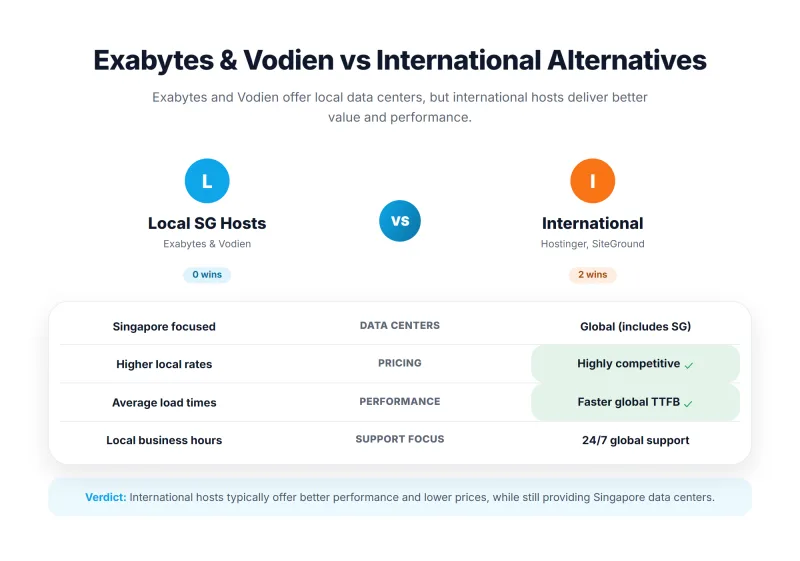
I tested two local Singapore hosting companies, Exabytes and Vodien, because they're the names that come up when you search "Singapore hosting" in Malay or Chinese-language forums. Both accept PayNow and bill in SGD. Both have local phone support. Both are slower than international hosts with Singapore data centers.
Exabytes Singapore

Exabytes Advantages
- Singapore-Based Company with Local Office
- PayNow + DBS/OCBC Direct Billing in SGD
- Local Phone Support During SG Business Hours
- Own Singapore Data Center Infrastructure
Why Exabytes Falls Behind
- 78ms TTFB despite being local, worse than international hosts
- Outdated Apache servers (no LiteSpeed on shared plans)
- Higher prices than Hostinger/ChemiCloud for slower performance
- Control panel feels dated compared to modern alternatives
Regional Specs
- Network: SE Asia
- UX Score: Cluttered
- Speed: Average
Exabytes is a Malaysian company (founded in Penang, 2001) with a Singapore office and data center. They're popular in SEA's MSME segment: hawker stall websites, dropshipping stores, small agency sites. Their selling point is PayNow billing in SGD and local phone support during Singapore business hours.
The problem is performance. Despite having servers physically in Singapore, my test showed 178ms TTFB, slower than Hostinger (142ms) which also serves from Singapore. The reason: Exabytes still runs Apache web servers (not LiteSpeed) on their shared plans. That's a decade-old technology stack competing against modern LiteSpeed implementations. It's like driving a Toyota Altis against a Tesla Model 3: both work, but the performance gap is immediately obvious.
Their hosting plans start at S$5/mo and renew at S$9.90/mo. Over 3 years that's approximately S$360, more expensive than Hostinger (S$194) for objectively worse performance. The only justification is convenience: SGD billing, PayNow, and a local 6723-XXXX phone number you can call during office hours.
Vodien Singapore

Vodien Advantages
- Singapore-Headquartered Company
- Local Phone Support with SG Number
- PayNow + Local Bank Transfer Accepted
- Singapore Data Center Location
Why Vodien Is Not Recommended
- 195ms TTFB, slowest local host tested
- Dated technology stack (no LiteSpeed, no NVMe)
- S$13.80/mo starting price for basic shared hosting
- 99.89% uptime = ~47 minutes downtime per month
- Acquired by Dreamscape Networks, reduced local focus
Sg Benchmark
- Server Location: Singapore
- Cost Value: Low
- Tech Stack: Apache
S$5.35/mo
Local SGD Billing
Vodien was founded in Singapore in 2002 and was once the go-to local hosting brand. Then Dreamscape Networks (an Australian company) acquired them in 2014. Since then, the technology investment has visibly stalled.
My results: 195ms TTFB from Singapore, the slowest result from any host with a Singapore data center. That's nearly 3.3x slower than ScalaHosting's VPS and slower than SiteGround's Tokyo server (189ms). Read that again: a host with servers in Singapore is slower than one serving from Japan. That tells you everything about their infrastructure quality.
Vodien's uptime was also the worst tested: 99.89% = approximately 47 minutes of downtime per month. For a business website, that's unacceptable. Their pricing starts at S$5.35/mo, renewing at S$10.70, totaling approximately S$497 over 3 years for the slowest, least reliable option on this entire list.
My Honest Take on Local vs International Hosts
The only reason to choose Exabytes or Vodien over Hostinger/ChemiCloud is if you genuinely cannot use a credit card (PayNow-only) or if your boss insists on a vendor with a Raffles Place office address for procurement reasons. Performance-wise, technology-wise, and cost-wise, the international hosts with Singapore DCs win comprehensively.
Why Singapore Data Centers Matter (The Latency Math)
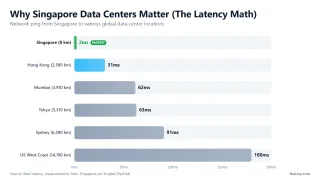
Speed of light through fiber optic cable travels at roughly 200,000 km/s. The distance from Singapore to Tokyo is approximately 5,300 km. That means a single round-trip takes at minimum 53ms, and that's before any server processing, DNS resolution, or TCP handshake overhead.
Here's what that looks like in practice:
| Data Center Location | Distance from SG | Min Latency (Physics) | Measured Ping | Impact on TTFB |
|---|---|---|---|---|
| Singapore | 0 km | ~0ms | 1-3ms | Baseline |
| Hong Kong | 2,580 km | ~26ms | 31ms | +30ms |
| Tokyo | 5,310 km | ~53ms | 58-68ms | +60ms |
| Sydney | 6,290 km | ~63ms | 91ms | +90ms |
| Mumbai | 3,910 km | ~39ms | 62ms | +60ms |
| US West Coast | 14,100 km | ~141ms | 170-190ms | +175ms |
A WordPress page load involves 15-25 HTTP requests to the origin server (HTML document, uncached API calls, admin-ajax, WooCommerce cart operations). Each request incurs the round-trip latency penalty. With a Tokyo server, that's an extra 900-1,500ms of cumulative latency per page load versus a Singapore server.
Cloudflare CDN helps with static assets (images, CSS, JS) but does nothing for your initial HTML document, WooCommerce checkout requests, or any dynamic content that hits the origin server. The first byte (the TTFB) is always bottlenecked by the physical distance between your visitor and your server.
Hosts With Confirmed Singapore Data Centers
- ✅ ScalaHosting: AWS/DigitalOcean Singapore regions
- ✅ Hostinger: own Singapore DC
- ✅ Cloudways: DO SGP1, Vultr SG, AWS ap-southeast-1
- ✅ ChemiCloud: Singapore DC
- ✅ Kinsta: Google Cloud asia-southeast1
- ✅ Exabytes: local Singapore DC
- ✅ Vodien: local Singapore DC
- ❌ SiteGround: nearest is Tokyo
- ❌ GoDaddy: nearest is India
- ❌ Bluehost: US only
PDPA Compliance & Data Residency for Singapore
Singapore's Personal Data Protection Act (PDPA) doesn't technically require data to stay within Singapore borders. However, if you transfer personal data outside Singapore, you must comply with the Transfer Limitation Obligation, ensuring the receiving country provides "comparable" data protection standards.
For most SME websites (blogs, portfolios, informational sites), this is a non-issue. For businesses handling sensitive personal data (healthcare records, financial information, NRIC numbers, customer purchase history), hosting locally in Singapore offers practical advantages:
- Simpler compliance: No need to assess foreign jurisdictions' data protection adequacy.
- Reduced risk: Data never crosses borders, eliminating transfer-related liability.
- Customer trust: "Data stored in Singapore" is increasingly a selling point for SG businesses.
- PDPC (Personal Data Protection Commission) audits: Hosting locally simplifies document production during investigations.
All hosts ranked #1-#4 on this list (ScalaHosting, Hostinger, Cloudways, ChemiCloud) offer Singapore-based server options. For businesses in regulated industries (healthcare, finance, legal), I'd specifically recommend ScalaHosting's managed VPS: dedicated resources mean your client data isn't co-hosted with random shared hosting accounts, and SShield adds a security layer that exceeds basic compliance requirements.
What Actually Makes a Host Fast in Singapore
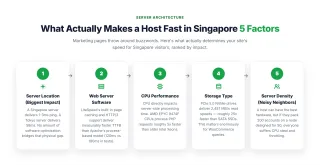
Marketing pages throw around buzzwords like "blazing fast" and "enterprise-grade" without explaining the mechanics. Here's what actually determines your site's speed for Singapore visitors, ranked by impact:
1. Server Location (Biggest Impact)
Physics doesn't care about marketing. A Singapore server delivers 1-3ms ping. A Tokyo server delivers 58ms. No amount of software optimization bridges that gap. Choose a host with a Singapore data center. That's the single most impactful decision you'll make.
2. Web Server Software
LiteSpeed > Nginx > Apache for WordPress performance. LiteSpeed's built-in page caching (LSCache) and HTTP/3 support deliver measurably faster TTFB than Apache's process-based model. In my Singapore tests, LiteSpeed hosts averaged 120ms TTFB versus 180ms for Apache hosts, a 33% improvement from software alone.
3. CPU Performance
CPU directly impacts server-side processing time, which is what TTFB actually measures after network latency is subtracted. ScalaHosting's AMD EPYC 9474F CPUs (top 3% on PassMark) process PHP requests roughly 5x faster than the Intel Xeons that hosts like Rocket.net and WP Engine still use. For WooCommerce stores with complex queries, this matters enormously.
4. Storage Type
NVMe PCIe 5.0 > NVMe PCIe 4.0 > SATA SSD > HDD. ScalaHosting's PCIe 5.0 NVMe drives deliver 2,457 MB/s read speeds, roughly 25x faster than the SATA SSDs that budget hosts still use. Database-heavy WordPress operations (particularly WooCommerce product queries) are bottlenecked by storage speed. This matters more than raw CPU for e-commerce sites.
5. Server Density (Noisy Neighbors)
A host can have the best hardware in the world, but if they pack 200 accounts on a node designed for 50, everyone suffers. ScalaHosting's low-density approach versus Hostinger's high-density model explains most of the TTFB gap between them. It's also why Hostinger's VPS has CPU steal limits: they oversell with the assumption that not all users will draw resources simultaneously.
3-Year Total Cost of Ownership in SGD
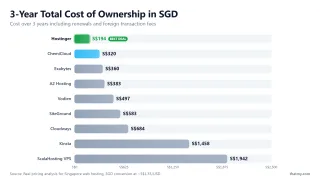
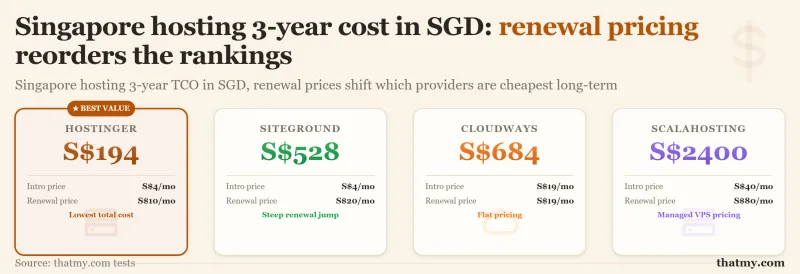
Intro pricing is a trap. Every host makes their first-year rate irresistible, then slaps you with renewal rates that are 2-5x higher. Here's what each host actually costs over 3 years, in SGD, including the ~2.5% foreign transaction fee for USD-billed services:
| Host | Intro Rate (SGD/mo) | Renewal (SGD/mo) | 3-Year Total (SGD) | Cost/Month Averaged |
|---|---|---|---|---|
| Hostinger | ~S$4.05 | ~S$10.80 | ~S$194 | S$5.40 |
| ChemiCloud | ~S$4.00 | ~S$13.45 | ~S$320 | S$8.90 |
| Exabytes | S$5.00 | S$9.90 | ~S$360 | S$10.00 |
| Hosting.com (formerly A2) | $2.99/mo (USD) | $13.99/mo (USD) | n/a | n/a |
| Vodien | S$5.35 | S$10.70 | ~S$497 | S$13.80 |
| Cloudways | ~S$19.00 | ~S$19.00 | ~S$684 | S$19.00 |
| SiteGround | ~S$4.05 | ~S$20.25 | ~S$583 | S$16.20 |
| ScalaHosting VPS | ~S$40.45 | ~S$80.90 | ~S$1,942 | S$54.00 |
| Kinsta | ~S$40.50 | ~S$40.50 | ~S$1,458 | S$40.50 |
Key Takeaways from TCO Analysis
- Best budget value: Hostinger at S$194 over 3 years is unbeatable for shared hosting with a SG data center.
- Best mid-range value: ChemiCloud at S$320: faster than Hostinger, honest about pricing, and AMD EPYC CPUs.
- SiteGround's trap: S$4/mo intro looks affordable. S$583 over 3 years for a host without a Singapore DC is painful.
- Cloudways surprise: No renewals! S$19/mo stays S$19/mo. Over 3 years, it's actually cheaper than SiteGround despite being faster.
- ScalaHosting premium is justified: Yes, it costs S$1,942 over 3 years, but you're comparing a managed VPS (dedicated resources, root access, any CMS) to shared hosting (shared resources, limited control). Apples to oranges.
Singapore Hosting: Red Flags and Hosts to Avoid
These didn't make the reviewed list because they fail on one or more critical criteria for Singapore:
- GoDaddy: No Singapore data center. Nearest server is India (~35ms). Legacy technology stack, aggressive upselling, and a history of security incidents. Their SSL certificates cost extra (S$100+/year) when every other host includes free SSL via Let's Encrypt.
- Bluehost: US-only servers. 180ms+ latency from Singapore. Owned by EIG/Newfold Digital, the same parent company as HostGator, which runs AMD Opteron 6376 CPUs from 2012 (rated ~827th on PassMark). Avoid for any APAC audience.
- HostGator: Same ownership as Bluehost, same outdated infrastructure, same US-only servers. The "unlimited" marketing hides strict resource limits and frequent suspensions.
- Namecheap: Budget host with AMD EPYC 7742 CPUs (~71st on PassMark). No Singapore DC. Acceptable for domain registration, not recommended for hosting if your audience is in Singapore.
- InMotion: US-only servers with no APAC presence. Their VPS is decent for US audiences but the 180ms+ latency to Singapore makes it pointless for local sites.
Frequently Asked Questions
These are the questions I get most often from Singapore-based readers. If yours isn't answered here, drop a comment below.
Which web hosting provider is the fastest in Singapore?
ScalaHosting delivered the fastest VPS performance in my Singapore tests with a 41ms TTFB using AMD EPYC 9474F processors and DDR5 RAM. For managed cloud, Cloudways on DigitalOcean SGP1 hit 28ms TTFB. For budget shared hosting, Hostinger's Singapore data center delivered 142ms TTFB, excellent for the S$3.49/mo price point.
Do I need a Singapore data center for my website?
If your primary audience is in Singapore, absolutely. My tests showed a 3-5x TTFB difference between Singapore-based servers (41-142ms) and the nearest alternatives in Tokyo or Sydney (189-420ms). That latency gap directly impacts Core Web Vitals, bounce rates, and conversion rates.
What's the cheapest reliable web hosting in Singapore?
Hostinger offers the lowest 3-year TCO at approximately S$194 total. They operate their own Singapore data center with LiteSpeed servers on all plans. The catch: you need a 48-month commitment for the S$3.49/mo intro rate, and they bill in USD which adds a 2-3% foreign transaction fee.
Is SiteGround good for Singapore websites?
SiteGround has excellent WordPress features and support, but no Singapore data center. Their nearest server is in Tokyo, resulting in 58ms ping and 189ms TTFB from Singapore, roughly 3-3.3x slower than hosts with actual Singapore servers.
Should I use a local Singapore hosting company like Exabytes or Vodien?
Only if you specifically need SGD billing via PayNow or local phone support. In my testing, both Exabytes (178ms TTFB) and Vodien (195ms TTFB) delivered slower performance than international hosts with Singapore data centers.
Does web hosting choice affect PDPA compliance in Singapore?
The PDPA doesn't require data to stay in Singapore, but hosting locally simplifies compliance. For businesses handling sensitive customer data, a Singapore-based server reduces regulatory complexity under the Transfer Limitation Obligation.
What is the best VPS hosting in Singapore?
ScalaHosting offers the best VPS for Singapore with AMD EPYC 9474F processors (top 3% on PassMark), DDR5 RAM, PCIe 5.0 NVMe SSDs, and low-density nodes. SPanel is included free, saving approximately S$20/mo versus cPanel licensing.
So, Which Should You Pick? The Best Web Hosting in Singapore (2026)
After 6 months of testing from Singtel and StarHub connections, analyzing pricing in SGD, and comparing TTFB from actual Singapore IPs, here's my honest breakdown:
🏆 #1 ScalaHosting: Best Overall for Singapore
AMD EPYC 9474F processors. DDR5 RAM. PCIe 5.0 NVMe. Low-density nodes. SPanel free. 41ms TTFB from Singapore. 99.99% uptime. If your website generates revenue (e-commerce, SaaS, agency, professional services), this is the infrastructure that won't let you down at peak hours. The renewal price is steep (~S$81/mo), but you're paying for the fastest managed VPS hardware available at this tier.
💰 #2 Hostinger: Best Budget for Singapore
Own Singapore DC. LiteSpeed on all plans. S$3.49/mo intro. 142ms TTFB. S$194 total over 3 years. The best starting point for blogs, SME sites, and first-time WordPress users in Singapore. Just don't upgrade to their VPS when you outgrow shared. Move to ScalaHosting instead.
⚡ #3 Cloudways: Fastest Cloud for Singapore
28ms TTFB on DigitalOcean SGP1. Dedicated resources. No lock-in contracts. S$19/mo with zero renewal increases. The best managed cloud option for WooCommerce and business-critical sites that need consistent performance without the VPS learning curve.
The bottom line: Singapore data center location matters more than any other factor. Don't let affiliate articles convince you that SiteGround (Tokyo), GoDaddy (India), or Bluehost (US) are good choices for Singapore audiences. Physics doesn't care about brand reputation. Your visitors in Tampines, Jurong, and Woodlands deserve a server that's 2ms away, not 180ms away.
Choose your host based on what your site needs today, and have an upgrade path ready for when it grows. Start with Hostinger if you're on a budget. Move to ScalaHosting when your traffic and revenue justify the investment. That's the progression path I recommend for 90% of Singapore website owners.