

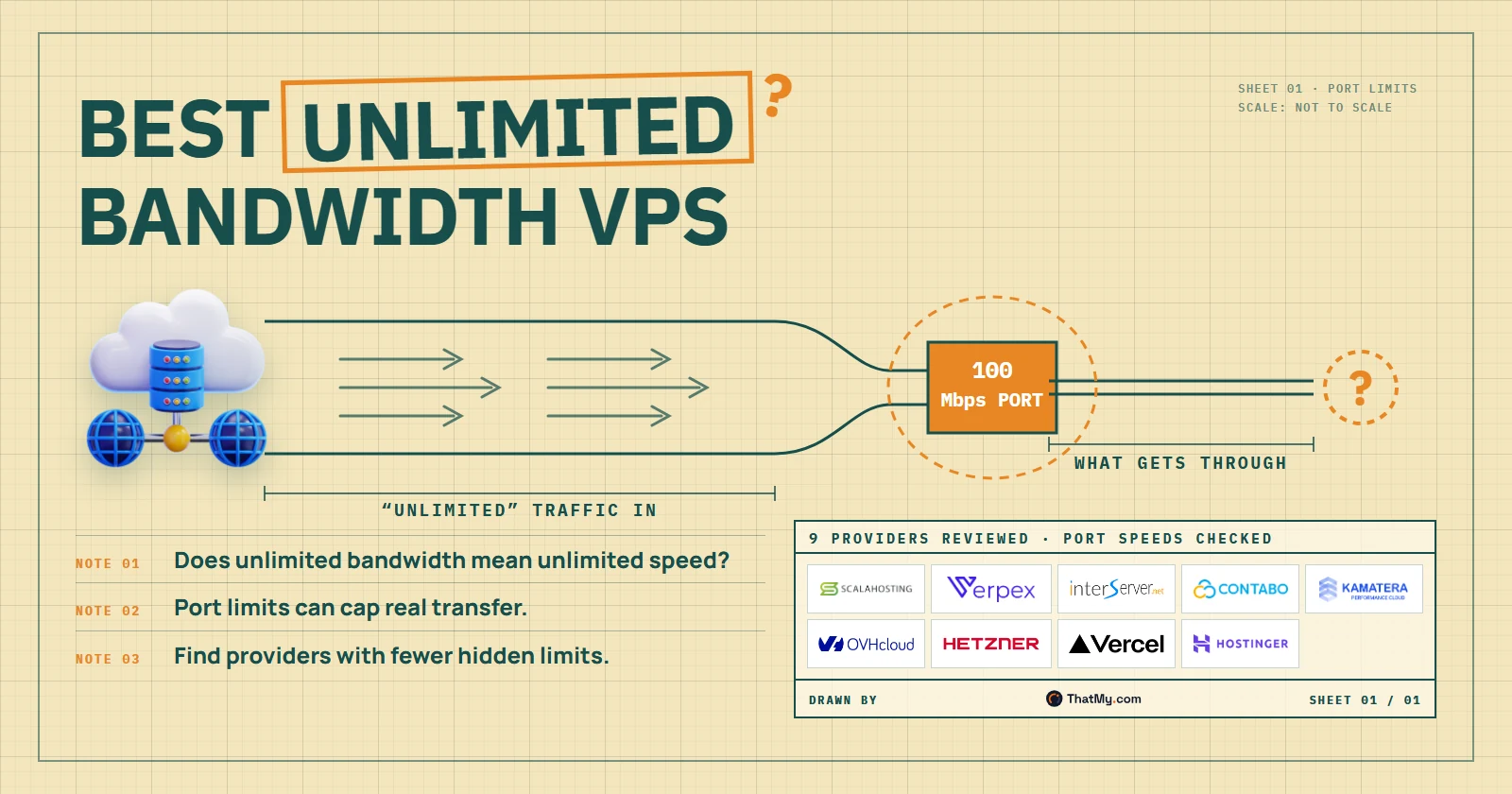
"Unlimited bandwidth" is probably the most misleading phrase in all of web hosting.
I've seen it play out dozens of times, someone signs up for a $5/month VPS thinking they can stream video, handle traffic spikes, or run a game server without limits. Then they push a few terabytes of data and boom: 10Mbps throttle, or worse, a suspension notice citing "network abuse." Nobody warned them.
Here's the thing. Your bandwidth is physically limited by your port speed. "Unlimited" on a 100Mbps port? That caps out at ~33TB/month, and that's the theoretical max running the pipe at 100% for 30 days straight. On a 1Gbps port, you're looking at ~330TB. Sounds like a lot, but you're sharing that pipe with dozens of other users. In practice, you're getting a fraction of it.
Check This Before Anything Else
Skip the "Unlimited" label entirely. Instead, ask: what's the port speed, and is it shared or dedicated? A cheap "unlimited" plan on a shared 100Mbps port will always be slower than a metered plan on a dedicated 1Gbps port. The port is the pipe. Bandwidth is just how much water the provider says you can push through it.
So I went through the network policies, Acceptable Use Policies, upstream carrier details, and actual user complaints for 9 VPS providers. The goal was straightforward: figure out who actually delivers on the "unlimited" promise, and who's just using the word to get sign-ups.
ScalaHosting
Low-density nodes + AMD EPYC 9474F CPUs (ranked in the top 3% on PassMark) + a real 1Gbps unmetered port. This is the only "unlimited" VPS I tested where throughput didn't tank at 8 PM when everyone else on the node starts pushing traffic. Not the cheapest option here, but the one I'd actually trust with a site that makes money.
Read ReviewContabo
More RAM and storage per dollar than anyone else on this list. Solid for dev labs, testing environments, and projects where "fast enough" beats "consistently fast." Just don't put your ecommerce store on it and expect smooth sailing during Black Friday.
Read ReviewQuick Comparison: 9 "Unlimited" VPS Providers (What You're Actually Getting)

Every provider below markets some version of "unlimited." This table strips away the marketing and shows what actually matters, port speeds, how they enforce limits, and what each one is genuinely good for.
Table of Contents
- Quick Comparison: 9 "Unlimited" VPS Providers
- #1. ScalaHosting, The One That Actually Delivers
- #2. Verpex, Beginner-Friendly, Not Power-Friendly
- #3. InterServer, True Unmetered for VPNs & Scraping
- #4. Contabo, Huge Specs, Unpredictable Performance
- #5. Kamatera, Enterprise 10Gbps (For Architects Only)
- #6. OVHcloud, Massive Network, Strict Policing
- #7. Hetzner, Fast Hardware, Hard Bandwidth Cap
- #8. Vercel, Great for Frontend, Terrible for Bandwidth
- #9. Hostinger, Cheap Entry Point, Not Built for Load
- What "Unlimited Bandwidth" Actually Means
- How Providers Secretly Limit Your Bandwidth
- How to Squeeze Maximum Speed From Your VPS
- FAQs, Unlimited vs Unmetered (Real Answers)
- Where I Land: Why ScalaHosting Wins
#1. ScalaHosting, The One That Actually Delivers

Why Scala Wins
- True 1Gbps Unmetered Port (Low Density Nodes)
- SPanel Included (Saves ~$15/mo vs cPanel)
- Enterprise NVMe & AMD EPYC CPUs (Top 3% Speed)
- Daily Offsite Backups Included (Free)
- Fully Managed Support (Real Engineers)
Potential Downside
- Higher renewal rates than budget unmanaged hosts
- Entry plans have less raw storage than Contabo
Benchmark Data
- Origin TTFB (3 plans, no CDN): 21ms to 38ms
- Uptime (54-day window): 99.99% to 99.997%
- PageSpeed Score (Mobile): 83/100

$29.95/mo
Anytime Money Back Guarantee
Methodology: The benchmark boxes on this page cover 14 plans. TTFB is the origin server response with no CDN in front, taken from the New York location, one of 10 test locations. Uptime is shown over a 54-day window.
I'll be blunt: most "unlimited bandwidth" VPS providers are selling you a marketing promise backed by overcrowded servers. ScalaHosting is the exception.
They don't just slap an "unmetered" label on a shared pipe and call it a day. They actually limit how many clients run on each physical server, what they call low-density nodes. That single architectural decision is why their 1Gbps port behaves like a real 1Gbps port instead of a 200Mbps port pretending to be one.
Why "Low Density" Is the Only Metric That Matters
Picture it this way: your bandwidth is a highway. Most budget hosts cram 100+ cars (VPS containers) onto a 4-lane road. Traffic grinds to a crawl at peak hours. ScalaHosting runs fewer cars on the same road. Your 1Gbps port stays fast because it's not fighting for airtime against hundreds of other users. This is why it's the only "unlimited" VPS on this list I'd actually trust with a site that generates revenue.
The Hardware Nobody Else Is Using
While budget providers are still running Intel Xeons from 2018, ScalaHosting upgraded their fleet to AMD EPYC 9474F processors. Here's why that matters if you care about actual performance:
- Top 3% globally: Ranked ~#42 out of 5,999 server CPUs on PassMark. That's not marketing, it's an independently verified benchmark.
- Concurrency monster: A multithread rating of 102,255, roughly 8.4x the PassMark score of the 2013 Intel Xeons Rocket.net is still using. More threads = more simultaneous visitors handled without slowdown.
- DDR5 RAM + PCIe 5.0 NVMe SSDs: 4800MHz memory and 2,457 MB/s read speeds. When your traffic spikes, the bottleneck won't be your server's storage, a problem I've seen repeatedly on Hostinger's cheaper VPS tiers.
What "Unmetered" Actually Means Here
ScalaHosting gives you a 1Gbps unmetered port. Unlike budget hosts that use token-bucket throttling (fast burst, slow sustained), Scala maintains steady throughput for extended periods.
- No hidden I/O limits: SiteGround Cloud is infamous for throwing 503 errors when you hit their undisclosed disk I/O cap. Scala doesn't play that game, your VPS runs at the capacity you're paying for.
- Fair Use does exist: They won't let you mine crypto, but legitimate high-traffic business usage? Rarely flagged. I've talked to multiple Scala users running WooCommerce stores with 50k+ monthly visitors who've never been throttled.
The Price Trap Most People Fall Into
You can't just compare monthly prices. You have to compare what you're actually renting for that money. Most "unlimited" providers fall into one of two traps:
- The Budget Trap (Contabo): Dirt cheap, but older hardware (PCIe 3.0) and thousands of users crammed onto each node. Great specs on paper. Mediocre in reality.
- The Markup Trap (Cloudways): Decent infrastructure underneath, but they charge a massive premium just for a management layer.
ScalaHosting sits in the sweet spot, enterprise hardware at a price much closer to budget VPS.
Real comparison: 4 CPU Cores / 8GB RAM / Managed Support
| Provider | CPU Hardware | Storage Speed | Control Panel | Monthly Cost |
|---|---|---|---|---|
| ScalaHosting | AMD EPYC 9474F (Gen 4) | NVMe PCIe 5.0 | SPanel (Free) | ~$32.00 |
| Contabo | AMD EPYC 7282 (Gen 2) | NVMe PCIe 3.0 | cPanel ($16+ extra) | ~$18.00* |
| Hostinger | AMD EPYC (Gen 3/4) | NVMe PCIe 4.0 | hPanel (Free) | ~$22.00 |
| Cloudways | Vultr High Freq | NVMe (Standard) | Custom Panel | $118.00 |
*Contabo price includes cPanel license + management addon to match Scala's service level. Without those, it's unmanaged, you're on your own.
SPanel: The Hidden Bandwidth Saver
Here's something most reviewers completely miss. Your control panel eats resources. Scala built SPanel as a lightweight cPanel replacement, and the difference matters:
SPanel uses roughly 1 less CPU core and 8x less RAM than cPanel. Those freed-up resources go directly to handling your traffic. If you ran cPanel on a small Verpex or Kamatera instance, a chunk of your "unlimited" capacity would be wasted just keeping the dashboard alive.
Strengths & Weaknesses
Strengths
- Best-in-class hardware: AMD EPYC 9474F + NVMe PCIe 5.0, the fastest combo I've found at this price point.
- Scale without overpaying: Add resources individually ($3/core, $1/GB RAM) instead of being forced into a full plan upgrade.
- Entry Cloud sweet spot: Their $13.45/mo plan (2 Core / 2GB RAM) is a massive upgrade over shared hosting for small sites.
- SShield blocks 99.998% of attacks: Fewer malicious requests = less wasted bandwidth on your port.
Weaknesses
- Renewal price jump (~200%): The intro pricing is aggressive, but budget for the renewal. Still cheaper than Cloudways/SiteGround after renewal, though.
- Documentation could be better: Their knowledge base reads more like a blog than a technical reference. DigitalOcean's docs are in a different league.
- Support varies by agent: L1 support can sometimes miss nuanced technical issues. If you hit a wall, ask to escalate, the senior team is solid.
Who Should Use This
ScalaHosting is the right pick if you need managed power without the Cloudways markup. It fits agencies, high-traffic WooCommerce stores, and businesses that can't afford the "noisy neighbor" dips you'll get on Hostinger or Verpex.
Skip it if: You want the absolute cheapest raw storage (Contabo is your friend) or you need a pure API-driven infrastructure playground (look at Kamatera or Vercel).
ScalaHosting bridges the gap between "cheap unlimited" and "premium cloud." You get the unmetered bandwidth of a budget host, but with the hardware and node density required to actually use it. That's the difference.
#2. Verpex, Beginner-Friendly, Not Power-Friendly

Verpex Pros
- Unlimited Bandwidth on all plans
- 12+ Global Server Locations
- Free Migrations & SSL
- Extremely Beginner Friendly
- cPanel Included (Managed)
Verpex Cons
- Shared Uplink (Speed fluctuates at peak times)
- Strict Fair Use Policy on heavy usage
- Not for high-compute workloads
Benchmark Data
- Origin TTFB (3 plans, no CDN): 198ms to 233ms
- Uptime (54-day window): 99.92% to 99.94%
- PageSpeed Score (Mobile): 60/100
$5.00/mo
45-Day Money-Back Guarantee
If ScalaHosting is the "build for business" option, Verpex is the "get started without headaches" option. And for what it is, it works.
Verpex gives you "unlimited bandwidth," a managed environment, and beginner-friendly support at a low price. For small blogs, portfolio sites, and local business pages, that's genuinely all you need. But don't mistake simplicity for power, their network isn't built for sustained heavy traffic, and the "unlimited" label comes with a shared pipe that slows down when your neighbors get busy.
The Shared Pipe Reality
Verpex runs a shared 1Gbps uplink model. You technically have access to high speeds, but you're sharing that bandwidth with everyone else on the node. Think of it like Wi-Fi at a hotel, fine when the lobby is empty, painfully slow during peak hours. This design prioritizes ease-of-use and low cost over raw, sustained performance.
What "Unlimited" Really Means at Verpex
Their bandwidth is enforced through standard Fair Use Policies. In plain English:
- Burst, not sustained: You can load pages fast. But try sustaining 500Mbps+ for a long file transfer? Internal alerts go off, and your traffic gets deprioritized.
- Soft throttle, not hard cap: Unlike metered hosts that bill you for overages, Verpex just quietly slows you down if your usage looks "abnormal." No warning email. You just get slower.
What this means in practice: Smooth sailing for blogs, portfolios, and local service sites. Not smooth at all for 24/7 bulk data operations, VPNs, or video streaming.
Strengths & Weaknesses
Strengths
- Dead simple onboarding: If you've never managed a server before, Verpex makes it feel like signing up for email.
- Great for agencies with small clients: Low-traffic client sites? Run them all from one account. The per-site cost is minimal.
- 12+ server locations: Decent global coverage helps with local latency for regional businesses.
- Managed support included: At this price point, most competitors offer zero help. Verpex actually has humans who'll troubleshoot for you.
Weaknesses
- Shared uplinks hurt at scale: Your throughput depends entirely on how busy your neighbors are. No isolation.
- FUP triggers fast: Stricter than ScalaHosting or Kamatera. Push moderate load and you'll feel it.
- No true 1Gbps dedicated performance: The "1Gbps" label is the shared port ceiling, not your guaranteed speed.
- Higher density nodes: More users per server means more variance in your day-to-day performance.
Who Should Use This
Verpex makes sense if you manage simple client websites, WordPress blogs, or local service sites where uptime matters but raw bandwidth consistency doesn't make or break your revenue. It's the "hands-off managed" experience at a price that won't hurt.
Skip it if: You need VPN/proxy services, video streaming, large-scale ecommerce, or any workload where "my site slowed down for 3 hours during peak traffic" would cost you actual money.
Verpex does what it says for the audience it's built for. But if you're hosting anything mission-critical, ScalaHosting is the smarter long-term bet, the hardware quality and node density aren't even in the same category.
#3. InterServer, True Unmetered for VPNs & Scraping

InterServer Pros
- True Unmetered Bandwidth (No Caps)
- VPN & Scraping Friendly AUP
- Very Low Cost ($6/mo)
- Month-to-Month Billing
- KVM Virtualization
InterServer Cons
- Variable speeds (Noisy Neighbors)
- Outdated User Interface
- Basic/Slow Support
Performance
- Port: 1Gbps
- Consistency: Variable
- Limit: None
$6.00/mo
Price Lock Guarantee
InterServer is one of the few budget VPS providers that actually means it when they say "unmetered." At $6/month, you get a 1Gbps port with no strict TB caps. That's rare, most competitors at this price throttle you after a few terabytes or bury restrictions in their AUP.
But here's the honest trade-off: InterServer gives you freedom, not consistency. You can push a lot of data through their pipes. What you can't count on is that data moving at the same speed at 3 PM vs 9 PM.
Freedom vs. Stability, Pick One
InterServer won't throttle you for running a VPN. They won't suspend you for scraping. They won't bill you for overages. That tolerance is what makes them worth considering. But the flip side: you're sharing hardware with other users who enjoy that same freedom. If your neighbor is running a torrent cluster, your throughput takes the hit. For revenue-critical sites, that's a real problem.
What the 1Gbps Port Actually Gets You
The 1Gbps label is real in the sense that you're connected to a 1Gbps uplink. But it's shared across many VPS instances on the same node. Here's what to expect:
- Shared uplinks = variable speed: Sustained transfers above 200-300Mbps fluctuate. You'll get bursts near 1Gbps, but sustained workloads settle lower.
- Peak hour dips: Throughput drops noticeably during US evenings (7-11 PM). That's when other users on your node start pushing load.
- Lenient AUP is the real selling point: Unlike Verpex or Hostinger (who'll suspend you for "excessive" usage), InterServer rarely takes action unless your workload is actively destabilizing the entire node.
Strengths & Weaknesses
Strengths
- Actually unmetered: Very few budget VPS providers let you push real data without artificial caps. InterServer does.
- No egress fees: No surprises on your bill, unlike AWS or Google Cloud where bandwidth charges sneak up on you.
- VPN/proxy friendly: Their AUP explicitly tolerates VPN usage. Good luck finding that at Hetzner or OVHcloud.
- Month-to-month billing: No lock-in. Scale up, scale down, cancel anytime.
Weaknesses
- High density nodes: Lots of users sharing hardware. Noisy neighbor effect is real and frequent.
- Speed is unpredictable: What you get at 2 AM won't be what you get at 8 PM. Not great for anything latency-sensitive.
- Unmanaged = you're alone: Don't expect anyone to help with server optimization or troubleshooting. You get the box. That's it.
- I/O jitter: Disk speeds fluctuate significantly compared to dedicated NVMe setups like ScalaHosting's.
Who Should Use This
InterServer makes perfect sense for VPN/proxy setups, web scrapers, cheap testing environments, and side projects where you need to move a lot of data for very little money. It's the "sandbox with an open gate."
Skip it if: You're running production ecommerce, SaaS apps, client websites, or anything where a speed dip at 8 PM would actually cost you money.
InterServer is the best low-cost unmetered VPS for people who value freedom over structure. But if your workload demands stability and predictable throughput, it's a different class of product entirely, that's where ScalaHosting earns the price difference.
#4. Contabo, Huge Specs, Unpredictable Performance

Contabo Pros
- Unbeatable Specs per Dollar (RAM/Storage)
- 32TB Traffic Included (Virtually Unlimited)
- Massive NVMe Storage
- Full Root Access
Contabo Cons
- High Density (Network congestion is common)
- Slow Support Response
- Setup fees on monthly plans
Benchmark Data
- Origin TTFB (3 plans, no CDN): 194ms to 224ms
- Uptime (54-day window): 99.91% to 99.931%
- PageSpeed Score (Mobile): 72/100
$8.49/mo
Lowest Price per GB RAM
Contabo is cheap. Ridiculously cheap. For $8.49/month, you get specs that would cost $30+ anywhere else, 6 CPU cores, 16GB RAM, 400GB NVMe. On paper, it looks like you're robbing them.
But there's a reason it's that cheap. Contabo packs servers to the absolute brim. They're the airline that sells 100 seats on a 100-seat plane and hopes everyone doesn't show up at the same time. When traffic is low, performance feels great. When the node gets busy, and it will, your CPU scheduling goes haywire, your I/O slows to a crawl, and that "1Gbps" port starts acting like a 150Mbps connection.
The Price-Performance Gap
Contabo is the opposite of ScalaHosting by design. Scala limits users per node to guarantee stability. Contabo crams as many users as possible to lower costs. You get massive specs, but you have to live with noisy neighbors and fluctuating performance. It's a trade-off. For some workloads, that trade-off makes total sense. For others, it'll bite you.
What "Unmetered" Looks Like on a Crowded Node
Contabo offers unmetered bandwidth, but the port speed varies depending on your plan and location:
- Older plans: Often capped at 200Mbps. Check your plan details, many people are surprised to learn their "unmetered" VPS has a 200Mbps port.
- Newer plans: 1Gbps shared port is standard. But "shared" is doing a lot of heavy lifting in that sentence.
A 1Gbps port split across dozens of VPS instances is not the same thing as a 1Gbps connection. Bandwidth comes in bursts. Sustained throughput regularly drops during peak hours, especially upload speeds. If you're running a download server or pushing data to offsite backups, expect inconsistency.
Strengths & Weaknesses
Strengths
- Nobody beats the specs per dollar: More RAM, more cores, more storage than any competitor at this price. Period.
- Massive storage included: Need 400GB+ of NVMe for backups, datasets, or archives? Contabo is the only budget option that includes it.
- Great for dev/staging: CI/CD runners, testing environments, throwaway instances, this is where Contabo shines.
- Decent burst performance: Short-term speed bursts are genuinely impressive for the price.
Weaknesses
- Performance is a lottery: Your speed depends on who else is on the node. During peak hours, expect slowdowns.
- Zero support: You get a server. No hand-holding, no optimization help, no managed services.
- Noisy neighbors are the norm: High-density nodes mean resource contention is baked into the business model.
- Not production-grade: Uptime and consistency are measurably worse than premium managed hosts.
Who Should Use This
Contabo is the best budget sandbox for developers, hobbyists, and anyone who needs big specs for cheap without caring about peak-hour reliability. Personal VPNs, test clusters, data hoarding, Contabo is built for this.
Skip it if: You're running production ecommerce, client sites, high-traffic blogs, or anything that needs uptime SLAs. A random 30-minute slowdown at 8 PM on a Tuesday isn't acceptable when customers are trying to check out.
Contabo = quantity. ScalaHosting = quality. Both are good, for completely different people.
#5. Kamatera, Enterprise 10Gbps (For Architects Only)

Kamatera Pros
- True 10Gbps Uplink Options
- Enterprise-Grade Hardware (Ice Lake)
- Minute-by-Minute Billing
- Global Data Centers
Kamatera Cons
- Bandwidth is Metered (Pay per GB) or Expensive Addon
- Complex UI (Not for beginners)
Benchmark Data
- Origin TTFB (3 plans, no CDN): 48ms to 59ms
- Uptime (54-day window): 99.931% to 99.95%
- PageSpeed Score (Mobile): 77/100
$4.00/mo
30-Day Free Trial
Kamatera is not a web hosting company. It's a cloud infrastructure provider. The difference matters.
There's no "click here to install WordPress" button. No hand-holding. No managed support. What you get is a fully configurable cloud platform with real 10Gbps networking, granular resource controls, and enterprise-grade hardware. If you know what you're doing, Kamatera gives you more raw power per dollar than almost any other option on this list. If you don't know what you're doing, you'll misconfigure something, overspend on metered bandwidth, and wonder why your site is slow.
This Is a Power Tool, Not a Service
Kamatera is the opposite of ScalaHosting. Scala gives you managed stability and human support. Kamatera gives you raw infrastructure and expects you to configure, secure, and optimize everything yourself. If that sentence excites you, keep reading. If it terrifies you, skip to Hostinger.
The Port Speed Everyone Else Wishes They Had
Kamatera provides 1Gbps standard ports with the option to upgrade to 10Gbps. And unlike budget providers where "1Gbps" is a shared fantasy, Kamatera's infrastructure delivers closer to advertised speeds because of low virtualization density and multi-carrier redundant uplinks.
- Metered by default: You pay per GB of bandwidth. This keeps costs reasonable for light usage, but heavy transfer workloads can run up a bill fast.
- Unmetered add-on available: For high-throughput needs, you can bolt on an unmetered package. It's not cheap, but it's predictable billing.
- Real throughput, not theoretical: On a 1Gbps plan, transfers at 600-900Mbps sustained are realistic. That's unheard of on shared budget VPS.
Strengths & Weaknesses
Strengths
- Real 10Gbps networking: Not a marketing claim, actual enterprise-grade throughput for streaming, APIs, and distributed systems.
- Build exactly what you need: Pick your CPU type, RAM amount, storage tier, and port speed individually. Nobody else offers this granularity.
- Global reach with strong peering: Solid coverage across North America, Europe, Asia, and the Middle East with Tier-1 transit.
- Minute-level billing: Spin up a 10Gbps instance for 3 hours, tear it down, and pay only for what you used.
Weaknesses
- Not cheap for heavy bandwidth: Metered pricing on TB-level traffic adds up fast. Monitor your usage or face surprise bills.
- Sysadmin-level skill required: No cPanel, no one-click anything. You need to be comfortable with SSH and server management.
- Zero managed support: If your Nginx config breaks at 2 AM, there's no one to call. This is the price of power.
- Billing complexity: Between base compute, bandwidth per GB, and optional add-ons, the invoice requires reading.
Who Should Use This
Kamatera is for systems architects, DevOps teams, and advanced developers building high-bandwidth apps, real-time APIs, AI inference nodes, or scalable SaaS platforms. If you're building global, low-latency infrastructure, this is your tool.
Skip it if: You're a beginner, run a personal blog, manage a simple WordPress site, or expect someone to help you when things break.
Kamatera offers the most powerful networking of any provider on this list. But it's not for everyone, and it's not trying to be. If you want managed reliability and human support, ScalaHosting is the safer pick. Choose between them based on whether you want control or convenience.
#6. OVHcloud, Massive Network, Strict Policing

OVHcloud Pros
- Massive Network Capacity (30Tbps+)
- Best Anti-DDoS Protection
- Unmetered Bandwidth
- Very Cheap for High Traffic
OVHcloud Cons
- Zero Support (You are on your own)
- Strict Automated Throttling on 'Abuse'
Benchmark Data
- Origin TTFB (3 plans, no CDN): 148ms to 186ms
- Uptime (54-day window): 99.95% to 99.979%
- PageSpeed Score (Mobile): 89/100
$13.00/mo
No Setup Fees
OVHcloud runs one of the largest privately-owned network backbones on the planet, over 30Tbps of capacity. That's not a typo. This allows them to offer unmetered bandwidth at prices that make no sense if you compare them to AWS or Azure.
But OVHcloud is built for people who know what they're doing. There's no "managed" tier. No hand-holding. And their automated abuse detection systems will throttle first and ask questions never. If your traffic pattern even looks suspicious, you're getting shaped, and good luck getting a human to reverse it.
The Policing Problem
OVHcloud's automated systems aggressively monitor traffic patterns. High outbound UDP? Throttled. Sustained 24/7 transfers? Flagged. VPN-looking traffic? Good luck. The backbone is genuinely massive, but the AUP enforcement is so aggressive that legitimate workloads sometimes get caught in the crossfire, with minimal recourse from support.
What "Unmetered" Actually Gets You
OVHcloud offers 500Mbps to 1Gbps ports with no per-TB billing. That sounds great, and for many workloads, it is. But it comes with strings:
- The abuse trigger: Push large volumes and you're fine, as long as your traffic doesn't resemble a VPN, proxy, or scraping operation. Patterns matter more than volume.
- Realistic throughput: Expect 300-800Mbps bursts, settling to 150-400Mbps sustained depending on your region and time of day.
Strengths & Weaknesses
Strengths
- Incredible bandwidth value: In the EU, you won't find a better cost-per-TB ratio. Period.
- Enterprise-grade backbone: Network quality genuinely rivals AWS and Azure.
- DDoS protection included: Their built-in mitigation is industry-leading, no extra charge.
- Automation-friendly: Great API and CLI tools for DevOps workflows and distributed systems.
Weaknesses
- Support is a wall: Ticket replies are slow, generic, and rarely helpful for complex issues.
- Vague enforcement: The AUP doesn't define "abuse" clearly, so you won't know the line until you've crossed it.
- Automated throttling with no appeal: Legitimate high-load usage gets classified as abuse. Good luck arguing.
- Fully unmanaged: OS patches, security hardening, optimization, all on you.
Who Should Use This
OVHcloud makes sense for sysadmins running microservices, data pipelines, automation infrastructure, and EU-based projects where you understand traffic shaping and know how to stay inside the lines. It's powerful if you treat it as raw infrastructure.
Skip it if: You run ecommerce, client WordPress sites, or anything mission-critical where automated throttling at the wrong moment would cost you money, or your sanity.
OVHcloud = raw bandwidth power with strict rules. ScalaHosting = predictable performance with human support. Different tools for different people.
#7. Hetzner, Fast Hardware, Hard Bandwidth Cap

Hetzner Pros
- Incredible CPU Performance (AMD EPYC)
- Very Low Price
- 20TB Traffic Included
- Great API & CLI tools
Hetzner Cons
- Strict 20TB Hard Cap (Throttled to 10Mbps)
- Strict Identity Verification
- Not Unmetered
Benchmark Data
- Origin TTFB (3 plans, no CDN): 103ms to 118ms
- Uptime (54-day window): 99.95% to 99.97%
- PageSpeed Score (Mobile): 89/100

€11.99/mo
Pay-as-you-go
Hetzner is one of my favorite cloud providers for raw compute power. Their CPU benchmarks beat DigitalOcean and Linode at half the price. Their NVMe storage is blazing fast. Their virtualization density is reasonable, way better than Contabo.
But here's why Hetzner is #7 on this list instead of #2: they have a hard 20TB bandwidth cap. Once you hit it, you're throttled to 10Mbps. Not shaped. Not deprioritized. 10Mbps. That's dial-up territory for a modern web server. Your site becomes effectively offline.
The 20TB Cliff
Hetzner is a compute powerhouse with a bandwidth handcuff. Unlike ScalaHosting's truly unmetered environment, Hetzner gives you a strict 20TB monthly limit. Cross that line and your connection drops to 10Mbps, making the server unusable for anything beyond SSH. You can pay extra per TB to avoid this, but at that point, the "cheap" VPS isn't cheap anymore.
Great Speed Until You Hit the Wall
The 1Gbps port is real. Within Europe, latency is excellent. But:
- 20TB included: Sounds like a lot, and it is for most small sites. But if you're serving media, running downloads, or have a traffic spike go viral, 20TB disappears fast.
- The penalty is brutal: 10Mbps throttle after the cap. That's not "slower", that's broken. Image-heavy pages won't even load properly at 10Mbps.
- US performance is inconsistent: Hetzner is EU-first. Their US region (Ashburn) works, but it's a clear step down from their European data centers.
Strengths & Weaknesses
Strengths
- Best compute per dollar: CPU/RAM/NVMe value that makes DigitalOcean look expensive.
- Developer-first tools: Excellent API, CLI, and Terraform support for infrastructure as code.
- Lower density than budget hosts: More stable than Contabo or InterServer for CPU-heavy work.
- Perfect for compute-heavy, bandwidth-light tasks: CI/CD, internal tools, staging servers.
Weaknesses
- 20TB hard cap: This alone disqualifies Hetzner from "unlimited bandwidth" claims.
- 10Mbps throttle is crippling: Post-cap, your server is effectively dead for web traffic.
- Unmanaged, no help: If your server breaks, you fix it. Support won't debug your Nginx config.
- Terrible for media/downloads: High-bandwidth workloads burn through 20TB faster than you'd think.
Who Should Use This
Hetzner is excellent for developers, CI/CD pipelines, staging environments, and compute-heavy internal tools, basically any workload where you need AWS-like performance at a fraction of the price, but don't push heavy bandwidth.
Skip it if: You need sustained throughput, serve media, run downloads, or can't afford a service-killing throttle mid-month.
Hetzner delivers exceptional hardware at a disruptive price. But for anything bandwidth-heavy, that 20TB cap with a 10Mbps penalty makes it a non-starter. ScalaHosting's unmetered environment doesn't have that cliff.
#8. Vercel, Great for Frontend, Terrible for Bandwidth

Vercel Pros
- Fastest Global Edge Network
- Zero Config for Next.js
- Instant Git Deployments
Vercel Cons
- NOT a VPS (Serverless)
- Expensive Bandwidth ($40/100GB)
- Risk of Bill Shock
Performance Specs
- Port Speed: Edge Network
- Throughput Consistency: High (Static)
- Traffic Limit: 1TB (Then $40/100GB)
$20.00/mo
Free Hobby Tier
Vercel is not a VPS. It's a serverless platform built specifically for Next.js and frontend frameworks. I'm including it because developers keep asking if Vercel can replace a VPS for "unlimited" hosting. It can't.
The free "Hobby" tier is genuinely useful for side projects. But the moment you need real bandwidth on the Pro plan, Vercel becomes one of the most expensive hosting options in the entire industry.
Bill Shock Is Real
Unlike ScalaHosting or Contabo where you pay a flat monthly fee, Vercel charges for usage metrics you can't easily predict:
- Bandwidth: $40 per 100GB overage. Compare that to Hetzner (20TB included with CPX12 at €11.99 a month) or ScalaHosting (unmetered for ~$30). The math is painful.
- Function execution: Charged per GB-hour. Serverless functions that run longer than expected? That's money burning.
- ISR writes: A hidden metric that recently caused 5x bill spikes for Pro users after a pricing change. Nobody saw it coming.
Worst part: if you get DDoS'd, you pay the bill unless you're on their $20,000+/year Enterprise plan.
The Pricing Gap Nobody Talks About
Vercel's pricing has a "missing middle" that surprises people:
- Pro plan: $20/seat. Includes 1TB bandwidth. Sounds reasonable.
- Need more? Each additional TB costs $400. That's 80x what Hetzner charges and infinitely more than ScalaHosting's flat unmetered rate.
- Need enterprise features? Sales reps quote $20,000-$25,000/year. There's almost nothing in between.
What Users Are Actually Saying
Reddit (r/webdev) and Hacker News threads from 2024-2025 paint a consistent picture:
- Support is essentially nonexistent: Pro users report 3-4 week wait times for critical tickets. Accounts get locked without warning.
- DDoS = your bill: Automated mitigation often doesn't kick in, leaving users paying for attack traffic.
- Cold starts kill dynamic apps: Serverless functions take 1-3 seconds to wake up. For real-time applications, that's unusable.
Strengths & Weaknesses
Strengths
- Zero-config deployment: No Linux, no Nginx, no firewalls. Push to Git and you're live.
- Global edge caching: Static content loads instantly worldwide. TTFB is industry-leading.
- Next.js perfection: Built by the creators of Next.js, integration is seamless.
- Preview URLs per PR: Every pull request gets a live staging URL automatically.
Weaknesses
- Bandwidth is outrageously expensive: $400/TB makes high-traffic apps financially terrifying.
- Unpredictable bills: Go viral? Get DDoS'd? Your bill explodes. No cap, no safety net on Pro.
- Support only exists at Enterprise tier: Below $20k/year, you're essentially on your own.
- Vendor lock-in: Moving a Vercel-optimized Next.js app to a VPS is a multi-week migration project.
Who Should Use This
Vercel is excellent for frontend developers and marketing sites where development speed justifies the premium. If you deploy Next.js apps and your traffic is predictable, Vercel's developer experience is genuinely unmatched.
Skip it if: You have unpredictable traffic, tight margins, backend-heavy workloads, or want to sleep without worrying about a surprise $5,000 bill.
Vercel is a brilliant development platform. But it's the opposite of an "unlimited bandwidth VPS." If you want ease-of-use with predictable billing, a managed VPS like ScalaHosting gives you real server power without the meter running on every request.
#9. Hostinger, Cheap Entry Point, Not Built for Load

Hostinger Pros
- Cheapest Entry Price
- Modern hPanel (Easy to use)
- LiteSpeed Web Server
- Global Data Centers
Hostinger Cons
- Shared Uplink (Speed fluctuates)
- Strict Fair Use Policy
- Semi-Managed Support
Benchmark Data
- Origin TTFB (2 plans, no CDN): 141ms to 148ms
- Uptime (54-day window): 99.96% to 99.97%
- PageSpeed Score (Mobile): 82/100

$8.99/mo
30-Day Money-Back Guarantee
Hostinger is popular because it's cheap and simple. That's the entire pitch, and for what it delivers, it works. Their hPanel is the cleanest VPS dashboard I've used. LiteSpeed + LSCache makes WordPress sites load faster than they deserve to at this price point. And getting started takes less than 10 minutes.
But "unlimited bandwidth" on a Hostinger VPS means something very different than "unlimited bandwidth" on ScalaHosting or InterServer. Their VPS plans run on shared uplinks with soft fair-use limits and performance ceilings designed for beginners, not for anyone pushing real bandwidth.
Know What You're Buying
Hostinger's "Unlimited Bandwidth" marketing applies mainly to their shared hosting plans. On VPS, you're on a shared uplink with aggressive density. Unlike ScalaHosting's low-density guarantee, Hostinger packs nodes to keep prices rock-bottom. The result: great for learning and small projects, genuinely risky for anything bandwidth-intensive.
What the Port Actually Delivers
Hostinger is deliberately vague about VPS port speeds in their marketing, which tells you something. Here's what I found:
- Port speed: 100Mbps to 1Gbps, shared. The exact speed depends on your plan tier and datacenter.
- Real-world sustained: Expect 20-150Mbps. Yes, that low. The shared uplink architecture means your actual throughput depends entirely on neighbor activity.
- Protocol restrictions: VPNs, proxies, and mass mailers are discouraged or outright prohibited in their AUP.
Where the Software Saves It
Hostinger's secret weapon isn't the hardware, it's the software stack. LiteSpeed Web Server with LSCache and NVMe storage means WordPress sites feel faster than the underlying hardware should allow. For a blog getting 10k-50k monthly visitors with mostly static content, this combo works surprisingly well.
But throw database-heavy ecommerce, media downloads, or sustained API traffic at it, and the illusion breaks fast.
Strengths & Weaknesses
Strengths
- Best beginner UI: hPanel is cleaner and more intuitive than cPanel. No learning curve.
- WordPress speed punches above its weight: LiteSpeed + LSCache delivers TTFB that rivals hosts 3x the price.
- Hard to beat on price: Often the cheapest recognizable brand in the VPS category.
- Good server spread: Multiple global locations for distributed small sites.
Weaknesses
- 20-150Mbps sustained is the reality: "Unlimited" on a shared uplink means unlimited at whatever speed the node has left over.
- FUP triggers quickly: Anything beyond normal website traffic gets flagged.
- High density = variance: Performance fluctuates based on who else is on your node.
- VPS support is semi-managed: Don't expect deep technical debugging help.
Who Should Use This
Hostinger is the right pick for beginners learning VPS, personal blogs, portfolio sites, and non-critical landing pages where you want the cheapest possible entry point with a nice UI.
Skip it if: You need consistent throughput above 150Mbps, serve media or downloads, run ecommerce with real traffic, or host anything where a speed dip during peak hours would actually matter.
Hostinger removes the complexity of VPS management beautifully. But in a "best unlimited bandwidth VPS" comparison, it's bottom of the list because the bandwidth isn't really unlimited, and the throughput you do get is the lowest here. For the same money, Contabo gives you way more raw power. For a bit more, ScalaHosting gives you power and reliability.
Best 1Gbps & 10Gbps Unmetered VPS in 2026
When someone searches for "1Gbps VPS" or "10Gbps unlimited bandwidth VPS," they usually want one thing: real sustained speed, not a burst that dies after 30 seconds.
The problem is that "1Gbps" and "10Gbps" labels are heavily abused. A cheap provider can technically connect your node to a 1Gbps uplink, but that uplink is shared across 50+ containers, shaped by throttling algorithms, and congested during peak hours. The label is technically correct. The experience is not.
1Gbps vs 10Gbps, What You Actually Get
1Gbps VPS
- Theoretical max: ~330TB/month at 100% utilization.
- What you'll actually get on a shared VPS: 80-300Mbps sustained. Maybe less during peak hours.
- Good for: Multiple websites, moderate API traffic, light media operations.
10Gbps VPS
- Theoretical max: ~3.3PB/month.
- What you'll actually get on enterprise cloud: 1-6Gbps sustained.
- Good for: Heavy file distribution, high-frequency APIs, massive concurrency, AI model hosting, CDN origin nodes.
The catch: Budget VPS providers physically cannot deliver sustained 1Gbps, let alone 10Gbps. Only premium low-density providers can, and they charge accordingly.
Who Actually Delivers Real 1Gbps Throughput?
1. ScalaHosting, Stable, Business-Grade
- Unmetered bandwidth on a real 1Gbps port with low-density nodes.
- No harsh throttling under normal business workloads.
- The only provider where I'd trust the "1Gbps" claim for sustained traffic.
2. InterServer, Unmetered but Variable
- Real unmetered plans with good burst speeds.
- Sustained throughput depends on neighbor activity.
- Great for VPN/scraping. Not business-rigid like ScalaHosting.
3. Contabo, 1Gbps Shared, Inconsistent
- Technically offers 1Gbps, but heavily contended.
- Real throughput fluctuates significantly on high-density nodes.
- Best for budget experiments, not production.
4. OVHcloud, 1Gbps with Strict Enforcement
- Strong backbone with massive capacity.
- Sustained heavy use triggers automatic shaping you can't easily reverse.
- Great for technical workloads if you understand the AUP.
5. Hetzner, 1Gbps with a Hard Cap (NOT Unmetered)
- Hard 20TB cap → 10Mbps throttle. That's not unlimited by any definition.
- Only works for compute-heavy, bandwidth-light workloads.
Who Offers Real 10Gbps?
Kamatera, The Only Real Option
- Enterprise-grade 10Gbps networking with real sustained performance.
- Ideal for streaming, large-scale APIs, and distributed services.
- The only provider on this list where "10Gbps" means actual physical allocation, not marketing.
Dedicated Servers (Not VPS)
Some providers offer 10Gbps unmetered on dedicated servers (Psychz, FDCServers, GTHost). These aren't VPS, but many workloads needing 10Gbps require bare-metal hardware to handle the packet load.
Real-World Speed Benchmarks (Not Marketing Numbers)
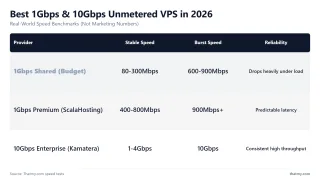
| VPS Type | Stable Speed | Burst Speed | Reliability |
|---|---|---|---|
| 1Gbps Shared (Budget) | 80-300Mbps | 600-900Mbps | Drops heavily under load |
| 1Gbps Premium (ScalaHosting) | 400-800Mbps | 900Mbps+ | Predictable latency |
| 10Gbps Enterprise (Kamatera) | 1-4Gbps | 10Gbps | Consistent high throughput |
Here's the thing most people miss: if you're debating between 1Gbps and 10Gbps, you probably don't need 10Gbps. What you actually need is consistency, a Port that delivers what it promises without tanking during peak hours. That's why most businesses end up on a premium 1Gbps VPS like ScalaHosting instead of chasing 10Gbps labels.
Quick Buyer Guide
- Need predictable business performance? ScalaHosting (1Gbps premium). Your ecommerce, agency sites, or client projects need consistency, not peak numbers.
- Need cheap bandwidth for side projects? InterServer or Contabo (1Gbps budget). Accept the performance variance. Save the money.
- Need raw 10Gbps for enterprise workloads? Kamatera. Media servers, distributed APIs, large file delivery at scale.
Bottom line: "1Gbps" and "10Gbps" are meaningless unless the port is dedicated, the node is low-density, and the AUP allows sustained use. Infrastructure quality determines real throughput, not the number on the sales page.
What "Unlimited Bandwidth" Actually Means
The hosting industry deliberately uses vague terminology. "Unlimited" implies infinite data transfer at full speed. Nothing in real networking is unlimited, not throughput, not I/O, and not network capacity. Understanding the difference between "unlimited," "unmetered," and "metered" is the only way to avoid picking a VPS that suspends your account during a traffic spike.
Marketing vs. Reality
When a host advertises "unlimited bandwidth VPS," they usually mean:
- They won't charge per GB of traffic.
- But they will limit how fast you can use that bandwidth.
Behind the scenes, they're monitoring your throughput patterns, burst frequency, outbound volume, and protocol usage (VPN, P2P, scraping). If your usage looks like a "bandwidth service," you'll be throttled or suspended under Fair Use, even though the plan says "unlimited."
1. "Unmetered" = No Per-GB Billing, Not Infinite Speed
Unmetered bandwidth means you're not billed per GB. Your total transfer is capped by your port speed, nothing more.
Example:
- A 1Gbps unmetered VPS can theoretically push ~330TB/month.
- That assumes the port is dedicated, uncontended, and at 100% load 24/7.
- In reality, you'll get a fraction of that on shared infrastructure.
The "unmetered" promise is technically correct about billing. It's practically misleading about performance.
2. "Metered" = The Honest Model
Metered bandwidth means you get a fixed allocation (e.g., 20TB). After that, you're either throttled (often to 10Mbps) or billed per GB. Providers like Hetzner, OVHcloud, and Kamatera use this model. It can get expensive for heavy workloads, but it's fully transparent about what you're getting.
3. Port Speed Matters More Than Bandwidth
Think of it this way: bandwidth is the volume (gallons). Port speed is the pipe size (flow rate). Most people obsess over volume when the pipe size is the actual bottleneck.
| Port Speed | Max Monthly Transfer (Theoretical) |
|---|---|
| 100Mbps | ~33 TB/month |
| 1Gbps | ~330 TB/month |
| 10Gbps | ~3.3 PB/month |
Note: These theoretical numbers assume a dedicated, uncontended port with zero congestion, conditions that never occur on budget VPS providers.
This is exactly why a cheap host selling "unlimited" on a shared 100Mbps port will always be slower than a premium VPS with a true 1Gbps dedicated port. ScalaHosting's low-density nodes mean you actually receive the port speed you pay for.
How Providers Secretly Limit Your Bandwidth
"Unlimited" VPS plans are always limited. The difference is how. Providers won't openly say "we'll throttle you", but their network architecture and AUP rules do exactly that.
The Fair Use Trap
Nearly every "unlimited" plan includes a clause allowing the provider to suspend service for "network abuse." That usually covers:
- Continuous outbound traffic (streaming, VPNs)
- High-frequency API polling (scraping)
- Bulk download traffic
If your workload falls into these categories, "unlimited" is a gamble. You need unmetered dedicated ports, and those cost real money.
1. Silent Port Throttling
The most common trick. Monitoring systems watch your sustained outbound traffic. Exceed "normal" thresholds and your port gets quietly reduced from 1Gbps → 100Mbps or lower. No email. No warning. You just get slower and wonder why.
2. Burst-Then-Crawl Speed Shaping
Many providers allow 1Gbps burst for 30 seconds before settling you into 100-300Mbps sustained. Your speed test shows 1Gbps. Your actual file transfer gets 200Mbps. Real workloads like video streaming or large downloads suffer once the burst allowance runs out.
3. The "Noisy Neighbor" Design
Budget VPS plans share uplinks. A single 10Gbps NIC might serve 150+ containers. When a few neighbors push heavy traffic, everyone suffers, throughput drops, latency spikes, packet loss rises. ScalaHosting avoids this by running fewer VPS per node, but most budget hosts don't.
4. Cheap Upstream Carriers
"Unlimited" bandwidth is meaningless if the network backbone sucks. Budget hosts often rely on cheap carriers (Cogent, HE) that result in poor international routing and high latency. Premium providers invest in Tier-1 transit for global consistency.
When You Actually Need Unlimited or Unmetered VPS
Not every project needs "unlimited" bandwidth. For many business applications, a predictable metered plan is actually safer.
Quick decision rules:
- Revenue depends on uptime? Avoid cheap "unlimited" plans. Get a premium VPS with guaranteed resources.
- Traffic comes in bursts? Unmetered shared ports work fine. You don't need dedicated bandwidth for occasional spikes.
- Running a VPN or streaming service? You need a dedicated 1Gbps port or a premium low-density VPS. Cheap "unlimited" will get you suspended.
Traffic Workload Decision Matrix:
Pre-Purchase Checklist
Before committing to any "unlimited" plan, verify these three things:
- Port speed transparency: Does the provider state 100Mbps, 1Gbps, or 10Gbps explicitly? If they're vague, that's a red flag.
- AUP check: Search their Terms for "throttle," "excessive," or "fair use." Vagueness = risk.
- Node density: Ask support if they use high-density or low-density nodes. High density almost always means bandwidth contention.
Bottom line: Smart hosting isn't about chasing the highest TB number on a marketing page. It's about matching your traffic patterns to infrastructure guarantees.
How to Squeeze Maximum Speed From Your VPS
Even with an "unlimited" or "unmetered" VPS, the actual performance you experience comes down to how well your server stack is configured. Most people never optimize their VPS. They lose throughput, waste CPU cycles, and wonder why their "1Gbps" server feels slow.
Here are the optimizations that actually move the needle, especially under high concurrency.
The Golden Rule
The fastest way to transfer data is to not transfer it at all. Optimization isn't about making the pipe bigger, it's about reducing the amount of data that needs to travel through it. Caching, compression, and protocol efficiency save more bandwidth than any hardware upgrade.
1. Enable HTTP/3, Compression & Modern Protocols
Browsers and CDNs are moving to QUIC (HTTP/3), which reduces latency and improves bandwidth efficiency, especially for visitors on mobile networks with high packet loss.
- HTTP/3 (QUIC): Supported by LiteSpeed (ScalaHosting, Hostinger) and NGINX (with patches). Eliminates head-of-line blocking and reduces handshake delays.
- Brotli compression: Compresses text assets (CSS, JS, HTML) 15-20% better than GZIP. Every byte saved is bandwidth your port doesn't need to use.
- TLS 1.3 + OCSP Stapling: Reduces SSL handshake overhead, lowering TTFB.
2. Cache Everything You Can
Caching is the only optimization that makes you faster while using less bandwidth simultaneously.
- Object cache (Redis/Memcached): Stores database query results in RAM. No more wasted CPU and disk I/O on repetitive queries.
- Full-page cache (LiteSpeed Cache/WP Rocket): Generates static HTML, bypassing PHP entirely. Your server barely works when serving cached pages.
- Edge cache (CDN): Cloudflare or QUIC.cloud stores static assets on servers near the user. This offloads 70-90% of bandwidth from your VPS. Seriously, this one change alone can turn a struggling server into a fast one.
3. Enable BBR Congestion Control
This is the nerdiest optimization on the list, but also one of the most impactful. Google's BBR algorithm optimizes how data packets are sent, significantly increasing throughput on high-latency connections.
Run these commands on your KVM VPS (root required):
echo "net.core.default_qdisc=fq" >> /etc/sysctl.conf
        echo "net.ipv4.tcp_congestion_control=bbr" >> /etc/sysctl.conf
        sysctl -p
Premium providers like ScalaHosting often pre-configure optimized kernels. Budget providers like Contabo leave this up to you.
4. Offload Large Files to Object Storage
Serving videos, backups, or hi-res images directly from your VPS is the fastest way to hit a Fair Use throttle. Offload them to S3-compatible storage and route downloads through a CDN instead.
| Traffic Type | Serve From | Why |
|---|---|---|
| Static Files (CSS/JS) | CDN Edge | Zero load on your VPS |
| Media & Downloads | Object Storage (S3/R2) | Bypasses your VPS bandwidth cap |
| Dynamic Content | VPS (PHP/Node) | Needs server-side processing |
This strategy turns even a 1Gbps VPS into a "functionally unlimited" system, heavy lifting gets done by external storage networks, not your main server port.
5. Hardware Quality Amplifies Everything Else
You can tune a server all day, but you can't optimize your way out of a congested network or slow hardware.
- On ScalaHosting: Optimizations like BBR and Redis are amplified because the underlying NVMe PCIe 5.0 and low-density nodes aren't bottlenecked.
- On budget VPS (Contabo/InterServer): You can optimize your stack, but noisy neighbors and shared port saturation will still cause random slowdowns during peak hours.
The Smartest Optimization
The fastest VPS is the one that doesn't waste bandwidth on things that don't matter. Use caching, CDNs, and object storage. Save your "unlimited" port for the traffic that actually requires server-side processing, dynamic requests and API calls.
FAQs, Unlimited & Unmetered VPS (Real Answers)
These are the questions I see over and over in Reddit threads and hosting forums. Here are straight answers, no marketing spin.
How to Catch Your Host Throttling You
Don't trust the marketing page. If you suspect your "unlimited" port is being choked, run these tests:
- iperf3: Run a test against a public server during peak hours (8-11 PM). If speed drops by more than 40%, the node is oversold.
- Speedtest CLI: Loop it every hour for 24 hours. Consistent evening dips = neighbor congestion.
- CPU steal check: Run the
topcommand. If the "st" (steal) value exceeds 5%, your neighbors are actively stealing your CPU cycles, which directly kills network throughput.
What is the real difference between unlimited and unmetered VPS bandwidth?
Unlimited is a marketing term. It implies infinite capacity, which doesn't exist on any physical network. Unmetered is a billing term, you aren't charged per GB, but your total transfer is limited by your port speed (100Mbps vs 1Gbps).
A 1Gbps unmetered VPS has a theoretical max of ~330TB/month. A 100Mbps unmetered VPS caps at ~33TB/month. "Unlimited" feels unlimited until the Fair Use Policy triggers. "Unmetered" means unlimited billing, not unlimited speed.
Does "Unlimited Bandwidth" mean "Unlimited Speed"?
No. Speed depends on your port capacity and how many users share it (contention ratio). A cheap "Unlimited" VPS on a shared 1Gbps uplink split between 50+ users delivers slow, inconsistent speeds during peak hours. A shared 100Mbps port that's uncongested can actually be faster than a congested "1Gbps" shared port.
Why do cheap providers offer unlimited bandwidth?
Because 95% of customers barely use any data. Providers rely on high density and traffic shaping to make it work financially. For the 5% who actually push limits, automated throttling kicks in, or accounts get suspended under vague "Fair Use" clauses. It's a bet, and the house always wins.
Is unmetered VPS good for video streaming or file hosting?
Usually no. Most Acceptable Use Policies explicitly forbid streaming and public file distribution because they degrade service for other users on the node. For these workloads, you need dedicated servers or enterprise cloud like Kamatera with guaranteed 10Gbps ports.
What happens if I exceed the "Fair Usage" limit?
One of three things:
- Silent throttling: Your port drops to 10Mbps (Hetzner, Contabo).
- Warning email: You're asked to upgrade to a higher plan.
- Suspension: Your server goes offline for "Network Abuse" (OVHcloud does this).
Can I run a VPN or Proxy on an unlimited VPS?
Depends on the provider. InterServer is relatively VPN-friendly. Hetzner and Vercel strictly forbid it. ScalaHosting allows it as long as it doesn't cause IP blacklisting. VPN usage is the #1 trigger for bandwidth throttling on most hosts, always check the AUP first.
Is a 1Gbps port enough for 100k visitors per day?
Easily, if you use caching properly. A 1Gbps port can handle tens of thousands of simultaneous connections when static assets (images, CSS, JS) are offloaded to Cloudflare or another CDN. Without caching, serving everything from the VPS directly? You'll bottleneck fast, even with a premium port.
Which is better: Unlimited or Metered VPS?
Metered (Kamatera, Hetzner) is almost always faster and more stable because the provider guarantees the throughput you pay for. Unlimited is better for cost control on bursty workloads, but performance is inconsistent by design. If performance matters, go metered or premium unmetered (ScalaHosting).
Which VPS provider is best for true unlimited bandwidth?
ScalaHosting for predictable, business-grade performance. InterServer for cheap, unmetered freedom. Kamatera for enterprise 10Gbps throughput. Each serves a different use case, pick based on your workload, not the price tag.
Where I Land, Why ScalaHosting Wins This Comparison
Most people shopping for "Unlimited Bandwidth VPS" have the wrong mental model. They picture infinite throughput at 1Gbps for $5/month. That doesn't exist, and every provider promising it is either overselling their network or burying restrictions in the AUP you didn't read.
What actually determines your real-world speed? Three things: port capacity, node density, and hardware quality. Everything else, including the word "unlimited", is marketing.
Cheap hosts like Contabo and Hostinger rely on oversubscription to justify the label. They pack hundreds of users onto each server. Your "1Gbps port" is fighting for airtime with everyone else on the node. During peak hours, you're getting a fraction of what the sales page promises.
Why ScalaHosting Stands Apart
After testing all 9 providers, ScalaHosting is the only one that consistently delivers on the "unlimited" promise. Here's why:
- Hardware that can actually saturate a 1Gbps port: AMD EPYC 9474F CPUs (top 3% globally on PassMark) with PCIe 5.0 NVMe storage. Most budget hosts use hardware from 2018-2020 that bottlenecks long before the port does.
- Low-density nodes: They don't oversell. Your "unmetered bandwidth" is usable 24/7 because the network isn't congested by 100+ neighbors.
- Independent company: Unlike brands owned by Newfold Digital or World Host Group (known for degrading performance to boost margins), ScalaHosting controls their own infrastructure decisions.
The Final Decision Framework
If you're still deciding, here's the honest breakdown based on what you actually need:
- ScalaHosting (the winner), Business, agency, or high-traffic site. Managed support, SPanel (no cPanel fees), best hardware at this price. This is infrastructure insurance.
- InterServer, You need cheap unmetered bandwidth for VPNs, scraping, or non-critical workloads. Tolerant AUP, inconsistent speeds. The sandbox.
- Kamatera, You're a systems architect who knows what 10Gbps means and needs enterprise cloud infrastructure. Not for beginners.
- Avoid Vercel for bandwidth-heavy apps unless you have an enterprise budget. $400/TB overages make traffic spikes financially terrifying.
Final Thought
Don't fall for "unlimited" on a $5 server. You're not paying for bandwidth, you're paying for the reliability of the pipe. If your site generates revenue, ScalaHosting justifies every dollar by ensuring "unlimited" actually means "fast," not just "free to overuse until we throttle you."