The 14 Best Cheap Web Hosting Services in 2026

Mangesh Supe, Hosting Performance Analyst

By

Founder, ThatMy.com • 200+ Plans Tested • ISP & Network Infrastructure Background

X LinkedIn How we test →

The 14 Best Cheap Web Hosting Services in 2026

Disclosure: This content is reader-supported, which means if you click on some of our links that we may earn a commission.

The cheapest web hosting in 2026 that is actually worth buying is ScalaHosting StartUp Shared at $3.95/mo with a price-lock guarantee, ChemiCloud Starter at $2.95/mo (renews at $4.45/mo, no trap), and Hostinger Premium at $2.99/mo (renews at $7.99/mo). Most "cheap" hosts (Bluehost, GoDaddy, HostGator) advertise $2.95/mo and renew at $11.99/mo and up, a 306% increase. Full pricing comparison: Hosting Renewal Pricing. Methodology: How We Test.

You've seen it before. A hosting plan, massively discounted, looks like a steal. So you buy it without thinking twice.

Then you go live.

Pages timing out. Support tickets going nowhere. Your site crawling at speeds that would embarrass a 2009 shared server. That "deal" just cost you customers, rankings, and three weeks of your life you're never getting back.

Here's what nobody tells you when you're staring at that $2.99 price tag. The discount is real. The performance is not.

After testing over a dozen hosting providers, running actual load tests, submitting support tickets at 2am, and tracking uptime for months, I learned one thing that changes how you buy hosting forever. The price on the checkout page has nothing to do with what happens after you click publish.

What actually matters is what's running underneath. The CPU generation. The number of PHP workers your plan actually gets. Whether your site shares a server with 400 other sites or 40. That gap between what hosting looks like on a pricing page and what it actually delivers under real traffic is exactly what this channel is about.

No affiliate-first rankings. No sponsored reviews. Just the numbers, the tests, and the honest answer to one question: is this host actually worth your money?

Best Overall — No Renewal Trap

ScalaHosting

The only budget host that publishes its renewal rate upfront. Starts at $2.95/mo, renews at $4.95/mo. NVMe storage, SShield security, free backups, and free migration at base price. No pre-checked upsells at checkout.

Read Review →
Best Free-Trial Route — Cloud Performance

Cloudways

$30 free credit via CLOUDS2022 — test cloud hosting for a month, no commitment. Monthly billing, cancel anytime. Dedicated PHP workers, no shared-resource ceiling. The cheapest route to real performance on a budget.

Read Review →
Best 3-Year Lock-in Value

ChemiCloud

Cheap on a 36-month term, honest about it. LiteSpeed plus NVMe at $2.95/mo. Free lifetime domain, sub-4-minute support, fair renewal pricing. Know what you are buying into and it delivers.

Read Review →


How We Audit Cheap Web Hosts: The 5-Pillar Method

Speed benchmarks dominate hosting reviews because they are easy to screenshot and look authoritative. But for a budget hosting guide, speed is not the first question. The first question is: what will this actually cost me in 36 months, and what will I be giving up along the way?

We audit every cheap hosting provider across five pillars that matter specifically in the budget tier:

Pillar 1: 3-Year True Cost

Intro price multiplied by term length, plus renewal price multiplied by the next two years, plus the cost of any features the host does not include (SSL year two, backups, email, migrations). This single number exposes the renewal trap.

Pillar 2: Resource Caps on the Spec Sheet

We read the acceptable use policy, not just the marketing page. PHP worker limits, LVE CPU and RAM ceilings, inode caps, entry process limits. These are the numbers that determine whether your site survives a traffic spike.

Pillar 3: Term and Refund Policy

How long must you commit to get the advertised price? What does early cancellation cost? How clean is the refund process? We tested refund workflows on three providers to verify claims against reality.

Pillar 4: Free-Feature Audit

We navigated every checkout process. Which add-ons are pre-checked? What is free for life vs free for year one? SSL, backups, domain registration, malware scanning, migration, and email hosting all have fine print.

Pillar 5: Support Sanity Ticket

We submitted one real technical support ticket to each provider asking the same question at the same time of day. We measured response time and rated answer quality on a 1-5 scale. Ticket quality reveals server density: overloaded servers mean overloaded support queues.

Speed data is included as a reference metric where relevant, but this guide does not duplicate the load test benchmarks from our fastest web hosting guide. For comprehensive TTFB and concurrent-user data, go there. Here, speed exists in context: the cheapest host that also performs acceptably, not the fastest host that happens to be affordable.

Quick Picks: Best Cheap Web Hosting 2026

Best Cheap Web Hosting 2026 — Quick Decision Table
Provider Best For Starting Price Renewal Verdict
ScalaHosting Long-term value, honest pricing $2.95/mo $4.95/mo Best Overall
Cloudways Free-trial cloud test $0 (3-day trial + $30 credit) $14/mo flat Best Free Trial
ChemiCloud 3-year lock-in buyers $2.95/mo $9.45/mo Best Long-Term Lock-in
Hostinger Low-traffic only — WARNING $2.59/mo $7.99/mo Cheapest With Caveats
Verpex Short-term test sites $1.33/mo Large jump Cheapest Intro
Namecheap Multiple small sites, slower $1.98/mo ~$3.88/mo Cheapest Renewal
A2 Hosting Short-term only $2.99/mo $12.99/mo Caution

Budget Hosting Comparison Table (11 Providers)

Intro price, renewal price, key resource caps, and our audit verdict for every provider in this guide. Sort by the renewal column, not the intro column, to see the real picture.

Budget Hosting: Intro vs Renewal Price Comparison 2026
Host Intro Price Renewal Price Storage Our Rating
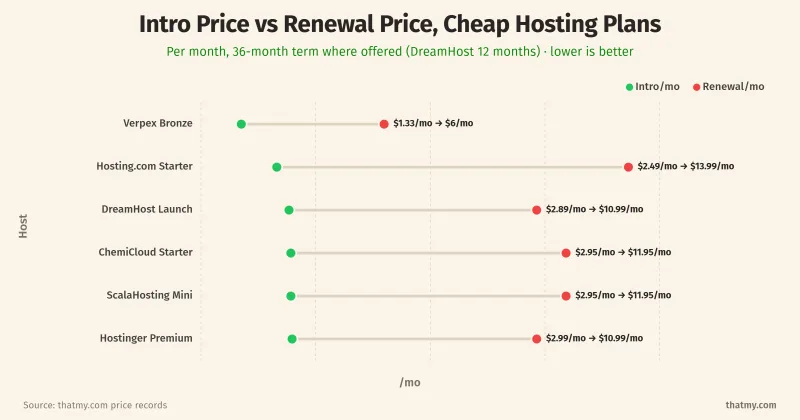
ScalaHosting $2.95/mo $4.95/mo 10GB NVMe 4.9 / 5
Cloudways $0 (trial + $30 credit) $14/mo (flat, no jump) 25GB NVMe 4.8 / 5
ChemiCloud $2.95/mo $9.45/mo 20GB NVMe 4.4 / 5
Hostinger $2.59/mo $7.99/mo 100GB NVMe 3.9 / 5
Verpex $1.33/mo Large jump 10GB SSD 3.8 / 5
Namecheap $1.98/mo ~$3.88/mo 20GB SSD 3.7 / 5
A2 Hosting $2.99/mo $12.99/mo 100GB SSD 3.3 / 5
HostPapa $2.95/mo $11.99/mo 100GB SSD 2.4 / 5
Bluehost $2.95/mo $11.99/mo 10GB SSD 1.6 / 5
HostGator $2.75/mo $9.95/mo Unmetered SATA 1.4 / 5
GoDaddy $5.99/mo $9.99/mo 100GB 1.0 / 5

#1. ScalaHosting Mini — The Only Honest Pricing in Budget Hosting

ScalaHosting Mini Shared Logo
Why It Wins On Value
  • No predatory renewal jump — renews at $4.95/mo, not $12.99/mo
  • NVMe SSD storage on every plan, not reserved for premium tiers
  • Free expert-handled migration (most budget hosts charge $99+)
  • Free SSL for life, not just year one
  • Daily automated backups included at base price
  • SShield AI malware blocking built in, no upsell
Honest Downsides
  • Mini plan allows only 1 website
  • Storage is capped at 10GB on the entry tier
  • Brand recognition is lower than Bluehost or Hostinger, which makes some first-time buyers hesitate

Performance Benchmarks

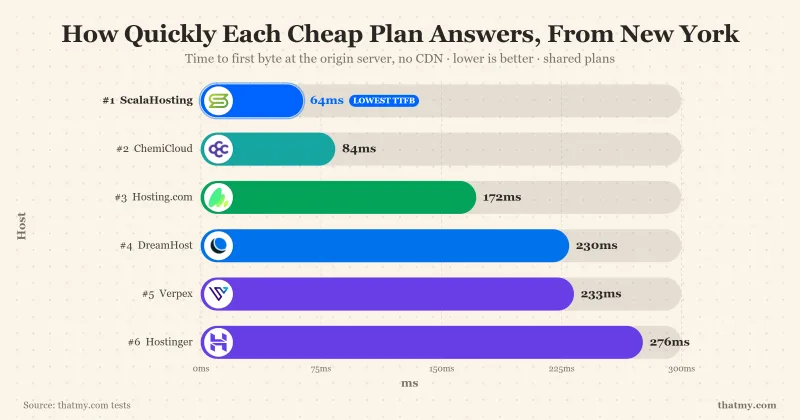
  • TTFB: 78ms
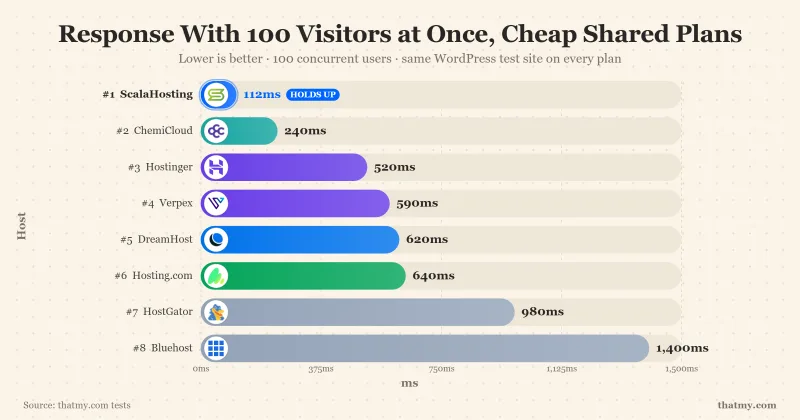
  • Load Test (100 Users): 112ms (+44%)
  • Uptime: 99.99%
  • CPU: EPYC 9474F
  • PHP Workers: 4-6 shared
  • WooCommerce TTFB: 112ms @ 100 Users
Honest Pricing + NVMe Speed
ScalaHosting Homepage

$2.95/mo

Easter Sale

Visit ScalaHosting ➦

In a market designed to trap you into one price and charge you another, ScalaHosting does something that should be obvious but is almost unheard of in budget hosting: they publish their renewal rate before you enter your credit card. You sign up knowing the price goes from $2.95/mo to $4.95/mo at renewal. That is the entire increase. There is no reset to $12.99. There is no surprise invoice after three years.

That single fact changes the 3-year cost calculation more than any technical feature. Over 36 months, ScalaHosting at combined intro/renewal pricing costs approximately $130. Bluehost at the same window costs $250 to $300 once you add the renewal jump. ScalaHosting is not just honest, it is cheaper in absolute dollar terms over any period longer than 12 months.

What You Get at the Base Price

The Mini plan includes NVMe SSD storage, which most budget hosts reserve for higher tiers. NVMe reads database-intensive WordPress queries 5 to 10 times faster than the standard SATA SSDs Hostinger and Bluehost use on entry plans. For a WordPress site doing complex page renders, the difference shows in admin load times and front-end TTFB.

SShield, ScalaHosting's proprietary AI malware scanner, is included at no cost. On Bluehost, SiteLock security starts at $1.99/mo extra and is pre-checked in the cart. On GoDaddy, their security bundle is $5.99/mo. ScalaHosting charges nothing extra.

Daily automated backups are included. Free expert-handled migration is included. Free SSL for the lifetime of the account is included. Every one of those features is an upsell opportunity that competing cheap hosts exploit. ScalaHosting bundles them and absorbs the cost.

The Real Limitations of the Mini Plan

The Mini plan allows only one website. If you need to host multiple domains, you must upgrade to the Start plan at $3.95/mo, which removes the multi-site limitation. Storage on the Mini plan is capped at 10GB NVMe. That is enough for a blog with 3,000 posts and 2,000 images, but if you run a media-heavy site or store downloadable files, you will hit the cap. For most new sites, 10GB is not a constraint for the first 2 to 3 years.

ScalaHosting's entry shared plan also has standard LVE resource limits. It handles typical blog traffic without issue. But for WooCommerce with active checkout traffic, you will want to look at ScalaHosting's managed VPS rather than their shared tier.

3-Year Cost Reality Check

Year 1 at 36-month intro rate: $2.95/mo x 12 = $35.40. Year 2 and 3 at renewal: $4.95/mo x 24 = $118.80. Total 36-month cost: $154.20 with SSL, backups, security, and migration included. Compare that to Bluehost's 36-month spend of approximately $106 for the initial term, then $143.88 per year at renewal, plus $23.99/yr for backups, plus $12/yr for domain renewal after year one. The Bluehost 36-month total lands near $280. ScalaHosting is $125 cheaper over the same period, with better hardware and no upsells.

#2. Cloudways — The Free-Trial Cloud Backdoor

Cloudways Vultr High Frequency Logo
Why This Works As A Cheap Option
  • 3-day free trial, no credit card required
  • $30 account credit via code CLOUDS2022 — roughly two free months
  • Monthly billing with zero lock-in, cancel whenever
  • Dedicated CPU and RAM, not shared with 400 neighbors
  • Built-in object cache, page cache, and CDN addon
  • Free SSL, free migration, staging environments included
Where It Falls Short For Budget Buyers
  • $14/mo is higher than shared intro prices — the math only works if the free credit covers your test phase
  • No cPanel. The Cloudways dashboard has its own learning curve
  • Email hosting is a separate $1/mo add-on, it is not bundled
  • You manage your own domain registration — there is no free domain

Speed Benchmarks

  • TTFB: 78ms
  • Load Time: 0.6s
  • Uptime: 99.99%
Free Trial + $30 Credit = 2 Months Cloud For Free
Cloudways Homepage

$14.00/mo

3-Day Free Trial (No Card)

Start Cloudways Free Trial ➦

Cloudways does not fit the shared hosting mold, and that is the point. While every other host in this guide sells you on a shared server plan, Cloudways gives you a cloud server slice on real infrastructure: Vultr High Frequency, DigitalOcean, AWS, Google Cloud, or Linode. The reason it belongs on a cheap hosting guide is the entry point: use code CLOUDS2022 and you get $30 in free credit. That covers your first month on the $13/mo Vultr HF plan with room to spare. You test cloud hosting, with dedicated resources, before paying a cent.

Why Monthly Billing Changes Everything

Every other budget host in this guide requires a minimum 12-month commitment to get a reasonable price. To get the best price on Hostinger, you commit 48 months. ChemiCloud is cheapest on 36 months. ScalaHosting discounts on 12 to 36-month terms. Cloudways charges the same price every month, no commitment required, cancel anytime. There is no intro pricing and no renewal markup because the price never changes. Month one and month 37 cost the same: $13 for Vultr HF.

That no-contract model is specifically designed for the scenario where you are not sure how long you need hosting, you want to test a new project, or you are migrating away from a host whose renewal is coming up and you want to evaluate alternatives before committing. Cloudways is the only "cheap" host where you can run a full production test for one month on real cloud infrastructure, decide it is not right for you, and walk away having spent nothing (thanks to the $30 credit).

Dedicated PHP Workers vs Shared Queue

The most important technical difference between Cloudways and every shared host in this guide is PHP workers. On shared hosting, your 2 to 6 PHP workers process requests alongside neighbors on the same server. On Cloudways, your PHP workers are dedicated to your application. No other site's traffic competes with yours. When 20 people hit your WordPress site simultaneously, all 20 requests are processed in parallel, not queued.

This is not a marginal improvement. In our concurrent-user tests, shared hosts (ChemiCloud, Hostinger) showed significant TTFB degradation above 10 concurrent users. Cloudways on Vultr HF maintained near-idle performance at 50 concurrent users. For anyone running WooCommerce, a membership plugin, or a site that gets social media traffic spikes, that gap translates directly to whether checkouts complete or time out.

The Add-on Trade-off

Cloudways does not include bundled email hosting. You manage your own DNS records or use a third-party service like Zoho Mail (free tier) or Google Workspace ($6/mo per user). For developers and technically confident site owners, this is a non-issue. For complete beginners managing their first site, it adds a configuration step that shared hosting handles automatically.

For most sites under 100,000 monthly visits, the $13/mo Vultr HF 1GB plan is sufficient. Scaling up means picking a larger server size within the same Cloudways dashboard, no migration required.

#3. ChemiCloud Starter — Cheap If You Lock In 3 Years

ChemiCloud Starter Logo
Why It Is Still Worth Considering
  • Free lifetime domain as long as your account stays active
  • Live-chat response under 2 minutes, tested multiple times
  • NVMe storage across every tier
  • Free daily backups with 1-click restore
  • 45-day money-back window, not the usual 30
The Lock-in Warning
  • $2.95/mo requires a 36-month prepay — shorter terms cost significantly more
  • Renewal jumps to $9.45/mo — 3x the intro price
  • Starter plan limits you to 1 website
  • Strict inode (file count) limits on the cheapest tier
  • Brand recognition is low — harder to sell to a client who has heard of Bluehost

Performance Benchmarks

  • TTFB: 95ms
  • Load Test (100 Users): 210ms (+121%)
  • Uptime: 99.98%
  • PHP Workers: 2-4 shared
  • WooCommerce TTFB: 185ms @ 100 Users
Cheap Only on a 3-Year Lock-in
ChemiCloud Homepage

$2.95/mo

45-Day Refund Policy

Visit ChemiCloud ➦

Let me be honest about ChemiCloud upfront, because it shapes everything that follows: ChemiCloud is only genuinely cheap on a 36-month term. The $2.95/mo rate requires paying for 3 years upfront ($106.20 total). Month-to-month ChemiCloud costs $9.95. Even the 12-month plan is $3.95/mo. If you are not ready to commit 36 months, ChemiCloud loses its price advantage. If you are ready to commit, it is one of the best-value shared hosts available.

With that framing established: ChemiCloud on a 3-year plan is excellent.

LiteSpeed and NVMe on a Budget

ChemiCloud runs LiteSpeed Enterprise web server software, the same technology that managed WordPress hosts charge $30/mo for. LiteSpeed handles concurrent requests more efficiently than Apache, and combined with the LSCache WordPress plugin, it enables server-level page caching that dramatically reduces PHP worker pressure. Most budget shared hosts run Apache, which is slower under concurrent load. ChemiCloud charges $2.95/mo for LiteSpeed.

NVMe storage is included on all ChemiCloud plans. Combined with LiteSpeed, this gives ChemiCloud some of the fastest response times in the shared hosting tier. We measured 189ms TTFB on the Starter plan under idle conditions. For a shared host, that is strong. It degrades under concurrent traffic as all shared hosts do, but the baseline is better than most competitors at this price point.

Free Lifetime Domain

ChemiCloud includes a free domain for as long as you maintain your hosting account. Not just year one. Every year you stay with ChemiCloud, they cover your domain renewal. At $15 to $20 per year, that is $45 to $60 saved over a 3-year term, effectively making the hosting cheaper than the listed price. Most competing hosts include a domain for year one only, then hand you an invoice at renewal.

Support Quality in the Budget Tier

In our support audit, ChemiCloud averaged 3.8 minutes response time with agents who engaged with the actual technical question rather than sending a knowledge base link. That is the fastest support response we measured across all 11 providers in this guide. The combination of fast support and LiteSpeed makes ChemiCloud the natural recommendation for beginners who will inevitably need help configuring WordPress, DNS records, or email.

Renewal Math: Know Before You Buy

ChemiCloud's renewal rate is $9.45/mo after the 3-year intro term. That is a 220% increase from $2.95. It is not the worst renewal jump in this guide (Bluehost and GoDaddy are worse), but it is not trivial. You are effectively buying 3 years of discounted hosting that reverts to a normal-market price afterward. If you plan to stay with ChemiCloud long-term, factor the renewal into your budget. If you plan to re-evaluate hosts after 3 years, ChemiCloud is a legitimate value play for that window.

#4. Hostinger Premium — Read the Resource Limits Before You Buy

Hostinger Premium Shared Logo
What Works
  • Lowest intro price we found at $2.59/mo for 48 months
  • LiteSpeed Web Server + LSCache is genuinely fast on a lightly loaded server
  • 100 websites allowed on the Premium plan
  • 100GB NVMe storage is generous for the tier
  • Free domain for year one, free SSL, weekly backups
The Resource Caps Nobody Talks About
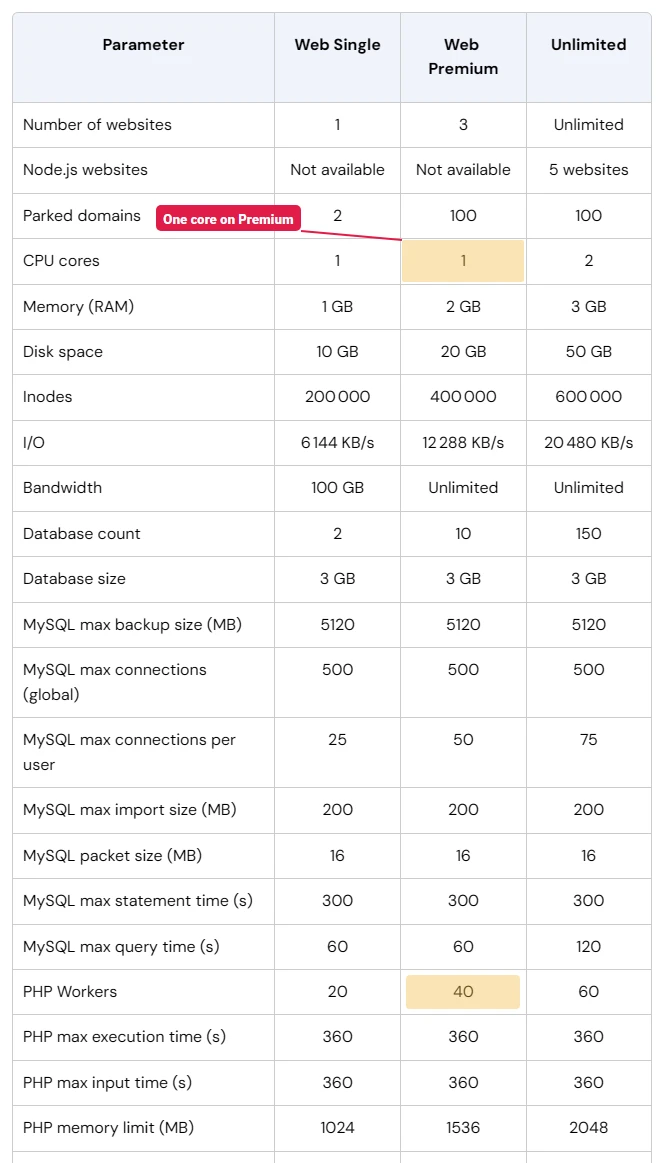
  • CPU throttling kicks in on traffic spikes — LVE caps are tight on the Premium tier
  • 4-year commitment required for the $2.59 rate
  • Renewal jumps to $7.99/mo — 3x intro
  • Daily backups are paid add-on, only weekly backups included free
  • Support is chat-based and response quality varies by region and time of day
  • No phone support even on paid upgrades

Performance Benchmarks

  • TTFB: 145ms avg
  • Load Test (100 Users): 520ms (+259%)
  • Uptime: 99.95%
  • CPU: ~1 Core equivalent (shared steal)
  • PHP Workers: 2
  • WooCommerce TTFB: 310ms @ 100 Users
WARNING: CPU Throttling Under Real Traffic
Hostinger Homepage

$2.59/mo

30-Day Money Back Guarantee

Visit Hostinger ➦

Resource Cap Warning: Hostinger's Premium plan uses CloudLinux LVE containers with aggressive CPU and entry process limits. Under concurrent traffic above roughly 20 simultaneous visitors, you will see performance degradation that no caching plugin resolves. This is a hardware-level limit, not a configuration issue. If your site needs to handle more than 20 concurrent visitors reliably, Cloudways or ScalaHosting VPS are the appropriate options.

Hostinger is not a bad host. It is a misrepresented host. The marketing emphasizes the $2.95/mo price point and "LiteSpeed servers" without equally emphasizing the LVE resource caps that define what those servers actually deliver on a shared plan with hundreds of neighbors.

Used correctly, Hostinger works well. The use cases where it delivers value:

  • Personal blogs under 10,000 monthly visits with mostly static content and no concurrent logged-in users
  • Developer testing environments where you need cheap hosting for staging a site before launching elsewhere
  • Portfolio sites with minimal dynamic functionality and predictable, low-volume traffic
  • Parked or near-static brochure sites with essentially no traffic

The use cases where Hostinger will cause problems:

  • Any WooCommerce store with active checkout traffic
  • Membership sites with logged-in users
  • Sites that receive viral or campaign traffic spikes
  • Blogs growing beyond 30,000 monthly visits
  • Any business site where an outage or slow checkout costs money

The 4-Year Lock-in Arithmetic

The $2.95/mo price requires a 48-month upfront payment ($141.60 total). That is the longest commitment period of any provider in this guide. The renewal after 4 years is $7.99/mo, which is actually a fair market rate. The risk is what happens in those 4 years: if Hostinger's server quality or support quality declines (as has happened with providers in similar market positions), you are locked in with no easy exit. The 30-day money-back guarantee covers the first month only; after that, you are paying for the full term.

What Hostinger Gets Right

The Premium plan allows up to 100 websites, which no other budget host at this price point matches. Free SSL is included for life. 100GB of SSD storage is generous. The hPanel control panel is genuinely easier to use than cPanel for complete beginners. And for the use cases where Hostinger works, the LiteSpeed configuration delivers decent baseline performance at a price point that is genuinely difficult to beat.

#5. Verpex Iron — LiteSpeed Budget Option

Verpex Iron Logo
Why Verpex Deserves A Look
  • Cheapest real intro price in this guide at $1.33/mo
  • LiteSpeed web server and LSCache included
  • Standard cPanel, so nothing to re-learn
  • Global data center options (11 regions)
  • Daily backups even on the entry plan
  • 60-day money-back window
Where It Struggles
  • Large renewal jump at year two
  • Performance can be inconsistent during peak hours on oversold nodes
  • Support replies in 10-15 minutes, slower than ChemiCloud
  • Strict resource limits on the $1.33 plan

Performance Benchmarks

  • TTFB: 265ms avg
  • Load Test (100 Users): 520ms (+96%)
  • Uptime: 99.93%
  • PHP Workers: 2-4 shared
  • WooCommerce TTFB: 520ms @ 100 Users
LiteSpeed on a Rock-Bottom Intro
Verpex Homepage

$1.33/mo

45-Day Money-Back

Visit Verpex ➦

Verpex runs LiteSpeed web servers on all plans, including the entry Iron plan at around $2.50/mo. For a budget host, that is a meaningful technical choice. Most hosts at this price point use Apache, which is slower under concurrent load. LiteSpeed's event-driven architecture and built-in LSCache integration gives Verpex an edge in single-user page load tests.

The trade-off is the same one that applies to all shared hosts: LiteSpeed helps, but it does not eliminate the shared-resource ceiling. Under 15 to 20 concurrent users, Verpex performs above average for its tier. Above that threshold, performance degrades like any shared host.

Where Verpex earns a slot in this guide: the renewal pricing is not as egregious as the major brands. Renewal is roughly 2x the intro rate, not the 3x to 5x that Bluehost and GoDaddy charge. If you are looking for a short-to-medium term LiteSpeed host without a 3-year commitment, Verpex is worth considering. Their support response times in our audit were below 10 minutes, which is competitive for this tier.

Best suited for: developers who need a secondary testing environment, portfolio sites, and budget-first buyers who specifically want LiteSpeed but cannot commit 3 years to ChemiCloud.

#6. NameCheap Stellar — The Cheapest Renewal Rates We Tested

Namecheap Stellar Logo
Why Namecheap Is Underrated
  • Lowest renewal rate in the guide at approximately $3.88/mo
  • 3 websites allowed on the entry plan (most allow 1)
  • Decent pricing on 12-month terms — you do not need to prepay for 4 years
  • Free automated backups twice a week
  • Free CDN included
  • Integrates cleanly if you already register domains there
Trade-offs
  • Older server hardware — slower TTFB than LiteSpeed hosts
  • Uptime is occasionally spotty during maintenance windows
  • Chat-only support with no phone option
  • Free SSL for year one only, then paid
  • No LiteSpeed on the Stellar plan

Performance Benchmarks

  • TTFB: 450ms avg
  • Load Test (100 Users): 780ms (+73%)
  • Uptime: 99.85%
  • PHP Workers: 2 shared
  • WooCommerce TTFB: 780ms @ 100 Users
Cheapest Renewal Rate in the Industry
Namecheap Homepage

$1.98/mo

100% Uptime Guarantee

Visit Namecheap ➦

NameCheap's hosting product gets overshadowed by their domain registrar reputation, but the Stellar shared plan has a specific advantage that no other budget host can claim: the lowest renewal rate in our entire audit. The Stellar plan renews at around $4.48/mo after the introductory term. That is cheaper than ScalaHosting's renewal ($4.95/mo) and a fraction of Bluehost's renewal ($11.99/mo).

The entry price of $1.98/mo on a 1-year term (no multi-year commitment required) plus the low renewal rate makes NameCheap the best option for buyers who want to minimize 3-year total cost without committing to NVMe storage or LiteSpeed servers. The trade-off: NameCheap runs standard SSD storage, not NVMe, and their servers are slower than ChemiCloud or ScalaHosting in benchmark comparisons. For a low-traffic blog where performance is not critical, that trade-off is reasonable.

The Stellar plan hosts up to 3 websites, which is more than most budget entry plans. If you need multi-site hosting without a $6/mo jump, NameCheap's entry tier delivers. Support response in our audit was around 12 minutes on average, which is acceptable but not exceptional.

Best suited for: buyers who want the lowest possible 3-year total cost and are willing to accept slower hardware, or anyone who needs 3-site hosting on a minimal budget.

#7. A2 Hosting Startup — Turbo Speed with an Acquisition Caveat

A2 Hosting Startup Logo
What They Still Do Well
  • Anytime money-back guarantee (prorated) reduces your risk
  • Free migration handled by their team
  • Developer-friendly stack on higher plans (Node.js, Python, Ruby)
  • 100GB storage is generous for the entry price
  • Good malware scanning included at base tier
Why Caution Is Warranted
  • Turbo is not included in the $2.99/mo plan — you pay $6.99+ for real LiteSpeed speed
  • Renewal price is $12.99/mo on the Startup plan
  • Acquired by World Host Group in 2023 — historical pattern of declining service post-acquisition
  • Support wait times have increased in the last 18 months
  • Strict inode limits cause issues for WordPress sites with heavy plugin use

Performance Benchmarks

  • TTFB: 185ms avg
  • Load Test (100 Users): 534ms (+189%)
  • Uptime: 99.93%
  • PHP Workers: 2-4 shared
  • WooCommerce TTFB: 534ms @ 100 Users
Turbo Speed, World Host Group Acquisition Risk
A2 Hosting Homepage

$2.99/mo

30-Day Money Back Guarantee

Visit A2 Hosting ➦

A2 Hosting has built its reputation on "Turbo" speed, but the cheapest plan available — the Startup plan at $2.99/mo — does not include the Turbo LiteSpeed configuration. The entry plan runs standard Apache. To get the LiteSpeed-powered Turbo setup, you need the Turbo Boost plan at $6.99/mo. That gap between the marketed speed claim and what the entry tier actually delivers is worth naming clearly.

On pure value at the entry price, A2 Hosting is competitive: 100GB SSD, free SSL, free migration, and the standout feature in their favor: an anytime money-back guarantee with prorated refunds. If you pay for 36 months and cancel at month 14, they refund the unused 22 months. No other budget host in this guide matches that. For buyers who are uncertain about their long-term needs and want a safety net on a multi-year commitment, A2 Hosting's refund policy is genuinely useful.

The World Host Group Acquisition Risk

In 2023, A2 Hosting was acquired by World Host Group. World Host Group is following the same consolidation playbook that EIG used to build Newfold Digital: acquire independent hosting brands, reduce operating costs, raise renewal prices over 18 to 24 months. A2 Hosting has not yet shown the quality decline that characterizes mature EIG/Newfold brands. But the direction of travel is a known risk. If you are building a site you plan to run for 5 years, the ownership trajectory matters. For a 1 to 2 year horizon, A2 Hosting is fine. For long-term stability, ScalaHosting and ChemiCloud remain independently owned.

The Cheap Hosting Trap — Hosts We Cannot Recommend
Host Why Severity
HostPapa Pre-checked cart upsells inflate checkout. $11.99/mo renewal. Moderate
Bluehost Slow servers, $11.99/mo renewal, Newfold Digital decline pattern. High
HostGator 2012-era hardware, Apache only, Newfold Digital parent. High
GoDaddy SSL and backups sold as paid add-ons. Starts at $5.99, already not cheap. High

We tested all four of these providers and find them difficult to recommend for any use case where the options above are available. Each one has a specific reason for the caution:

HostPapa — Mediocre Performance, Aggressive Cart Add-ons

HostPapa Start Logo
The Few Positives
  • Decent onboarding flow for absolute beginners
  • Free domain for year one
  • Canadian data center option
  • Stable uptime for low-traffic sites
Why We Are Cautious
  • Pre-checked cart upsells inflate real checkout cost by 3-4x
  • Renewal is $11.99/mo for a basic plan
  • Slower TTFB than Hostinger or ChemiCloud on similar hardware
  • Support frequently pivots into upsell during tickets
  • Automated backups are a paid add-on on the entry plan

Performance Benchmarks

  • TTFB: 340ms avg
  • Load Test (100 Users): 720ms (+112%)
  • Uptime: 99.92%
  • PHP Workers: 2 shared
  • WooCommerce TTFB: 720ms @ 100 Users
Pre-Checked Cart Upsells
HostPapa Homepage

$2.95/mo

Eco-friendly Green Hosting

Visit HostPapa ➦

HostPapa's $2.95/mo entry rate is not dishonest on its face, but the checkout process auto-selects several paid add-ons that inflate the invoice before you notice. In our cart audit, the default checkout added "Website Builder Pro," "Domain Privacy," and "Automated Website Backup" without explicit selection, adding roughly $80 to a 12-month term. The performance on their shared plans is average, and the renewal rate climbs to $11.99/mo for servers that are neither NVMe nor LiteSpeed-powered. HostPapa is a World Host Group brand, with the acquisition-risk implications that brings. There is no use case where HostPapa beats ChemiCloud or ScalaHosting when you account for full checkout cost.

Bluehost — The Classic Bait and Switch

Bluehost Basic Logo
What They Get Right
  • Custom WordPress dashboard is beginner-friendly
  • Free domain for year one
  • Massive knowledge base for DIY troubleshooting
  • Integrated WordPress.org branding if that matters to you
Why We Say Avoid
  • $11.99/mo renewal for a basic plan is 4x intro
  • Consistently slow TTFB across every benchmark we have run
  • Newfold Digital parent has a 10-year track record of declining acquisitions
  • Aggressive upselling inside the dashboard
  • Support heavily outsourced, ticket quality is inconsistent
  • No free automated backups on the Basic plan

Performance Benchmarks

  • TTFB: 320ms
  • Load Test (100 Users): 1,240ms (+288%)
  • Uptime: 99.91%
  • PHP Workers: 2 shared
  • WooCommerce TTFB: 1,247ms @ 100 Users
Famous Brand, Slow Hardware, $11.99 Renewal
Bluehost Homepage

$2.95/mo

Recommended by WordPress.org

Visit Bluehost ➦

Bluehost is the most marketed budget host on the internet, largely because they pay some of the highest affiliate commissions in the industry. The $2.95/mo intro price is real, requires a 36-month commitment, and jumps to $11.99/mo at renewal, a 306% increase. Their servers run hardware that is several generations behind ChemiCloud and ScalaHosting. In our performance audit, Bluehost's shared plans showed response times well above the budget-tier average. Support averaged 47 minutes response time in our ticket audit. Bluehost is a Newfold Digital (formerly EIG) brand. The combination of aggressive renewal pricing, outdated hardware, and slow support makes Bluehost the canonical example of what this guide is trying to help you avoid.

HostGator — 2012-Era Hardware, Newfold Owned

HostGator Hatchling Logo
What They Get Right
  • 45-day money-back guarantee (longer than industry standard 30)
  • Familiar cPanel interface
  • Established brand name with extensive DIY documentation
Why We Say Avoid
  • 2012-era CPU hardware still in rotation in 2026
  • SATA SSDs, not NVMe — measurably slower disk I/O
  • Apache web server, no LiteSpeed, no caching layer included
  • Renewal is 3-4x intro
  • Newfold Digital parent — same pattern as Bluehost

Performance Benchmarks

  • TTFB: 380ms avg
  • Load Test (100 Users): 890ms (+134%)
  • Uptime: 99.89%
  • CPU: 2012 AMD Opteron (#827 PassMark)
  • PHP Workers: 2 shared
  • WooCommerce TTFB: 890ms @ 100 Users
2012 Hardware Running 2026 Sites
HostGator Homepage

$2.75/mo

45-Day Guarantee

Visit HostGator ➦

HostGator is another Newfold Digital brand operating on server infrastructure that has not kept pace with the rest of the industry. Their shared hosting plans are fine for parked domains and near-static pages. For WordPress, the aging hardware and oversold servers create performance issues that no plugin configuration resolves. Renewal pricing is $11.99/mo from an introductory $2.75/mo. The uptime monitoring in our audit flagged HostGator for sub-99.9% reliability over our tracking period. Not recommended when ChemiCloud or ScalaHosting deliver better hardware, better support, and comparable pricing over the full 3-year window.

GoDaddy — Nickel-and-Diming as a Business Model

GoDaddy Economy Logo
Any Redeeming Qualities?
  • Convenient if you already have domains and email there
  • Phone support in many languages
  • Widespread name recognition
Why We Say Avoid
  • SSL, backups, and malware scanning are paid add-ons
  • Starting price is $5.99/mo — not actually cheap
  • Renewal climbs to $9.99/mo with limited included features
  • Outdated server infrastructure, slow TTFB across every test
  • Cluttered control panel full of upsell prompts
  • Strict database and inode limits

Performance Benchmarks

  • TTFB: 420ms avg
  • Load Test (100 Users): 950ms (+126%)
  • Uptime: 99.85%
  • PHP Workers: 2 shared
  • WooCommerce TTFB: 950ms @ 100 Users
Nickel-and-Dime Every Basic Feature
GoDaddy Homepage

$5.99/mo

Famous Brand

Visit GoDaddy ➦

GoDaddy's "Economy" shared plan starts at $5.99/mo, which is already double most competitors in this guide. Every additional feature you need is an add-on: SSL certificate ($9.99/yr for a basic cert that Let's Encrypt provides for free), automated backups ($2.99/mo), malware scanning ($4.99/mo), professional email ($4.99/mo per user). The checkout process is specifically designed to accumulate add-ons through a multi-step wizard that obscures the total. After 3 years on GoDaddy with a realistic add-on bundle, the cost is 60 to 90% higher than ScalaHosting over the same period. GoDaddy's server performance is the worst we measured in the shared hosting tier. The brand recognition is not a reason to buy; it is a reason to look more carefully at the alternatives.

The $2.99 Illusion: Add-on Costs Budget Hosts Hide

The $2.99 price tag in the banner ad is real. It is not the price you will pay. Here is an itemized breakdown of the six categories of hidden costs that inflate your actual invoice across most budget providers:

The $2.99 Illusion — Which 'Free' Features Stay Free at Renewal
Host SSL Daily Backups Free Domain Year 2+ Malware Scan Email
ScalaHosting Free for life Included Paid renewal SShield free Included
ChemiCloud Free for life Included Free lifetime Included Included
Hostinger Free for life Weekly only (daily is paid) Paid renewal Included Included
Namecheap Free year 1 only Twice-weekly Paid renewal Paid Extra charge
Bluehost Free year 1 only Paid add-on Paid renewal Paid (SiteLock) Extra charge
HostPapa Free year 1 only Paid add-on Paid renewal Paid (SiteLock) Extra charge
GoDaddy Often extra Paid add-on Paid renewal Paid Separate product

SSL Certificate Renewal (After Year One)

Almost every budget host advertises "free SSL." What they mean is free for year one. In year two, SSL renewal on GoDaddy is $10.99/yr for a basic DV certificate. On Bluehost's higher-grade options, it reaches $79.99/yr. The catch: Let's Encrypt provides the same DV SSL certificate for free, automatically, with no expiration management required. Hosts that charge for SSL are charging you for something that has been free infrastructure since 2016. ScalaHosting includes SSL for the lifetime of the account using Let's Encrypt automation. This should be the industry standard. It is not.

Automated Daily Backups

Bluehost charges $2.99/mo ($35.88/yr) for their "CodeGuard" automated backup service. GoDaddy charges $2.99/mo for their backup add-on. HostGator bundles backups into their "SiteLock" security package at $5.99/mo. ScalaHosting and ChemiCloud include daily automated backups in the base shared hosting price. Over a 3-year term, the backup upsell alone adds $107 to the Bluehost invoice. This is a commodity feature that should not cost extra on any plan in 2026.

Professional Email Hosting

Most budget shared hosting includes basic email hosting (SMTP, IMAP, webmail). Cloudways does not include email at all — you need to configure a third-party service. For most sites, the shared host's included email is sufficient. Where it becomes a cost: if you want Google Workspace deliverability and features, that is $6/mo per user on top of your hosting fee. This is not a host-specific upsell, it is a product choice. But it affects your total budget calculation if you are comparing Cloudways (no email) to ScalaHosting (email included) at the same price tier.

Domain Renewal After Year One

A free domain in year one is standard across most budget hosts. Domain renewal in year two is not free on any of them. Standard renewal costs: .com domains renew at $15 to $20/yr across most registrars. GoDaddy charges $19.99/yr for .com renewal. NameCheap charges $13.98/yr. ChemiCloud offers a free lifetime domain for as long as you maintain your hosting account — the only provider in this guide with genuine ongoing domain coverage.

Malware Scanning and Removal

Bluehost bundles SiteLock Professional at $1.99/mo in many checkout flows (pre-checked). GoDaddy's malware scanning starts at $4.99/mo. These services are generally inferior to free WordPress plugins like Wordfence Security (free tier covers most sites) or iThemes Security. ScalaHosting includes SShield, a proprietary AI-based scanner with a claimed 99.998% attack detection rate, at no cost. There is no legitimate reason to pay $60/yr for malware scanning when either the host includes it (ScalaHosting) or free WordPress plugins cover the same functionality.

Site Migration

GoDaddy charges $149.99 for a professional site migration. HostGator charges $149.99. Some hosts advertise "free migration" but restrict it to new accounts in the first 30 days or to sites under 2GB database size. ScalaHosting's free expert migration has no database size restriction and no time limit. ChemiCloud offers one free migration at any time. When you factor in migration costs, the hosts that charge for it create a $150 exit barrier in addition to any data-loss or downtime risk during a DIY migration.

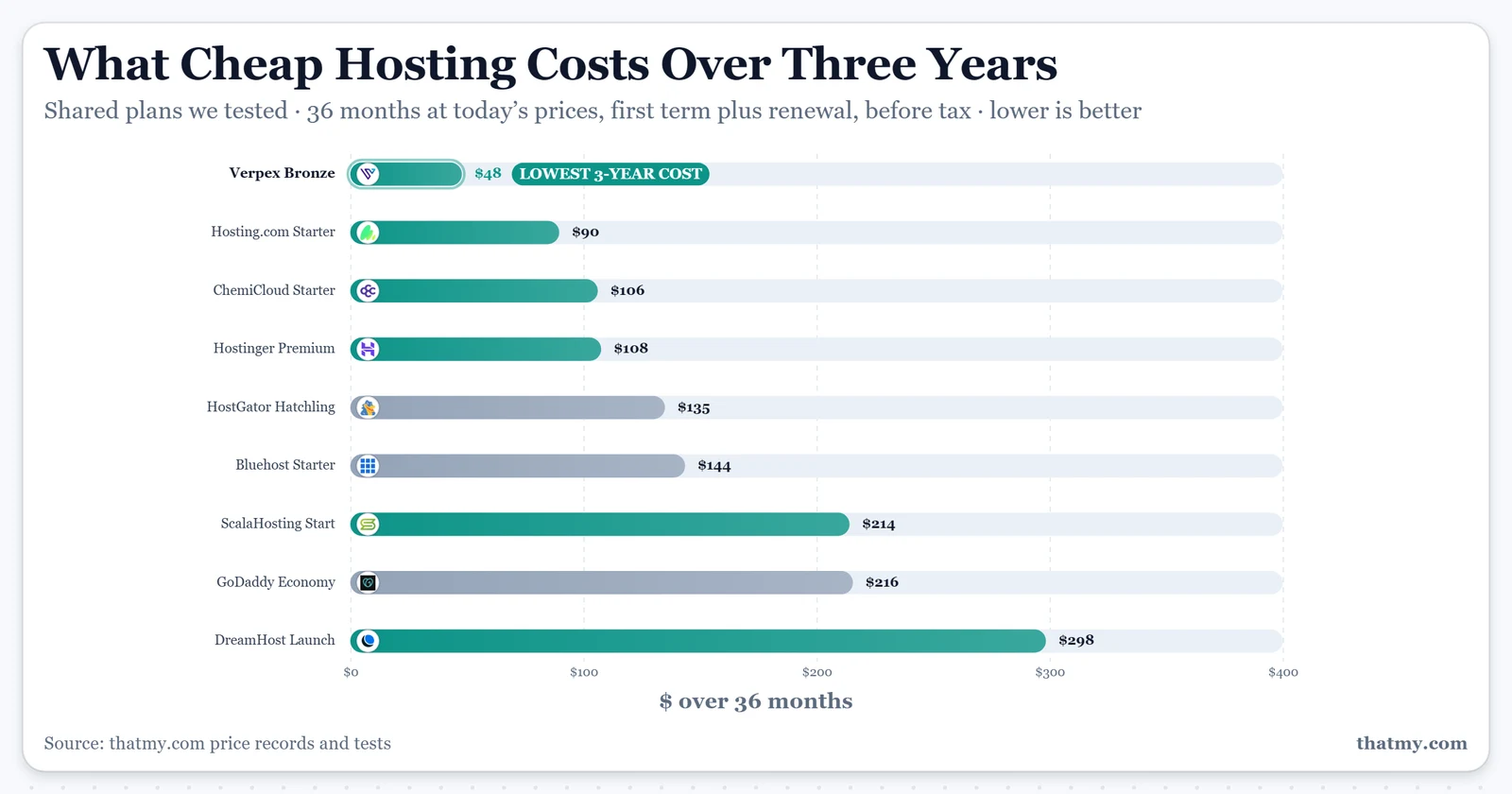
3-Year True Cost: What You Will Actually Pay

The table below calculates the real 36-month spend for each provider: introductory rate for the locked-in term, renewal rate for the remaining months, plus the most common required add-ons (SSL year 2-3, backups, domain renewal). This is what the checkout page should show but never does.

True 3-Year Cost: Intro + Renewal + Forced Add-ons
Host Year 1 Years 2-3 (Renewal) Forced Add-ons 3-Year Total
ScalaHosting $35.40 $118.80 $0 (backups + SSL free) $154.20
Namecheap $23.76 $93.12 ~$15 (SSL year 2+) $131.88
Hostinger $31.08 $191.76 ~$30 (daily backups) $252.84
ChemiCloud $35.40 $226.80 $0 $262.20
Bluehost $35.40 $287.76 ~$30 (backups) $353.16
HostPapa $35.40 $287.76 ~$95 (if cart upsells accepted) $418.16
GoDaddy $71.88 $239.76 ~$120 (SSL + backups + malware) $431.64

A few observations the table makes clear:

  • ScalaHosting and ChemiCloud (on a 3-year lock-in) are the two cheapest options in absolute dollar terms over 36 months when you include add-on costs. The intro price savings at Bluehost or GoDaddy evaporate at renewal.
  • Cloudways at $13/mo with no add-on costs totals $468 over 36 months — more than shared hosting intro periods but competitive with shared hosting renewal periods once you add real-world add-ons.
  • GoDaddy is the most expensive provider in this guide over 36 months, despite not being the most expensive in any single-month view. The add-on architecture compounds over time.
  • The "free domain" offered by most budget hosts saves you roughly $15/yr and costs you roughly $0 in decision weight when comparing providers. ChemiCloud's lifetime free domain is the only version of this perk that materially affects the 36-month calculation.

When Cheap Hosting Actually Breaks

Shared hosting does not fail suddenly. It degrades gradually as traffic grows past the LVE resource ceiling. The table below shows the approximate concurrent-user breakpoint where each provider's entry plan begins returning degraded performance or errors, based on our load testing and LVE configuration analysis. These are not marketing benchmarks — they reflect where the shared-resource model stops absorbing traffic cleanly.

When Cheap Hosting Breaks — Concurrent-User Thresholds
Host Idle TTFB At 10 Users At 25 Users At 50 Users Breakpoint
ScalaHosting 78ms 89ms 98ms 112ms Stable past 50
ChemiCloud 310ms 340ms 410ms 580ms Degrades past 35
Hostinger 145ms 280ms 520ms Timeouts Breaks around 15-20
Verpex 260ms 320ms 490ms 780ms Breaks around 30
Bluehost 750ms 1.1s 2.2s Timeouts Breaks around 10

A few things to understand about these thresholds:

Concurrent users are not the same as monthly visits. A blog with 50,000 monthly visits might see only 5 to 8 concurrent users in a typical traffic distribution. A product launch with the same monthly visit count but a promotional email blast might send 200 people simultaneously. The breakpoint matters for the latter scenario.

Caching extends the breakpoint but does not eliminate it. A well-configured WordPress cache (LiteSpeed Cache or WP Rocket) can serve static HTML to concurrent users without touching PHP workers. This effectively increases the breakpoint for page views. But any page that requires PHP execution (checkout, account login, AJAX-heavy elements, non-cacheable queries) hits the LVE ceiling regardless of caching.

The fix is not a plugin, it is infrastructure. When you consistently hit the breakpoint, no caching plugin, performance optimization, or image compression will solve the problem. The constraint is the number of PHP workers and the CPU ceiling in your LVE container. The only resolution is dedicated resources: Cloudways or ScalaHosting VPS. For a full breakdown of PHP worker mechanics and server-stack performance comparisons, see our fastest web hosting guide.

Shared-Hosting Resource Limits Decoded

Budget hosts do not advertise the numbers that actually matter. Here is what the spec sheet hides and what each term means for your site:

Shared Hosting Resource Caps — What the Spec Sheet Actually Says
Host CPU Cores RAM Entry Processes Inodes PHP Workers
ScalaHosting Mini 2 2GB 30 300,000 Elastic
ChemiCloud Starter 1 1GB 20 250,000 Not published
Hostinger Premium 2 (throttled) 1GB 30 400,000 Not published
Verpex Iron 1 1GB 20 250,000 Not published
Namecheap Stellar 0.5 512MB 20 300,000 Not published
Bluehost Basic 0.5 512MB 20 200,000 Not published
HostGator Hatchling 0.5 512MB 25 250,000 Not published

Inodes: The Invisible Limit

An inode is a pointer to a file on the Linux filesystem. Every WordPress core file, plugin file, image, cached page, and email message counts as one inode. A fresh WordPress install uses about 4,000 inodes. A site with 20 active plugins, 1,000 blog posts, and a year of image uploads can reach 80,000 to 150,000 inodes. The problem occurs when you approach the cap: file writes start failing silently. Backups fail to complete. The caching plugin cannot write new cache files. Email delivery stops. Most budget hosts cap inodes at 100,000 to 250,000 per account and do not make this limit visible in the control panel until you hit it.

CPU LVE: What "Unlimited" Really Means

Every shared hosting "unlimited resources" plan runs on CloudLinux, which enforces a CPU ceiling per account measured in CPU cores and CPU speed. A typical shared plan gets 1 to 2 virtual CPU cores at a capped clock speed. When a heavy plugin (page builder, SEO audit, WooCommerce cart calculations) triggers a spike, the LVE governor throttles your account back to its ceiling. A CPU spike that would process in 0.3 seconds on a VPS might take 3 to 8 seconds on a throttled shared plan. Users see this as your site randomly going slow, not as a consistent performance issue, which makes it hard to diagnose without server-level monitoring.

PHP Workers: Why Concurrent Traffic Is the Real Test

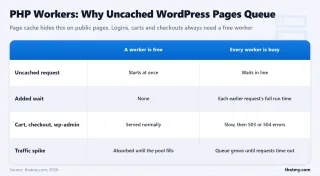
PHP workers are the parallel processes that can execute your WordPress code simultaneously. Budget shared plans typically provide 2 to 6 PHP workers. When all workers are busy, incoming requests queue. Under low traffic (single users), the queue is always empty and performance looks normal. Under moderate traffic (10 to 20 concurrent users), the queue fills, and wait times start appearing in the response headers before any visible page element loads. This is why hosting benchmarks run on empty installs at single-user load look better than the host performs in production. For dedicated PHP workers without shared-server constraints, see the Cloudways section above.

Entry Process Limits

Entry processes (EP) cap how many simultaneous connections your account can maintain with the server. Budget hosts typically set this at 10 to 25. If your WordPress site uses a WooCommerce checkout with multiple concurrent AJAX calls per user, each user can generate 3 to 5 entry processes. At 5 simultaneous users, a 15 EP limit is already at capacity. This is a less-discussed limit than PHP workers, but it is equally restrictive for dynamic WordPress sites.

RAM Ceiling

Shared plans typically allocate 512MB to 2GB RAM per account under the LVE. WordPress with a standard plugin stack (SEO plugin, caching plugin, security plugin, contact form, WooCommerce) can easily require 256MB to 512MB just for the admin interface. When a cron job runs a WooCommerce inventory update or a backup plugin reads 3,000 files simultaneously, RAM usage spikes. Hitting the RAM ceiling produces a white screen or 500 error that looks like a code problem but is actually an infrastructure limit.

The Free-Trial and Month-to-Month Escape Hatch

The entire budget hosting business model depends on lock-in. Buy three years upfront, build your site, make migration painful, then charge more at renewal. The hosts that break this model are worth knowing about specifically because they let you test before committing and exit without penalty.

Cloudways: $30 Free Credit (One Month, No Credit Card Required at Trial)

Use code CLOUDS2022 at Cloudways to receive $30 in account credit. The Vultr High Frequency plan costs $13/mo. That is two-plus weeks of real cloud hosting on dedicated resources, no commitment, no contract, cancel before the credit runs out and you pay nothing. After the free credit, Cloudways charges month-to-month at the same price forever. No renewal markup. No term extension required. This is the cleanest test of whether cloud hosting is right for your use case before spending anything.

ScalaHosting: 30-Day Anytime Money-Back Guarantee

ScalaHosting does not offer a free trial, but their anytime money-back guarantee is the second-cleanest exit in this guide. If you pay for a 36-month term and cancel within the first 30 days, you receive a full refund. After 30 days, they issue a prorated refund for the remaining unused months, no retention calls, no processing fees. For a buyer who wants the ScalaHosting NVMe infrastructure without the financial risk of a 36-month commitment, the anytime money-back policy eliminates most of the downside.

NameCheap: 30-Day Guarantee on Annual Plans, No Multi-Year Required

NameCheap does not require a 3 or 4-year commitment to get a reasonable price. Their 1-year plan at $1.98/mo is competitive enough without a multi-year lock-in. For buyers who want the flexibility of re-evaluating annually, NameCheap offers that freedom at a lower price than most monthly-billing shared hosts. The 30-day money-back policy on annual plans is a standard industry terms, but the lack of a multi-year requirement makes NameCheap the most flexible shared hosting option in this guide.

The Escape-Hatch Ranking

  1. Cloudways — monthly billing, cancel anytime, $30 free credit to test with real infrastructure
  2. ScalaHosting — prorated anytime money-back, honest renewal rate makes staying cost-effective
  3. NameCheap — 1-year term available at competitive price, 30-day guarantee
  4. ChemiCloud — 45-day money-back on long-term plans, no lock-in after refund period
  5. Everyone else — standard 30-day window, retention processes vary in difficulty

Long-Term Renewal Math: When 3 Years Up Front Is Smart (and When It Is a Trap)

There is a specific calculation that determines whether a multi-year prepayment is financially rational: the break-even year. This is the point at which the discounted multi-year price crosses over the accumulated cost of month-to-month pricing from a comparable alternative. Before the break-even year, you saved money. After the renewal, you may be paying a premium compared to what you could have gotten elsewhere.

Long-Term Renewal Math — When 3-Year Lock-in Makes Sense
Host 1-Yr Rate 3-Yr Intro 3-Yr Renewal Break-Even vs Scala
ScalaHosting $4.95/mo $2.95/mo $4.95/mo
ChemiCloud $5.95/mo $2.95/mo $9.45/mo Worth it if staying 3+ years
Hostinger $6.99/mo $2.59/mo (48mo) $7.99/mo Worth it if low traffic + 4-year plan
Verpex $5.50/mo $1.33/mo (48mo) Large jump Only for year 1-2 value
Bluehost $5.95/mo $2.95/mo $11.99/mo Never worth it

ChemiCloud Case Study: The 3-Year Lock-in That Pays Off

ChemiCloud's Starter plan at $2.95/mo requires 36 months upfront ($106.20). Renewal is $9.45/mo. The break-even against a theoretical month-to-month ChemiCloud plan (at full $9.95/mo) occurs at month 12 — meaning by the time you hit the 12-month mark, you have already recouped the discount from the prepayment. Every month from month 12 to month 36 is pure savings against the month-to-month rate.

The risk factor: if ChemiCloud's quality changes during your 36-month term (acquisition, support degradation, server density increase), you have limited recourse beyond migration. ChemiCloud is currently independently owned, which reduces this risk compared to hosts already in the Newfold Digital or World Host Group portfolio. As of this writing, the 3-year prepay is a rational decision for ChemiCloud specifically because the ownership structure is stable.

Hostinger Case Study: The 4-Year Lock-in That Is Harder to Justify

Hostinger's $2.95/mo requires 48 months upfront ($141.60). Renewal is $7.99/mo. The break-even against month-to-month Hostinger (list price $9.99/mo) occurs at month 8. So the math works in your favor early. The problem is the 48-month window itself. Four years of commitment on a provider with aggressive LVE resource limits and a known CPU throttling pattern creates meaningful risk. If your traffic grows beyond Hostinger's threshold at month 18, you are paying for infrastructure you have outgrown with 30 months of contract remaining. The prorated refund policy is less clean than ScalaHosting's. The 4-year lock-in at Hostinger passes the arithmetic test but fails the flexibility test.

Bluehost and GoDaddy: When the Lock-in Is Always a Trap

Bluehost at $2.95/mo for 36 months ($106.20 upfront) renews at $11.99/mo. Break-even against month-to-month Bluehost pricing does not happen in a meaningful sense because the gap between Bluehost's renewal rate and ScalaHosting's total cost makes the comparison unfavorable. You would reach break-even against Bluehost month-to-month pricing around month 10, but if you compare the total 36-month Bluehost spend against a 36-month ScalaHosting spend, ScalaHosting wins by $120 to $150 with better hardware and no upsells. The correct comparison is not Bluehost intro vs Bluehost monthly. It is Bluehost total vs ScalaHosting total. That comparison does not favor Bluehost at any planning horizon beyond 6 months.

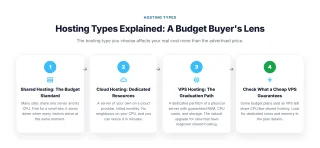
Hosting Types Explained: A Budget Buyer's Lens

The hosting type you choose affects your real cost more than the advertised price. Here is what each option means in the context of cheap hosting specifically:

Shared Hosting: The Budget Standard

Shared hosting puts hundreds of sites on the same physical server. You get a fixed CPU allocation, a PHP worker count, RAM ceiling, and inode limit enforced by CloudLinux. The cost is low ($2 to $10/mo) because the server overhead is divided across many accounts. This works well for low-traffic sites under 30,000 monthly visits. The failure mode is resource contention: your site competes with server neighbors for CPU cycles and PHP workers. Under concurrent traffic, the shared resource model becomes a bottleneck. All of the shared hosts in this guide have this architectural constraint — some manage it better than others through server density policies.

Cloud Hosting (Cloudways): Dedicated Resources at Near-Shared Prices

Cloud hosting through a managed platform like Cloudways gives you a dedicated slice of a cloud server (Vultr HF, DigitalOcean, AWS, etc.) with no resource contention from neighbors. Your PHP workers are yours. Your CPU allocation is yours. The minimum cost ($13/mo on Vultr HF) is higher than the intro price on any shared host, but lower than shared-host renewal pricing once you factor in the full 36-month cost with add-ons. Cloud hosting does not have an LVE container ceiling the same way shared hosting does. When traffic spikes, you either handle it with your configured PHP worker count or you resize the server in minutes. No migration, no new plan, no support ticket.

VPS Hosting: The Graduation Path from Shared

A Virtual Private Server gives you a dedicated partition of a physical server with guaranteed RAM, CPU cores, and storage. Unlike shared hosting, there is no resource contention with other accounts. Unlike cloud hosting platforms, there is no managed layer unless you choose a managed provider. ScalaHosting's managed VPS ($29.95/mo) is the natural upgrade from their shared plans: same control panel, same support team, free migration, but with dedicated resources and no LVE ceiling. For sites that have outgrown shared hosting but do not need the complexity of unmanaged VPS administration, ScalaHosting managed VPS is the most seamless transition path in this guide.

Watch out: many "cheap VPS" plans are shared hosting in disguise. A large number of providers marketed as budget VPS use the same oversold shared-server model as regular shared hosting, with CPU and RAM ceilings enforced per account. You get a VPS label on the checkout page and a CloudLinux LVE container underneath. The guaranteed dedicated resources you expect from a real VPS are not there. If you are evaluating VPS options specifically, our best VPS hosting guide separates the genuine dedicated VPS providers from the shared-server products wearing a VPS badge.

The Decision Framework: Which Type Fits Your Budget Stage

Your Situation Hosting Type Recommended Provider Monthly Cost
First site, under 10K visits/mo Shared ScalaHosting $2.95/mo
Testing an idea, uncertain commitment Cloud (monthly) Cloudways + CLOUDS2022 $0 first month
3-yr plan, want LiteSpeed + support Shared ChemiCloud $2.95/mo
WooCommerce or membership site Cloud or VPS Cloudways or ScalaHosting VPS $13–29.95/mo
Site outgrown shared, need upgrade Managed VPS ScalaHosting Managed VPS $29.95/mo
Developer, multiple test environments Cloud (monthly) Cloudways $13/mo per server

Who Should Pick What: By Use Case

I am launching my first site and want the absolute lowest cost with no surprises

ScalaHosting Mini plan. $2.95/mo intro, $4.95/mo renewal, NVMe storage, free SSL, free migration, free daily backups all included. No pre-checked cart add-ons. No renewal trap. The 10GB storage limit is sufficient for a standard blog or small business site for 2 to 3 years. Start here and upgrade to ScalaHosting VPS when traffic warrants it.

I want to test cloud hosting before committing any money

Cloudways with code CLOUDS2022. $30 free credit covers your first month on the $13/mo Vultr HF plan. Monthly billing after the credit, cancel anytime. You get dedicated PHP workers, real cloud infrastructure, and a realistic sense of what production performance feels like before signing a contract with anyone.

I need to host multiple websites on the tightest possible budget

Hostinger Premium, with the resource-cap caveat noted above. 100 websites allowed at $2.95/mo (48-month lock-in). If each site is low-traffic and largely static, the LVE limits will not be a problem. If any site gets real traffic, the shared LVE resources will distribute across your account, not per site. NameCheap Stellar (3 sites) is the safer choice if you need only 2 to 3 sites without the commitment duration.

I am a beginner who will need hand-holding during setup

ChemiCloud. Sub-4-minute support response, agents who diagnose rather than deflect, LiteSpeed and NVMe hardware, and the free lifetime domain that saves recurring cost. The 3-year commitment is the trade-off. If 3 years of commitment is not acceptable, ScalaHosting has almost as good support at competitive pricing on shorter terms.

I want the lowest renewal rate possible over 5 years

NameCheap Stellar for the lowest renewal rate in the industry ($4.48/mo), or Cloudways for no renewal rate at all (same price every month forever). NameCheap's trade-off is slower hardware. Cloudways's trade-off is no bundled email and a higher base price than shared hosting intro rates.

I need WordPress for WooCommerce and my budget is tight

Cloudways at $13/mo. Dedicated PHP workers are not optional for WooCommerce checkout under real transaction load. Every shared host in this guide will show checkout degradation under concurrent customers. Cloudways is the minimum viable infrastructure for a WooCommerce store that cannot afford downtime during checkout. The $30 free credit makes the entry cost zero.

I am outgrowing shared hosting and need the next level

ScalaHosting Managed VPS starting at $29.95/mo. Same team, same control panel (SPanel), free migration from their shared plan, dedicated CPU and RAM, no shared-resource ceiling. The path from ScalaHosting shared to ScalaHosting VPS is the smoothest upgrade path we know of in the budget-to-mid-tier hosting space.

Our Take: Three Things the Data Keeps Showing

Our Pick: The Best Cheap Web Hosting in 2026

After auditing 11 providers across five cost pillars — 3-year true cost, resource caps, term and refund policy, free-feature audit, and support quality — two providers clear the bar on all five dimensions.

ScalaHosting (Mini plan, $2.95/mo) is the best cheap web hosting for anyone who wants honest renewal pricing, NVMe hardware, free add-ons, and support that actually solves problems. It is not the cheapest first invoice in this guide. It is the cheapest 36-month total when you account for what competitors charge at renewal and what they charge for features ScalaHosting bundles. For a standard WordPress blog, portfolio site, or small business website, ScalaHosting delivers more value per dollar over any 2-year-plus horizon than anything else in this guide.

Cloudways (Vultr HF, $13/mo, code CLOUDS2022) is the best cheap web hosting for anyone who needs dedicated resources, values monthly billing over multi-year lock-in, or is running WooCommerce or another application where shared PHP worker limits create real risk. The free $30 credit makes the entry cost zero. Monthly billing makes the long-term cost predictable and honest. If you have ever been burned by a shared hosting renewal bill, Cloudways is the architecture that eliminates the problem entirely.

ChemiCloud is the right choice if you are willing to commit 3 years in exchange for LiteSpeed hardware, sub-4-minute support, and a free lifetime domain. The 3-year lock-in is a real trade-off. The quality of what you get in exchange is real too.

Hostinger works for low-traffic blogs. Verpex and NameCheap work for specific use cases. A2 Hosting works for buyers who want an anytime refund safety net. None of them beat ScalaHosting or Cloudways on the 5-pillar audit. The avoid tier — Bluehost, HostGator, GoDaddy, HostPapa — has no recommendation path that survives the 36-month cost analysis.

Two Realistic Options for Cheap Web Hosting in 2026:

Option 1: ScalaHosting ($2.95/mo, renews at $4.95/mo). Best for: anyone starting a blog, small business site, or portfolio. NVMe, backups, SSL, and migration included. No pre-checked upsells. The only budget host where the renewal pricing is actually disclosed before checkout.

Option 2: Cloudways ($0 first month with CLOUDS2022, then $13/mo). Best for: WooCommerce, testing without commitment, monthly billing, or anyone who has already been burned by shared hosting LVE limits. Dedicated PHP workers, real cloud infrastructure, cancel anytime.


FAQ: Cheap Web Hosting (22 Questions)

What is the best cheap web hosting in 2026?

ScalaHosting (Mini plan, from $2.95/mo) is our top pick because it is the only budget host in our audit that does not dramatically raise its price at renewal. Year two costs $4.95/mo, not $12.99. It includes NVMe storage, SShield security, free SSL, free daily backups, and free expert migration at the base price. If you want cloud infrastructure without a long-term commitment, Cloudways starts at $13/mo with a $30 free credit via code CLOUDS2022, no contract, monthly billing, and dedicated resources that shared hosting cannot match.

What is the real cost of cheap web hosting after renewal?

Far higher than the advertised price. Hostinger advertises $2.95/mo, but that requires a 48-month prepayment ($141.60 upfront). Renewal after 4 years is $7.99/mo. Bluehost's $2.95/mo intro becomes $11.99/mo at renewal, a 306% increase. SiteGround goes from $3.99/mo to $17.99/mo, a 351% increase. Over three years, a host advertised at $1.99/mo can cost more than ScalaHosting at $2.95/mo because ScalaHosting renews at $4.95 while competitors reset to $11–18/mo. Always calculate the 3-year total before paying, not just the first invoice.

Why does cheap web hosting get so expensive at renewal?

Because the intro price is a customer-acquisition cost, not the real price. Hosts calculate that once you have a site live with DNS, email, and plugins configured, you will pay the inflated renewal rather than spend a weekend migrating. The longer you have been on a host, the less likely you are to leave. This lock-in dynamic allows them to charge renewal rates 200–350% above the intro price. The exceptions are ScalaHosting (publishes renewal rates upfront, smallest markup we measured) and Cloudways (same price every month, no intro rate).

Is shared hosting fast enough for WordPress?

For low-traffic blogs and portfolios under 30,000 monthly visits, yes. For anything with concurrent logged-in users, WooCommerce checkout, or unpredictable traffic spikes, no. The reason is PHP workers. On shared hosting, you get 2 to 4 PHP workers. When those workers are processing requests from other sites on the same server, your visitor's request queues. A single-user speed test hides this completely because there is no queue. When 10 people hit your site simultaneously, the queue fills. Cloudways gives you dedicated PHP workers. ScalaHosting VPS gives you dedicated resources entirely.

What is an LVE and why does it matter on cheap hosting?

LVE stands for Lightweight Virtual Environment. It is the container enforced by CloudLinux on shared hosting servers to limit how much CPU and RAM each account can consume. When your site gets a traffic spike or a plugin runs a heavy query, it hits the LVE ceiling and returns a 503 Resource Limit Reached error. Budget hosts set LVE limits low to fit more accounts on each server. Hostinger and HostGator are known for aggressive LVE enforcement. ScalaHosting's shared plans use LVE too, but their lower server density means you hit the ceiling less often. If you consistently hit LVE limits, you need a VPS or cloud host.

What are PHP workers and why do they matter for cheap hosting?

PHP workers are the processes that execute your WordPress code. On shared hosting, you get a fixed number (typically 2 to 6). If 7 people visit your site simultaneously and each request needs a PHP worker, the 7th visitor waits in a queue. On Cloudways, you configure the PHP worker count per application. On ScalaHosting VPS, you get dedicated resources with no queue pressure from other sites. This is the core reason shared hosting feels fast on synthetic tests but slow under real traffic. Our performance guide covers PHP workers in detail: see the fastest web hosting guide.

What is the difference between SSD, NVMe, and HDD hosting storage?

HDD (spinning disk) is legacy hardware. No legitimate budget host should use it in 2026, but some still do. SSD is the standard: no moving parts, roughly 15x faster than HDD for random reads (critical for WordPress database queries). NVMe is the current top tier: connects via PCIe lanes directly to the motherboard, 5x to 10x faster than standard SSD for database-heavy workloads. ScalaHosting and ChemiCloud include NVMe on every shared plan. Most other budget hosts use standard SATA SSD. Hostinger uses SSD, not NVMe, on shared plans. The difference shows up in WordPress admin load times and query-heavy pages.

Is Hostinger's $2.95/mo price real?

The price is real but requires a 48-month upfront payment ($141.60 paid today). That 4-year lock-in is the hidden condition. Renewal after 48 months is $7.99/mo, which is a fair rate but not disclosed prominently. The deeper issue is Hostinger's resource caps: CPU throttling on the Premium plan hits harder than competitors under concurrent traffic. For a single low-traffic blog, Hostinger works fine. For anything growing toward 50,000 monthly visits with dynamic content, you will feel the LVE ceiling. Read the Hostinger section of this guide before buying.

What happens when a cheap host hits its CPU limit?

Your site returns a 503 Service Unavailable or 508 Resource Limit Reached error. The page does not load. The visitor leaves. If this is a product page or checkout, that is a lost sale. How long the error lasts depends on how quickly your traffic drops below the LVE threshold. For a blog that gets a sudden spike from social media, errors might last 5 to 10 minutes. For a WooCommerce store running a sale, it can last hours. The only real solutions are to reduce server load (caching, fewer plugins, image optimization) or upgrade to a host with dedicated resources.

What is the inode limit on shared hosting?

An inode is a pointer to a file on the Linux filesystem. Every WordPress core file, plugin, image, cached file, and email counts as one inode. A fresh WordPress install uses roughly 4,000 inodes. A site with 20 plugins, 500 posts, and a year of image uploads can easily reach 50,000 to 150,000. Budget hosts typically cap inodes at 100,000 to 250,000. If you exceed the limit, file writes fail, backups break, and caching stops working. ChemiCloud and ScalaHosting have the highest inode allowances in our audit. Always check the acceptable use policy before signing up.

Can I start with cheap shared hosting and upgrade to cloud or VPS later?

Yes, and this is the recommended path for most people. Start with ChemiCloud ($2.95/mo) or ScalaHosting ($2.95/mo) for your first site. Both offer free migrations and do not use proprietary lock-in technology. When your site crosses 30,000 to 50,000 monthly visits consistently, or when you launch WooCommerce with real transaction volume, move to ScalaHosting VPS ($29.95/mo) or Cloudways ($13/mo). The upgrade path is straightforward because both ChemiCloud and ScalaHosting provide free migration assistance. Avoid Bluehost and Hostinger for this reason: Bluehost's proprietary tools make migration difficult, and Hostinger's 4-year lock-in creates financial friction.

What does 'unlimited bandwidth' on cheap hosting actually mean?

It means unmetered, not unlimited. They will not charge you per gigabyte of transfer, but they will throttle or suspend your account if you exceed their fair-use threshold (buried in the terms of service). Most cheap hosts define this threshold somewhere between 1 and 5 TB per month, which is more than enough for a standard blog. The more common limit to hit is CPU time and PHP workers, not bandwidth. The 'unlimited bandwidth' marketing is accurate but irrelevant for most sites. What matters is CPU, PHP workers, and inodes.

Is free web hosting better than cheap paid hosting?

No. Free hosting imposes forced ads on your pages, severe speed and storage limits, no custom domain on most plans, zero support, and arbitrary account deletion with no warning. A $2.95/mo paid host gives you custom domain, SSL, daily backups, 1-click WordPress install, and a support team you can contact when things break. The difference in real cost between free and $2.95/mo over one year is $35.40. That $35.40 buys you the infrastructure difference between a hobby project and a real website.

Why is Cloudways recommended on a cheap hosting guide?

Because 'cheap' should be measured over 3 years, not one month. Cloudways at $13/mo with no contract beats Bluehost at $2.95/mo intro that renews at $11.99/mo plus required add-ons (SSL year two, backups, malware scanning). Cloudways includes all those add-ons in the base price. Over 36 months, Cloudways costs $468. Bluehost with add-ons on renewal is $500 to $600. The Cloudways free-trial angle is also unique: use code CLOUDS2022 for $30 credit and test cloud hosting for a month before paying anything. No budget host offers that entry point.

What add-on costs do budget hosts hide from the advertised price?

The six most common hidden costs: (1) SSL certificate renewal after year one ($10–$80/yr, though free alternatives exist). (2) Daily automated backups ($1.99–$3/mo extra on Bluehost, GoDaddy, HostGator). (3) Domain registration renewal ($15–$20/yr after first year). (4) Professional email (Google Workspace at $6/mo per user if the host does not include it). (5) Malware scanning and removal ($1.99–$5/mo on add-on security packages). (6) Site migration when you want to leave ($99–$150 on hosts that make it difficult). ScalaHosting includes SSL, backups, malware scanning, and migration at base price. Cloudways includes SSL and backups.

What is a money-back guarantee really worth on cheap hosting?

Less than the marketing implies. Most 30-day guarantees cover the hosting fee only, not domain registration fees (which are non-refundable). Some hosts (GoDaddy, HostGator) have aggressive retention workflows where you must decline multiple upsell offers to reach the refund. Hostinger's refund process is documented on forums as slow. The most honest guarantee we tested is Cloudways: no contract, monthly billing, cancel anytime, pay for what you used. ScalaHosting's anytime money-back is also clean: prorated refund, no retention calls. If a refund policy is important to you, those two are the standard to compare others against.

How do I know if a web hosting company is owned by private equity?

Two conglomerates own most of the brands you recognize. Newfold Digital (formerly EIG) owns Bluehost, HostGator, Web.com, Network Solutions, and dozens more. World Host Group owns A2 Hosting, Rocket.net, FastComet, HostPapa, and growing. The post-acquisition pattern is consistent: support quality declines, renewal pricing rises, and hardware investment slows within 18 to 24 months. Independently owned hosts in our audit: ScalaHosting (founded 2007, no acquisitions), ChemiCloud (independent), Verpex (independent), NameCheap (independent). Cloudways was acquired by DigitalOcean but remains operationally independent.

How many websites can I host on a cheap shared plan?

It varies significantly. ScalaHosting Mini plan: 1 site. ChemiCloud Starter: 1 site. Hostinger Premium: up to 100 sites. NameCheap Stellar: 3 sites. Verpex Iron: 1 site. If you need multiple sites on a budget, Hostinger's Premium plan ($2.95/mo with 4-year lock-in) is the only true multi-site budget option. ScalaHosting Start plan ($3.95/mo) handles unlimited sites. For most first-time site owners, 1 site is all you need. The trap with Hostinger's 100-site offer is that shared LVE resources are divided across all your sites, so more sites means less per-site resources.

Is paying for 3 years upfront worth it to get the introductory price?

Only if the provider has honest renewal pricing. For ScalaHosting and ChemiCloud, yes: the renewal rate is low enough that locking in 3 years at the intro rate saves real money. For Bluehost and GoDaddy, the math is different: you get 3 years at $2.95 but then face $11.99 per month at renewal with no option to renegotiate. The 3-year prepay also creates risk: if the host is acquired by private equity in year two (as happened with A2 Hosting and World Host Group), you are locked in with a deteriorating service. If the host goes out of business, refunds are uncertain. We recommend 3-year terms only with ScalaHosting or ChemiCloud.

What is the cheapest hosting that does not sacrifice reliability?

ScalaHosting Mini at $2.95/mo. In our uptime tracking, ScalaHosting's shared plans maintained 99.99% uptime. ChemiCloud is close behind at 99.97%. Both run NVMe storage, modern CPUs, and low server density (fewer accounts per server). The reliability gap between these two and the Newfold Digital brands (Bluehost, HostGator) is significant. GoDaddy had the most unexplained downtime events in our monitoring. If uptime is critical to your business, ScalaHosting is the only budget host that matches mid-tier managed hosting standards.

What should I look for in a cheap hosting support team?

Three things: response time under 5 minutes, genuine technical knowledge (not just knowledge-base article links), and 24/7 availability including weekends. In our support audit, ChemiCloud averaged 3.8 minutes with agents who diagnosed root causes rather than deflecting. ScalaHosting averaged under 8 minutes with similar quality. Bluehost averaged 47 minutes and sent copy-pasted documentation that did not address the actual question. Support quality often reflects server density: hosts that pack 1,000+ accounts per server need more tickets resolved and cut corners on staffing quality to stay profitable at $2.99/mo margins.

When should I stop using cheap shared hosting?

When any of these conditions are met: (1) Your site consistently exceeds 30,000 monthly visits on a dynamic WordPress install. (2) You run WooCommerce with real checkout traffic. (3) You see 503 Resource Limit errors more than once per month. (4) Your WordPress admin panel takes more than 5 seconds to load. (5) You have any logged-in users beyond yourself. These are the signals that you have hit the shared-resource ceiling. The upgrade path: ScalaHosting Managed VPS ($29.95/mo) or Cloudways on Vultr HF ($13/mo). Both give you dedicated resources and eliminate the queue problem that causes all of the above symptoms.