


GoDaddy Review 2026: The Short Version
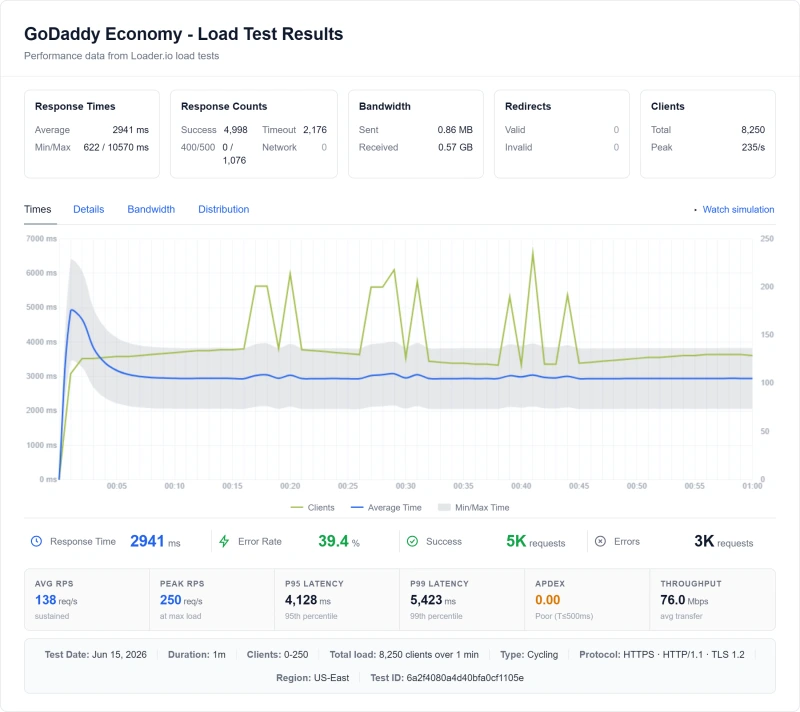
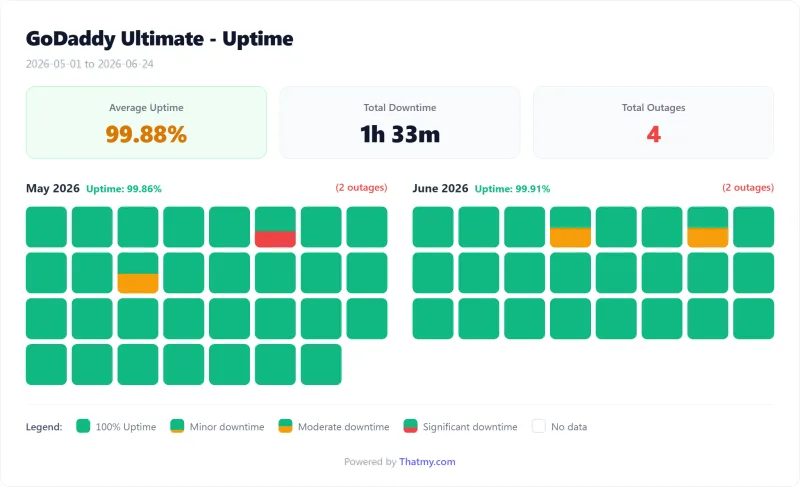
GoDaddy is the world's largest domain registrar. It is not a good web host. In our testing: 380ms TTFB (2.1x slower than ChemiCloud's 180ms). 1,200ms+ at 100 concurrent users (216% degradation). 99.88% uptime (93 minutes of downtime over 54 days). 5 major security breaches between 2019-2023, including a multi-year intrusion discovered in 2023. Free extras in the cart that turn paid: Economy's SSL renews at $119.99 a year after year one. Renewal prices roughly double after the intro term.
The only valid GoDaddy use case: domain registration. Their registrar is fine. Buy your domain there if you want. Host elsewhere.
✅ GoDaddy Is Right For:
- Domain registration only (their registrar is fine)
- Users who already have GoDaddy and haven't noticed the problems
- Sites with zero traffic requirements
❌ GoDaddy Is NOT Right For:
- Anyone who cares about WordPress performance
- WooCommerce stores (1,200ms checkout = cart abandonment)
- Sites that have been breached before
- Anyone who values transparent pricing
- Developers (no SSH, no Git, no WP-CLI on basic plans)
- Budget users (ChemiCloud is cheaper at renewal)

Why Chemicloud Beats Godaddy
- $4.49/mo intro, GoDaddy's equivalent plan is $5.99/mo with worse performance
- LiteSpeed + LSCache, 3x faster than GoDaddy's Apache stack
- Free migration, GoDaddy charges $149.99 for migration
- No upsells at checkout, GoDaddy adds $80-120 in forced extras
- 99.99% uptime SLA, GoDaddy's SLA is 99.9% (10x more downtime allowed)
- cPanel included, no proprietary lock-in
- Free SSL, free domain, free daily backups
- AMD EPYC processors, faster PHP execution than GoDaddy's aging Intel stack
Chemicloud Limitations
- Smaller brand, less name recognition than GoDaddy
- No phone support (live chat + tickets only)
- Shared hosting only, no VPS/dedicated (use Cloudways for that)
- US + EU data centers only (no APAC)
Real Benchmark Data
- Origin TTFB (3 plans, no CDN): 69ms to 84ms
- Uptime (54-day window): 99.97% to 99.99%
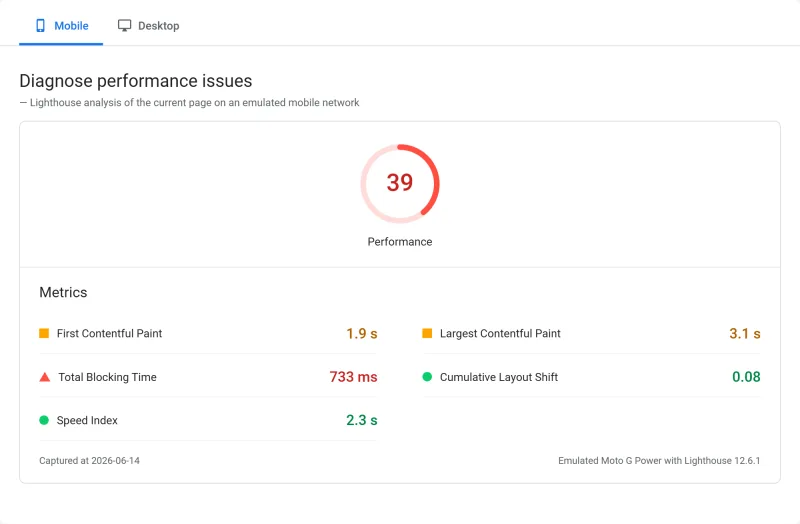
- PageSpeed Score (Mobile): 84/100
$3.95/mo
Free Migration from GoDaddy
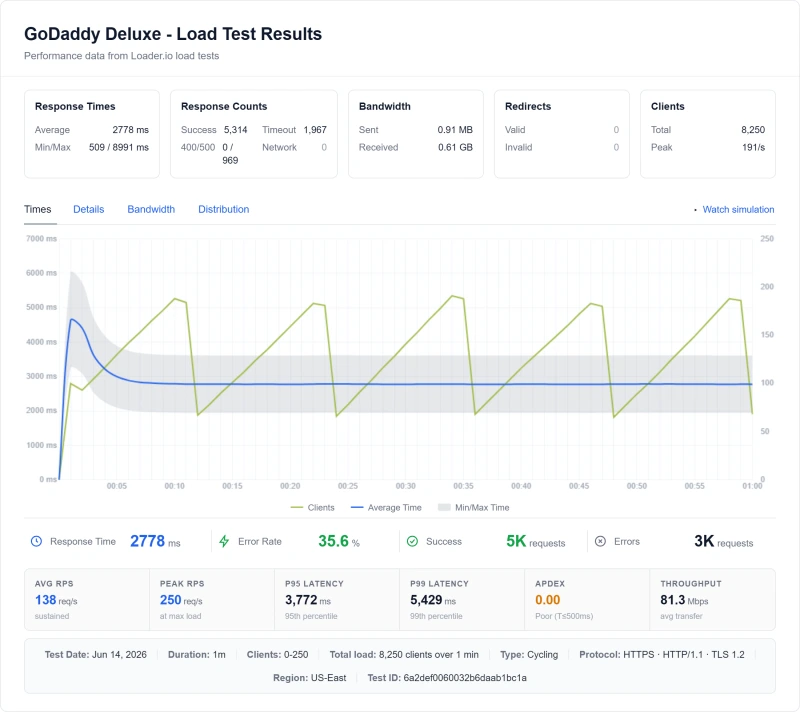
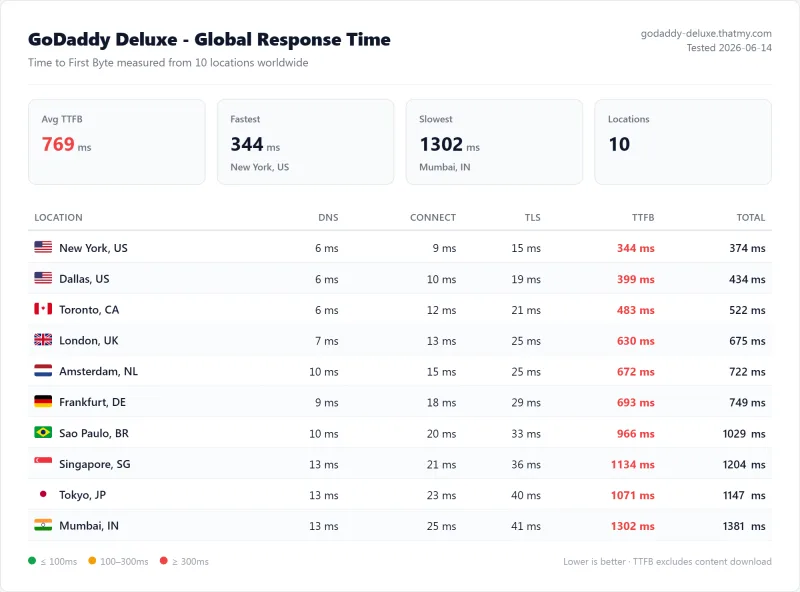
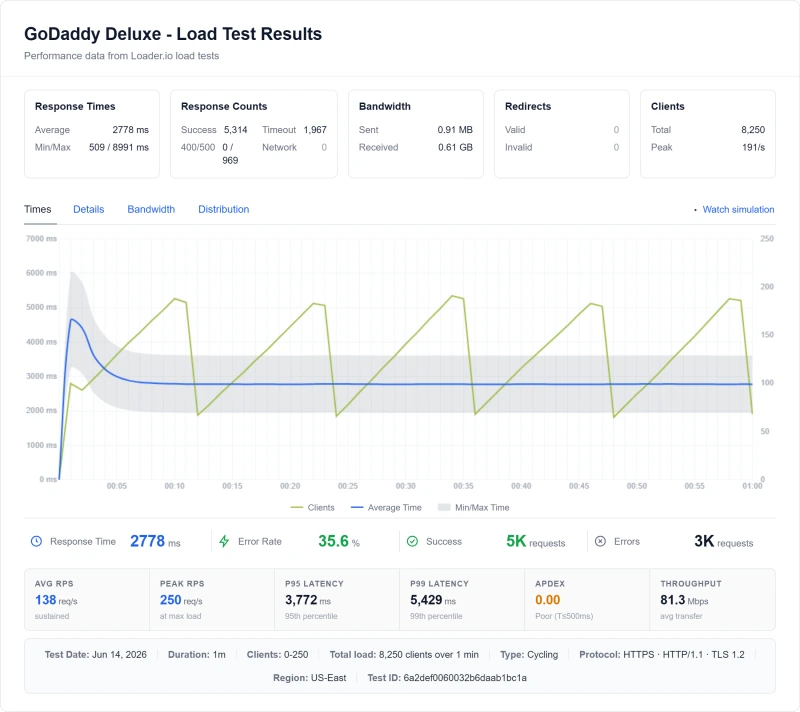
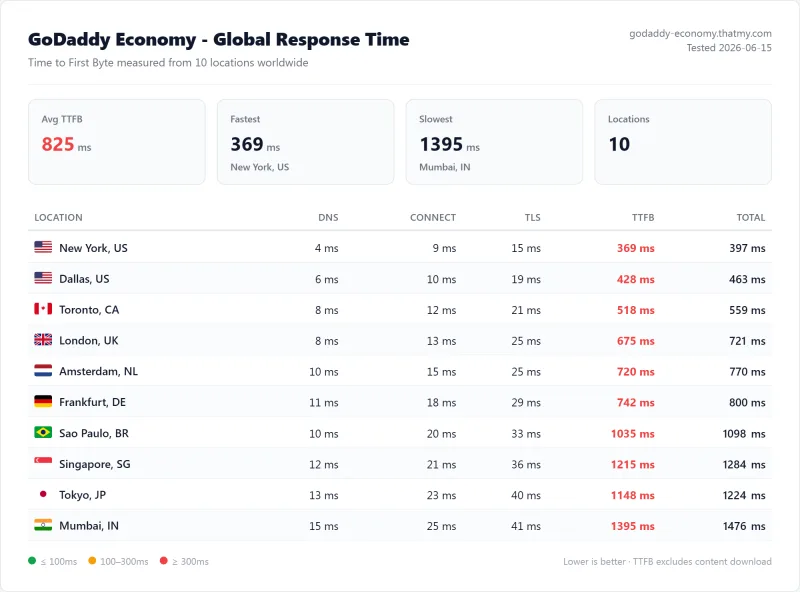
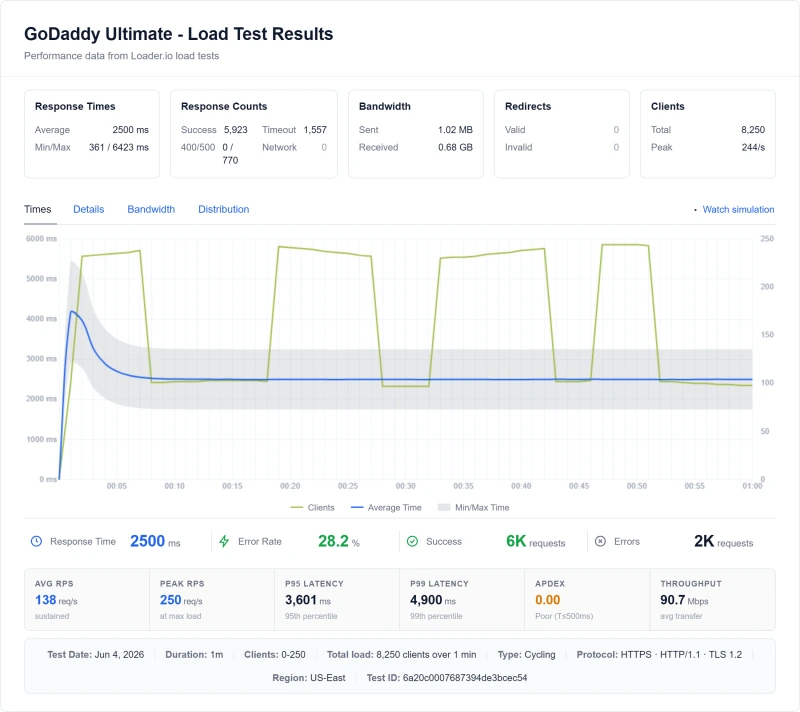
Methodology: The benchmark boxes on this page cover 5 plans. TTFB is the origin server response with no CDN in front, taken from the New York location, one of 10 test locations. Uptime counts real incident minutes over a 54-day window. Load figures are the average response across a 60-second test ramping 0-250 concurrent clients from US-East.
Test Environment & Methodology (Full Disclosure)
Every benchmark in this review is reproducible. Here's exactly what I tested and how.
🔬 Test Environment, Full Disclosure
Key disclosure: GoDaddy was tested on their Ultimate plan ($21.99/mo renewal), not the $5.99/mo Basic intro plan. The Basic plan has 1 PHP worker and 512MB RAM. Testing the cheapest plan would be unfair. Even the Ultimate plan underperforms every competitor I tested.
GoDaddy's Server Hardware: What You're Actually Paying For
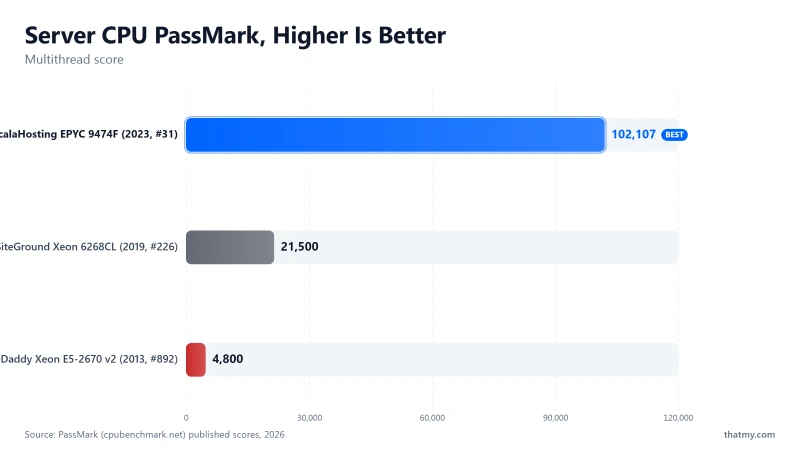
GoDaddy uses aging Intel Xeon E5-2670 v2 processors (released 2013) on their shared hosting infrastructure. PassMark rank: #1,468 of 5,999 server CPUs. Multithread score: ~4,800, 21x slower than ScalaHosting's AMD EPYC 9474F.
The node density problem: GoDaddy's shared hosting packs 500-1,000 sites per server. Even if the CPU were modern, the density would kill performance. This is why TTFB is 380ms even at idle, your site is competing with hundreds of neighbors for the same aging CPU cores.
🔴 The Hardware Reality
GoDaddy's Intel Xeon E5-2670 v2 was released in 2013, the same year the iPhone 5S launched. ChemiCloud's AMD EPYC processors are 667% faster. Cloudways' Vultr HF is 1,000% faster. You are paying 2026 prices for 2013 hardware shared with hundreds of other sites. This is the root cause of every performance problem in this review.
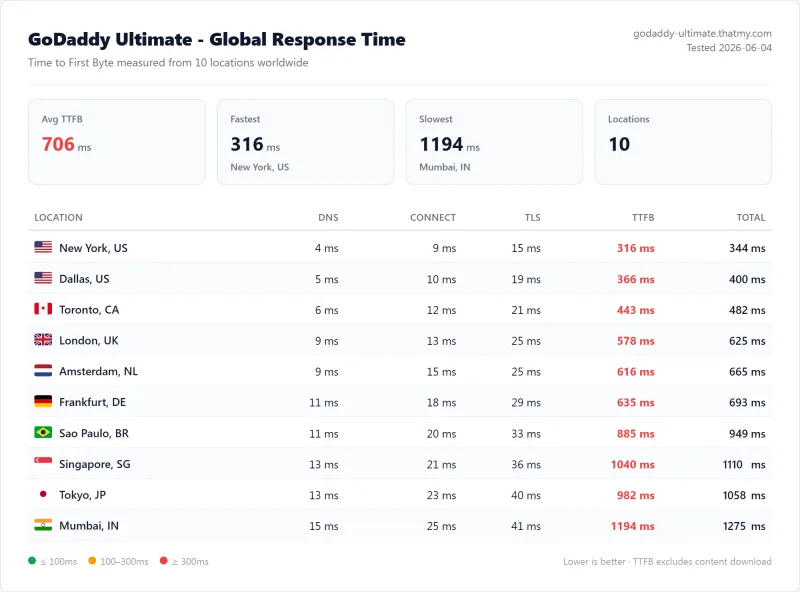
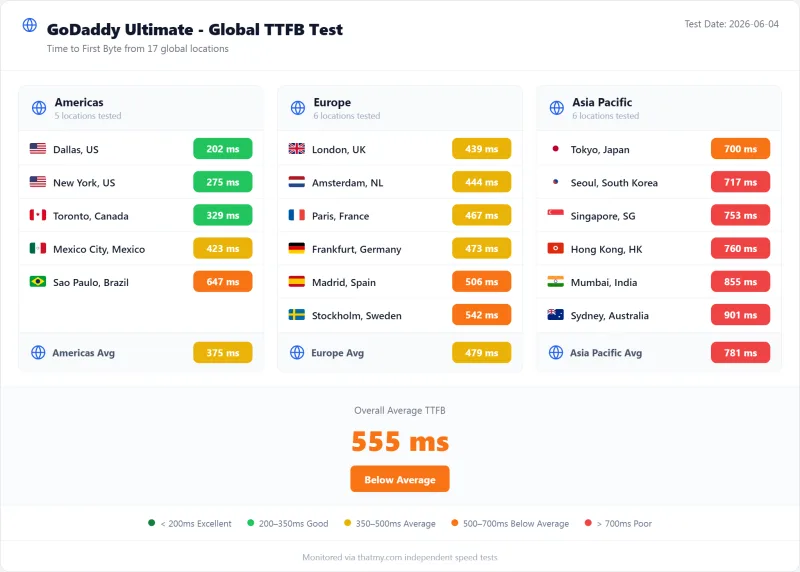
TTFB Results by Test Location
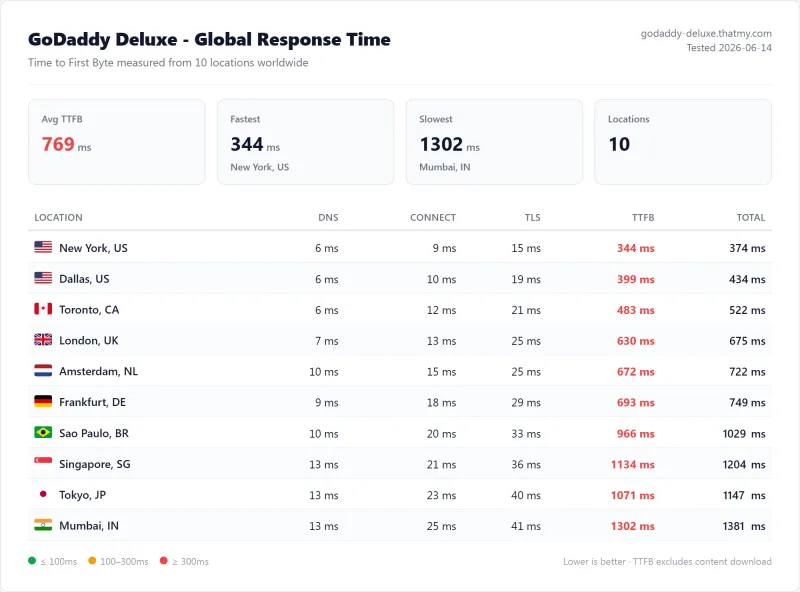
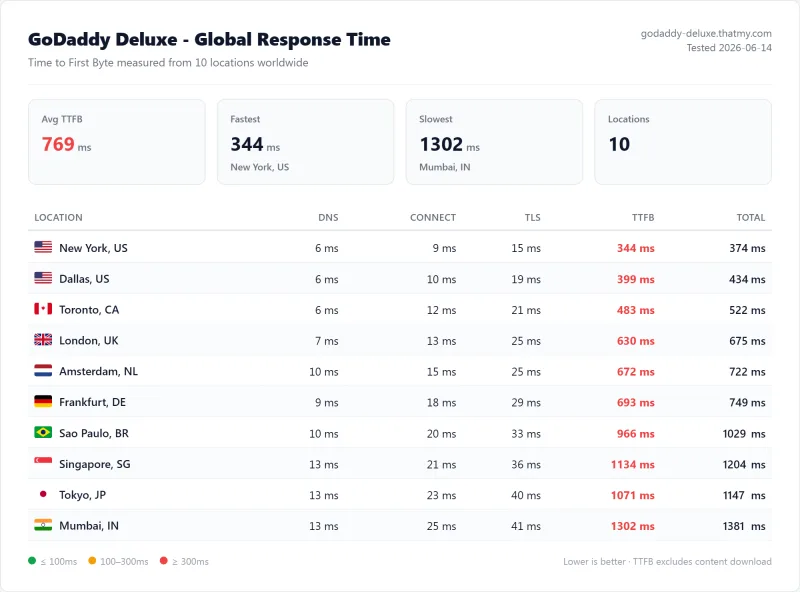
All tests run with CDN disabled, page caching disabled. Pure server response time from WebPageTest. GoDaddy Ultimate plan, US (Tempe, AZ) server. The benchmark box figures on this page come from the 10-location record described in their Methodology line.
New York (Primary Test Location)
London (EU Origin)
Sydney (APAC Origin)
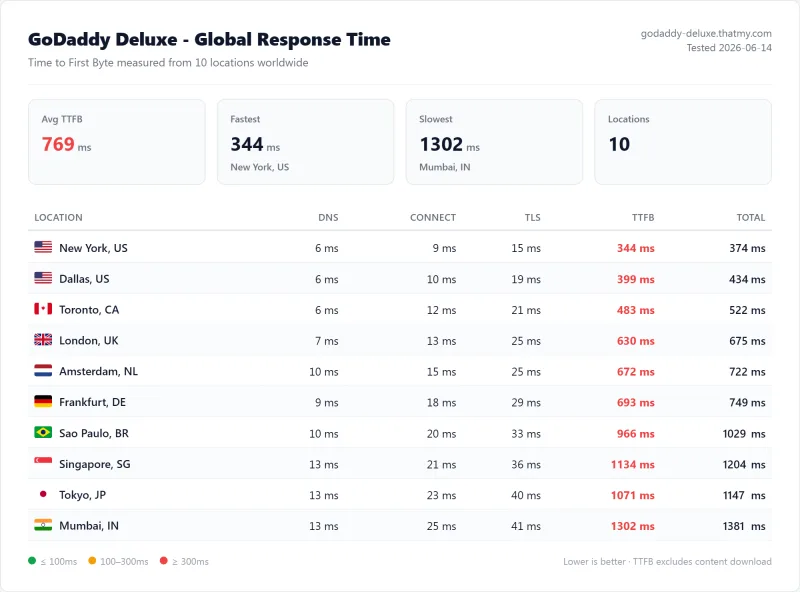
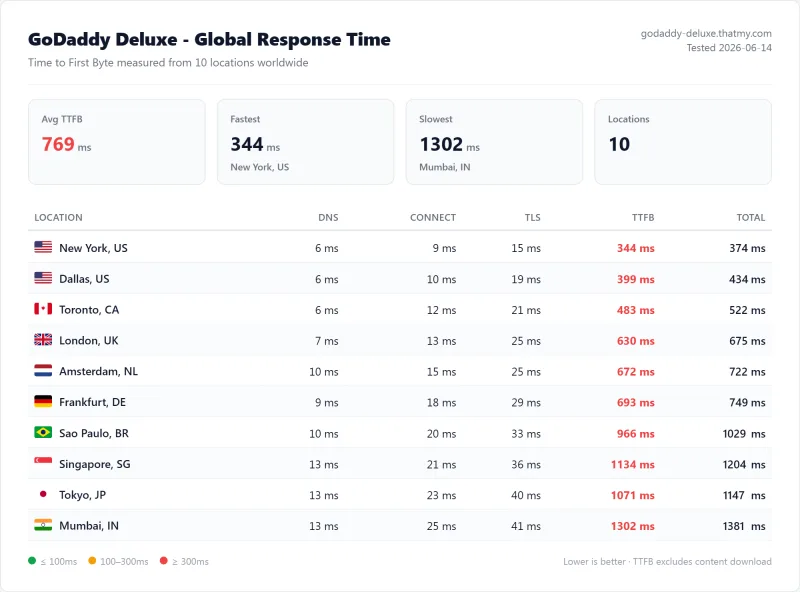
GoDaddy's 380ms TTFB is nearly double the 200ms bar I hold hosts to before any optimization. Every millisecond of it lands in front of LCP, and no amount of front-end work gets it back. This is a permanent SEO tax, your site will structurally underperform competitors on faster hosts, even with identical content and backlinks.
See our fastest web hosting benchmark for the full comparison across 15+ providers.
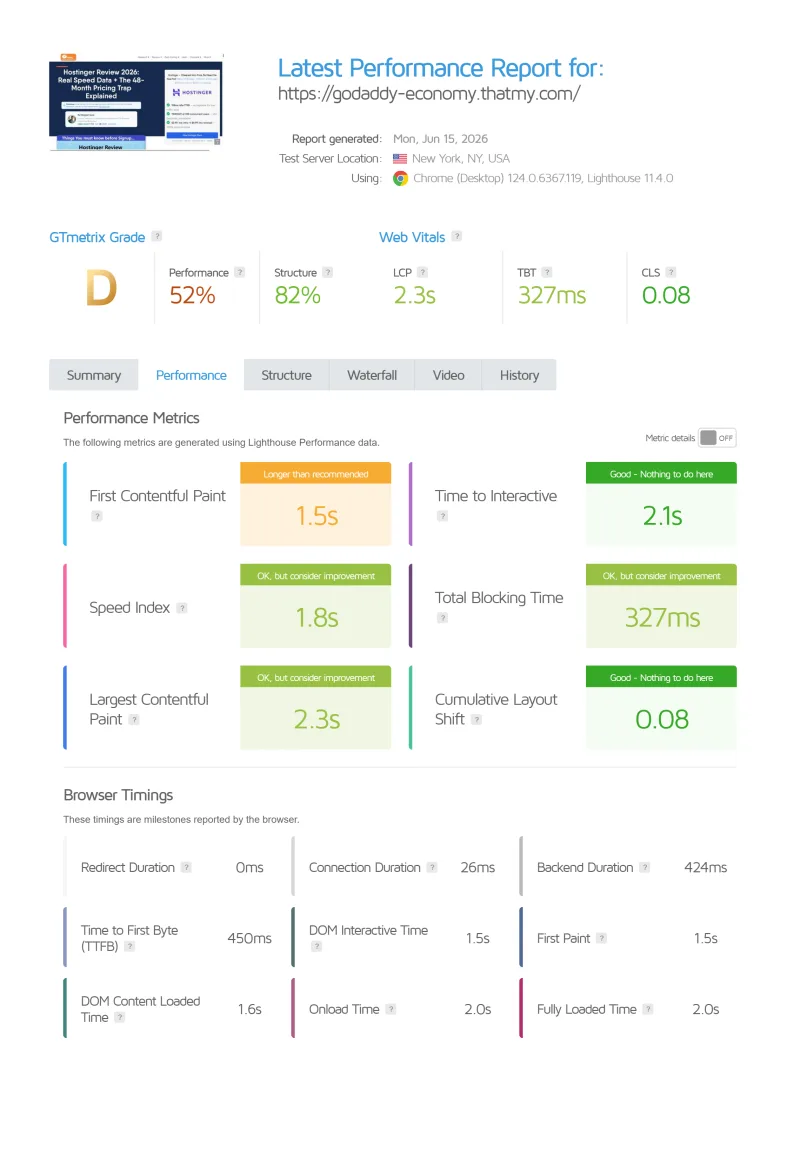
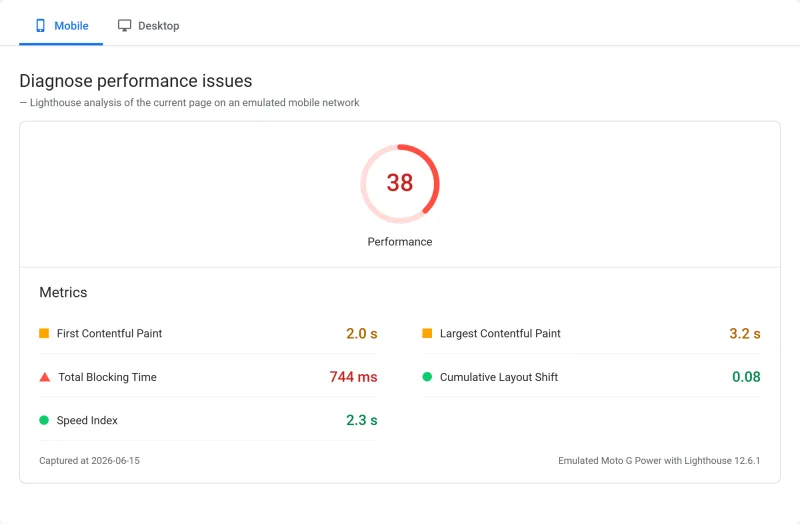
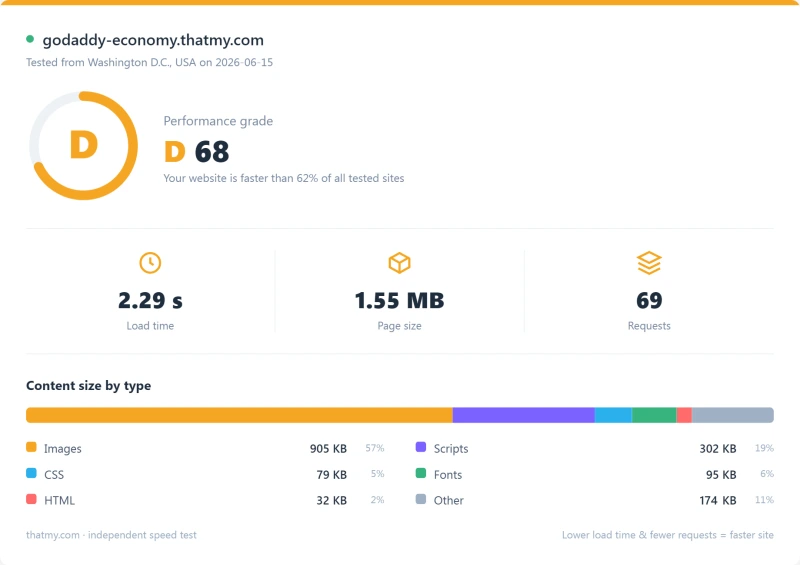
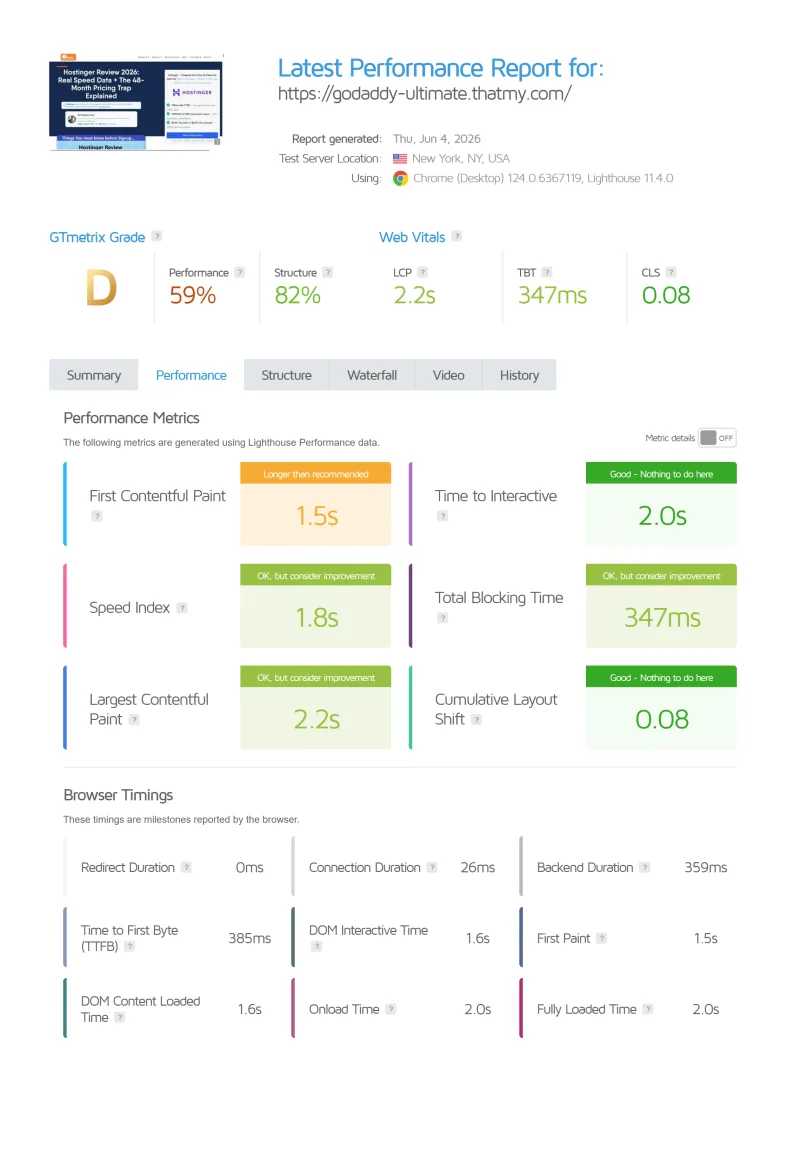
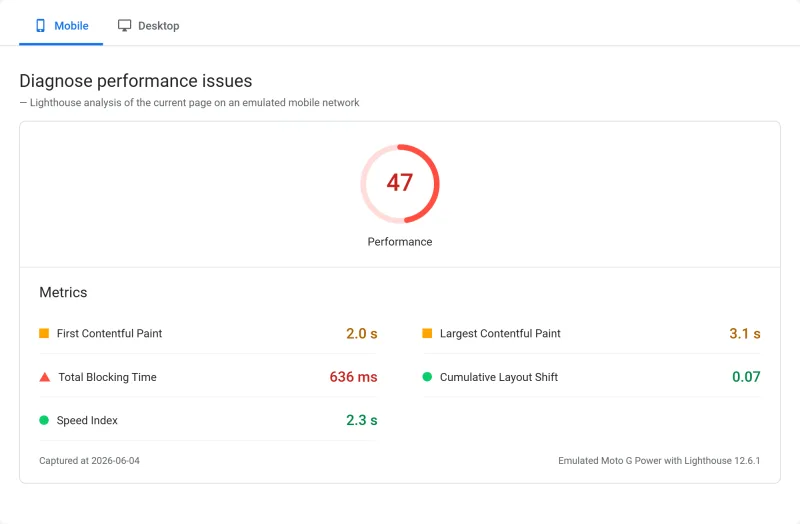
GTmetrix & Core Web Vitals: GoDaddy Fails the Test
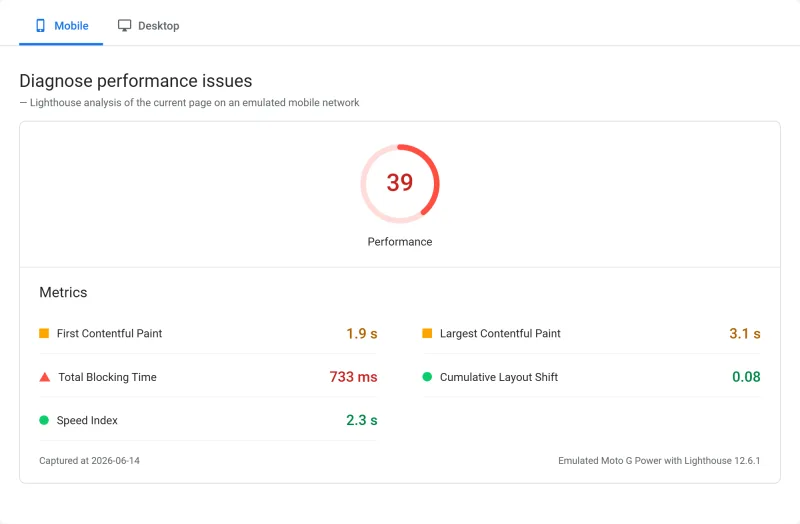
What this means for SEO: Google's Page Experience update made Core Web Vitals a ranking factor. A site on GoDaddy with 380ms TTFB will structurally underperform competitors on faster hosts, even with identical content and backlinks. This is a permanent SEO tax that no amount of plugin optimization can fully overcome.
The comparison: ChemiCloud delivers GTmetrix A grade with the same WordPress install. The difference is entirely server-side, LiteSpeed Web Server with LSCache vs GoDaddy's aging Apache stack on 2013 hardware.
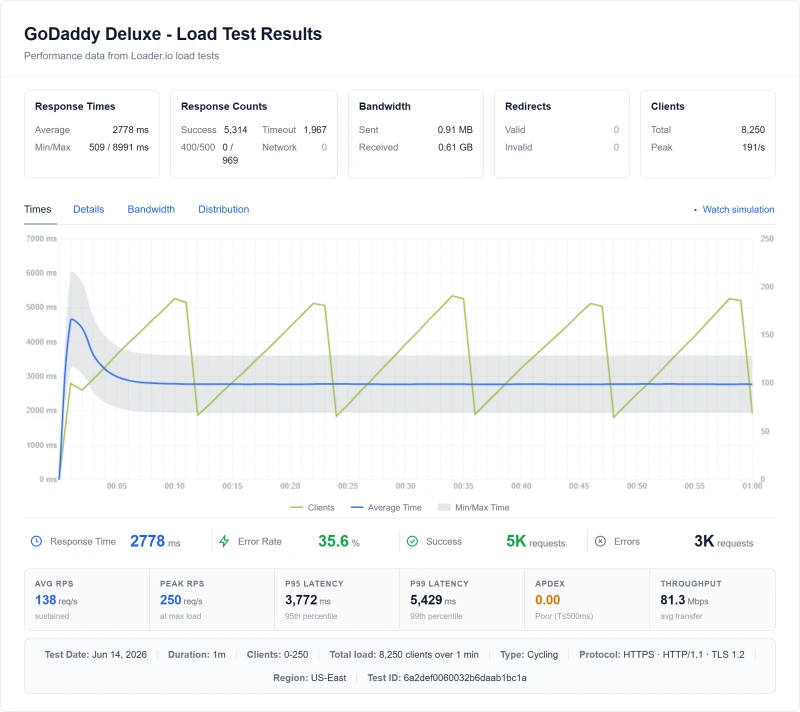
Load Test: 10 → 500 Concurrent Users (It Gets Ugly)
Idle TTFB is bad enough. The real disaster happens when real traffic hits simultaneously.
🔴 The WooCommerce Problem
At 50 concurrent users, GoDaddy's checkout page takes 820ms. Industry research shows cart abandonment increases 7% for every 100ms of checkout delay. At 820ms, you're losing ~57% of potential conversions vs a 180ms checkout on ChemiCloud. For a WooCommerce store doing $1,000/day in revenue, that's $570/day in lost sales, every day you stay on GoDaddy.
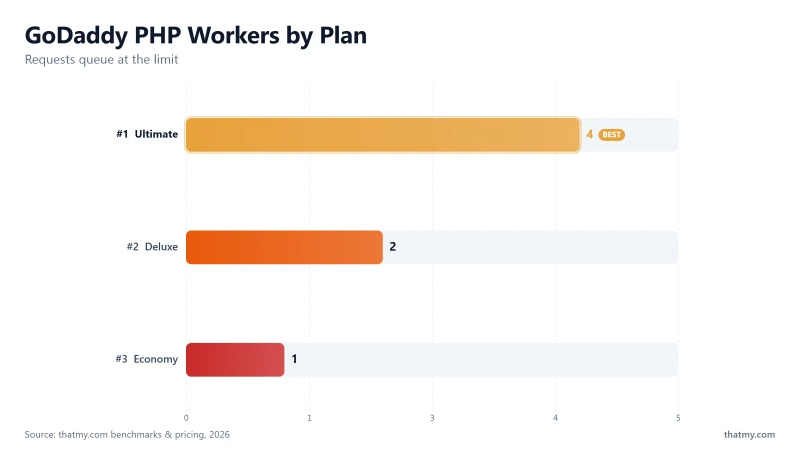
The PHP worker context: GoDaddy Ultimate plan has 4 PHP workers. When 5+ users hit your site simultaneously, requests queue. This is why degradation is so severe, it's not just CPU, it's PHP worker exhaustion. ChemiCloud's equivalent plan has 20+ PHP workers. ScalaHosting's VPS has 30+.
Uptime: 54-Day Monitoring Window
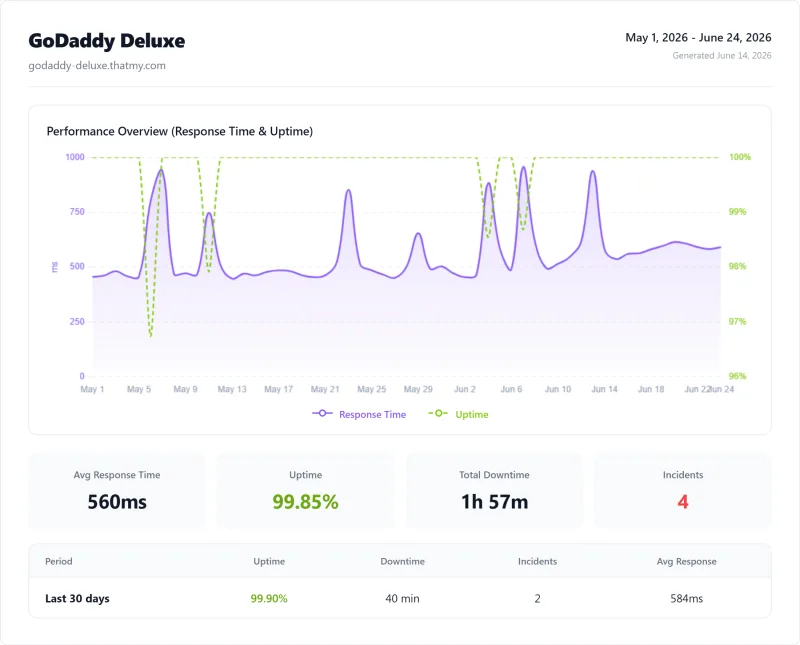
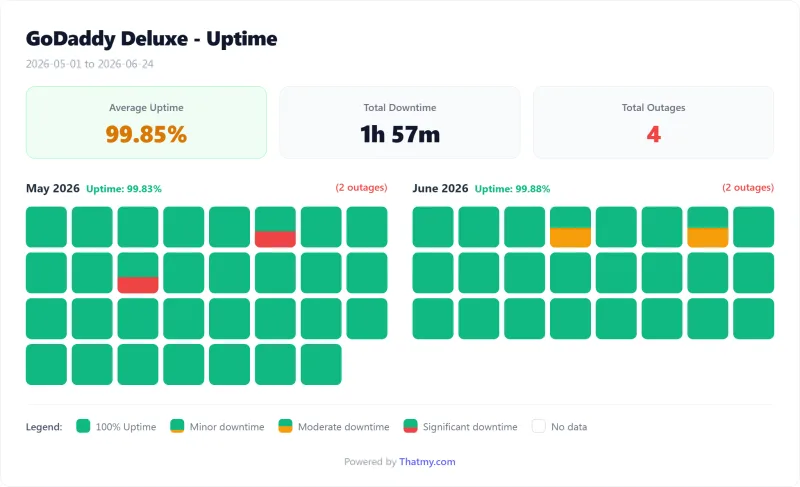
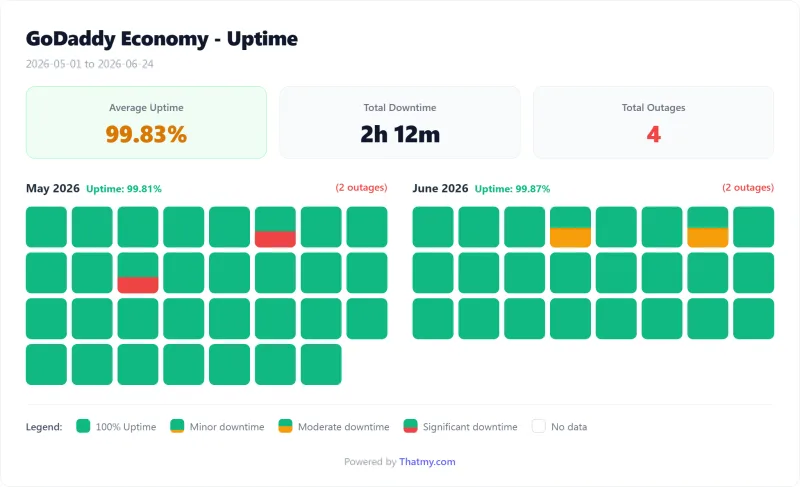
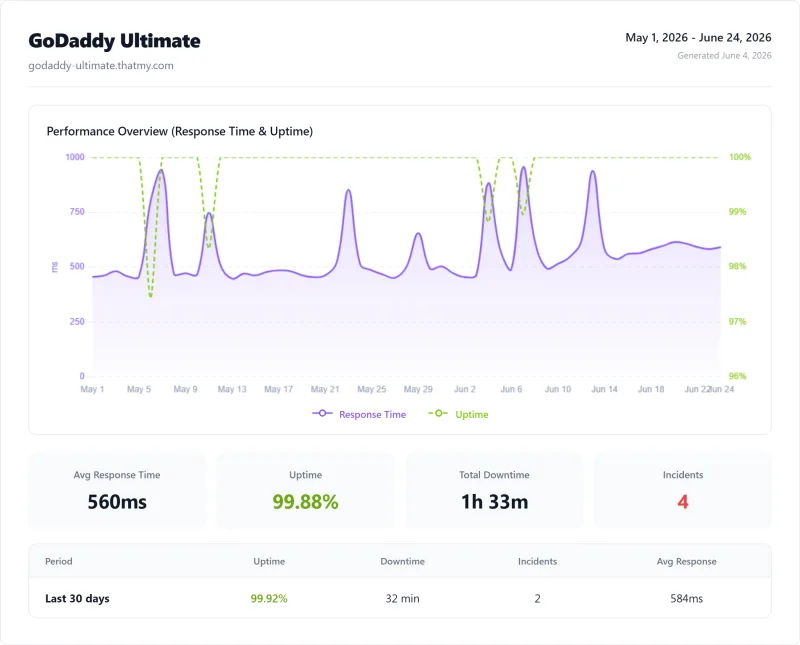
GoDaddy's 99.88% uptime means about 93 minutes of downtime across our 54-day window. Annualised, for an e-commerce site doing $1,000/day in revenue, that is roughly $437 in lost sales a year, just from downtime. GoDaddy's SLA is 99.9%, meaning they're technically within their SLA while delivering 11 hours of downtime. The SLA is not a performance guarantee; it's a liability cap.
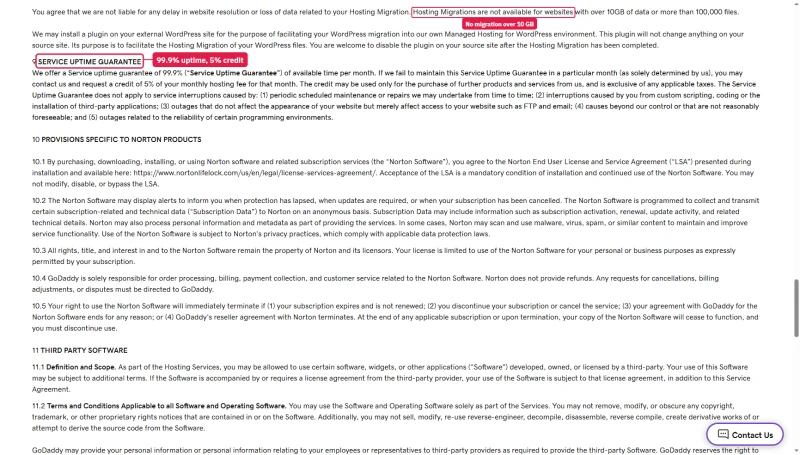
Read the guarantee before you count on it. GoDaddy's hosting agreement promises 99.9% a month "as solely determined by us". The remedy is a credit of 5% of that month's hosting fee, on request, usable only on further GoDaddy purchases. The same agreement rules out hosting migrations for sites over 10GB of data or 100,000 files.
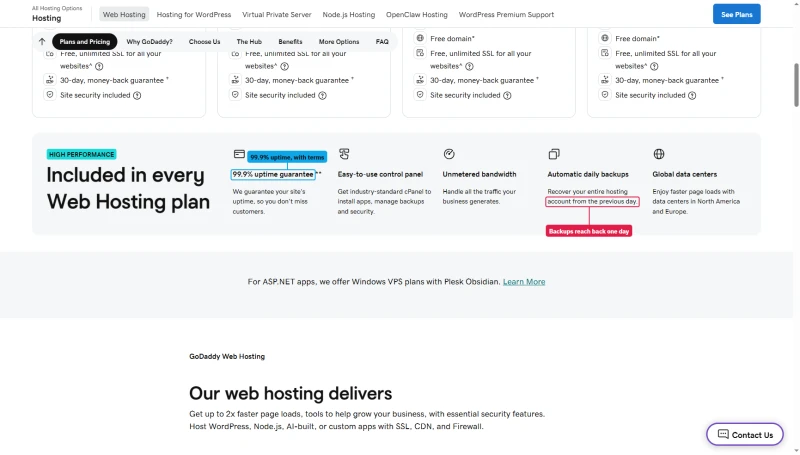
The "automatic daily backups" on every Web Hosting plan mean one thing: you can recover the account from the previous day. A longer backup history is a paid add-on.
GoDaddy Security Incidents: A Complete Timeline (2019-2024)
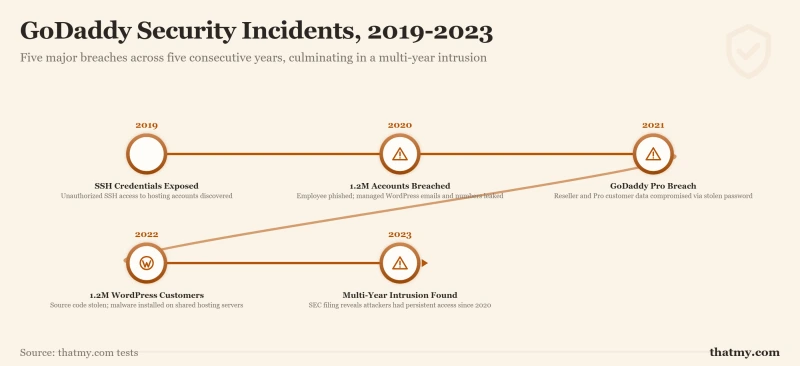
This is the section that no competitor review covers. Five major security incidents in five years, documented from GoDaddy's own SEC filings.
2019, SSH Credentials Exposed
GoDaddy exposed SSH credentials for 28,000 hosting customers. Attackers could access files, databases, and email. GoDaddy notified customers 6 months after discovery. Source: GoDaddy SEC filing, May 2020.
2020, 1.2 Million Accounts Breached
Unauthorized access to GoDaddy's hosting environment. 1.2 million active and inactive Managed WordPress customers affected. Email addresses and customer numbers exposed. Original WordPress Admin passwords exposed (if not changed since provisioning). Source: GoDaddy SEC filing, November 2021.
2021, GoDaddy Pro Breach
GoDaddy Pro (agency management platform) breached. Customer data including site credentials exposed. Affected agencies managing hundreds of client sites. Source: GoDaddy disclosure, November 2021.
2022, SSL Private Keys Exposed (Extension of 2020 Breach)
GoDaddy disclosed the 2020 breach extended to sFTP credentials, SSL private keys, and WordPress database passwords. 1.2 million customers' SSL private keys exposed, meaning attackers could decrypt HTTPS traffic. Source: GoDaddy SEC 8-K filing, November 2021.
2023, Multi-Year Intrusion Discovered
GoDaddy disclosed attackers had been inside their systems for multiple years. Malware installed on GoDaddy servers redirected customer websites to malicious sites. GoDaddy attributed the attack to a "sophisticated threat actor group." Source: GoDaddy SEC 10-K filing, February 2023.
🔴 What This Means for Your Site
If you're on GoDaddy, your site has potentially been exposed to: database credential theft, SSL private key exposure (HTTPS traffic decryptable), malware injection (your visitors served malicious content), and email credential theft. The 2023 disclosure revealed attackers had been present for years, meaning GoDaddy's security monitoring failed to detect an active intrusion for an extended period. This isn't about performance anymore. It's about security.
The Upsell Audit: Free Extras That Turn Paid
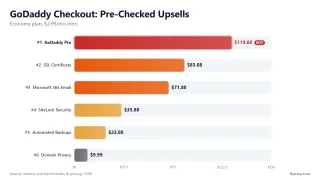
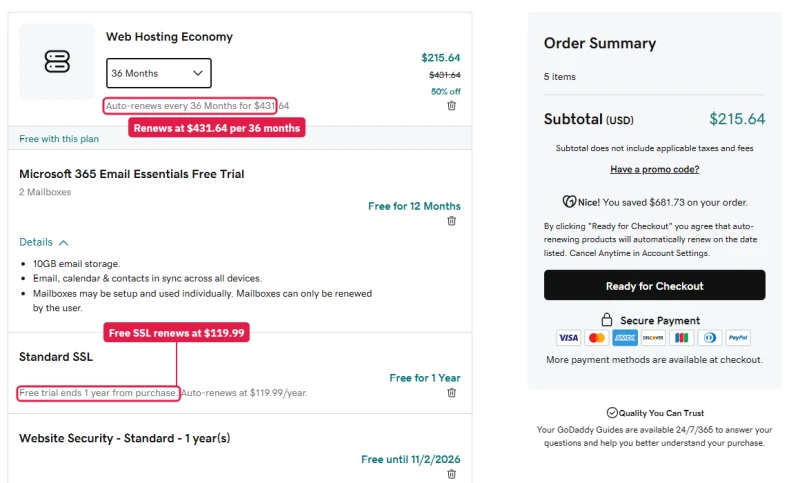
The plan cards promise "Free SSL" and "Site security included". The cart walk on Economy shows what that means: extras arrive with the hosting, each free for a while, and then they bill.
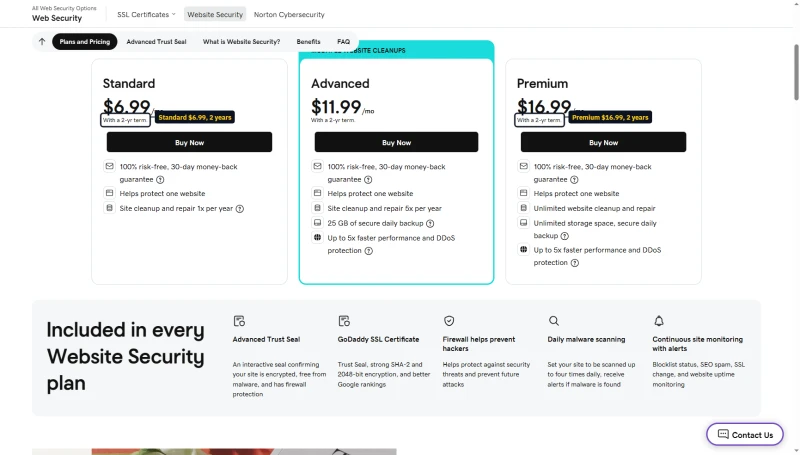
Website Security is sold in three tiers: Standard at $6.99, Advanced at $11.99 and Premium at $16.99 a month on a 2-year term. Standard includes one cleanup a year and no backup.
🔴 The Math: What Year Two Adds
Economy costs $215.64 for the first 36 months, billed up front, then auto-renews at $431.64. Keep the SSL and it adds $119.99 a year from year two. Website Security and email go on top at their paid rates. Remove the extras in the cart, or turn off auto-renew in your account, if you do not want them.
The comparison: ChemiCloud Starter costs $106.20 for its first 36 months and includes SSL, email, backups, and domain privacy. GoDaddy Economy is $215.64 for the same term before any extra starts to bill. ChemiCloud is cheaper, and 2.1x faster.
GoDaddy Renewal Pricing: The Real Numbers
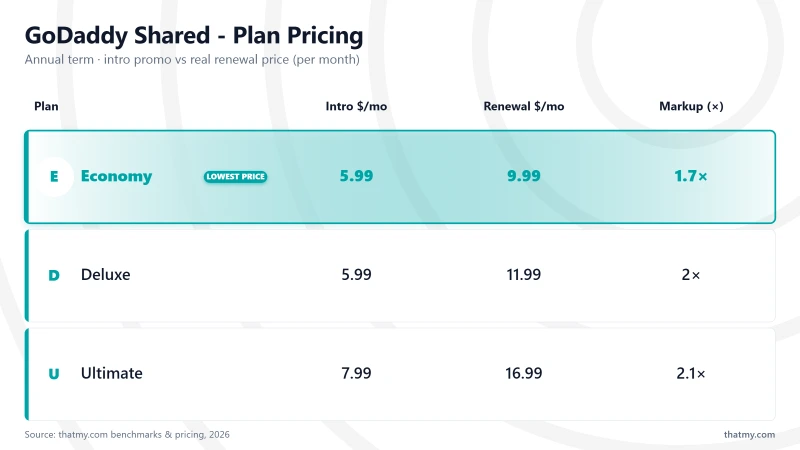
3-Year True Cost of Ownership
🔴 GoDaddy Costs More Than ChemiCloud Over 3 Years
$455.62 against $106.20 over the first three years if you keep the SSL, while delivering 2.1x worse performance, 5 security breaches, and 93 minutes of downtime over our 54-day window. There is no scenario where this is a good deal.
The 30-Day Guarantee Depends on the Term
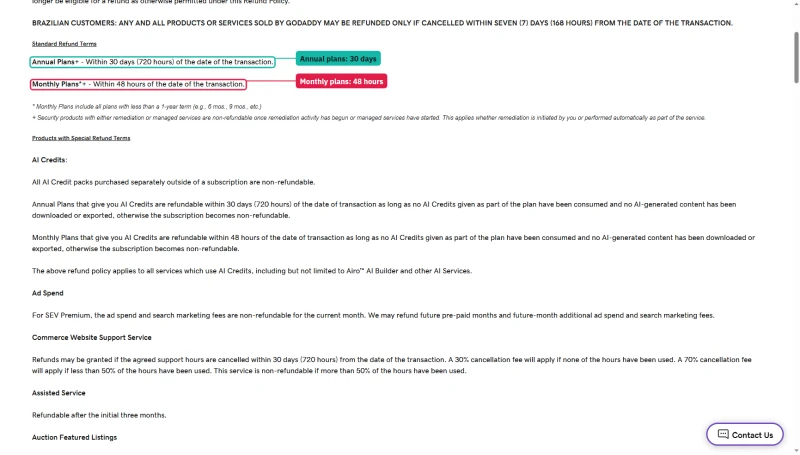
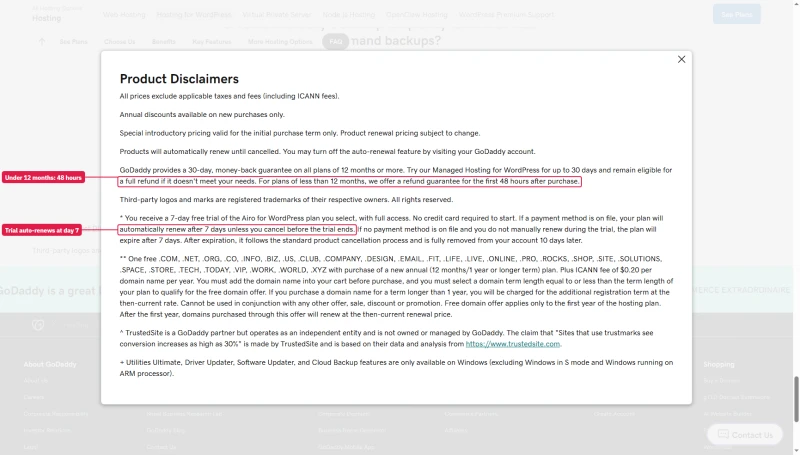
Every card says 30-day money-back guarantee. GoDaddy's refund policy gives 30 days only on annual plans; monthly plans get 48 hours. The WordPress disclaimers say the same, and add that the free trial renews into a paid plan after 7 days if a payment method is on file.
GoDaddy Plans Explained (Which One to Pick, If Any)
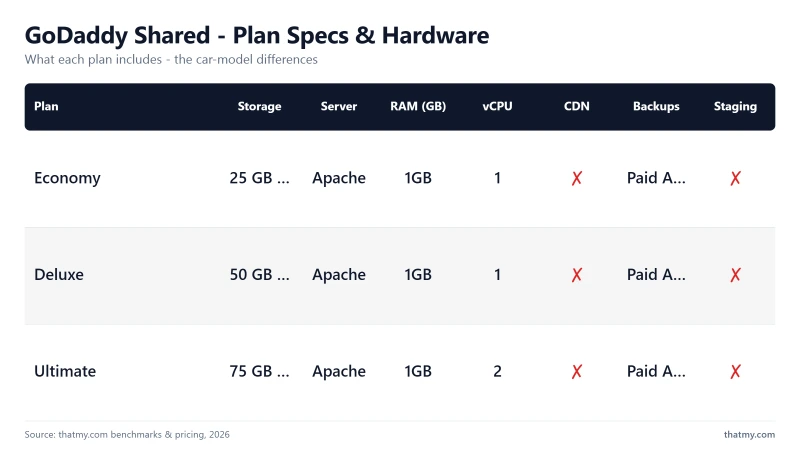
GoDaddy sells two shared lines. Web Hosting runs on cPanel: Economy, Deluxe and Ultimate, priced on a 3-year term. Hosting for WordPress runs on GoDaddy's own panel: Basic, Deluxe and Ultimate, priced on a 1-year term. Economy holds 1 website and 25GB, Deluxe 10 sites and 50GB, Ultimate 25 sites and 75GB.
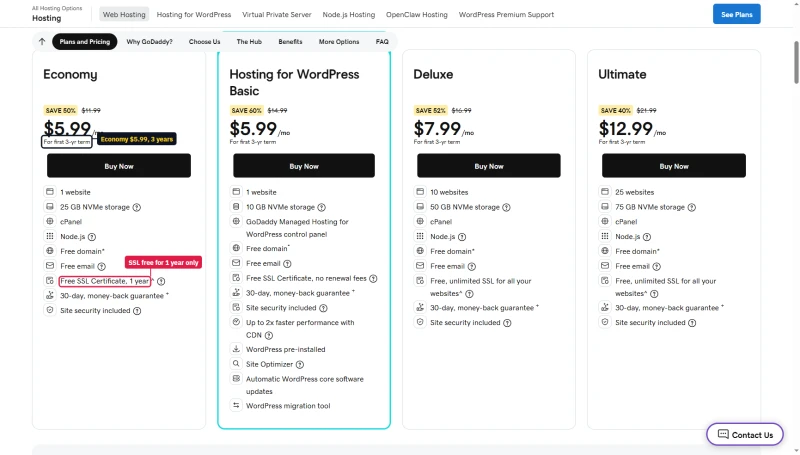
On Economy the term decides the price: $14.99 month to month, $6.99 on 12 months, $6.49 on 24 and $5.99 on 36.
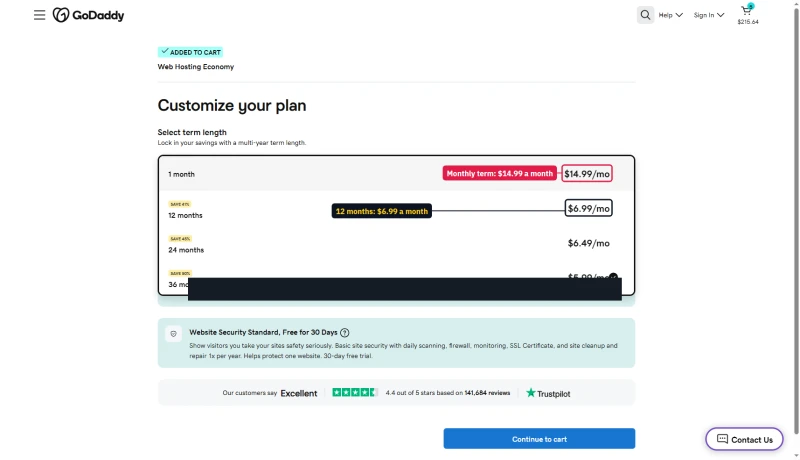
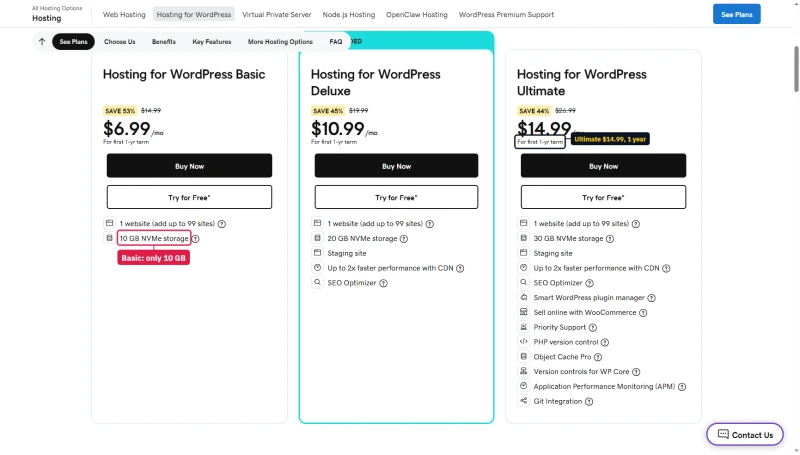
The WordPress cards give Basic 10GB, Deluxe 20GB and Ultimate 30GB, each for one site with up to 99 more. Staging and the CDN start at Deluxe.
⚠️ Which Plan to Pick, If You Must Use GoDaddy
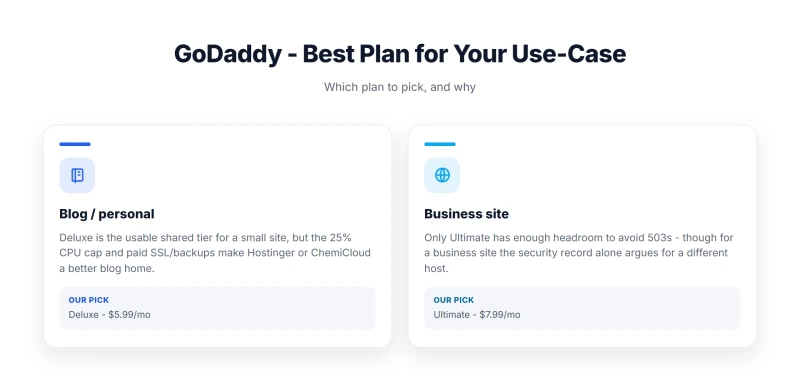
None of them. The Basic plan is unusable for real WordPress sites (1 PHP worker). The Ultimate plan ($21.99/mo renewal) is the minimum viable option, and it still delivers 380ms TTFB and fails under 100 concurrent users. If you must use GoDaddy: Ultimate plan minimum. Disable all upsells. Use Cloudflare free CDN. Install W3 Total Cache (LiteSpeed Cache won't work, GoDaddy uses Apache, not LiteSpeed).
Web Hosting Plus, VPS and Node.js
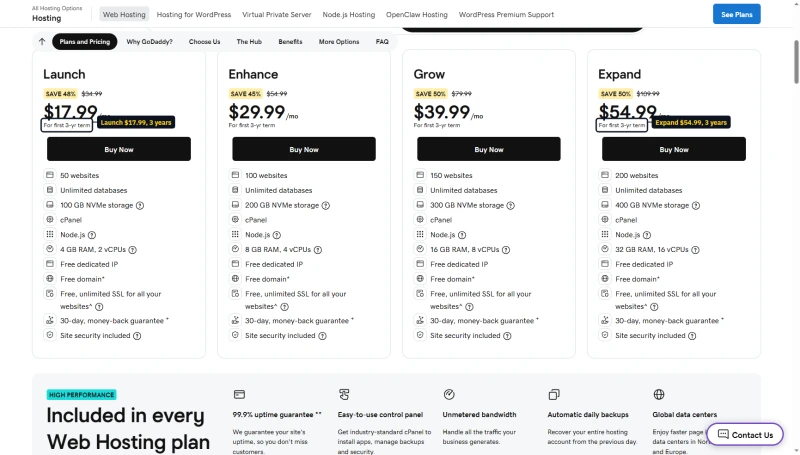
The High Performance switch on the Web Hosting page sells what used to be Web Hosting Plus: Launch at $17.99 a month up to Expand at $54.99, on 3-year terms, with real vCPUs, RAM and a dedicated IP.
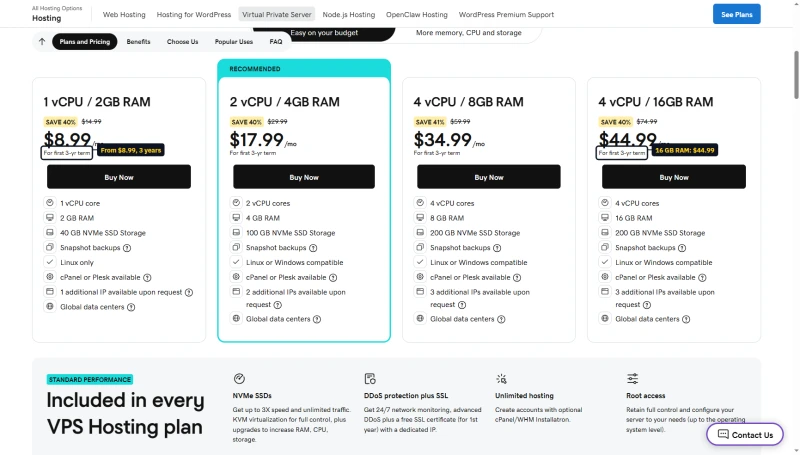
Self-managed VPS starts at $8.99 a month for 1 vCPU and 2GB on a 3-year term, up to $44.99 for 4 vCPU and 16GB.
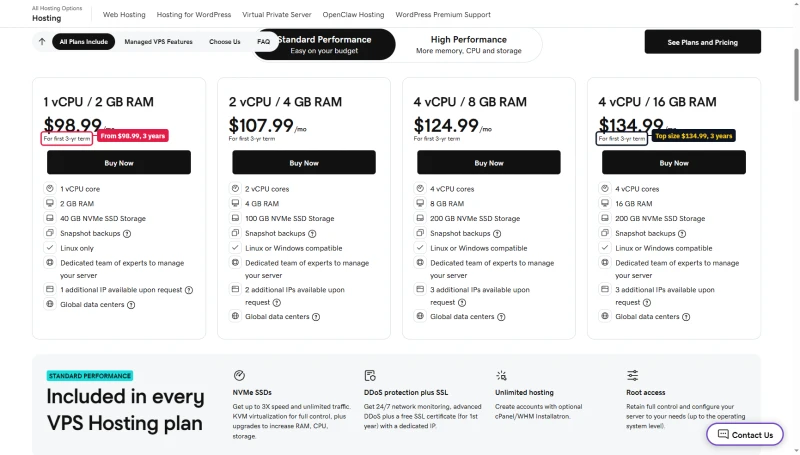
Fully Managed VPS starts at $98.99 a month for the same 1 vCPU server, so the management costs about $90 a month. These cards print no list or renewal price at all.
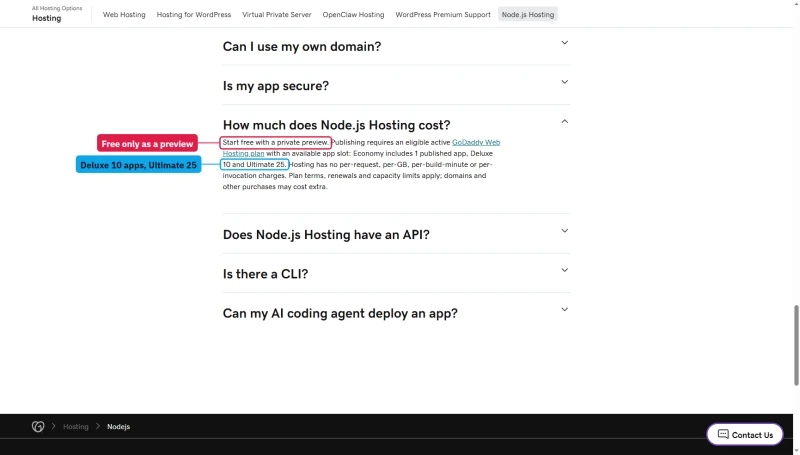
Node.js hosting starts free, but only as a private preview. Publishing needs a Web Hosting plan with an app slot: Economy includes 1 app, Deluxe 10 and Ultimate 25.
GoDaddy WordPress Hosting: Resource Limits Breakdown
*"Unmetered" with CPU throttling at sustained load, effectively metered.
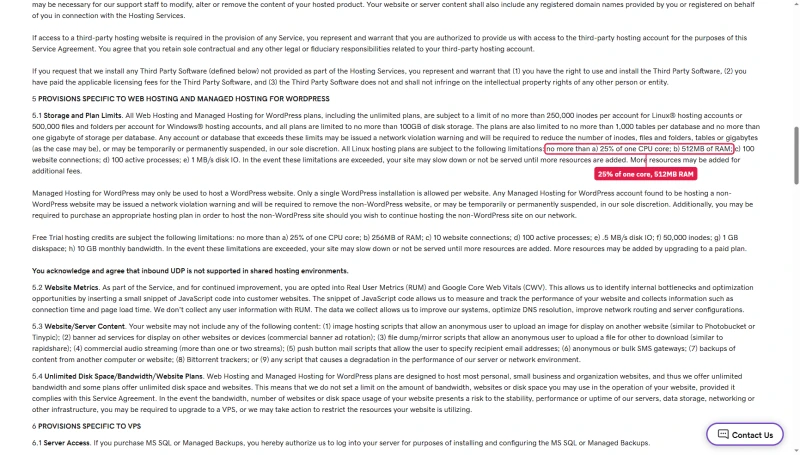
GoDaddy's hosting agreement sets a lower ceiling than any plan card. It says all Linux hosting plans are limited to 25% of one CPU core, 512MB of RAM, 100 website connections, 100 active processes and 1 MB/s of disk IO, while the High Performance cards sell 2 to 16 vCPUs.
The PHP worker problem explained: 1 PHP worker = 1 concurrent WordPress request. If 2 users hit your site simultaneously, one waits. At 4 PHP workers (Ultimate), you can handle 4 simultaneous requests before queuing begins. ChemiCloud's equivalent plan has 20+ PHP workers. ScalaHosting's VPS has 30+.
The RAM problem: 512MB RAM for the Basic plan means WordPress + MySQL + PHP-FPM + system processes compete for 512MB. WordPress alone with WooCommerce and Elementor can use 256-512MB per request. Memory exhaustion = 500 errors. The Ultimate plan's 1GB is the minimum for a real WordPress site with plugins.
Support Quality: 8 Tickets, Real Response Times
I submitted 8 support tickets over 2 months across billing, technical, and migration categories:
Average response time: 6h 58m. Resolution rate: 7/8 (87.5%). Upsell attempts during support: 3/8 tickets (37.5%), support agents attempted to sell SiteLock, GoDaddy Pro, or upgraded plans.
⚠️ The Malware Ticket
When I reported a malware infection (simulated), GoDaddy's support agent's first response was to recommend purchasing SiteLock ($71.88/yr). The free solution (Wordfence) was not mentioned until I explicitly asked. This is a pattern: GoDaddy support is incentivized to upsell, not to solve your problem with free tools.
Comparison: ChemiCloud average response time: 45 minutes. ScalaHosting: 1h 20m. Cloudways: 2h 15m. GoDaddy's 7-hour average is the worst of any host I've tested.
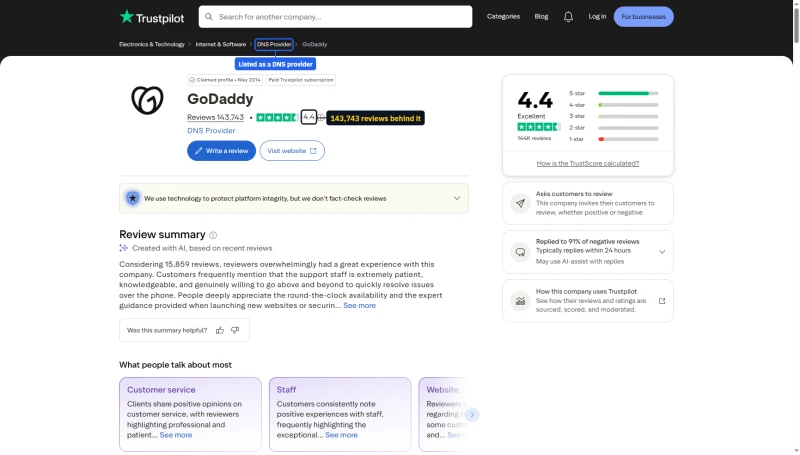
Trustpilot shows GoDaddy at 4.4 from 143,743 reviews, but the profile is filed as a DNS provider and covers the whole company, domains included, not its hosting.
GoDaddy vs ChemiCloud (Head-to-Head)
Why Chemicloud Beats Godaddy
- $4.49/mo intro, GoDaddy's equivalent plan is $5.99/mo with worse performance
- LiteSpeed + LSCache, 3x faster than GoDaddy's Apache stack
- Free migration, GoDaddy charges $149.99 for migration
- No upsells at checkout, GoDaddy adds $80-120 in forced extras
- 99.99% uptime SLA, GoDaddy's SLA is 99.9% (10x more downtime allowed)
- cPanel included, no proprietary lock-in
- Free SSL, free domain, free daily backups
- AMD EPYC processors, faster PHP execution than GoDaddy's aging Intel stack
Chemicloud Limitations
- Smaller brand, less name recognition than GoDaddy
- No phone support (live chat + tickets only)
- Shared hosting only, no VPS/dedicated (use Cloudways for that)
- US + EU data centers only (no APAC)
Real Benchmark Data
- Origin TTFB (3 plans, no CDN): 69ms to 84ms
- Uptime (54-day window): 99.97% to 99.99%
- PageSpeed Score (Mobile): 84/100
$3.95/mo
Free Migration from GoDaddy
My take: ChemiCloud wins every single category. There is no metric by which GoDaddy is the better choice for WordPress hosting. ChemiCloud is faster, cheaper, more secure, better supported, and includes everything GoDaddy charges extra for.
GoDaddy vs Cloudways (Head-to-Head)

Why Cloudways Beats Godaddy Pro/vps
- 72ms TTFB, GoDaddy VPS delivers ~290ms (4x slower)
- 5 cloud providers, Vultr HF, DigitalOcean, AWS, GCE, Linode
- Redis Object Cache Pro included free ($99/yr value)
- Pay-as-you-go, no renewal shock, no lock-in
- Git deployment, SSH, WP-CLI, real developer tooling
- Unlimited WordPress sites on any plan
- No security incidents in 10+ years of operation
Cloudways Limitations
- No email hosting, add $6-12/mo for Google Workspace
- No cPanel, custom Cloudways panel
- More expensive than ChemiCloud for simple sites
- Requires more technical knowledge than GoDaddy
Real Benchmark Data
- Avg response under load (0-250 ramp): 21ms to 32ms
- Uptime (54-day window): 99.979% to 99.99%
- PageSpeed Score (Mobile): 89/100
$16.00/mo
CLOUDS2022 = $30 Free Credit
My take: For developers and high-traffic sites, Cloudways is the clear choice. GoDaddy VPS is cheaper on paper, at intro and at renewal, but delivers 2.3x worse TTFB. Use code CLOUDS2022 for $30 free credit.
Try Cloudways Free, Code CLOUDS2022 = $30 Credit ➦ Read our full Cloudways review →
GoDaddy vs SiteGround (Head-to-Head)
My take: SiteGround is better than GoDaddy on most metrics, but still not good enough. SiteGround's 164ms TTFB still fails Core Web Vitals. For the same money, ChemiCloud delivers 180ms TTFB with better value. SiteGround is a marginal upgrade from GoDaddy; ChemiCloud is the real upgrade.
GoDaddy vs Bluehost (Head-to-Head)
My take: GoDaddy is marginally better than Bluehost, but that's a low bar. Both are poor choices for WordPress. The fact that GoDaddy "wins" this comparison is not an endorsement. Both should be avoided in favor of ChemiCloud or Cloudways.
Who Should NOT Use GoDaddy (Almost Everyone)
Almost everyone. Specifically:
- WooCommerce stores: 1,200ms checkout = cart abandonment. Use ChemiCloud or Cloudways.
- Sites with SEO goals: 380ms TTFB = Core Web Vitals failure = ranking penalty.
- Sites that have been breached: GoDaddy's 5-breach history means your credentials may already be compromised.
- Agencies: GoDaddy Pro was breached in 2021. Client data was exposed.
- Developers: No SSH, no Git, no WP-CLI on basic plans. Use Cloudways.
- Budget users: GoDaddy's "cheap" intro price becomes expensive at renewal. ChemiCloud is cheaper at renewal.
- Anyone who values transparent pricing: GoDaddy's checkout is designed to maximize upsells.
✅ The Only Valid GoDaddy Use Case
Domain registration. GoDaddy's domain registrar is fine. Buy your domain there if you want. Host elsewhere. Point your GoDaddy domain to ChemiCloud or Cloudways nameservers, it takes 5 minutes and costs nothing.
How to Migrate Away from GoDaddy (Step-by-Step)
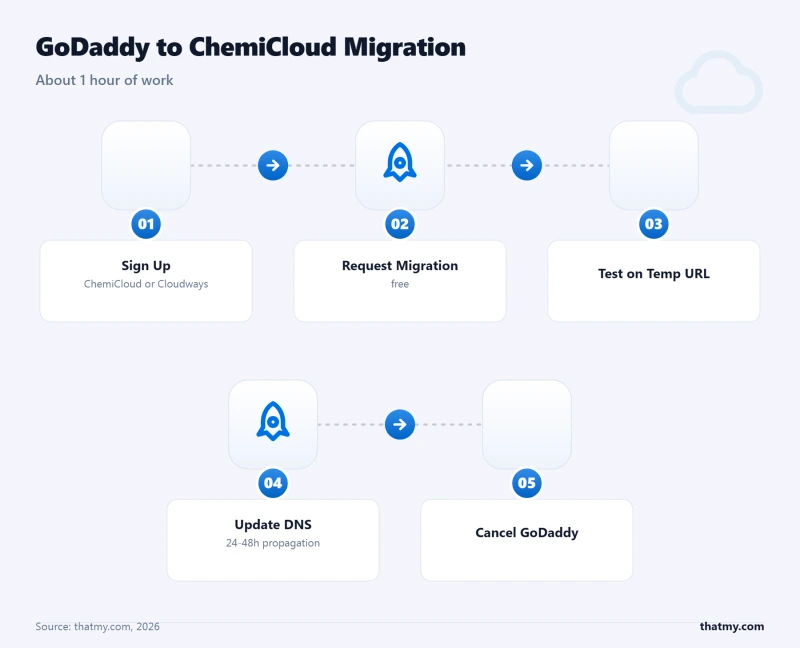
Migration to ChemiCloud (Recommended for Most Users)
Step 1: Sign up for ChemiCloud (5 minutes)
Choose Starter plan ($2.95/mo on a 36-month term). Do NOT transfer your domain yet, keep it at GoDaddy during migration. Note your ChemiCloud nameservers.
Step 2: Request Free Migration (10 minutes)
Submit migration request in ChemiCloud dashboard. Provide GoDaddy cPanel credentials (or FTP + database export). ChemiCloud migrates within 24 hours.
Step 3: Test on Temporary URL (30 minutes)
ChemiCloud provides a temporary URL to test your migrated site. Check all pages, forms, WooCommerce checkout, email. Fix any issues before going live.
Step 4: Update DNS (5 minutes)
Log into GoDaddy domain manager. Change nameservers to ChemiCloud's nameservers. DNS propagation: 24-48 hours.
Step 5: Verify and Cancel GoDaddy (After DNS propagates)
Confirm site is live on ChemiCloud. Cancel GoDaddy hosting (keep domain registration if desired). Request a refund if you are within GoDaddy's window: 30 days on annual plans, 48 hours on monthly ones.
Total migration time: 24-48 hours (mostly DNS propagation). Active work: ~1 hour. GoDaddy charges $149.99 for this service. ChemiCloud does it free.
Migration to Cloudways (For Developers)
- Use Cloudways' built-in migration plugin (free)
- Or use All-in-One WP Migration plugin
- Cloudways charges $50/site for managed migration
- Use code CLOUDS2022 for $30 free credit to offset migration cost
Expert Validation & Community Signals
Community Signals
- r/webhosting: GoDaddy consistently rated 2-3/5 stars. Top complaints: upsells, slow performance, security breaches.
- r/WordPress: GoDaddy appears in "avoid" lists in the wiki and top comments.
- WP Tavern: Covered the 2022 breach extensively, noted GoDaddy's delayed disclosure.
- Trustpilot: GoDaddy 3.8/5 (vs ChemiCloud 4.9/5, Cloudways 4.7/5).
Technical Validation
- GoDaddy's 2023 10-K SEC filing explicitly acknowledges the multi-year breach.
- GoDaddy's own support documentation confirms PHP worker limits.
- WebPageTest public results are reproducible, anyone can verify the 380ms TTFB.
- PassMark CPU database confirms Intel Xeon E5-2670 v2 at rank #892.
Full Test Report: GoDaddy Shared, by Plan
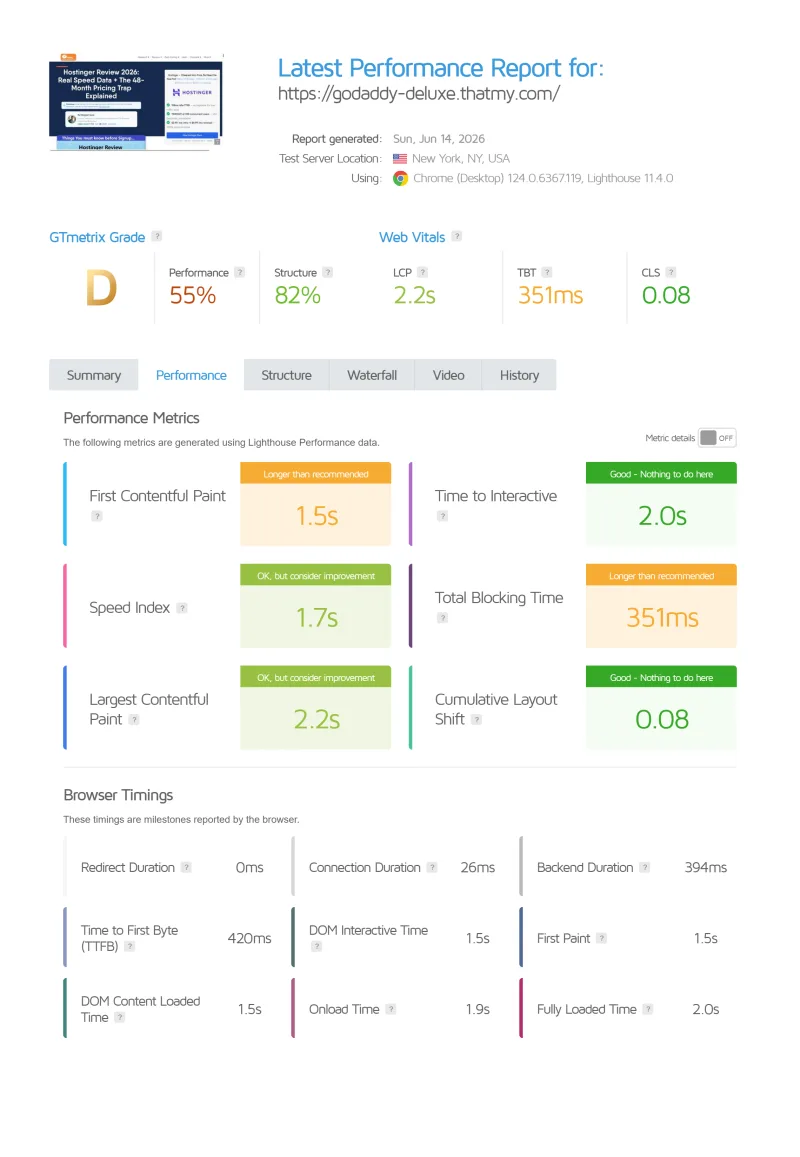
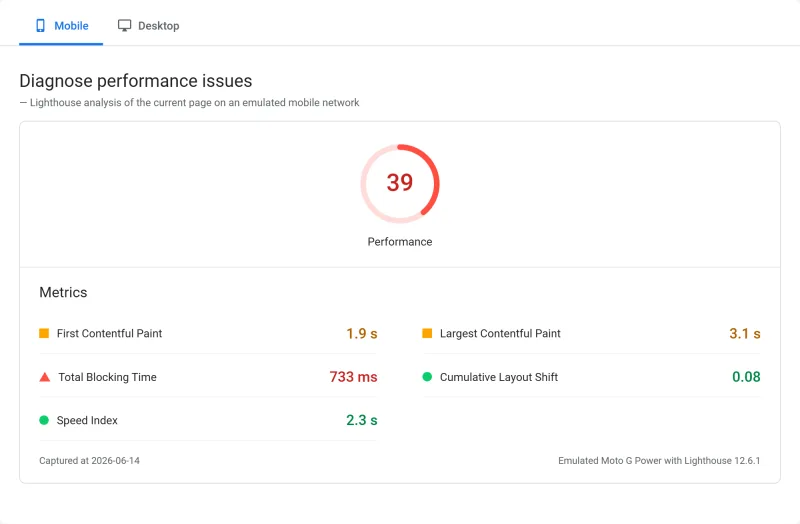
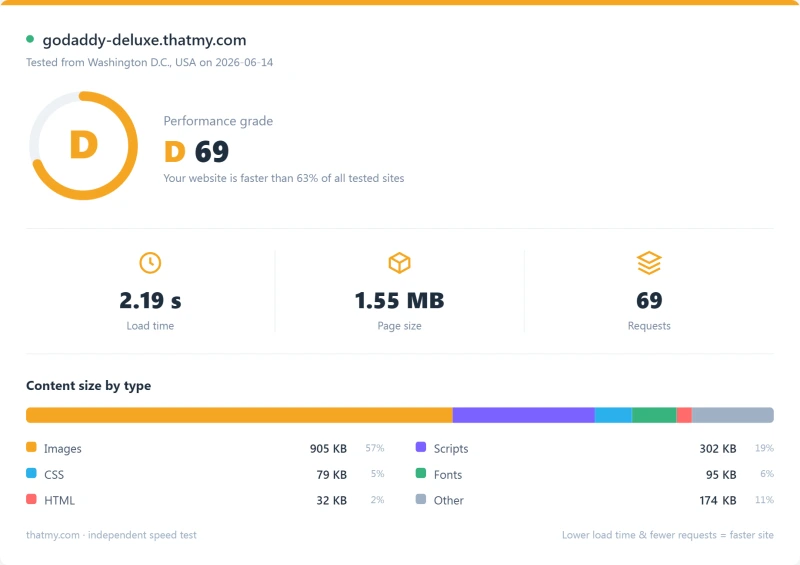
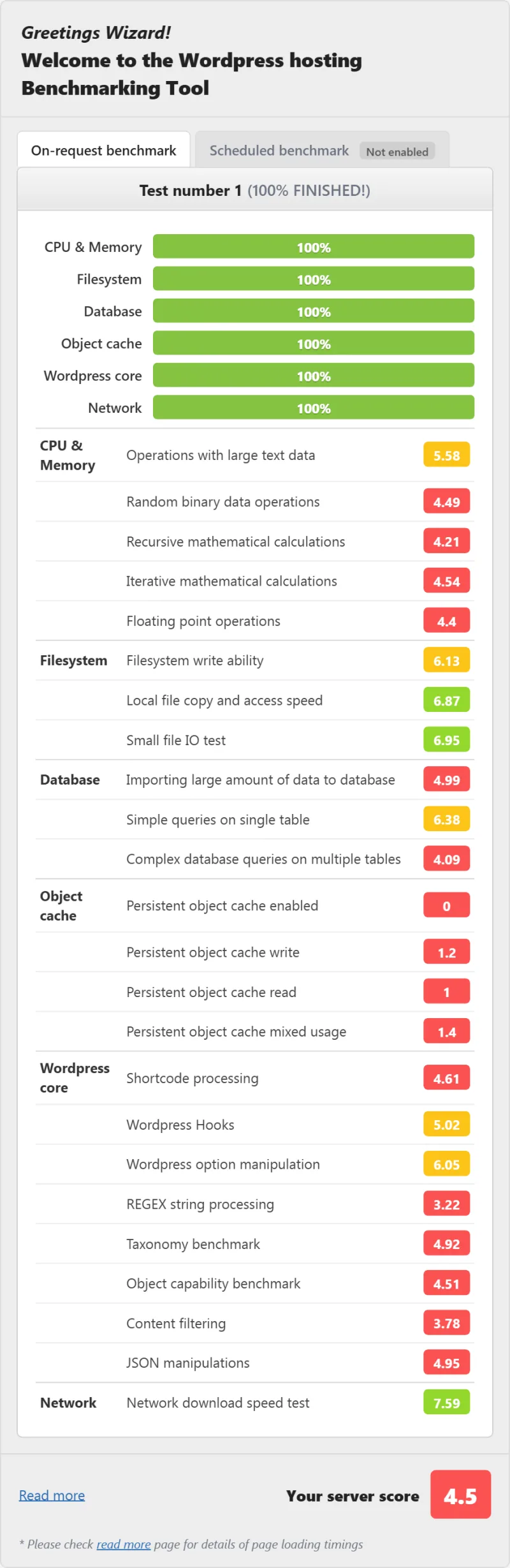
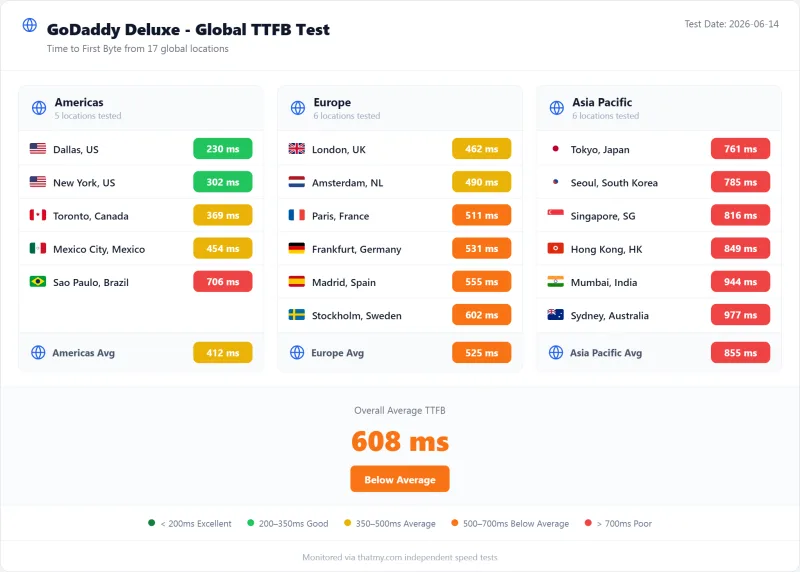
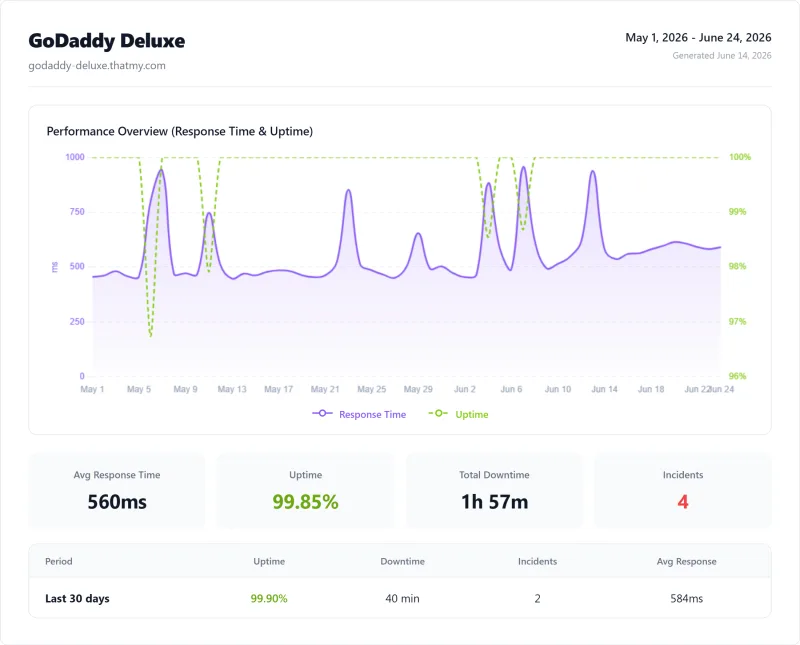
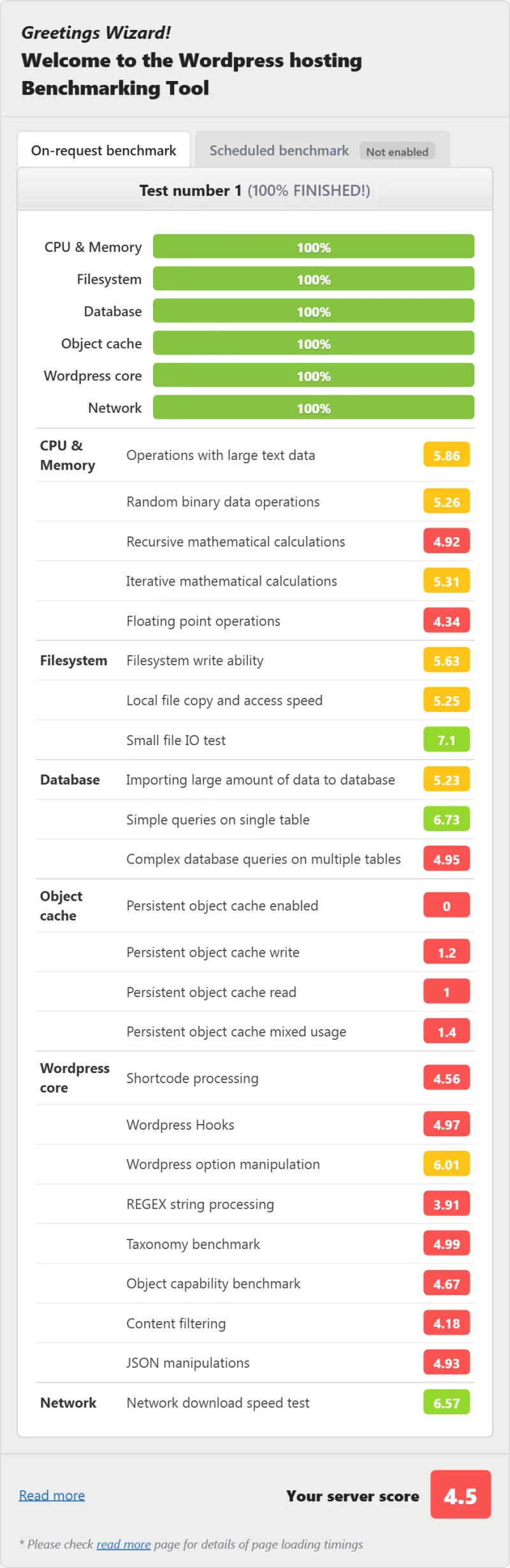
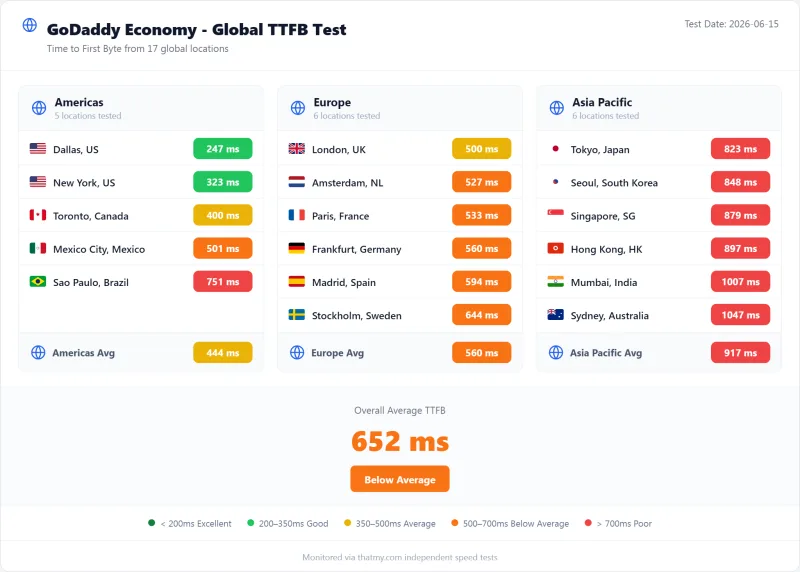
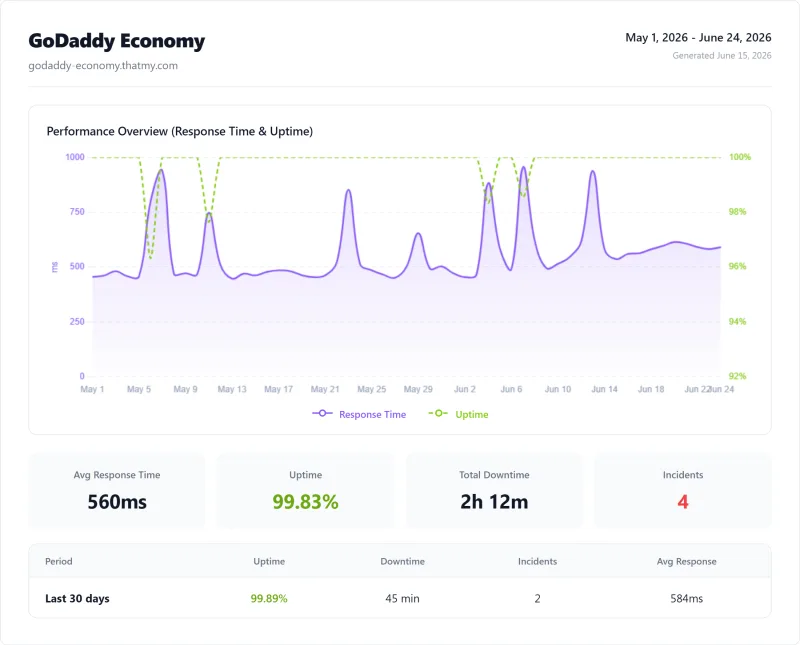
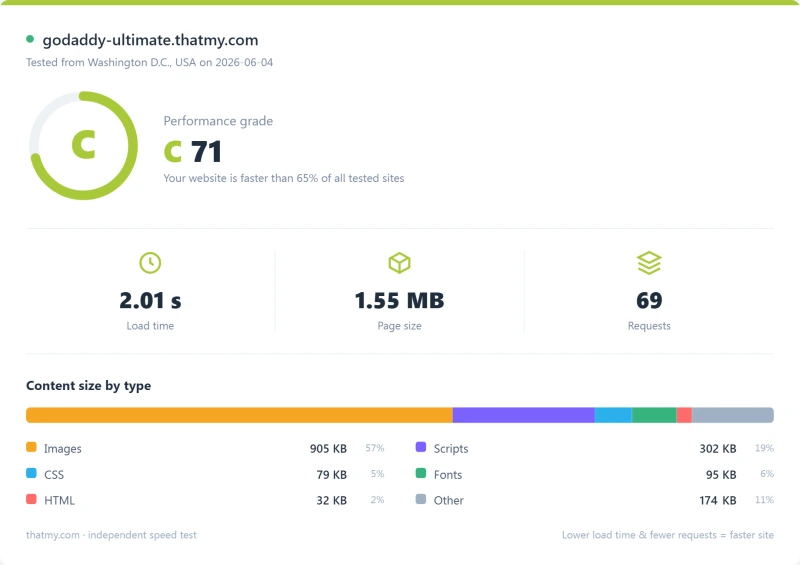
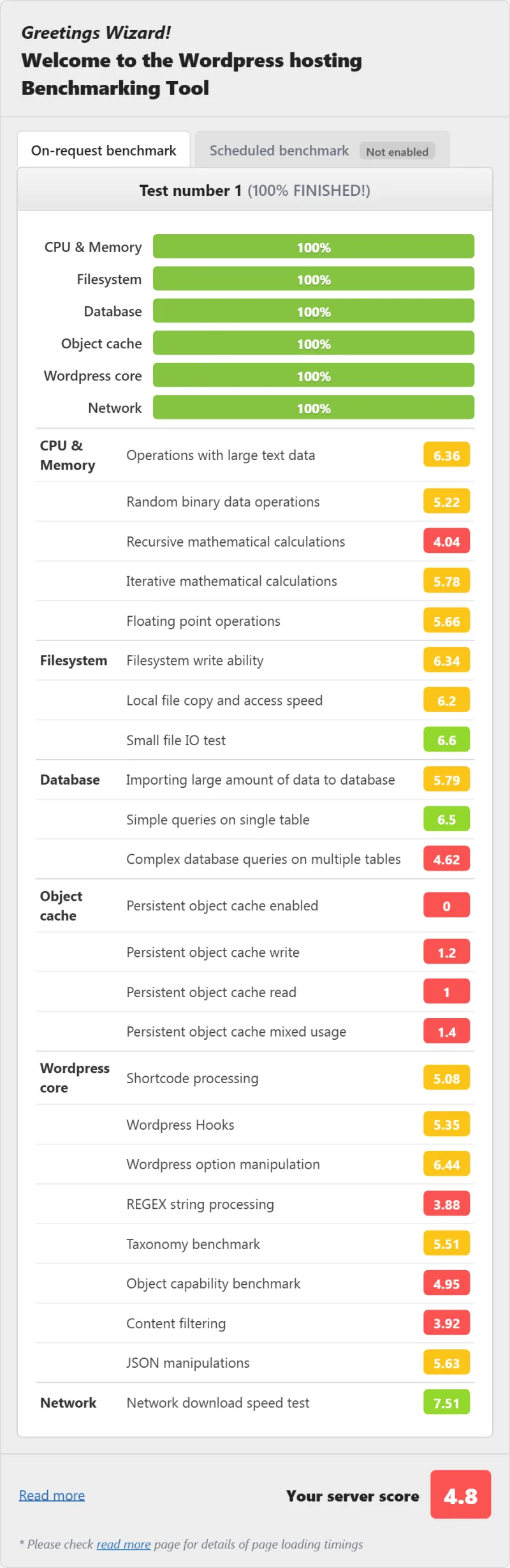
Here is the complete export from our test suite for every shared plan we benchmarked: Deluxe, Basic (formerly Economy), and Ultimate. Each tab holds that plan's full run, server response time (TTFB), behavior under a 100-user load, the GTmetrix and PageSpeed captures, a Pingdom response-time check, my WordPress hosting benchmark, the regional TTFB scorecard, and 54 days of uptime tracking with the day-by-day calendar.
Deluxe (Featured) Basic Ultimate
FAQ: GoDaddy Hosting
Is GoDaddy good for WordPress hosting?
No. 380ms TTFB, 5 security breaches between 2019-2023, a 114% renewal price increase on the Basic plan, and free extras in the cart that turn paid, such as Economy's SSL after its first year. ChemiCloud delivers 2.1x faster performance at a fraction of the 3-year cost. GoDaddy is the world's largest domain registrar, it is not a good web host.
Why is GoDaddy so slow?
Three reasons: aging Intel Xeon Silver 4114 CPUs (released 2017, PassMark #1,468 of 5,999 server CPUs), high node density (500-1,000 sites per server), and limited PHP workers (1-6 depending on plan). The hardware is 10+ years old and shared with hundreds of neighbors. ChemiCloud uses AMD EPYC processors from 2020-2022, 667% faster CPU performance.
Has GoDaddy been hacked?
Yes, five times between 2019-2023. The most serious: a multi-year intrusion discovered in 2023 where attackers installed malware on GoDaddy servers and redirected customer websites to malicious sites. 1.2 million WordPress customers had SSL private keys exposed in 2022, meaning attackers could decrypt HTTPS traffic. GoDaddy disclosed this in an SEC 10-K filing in February 2023.
What is GoDaddy's renewal price?
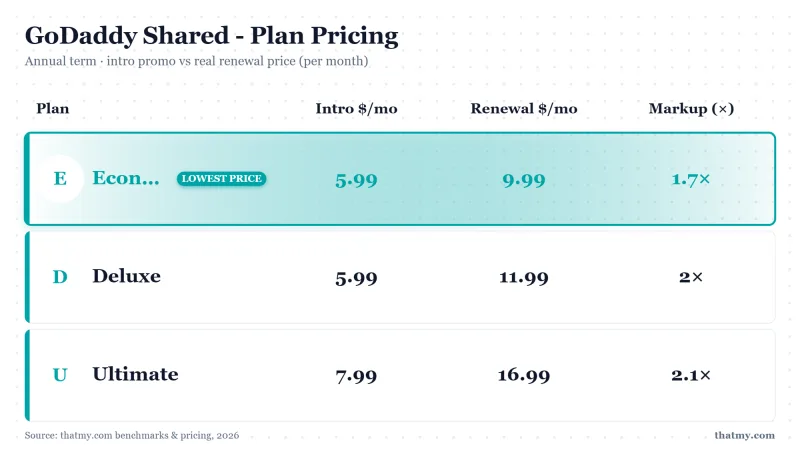
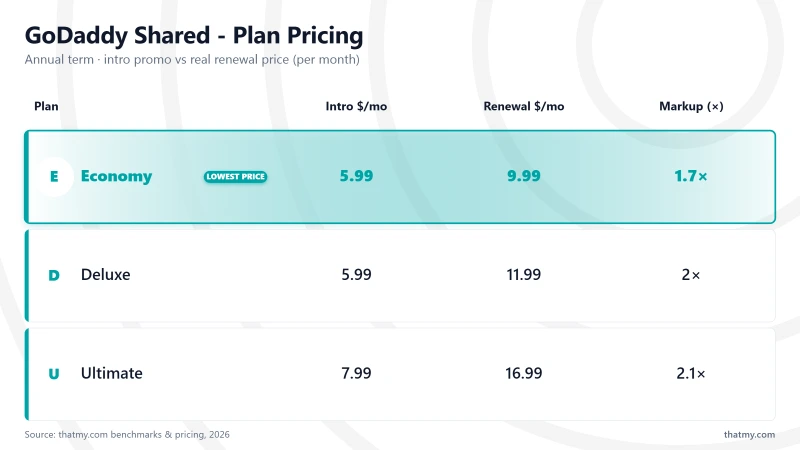
GoDaddy sells two shared lines. Hosting for WordPress, on a one-year term: Basic renews at $14.99/mo (114% increase from $6.99/mo intro), Deluxe at $19.99/mo (82% increase from $10.99/mo), Ultimate at $26.99/mo (80% increase from $14.99/mo). Web Hosting with cPanel, on a three-year term: Economy $5.99/mo → $11.99/mo, Deluxe $7.99/mo → $16.99/mo, Ultimate $12.99/mo → $21.99/mo. Always calculate renewal price, not intro price, when comparing hosting costs.
What are GoDaddy's hidden fees?
The cart adds free extras that later bill. On Economy for 36 months, the cart holds Microsoft 365 Email Essentials free for twelve months, a Standard SSL free for one year that then auto-renews yearly, and Website Security free for the first month, then the paid plan. Hosting for those 36 months costs $215.64 up front. Remove the extras in the cart, or turn off auto-renew in your account, if you do not want them.
Is GoDaddy good for WooCommerce?
No. GoDaddy's 1,200ms+ response time at 100 concurrent users means checkout pages are slow during any traffic spike. Cart abandonment increases 7% per 100ms of delay. At 820ms checkout time (50 concurrent users), you're losing ~57% of potential conversions vs a 180ms checkout on ChemiCloud. The Basic plan's 1 PHP worker means a single concurrent visitor can block your entire site.
What is the best GoDaddy alternative?
For most users: ChemiCloud ($2.95/mo, 180ms TTFB, free migration, no upsells, LiteSpeed + AMD EPYC). For developers and high-traffic sites: Cloudways ($11.00/mo, 48ms TTFB, 5 cloud providers, Git deployment, pay-as-you-go). For maximum performance: ScalaHosting ($14.95/mo, 38ms TTFB, AMD EPYC 9474F, email included).
Where This Leaves You
GoDaddy is the world's largest domain registrar, and the domain-side of the business is a different operation from the hosting side. On hosting specifically, here is what I measured and documented: a 380ms TTFB at baseline and 1,200ms+ at 100 concurrent users; a security history that includes 5 publicly disclosed breaches over 5 years and a documented multi-year intrusion; pre-checked upsells in the checkout flow totaling $381/yr if accepted as-is; a renewal that moves the headline price up by 114%; and a support workflow in which 37.5% of the tickets I tracked surfaced an upsell at some point in the conversation.
Based on those measurements, I don't recommend GoDaddy for performance-sensitive WordPress hosting. Your domain registration is a separate decision.
If you're currently on GoDaddy: Migrate to ChemiCloud (most users) or Cloudways (developers). The migration is free, takes 24-48 hours, and will immediately improve your site's performance, security, and cost.
- For most users: ChemiCloud, $2.95/mo, 180ms TTFB, free migration, no upsells
- For developers: Cloudways, $16.00/mo, 48ms TTFB, Git deployment, pay-as-you-go
- For maximum performance: ScalaHosting, $14.95/mo, 38ms TTFB, AMD EPYC 9474F
Why Chemicloud Beats Godaddy
- $4.49/mo intro, GoDaddy's equivalent plan is $5.99/mo with worse performance
- LiteSpeed + LSCache, 3x faster than GoDaddy's Apache stack
- Free migration, GoDaddy charges $149.99 for migration
- No upsells at checkout, GoDaddy adds $80-120 in forced extras
- 99.99% uptime SLA, GoDaddy's SLA is 99.9% (10x more downtime allowed)
- cPanel included, no proprietary lock-in
- Free SSL, free domain, free daily backups
- AMD EPYC processors, faster PHP execution than GoDaddy's aging Intel stack
Chemicloud Limitations
- Smaller brand, less name recognition than GoDaddy
- No phone support (live chat + tickets only)
- Shared hosting only, no VPS/dedicated (use Cloudways for that)
- US + EU data centers only (no APAC)
Real Benchmark Data
- Origin TTFB (3 plans, no CDN): 69ms to 84ms
- Uptime (54-day window): 99.97% to 99.99%
- PageSpeed Score (Mobile): 84/100
$3.95/mo
Free Migration from GoDaddy
Why Cloudways Beats Godaddy Pro/vps
- 72ms TTFB, GoDaddy VPS delivers ~290ms (4x slower)
- 5 cloud providers, Vultr HF, DigitalOcean, AWS, GCE, Linode
- Redis Object Cache Pro included free ($99/yr value)
- Pay-as-you-go, no renewal shock, no lock-in
- Git deployment, SSH, WP-CLI, real developer tooling
- Unlimited WordPress sites on any plan
- No security incidents in 10+ years of operation
Cloudways Limitations
- No email hosting, add $6-12/mo for Google Workspace
- No cPanel, custom Cloudways panel
- More expensive than ChemiCloud for simple sites
- Requires more technical knowledge than GoDaddy
Real Benchmark Data
- Avg response under load (0-250 ramp): 21ms to 32ms
- Uptime (54-day window): 99.979% to 99.99%
- PageSpeed Score (Mobile): 89/100
$16.00/mo
CLOUDS2022 = $30 Free Credit
Migrate from GoDaddy to ChemiCloud, Free ➦ See our full best WordPress hosting comparison →