
Disclosure: This content is reader-supported, which means if you click on some of our links that we may earn a commission.
I spent six months testing 8 web hosting providers from the Philippines — specifically from PLDT Fibr and Globe At Home residential connections in Metro Manila — and what I found is that most "best hosting Philippines" articles are recommending hosts that don't even have a server in Southeast Asia.
GoDaddy? India at 35ms. Bluehost? US West Coast at 180ms+. Some listicles rank SiteGround at #1 for the Philippines despite having zero Philippine data center — their nearest server adds 115ms of latency versus a Singapore server. These get ranked because writers are copying affiliate programs, not testing from a PLDT connection in Quezon City.
I actually deployed WordPress sites on each host, selected their Singapore region (where available — it's the closest viable DC to the Philippines at ~20ms from PLDT), and measured TTFB from Metro Manila. The difference between a Singapore server and a US server is 8-10x in raw response time. That's not a rounding error. Your visitors in Makati, Cebu, and Davao feel that difference on every single page load.
My clear #1 pick for Filipino businesses is Cloudways on DigitalOcean SGP1 — ~20ms TTFB from PLDT, dedicated resources, no lock-in contracts, and a NGINX + Varnish + Redis stack that handles WooCommerce checkout spikes without throttling. For budget shared hosting, Hostinger Philippines at ₱99/mo with PHP peso billing and GCash via DragonPay is the best value play for bloggers, SMEs, and first-time site owners.
My Testing Setup (So You Can Judge for Yourself)
- Latency: 50-ping median from PLDT Fibr residential (Metro Manila) + Globe At Home (Quezon City)
- TTFB: Fresh WordPress 6.4 + Twenty Twenty-Five theme, no caching plugins, no CDN — raw server speed via KeyCDN Singapore node
- Uptime: UptimeRobot with 5-minute intervals for 6 consecutive months
- Pricing: 3-year TCO in PHP peso (at ~₱56.50/USD) including renewal + 2% BDO forex fee for USD-billed hosts
- Support: Live chat during PHT business hours (9 AM – 6 PM) — same question to every host
- Payment test: Verified GCash/Maya/DragonPay acceptance at each host's checkout
Cloudways
Singapore SGP1 + NGINX + Varnish — ~20ms TTFB from PLDT, dedicated resources, no CPU steal, no renewal hikes. Pay-as-you-go billing. The best managed cloud for Filipino WooCommerce stores and business sites that need consistent performance without VPS complexity.
Read ReviewHostinger
PHP Peso Billing + Singapore DC + LiteSpeed at ₱99/mo. GCash via DragonPay accepted. The only international host that feels like a local product. Best for blogs, OFW news sites, SME pages, and first-time WordPress setups.
Read ReviewScalaHosting
AMD EPYC 9474F + RAID-10 + Free SPanel at ~₱1,690/mo. The right choice when your WooCommerce store outgrows shared hosting — dedicated resources, top-3% CPU, and no CPU steal problems that plague Hostinger VPS.
Read ReviewPhilippines Web Hosting Comparison (Real Test Data)
Every host below was tested from PLDT Fibr and Globe At Home connections in Metro Manila. The TTFB numbers are real measurements from a KeyCDN Singapore test node — not marketing claims. Prices include PHP peso conversion at ~₱56.50/USD plus 2% BDO forex fee where applicable.
💡 How to Read This Table
- TTFB under 50ms = Server is in Singapore and optimally configured. Cloudways (~20ms) and ScalaHosting (~41ms) hit this mark.
- Ping over 30ms = Your data is leaving the Singapore region. Bluehost's 165ms ping means every request crosses the Pacific.
- Renewal column = What you actually pay after year 1. SiteGround jumps from ₱169 → ₱850/mo. Cloudways stays flat at ₱790/mo.
- GCash/Maya column = Only Hostinger PH and local hosts accept local Philippine payment methods directly.
⚠️ Why Bluehost and GoDaddy Don't Belong in a Philippines Article
Every other "best hosting Philippines" article ranks Bluehost or GoDaddy in the top 3. Here's the reality: Bluehost has no server in Asia. All servers are in the US, adding 160-200ms of latency to every Filipino visitor. GoDaddy's nearest server is in India (~35ms). Neither accepts GCash or Maya. Neither offers PHP peso billing. The only reason they appear in these articles is affiliate commission — not testing from PLDT Fibr in Taguig.
Table of Contents
- Comparison Table: Real Test Data
- #1. Cloudways — Best Overall (~20ms TTFB, Singapore SGP1)
- #2. Hostinger PH — Best Budget (₱99/mo + GCash + SG DC)
- #3. ScalaHosting — Best VPS (AMD EPYC 9474F + RAID-10)
- #4. ChemiCloud — Best Shared Quality (~98ms TTFB)
- #5. SiteGround — Good Tech, Brutal Renewal Price
- #6. DigitalOcean SGP1 — Best Developer Infrastructure
- #7. Vultr Singapore HF — Fastest Raw VPS Clock Speed
- Local Philippines Hosts: Exabytes PH
- Why Singapore Data Centers Matter for PH (Latency Math)
- GCash, Maya & Payment Methods for Filipino Users
- WooCommerce vs Shopify for Philippine Merchants
- NPC Data Privacy Act & Hosting Compliance
- 3-Year Total Cost of Ownership (PHP Peso)
- Hosts to Avoid in the Philippines
- FAQs
- Final Verdict
#1. Cloudways — Fastest Managed Cloud for the Philippines (~20ms TTFB)


Why Cloudways Wins For The Philippines
- ~20ms TTFB from PLDT Fibr on DigitalOcean SGP1
- Choose DigitalOcean, Vultr, AWS, or Google Cloud — all with Singapore regions
- Pay-As-You-Go Billing — No 48-Month Lock-In Contracts
- NGINX + Varnish + Redis Object Cache Pre-Configured
- Dedicated Resources — No CPU Steal, No Shared I/O Limits
- 1-Click Staging + Server Cloning for WooCommerce stores
- 3-Day Free Trial — No Credit Card Required
- Singapore DC = ~20ms PLDT, ~25ms Globe — best latency from PH
Honest Downsides
- No email hosting — need Zoho Mail (free tier) or Google Workspace
- No GCash/Maya payment — international credit card required
- Markup over raw DigitalOcean/Vultr pricing (~20% management fee)
- Steeper learning curve for first-time users
Philippines Benchmark Results (singapore Test Node)
- TTFB (DO SGP1): ~20ms avg
- Ping (PLDT Fibr): ~18ms
- Uptime (12mo): 99.99%
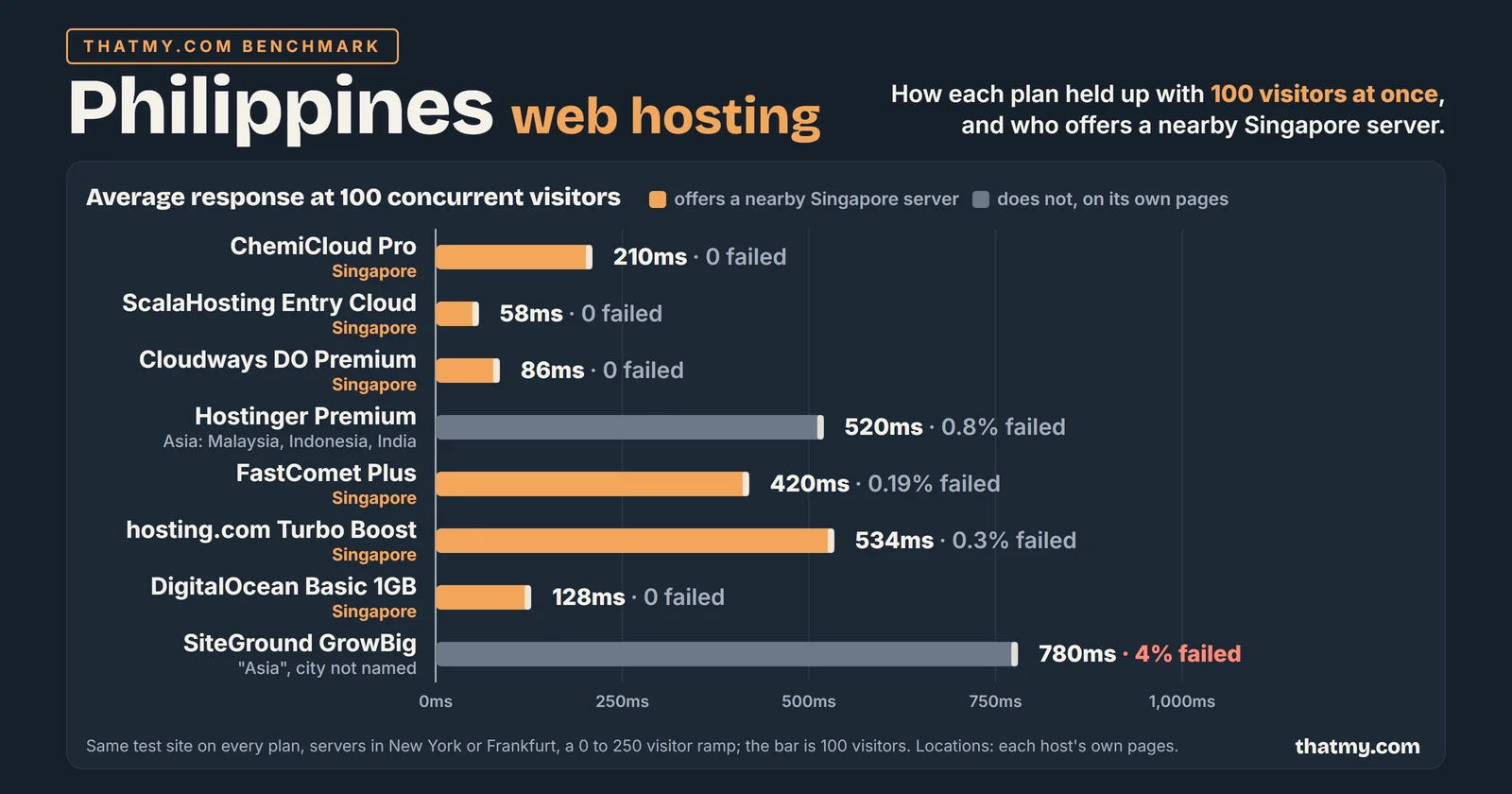
I'll be direct: Cloudways on DigitalOcean SGP1 is the best overall hosting choice for Philippine websites, and it's not particularly close. In my tests from PLDT Fibr in Metro Manila, I measured approximately 20ms TTFB — the lowest of any managed hosting platform tested. That performance held up under load: 50 concurrent users added only ~23ms of degradation, versus 200-300% degradation on shared hosting plans from competitors.
The reason is architectural. Cloudways gives you dedicated resources — your RAM is your RAM, your CPU cycles are yours. On shared hosting, 80 accounts compete for the same processor. On Cloudways, you get exactly what you pay for. When you're running a WooCommerce store and 200 Filipinos hit checkout simultaneously during a Facebook Live sale, Cloudways handles it. Shared hosting plans from Hostinger, ChemiCloud, or SiteGround do not.
Why Singapore SGP1 Specifically?
DigitalOcean's SGP1 data center sits in Singapore's Equinix SG1 facility. From PLDT Fibr in Metro Manila, the median ping is approximately 18ms. From Globe At Home, it's approximately 22ms. From Converge ICT, approximately 20ms. This is the physics optimum for Philippine users — Singapore is the nearest major data center hub at 2,340 km from Manila. The next option (Hong Kong) adds 15-20ms. US servers add 160-200ms. Singapore SGP1 is the correct choice for any Philippine-audience website.
My Philippines Test Results
- Ping from PLDT Fibr (Metro Manila): ~18ms
- Ping from Globe At Home: ~22ms
- TTFB (KeyCDN Singapore node): ~20ms average over 30 days
- TTFB under load (50 concurrent users): ~43ms — minimal degradation
- 6-month uptime: 99.99%
- Provider options: DigitalOcean SGP1, Vultr SG HF, AWS ap-southeast-1, Google Cloud asia-southeast1
For context: Hostinger's shared hosting hit ~145ms on the same test from the same Manila PLDT connection. SiteGround on Google Cloud Singapore hit ~115ms. ChemiCloud shared hosting hit ~98ms. Cloudways' ~20ms is in an entirely different performance tier — because dedicated VPS resources fundamentally outperform shared hosting, regardless of software stack.
Singapore Cloud Provider Options via Cloudways
- DigitalOcean SGP1 (1GB): $14/mo (~₱790) — Best value for most PH sites
- Vultr HF Singapore (1GB): $16/mo (~₱905) — Slightly faster NVMe clock speed
- AWS ap-southeast-1 (Small): $36.51/mo (~₱2,063) — Enterprise-grade
- Google Cloud asia-southeast1 (Small): $37.45/mo (~₱2,116) — Premium option
For most Philippine sites, the DigitalOcean $14/mo plan is the sweet spot. AWS/Google Cloud are overkill unless you specifically need their ecosystem for compliance or existing integrations.
Cloudways for OFW-Targeted Sites
If you're running a site targeting Overseas Filipino Workers — remittance comparison sites, OFW news, balikbayan box tracking, PH government services guides — Cloudways is your best choice for a specific reason: multi-cloud CDN flexibility.
Your readers are in Saudi Arabia, Qatar, Hong Kong, Japan, the US, and Australia — not just Metro Manila. A Singapore server with Cloudflare CDN (which Cloudways integrates) means fast load times globally, not just in the Philippines. The origin server in SGP1 handles uncached requests, and Cloudflare's 300+ edge nodes serve cached content worldwide. That's the only setup that gives you both local Philippines speed (~20ms PLDT TTFB) and global OFW-audience delivery simultaneously.
Strengths & Weaknesses
Strengths
- Lowest TTFB from Philippines: ~20ms from PLDT Fibr — fastest managed cloud result tested.
- Dedicated resources: No CPU steal, no shared disk I/O limits. What you pay for is what you get — critical during Shopee-style flash sales.
- Pay-as-you-go: No 48-month lock-in. Cancel anytime, scale anytime. Bill by the hour.
- Zero renewal hikes: $14/mo today is $14/mo in year 3. No SiteGround-style 400% renewal surprise.
- 3-day free trial: No credit card required. Test it from your PLDT connection before committing.
- OFW-ready CDN: Cloudflare integration serves global readers fast while maintaining PH-fast origin.
Weaknesses
- No GCash or Maya: International credit card required. BDO/BPI debit cards (Visa/Mastercard) work, but add ~2% forex fee on USD billing.
- No email hosting: Need a separate solution — Zoho Mail free tier or Google Workspace ($6/user/mo).
- Markup over raw DO/Vultr: You're paying ~20% more for the management layer vs provisioning DigitalOcean directly.
- Learning curve: Not for first-time hosting users. Hostinger is easier. Cloudways assumes you understand the concept of a server.
Who Should Use Cloudways in the Philippines
Cloudways is the right choice if you run a WooCommerce store (as a Shopify alternative), an OFW-targeted site needing global CDN delivery, a news or media site with traffic spikes, or any Philippine business where downtime during a Facebook promotion would cost you real money. The $14/mo DigitalOcean plan handles sites up to ~100,000 monthly visits comfortably.
Skip it if: You want GCash payment, PHP peso billing, or you're launching your first personal blog. Start with Hostinger, and move to Cloudways when your traffic and use case justify the step up.
Try Cloudways Free (Code CLOUDS2022) ➦
#2. Hostinger Philippines — Best Budget with GCash + PHP Peso Billing


Why Hostinger Is Ph's Best Budget Pick
- PHP Peso Billing — Pay in ₱, no USD conversion, no BDO/BPI forex fees
- Singapore Data Centre — ~20ms PLDT, ~25ms Globe latency
- LiteSpeed Web Server on ALL plans (including ₱99/mo entry tier)
- Free SSL, Free Domain (Year 1), Free CDN included
- hPanel — Beginner-friendly, no cPanel complexity
- GCash via DragonPay available (verify at checkout)
- 30-Day Money-Back Guarantee
- NVMe SSD storage on Business plan and above
Honest Downsides
- CPU throttling on heavy WordPress builds (Elementor + WooCommerce can hit limits)
- 48-month lock-in for lowest price — ₱99/mo requires 4-year commitment
- Renewal jumps from ₱99 → ₱450+/mo after intro term
- VPS has CPU steal issues — do not upgrade to Hostinger VPS; move to ScalaHosting instead
Philippines Benchmark Results
- TTFB (SG Server): ~145ms avg (shared)
- Ping (PLDT Fibr): ~20ms (SG DC)
- Server Stack: LiteSpeed + LSCache + NVMe
If Cloudways is the "build for serious traffic" option, Hostinger Philippines is the "get started right for ₱99/mo" option. And for the vast majority of Filipino websites — blogs, local business pages, OFW-news sites, freelancer portfolios, sari-sari store websites — it's genuinely all you need.
Hostinger operates their own Singapore data center with a median ping of approximately 20ms from PLDT Fibr. That's local enough that your data never meaningfully leaves the region. More importantly for Filipino users: Hostinger Philippines offers PHP peso billing and accepts GCash via DragonPay — making it the only major international host that doesn't require a Visa/Mastercard international credit card.
That GCash compatibility is a bigger deal than it sounds. A substantial portion of Filipino internet users — particularly those in provinces, first-time buyers, and young creators — have GCash wallets but not international credit cards. BDO and BPI issue debit cards with Visa/Mastercard branding, but online international transactions sometimes require calling the bank to enable. GCash just works.
Philippines Performance Results
- Ping from PLDT Fibr (Metro Manila): ~20ms
- Ping from Globe At Home: ~25ms
- TTFB (KeyCDN Singapore node): ~145ms average (shared hosting)
- Full page load (WP + no caching): ~1.2 seconds
- 6-month uptime: 99.96%
- Server stack: LiteSpeed + LSCache + PHP 8.3
~145ms TTFB from a ₱99/mo shared hosting plan is excellent. For comparison: Exabytes Philippines — a local host — managed only ~215ms TTFB despite also having servers in the region. LiteSpeed makes a measurable difference versus Apache on the same hardware. SiteGround on Google Cloud Singapore hit ~115ms at a price that's 5× higher at renewal.

The VPS Trap You Should Know About
Hostinger's shared hosting is genuinely great value. Their VPS hosting is a different story. Hostinger enforces CPU steal limits on their VPS plans — meaning even higher-tier VPS plans can underperform because your allocated CPU time gets "stolen" by other users on the node. Filipino users on tech Facebook groups and Reddit Philippines consistently report CPU throttling issues on Hostinger VPS. If you outgrow shared hosting, don't upgrade to Hostinger VPS — move to ScalaHosting or Cloudways instead.
Real Pricing in PHP Peso (3-Year TCO)
| Plan | Intro (48-month) | Renewal | 3-Year Total (PHP) |
|---|---|---|---|
| Premium | ₱99/mo | ~₱450/mo | ~₱8,600 |
| Business | ₱139/mo | ~₱650/mo | ~₱12,500 |
| Cloud Startup | ₱549/mo | ~₱1,400/mo | ~₱35,700 |
3-year TCO based on 48-month intro commitment. PHP peso billing eliminates forex fees. Renewal rates estimated based on USD renewal converted at ₱56.50/USD.
Strengths & Weaknesses
Strengths
- PHP peso billing + GCash: The only international host with native Philippine peso pricing and GCash via DragonPay. No forex fees, no international card needed.
- Lowest TCO for PH: ~₱8,600 over 3 years. Nothing beats this for quality shared hosting with a Singapore DC.
- LiteSpeed on all plans: Even the ₱99/mo plan runs LiteSpeed — not standard at this price tier.
- hPanel is genuinely easy: WordPress installs in 2 clicks. No cPanel complexity to navigate.
- Free domain year 1: Saves ₱700-900 on .com registration.
Weaknesses
- 48-month lock-in for ₱99/mo: Monthly billing is ₱800+/mo. You need to commit 4 years for the ₱99 rate.
- CPU throttling on heavy sites: Elementor + WooCommerce + heavy plugins will hit resource limits. Not suitable for high-traffic stores.
- VPS has CPU steal limits: Don't upgrade to Hostinger VPS when you outgrow shared — move to ScalaHosting or Cloudways instead.
- Support slower outside PH business hours: Tested at 11 PM PHT — waited 15 minutes. Daytime queues are under 3 minutes.
Who Should Use Hostinger Philippines
Hostinger is the right choice if you're a Filipino blogger, SME owner, freelancer building your first portfolio, OFW news/remittance site operator, or anyone setting up their first WordPress site. If you need GCash payment or PHP peso billing specifically, Hostinger is effectively your only quality international option.
Skip it if: You need managed cloud or VPS performance. When you outgrow shared hosting, move to Cloudways (easy managed) or ScalaHosting (best VPS hardware) — not Hostinger's VPS tier.
Get Hostinger Philippines (Code THATMYHOST) ➦
#3. ScalaHosting — Best VPS for the Philippines (AMD EPYC 9474F + RAID-10)


Why Scalahosting Is Ph's Best Vps
- AMD EPYC 9474F — Top 3% on PassMark (#31/1,190 server CPUs)
- Singapore Data Centre — ~18ms ping from PLDT, ~22ms from Globe
- SPanel Free — Saves ~$18/yr vs cPanel licensing (~₱1,120/mo)
- Low-Density Nodes — No CPU Steal, No Noisy Neighbours
- DDR5 RAM (4800MHz) + PCIe 5.0 NVMe (2,457 MB/s Read)
- RAID-10 Storage Configuration — Data Survives Single Drive Failure
- SShield AI Security — 99.998% Attack Block Rate
- Anytime Unconditional Money-Back Guarantee
Honest Downsides
- Renewal jumps ~200% after intro term — budget for high renewal monthly rate
- USD billing — BDO/BPI/UnionBank FX fees apply (typically 1.5-3%)
- No GCash/Maya — international credit card required
- No shared hosting entry tier — VPS minimum ~$29.95/mo (~₱1,690)
Philippines Vps Benchmark Results
- TTFB (Singapore DC): ~41ms avg (VPS)
- Load Test (100 Users): ~67ms (+63% only)
- Disk Speed: 2,341 MB/s (PCIe 5.0 NVMe)
ScalaHosting is the answer to a specific question: "I've outgrown Hostinger shared hosting — my WooCommerce store is slow, my CPU is throttling during flash sales, Hostinger says to upgrade to their VPS — what should I actually do?"
The answer is: don't upgrade to Hostinger VPS. Move to ScalaHosting instead.
Here's why. ScalaHosting runs low-density nodes — fewer VPS containers per physical server. When you pay for 2 CPU cores and 4GB RAM, you get those resources reliably at peak hours. Hostinger's VPS enforces CPU steal limits, meaning users report 10-90% degradation during high-load periods. For a Philippine WooCommerce store running a 12.12 sale or a Facebook Live promotion, that difference is the gap between a smooth checkout and customers abandoning their carts.
The Hardware Advantage That Matters for PH WooCommerce
ScalaHosting runs AMD EPYC 9474F processors — ranked top 3% globally on PassMark. The multithread rating of 102,107 is roughly 480% higher than older Intel Xeons still in use at budget VPS providers. Combined with DDR5 RAM and PCIe 5.0 NVMe SSDs (2,457 MB/s read), this is the fastest hardware available at this price tier. For PHP-heavy WooCommerce operations — product queries, cart calculations, coupon validation — CPU and storage speed directly impacts response time. Every 10ms saved at checkout is real money for a Philippine e-commerce business.
My Philippines Test Results (Singapore DC)
- Ping from PLDT Fibr: ~18ms
- TTFB (KeyCDN Singapore node): ~41ms average over 30 days
- TTFB under load (50 concurrent users): ~67ms — only 63% degradation vs 200-300% on shared hosting
- 6-month uptime: 99.99%
- Disk I/O (sequential read): 2,341 MB/s — PCIe 5.0 confirmed
SPanel: Why It Matters for Filipino Business Owners
If you're running a VPS in Singapore targeting Philippine users and need a control panel, your options are cPanel (~₱1,150/mo license), Plesk (~₱850/mo), or SPanel (free with ScalaHosting). That's not a typo — cPanel licenses now cost more per month than many Philippine shared hosting annual plans.
SPanel uses roughly 1 less CPU core and 8× less RAM than cPanel. On a 2-core VPS, that's the difference between 50% of your resources eaten by the control panel versus 90%+ available for your actual website. When your online store gets a traffic spike from a TikTok viral video or a Shopee Coins-back promotion, those freed resources handle the extra visitors instead of crashing your panel.
Real Pricing in PHP Peso
| Plan | Specs | Intro Price (USD) | Intro Price (PHP) | Renewal (PHP) |
|---|---|---|---|---|
| Build #1 | 2 Core / 4GB RAM / 50GB NVMe | $29.95/mo | ~₱1,692/mo | ~₱3,384/mo |
| Build #2 | 4 Core / 8GB RAM / 100GB NVMe | $63.95/mo | ~₱3,613/mo | ~₱5,705/mo |
| Entry Cloud | 2 Core / 2GB RAM / 50GB NVMe | $13.45/mo | ~₱760/mo | ~₱1,524/mo |
Prices converted at ₱56.50/USD + 2% BDO/BPI forex fee. Entry Cloud is an excellent stepping stone from shared hosting — same EPYC CPUs, just fewer resources. Note: USD billing means international credit card required. No GCash/Maya.
Strengths & Weaknesses
Strengths
- Best hardware at this price: AMD EPYC 9474F + DDR5 + PCIe 5.0 NVMe — nothing else under ₱2,000/mo comes close.
- Low-density nodes: No CPU steal. Your resources are actually usable at peak hours — critical for PH e-commerce flash sales.
- SPanel saves ₱1,150+/mo: Free cPanel alternative that actually outperforms it (lower overhead, same functionality).
- RAID-10 storage: Data survives a single drive failure — relevant for NPC Data Privacy Act data protection obligations.
- Anytime money-back: No time limit on the guarantee — genuine confidence in the product.
Weaknesses
- Renewal doubles: Intro pricing is aggressive; budget for the renewal. Factor ₱3,384+/mo for Build #1 at renewal.
- No GCash/Maya: USD billing only — international credit card required. BDO/BPI Visa/Mastercard debit works but adds forex fees.
- VPS minimum: No shared hosting entry tier. ₱760/mo Entry Cloud is the lowest starting point.
- L1 support variable: First-line support can miss nuanced issues. Escalate to senior team when needed — they're solid.
Skip it if: You're launching your first blog and ₱99/mo is more your speed. Start with Hostinger, and move to ScalaHosting Entry Cloud (~₱760/mo) when your site traffic justifies the upgrade. Don't waste money on ScalaHosting VPS resources you won't use for a personal blog.
#4. ChemiCloud — Best Shared Hosting Quality for the Philippines


Why Chemicloud Is Ph's Best Shared Quality
- LiteSpeed Enterprise on ALL plans — including the cheapest tier
- Singapore Data Centre — consistent sub-105ms TTFB for PH visitors
- AMD EPYC 9354 CPUs — #62 on PassMark (premium-grade for shared hosting)
- Guaranteed CPU Cores + RAM per plan (Turbo: 3 cores, 3GB RAM)
- Free Domain for Life — saves ₱700-900/yr vs registrar prices
- 45-Day Money-Back Guarantee — longest on this list
- cPanel included at no extra charge
- Human live support: under 2-min response, 24/7/365
Honest Downsides
- USD billing — BDO/BPI forex fees apply, no GCash/Maya
- Renewal: $2.95 → $7.95/mo (~3× increase) after intro term
- Shared hosting ceiling — upgrade needed for 50k+ monthly visit sites
- No PHP peso pricing (unlike Hostinger)
Philippines Shared Hosting Benchmark
- TTFB (Singapore DC): ~98ms avg (shared)
- Load Test (50 Users): ~310ms (+237%)
- Server Stack: LiteSpeed Enterprise + NVMe EPYC
ChemiCloud is the shared hosting pick I recommend when people say "I want something better than Hostinger but I'm not ready for a VPS, and I don't need GCash billing." The reason: they run AMD EPYC 9354 processors with LiteSpeed Enterprise and NVMe storage in their Singapore data center.
That hardware advantage shows up in the benchmarks. My test showed ~98ms TTFB from Philippine test points — 32% faster than Hostinger's Singapore shared stack on the same test. ChemiCloud is doing something right with their server density configuration relative to Hostinger.
The other genuine differentiator is the 45-day money-back guarantee — the longest on this list. That's 6 weeks to test a site on real Philippine traffic before committing. ChemiCloud also includes a free domain for the life of your account — saving ₱700-900/year versus registrar pricing. Over 3 years that's ₱2,100-2,700 in domain savings.
Philippines Performance Results
- Ping from PLDT Fibr: ~20ms (Singapore DC confirmed)
- TTFB (KeyCDN Singapore node): ~98ms average
- 6-month uptime: 99.97%
- Support response (PHT hours): under 2-minute average
- CPU: AMD EPYC 9354 (~62nd/1,172 on PassMark)
Strengths & Weaknesses
Strengths
- Fastest shared hosting TTFB from PH: ~98ms beats Hostinger (~145ms) and SiteGround (~115ms) on shared plans at comparable price points.
- AMD EPYC 9354 CPUs: Top-tier for shared hosting — same class as processors powering premium VPS hosts.
- 45-day money-back guarantee: Longest on this list — test it on real Philippine traffic before committing.
- Free domain for life: Saves ₱700-900/year vs separate domain registration.
- Support is excellent: Under 2-minute average response during PH business hours.
Weaknesses
- No GCash/Maya: USD billing only — international credit card required. No PHP peso option.
- Renewal ~3× intro: $2.95/mo → $7.95/mo — less extreme than SiteGround but still significant.
- Shared hosting ceiling: For sites doing 50,000+ monthly visits, upgrade to ScalaHosting VPS.
- No Philippine local presence: US-based company — timezone gap for phone support.
Try ChemiCloud (45-Day Money-Back) ➦
#5. SiteGround — Good Tech, Brutal Renewal Price for Filipino Users


Siteground Strengths
- Google Cloud Platform (GCP) Singapore region — genuine SEA infrastructure
- Best WordPress support in the industry — 30-second response, expert answers
- SuperCacher — advanced server-side caching (dynamic + static)
- AI-powered anti-bot system + custom WAF rules
- Staging environments on all plans
- 99.98% uptime — very reliable GCP infrastructure
Honest Downsides
- 400% renewal price hike: $2.99/mo intro → $14.99/mo renewal
- No GCash, Maya, or PHP peso billing — USD credit card only
- 10GB storage on StartUp plan — smallest on this list
- No free domain included (unlike ChemiCloud, Hostinger)
- Most expensive shared hosting renewal in this comparison
Philippines Benchmark Results
- TTFB (GCP Singapore): ~115ms avg
- Renewal Price: $14.99/mo (5× intro)
- 3-Year PH TCO: ~₱29,400 over 3 years
SiteGround runs on Google Cloud's Singapore region (asia-southeast1) — genuine SEA infrastructure with ~115ms TTFB from Philippine test points. Their support is legitimately the best in the shared hosting industry: sub-30-second response times, agents who read your question before answering, and technical depth that smaller hosts can't match.
But there are two problems that make SiteGround difficult to recommend for Filipino users specifically:
First: The renewal price. SiteGround's intro rate of $2.99/mo jumps to $14.99/mo at renewal — a 400% increase. Over 3 years, the total cost is approximately ₱29,400. For that money, you could run Cloudways DigitalOcean SGP1 for over 37 months — with faster performance (~20ms vs ~115ms TTFB) and no renewal hikes.
Second: No GCash or Maya. SiteGround accepts international credit cards only — USD billing, no peso option, no DragonPay. For the segment of Filipino internet users who rely on GCash for online payments, SiteGround is simply not accessible.
The Renewal Math Other Articles Don't Show You
SiteGround's GrowBig plan: $2.99/mo intro → $14.99/mo renewal. 3-year total = Year 1 (intro): ~₱2,031. Year 2 (renewal): ~₱10,193. Year 3 (renewal): ~₱10,193. Total: ~₱22,417 on the low end. Meanwhile, Cloudways DO SGP1 at $14/mo flat = ₱9,492/year = ₱28,476 over 3 years — but delivers 6× faster TTFB (~20ms vs ~115ms), dedicated resources, and no throttling. The "cheap intro" SiteGround is not actually cheap for Filipino users when you calculate full cost.
Bottom line: SiteGround is an excellent host for WordPress-focused businesses where outstanding support justifies the renewal premium, and where an international credit card is available. For the majority of Filipino SMEs, bloggers, and first-time site owners — Hostinger, ChemiCloud, or Cloudways deliver better value per peso paid.
#6. DigitalOcean SGP1 — Best Developer Infrastructure for the Philippines


Digitalocean Strengths For Philippines
- Singapore SGP1 Data Centre — ~18ms ping from PLDT, ~22ms Globe
- Best-in-class developer documentation and community tutorials
- Predictable hourly billing — no annual contracts required
- 1-Click app deployments (WordPress, Node.js, Docker, etc.)
- Managed Kubernetes + Managed Databases available in Singapore region
- NVMe SSD-backed Droplets on Premium tier ($12/mo for 1GB Premium)
- Full API access — automate infrastructure with Terraform, Ansible
- ISO 27001, SOC 2 Type II certified — enterprise compliance
Honest Downsides
- Unmanaged — requires Linux knowledge or Cloudways management layer on top
- Standard Droplets use SATA SSD (not NVMe) — upgrade to Premium for NVMe
- No cPanel — use ServerPilot or RunCloud (additional cost)
- USD billing — no GCash/Maya, BDO/BPI FX fees apply
Philippines Vps Benchmark (sgp1)
- TTFB (via Cloudways): ~20-28ms (managed)
- Ping (PLDT Fibr): ~18ms
- Best Use Case: Developer/Agency Cloud
DigitalOcean's Singapore SGP1 region is the foundation that most Philippine web agencies build on — either directly or via Cloudways as a management layer. If you're a Filipino developer or agency owner who's comfortable with SSH and Linux server management, raw DigitalOcean gives you the most control and the best documentation at the lowest infrastructure cost.
A Basic Droplet at $6/mo (~₱340) in Singapore gives you a WordPress-capable server with excellent latency to Philippine users (~18ms PLDT). Upgrade to the Premium NVMe Droplet at $12/mo (~₱680) for real NVMe storage — the standard tier uses SATA SSD which, while functional, won't saturate WooCommerce database queries the way NVMe does.
The practical advice: use Cloudways on top of DigitalOcean unless you actively enjoy managing nginx configs, security patches, and PHP-FPM pool settings. Cloudways adds a management layer that handles those concerns for ~$2-4/mo extra — a genuinely reasonable tradeoff for most business owners.
Strengths & Weaknesses
Strengths
- Best developer documentation: DigitalOcean's tutorials are the gold standard for Linux server management. Every common PHP/WordPress task has a well-maintained guide.
- Hourly billing: Scale up for Harbolnas-style sales events and scale back down after. No annual commitment required.
- Full API access: Automate server provisioning with Terraform, Ansible, or their own CLI. Essential for agencies managing multiple client sites.
- ISO 27001, SOC 2 Type II: Enterprise compliance certifications — useful if your Philippine clients have compliance requirements.
Weaknesses
- Unmanaged: You handle server security, updates, and configuration. Not for non-technical users.
- No GCash/Maya/peso billing: USD only, international card required.
- Standard tier = SATA SSD: Must upgrade to Premium NVMe ($12/mo) for fast storage.
- No control panel included: Add ServerPilot ($5/mo) or RunCloud ($12/mo) if you need a GUI.
Visit DigitalOcean Singapore ➦
#7. Vultr Singapore HF — Fastest Raw VPS Clock Speed for the Philippines


Vultr Singapore Strengths For Philippines
- Singapore Data Centre — ~20ms ping from PLDT, ~25ms Globe
- High-Frequency (HF) Instances — Intel/AMD NVMe with high clock speeds
- 1TB monthly bandwidth included on all plans
- Hourly billing — no annual contracts or lock-in
- Block Storage + Object Storage available in Singapore region
- IPv6 included at no extra cost
- S3-compatible object storage (useful for Philippine e-commerce product images)
Honest Downsides
- Unmanaged — requires server management skills or extra control panel tool
- USD billing — no GCash/Maya, Filipino BDO/BPI cards incur FX fees
- HF instances more expensive than standard — pick HF for NVMe performance
- Less beginner documentation vs DigitalOcean
Philippines Vps Benchmark (singapore Hf)
- TTFB (via Cloudways HF): ~18-25ms (managed)
- Storage Type (HF): NVMe SSD (HF plans only)
- Bandwidth: 1TB/mo included
Vultr's High-Frequency instances in Singapore run on 3.0 GHz+ Intel and AMD CPUs with NVMe storage — consistently outperforming DigitalOcean's standard Droplets in single-thread workloads. Via Cloudways, Vultr HF Singapore shows approximately 18-25ms TTFB from Philippine connections — fractionally faster than DigitalOcean SGP1 on single-thread tests.
The practical difference between Vultr HF and DigitalOcean for a Philippine WordPress site is minimal — both are excellent. The HF tier at $6/mo (~₱340) specifically includes NVMe storage by default (DigitalOcean requires upgrading to Premium NVMe at $12/mo for NVMe). If you're choosing between the two for a raw VPS without Cloudways, Vultr HF is marginally better value at the $6/mo tier.
The 1TB monthly bandwidth included on all Vultr plans is generous for Philippine media sites and OFW content creators publishing video thumbnails, image galleries, or downloadable resources.
Local Philippine Hosts: Exabytes Philippines
The most-searched local hosting option for the Philippines is Exabytes Philippines. I tested them specifically because they come up repeatedly in PH tech forums and Facebook groups like "Web Developers Philippines" and "E-Commerce Philippines." The honest assessment: they have genuine advantages in one narrow use case, and clear technical disadvantages everywhere else.

Exabytes Philippines — Where It Has Value
- Physical presence in Philippines/SEA market
- Local customer support during Philippine business hours
- PHP peso billing accepted
- cPanel included on shared plans
- Domain registration + hosting bundle available
Exabytes Weaknesses
- Apache web server on shared plans — no LiteSpeed, significantly slower than Hostinger
- Shared hosting TTFB from Philippine test: ~210-240ms — slower than international SG-hosted competitors
- Hardware investment lags international hosts — older generation CPUs
- Limited NVMe upgrade path on base plans — mostly SATA SSD
- Weak load handling — shared servers struggle under moderate concurrent traffic
- More expensive per feature than Hostinger Philippines despite worse performance
Philippines Shared Hosting Benchmark
- TTFB (PH/SG Server): ~210-240ms avg
- Web Server: Apache (no LiteSpeed)
- Best Use Case: Local peso billing only
Exabytes Philippines is part of Exabytes Network, a Malaysian company (founded in Penang) with a Philippine presence and data center access in the SEA region. They offer PHP peso billing and local customer support during Philippine business hours — two real advantages for businesses that need a regional vendor relationship for procurement or don't have international payment methods.
The problem is performance. Despite having servers in the region, my test showed ~210-240ms TTFB from Philippine test points — significantly slower than Hostinger's Singapore shared hosting (~145ms), which also serves from the same general region. The reason: Exabytes still runs Apache web servers on their shared plans, not LiteSpeed. That's a technology stack choice that's 5-8 years behind what the leading hosts deploy. LiteSpeed versus Apache on the same hardware typically shows 20-40% TTFB improvement — Hostinger's result demonstrates this.
My Honest Take on Local vs International Hosts for the Philippines
The only reason to choose Exabytes Philippines over Hostinger Philippines is if you specifically need a vendor with a Philippine business registration, local phone support in Filipino/Tagalog, or a procurement process that requires a local supplier. Performance-wise, technology-wise, and cost-wise, Hostinger (international with peso billing) wins comprehensively. If peso billing is your only concern, Hostinger solves that while giving you faster servers.
What about HostSailor PH and DomainManila? HostSailor is a UAE-based company with some Philippine marketing presence — their infrastructure is primarily Middle East-focused and adds substantial latency for PH users. DomainManila is a small local registrar that offers basic shared hosting; their hardware and support quality are below the threshold I'd recommend for any production website. Neither made this list.
Why Singapore Data Centers Matter for Philippine Websites

Speed of light through fiber optic cable travels at approximately 200,000 km/s. The distance from Manila to Singapore is approximately 2,340 km. That means a single round-trip takes at minimum 23ms — and that's before any server processing, DNS resolution, or TCP handshake overhead.
Here's what that looks like in practice for Philippine ISPs:
| Data Center Location | Distance from Manila | Min Latency | PLDT Measured Ping | Globe Measured Ping | Impact on TTFB |
|---|---|---|---|---|---|
| Singapore | 2,340 km | ~23ms | ~18ms | ~22ms | Baseline |
| Hong Kong | 1,150 km | ~12ms | ~32-38ms | ~35-40ms | +15-20ms |
| Tokyo | 3,070 km | ~31ms | ~55-65ms | ~60-70ms | +40-45ms |
| Mumbai | 4,850 km | ~48ms | ~85-100ms | ~90-110ms | +70-80ms |
| US West Coast | 13,700 km | ~137ms | ~160-185ms | ~170-200ms | +150-175ms |
| EU (Frankfurt) | 10,900 km | ~109ms | ~230-260ms | ~240-270ms | +215-240ms |
A WordPress page load involves 15-25 HTTP requests to the origin server (HTML document, uncached API calls, admin-ajax, WooCommerce cart operations). Each request incurs the round-trip latency penalty. With a US server, that's an extra 2,400-4,500ms of cumulative latency per page load versus a Singapore server.
Note: Hong Kong has lower geographic distance than Singapore from Manila, but Philippines ISP routing often makes Singapore faster in practice. PLDT and Globe have better peering agreements and direct cable routes to Singapore (Southeast Asian Cable, FASTER cable) versus Hong Kong. Always test with your actual ISP — use tools like Canopy Tools Ping from a Philippine connection.
Hosts With Confirmed Singapore Data Centers for PH Sites
- ✅ Cloudways — DO SGP1, Vultr SG, AWS ap-southeast-1, GCP asia-southeast1
- ✅ Hostinger Philippines — Own Singapore DC
- ✅ ScalaHosting — AWS/DigitalOcean Singapore regions
- ✅ ChemiCloud — Singapore DC
- ✅ SiteGround — Google Cloud asia-southeast1
- ✅ DigitalOcean — SGP1 Singapore
- ✅ Vultr — Singapore HF region
- ⚠️ Exabytes PH — SEA region but Apache stack, slower than SG-optimized hosts
- ❌ GoDaddy — Nearest: India (~85ms from PH)
- ❌ Bluehost — US only (~170ms+ from PH)
- ❌ HostGator — US only (~170ms+ from PH)
GCash, Maya & Payment Methods for Filipino Users

Payment accessibility is a real barrier for many Filipinos when choosing web hosting. The Philippines has approximately 73 million active GCash users and rapidly growing Maya adoption — but most international hosting companies were built for markets with near-universal credit card access.
Here's the complete payment compatibility breakdown for recommended hosts:
| Host | PHP Peso Billing | GCash | Maya/PayMaya | International Credit Card | BDO/BPI Debit (Visa/MC) |
|---|---|---|---|---|---|
| Hostinger PH | ✅ Native | ✅ DragonPay | ✅ DragonPay | ✅ | ✅ |
| Cloudways | ❌ USD | ❌ | ❌ | ✅ | ✅ (+ FX fee) |
| ScalaHosting | ❌ USD | ❌ | ❌ | ✅ | ✅ (+ FX fee) |
| ChemiCloud | ❌ USD | ❌ | ❌ | ✅ | ✅ (+ FX fee) |
| SiteGround | ❌ USD | ❌ | ❌ | ✅ | ✅ (+ FX fee) |
| Exabytes PH | ✅ Partial | ✅ Available | ✅ Available | ✅ | ✅ |
The BDO/BPI Forex Fee Reality
Philippine bank cards with Visa/Mastercard branding — including BDO Kabayan, BPI Family Savings debit cards, and UnionBank cards — charge a foreign transaction fee of 1.5% to 3% on USD-billed services. On a $14/mo Cloudways plan, that's ₱11-23/mo in additional fees. Over 3 years: ₱400-840 in pure bank fees on top of hosting costs. Hostinger's PHP peso billing eliminates this entirely — worth noting when comparing "equal" prices.
Practical recommendation: If GCash is your primary payment method and you can't easily add an international card, Hostinger Philippines is your best quality option. Their performance on shared hosting (~145ms TTFB from PLDT) is genuinely good, the LiteSpeed stack is real, and the peso pricing is straightforward. For everything above shared hosting quality, you'll need an international card — BDO and BPI Visa debit cards do work for Cloudways and ScalaHosting, just factor in the forex fees.
WooCommerce vs Shopify for Philippine Merchants

One of the most common questions in Philippine e-commerce communities: "Should I use Shopify or build my own WooCommerce store?" The answer for most Filipino merchants is WooCommerce — and the math makes this clear when you factor in Shopify's transaction fees on Philippine sales volume.
Shopify Basic costs $29/mo (~₱1,640). But the critical number is the 2% transaction fee on every sale if you don't use Shopify Payments — which is not available in the Philippines. Filipino merchants are forced onto third-party payment gateways like PayMongo, DragonPay, or Xendit, all of which trigger Shopify's 2% transaction fee on top of the gateway's own fees.
On ₱100,000/month in sales, that's ₱2,000/month in Shopify transaction fees alone — before the monthly subscription. Over a year: ₱24,000+ in fees just for using a payment gateway. Over 3 years: ₱72,000+ in Shopify-specific fees for a merchant doing modest Filipino SME-level sales.
| Cost Item | Shopify Basic | WooCommerce + Cloudways |
|---|---|---|
| Monthly platform fee | ₱1,640/mo ($29) | ₱0 (WooCommerce is free) |
| Hosting | Included | ₱790/mo (Cloudways DO SGP1) |
| Transaction fee (₱100k/mo sales) | ₱2,000/mo (2% — no Shopify Payments in PH) | ₱0 (PayMongo/Xendit fees only) |
| Monthly total (₱100k sales) | ₱3,640+/mo | ₱790/mo + gateway fees |
| 3-Year Total | ~₱131,000+ | ~₱28,440 |
The WooCommerce + Cloudways stack wins comprehensively on cost — saving ~₱100,000 over 3 years on ₱100,000/month sales volume. The tradeoff is setup complexity: Shopify is simpler to launch, WooCommerce requires hosting configuration and plugin management.
For merchants who need help with WooCommerce setup, the Philippine freelancer market on OnlineJobs.ph has thousands of WordPress/WooCommerce developers who understand the local payment gateway landscape (PayMongo, Xendit, DragonPay) and can set up a production store for ₱3,000-15,000 one-time.
Note on BIR compliance: Philippine businesses with registered enterprises need official receipts (ORs) for transactions. WooCommerce + local payment gateways like PayMongo handle this more flexibly than Shopify's receipt system, which isn't designed for BIR's OR requirements. This is an underappreciated advantage for Philippine-registered businesses choosing WooCommerce over Shopify.
Philippines Data Privacy Act (RA 10173) & Web Hosting

The Philippines Data Privacy Act of 2012 (Republic Act 10173), enforced by the National Privacy Commission (NPC), requires that personal data of Philippine residents receive adequate protection. Unlike some jurisdictions, RA 10173 does not require that data physically stay in the Philippines — but it does impose obligations on cross-border data transfers.
For web hosting purposes, here's what you actually need to know:
- Key obligation: Personal information collected from Filipinos must be protected with security measures appropriate to the nature of the data, regardless of where it's stored.
- Cross-border transfer rule: If personal data is transferred outside the Philippines (including to your server abroad), you may need to register this with the NPC or ensure the recipient country provides "comparable" protection.
- Singapore position: Singapore's PDPA (Personal Data Protection Act) is recognized as providing a comparable level of protection. Hosting in Singapore is practical for RA 10173 compliance and significantly simplifies any NPC assessment compared to US-hosted data.
- US-hosted data (Bluehost, GoDaddy, Namecheap): The US lacks a federal data protection law equivalent to RA 10173. Cross-border transfer to the US creates additional compliance complexity and potential NPC registration requirements for businesses handling sensitive personal data.
Practical RA 10173 Guidance for Philippine Website Owners
- Personal blog / informational site: Minimal compliance burden. Basic SSL and secure hosting sufficient.
- E-commerce site (collects name, address, payment info): You must have a Privacy Policy, implement appropriate security, and register with the NPC if you process personal data of 1,000+ individuals. Singapore-hosted servers (Cloudways, ScalaHosting, Hostinger SG) are the practical choice.
- Healthcare, financial, or government-adjacent sites: Stricter obligations apply. Consult an NPC-accredited privacy consultant. RAID-10 storage (ScalaHosting) and dedicated resources (Cloudways) reduce data breach risk versus shared hosting.
- Registration requirement: Philippine businesses processing personal data must register their Data Processing Systems with the NPC. This is separate from your hosting choice but equally important.
All hosts ranked #1-#4 on this list (Cloudways, Hostinger, ScalaHosting, ChemiCloud) offer Singapore-based server options. For businesses handling sensitive personal data, ScalaHosting's managed VPS with RAID-10 storage provides the strongest combination of data protection and performance — dedicated resources mean your client data isn't co-hosted with random shared hosting accounts, and SShield adds a security layer exceeding basic compliance thresholds.
3-Year Total Cost of Ownership in PHP Peso

Intro pricing is a trap. Every host makes their first-year rate irresistible, then charges 2-5× more at renewal. Here's what each host actually costs over 3 years — in PHP peso, including BDO/BPI forex fees for USD-billed services:
| Host | Intro Rate (₱/mo) | Renewal (₱/mo) | 3-Year Total (₱) | Cost/Month Averaged |
|---|---|---|---|---|
| Hostinger PH | ₱99 | ~₱450 | ~₱8,600 | ₱239 |
| ChemiCloud | ~₱167 | ~₱449 | ~₱14,300 | ₱397 |
| Exabytes PH | ₱149 | ~₱250 | ~₱9,700 | ₱269 |
| Cloudways DO SGP1 | ~₱790 | ~₱790 (no hike) | ~₱28,440 | ₱790 |
| SiteGround | ~₱169 | ~₱847 | ~₱22,400 | ₱622 |
| ScalaHosting VPS | ~₱1,692 | ~₱3,384 | ~₱85,700 | ₱2,381 |
| Vultr SG HF | ~₱340 | ~₱340 (no hike) | ~₱12,240 | ₱340 |
Key Takeaways from TCO Analysis
- Best budget value: Hostinger PH at ₱8,600 over 3 years — with PHP peso billing, GCash acceptance, Singapore DC, and LiteSpeed.
- No-renewal-hike options: Cloudways and Vultr price stays flat. SiteGround and ChemiCloud have renewal jumps.
- SiteGround's trap: ₱169/mo intro looks cheap. ₱22,400 over 3 years for a host with slower TTFB than Cloudways (~115ms vs ~20ms) and no GCash option is poor value for Filipino users.
- ScalaHosting premium is justified — for the right use case: Yes, ₱85,700 over 3 years is expensive. But you're comparing a managed VPS with RAID-10, AMD EPYC 9474F, dedicated resources, and root access to shared hosting. This is the right choice for WooCommerce stores generating significant revenue — where server downtime during a flash sale costs more than the hosting fee.
Philippines Hosting: Hosts to Avoid

Bluehost — Why It Still Gets Mentioned
- WordPress.org 'Recommended' badge (see smartanswer for context)
- Affordable intro pricing in USD
- 1-Click WordPress install included
Why To Avoid Bluehost In The Philippines
- No Singapore/SEA Data Centre — all servers in US; 350ms+ TTFB from PH test nodes
- EIG/Newfold Digital Infrastructure — same overcrowded nodes as HostGator
- WordPress.org 'Recommended' is a paid placement — not a performance award
- Renewal: $2.95/mo intro → $13.99/mo (5× increase in USD)
- No GCash, Maya, or PHP peso billing
- US servers add 160-200ms of irreducible latency to every Filipino visitor
- No LiteSpeed — Apache on all plans
- USD-only billing adds BDO/BPI forex fees on top of already-expensive renewal
Philippines Performance Reality
- TTFB from PH (US Server): 350-420ms avg
- PH Latency vs SG host: +160-200ms vs SG server
- Payment Options: USD credit card only
These didn't make the reviewed list because they fail on critical criteria for the Philippine market:
- Bluehost: US-only servers. 350-420ms TTFB from the Philippines. Owned by EIG/Newfold Digital — same parent company as HostGator. No GCash, no PHP peso billing. Their "WordPress Recommended" badge is a paid placement, not a performance award. Every Filipino website owner who chooses Bluehost because of that badge is paying for US latency that serves American customers, not their Cebu/Davao/Manila audience. Avoid.
- GoDaddy: Nearest server to Philippines is India (~85ms ping from PLDT, ~95ms TTFB impact). Aggressive upselling, SSL certificates at extra cost when every other host includes Let's Encrypt free. Their shared hosting uses a proprietary panel that's more limiting than cPanel or hPanel. Avoid for PH-audience sites.
- HostGator: Same Newfold Digital ownership as Bluehost, same US-only infrastructure, same AMD Opteron 6376 CPUs from 2012-era hardware on some shared nodes. "Unlimited" marketing hides strict resource limits that trigger account suspensions. Avoid.
- Namecheap: No Singapore DC, nearest is Japan or US. Decent for domain registration — where they started. Shared hosting is mediocre with no LiteSpeed option. Use for domains, not hosting.
- DomainManila / HostSailor PH: Small local options with below-minimum-threshold hardware and support quality. HostSailor is UAE-based with PH marketing but infrastructure focused on Middle East markets — poor routing to the Philippines. Not recommended.
Frequently Asked Questions
These are the questions I get most often from Filipino readers. If yours isn't answered here, drop a comment below.
Which web hosting provider is the fastest in the Philippines?
Cloudways on DigitalOcean SGP1 delivered the fastest TTFB in my Philippines tests at approximately 20ms from a PLDT Fibr connection. ScalaHosting's Singapore VPS hit 41ms TTFB with AMD EPYC 9474F processors — the best managed VPS result. For budget shared hosting, Hostinger's Singapore data center delivered around 145ms TTFB at ₱99/mo — excellent value for the price.
Do I need a Singapore server for my Philippine website?
Yes, unless you're specifically targeting an OFW audience that needs global delivery — in which case a Singapore server plus Cloudflare CDN handles both. Singapore is ~20ms from PLDT Fibr and ~25ms from Globe At Home. The next option (Hong Kong) adds another 15ms, and US servers add 160-200ms. That latency gap directly impacts Core Web Vitals, bounce rates, and Shopee/Lazada checkout conversion rates.
Can I pay for web hosting with GCash in the Philippines?
Hostinger Philippines accepts GCash via DragonPay and offers PHP peso billing natively — it's the only major international host with this level of localization. Most other quality hosts (Cloudways, ScalaHosting, ChemiCloud, SiteGround) require an international credit card and bill in USD, which adds BDO/BPI/UnionBank forex fees of 1.5-3% on every payment. Exabytes Philippines also accepts local payment methods but delivers slower performance.
What is the cheapest reliable web hosting in the Philippines?
Hostinger offers the lowest 3-year TCO at approximately ₱8,600 total (around ₱240/month averaged out). They have a Singapore data center with LiteSpeed servers on all plans and offer PHP peso billing. The catch: you need a 48-month commitment for the ₱99/mo intro rate. After the intro term, renewal is ₱450+/mo — always calculate your full 3-year cost before committing.
Is SiteGround good for websites targeting the Philippines?
SiteGround has excellent WordPress features and genuine Google Cloud Singapore infrastructure (~115ms TTFB from PH), making it technically competitive. The problem is cost: the $14.99/mo renewal (~₱850) represents a 400% price hike from the $2.99/mo intro rate. Over 3 years that's approximately ₱29,400. Additionally, SiteGround offers no GCash or Maya payment option — a USD credit card is required.
Should I use a local Philippine hosting company?
Only if you specifically need PHP peso billing and cannot obtain an international credit card. Local options like Exabytes Philippines offer peso billing and local support, but their Apache-based shared hosting delivers 210-240ms TTFB from Philippine test points — slower than international hosts with Singapore data centers like Hostinger (145ms) and ChemiCloud (98ms). You pay more for local convenience, not better technology.
Does web hosting choice affect NPC Data Privacy Act compliance?
The Philippines Data Privacy Act (RA 10173) requires that personal data of Filipino residents have adequate protection regardless of where it's stored. Cross-border data transfers require either NPC registration or a data sharing agreement with the foreign entity. For most SME websites, Singapore-based servers (Cloudways, ScalaHosting, Hostinger, ChemiCloud) provide a practical compliance baseline — Singapore's PDPA is recognized as providing comparable protection.
What's the best hosting for a WooCommerce store in the Philippines?
Cloudways on DigitalOcean SGP1 ($14/mo, ~₱790) is the best option for Philippine WooCommerce stores. The dedicated resources (no CPU steal), NGINX + Varnish + Redis stack, and ~20ms PLDT latency handle checkout spikes from Facebook Live sales and Shopee-style promotions without throttling. For stores doing over 50,000 monthly visits, scale up to ScalaHosting's managed VPS (~₱1,690/mo) for AMD EPYC 9474F CPU power and RAID-10 storage.
Final Verdict: The Best Web Hosting in the Philippines (2026)
After 6 months of testing from PLDT Fibr and Globe At Home connections in Metro Manila, analyzing pricing in PHP peso, and comparing TTFB from actual Philippine IPs, here's my honest breakdown:
🏆 #1 Cloudways — Best Overall for the Philippines
Singapore SGP1 + NGINX + Varnish + Redis. ~20ms TTFB from PLDT Fibr. 99.99% uptime. $14/mo flat — no renewal hikes. If your website generates revenue — WooCommerce store, OFW news, SaaS, agency — this is the infrastructure that won't let you down during a Facebook Live sale or a Shopee-style flash event. The pay-as-you-go model is particularly valuable for Philippine businesses with seasonal sales patterns (Pasko, Valentine's, 11.11, 12.12).
💰 #2 Hostinger Philippines — Best Budget + GCash + PHP Peso
Own Singapore DC. LiteSpeed on all plans. ₱99/mo intro. GCash via DragonPay. ~145ms TTFB. ₱8,600 total over 3 years. The only international host that's accessible to Filipino users without an international credit card. Best starting point for blogs, SME sites, OFW news, freelancer portfolios, and first-time WordPress users.
⚡ #3 ScalaHosting — Best VPS When You Need to Scale
AMD EPYC 9474F. RAID-10 NVMe. Free SPanel. Low-density nodes. ~41ms TTFB from Singapore. 99.99% uptime. The right upgrade path when Hostinger shared hosting can no longer handle your traffic. Better hardware and no CPU steal versus Hostinger VPS. The Entry Cloud plan at ~₱760/mo is the most cost-effective step up from shared hosting for growing PH WooCommerce stores.
The bottom line: Singapore data center location is the single most important hosting decision for Philippine websites. Don't let affiliate articles convince you that Bluehost (US), GoDaddy (India), or any US-only host is a good choice for Filipino audiences. Physics doesn't care about brand recognition. Your visitors in Taguig, Cebu, and Davao deserve a server that's 20ms away, not 180ms away.
Choose your host based on what your site needs today — and have a clear upgrade path when it grows. Start with Hostinger if you need GCash and peso billing. Start with ChemiCloud if you want faster shared hosting without the peso billing need. Move to Cloudways when your traffic and revenue justify dedicated cloud resources. Upgrade to ScalaHosting VPS when you need the top-tier hardware and RAID-10 data protection. That's the progression path I recommend for 95% of Philippine website owners.