
Hosting Renewal Pricing: Real Costs, Shock Scores and Why Prices Keep Rising
Disclosure: some hosting links on this page earn me a commission if you buy. Pricing and benchmark data are verified independently. Full disclosure.


The price you see on a hosting homepage is not the price you will pay. The average renewal increase across the 11 shared hosting plans in this guide is 250%, taken from each host's own pricing and checkout pages, not from ads. A $3.99/mo intro that renews at $17.99/mo means your "budget hosting" costs $215.88 a year after year one. This guide gives you the renewal prices for 14 plans, the exact formula to calculate your 3-year true cost, the hidden fees nobody mentions, and the hosts that charge the same price at renewal as at signup.
Every plan price in this guide comes from our pricing records, read from each host's own pricing and checkout pages, and the tables recalculate when a host changes a price. The add-on figures come from a full Bluehost checkout with every add-on selected, including the renewal price Bluehost prints beside each one.
What "Renewal Pricing" Actually Means
Most people think hosting has two prices: the price they signed up at, and the price it renews at. There are actually three. Understanding all three is how you avoid the shock invoice.
Price 1: The marketing price. This is the number on the homepage, "$2.95/month" in large type. It exists to win the click. It is real, but it comes attached to conditions that most visitors never read.
Price 2: The checkout price. This is the number at actual purchase. It almost always requires committing to a multi-year term upfront. Bluehost Starter at "$3.99/mo" requires a 36-month prepayment of $143.64 to unlock that rate. Hostinger Premium at "$2.99/mo" requires a 48-month prepayment of $143.52. The monthly price is real, but you pay all of it today, and if the host's performance disappoints in month 4, you are locked in through month 48.
Price 3: The renewal price. This is what you pay after that initial term expires. It is the only price that reflects what the host actually needs to charge to run a profitable business. The intro price is a marketing expense. The renewal price is the product's real value in the market.
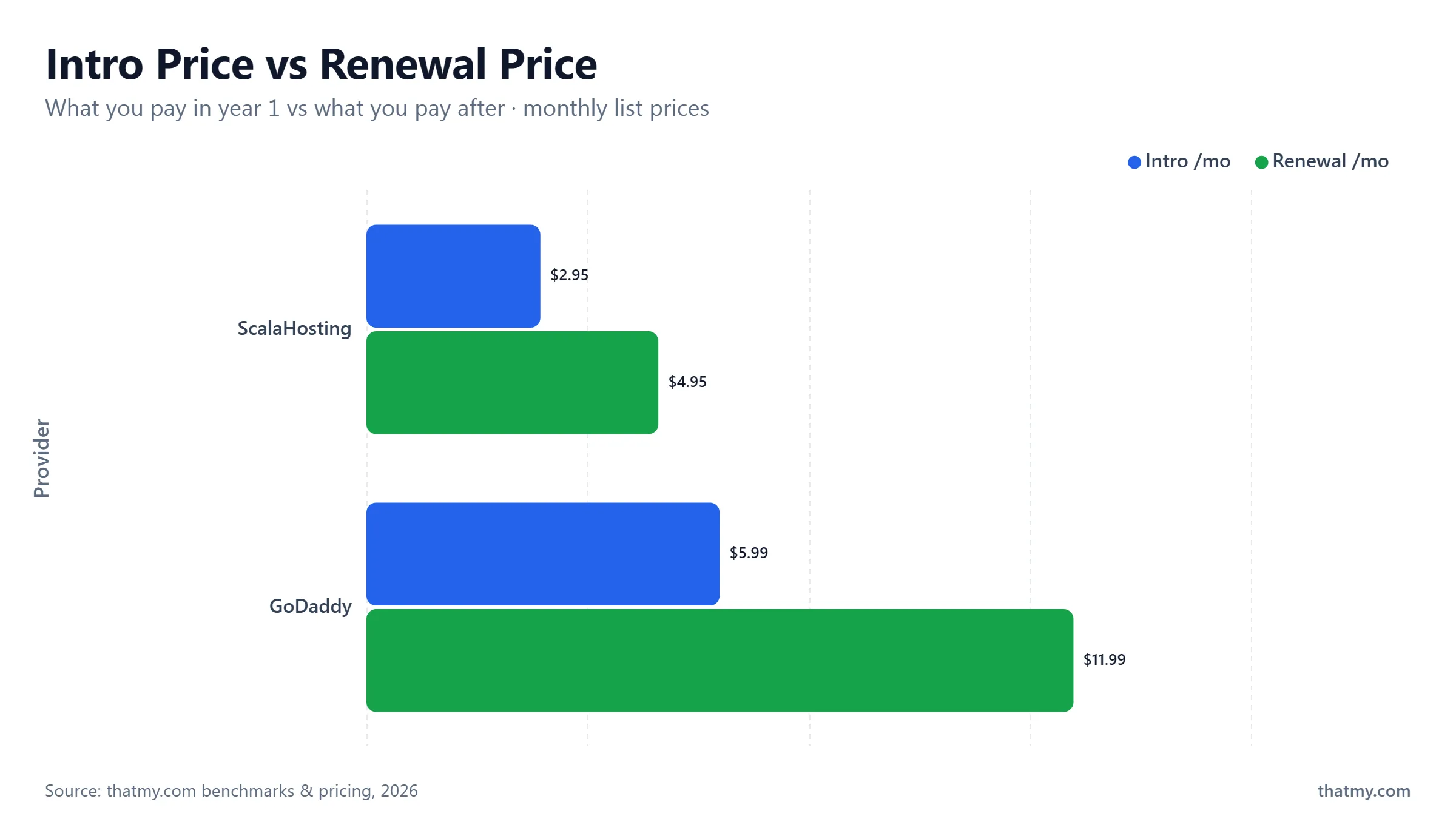
The gap between Price 1 and Price 3 is where most hosting budget surprises live. The average jump across the shared plans in this guide is 250%. On SiteGround StartUp that means a site that cost you $47.88 in year one costs $215.88 in year two, from the same host, doing the same work, on the same server.
| Provider | Marketing Price/mo | Checkout (prepaid) | Renewal Price/mo | True Monthly Avg (3 yrs) |
|---|---|---|---|---|
| Hostinger Premium | $3.99/mo | $47.88 for 12 months | $10.99/mo | $8.66/mo |
| Bluehost Starter | $3.99/mo | $143.64 for 36 months | $9.99/mo | $3.99/mo |
| SiteGround StartUp | $3.99/mo | $47.88 for 12 months | $17.99/mo | $13.32/mo |
| GoDaddy Economy | $5.99/mo | $215.64 for 36 months | $11.99/mo | $5.99/mo |
| ScalaHosting Mini | $2.95/mo | $106.20 for 36 months | $11.95/mo | $2.95/mo |
| Cloudways DigitalOcean 1GB Standard | $11.00/mo | Monthly (no prepay) | $11.00/mo | $11.00/mo |
| ⚠ True monthly average = (Intro term cost + All renewal months) ÷ 36. A 36-month plan reaches its renewal in month 37, so its average here is still the intro rate. | ||||
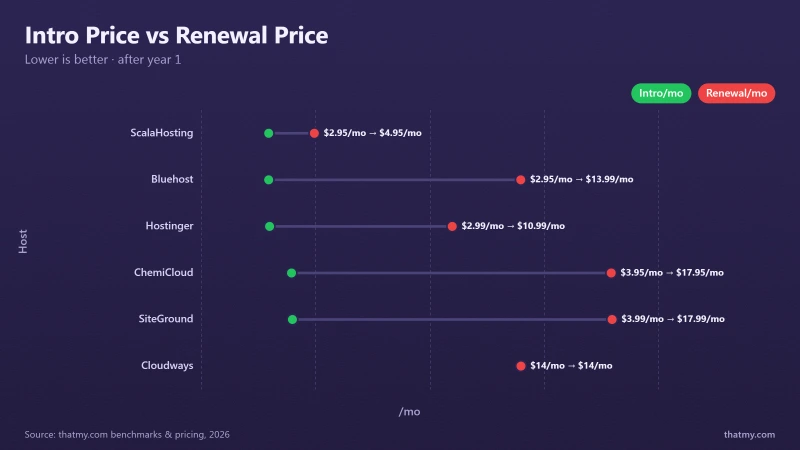
The true monthly average column is the only number that matters for budget planning. SiteGround StartUp's $3.99/mo intro looks cheap. At a $13.32 true monthly average, it is the most expensive option in this table. Cloudways never offers a promo price at all, what you see is what you always pay.
Why Hosts Use Low Intro Pricing, The Business Model Explained
Shared hosts like Bluehost pay a one-time commission to the affiliate sites that send customers their way, and on a budget plan that commission can be larger than everything the customer pays in the first year. The math only works if the customer stays long enough to pay the renewal price, and long enough after that to cover the acquisition cost.
This is not a flaw in the business model. It is the business model. Understand it, and you understand every pricing decision in the shared hosting industry.
The four forces pushing renewal prices up
Shared hosting affiliate programs pay a fixed amount per signup that varies by host and traffic source. A host paying that on a customer who pays a few dollars a month needs the customer to stay for years to break even. Low intro prices extend signup rates. High renewal prices recoup CAC.
Since mid-2019 cPanel charges per account, not per server, and its list has gone up almost every year since. The licence is inside every cPanel host's renewal price. The numbers are below.
AI buildouts compete with hosting for datacenter power and space. Hosts that lease their racks meet the higher price when the lease is renewed, and pass it on at a later renewal of yours. How the lag works.
Bluehost, HostGator, iPage and Network Solutions belong to one private-equity-owned group, Newfold Digital. An owner that plans to sell the business needs margin, and renewal prices are where it comes from. What that means for your bill.
The implication for your hosting decision: if you choose a promo-heavy host, your real decision is not "which host is cheapest" but "how long will I stay before migrating?" A host with a 300% renewal jump is a cheap option for 12 months and an expensive option for 36 months. Run your numbers before you sign up, not after your renewal invoice arrives.
The Renewal Shock Spreadsheet, 14 Plans Compared
Nobody publishes this table. Hosts certainly do not put it on their pricing pages. Here it is: renewal prices, 3-year total cost of ownership, and an original Renewal Shock Score for 14 plans, largest jump first.
The Renewal Shock Score is a 0-to-10 index developed for this guide. A score of 10 means maximum unpredictability: a large percentage jump, a PE-owned host and no price-lock option. A score of 0 means no renewal shock: flat pricing, no intro/renewal distinction, monthly billing available. The formula: (renewal_jump_pct ÷ 50) + PE_ownership_penalty + no_lock_penalty, where each penalty is 1 point, capped at 10.
| Provider | Intro $/mo | Renewal $/mo | Jump % | 3-Year TCO | Shock Score | Ownership | Price Lock? |
|---|---|---|---|---|---|---|---|
| ⚠ LARGEST RENEWAL JUMPS, 250% or More | |||||||
| FastComet Starter | $1.99 | $9.95 | +400% | $262.68 | 9 / 10 🔴 | World Host Group (PE) | ✓ Partial |
| SiteGround StartUp | $3.99 | $17.99 | +351% | $479.64 | 8 / 10 🔴 | Independent | ✗ No |
| ChemiCloud Starter | $3.49 | $14.95 | +328% | $400.68 | 7.6 / 10 🔴 | Independent | ✗ No (free domain for life) |
| ScalaHosting Mini | $2.95 | $11.95 | +305% | $106.20 | 7.1 / 10 🔴 | Independent | ✗ No (VPS plans only) |
| GreenGeeks Pro | $4.95 | $18.95 | +283% | $514.20 | 6.7 / 10 🟡 | Independent | ✗ No |
| DreamHost Web Hosting Launch | $2.89 | $10.99 | +280% | $298.44 | 5.6 / 10 🟡 | Independent | ✓ Monthly available |
| ⚠ LARGE RENEWAL JUMPS, 100% to 250% | |||||||
| HostGator Hatchling Plan | $3.75 | $10.99 | +193% | $135.00 | 5.9 / 10 🟡 | Newfold Digital (PE) | ✗ No |
| InterServer Standard Web Hosting | $2.50 | $7.00 | +180% | $198.00 | 3.6 / 10 🟢 | Independent | ✓ Renewal rate locked |
| Hostinger Premium | $3.99 | $10.99 | +175% | $311.64 | 4.5 / 10 🟡 | Independent | ✗ No |
| Bluehost Starter | $3.99 | $9.99 | +150% | $143.64 | 5 / 10 🟡 | Newfold Digital (PE) | ✗ No |
| GoDaddy Economy | $5.99 | $11.99 | +100% | $215.64 | 3 / 10 🟢 | Public (NYSE: GDDY) | ✗ No |
| ✅ LOWER SHOCK, Under 100% or Flat Pricing | |||||||
| Cloudways Vultr High Frequency 1GB | $16.00 | $16.00 | 0% | $576.00 | 0 / 10 ✅ | DigitalOcean (NYSE) | ✓ Monthly billing |
| WP Engine Startup | $25.00 | $25.00 | 0% | $900.00 | 0 / 10 ✅ | Independent | ✓ Monthly billing |
| Kinsta Single 20GB | $29.17 | $29.17 | 0% | $1,050.12 | 0 / 10 ✅ | Independent | ✓ Monthly billing |
| Average (shared plans only) | $3.68/mo intro | $12.34/mo renewal | +250% avg | $278.71 | 6 / 10 avg | ||
Three things stand out from this data. First, the largest jump belongs to FastComet Starter: its $1.99 intro becomes $9.95 at renewal, +400%. A low intro price is paid for at renewal. Second, the jump percentage and the renewal price are different questions: InterServer Standard Web Hosting has the lowest renewal of the shared plans at $7.00/mo, even though its jump is +180%. Third, the plans with no jump at all (Cloudways Vultr High Frequency 1GB, WP Engine Startup, Kinsta Single 20GB) have no intro discount to expire: you pay the same rate from the first month.
The Real Cost of Hosting Over 3 Years (TCO Breakdown)
The number on the pricing page is not wrong. It is just incomplete. Here is what "complete" looks like, using Bluehost Starter as the worked example, with the prices from a real Bluehost checkout.
Say you sign up for Bluehost Starter at the advertised $3.99/mo on the 36-month term. You pay $143.64 at checkout, which covers all three years of hosting. The .com domain is free for the first year and renews at $23.99. You also keep one add-on from the checkout page, daily backups (Jetpack Backup Premium, sold as CodeGuard until recently), at $59.40 a year. Year one: $203.04.
Years two and three: the hosting is already paid, but the domain renews at $23.99 and the backups at $59.40, $83.39 a year. In month 37 the plan itself renews at $9.99/mo, and from then on you pay $203.27 a year for the same three lines.
True 3-year total: $369.82. True monthly average: $10.27. The advertised price was $3.99/mo.
| Cost Component | Year 1 | Year 2 | Year 3 | 3-Year Total |
|---|---|---|---|---|
| Year 1 Hosting (36 months paid at checkout) | $143.64 | $0 (prepaid) | $0 (prepaid) | $143.64 |
| Domain registration / renewal (.com) | $0 (free yr 1) | $23.99 | $23.99 | $47.98 |
| Daily backup add-on (added at checkout) | $59.40 | $59.40 | $59.40 | $178.20 |
| 3-Year Grand Total | $203.04 | $83.39 | $83.39 | $369.82 |
| Year 4+ Hosting at the renewal price, plus domain and backups | $203.27 a year | |||
| True monthly average over 3 years | $10.27/mo vs. $3.99/mo advertised | |||
Now compare the hosting alone across five providers at similar capability levels, with prepaid terms spread across the months they cover:
| Bluehost Starter | Hostinger Unlimited | SiteGround StartUp | ScalaHosting Mini | Cloudways DigitalOcean 1GB Standard | |
|---|---|---|---|---|---|
| Year 1 total | $47.88 | $59.88 | $47.88 | $35.40 | $132.00 |
| Year 2 total | $47.88 | $203.88 | $215.88 | $35.40 | $132.00 |
| Year 3 total | $47.88 | $203.88 | $215.88 | $35.40 | $132.00 |
| 3-Year Grand Total | $143.64 | $467.64 | $479.64 | $106.20 | $396.00 |
| True monthly avg | $3.99/mo | $12.99/mo | $13.32/mo | $2.95/mo | $11.00/mo |
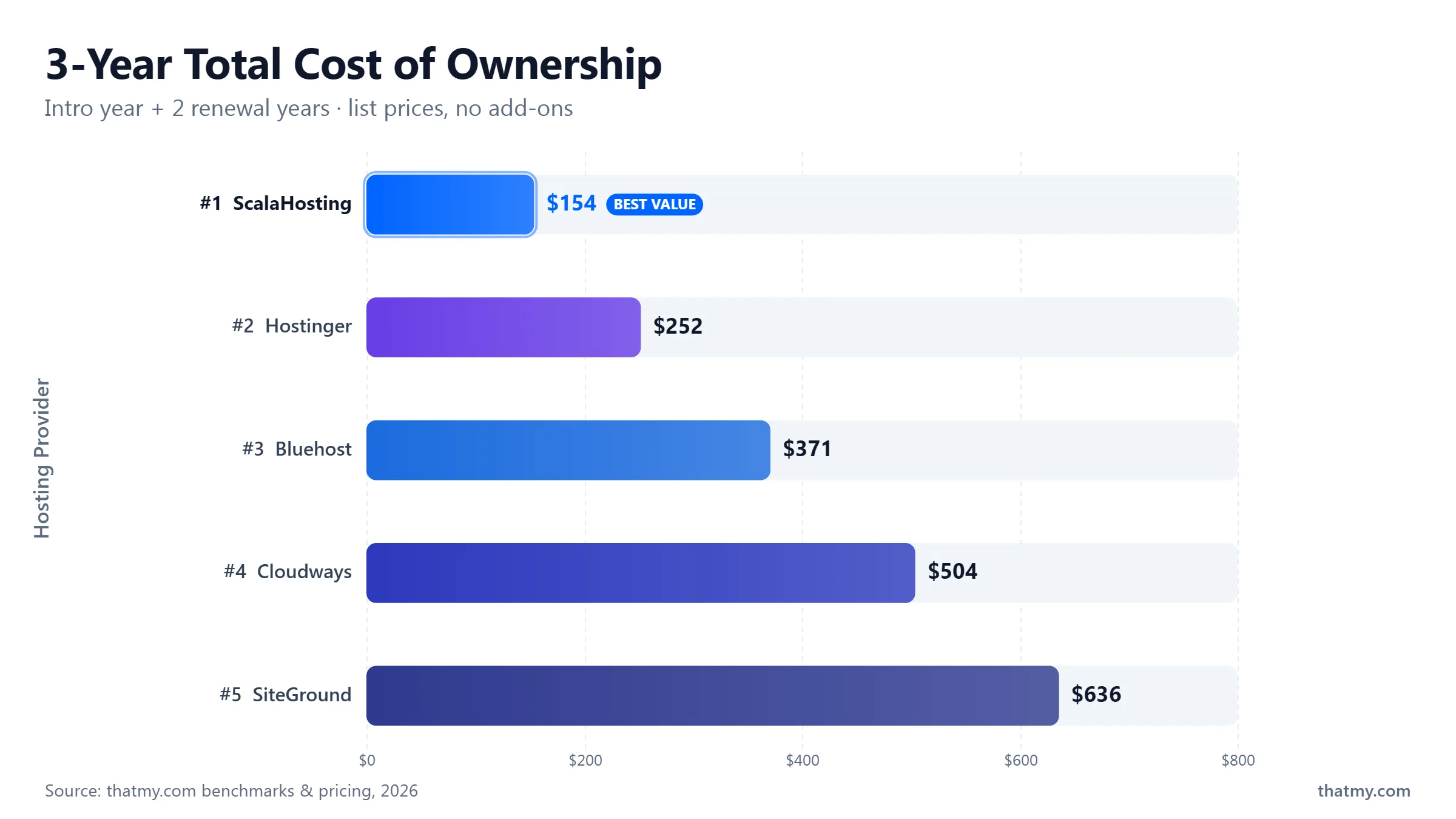
SiteGround's first year costs $47.88 against $132.00 at Cloudways, which is why the $3.99/mo intro looks like the bargain. After year three, SiteGround has cost $479.64 and Cloudways $396.00. The "cheap" SiteGround costs $83.64 more over 3 years than the "premium" Cloudways. This is what happens when renewal math runs over time.
Hidden Costs Most People Miss at Renewal Time
The renewal price itself is just the start. Every shared hosting renewal invoice contains line items that most customers do not remember choosing, because they were ticked at the original checkout, buried in an annual auto-renewal, or added as a "free trial" that converted to paid without a separate confirmation.
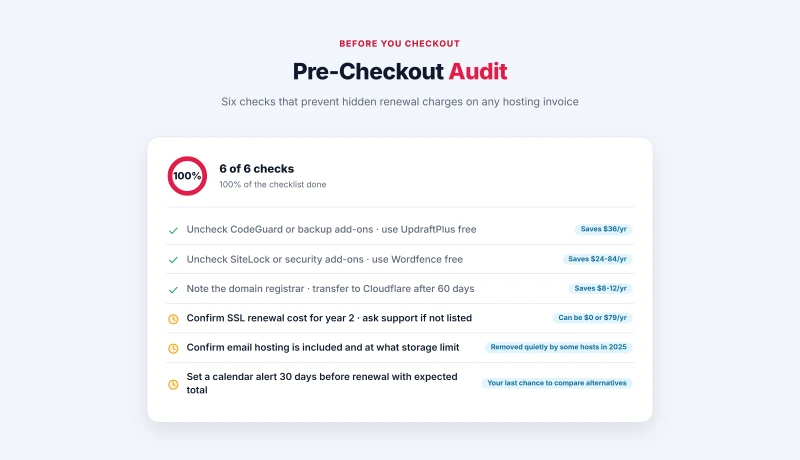
Here is the taxonomy of renewal-time surprises, with the typical annual cost and the free alternative. The Bluehost figures come from a Bluehost checkout with every add-on selected, including the renewal price Bluehost prints beside each one.
| Hidden Fee | Typical Cost/Year | Who Does It | Avoidable? | How to Avoid It |
|---|---|---|---|---|
| Daily backup add-on (Bluehost: Jetpack Backup Premium, formerly CodeGuard) | $59.40/yr | Bluehost (offered at checkout) | Yes | UpdraftPlus free + Google Drive storage |
| Security add-on (Bluehost Complete Security, formerly SiteLock) | $71.88 year one, renews at $239.88 | Bluehost (offered at checkout), HostGator | Yes | Sucuri free scanner + Wordfence free |
| SEO tool add-on (Bluehost: Yoast Premium SEO) | $35.88 year one, renews at $99.99 | Bluehost (offered at checkout) | Yes | Yoast SEO free or Rank Math free |
| SSL Certificate (year 2+) | A paid certificate, where the host charges for one | Bluehost, GoDaddy (free year 1 only) | Yes | Let's Encrypt free (auto-renews via host or Certbot) |
| Email hosting removal | $24-$60 | Hostinger (removed from basic plans 2025), GoDaddy | Yes | Zoho Mail Free (5 users), ImprovMX free forwarding |
| Domain renewal price jump | Bluehost .com: $0 year one, $23.99 at renewal | Most hosts that include a free first-year domain | Yes | Transfer to Cloudflare Registrar, which charges the registry price with no markup |
| Daily backup add-on | Varies by plan | SiteGround (included intro, charged at renewal on some plans) | Yes | BackWPup free, UpdraftPlus free, or Jetpack Backup |
| Priority support tier upgrade | Varies by host | GoDaddy, Bluehost | Yes | ChemiCloud includes instant support at base price |
| cPanel license surcharge | Built into the renewal price | Passed through by all cPanel hosts since 2019 | Partially | SPanel (ScalaHosting) eliminates this charge entirely |
| Malware cleanup fee | $50-$200/incident | Most shared hosts (not included in standard plan) | Partially | SShield AI security (ScalaHosting), Cloudflare WAF |
| ⚠ If you have Bluehost, add up the backup, security and domain lines. With all three, year two costs $323.27 before the hosting itself. | ||||
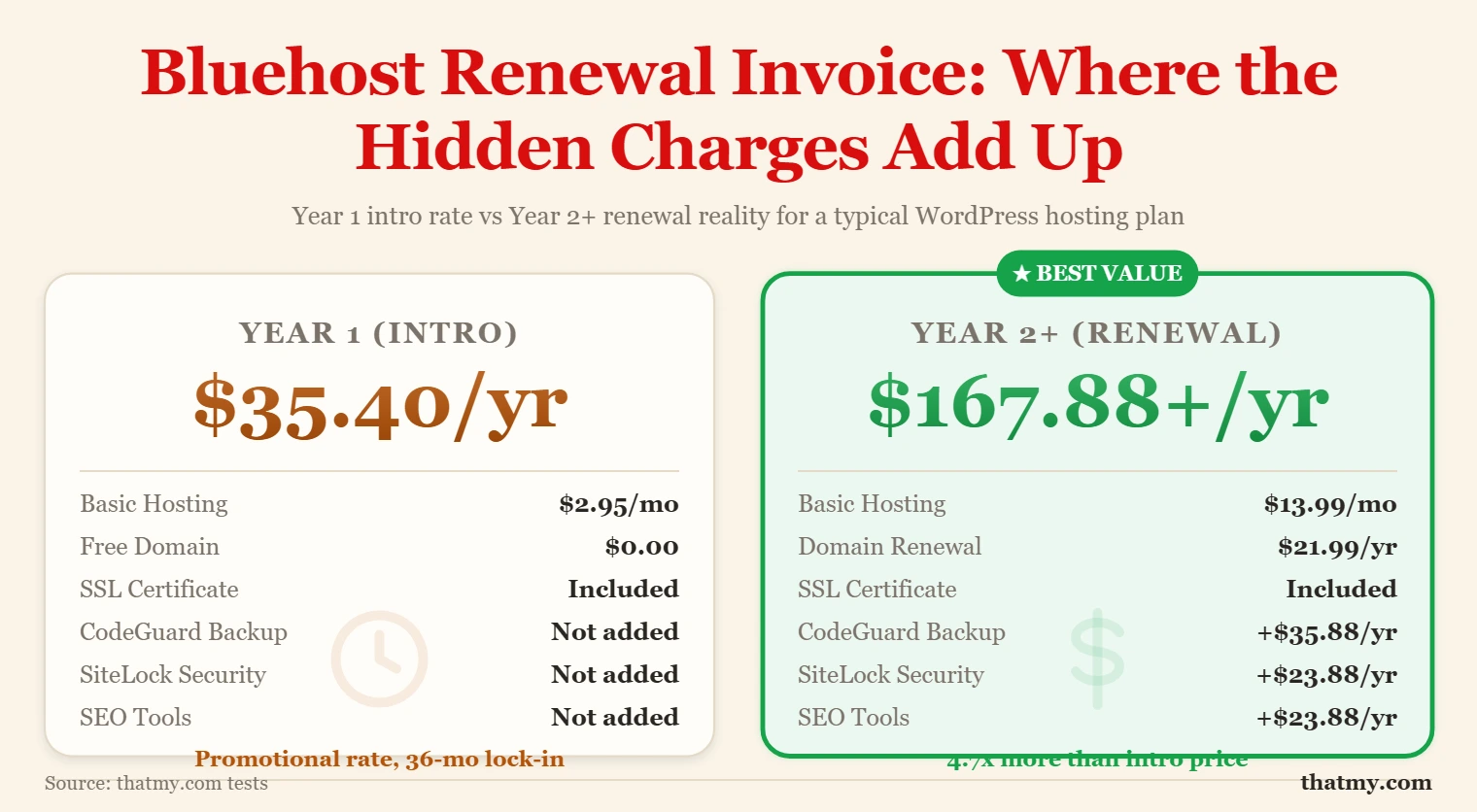
The pre-checkout audit checklist
Before completing any hosting checkout, scroll to the bottom of the cart and look for anything with its own line item that was not in the plan description. Specifically:
How to Calculate Your True Monthly Hosting Cost
Your hosting bill has four variables. Get these four numbers, run one formula, and you have your true monthly cost. Do it before you buy. Do it again 60 days before your renewal date.
Find the exact checkout total (not the monthly advertised price). For Bluehost Starter at $3.99/mo × 36 months, this is $143.64. This is what you pay on day one, regardless of what the monthly rate looks like.
Check the host's billing FAQ or log into your account dashboard. If the renewal price is not shown, open a support chat and ask: "What will my plan cost at renewal after the initial term?" A host that hedges on this answer is signaling bad renewal behavior. Get it in writing.
Domain renewal: Bluehost's .com renews at $23.99 after the free first year. Add any add-ons you actually intend to keep, not everything offered at checkout, only the ones you consciously want. SSL: $0 if your host includes it, up to $79/yr if they do not.
Over 36 months: TCO = Checkout Total + (Renewal Rate × Months After Intro) + (Domain × 3) + Add-ons. Divide by 36 for true monthly average. If it exceeds $15/month, compare against alternatives before renewing.
If your true monthly cost is...
Under $8/month: You are on a well-priced shared plan. Renew unless performance or support is failing you.
$8 to $15/month: Compare against the lowest shared renewal in this guide, InterServer Standard Web Hosting at $7.00/mo, before deciding.
Over $15/month: You are overpaying for shared hosting. A managed VPS such as ScalaHosting Entry Cloud ($24.95/mo on a 36-month term, renewing at $39.95/mo) gives you dedicated resources; put its cost next to your renewal before you decide.
Over $20/month at a shared host: Migrate. You are close to managed VPS prices for shared hosting infrastructure.
Renewal Pricing by Hosting Type
Renewal shock is a shared hosting phenomenon, but it is not exclusive to it. Different hosting categories have different pricing structures, different renewal behaviors, and different risks. Here is the complete picture by category.
Shared Hosting: Highest Renewal Risk
Shared hosting is where renewal shock is worst because the lowest intro prices require the highest recovery margins at renewal. The average jump across the shared plans in this guide is 250%. The lowest renewal among them, InterServer Standard Web Hosting at $7.00/mo, is still a +180% increase on its intro price. None of the shared plans here keeps its intro price at renewal.
| Provider | Plan | Intro/mo | Renewal/mo | Jump % | 3-Year Cost | Best For |
|---|---|---|---|---|---|---|
| Bluehost | Starter | $3.99 | $9.99 | +150% | $143.64 | Long 36-month intro term |
| DreamHost | Launch | $2.89 | $10.99 | +280% | $298.44 | Monthly billing available |
| Hostinger | Premium | $3.99 | $10.99 | +175% | $311.64 | hPanel dashboard, many data center locations |
| ScalaHosting | Mini Shared | $2.95 | $11.95 | +305% | $106.20 | SPanel instead of cPanel |
| GoDaddy | Economy | $5.99 | $11.99 | +100% | $215.64 | Domain and hosting in one account |
| ChemiCloud | Starter | $3.49 | $14.95 | +328% | $400.68 | Free domain for life |
Managed WordPress: The Surprising Exception
Managed WordPress hosting has a counterintuitive renewal story. SiteGround's GrowBig starts at $6.69/mo and renews at $29.99/mo, a +348% jump. Kinsta Single 20GB is $29.17/mo from the first month to the last. Over 36 months GrowBig costs $800.04 and Kinsta $1,050.12; one tier up, SiteGround GoGeek costs $1,208.04, more than Kinsta despite its lower sticker price. A flat-priced managed WordPress plan can cost less in total than a higher shared tier with a steep renewal.
| Provider | Plan | Intro/mo | Renewal/mo | Jump % | 3-Year Total |
|---|---|---|---|---|---|
| Kinsta | Single 20GB | $29.17 | $29.17 | 0% | $1,050.12 |
| WP Engine | Startup | $25.00 | $25.00 | 0% | $900.00 |
| SiteGround | GrowBig | $6.69 | $29.99 | +348% | $800.04 |
| SiteGround | GoGeek | $10.69 | $44.99 | +321% | $1,208.04 |
| DreamHost | DreamPress 1 | $14.99 | $19.99 | +33% | $659.64 |
VPS and Cloud: The Price-Stable Category
VPS and cloud hosting is where renewal pricing is most transparent. Pay-as-you-go providers (Cloudways, Hetzner, DigitalOcean) charge the same rate month after month. There is no intro price and no renewal premium. This is structurally different from shared hosting because there is no cPanel license overhead and no affiliate commission model dominating the acquisition economics.
| Provider | Plan | Monthly Rate | Renewal Change | 36-Month Total | Notes |
|---|---|---|---|---|---|
| Cloudways Vultr HF | 1 vCPU / 1GB RAM | $16.00/mo | 0%, no intro price | $576.00 | Managed cloud, billed monthly |
| ScalaHosting Entry Cloud | 2 dedicated CPUs / 2GB RAM | $24.95/mo | +60% after the first term | $898.20 | SPanel included instead of a paid cPanel licence |
| Hetzner CX23 | 2 vCPU / 4GB RAM | €5.49/mo | 0%, no intro price | €197.64 | Best price/performance in Europe, unmanaged; price excludes VAT |
| Contabo Cloud VPS 4 | 4 vCPU / 8GB RAM | €5.50/mo | Not published after month 24 | Depends on the renewal | Highest specs per dollar, support is slow; price includes VAT |
| Hostinger KVM 2 | 2 vCPU / 8GB RAM | $8.99/mo | +67% after the first term | $395.64 | Has intro price on VPS, uncommon for this category |
Dark Patterns: The Renewal Scam Tactics to Know
Most hosting companies are not running outright scams, they are using dark patterns. A dark pattern is a user interface or business process designed to make you do something you would not do if the information were presented clearly. The hosting industry has developed at least five of them that directly affect your renewal bill.
| Tactic | Severity | Who Does It | What It Costs You | How to Counter It |
|---|---|---|---|---|
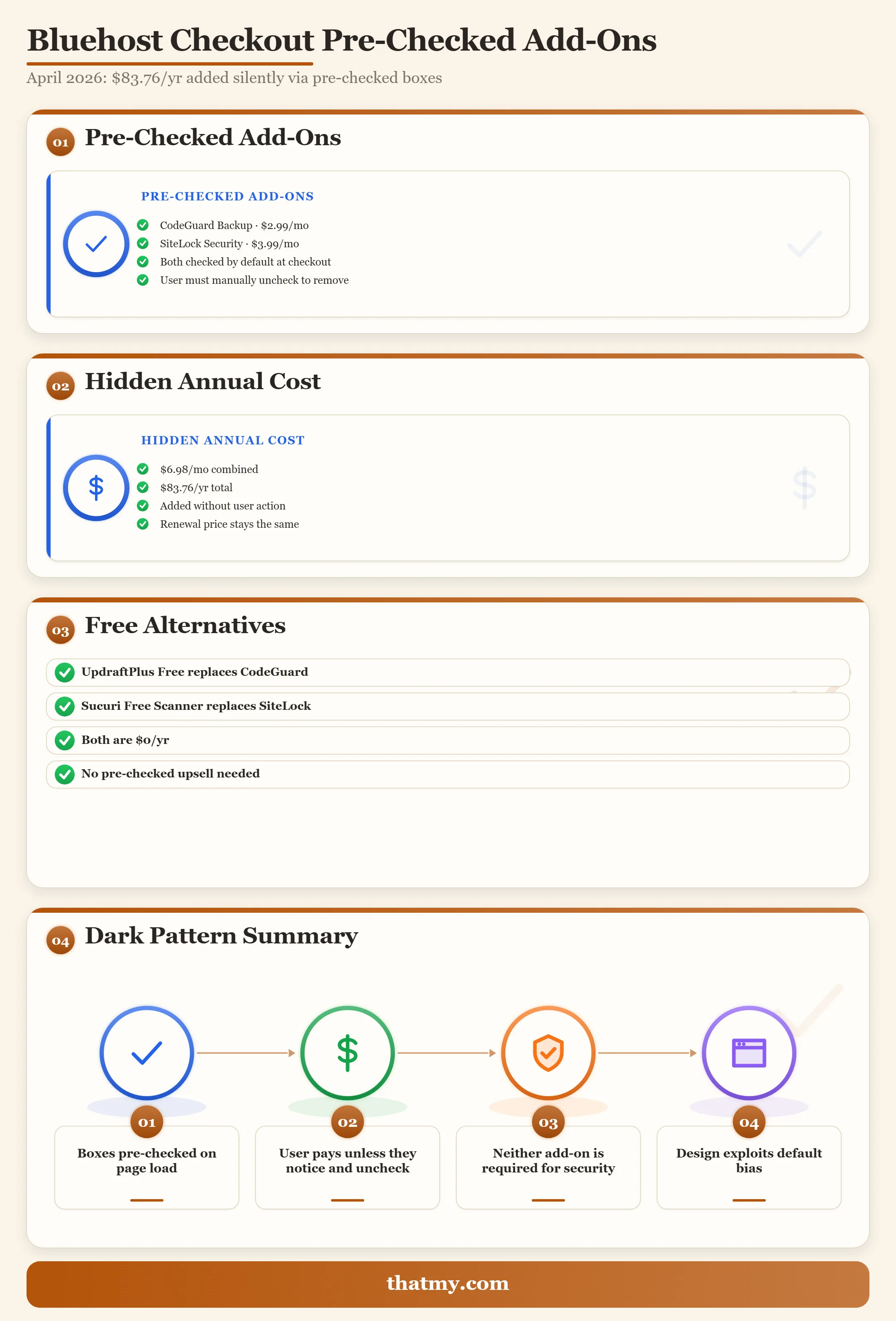
| Add-ons at checkout that renew higher than the hosting | 🔴 Critical | Bluehost (backup, security, SEO and email add-ons), HostGator | $209.16 in year one with all four Bluehost add-ons, then higher renewals | Read every line of the cart and untick each add-on you do not need before completing purchase |
| Fake countdown timers | 🔴 Critical | Hostinger, GoDaddy, many budget hosts | Urgency-driven overpurchase of wrong plan or longer term | Reload the page. The countdown resets. The offer is not expiring, it is rotating. |
| Renewal price hidden behind login wall | 🟡 Major | Most shared hosts, renewal price only visible in billing dashboard | Customers do not learn the renewal price until they receive the invoice | Ask support specifically: 'What is the renewal price after my intro term expires?' |
| Auto-renewal without email notice | 🟡 Major | Bluehost, HostGator, 30-day notice buries the amount | Full annual charge hits card before you can compare alternatives | Set your own 30-day calendar alert before every renewal date, do not rely on host email |
| Domain held hostage (transfer lock) | 🟡 Major | GoDaddy most aggressively, 60-day post-registration lock | $20+ transfer fee or 60-day inability to migrate after switching | Register domain at a separate registrar from day one, Cloudflare, Namecheap, or Porkbun |
| Free trial converts to paid silently | 🟢 Low | Add-on trial periods, Microsoft 365 bundles, security suites | $10-$99/yr on services you forgot you trialed | Never enable a free trial you do not intend to evaluate within 30 days |
| The add-on renewals are where this adds up: on Bluehost's checkout, the security add-on renews at $239.88 a year against $71.88 in year one, and the SEO tool at $99.99 against $35.88. A backup tool that was never set up still bills every year. | ||||
Should You Renew or Migrate? Decision Framework
This is the question most hosting articles avoid because the honest answer requires them to recommend against renewal to a provider they have an affiliate relationship with. Here is the honest answer.
The break-even point is 6 months. If your renewal price jump exceeds 100%, and you migrate to a host with a lower standard rate, you recover the one-time migration cost within 6 months in most cases. After that, you are saving money every month compared to renewing.
| Your Situation | My take | Why | Next Action |
|---|---|---|---|
| Renewal jump under 50% | Renew | Migration cost and downtime risk exceed savings | Renew for longest available term to delay next jump |
| Renewal jump 50%-100% | Negotiate First | Retention offers often appear in the cancellation flow | Go through cancellation steps; accept if offer is 25%+ off |
| Renewal jump over 100% | Migrate | Break-even is 3 to 6 months; every month after you save money | Start migration 2 weeks before renewal to allow DNS propagation |
| Uptime under 99.9% in past year | Migrate Now | Infrastructure quality does not improve after renewal | Migrate regardless of jump percentage |
| Happy with performance + jump under 30% | Stay | Working hosting is worth paying for | Renew for 1 or 2 years and re-evaluate |
| The negotiation script: Log in → Billing → Cancel → proceed through steps (do not confirm cancellation) → wait for retention chat trigger → ask: 'What is the best renewal rate you can offer me to stay?' Take the offer only if it beats your alternatives. | |||
The migration that most people delay because it sounds complicated usually takes 3 to 4 hours when done correctly with a free migration offer. Most major hosting providers, ScalaHosting, ChemiCloud, SiteGround, Cloudways, offer free migrations as a customer acquisition incentive. You can move your site, test it on the new host, and flip DNS only after confirming everything works. Your old hosting account remains live as a fallback until you are satisfied.
Best Hosts for Long-Term Price Stability
Three categories of pricing stability show up in the tables above: flat-rate hosts that never have a renewal event, low-jump hosts where the renewal price is predictable and fair, and volatile hosts where the renewal is the primary risk factor. Here are the best options in each category, with the specific numbers, the acknowledged tradeoff, and the affiliate code where we have one.
| Host | Type | Renewal Behavior | 3-Year Cost | Best For | My take |
|---|---|---|---|---|---|
| ScalaHosting | Shared + VPS | +305% shared / +60% VPS | $106.20 shared / $898.20 VPS | SPanel instead of a paid cPanel licence | Own Panel |
| Cloudways | Managed Cloud VPS | 0%, flat pricing | $396.00 (DO 1GB) | Speed, flexibility, zero shock | Best Speed |
| ChemiCloud | Shared | +328% (free domain offsets) | $400.68 + $0 domain | Budget, best support | Best Support |
| InterServer | Shared | +180%, then the renewal rate is locked | $198.00 (36 months) | Lowest shared renewal in this guide | Locked Renewal |
| Kinsta | Managed WP | 0%, flat pricing | $1,050.12 (36 months) | WordPress performance + zero shock | Best WP |
| Bluehost / HostGator | Shared (PE-owned) | +150% / +193% renewal jump | $143.64 / $135.00 | Long prepaid terms; the add-ons renew higher than the hosting | Watch Add-ons |
How to Lock In the Best Long-Term Rate Right Now
An intro price does not survive your first billing term. The promotional rate at any major shared host expires with it. But there are five actions you can take today that will materially reduce your hosting bill over the next three years, regardless of which host you are on.
Every day you delay is a day closer to renewal pricing. If you pay Hostinger Premium month to month at $11.99/mo and its 48-month term is available at $2.99/mo, switching now saves $324.00 over the next three years. The intro rate is real money. The month-to-month convenience has a dollar cost.
Open Google Calendar now. Add an event 30 days before your renewal date titled "Hosting renewal, compare prices." You need 30 days to migrate if the renewal price is unacceptable. Most people discover the renewal price 3 days before it processes, which is not enough time. One calendar event saves you from the worst-case scenario.
Log into your hosting account → Billing → Cancel Service. Go through the cancellation steps without confirming the final cancellation. Many hosts show a retention discount before the final step, sometimes through a live chat agent. The discount is not guaranteed, but trying it costs 10 minutes.
Free migrations are available at ScalaHosting, ChemiCloud, SiteGround, and Cloudways, all you need to do is sign up and ask. Migration usually takes 2 to 4 hours including DNS propagation. Do it 2 weeks before your renewal date: this gives you 14 days to confirm the new host is working correctly before the old one expires, and your old account remains live as a fallback the entire time.
Cloudflare Registrar charges the registry's wholesale price for .com, .net and .org. There is no markup. Hosts that give you a free first-year domain charge far more at renewal: Bluehost's .com renews at $23.99. Transferring your domain to Cloudflare cuts that every year, and Cloudflare Registrar does not have a renewal markup model. The 60-day transfer lock after original registration expires: once it does, transfer out. This is the easiest saving on this list.
Why Hosting Renewal Prices Keep Rising
The intro price is set to win the signup. The renewal price has to carry the cost of running the host, and five of those costs have gone up together: the control panel licence, the owner's need for margin, datacenter power, the paid software on the server, and the hardware itself. None of them is a one-off, which is why a renewal price rarely comes back down. The commission model that sets the intro price is explained in the business model section; this section is about the costs underneath.
cPanel licensing: from one fee per server to a fee per account
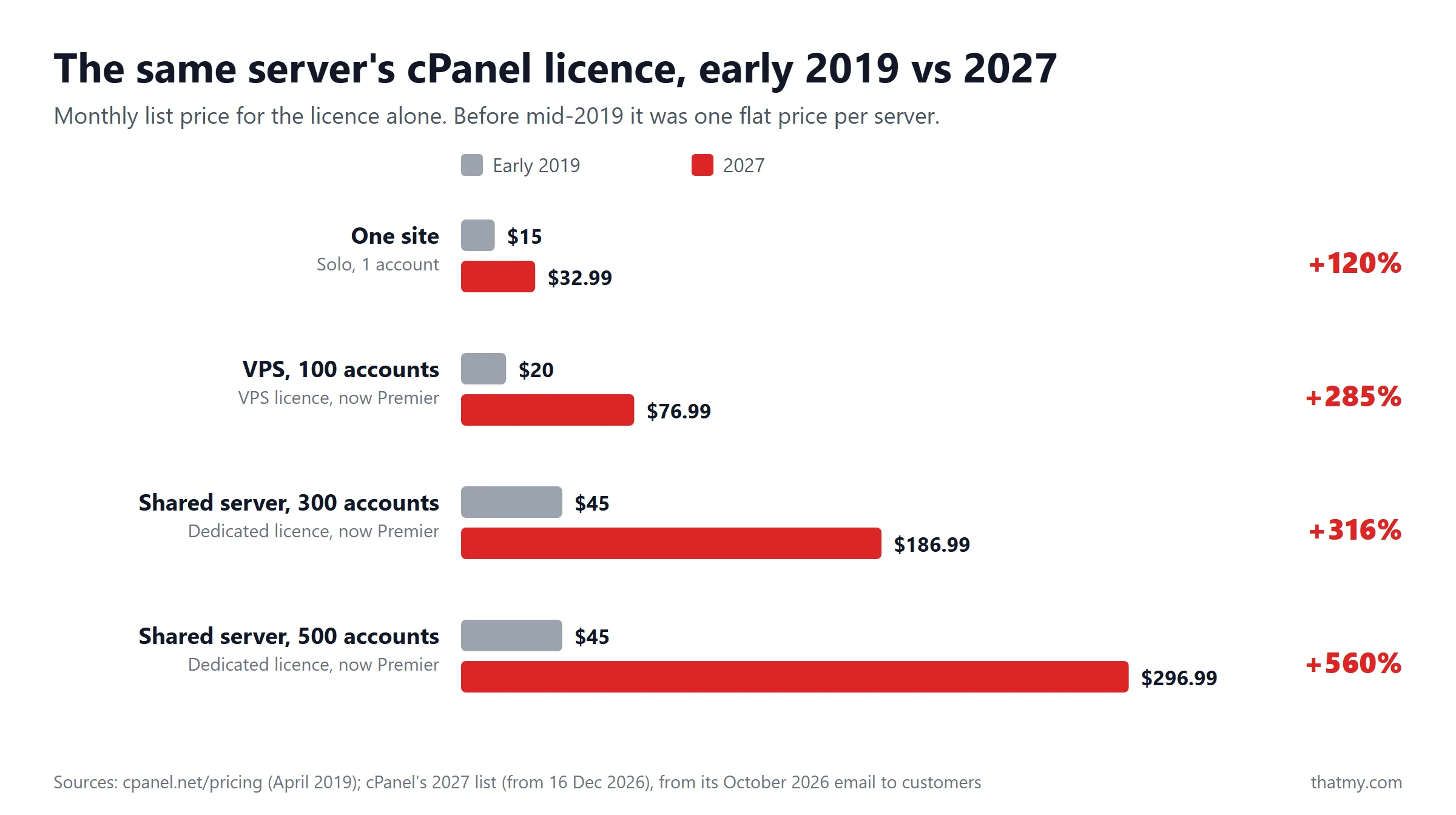
Until mid-2019 a cPanel licence was one flat monthly fee per server, $45 for a dedicated server however many accounts it held. Then cPanel switched to tiers counted by the account. Its Premier tier covers 100 accounts and charges for every account above that, so a shared server's licence now grows with every customer the host adds. Here is what that does to one shared server with 300 accounts, at list price:
| cPanel price list | Premier, 100 accounts | Each account above 100 | 300-account server per month | Against the flat fee |
|---|---|---|---|---|
| Flat licence, before mid-2019 | Any number of accounts | None | $45.00 | Baseline |
| First per-account list, mid-2019 | $45 | $0.20 | $85.00 | +89% |
| Current list | $69.99 | $0.49 | $167.99 | +273% |
| cPanel's 2027 list | $76.99 | $0.55 | $186.99 | +316% |
Big hosts buy through partner agreements below list price, and those rates are not public, but they move in the same direction. You will not see a cPanel line on your invoice: it sits inside the renewal price. Every tier and year since 2019 is in cPanel, Plesk and WHMCS price increases.
The only way out of the licence is a host that does not run cPanel. SiteGround moved every account to its own Site Tools between 2019 and 2021, Hostinger built hPanel, and ScalaHosting built SPanel, which comes free with its plans. Cloudways and Kinsta never used cPanel. An own panel removes this one cost; on its own it does not remove the renewal jump, as the table at the end of this section shows.
Private equity ownership
Bluehost, HostGator, iPage, Network Solutions and Register.com belong to Newfold Digital, the group formed when private equity bought Endurance International Group (EIG) and merged it with Web.com. FastComet belongs to World Host Group, which is also backed by private equity. The full ownership story is in who owns Bluehost.
An owner that plans to sell the business in a few years needs rising margin before the sale, and the sequence is usually the same: cut operating costs first, support staff above all, then raise renewal prices, then sell. Customers see slower support and a bigger renewal invoice, never a notice that says "our owner needs margin". The two Newfold plans in the shock table show a +150% jump at renewal (Bluehost Starter) and a +193% jump (HostGator Hatchling), and the Shock Score adds a point for private equity ownership because an owner change can move prices at any renewal, not only the first.
Datacenter power and AI demand
AI training and inference run on GPU racks that draw many times the power of a rack of ordinary hosting servers, and they are built in the same places hosting lives: Northern Virginia, Frankfurt, Amsterdam, London. When AI demand fills a datacenter's power capacity, everything else in it gets more expensive to run, including the server your website sits on.
The cost reaches you late. Most shared hosts lease their space under multi-year colocation contracts with the power price fixed, so a rise lands on the host when the lease is renewed, and on you at the renewal after that. Hosts that own their datacenters, such as Hetzner and OVHcloud, manage power cost directly, and hosts built on the big cloud platforms (Cloudways on DigitalOcean, Vultr and AWS, Kinsta on Google Cloud) buy capacity at a scale no shared host can match.
Paid server software: LiteSpeed, CloudLinux and Imunify360
A shared server used to run free software: Apache, CentOS and hand-written security rules. A good shared host now runs LiteSpeed Web Server, CloudLinux and Imunify360, and each one is a licence paid per server, per month. They earn their place: LiteSpeed and its cache plugin make WordPress faster (see web servers compared), CloudLinux stops one busy account from slowing everyone else on the server (see CloudLinux and LVE), and Imunify360 blocks malware and brute-force logins. Each licence is a fixed cost per server that the vendor revises up, not down.
Hardware: NVMe storage and newer CPUs
Shared hosting has moved from SATA SSDs to NVMe drives and from older Intel Xeons to AMD EPYC processors. That is a real upgrade, and it shows in faster admin pages and database queries (NVMe vs SSD hosting). A new server also costs more to buy than the generation it replaces, and the host recovers that over the server's life, spread across the accounts on it. Hosts that skip the upgrade keep prices down by running old hardware, which is a different problem: why cheap hosting uses old CPUs.
Which hosts sit outside these costs
Three things decide how much of this reaches your renewal: whether the host pays for cPanel, who owns it, and how it bills. Here is where the main hosts in this guide stand, with the jump and Shock Score from the shock table.
| Host | Control Panel | Owner | Billing | Renewal Jump | Shock Score |
|---|---|---|---|---|---|
| Bluehost Starter | cPanel | Newfold Digital (PE) | Prepaid intro term, then the renewal rate | +150% | 5 / 10 🟡 |
| HostGator Hatchling Plan | cPanel | Newfold Digital (PE) | Prepaid intro term, then the renewal rate | +193% | 5.9 / 10 🟡 |
| SiteGround StartUp | Site Tools (own) | Independent | Prepaid intro term, then the renewal rate | +351% | 8 / 10 🔴 |
| Hostinger Premium | hPanel (own) | Independent | Prepaid intro term, then the renewal rate | +175% | 4.5 / 10 🟡 |
| ScalaHosting Mini | SPanel (own) | Independent | Prepaid intro term, then the renewal rate | +305% | 7.1 / 10 🔴 |
| Cloudways Vultr High Frequency 1GB | Cloudways platform (own) | DigitalOcean (NYSE) | Monthly, one rate from the first month | 0% | 0 / 10 ✅ |
| Kinsta Single 20GB | MyKinsta (own) | Independent | One rate from the first month | 0% | 0 / 10 ✅ |
An own panel and an independent owner remove two of the costs, but the intro discount is a separate matter: SiteGround StartUp and Hostinger Premium run their own panels and still jump +351% and +175% at renewal, because their intro price is the commission-funded discount described in the business model section. The plans with no jump at all are the ones that charge one rate from the first month. If a stable price matters more to you than the lowest first year, start with hosts with stable pricing.
Renewal Pricing Myths Debunked
Five myths circulate about hosting renewal pricing. Each one costs the people who believe them money, either through wrong purchasing decisions, missed negotiations, or false confidence. Here is the reality.
"Longer billing terms always save you money long-term."
PARTLY FALSE
Longer terms save money during the intro period only. A 48-month Hostinger Premium term at $2.99/mo costs $143.52 for those 48 months; the 12-month term at $3.99/mo renews at $10.99/mo after year one and costs $443.52 over the same 48 months. That part is true. But after those 48 months, you are on renewal pricing regardless, $10.99/mo for every month after. If you plan to stay for 10 years, the longer intro term saves you money in years one to four and makes no difference to years five to ten.
"Premium plans have smaller renewal price jumps than basic plans."
PARTLY TRUE
The percentage jump on premium plans is often smaller: Bluehost Business goes from $6.99/mo to $13.99/mo (+100%) against Starter at $3.99/mo to $9.99/mo (+150%). But the dollar increase is larger on the premium plan, and you pay $167.88 a year at renewal. The percentage metric is misleading. What matters is the absolute renewal cost against alternatives.
"Managed WordPress hosting is always more expensive than shared hosting."
FALSE
Kinsta Single 20GB at $29.17/mo flat costs $1,050.12 over 36 months. SiteGround GrowBig at $6.69/mo, renewing at $29.99/mo, costs $800.04, so GrowBig is still cheaper, by $250.08 over 3 years. At the GoGeek tier, SiteGround renews at $44.99/mo and costs $1,208.04 over 36 months, more than Kinsta. The "shared is always cheaper than managed WP" assumption does not survive TCO math at the higher tiers.
"You cannot negotiate your hosting renewal price."
PARTLY TRUE
You cannot negotiate a permanent price reduction. But through the cancellation flow, you can often trigger a retention offer, a discount on the renewal for one or more cycles. It works because winning a replacement customer costs the host more than giving you a discount. The key is going through the cancellation steps, not just emailing support and asking for a discount, which almost never works.
"Free hosting eliminates renewal pricing risk."
FALSE
Free hosting has a different renewal risk: the data hostage problem. Providers like 000webhost (shut down 2024) and InfinityFree have a business model where the "free" hosting is a funnel to paid upgrades. When the provider discontinues the free tier or the site outgrows it, migration is difficult because export tools are limited or the backup format is non-standard. The renewal cost of free hosting is paid in migration complexity, not dollars. Use free hosting only for testing, never for a site that matters.
Hosting Renewal Pricing FAQ
What is the average hosting renewal price increase in 2026?
Across the 11 shared hosting plans in this guide, the average renewal price is 250% above the intro price. FastComet Starter has the largest jump at +400% (from $1.99 to $9.95/mo). GoDaddy Economy has the smallest among shared plans at +100% (from $5.99 to $11.99/mo). Cloudways Vultr High Frequency 1GB, WP Engine Startup, Kinsta Single 20GB charge the same price at renewal as at signup.
Why did my hosting price go up so much at renewal?
Your hosting price increased because the intro price you paid was a promotional rate, not the standard rate. Hosting companies use discounted first-term pricing as a customer acquisition tool, sometimes selling the first year below cost to earn the affiliate commission revenue first. The renewal price is the real price the host needs to charge to run a profitable business. On top of that, the costs behind it keep rising: cPanel licences, which a 300-account server paid $45 a month for before mid-2019 and pays $167.99 for today at list price, datacenter power pushed up by AI demand, paid server software such as LiteSpeed and CloudLinux, and private equity owners at some of the biggest brands.
Does the cPanel price change affect every hosting provider?
Only the hosts that run cPanel. Bluehost, HostGator, GoDaddy, InMotion, FastComet and ChemiCloud pay cPanel per account, $0.49 a month for every account above 100 on a Premier licence at list price, and that cost sits inside their renewal prices. Hosts on their own control panel do not pay it: Hostinger (hPanel), SiteGround (Site Tools, after moving every account off cPanel by 2021), ScalaHosting (SPanel), Cloudways, Kinsta (MyKinsta) and DreamHost. An own panel removes one cost, not the renewal jump itself: SiteGround and Hostinger still renew well above their intro prices.
Will hosting renewal prices keep going up?
At promo-priced shared hosts, most likely yes. cPanel has raised its list almost every January since 2021 and has announced another rise, datacenter power is still in demand from AI buildouts, and private equity owners still need margin before a sale. None of these is a one-off. Flat-rate hosts that bill monthly change prices too, but as a published rate change with notice rather than as a renewal jump: Cloudways has changed its entry price once since 2019.
Can I negotiate my hosting renewal price?
Often, yes. The most effective method is the cancellation flow: log into your hosting account, navigate to Cancel Service, and go through the cancellation steps without completing the cancellation. Many hosts show a retention offer, a discount on the renewal price, before you confirm. Do this 30 days before your renewal date. If no offer appears, you still have 30 days to migrate to a better-priced host.
Which hosting companies do not raise their prices at renewal?
Three hosting companies in this guide charge the same price at renewal as they do at signup: Cloudways (pay-as-you-go from $11.00/mo, no intro/renewal distinction), Kinsta (from $29.17/mo on annual billing, the same rate every year), and WP Engine (from $25.00/mo on annual billing). All three use monthly or flat-rate billing without a promotional intro period. Hetzner and Contabo also have stable pricing for VPS plans with no renewal markup. The common thread is that all five use transparent, non-discounted pricing from day one, no bait price, no renewal shock.
Is it better to pay monthly or yearly for hosting?
It depends on the host type. For promo-heavy shared hosts (Bluehost, Hostinger, SiteGround), paying for the longest intro term available locks in the discounted rate for longer: a 48-month Hostinger Premium term costs $2.99/mo against $11.99/mo month to month. The savings during that first term are real. For flat-rate providers (Cloudways, Kinsta), monthly billing is better because you retain the flexibility to cancel or scale without locking in annual payments. Never pay annually at a promo-heavy host's renewal price, that is the worst possible scenario, committing to 12 months at the inflated rate.
Where to Go Next
If your renewal is coming up and the numbers above tell you to migrate, the practical question is which host to move to and how to do it without downtime. The best web hosting guide ranks hosts on our own benchmark data. If you are specifically leaving Bluehost, the ScalaHosting and Cloudways alternatives are the most commonly recommended because both offer free migrations, and Cloudways bills monthly with no renewal price at all.
If you want to understand the full cost picture before deciding, the TCO calculator section above walks through the exact formula. Run it for your current host and your top alternative. The number that comes out is the only number that matters for this decision.