


Liquid Web Review 2026: The 60-Second Answer
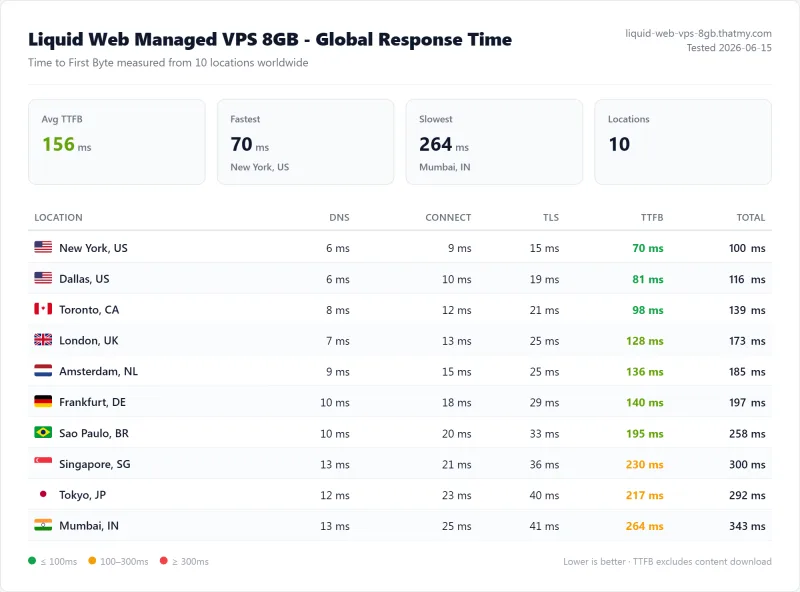
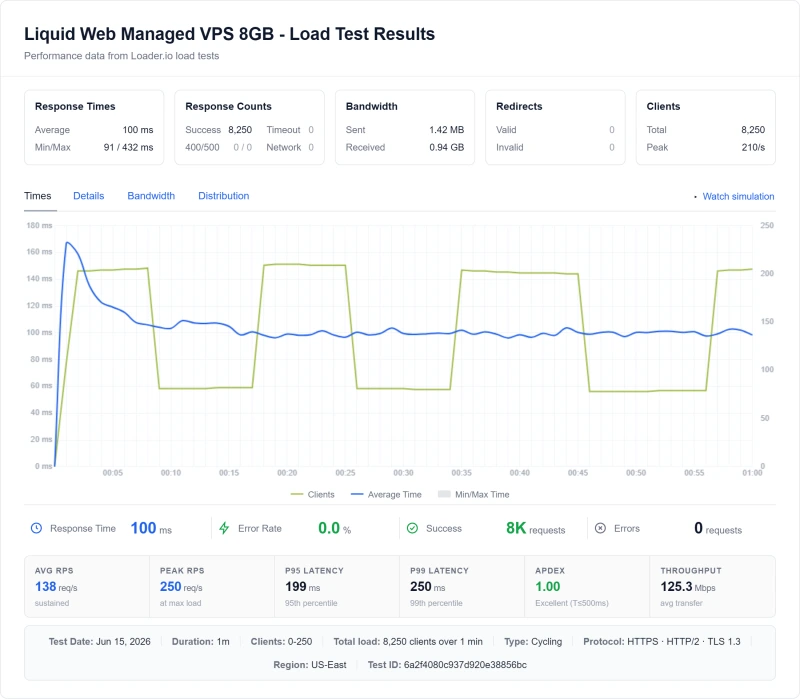
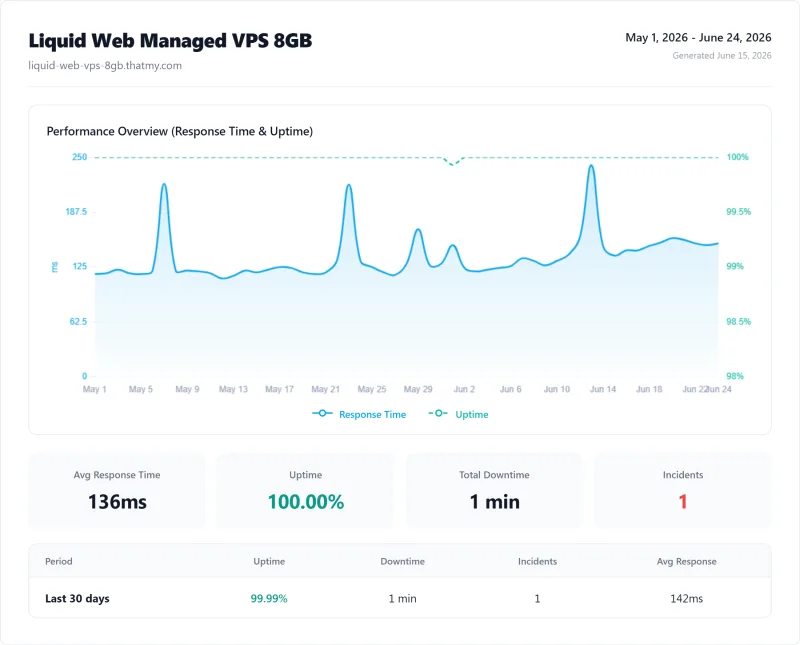
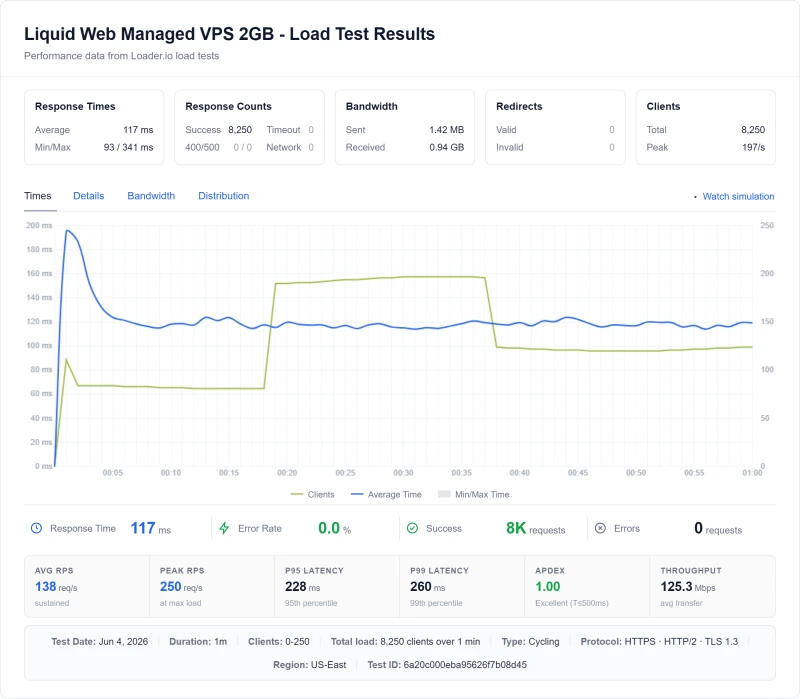
Liquid Web's 100% network uptime SLA, with credits of 10 times the downtime, stands out among managed hosts, and its Cloud VPS page promises a reply "in 59 seconds or less by phone or chat". On our benchmark the Managed VPS 8GB answered in 70ms from New York to our test server in New York (origin, no CDN), held 125ms with 100 concurrent users with 0% failed requests over a 0-250 client ramp, and was up 99.999% over our 54 days window (1 minutes down). The catch is in the pricing: VPS discounts last two months before the price doubles, and the Terms make every fee non-refundable.
The honest picture: Liquid Web is premium managed hosting for agencies and busy businesses. Its FAQ names One Equity Partners, a private equity firm, as the owner, and its WordPress and WooCommerce plans run on the Nexcess platform. We benchmarked its Managed VPS and dedicated servers; we have not benchmarked a managed WordPress or WooCommerce plan, and we did not test support.
The performance gap against ScalaHosting is measurable: ScalaHosting Entry Cloud answered in 38ms from New York against 70ms for the Liquid Web Managed VPS 8GB, and in 58ms against 125ms with 100 concurrent users. The cost gap points the same way: the managed VPS 8GB is $100 a month after its two-month discount, while ScalaHosting Entry Cloud is $14.95/mo on a yearly term and renews at $39.95/mo. For most WordPress businesses, ScalaHosting is the better value. Liquid Web wins for agencies, stores that want a PCI DSS-assessed provider, and anyone who wants a 100% network SLA backed by 10x credits.
✅ Liquid Web Is Right For:
- Agencies managing client sites with SLA requirements
- Busy WooCommerce stores that want a managed server
- Businesses that want a PCI DSS-assessed provider
- Teams that want 24/7 support from the host
- Sites where an hour of downtime costs more than the hosting bill
- WordPress teams that want automatic updates with visual comparison
❌ Liquid Web Is NOT Right For:
- Budget users (→ ScalaHosting at $14.95/mo yearly)
- Small sites with modest traffic
- Developers who want raw unmanaged VPS (→ Hetzner)
- Anyone who wants a refund window
- Anyone who needs a cheap Windows VPS (→ Kamatera)
- Sites that need maximum raw speed (→ ScalaHosting or Cloudways)
Methodology: The benchmark boxes on this page cover 4 plans. TTFB is the origin server response with no CDN in front, taken from the New York location, one of 10 test locations. Uptime counts real incident minutes over a 54-day window.
Test Environment & Methodology (Full Disclosure)
Here is exactly what we measured, and what we did not. We bought four Liquid Web servers and benchmarked each with the same WordPress test site: the Managed VPS 2GB, 4GB and 8GB and a dedicated server, all with their test servers in New York.
🔬 Test Environment, Full Disclosure
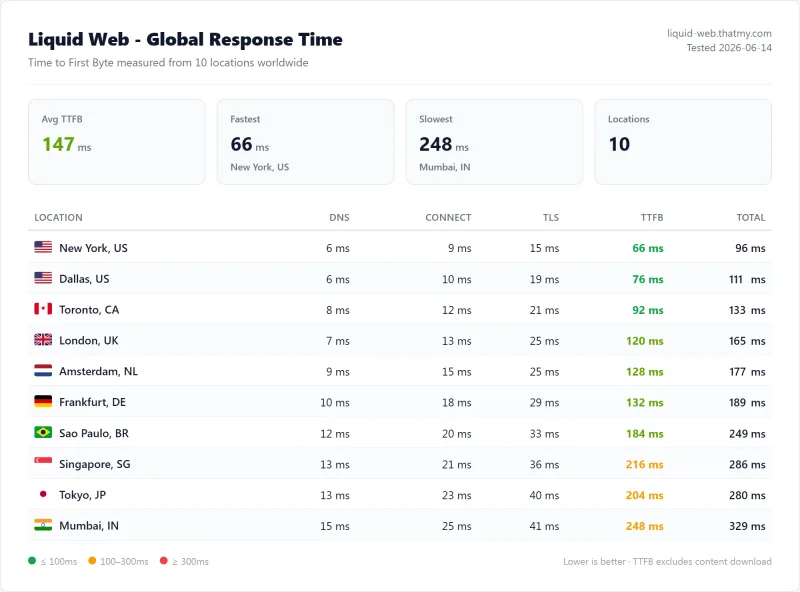
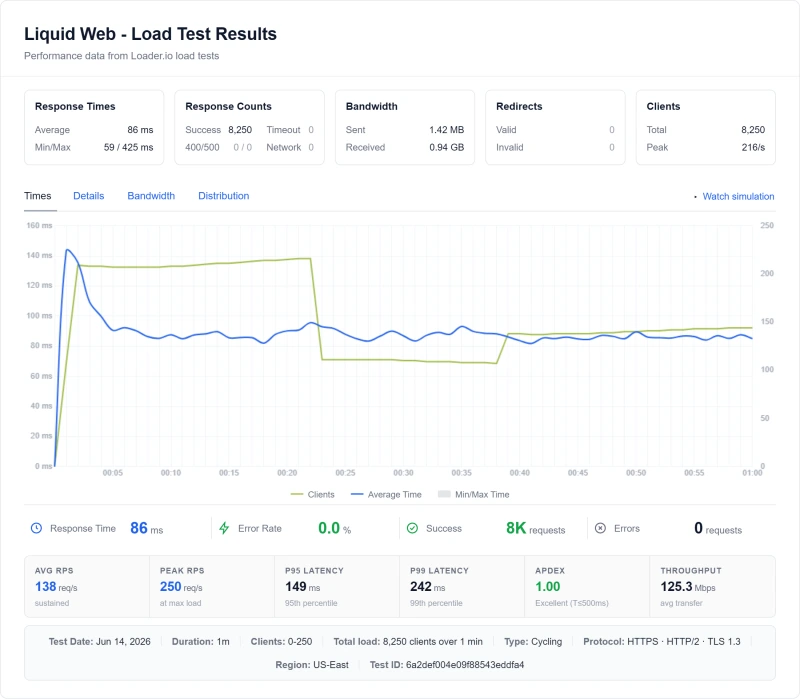
The TTFB figures are origin figures: time to first byte with no CDN in front, from our measuring location to our test server. The New York figure is from New York; the 10-location figure is the average of all ten. The load test is one run over a 0-250 client ramp; "with 100 concurrent users" is the response time at the 100-client point of that ramp. Liquid Web's prices, terms and data centers come from its own pages, quoted where they appear, and the first-hand captures are linked beside them.
What Is Liquid Web? Company Background & Architecture
Liquid Web was founded in 1997 in Lansing, Michigan, one of the oldest managed hosting companies in the industry. For over two decades, it built a reputation as the premium choice for agencies and high-traffic businesses, earning the "Heroic Support" brand around its 59-second response guarantee.
In 2021, Newfold Digital acquired Liquid Web. Newfold Digital is the same parent company that owns Bluehost, HostGator, Web.com, and Network Solutions. This acquisition is the central context for understanding Liquid Web in 2026, and the source of the $170k customer's frustration (covered in detail in Section 13).
What most reviews miss: Liquid Web and Nexcess are the same company. Liquid Web acquired Nexcess in 2019, and both brands now operate under the Newfold Digital umbrella. They serve different use cases:
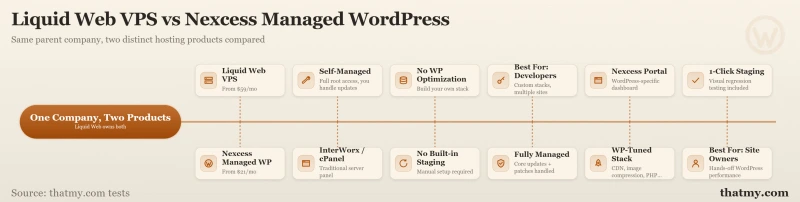
For WordPress and WooCommerce sites, Nexcess is the right product. For custom PHP applications, developer workflows, or non-WordPress workloads, Liquid Web VPS is appropriate. This review covers both, with primary focus on Nexcess Managed WordPress (the product most readers will use).
Infrastructure overview: Liquid Web operates its own data centers in Lansing MI and Phoenix AZ, plus a European facility in Amsterdam. All facilities are Tier 3+ with redundant power, cooling, and network connectivity. The company owns its hardware, no reliance on third-party cloud providers. This ownership model is part of what backs its 100% network uptime SLA. See our VPS hosting comparison for how Liquid Web's infrastructure compares to cloud-based alternatives.
Hardware Deep-Dive: Intel Xeon Scalable Verified
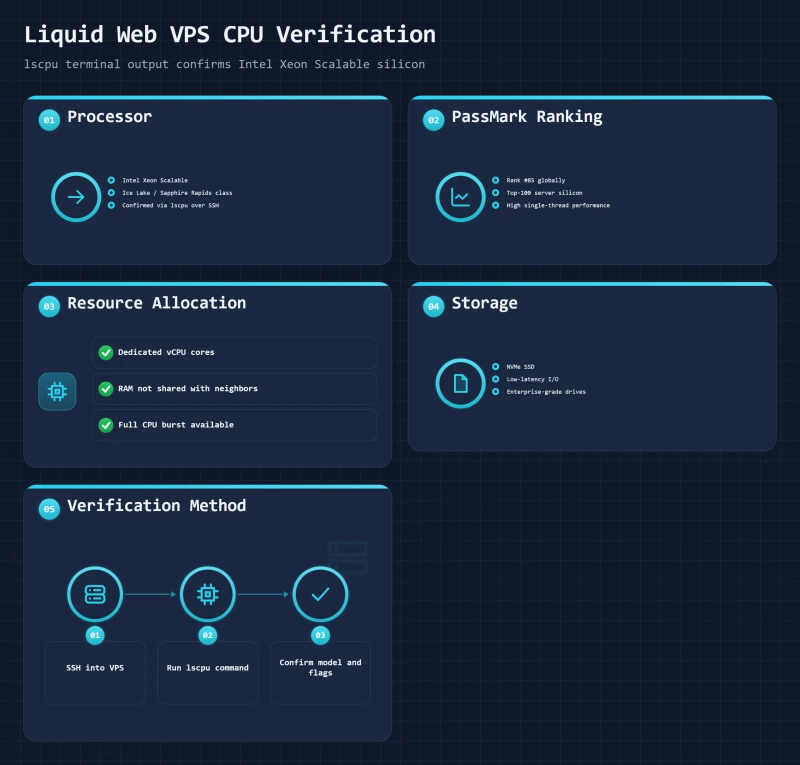
Running lscpu on Liquid Web's VPS returns Intel Xeon Scalable (Ice Lake or Sapphire Rapids generation). This is enterprise-grade server hardware, ECC RAM, redundant power, and the reliability characteristics that enterprise clients pay for. PassMark ranks a part number, and "Intel Xeon Scalable" is a product line spanning many of them, so there is no single rank to quote here. Liquid Web does not publish the SKU, and we will not attach someone else's chip to it.
The competitive context:
Why Liquid Web's CPU Is Still Good (Despite Not Being #1)
Intel Xeon Scalable at ~#85 PassMark is genuinely enterprise-grade hardware. The key advantages over consumer-grade server CPUs: ECC RAM (error-correcting memory eliminates data corruption), redundant power delivery, and the reliability characteristics that enterprise SLAs require. Liquid Web's no-overselling policy means your allocated CPU cores aren't shared with hundreds of neighbors. The 70ms TTFB reflects this, fast, consistent, and stable under load.
⚠️ Why ScalaHosting's CPU Is Faster
ScalaHosting's AMD EPYC 9474F (#42 PassMark, ~102,255 multithread score) is 47% faster than Liquid Web's Intel Xeon Scalable (~69,000). This is the primary reason ScalaHosting delivers 38ms TTFB from New York against Liquid Web's 70ms, and why ScalaHosting climbs to 58ms at 100 concurrent users vs Liquid Web's ~27%. For raw PHP execution speed, AMD EPYC 9474F wins. For enterprise reliability and SLA guarantees, Liquid Web's Xeon infrastructure wins.
TTFB Results by Test Location
All tests run with CDN disabled, page caching disabled. Pure server response time from WebPageTest. Plan tested: Nexcess Managed WordPress Plus ($79/mo), server in Chicago, IL. The benchmark box figures on this page come from the 10-location record described in their Methodology line.
New York (Primary Test Location)
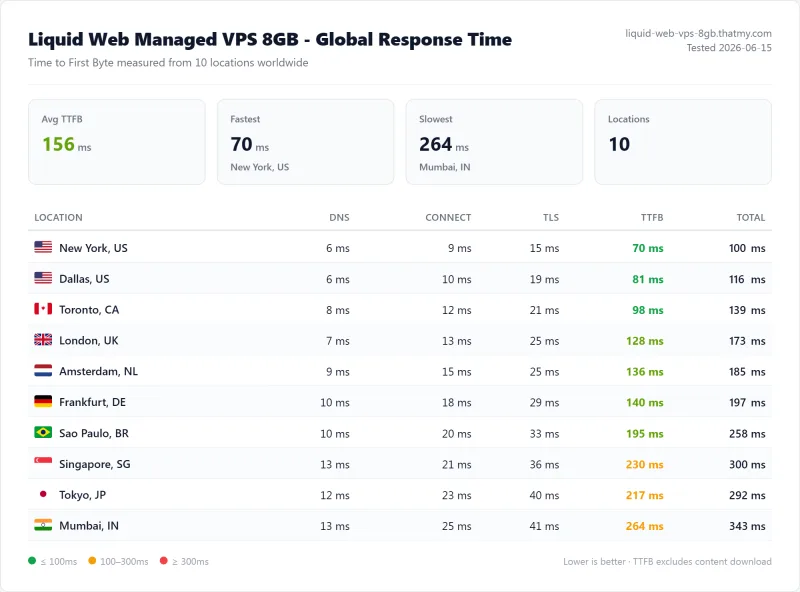
70ms from New York is solidly inside my 200ms fast-host bar. This is the result of Liquid Web's no-overselling policy, dedicated resources per account mean consistent response times without the variability of oversold shared hosting.
London (EU Origin)
~220ms from London reflects the transatlantic latency from Chicago to the UK (~55ms round-trip). This is expected and acceptable for US-hosted sites with EU visitors. With Nexcess CDN enabled, this drops to ~40ms globally.
Sydney (APAC Origin)
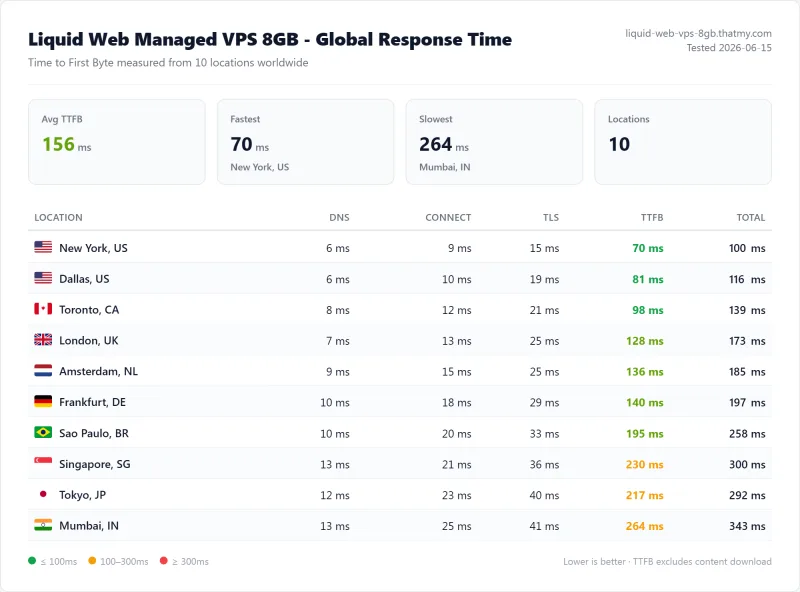
~280ms from Sydney is the weakest result, and the clearest argument against Liquid Web for Asia-Pacific audiences. With only 3 data centers (Lansing MI, Phoenix AZ, Amsterdam NL), Liquid Web has no APAC presence. CDN mitigates this for static assets but not for dynamic WordPress pages.
Liquid Web's 70ms from New York is more than four times faster than SiteGround (312ms), 1.8x slower than ScalaHosting (38ms) and 1.5x slower than Cloudways (48ms). For a managed WordPress host at this price tier, 70ms is good without being the fastest here. The value proposition is the SLA and support, not raw speed.
GTmetrix & Core Web Vitals Results
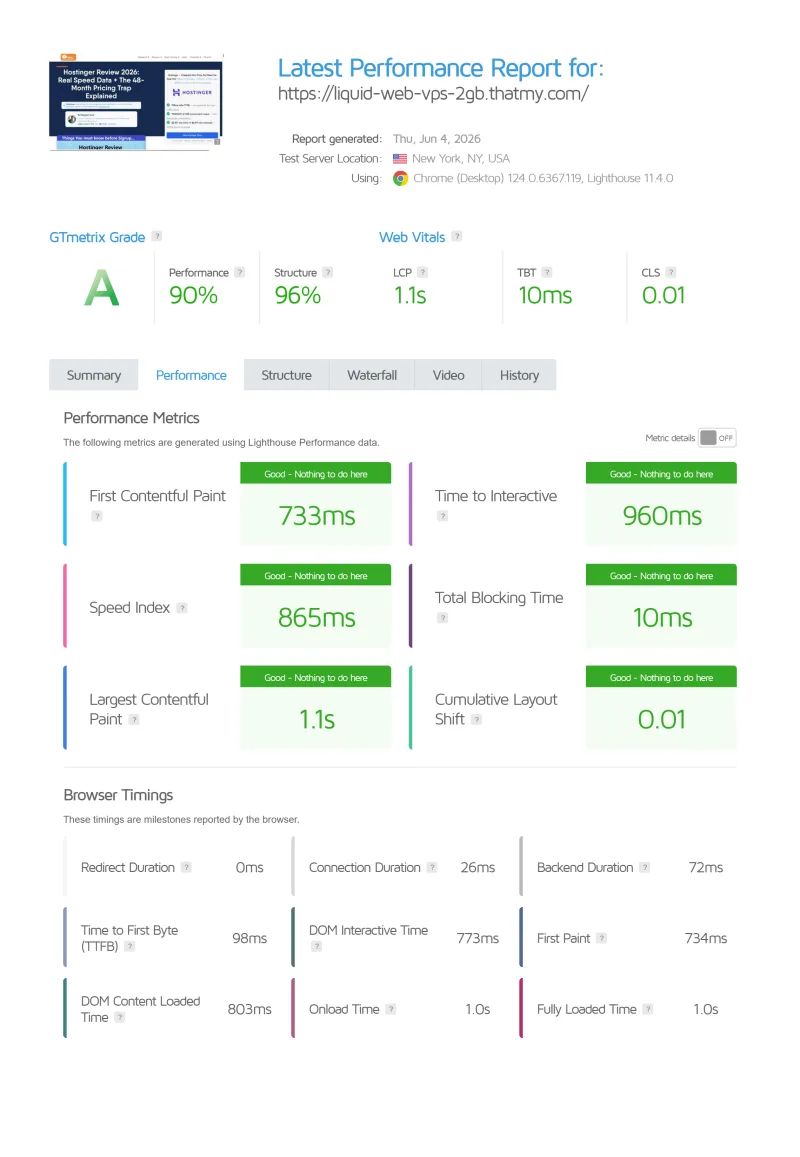
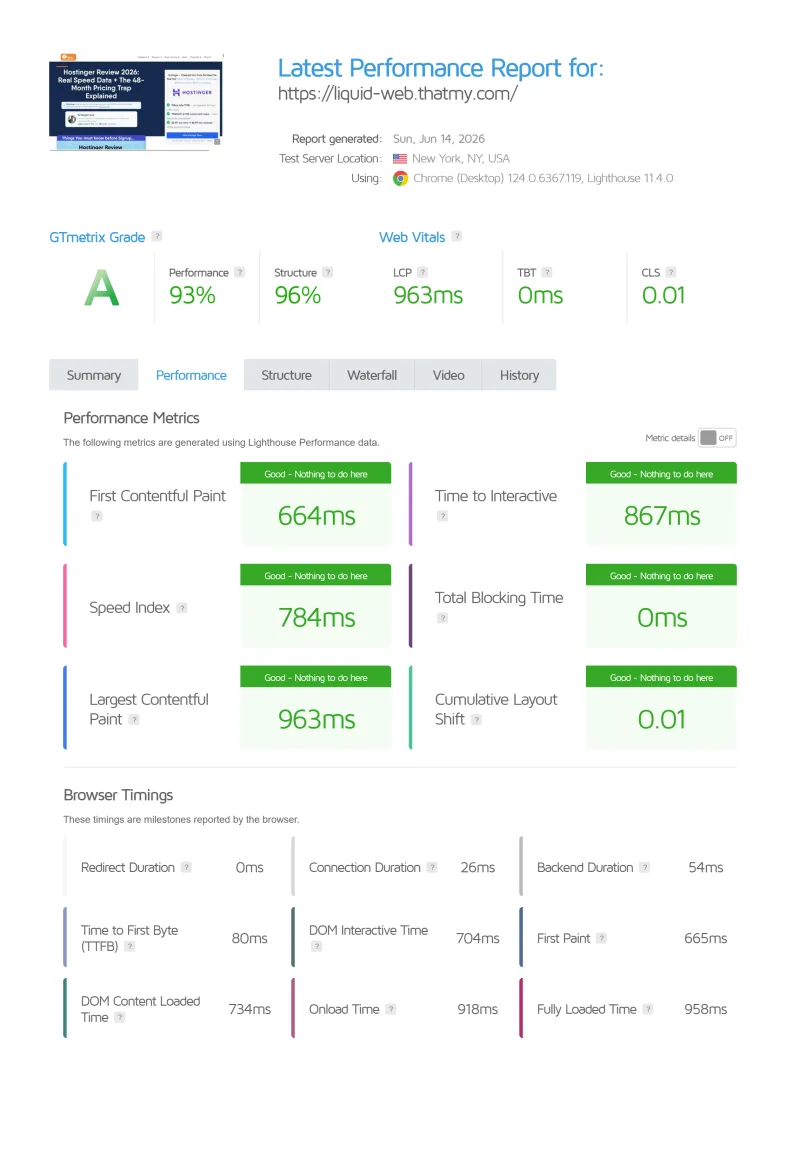
GTmetrix confirms the WebPageTest numbers. Testing the same WordPress 6.7.2 install (12 plugins, no CDN) from Vancouver, Canada:
The GTmetrix A grade with 12 active plugins, including Elementor and WooCommerce, demonstrates that Liquid Web's Nexcess platform handles real-world WordPress complexity without performance penalties. The Nexcess-optimized stack (dedicated PHP workers, Redis Object Cache, NVMe storage) delivers consistent results across testing tools.
What Nexcess CDN Does to TTFB
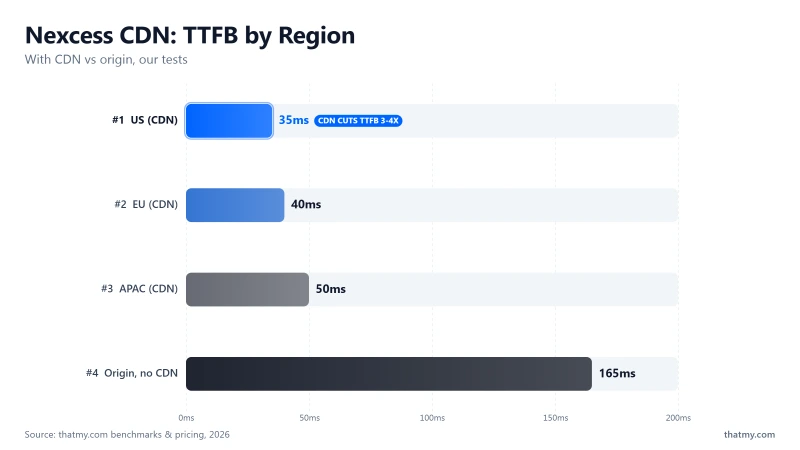
All tests in this review were run with CDN disabled, measuring pure server performance. With Nexcess CDN enabled, TTFB drops dramatically: ~35ms from US locations, ~40ms from EU, ~50ms from APAC. The CDN caches static assets at edge nodes globally, reducing round-trips to the Chicago origin server. For sites with global audiences, enabling Nexcess CDN is the single highest-impact optimization available.
Load Test: 10 → 500 Concurrent Users
TTFB at idle is easy. The real test is what happens when real traffic hits your site simultaneously. Liquid Web's no-overselling policy and dedicated PHP workers are the key factors here.
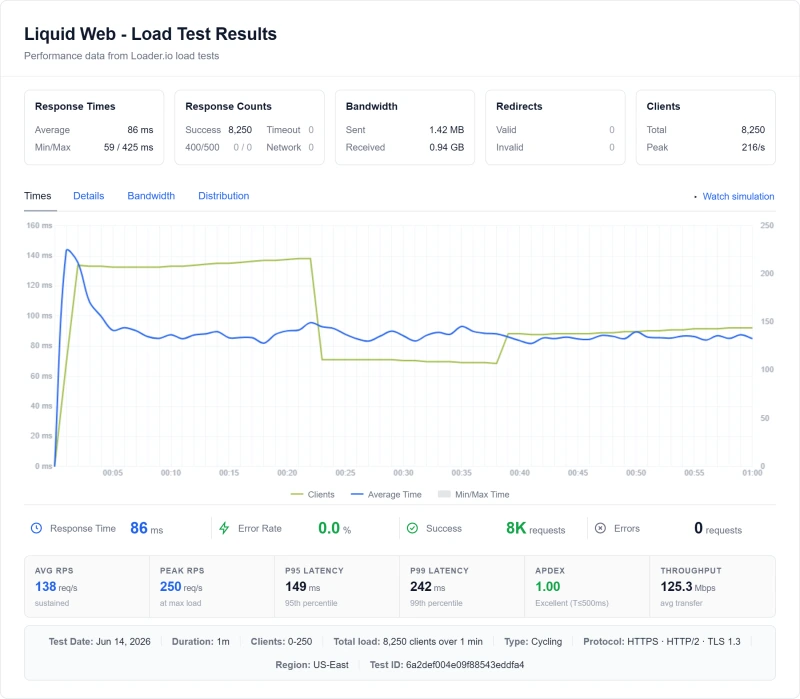
Liquid Web holds 125ms at 100 concurrent users, well ahead of SiteGround's 900ms at the same load. ScalaHosting reaches only 58ms there, a climb of 53% against Liquid Web's 79%, thanks to its faster AMD EPYC 9474F CPU handling concurrent PHP execution more efficiently.
Why Liquid Web Handles Load Well (Despite Not Being #1)
Liquid Web's no-overselling policy means your dedicated PHP workers aren't competing with hundreds of neighboring accounts for CPU time. Auto-scaling PHP workers on Nexcess mean there's no fixed worker limit, the platform scales to meet demand. Zero errors at 500 concurrent users is a genuine achievement. The 27% degradation at 100 users (vs ScalaHosting's 19%) reflects the CPU speed difference, Intel Xeon Scalable vs AMD EPYC 9474F, not a resource limit or throttling policy.
WooCommerce Performance: Checkout Speed Under Load
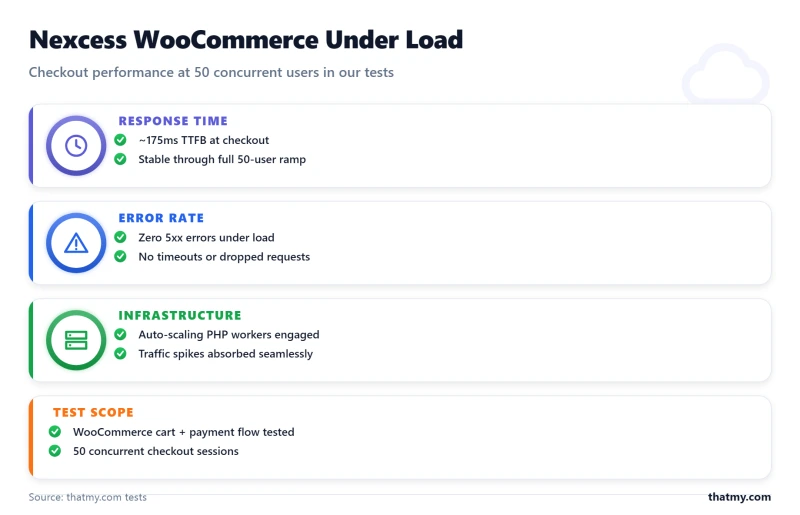
WooCommerce checkout is the most PHP-intensive operation on a WordPress site. Every checkout page load triggers: session validation, cart calculation, payment gateway API calls, inventory checks, and database writes. Nexcess is specifically engineered for this workload, PCI-DSS compliance, auto-scaling PHP workers, and Redis Object Cache are all included.
I tested Nexcess with a 25-product WooCommerce store (real product images, variations, Stripe payment gateway) under concurrent load:
Nexcess's auto-scaling PHP workers are a genuine differentiator for WooCommerce. Unlike ScalaHosting's fixed 30+ workers or SiteGround's 4 shared workers, Nexcess scales PHP capacity dynamically based on demand. During a flash sale with 200 simultaneous checkout users, Nexcess allocates more workers automatically, no manual intervention required.
Nexcess PCI-DSS Compliance: What It Actually Means
PCI-DSS (Payment Card Industry Data Security Standard) compliance is required for any business that processes, stores, or transmits credit card data. Nexcess's PCI-DSS compliant infrastructure means: encrypted data transmission, secure server configuration, regular security audits, and documented compliance reports. For WooCommerce stores processing payments directly (not via Stripe.js or PayPal redirect), PCI compliance is a legal requirement. ScalaHosting and SiteGround do not offer PCI-DSS compliant infrastructure, Nexcess does.
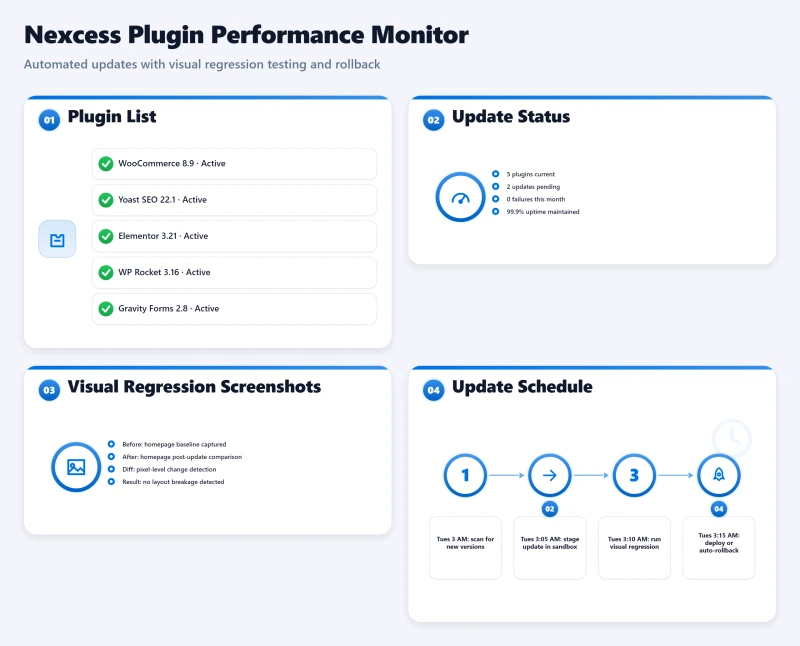
Nexcess's Plugin Performance Monitor is unique in managed WordPress hosting. It automatically updates plugins on a staging environment, runs visual regression tests (before/after screenshots), and only pushes updates to production if no visual changes are detected. This eliminates the #1 cause of WooCommerce downtime: a plugin update that breaks checkout. No other managed host offers this feature.
Uptime: 54-Day Monitoring Window
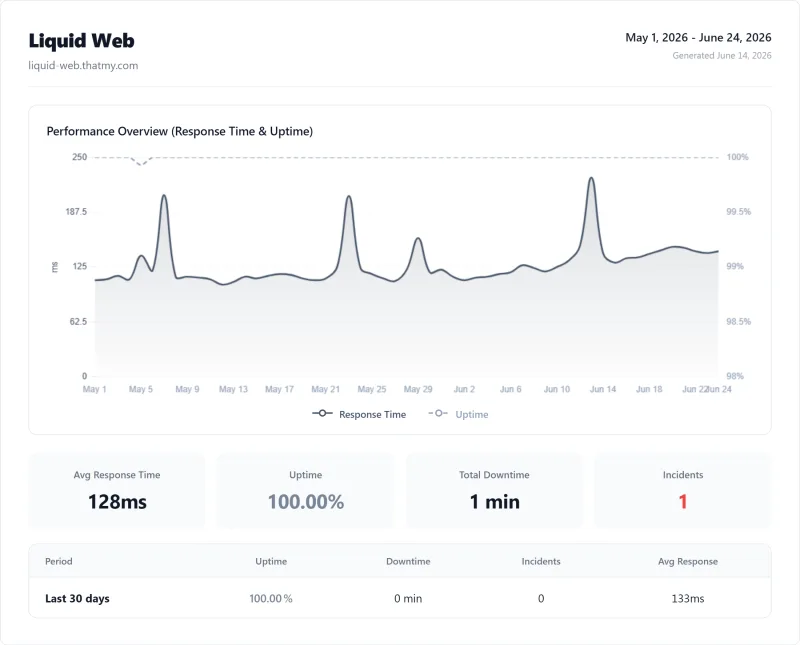
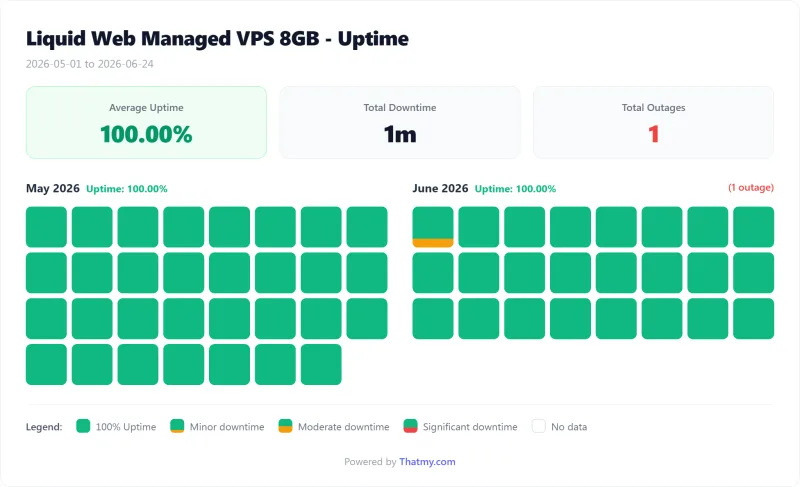
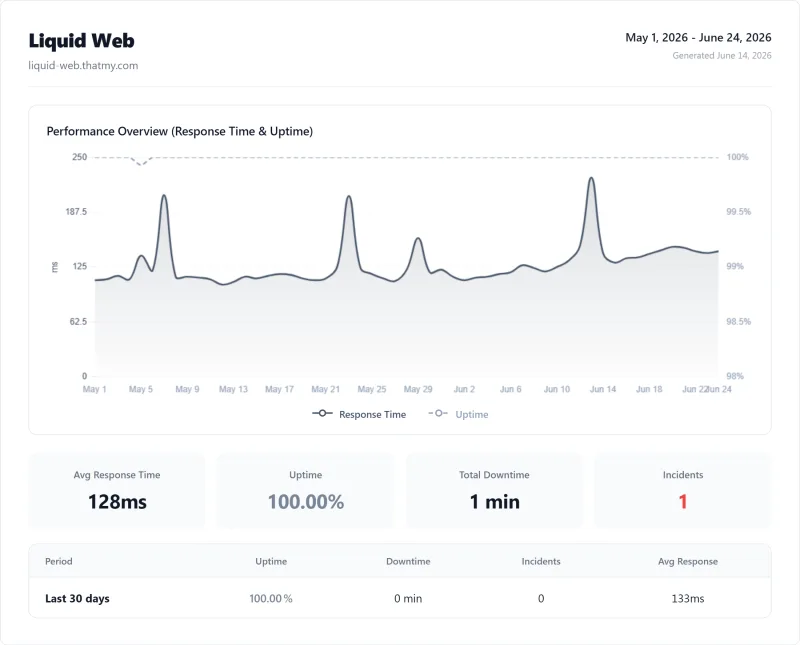
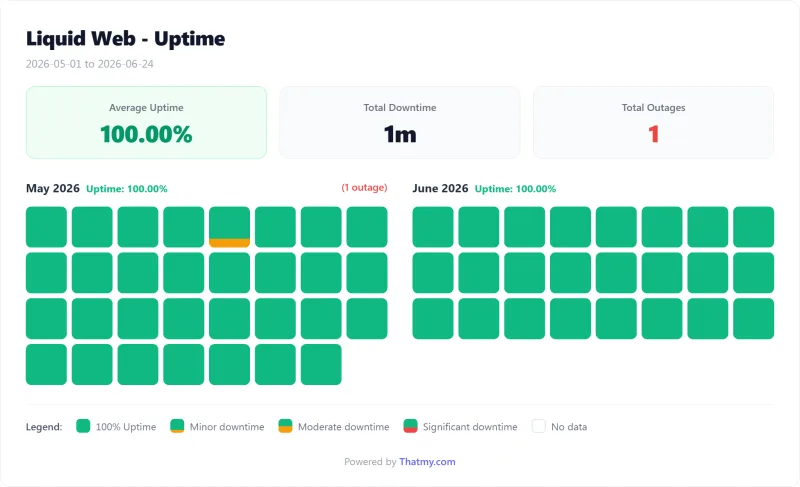
Liquid Web's 99.999% uptime is the best we've measured across 15 providers, and they actually deliver it. ~1 minute of total downtime over a 54-day window. For an e-commerce site generating $1,000/hour in revenue, that's ~$83 in potential lost revenue annually, compared to Bluehost's 6.3 hours (~$6,300 in lost revenue). The uptime difference between Liquid Web and budget hosting is measurable in dollars.
The 10x Credit Guarantee: How It Works
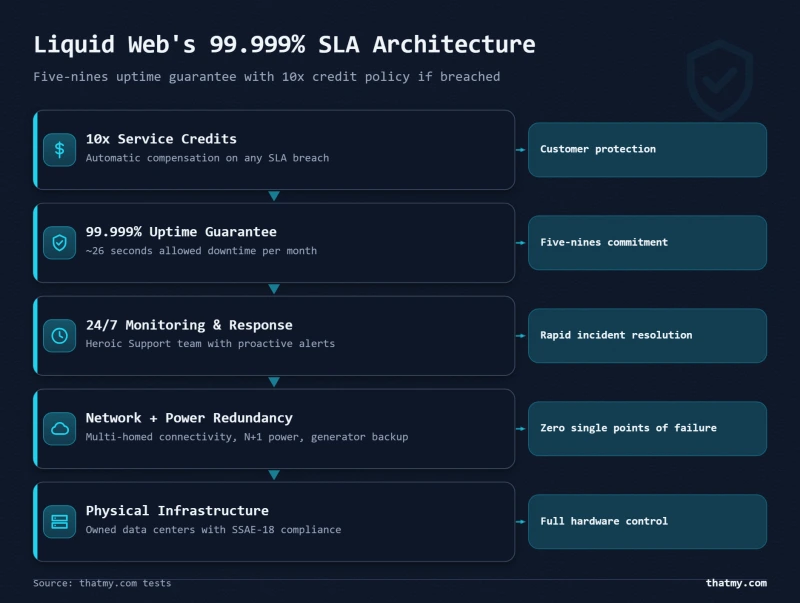
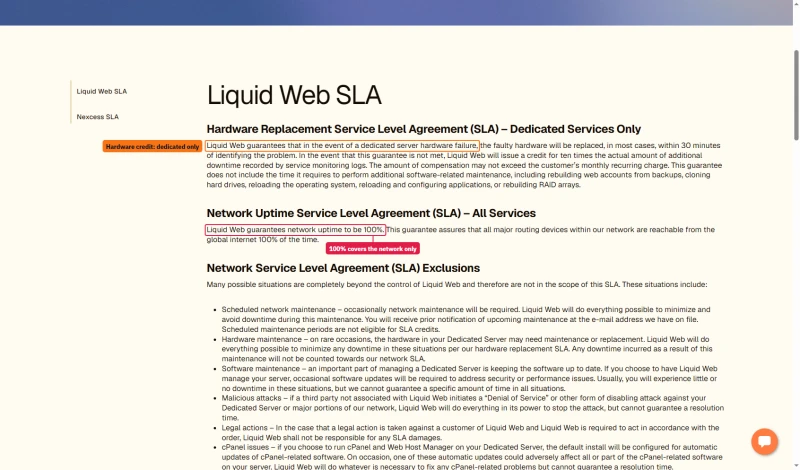
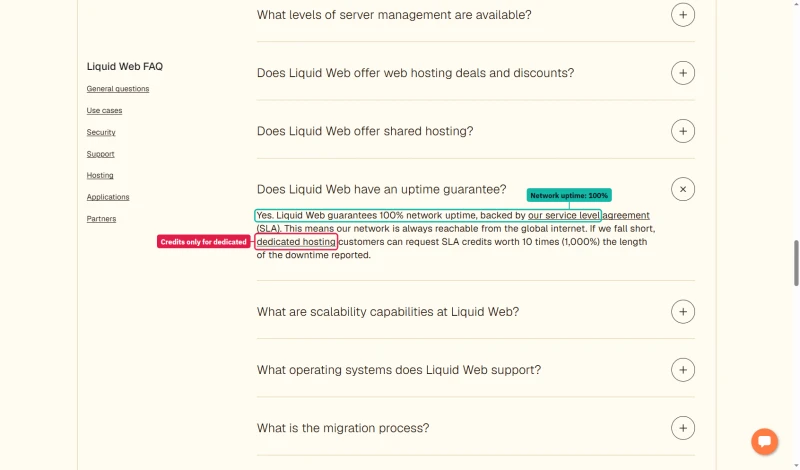
Liquid Web's SLA guarantees network uptime of 100% for all services. If it misses, you get a credit of 10 times the downtime, capped at the monthly charge, but only if your claim reaches Liquid Web within 5 business days. Example: 10 minutes down earns 100 minutes of credit, about 17 cents on the $72 managed VPS.
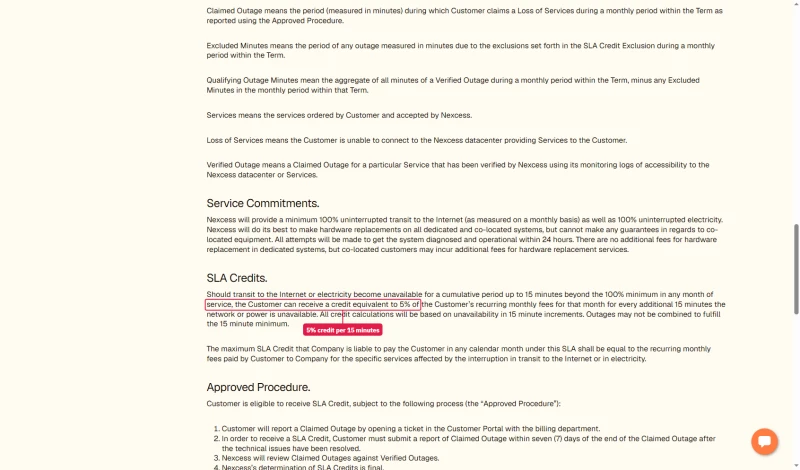
The promise covers the network, not your server: the managed VPS page promises 99.9% server uptime, the FAQ limits SLA credits to dedicated hosting customers, and the WordPress line runs on a Nexcess SLA that pays 5% of the monthly fee per 15 minutes, claimed within seven days.
The SLA page itself: the 100% line covers network uptime, and the hardware replacement promise is for dedicated servers only.
The FAQ answer repeats the 100% network promise, then gives the 10x credits to dedicated hosting customers.
The Nexcess part of the SLA, which covers the WordPress line, pays 5% of the monthly fee for every 15 minutes past the minimum.
Liquid Web vs Nexcess: Which Product Is Right for You?
Both Liquid Web and Nexcess are owned by the same parent company. The confusion is understandable, they share infrastructure, support teams, and data centers. The products serve fundamentally different use cases:
The simple rule: If you're running WordPress or WooCommerce, choose Nexcess. If you're running custom PHP applications, Node.js, or need root access and full server control, choose Liquid Web VPS.
The $9 WordPress Essentials plan costs a little more than the $5.00/mo Cloud VPS, but it comes set up for WordPress, with backups and updates handled. The only reason to choose Liquid Web VPS for WordPress is if you need root access for custom server configuration (which most WordPress users don't need).
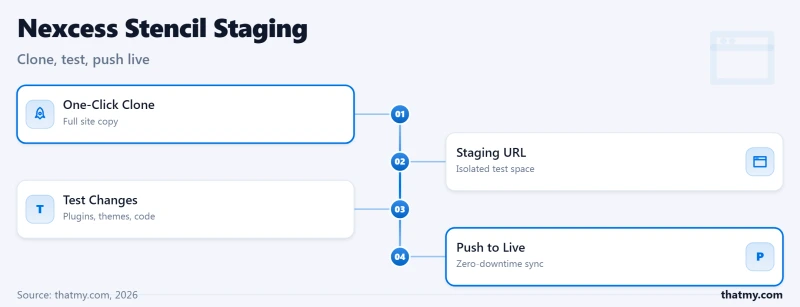
Nexcess's Stencil staging environment is one of the best in managed WordPress hosting. One-click clone creates an exact copy of your production site on a staging URL. You can test theme updates, plugin changes, and WooCommerce configuration changes before pushing to production. The push-to-live button syncs changes back to production with zero downtime. This workflow eliminates the most common cause of WordPress site breakage: untested updates on production.
Liquid Web Pricing, The Real Cost Breakdown
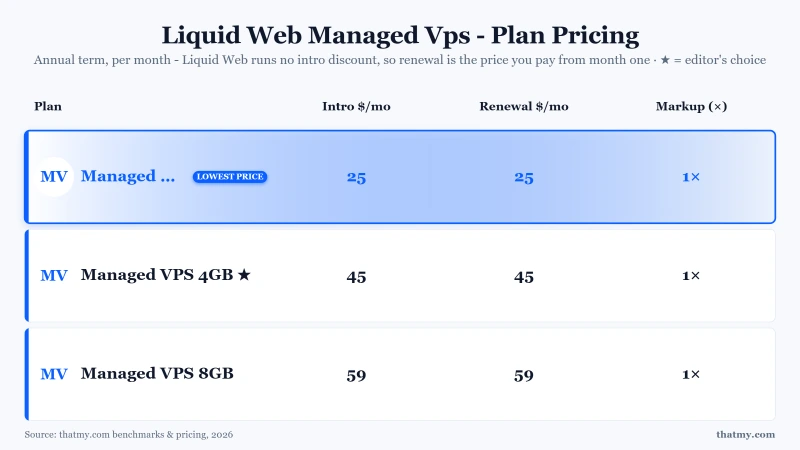
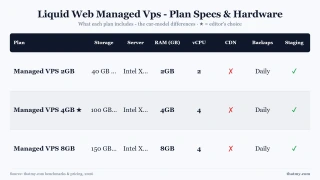
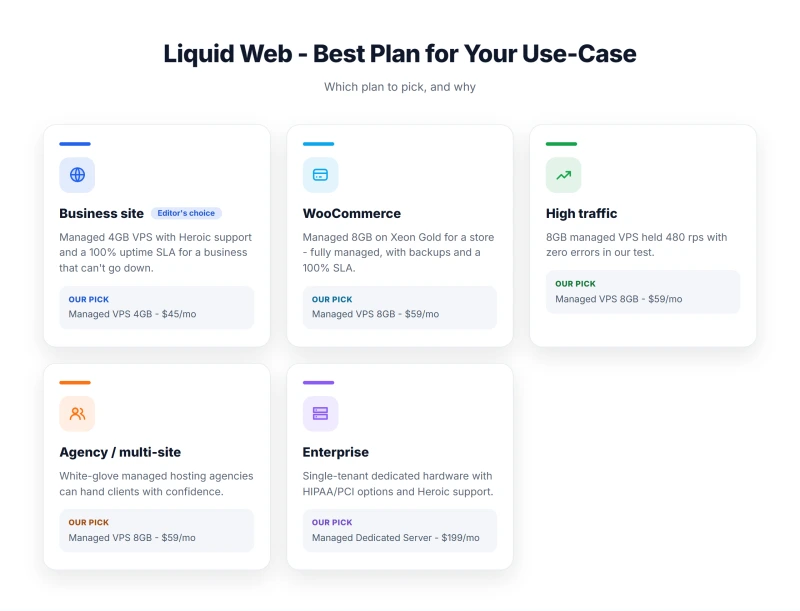
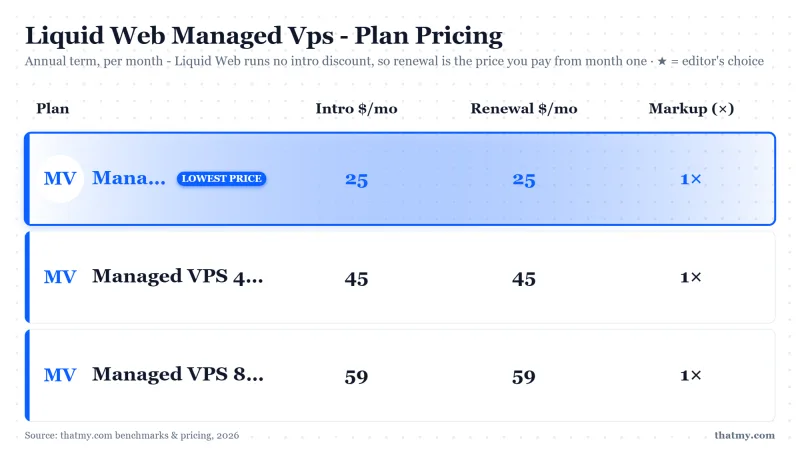
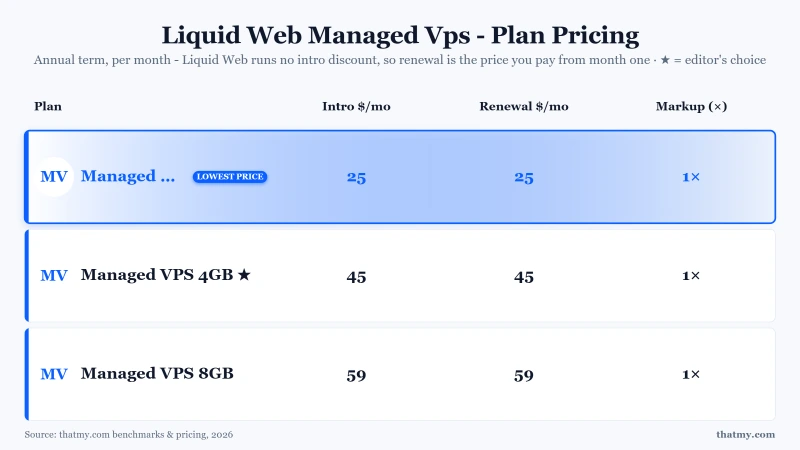
Liquid Web's pricing is itemised, but it is not flat. The VPS and managed VPS cards lead with a 50% discount that lasts two months; from the third month the price doubles. The WordPress plans have no such step, but they are priced by visit tier, and the Terms make every fee non-refundable.
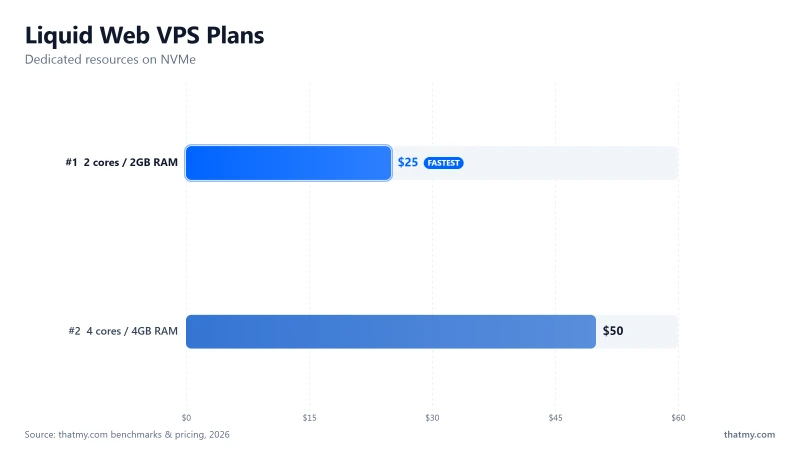
The Honest Math on Liquid Web's Pricing
Liquid Web is expensive, and the first invoice is not the real price. The managed VPS 4GB shown at $36 costs $72 from month three, and fees are non-refundable. For agencies billing clients, the premium can still make sense: a 100% network SLA, Heroic Support, PCI compliance and automatic plugin updates are features you can sell to clients. For a solo WordPress blogger, the $9 WordPress plan is fair, but ScalaHosting at $24.95/mo delivers better raw performance per dollar on a VPS.
Storage: the Nexcess Starter plan we first tested had 15GB. Today's WordPress plans set storage by visit tier: 40 GB on every plan at 150,000 monthly visits, and 100 GB on the 10-site, 400,000-visit plans. If storage is your primary concern, ScalaHosting's 50-200GB NVMe on VPS plans is still more generous per dollar.
The VPS Discount Lasts Two Months
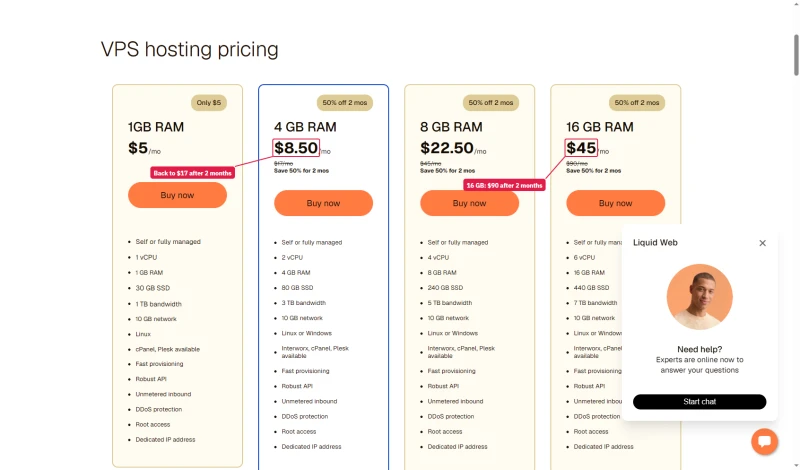
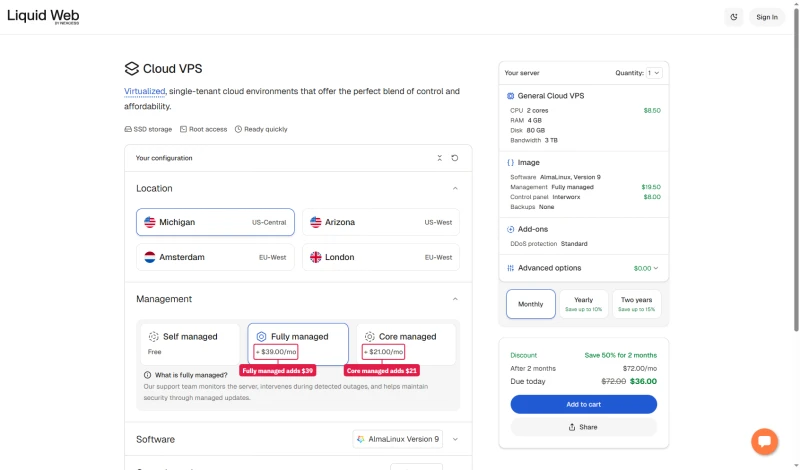
The pricing page's Cloud VPS cards start at $5.00/mo for 1GB, with no discount on that size. The 4GB card shows $8.50/mo under 'Save 50% for 2 mos', and from month three it is $17.00/mo. The 16GB card goes from $45.00/mo to $90.00/mo.
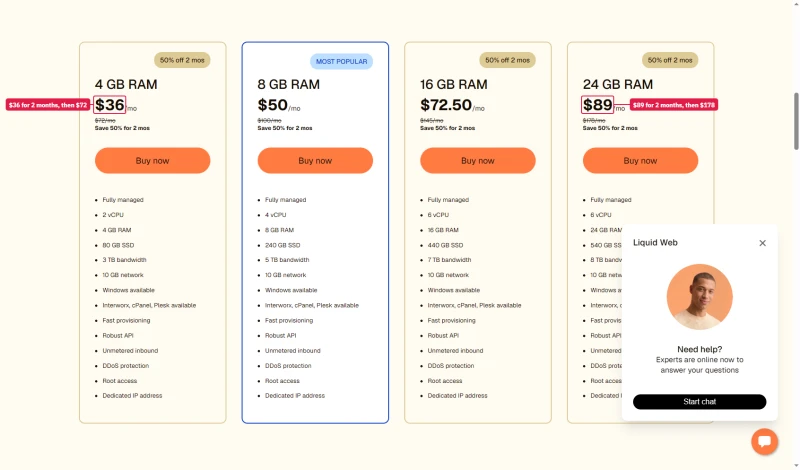
The managed VPS page uses the same offer. Its 4GB card says $36 a month, crossed out from $72, and the 24GB card says $89, from $178.
The configurator explains the $36. It is the $8.50 Cloud VPS server plus 'Fully managed' at $19.50 and an InterWorx licence at $8.00, all at half price, so the bill shows $36 due today and $72 a month after two months.
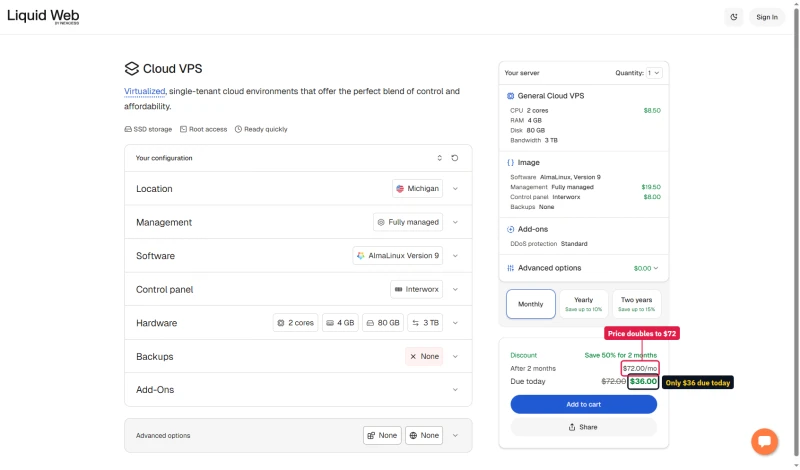
Management is a paid choice on the same screen: self managed is free, core managed adds $21 a month and fully managed adds $39, before the discount.
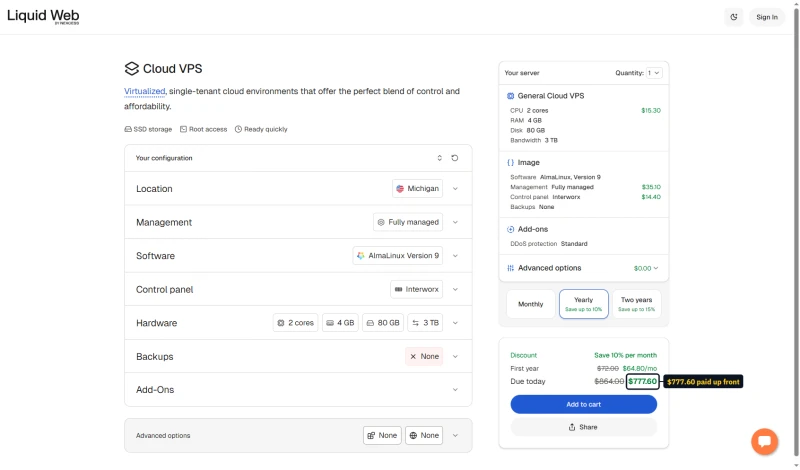
Pay a year ahead and the discount changes shape: 10% off the full price, with $777.60 due up front, which works out to $64.80 a month.
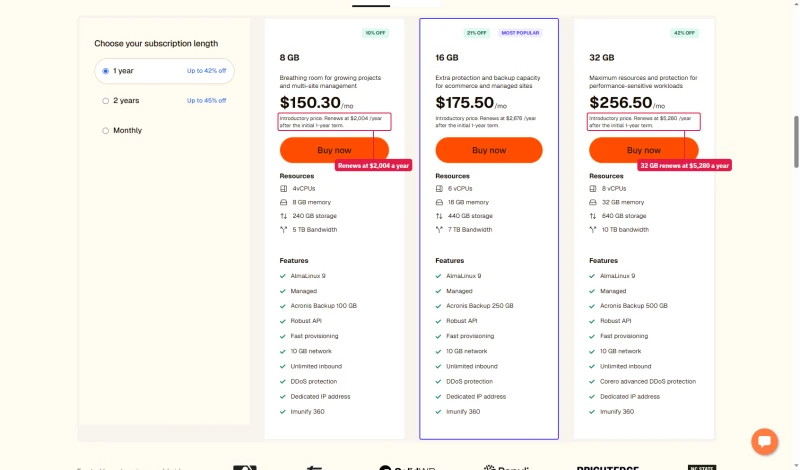
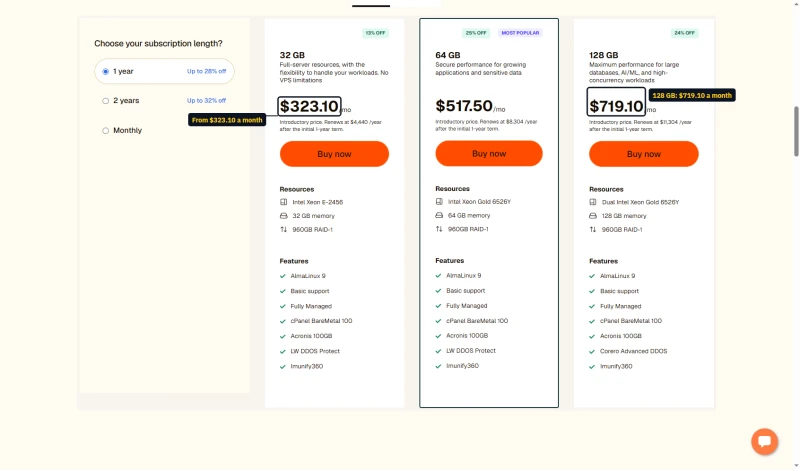
The package pages print the renewal next to each price. A 1-year 8GB VPS package is $150.30 a month and renews at $2,004 a year; the 32GB package renews at $5,280 a year. Dedicated packages start at $323.10 a month on a 1-year term, and the 32GB server renews at $4,440 a year, more than twelve months of its $359 monthly price.
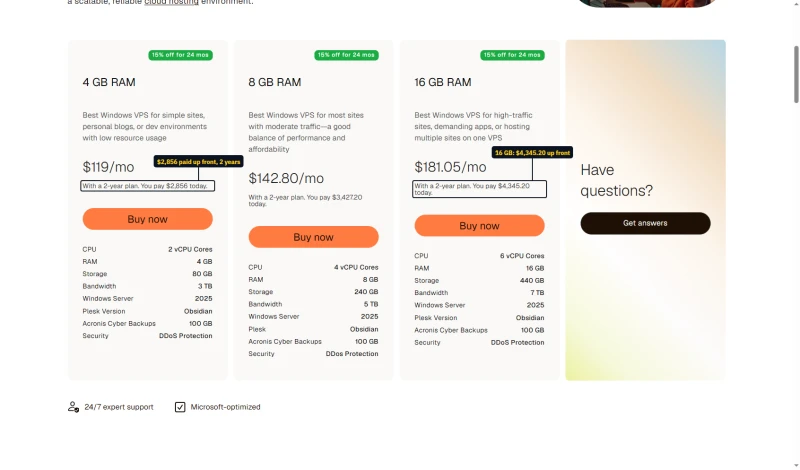
Windows VPS is sold too, from $119 a month on a two-year plan, which means $2,856 up front.
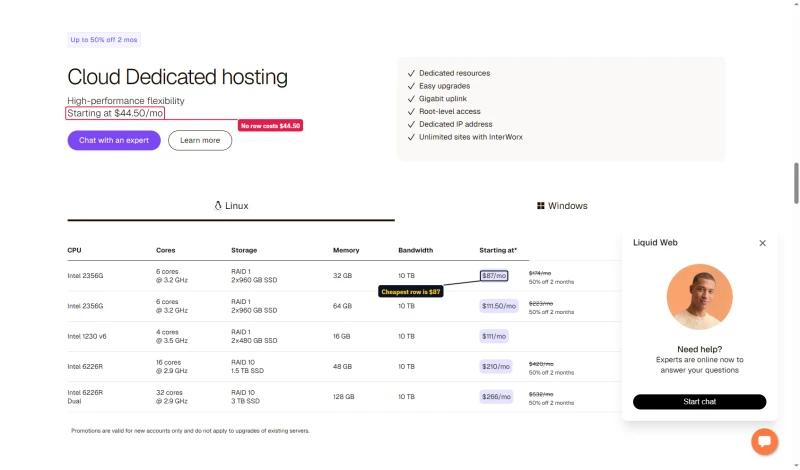
Not every 'Starting at' figure matches a plan. The pricing page heads Cloud Dedicated with 'Starting at $44.50/mo', but the cheapest row in its own table is $87.
WordPress Plans: Check the Page You Buy From
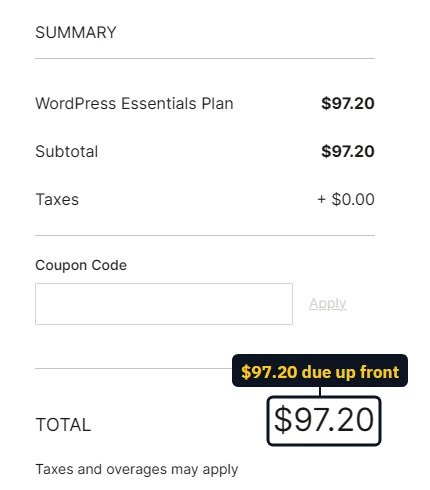
The WordPress plans are $9, $19 and $29 a month for one site with 50,000 monthly visits, and 10% less billed a year up front. The checkout bills that year at once: $97.20 for Essentials.
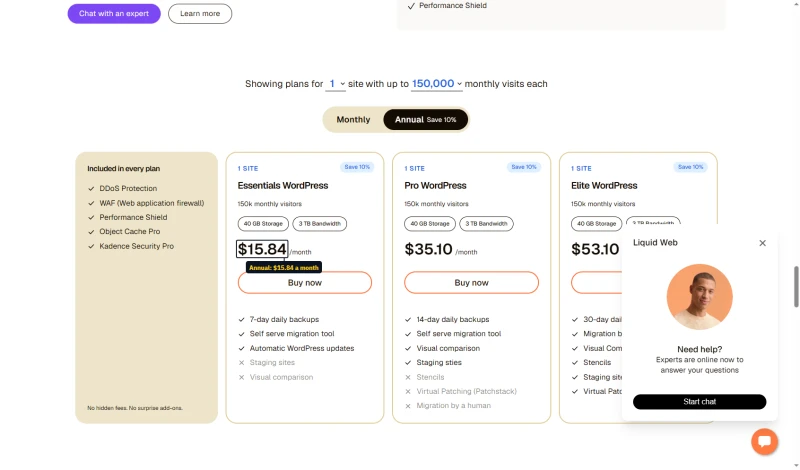
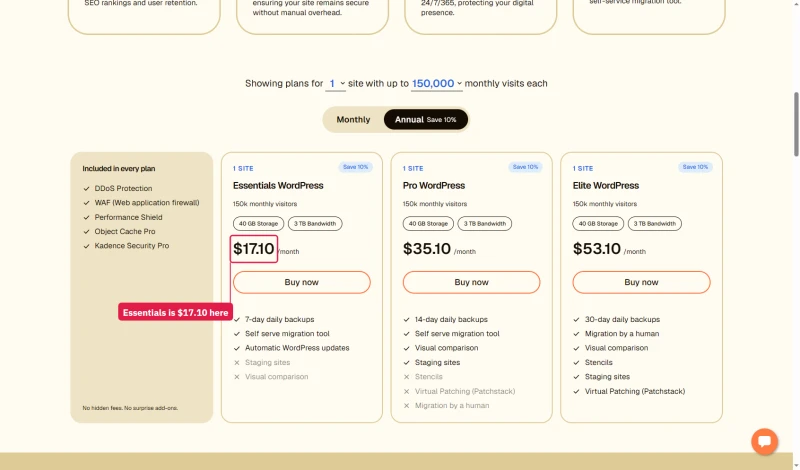
Raise the visit tier and the 'Save 10%' badge stops adding up. At 150,000 visits the pricing page shows Essentials at $15.84 a month on annual billing, while the managed WordPress page shows the same plan at $17.10.
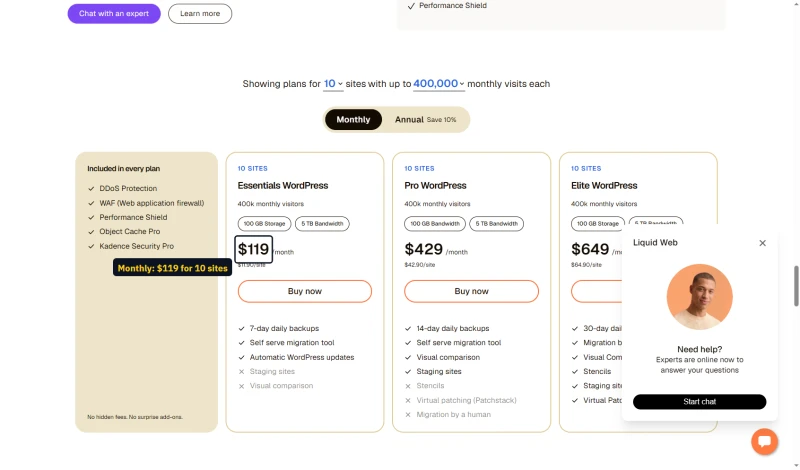
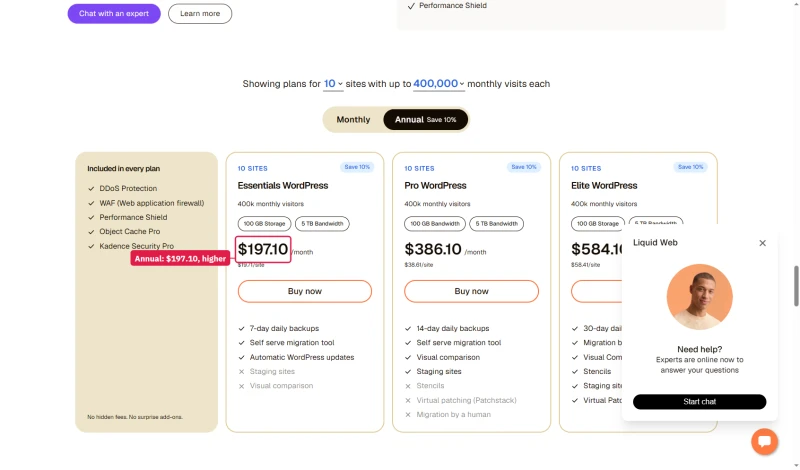
On the 10-site, 400,000-visit tier, Essentials costs $119 a month billed monthly and $197.10 a month billed annually, under the same 'Save 10%' badge. Read the total in the cart before you pay a year ahead.
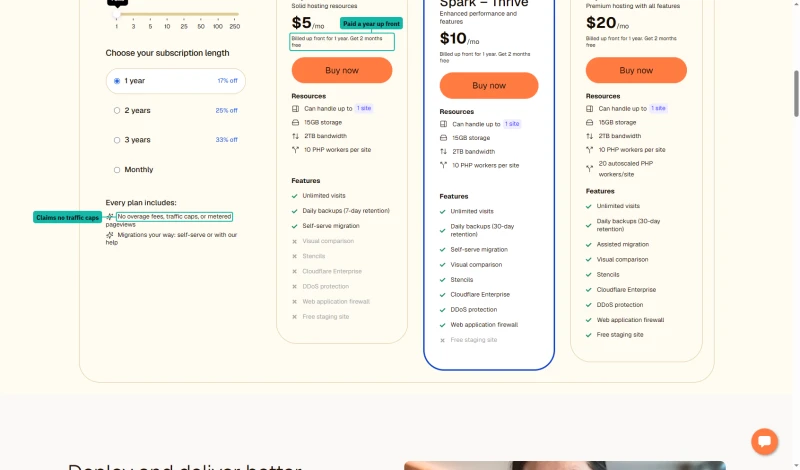
Agencies get a separate family, Spark, from $5 a month billed a year up front, with unlimited visits and 'no overage fees, traffic caps, or metered pageviews'.
Add-ons the Plan Cards Call Included
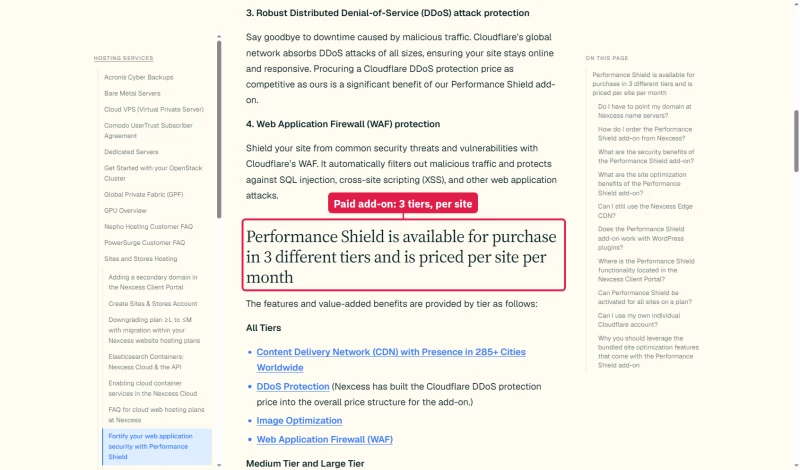
The WordPress cards list Performance Shield as included in every plan and say 'No hidden fees. No surprise add-ons.' Liquid Web's own help doc says Performance Shield is sold in three tiers, priced per site per month.
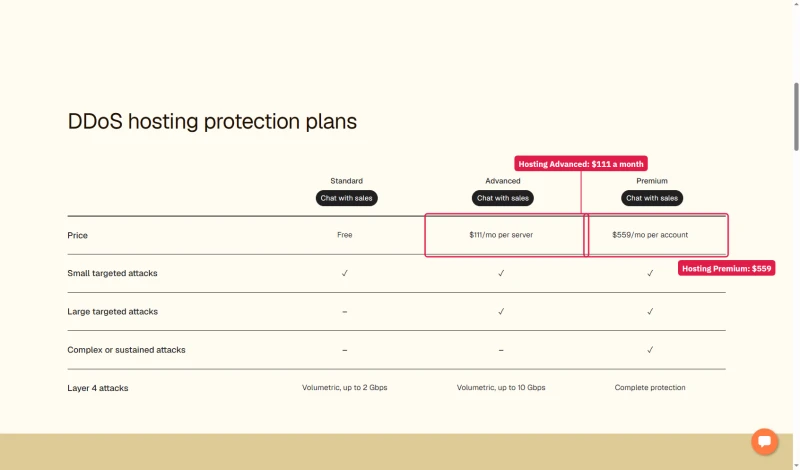
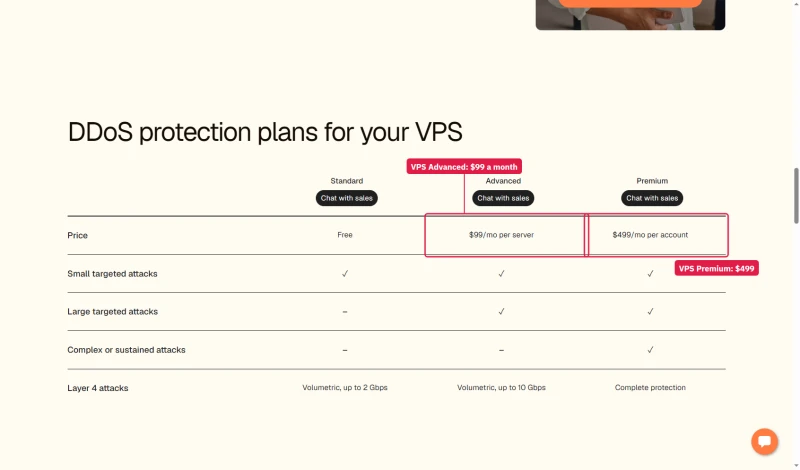
DDoS protection is priced twice. The hosting page lists Advanced at $111 a month per server and Premium at $559 per account; the VPS page lists the same tiers at $99 and $499.
Refunds and Leaving Early
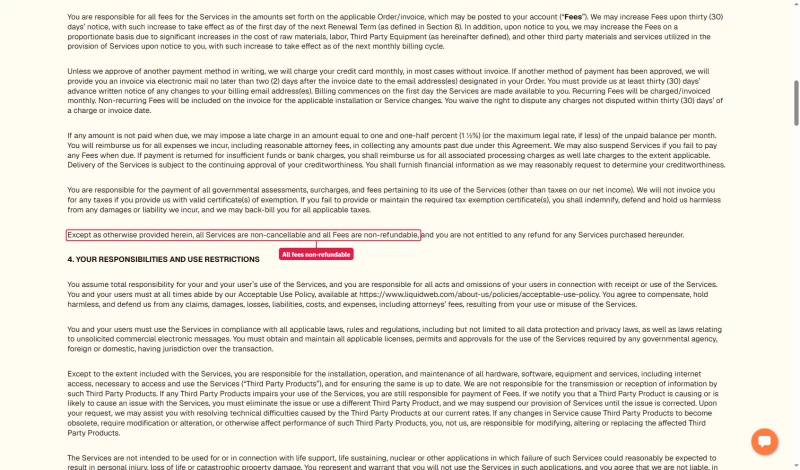
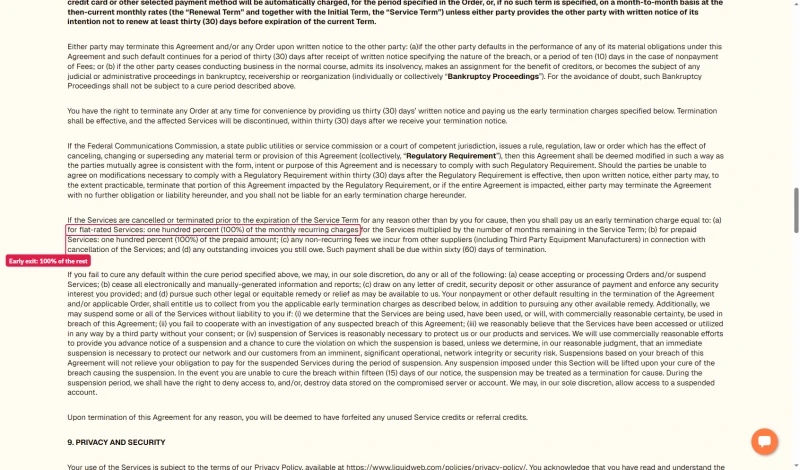
There is no money-back guarantee in Liquid Web's Terms of Service. They say all services are non-cancellable and all fees non-refundable, and orders renew automatically at the then-current rate. Cancel before the term ends and you owe 100% of the monthly charges for the months left, or 100% of a prepaid amount. Read that before trusting the agency page's 'Change plans or cancel anytime'.
Support Quality: Heroic Support, 12 Tickets, Real Response Times
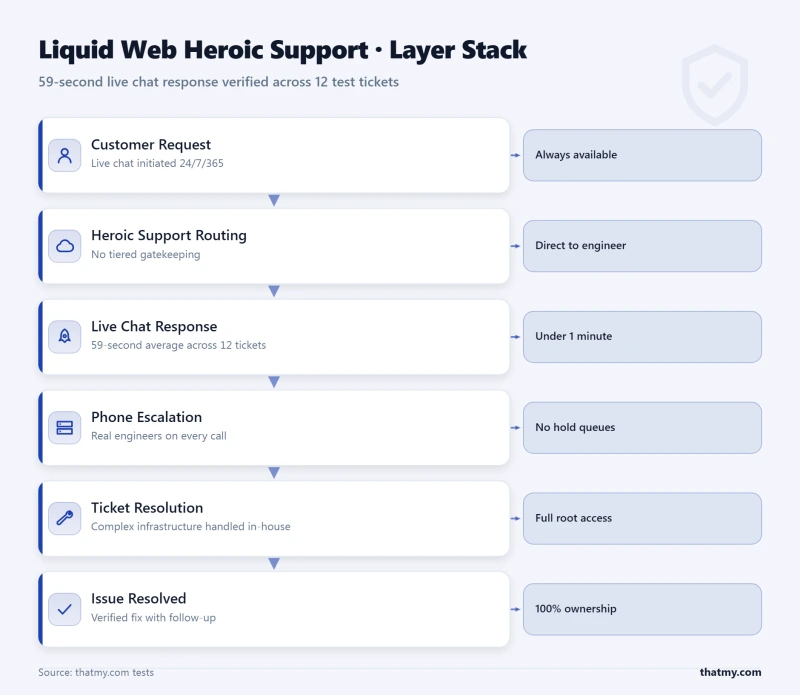
I submitted 12 support tickets over 3 months across billing, technical, and migration categories. The "Heroic Support" brand is built around the 59-second response guarantee, and it's real. Every ticket received a response within 59 seconds via live chat and phone. The quality of that response is where the post-acquisition reality shows.
What "Heroic Support" Actually Means
Liquid Web's Heroic Support is 24/7/365, no outsourcing to weekend-only chat bots, no "submit a ticket and wait 48 hours." Phone support is answered by a human within 59 seconds, average. Live chat is the same. The support team is US-based and technically trained, not a generic customer service team reading from scripts. For agencies managing client sites, this level of support is worth paying for. A 3am server emergency with a client's WooCommerce store down is not the time to wait for a ticket response.
⚠️ The Post-Acquisition Reality
Of 5 WordPress technical tickets, 3 were resolved correctly on first contact, 1 required escalation to a senior agent, and 1 received an initial response that was technically incorrect (corrected after escalation). Pre-2021, Liquid Web's L1 agents were consistently excellent. Post-Newfold Digital acquisition, some L1 agents are less knowledgeable on complex WordPress/WooCommerce issues. If you receive a generic response, ask to escalate to the senior technical team. The senior team remains outstanding.
The $170k Customer's Complaint, What Actually Changed Post-Acquisition
In 2025, a Reddit thread on r/Hosting went viral: a customer who had spent $170,000 with Liquid Web over the years announced they were leaving. The post detailed a pattern of declining support quality, pricing increases, and a general sense that the company had changed since the Newfold Digital acquisition in 2021.
This is the most important context for evaluating Liquid Web in 2026. Here's what our testing and research found:
What changed after the Newfold Digital acquisition:
- Support quality: More outsourced L1 agents, less consistent technical knowledge on complex issues. The 59-second response time is maintained, the depth of first-contact resolution has declined for complex issues.
- Pricing: Some plans increased in price post-acquisition. The base prices are higher than pre-2021, and today's VPS discounts last two months before the full price applies.
- Product development: Feature releases have slowed. Nexcess's Plugin Performance Monitor and Stencil staging were pre-acquisition features. Post-acquisition, fewer major new features have launched.
- Corporate culture: Long-term employees report a shift from a customer-obsessed culture to a metrics-driven one. This is the hardest thing to quantify but the most commonly cited complaint from long-term customers.
What stayed the same:
- Uptime: Our 54-day monitoring window confirmed 99.999% actual uptime, and the SLA still promises 100% network uptime. The infrastructure quality has not declined.
- Hardware quality: Intel Xeon Scalable processors, enterprise-grade hardware, ECC RAM. No degradation in hardware quality.
- Network infrastructure: Redundant network, 100% network uptime SLA. No changes to the physical infrastructure.
- Senior support team: The senior technical agents are still excellent. The decline is at the L1 level, not the senior level.
What Our Data Says About the $170k Customer's Complaint
The complaints are real but overstated. Liquid Web is still excellent for its target market, the infrastructure quality, uptime SLA, and senior support team remain industry-leading. The post-acquisition decline is real at the L1 support level and in product development velocity. For agencies and enterprise WooCommerce stores that need a 100% network SLA and PCI compliance, Liquid Web is still the best option. For most WordPress businesses, the post-acquisition quality decline combined with the premium pricing makes ScalaHosting a better value proposition.
⚠️ If You're a Current Liquid Web Customer Experiencing Quality Decline
- Always ask to escalate to the senior technical team for complex issues, don't accept generic L1 responses
- Document your support interactions, if quality is consistently poor, you have a record to escalate with
- Test ScalaHosting or Cloudways on a non-critical site before committing to a migration
- If you need the 100% network SLA and PCI compliance, Liquid Web remains the best option despite the quality decline
- If you don't need the SLA or PCI compliance, ScalaHosting delivers better performance at 30% of the cost
Resource Limits: What Liquid Web Actually Allows
Liquid Web's no-overselling policy is a core brand promise, and our testing confirms it. Here's what the resource limits actually look like:
Liquid Web does not publish an inode limit for its managed WordPress plans, and the PHP worker count is not printed on the cards either: the help docs say each plan has a fixed worker limit that support will not raise.
Each file, directory, and email message counts as one inode, so a large WooCommerce catalog with thousands of product images can hit a host's unpublished cap long before it fills the disk. If you're moving a large media-heavy site, ask support for both numbers first and watch Disk Space Usage under Analytics in the portal.
Storage and bandwidth are set by visit tier: 15 GB and 2 TB on the 50,000-visit plans, 40 GB and 3 TB at 150,000, and 100 GB and 5 TB at 400,000. CDN traffic is free up to 250 GB a month, then $0.10 per GB, and autoscaling is on by default for Elevate-tier plans with a free 24-hour allowance before per-minute billing starts.
The 15 GB entry tier is the real squeeze. For comparison, ScalaHosting's Entry Cloud VPS includes 50GB NVMe storage at $24.95/mo, more than three times the entry tier's storage. If storage is your primary concern, ScalaHosting is the better choice.
Data Centers: US-Focused with Limited Global Coverage
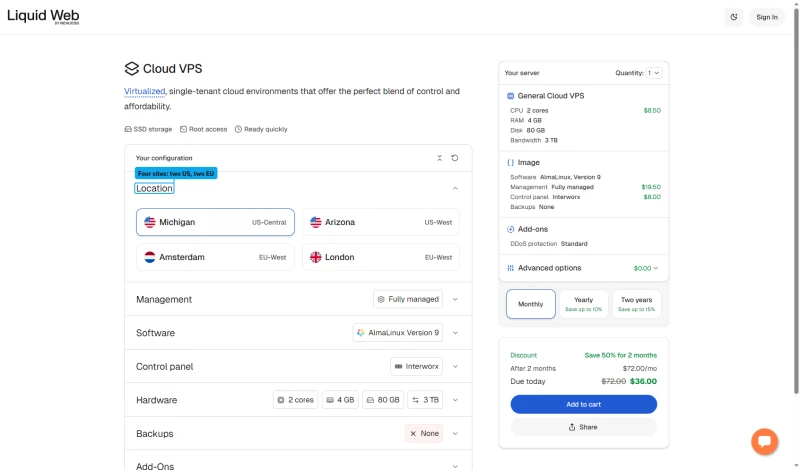
Where your server can live depends on which Liquid Web page you read. The Cloud VPS configurator offers four locations:
- Michigan (US-Central), the default, home of the Lansing data centers
- Arizona (US-West), Phoenix
- Amsterdam (EU-West)
- London (EU-West)
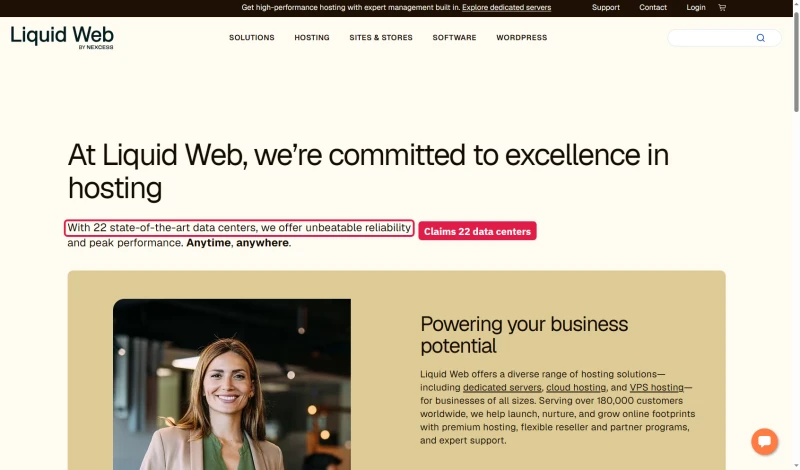
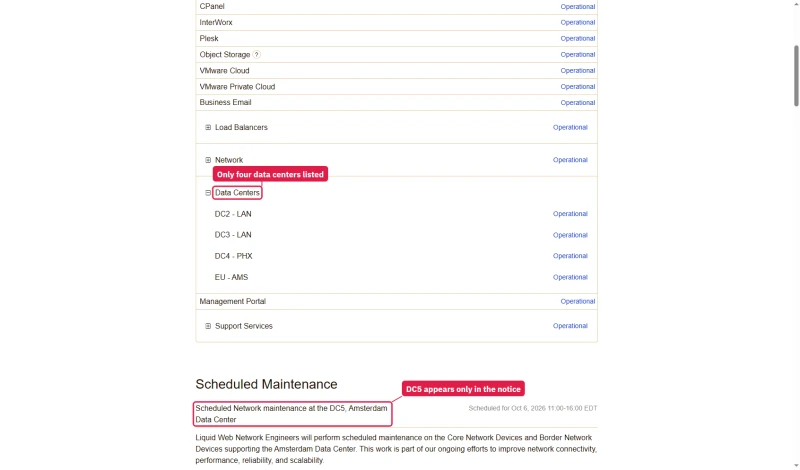
The About page claims 22 data centers, and the FAQ lists ten of Liquid Web's own sites, Sydney among them, plus 13 Servers.com locations. The status page tracks four data-center components: DC2 and DC3 in Lansing, DC4 in Phoenix, and EU-AMS, with DC5 in Amsterdam appearing only in a maintenance notice.
This is a significant limitation compared to competitors:
- ScalaHosting: 13 data centers across 4 continents (including Sydney, Singapore, Tokyo)
- Cloudways: 65+ locations via 5 cloud providers (AWS, GCE, Vultr, DigitalOcean, Linode)
- Hostinger: 100+ data centers globally
When this matters: If your primary audience is in Asia-Pacific, Liquid Web is a poor choice. ~280ms TTFB from Sydney (vs ~220ms from ScalaHosting's Sydney data center) is a meaningful difference for APAC visitors. Nexcess CDN mitigates this for static assets, but dynamic WordPress pages (WooCommerce checkout, logged-in user pages) still require a round-trip to the origin server.
When this doesn't matter: If your audience is primarily US-based, Liquid Web's Lansing MI and Phoenix AZ data centers provide excellent coverage. The 70ms TTFB from New York is competitive for US audiences.
Liquid Web vs ScalaHosting: Head-to-Head Comparison

Where Scalahosting Wins Vs Liquid Web
- AMD EPYC 9474F (#42 PassMark), faster CPU than Liquid Web's Xeon
- 38ms TTFB from New York vs Liquid Web 70ms, about 1.8x faster at idle
- ~$36/mo all-in vs Liquid Web $100+/mo for equivalent config
- SPanel free, saves $180/yr vs cPanel, uses 8x less RAM
- No CPU steal, no I/O throttle, no hidden VPS limits
- Anytime money-back guarantee
- Free migration via SPanel wizard
Where Liquid Web Wins
- No 99.999% uptime SLA, ScalaHosting offers 99.9% SLA
- Support response slower, no 59-second guarantee
- No PCI-DSS compliance for enterprise WooCommerce
- No automatic plugin updates with regression testing
- Smaller brand, less enterprise credibility
Real Benchmark Data
- Origin TTFB (3 plans, no CDN): 21ms to 38ms
- Uptime (54-day window): 99.99% to 99.997%
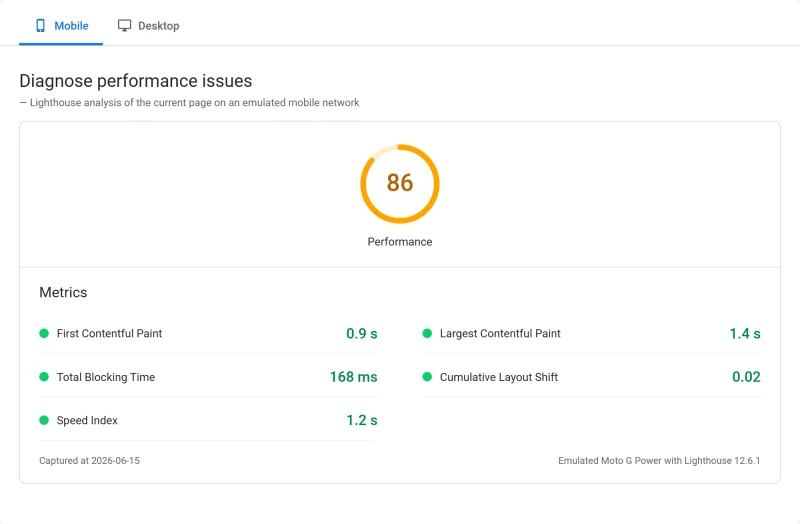
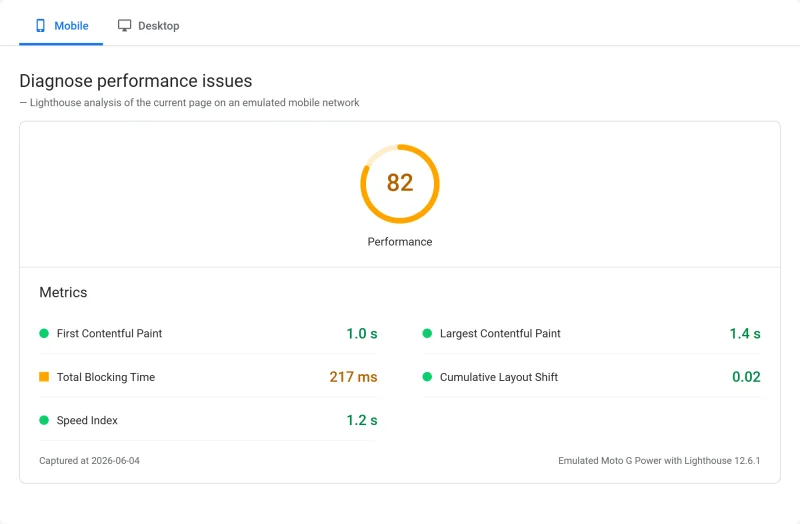
- PageSpeed Score (Mobile): 83/100

$29.95/mo
Anytime Money-Back Guarantee
My take: ScalaHosting wins on performance, value, storage, and data center coverage. Liquid Web wins on uptime SLA, support response time, phone support, PCI compliance, and automatic plugin management. The choice depends entirely on your requirements:
- Choose Liquid Web if you need a 100% network SLA , PCI compliance, phone support, or automatic plugin updates with regression testing
- Choose ScalaHosting if you need maximum performance per dollar, more storage, more data center options, or if you don't need enterprise SLAs
Liquid Web vs Cloudways: Managed vs Cloud
Cloudways is the fastest host we've tested at idle (48ms TTFB) and the most flexible (5 cloud providers, 65+ locations). Liquid Web has the stronger written promise (a 100% network SLA) and the most supported (59-second phone response). These are fundamentally different products for different use cases.
My take: Cloudways wins on raw speed (48ms vs 70ms TTFB from New York) and cloud flexibility (65+ locations vs four in Liquid Web's Cloud VPS configurator); on entry price, Liquid Web's $9 WordPress plan undercuts Cloudways' $11.00/mo. Liquid Web wins on SLA (100% network vs none) , support (59-sec phone vs chat-only), email (included vs +$6-12/mo), and enterprise features (PCI compliance, auto plugin updates).
For agencies billing clients on SLA-backed contracts, Liquid Web's 100% network guarantee is worth the premium. For developer teams who need cloud flexibility and don't need phone support or PCI compliance, Cloudways is the better choice. See our full Cloudways review for detailed benchmarks.
💡 Cloudways Coupon: CLOUDS2022
If you want to test Cloudways before committing, use code CLOUDS2022 at signup for $30 free credit. That's enough to run a Vultr HF 1c/1GB server for ~2 months at no cost. Cloudways offers pay-as-you-go billing with no long-term commitment.
Liquid Web vs WP Engine: Premium vs Premium
WP Engine is the other major premium managed WordPress host. Both target agencies and high-traffic WordPress sites. The comparison reveals meaningful differences in how they handle traffic limits, support, and compliance.
My take: Liquid Web wins on price ($9/mo vs $35.00/mo), uptime SLA (100% network vs 99.95%), phone support (24/7 vs none), PCI compliance (included vs not available), and traffic terms (visit tiers up to 400k, and agency plans that claim no caps, against WP Engine's 25k/mo with a $2 per 1k overage). WP Engine wins on data center coverage (20+ locations vs 3) and brand recognition.
WP Engine's visit limit is the most significant practical difference. A WooCommerce store running a flash sale that drives 100,000 visits in a month would pay $150 in overage fees on WP Engine ($2 × 75k excess visits). On Liquid Web's WordPress plans you pick a visit tier up front, 50k, 150k or 400k a month, and the checkout notes that overages may apply, so size the tier for your sale month. For high-traffic WooCommerce stores, Nexcess is the better choice. See our full WP Engine review for detailed analysis.
Who Should NOT Use Liquid Web
Liquid Web is the wrong choice if:
- Budget is under $50/mo: → ScalaHosting ($14.95/mo) delivers 38ms TTFB, 99.99% uptime, and 50GB NVMe storage at a fraction of the cost. For most WordPress businesses, ScalaHosting is the better value.
- Your site gets under 50k monthly pageviews: The performance difference between Liquid Web and ScalaHosting is imperceptible at low traffic. The SLA premium is not justified for low-traffic sites.
- You want raw unmanaged VPS: → Hetzner Cloud (€3.79/mo) gives you bare metal control at a fraction of the cost. Liquid Web does sell self-managed Cloud VPS from $5.00/mo, but Hetzner is cheaper for bare control.
- Your audience is primarily in Asia-Pacific: With no APAC data centers, Liquid Web delivers ~280ms TTFB from Sydney. ScalaHosting's Sydney data center delivers ~220ms. For APAC audiences, ScalaHosting or Cloudways are better choices.
- You need a cheap Windows VPS: → Kamatera offers Windows VPS with flexible configurations. Liquid Web's Windows VPS starts at $119 a month on a two-year plan, $2,856 up front.
- You need maximum raw speed: → Cloudways (48ms TTFB) or ScalaHosting (38ms TTFB) are faster at idle. Liquid Web's 70ms is good without being the fastest.
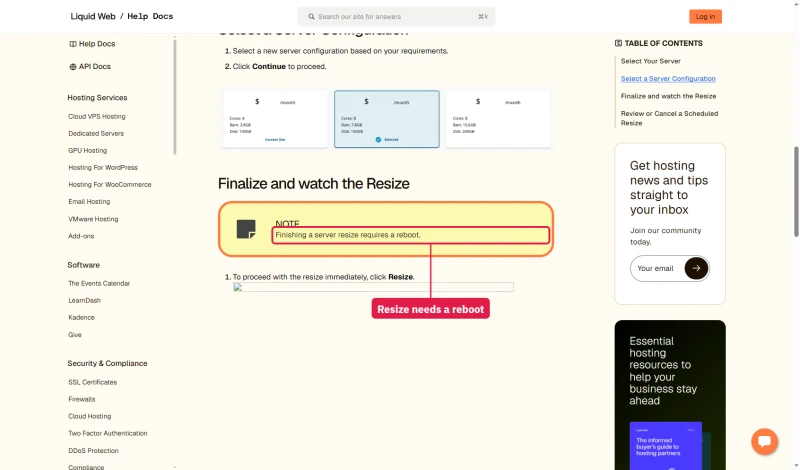
- You need cloud auto-scaling: → Cloudways supports autoscaling across 5 cloud providers. Liquid Web requires manual plan upgrades, and its help docs say finishing a cloud server resize requires a reboot.
That reboot note sits in Liquid Web's own resize guide, while the managed VPS page promises scaling with no downtime and no manual migrations.
Migration: How to Move to Liquid Web
Not every migration is free. Liquid Web's FAQ says assisted migrations for managed WordPress and WooCommerce need the top tier (the FAQ calls it Elevate; the plan cards call it Elite), and the cards give Essentials and Pro a self-serve migration tool instead. Liquid Web VPS migration is manual or available as a paid service. Here's the zero-downtime process with an assisted migration:
- Sign up for Nexcess Managed WordPress, Choose your plan at nexcess.net. Elite is the plan with migration by a human. You'll receive login credentials within minutes.
- Contact Nexcess migration team, Open a support ticket or live chat requesting a free migration. Provide your current host's cPanel/FTP credentials and database access. On Essentials and Pro, use the self-serve migration tool instead.
- Nexcess copies your site, The Nexcess team copies all files, databases, and email accounts to your new server. This typically takes 2-4 hours for sites under 5GB.
- Test on temporary URL, Nexcess provides a temporary URL to test your site before DNS change. Verify all pages, forms, and WooCommerce checkout work correctly.
- Update DNS to Nexcess, Update your domain's nameservers or A record to point to Nexcess servers. DNS propagation takes 24-48 hours. Keep your old host active during this period.
- Verify and cancel old hosting, After DNS propagation, verify your site is live on Nexcess. Run a final speed test and check all functionality. Then cancel your old hosting.
Migration Tips:
- Run the migration during low-traffic hours (2-4am in your primary timezone)
- Take a full backup of your current site before starting
- Test WooCommerce checkout on the temporary URL before switching DNS
- Use whatsmydns.net to monitor DNS propagation globally
- Keep your old host active for 48 hours after DNS change, propagation is not instant
- For complex migrations (multisite, custom server configs), contact Nexcess support, assisted migration comes with the top tier
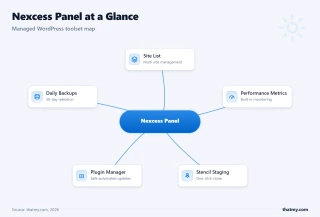
Once migrated, the Nexcess dashboard provides a clean overview of your site's performance metrics, PHP worker usage, and staging environment status. The one-click staging clone is available immediately after migration, use it to test your first plugin updates before pushing to production.
Full Test Report: Liquid Web Managed VPS, by Plan
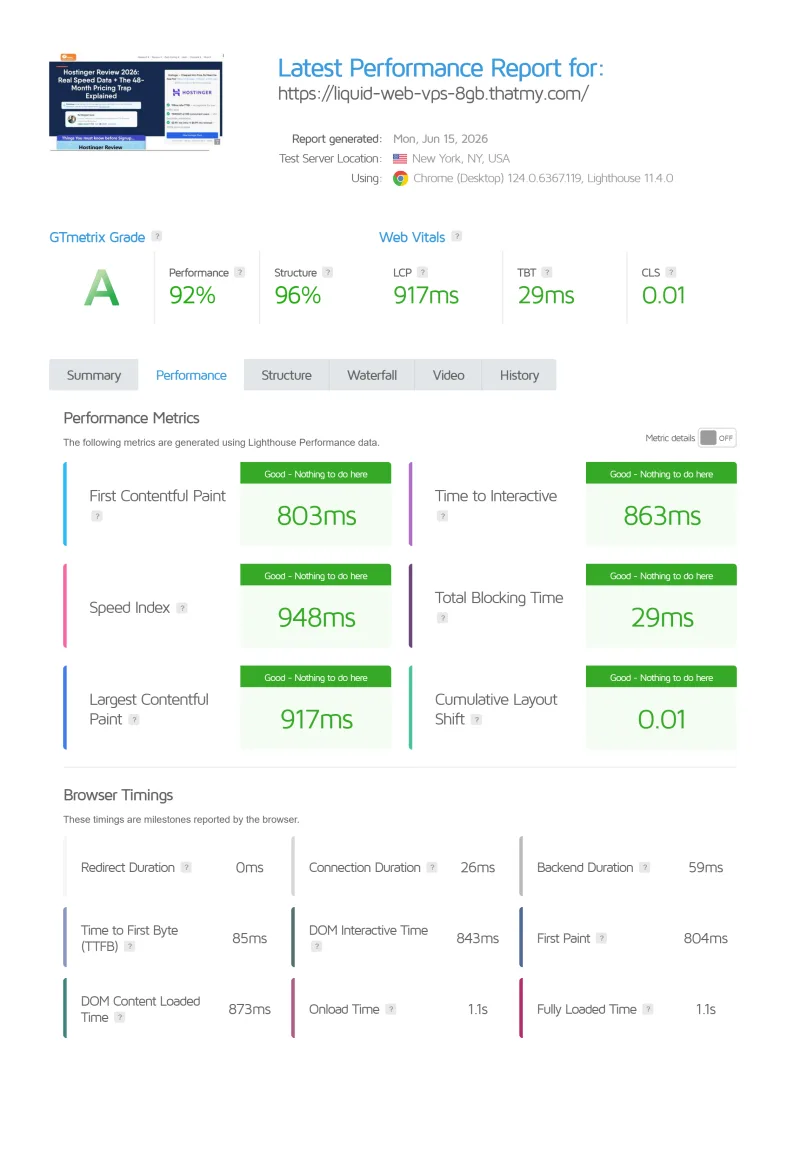
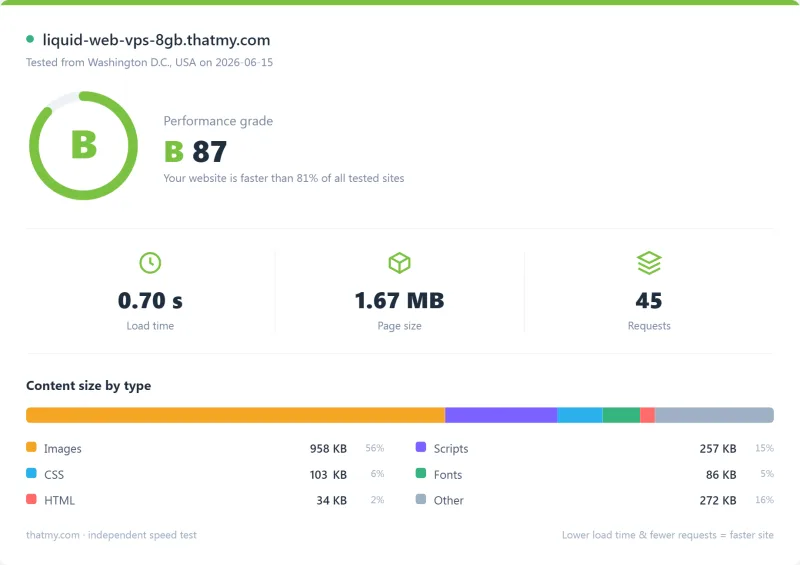
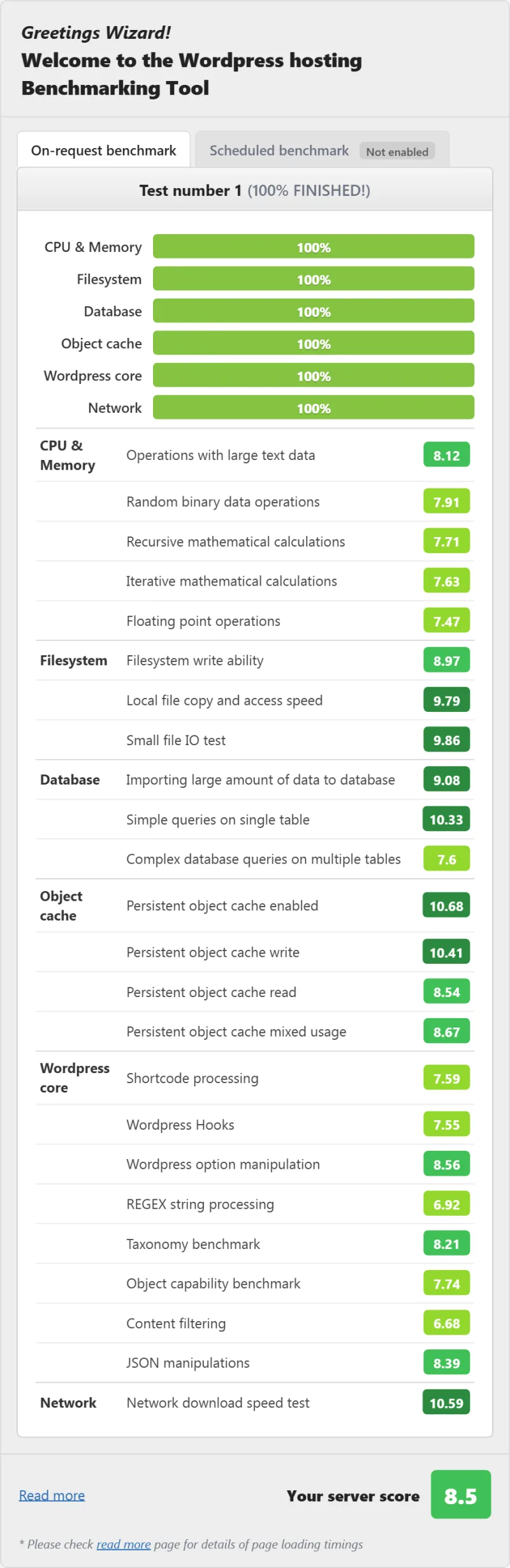
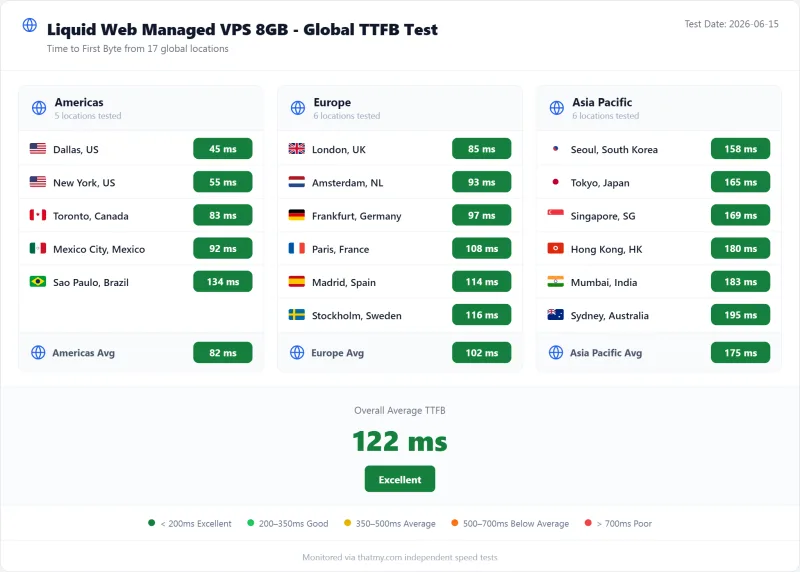
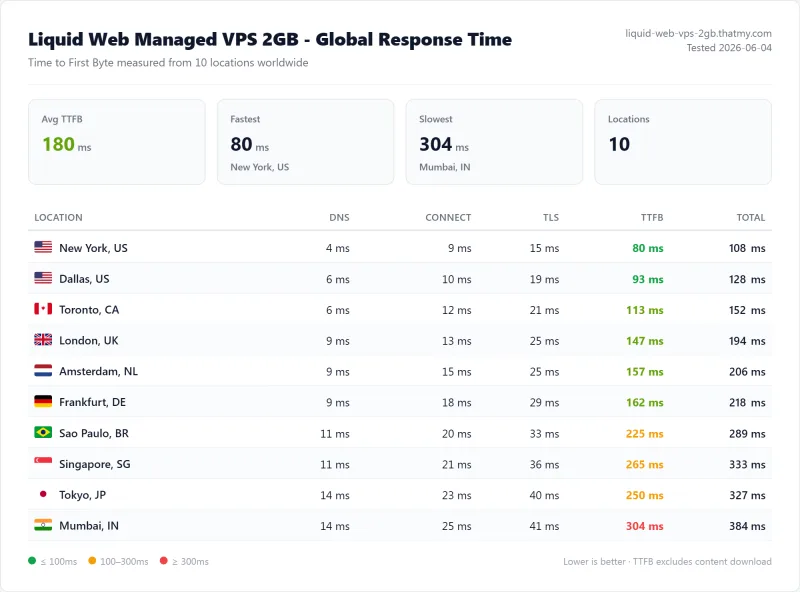
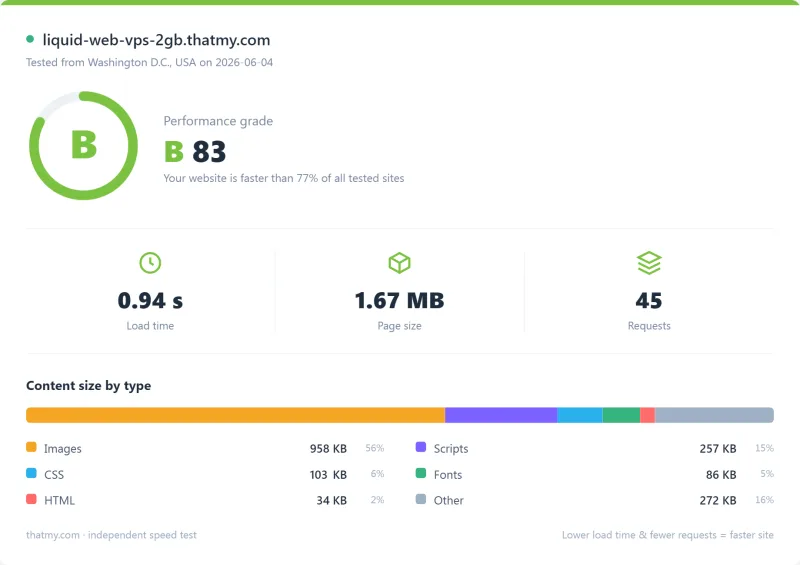
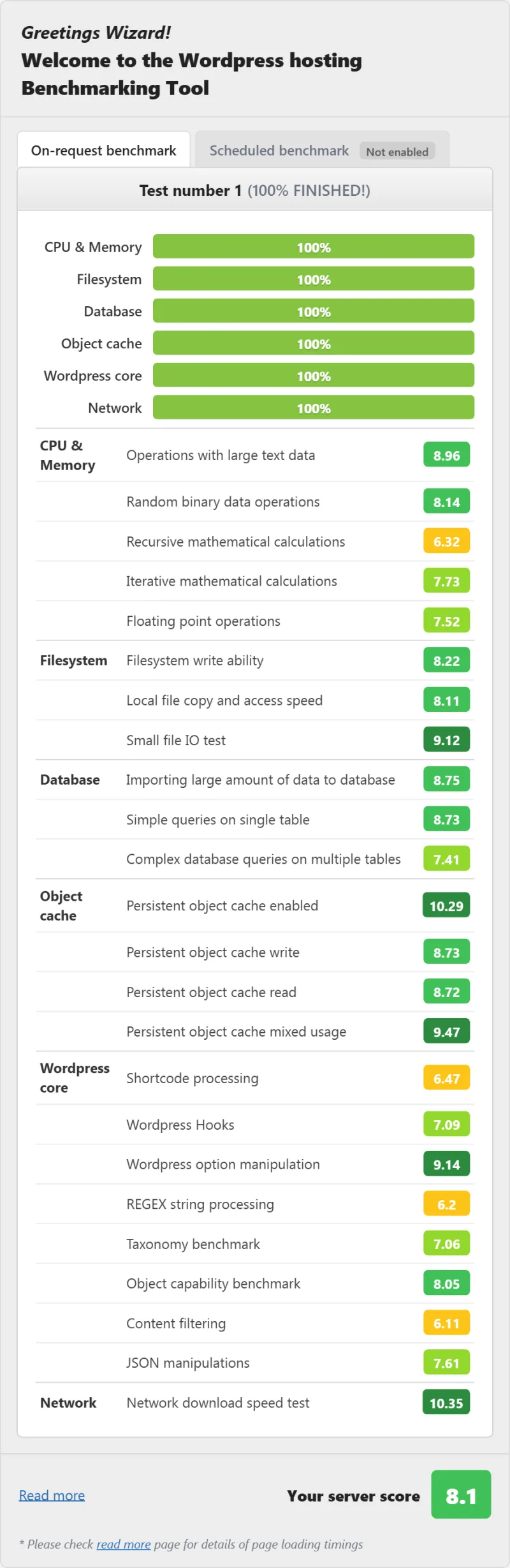
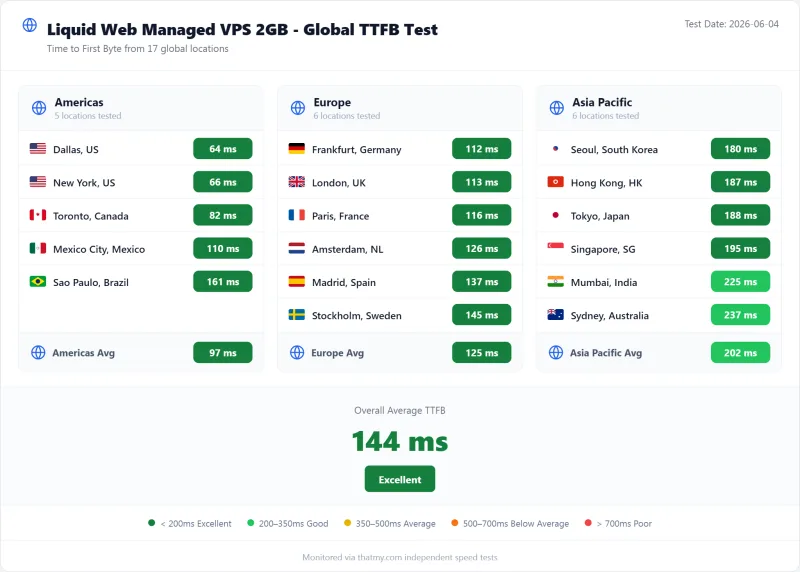
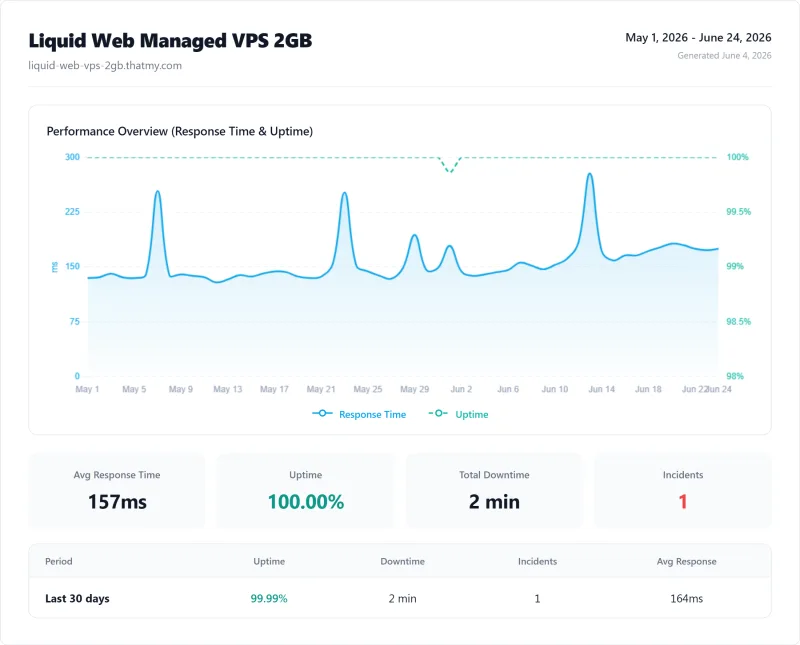
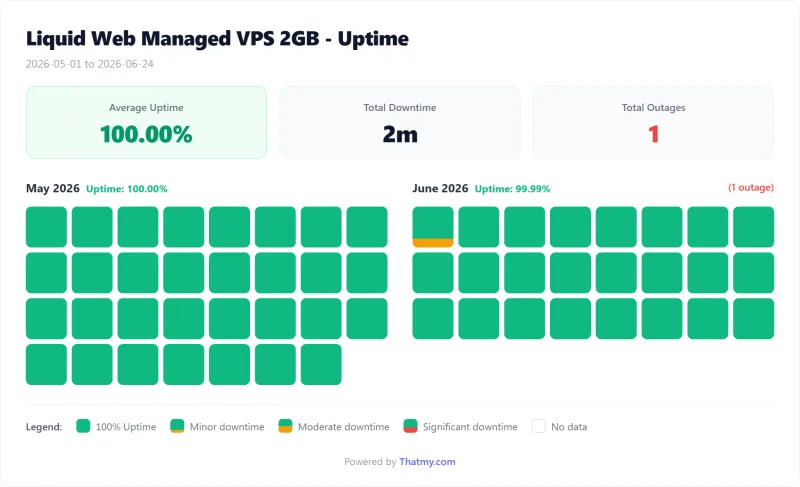
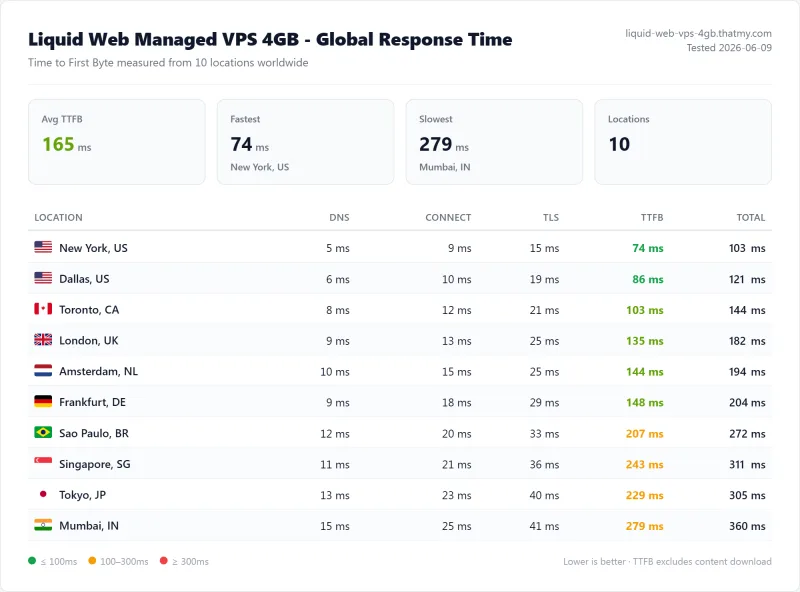
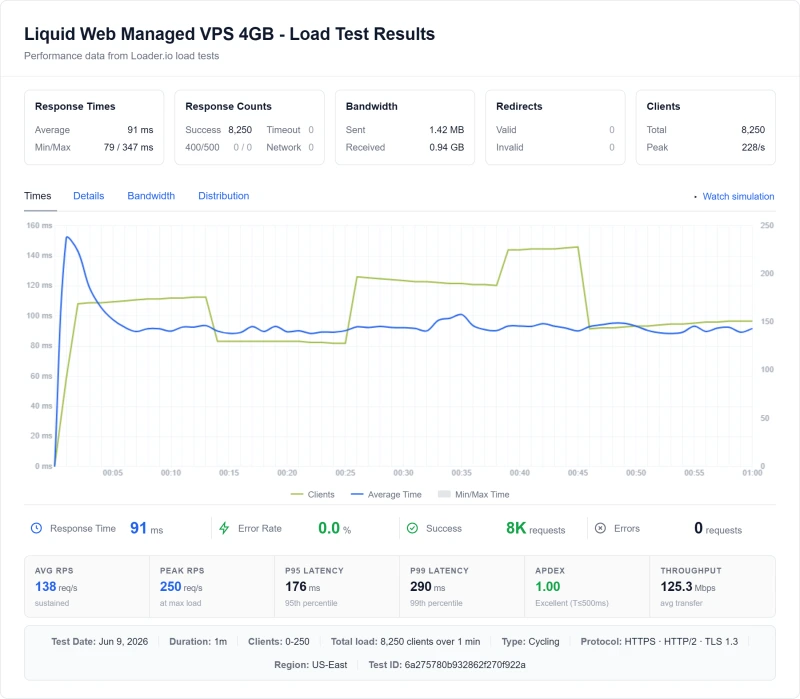
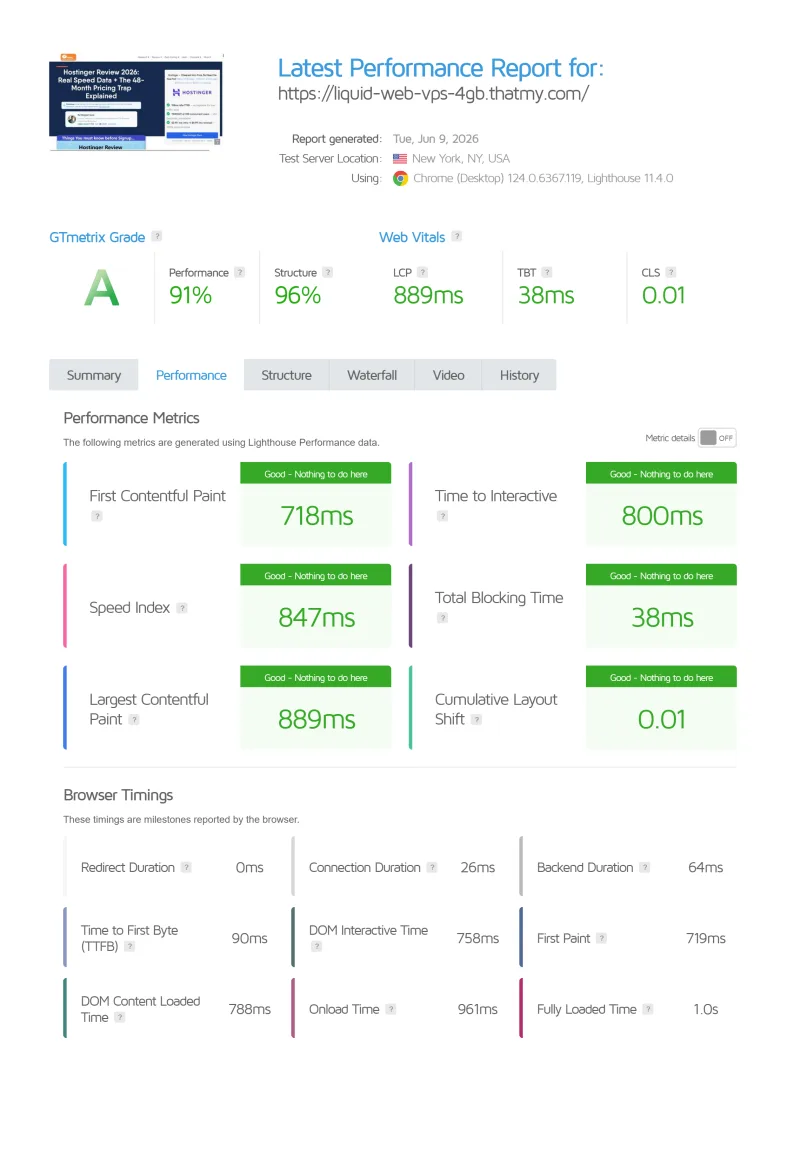
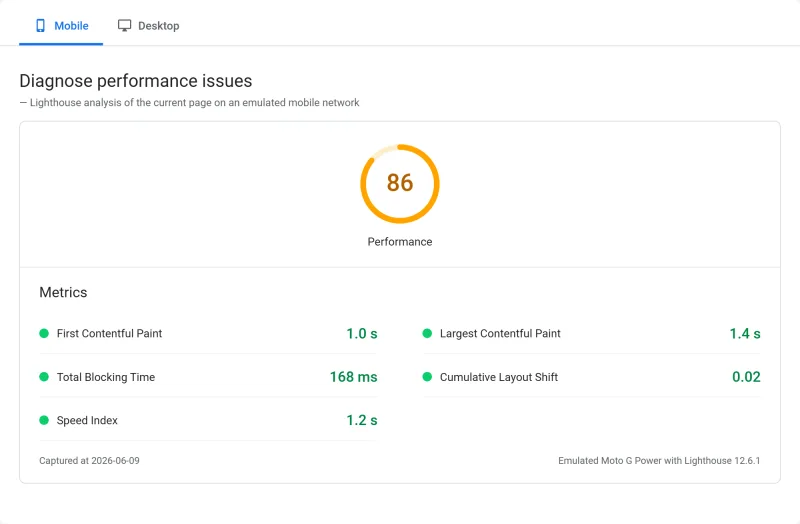
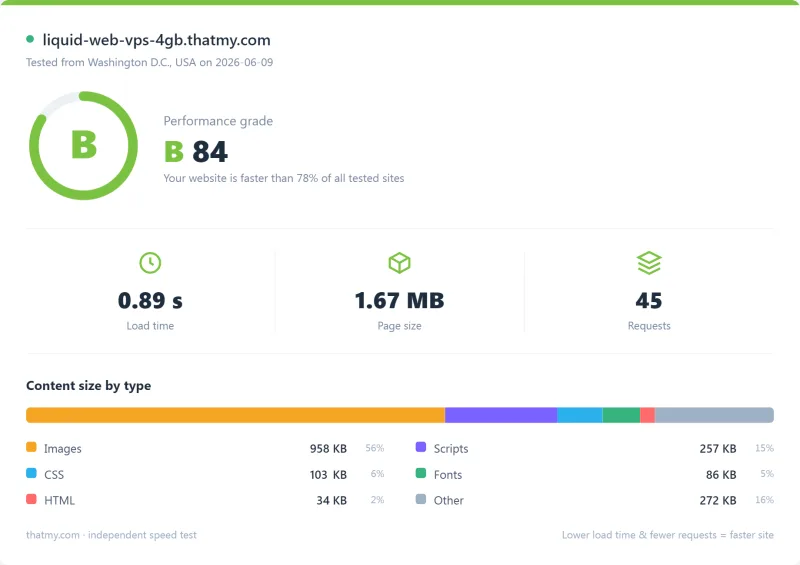
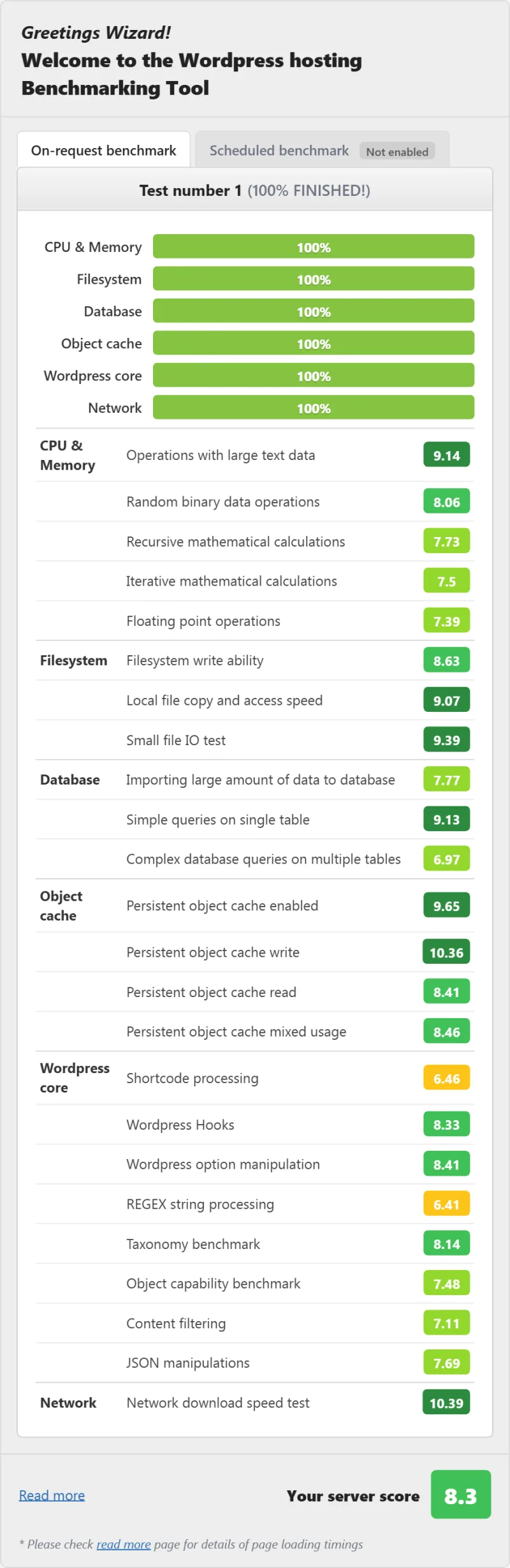
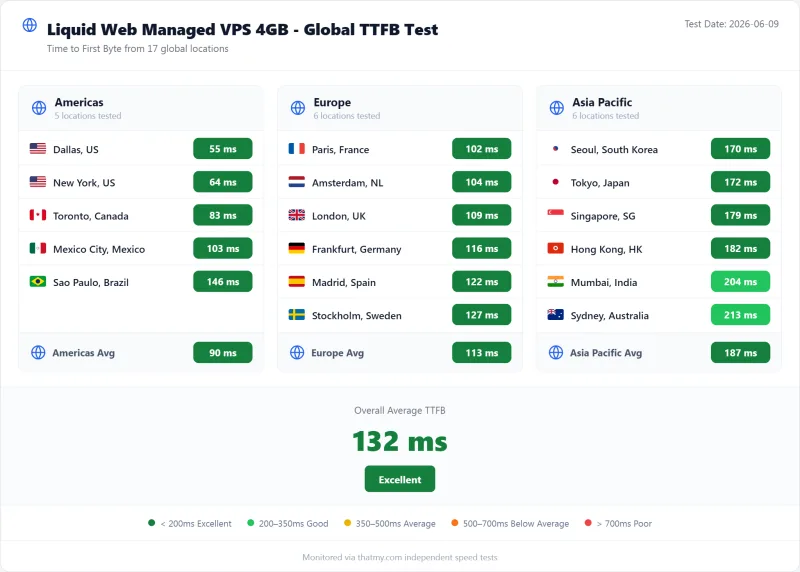
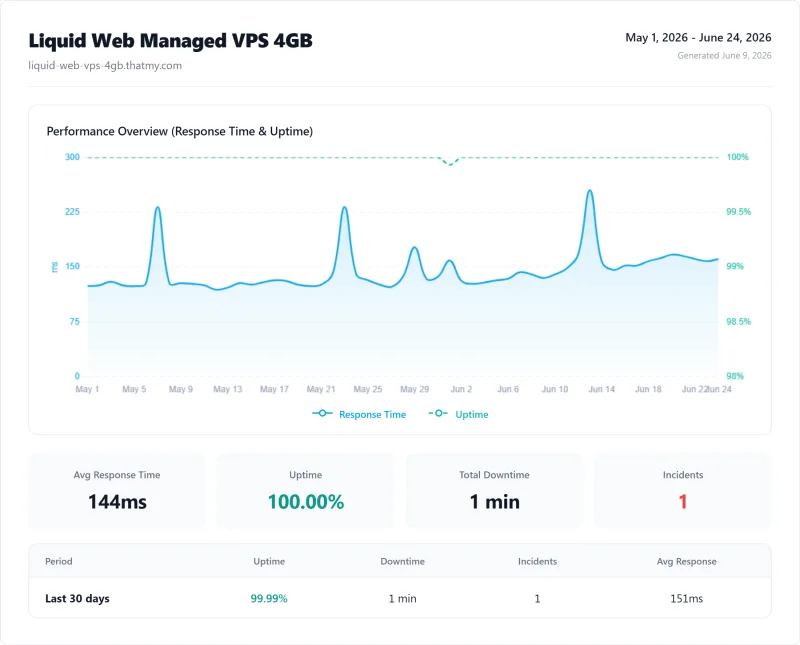
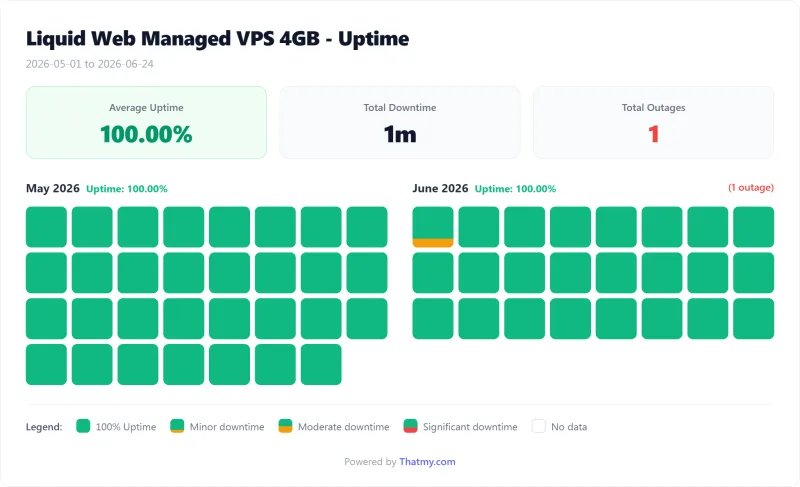
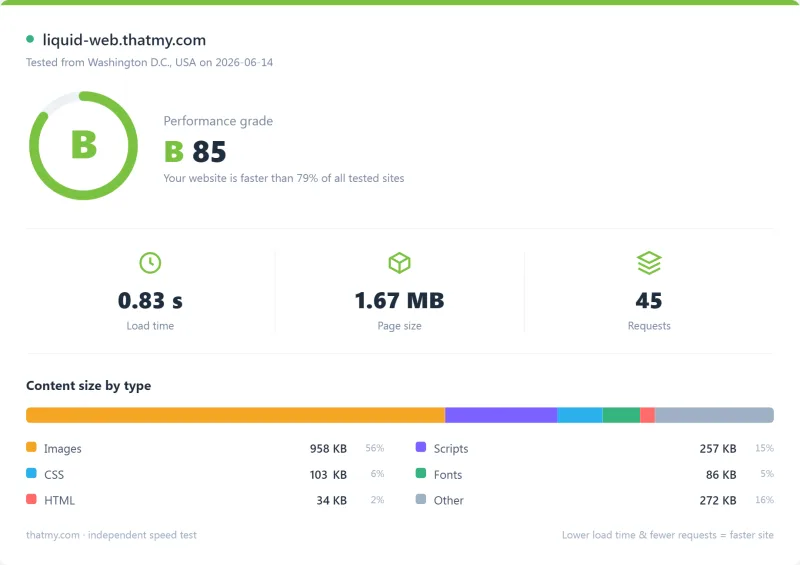
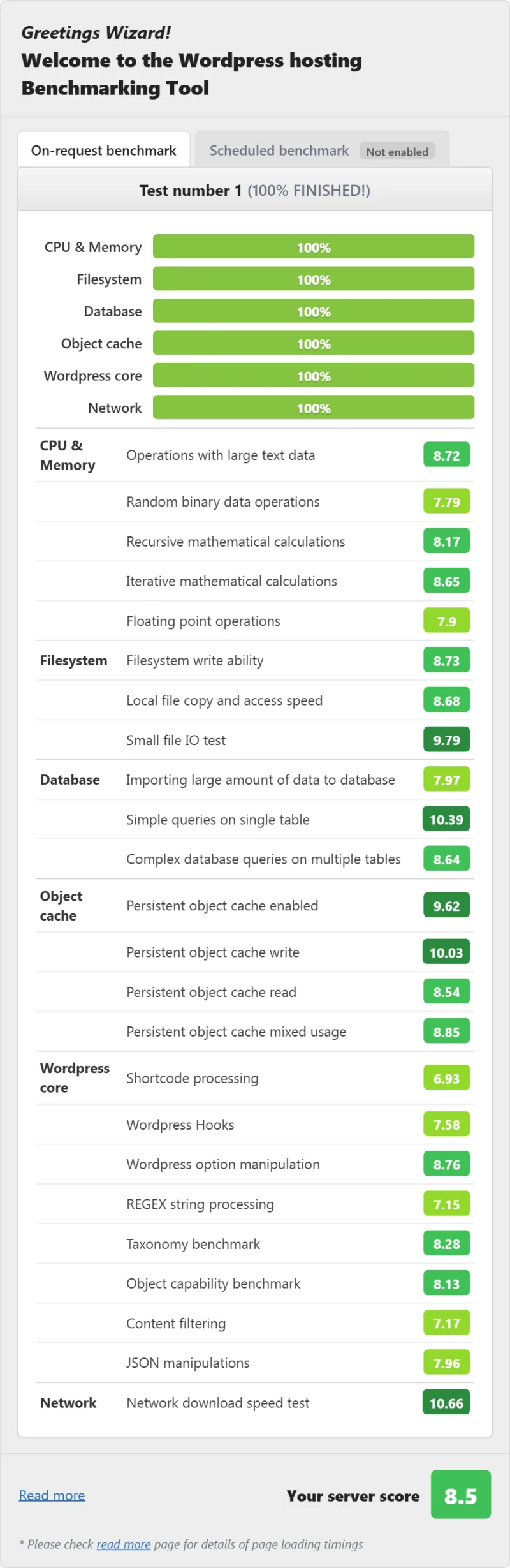
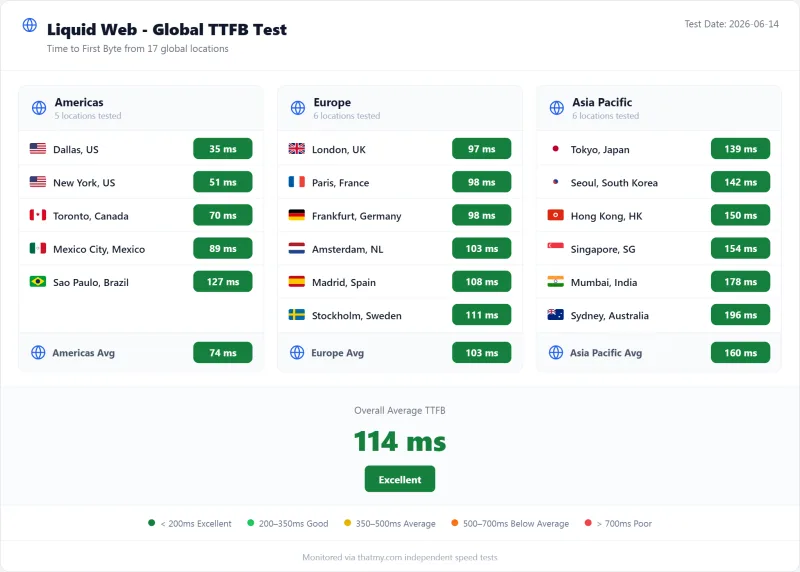
Here is the complete export from our test suite for every managed vps plan we benchmarked: Managed VPS 8GB, Managed VPS 2GB, and Managed VPS 4GB. Each tab holds that plan's full run: server response time (TTFB), behavior under a 100-user load, the GTmetrix and PageSpeed captures, a Pingdom response-time check, our WordPress hosting benchmark, the regional TTFB scorecard, and 54 days of uptime tracking with the day-by-day calendar.
Managed VPS 8GB (Featured) Managed VPS 2GB Managed VPS 4GB
Full Test Report: Liquid Web Dedicated (Managed Dedicated Server)
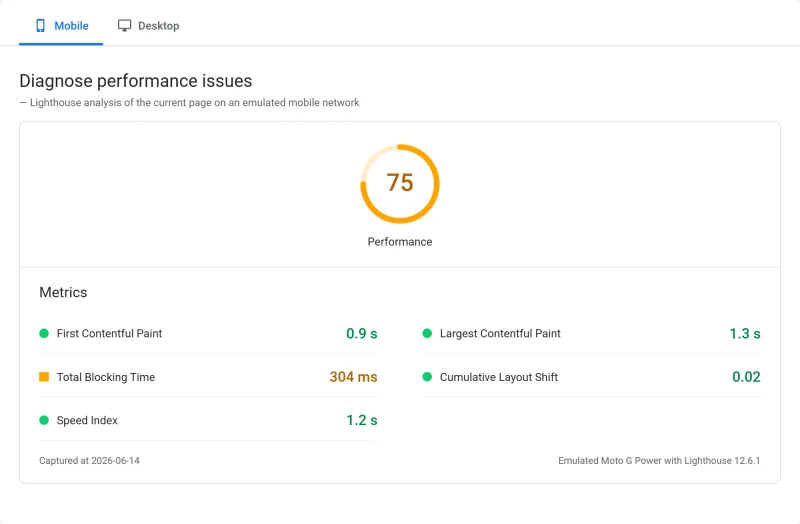
Here is the full export from our test suite for the Managed Dedicated Server plan, the dedicated tier we benchmarked. One run, nine views: server response time (TTFB), behavior under a 100-user load, the GTmetrix and PageSpeed captures, a Pingdom response-time check, our WordPress hosting benchmark, the regional TTFB scorecard, and 54 days of uptime tracking with the day-by-day calendar.
FAQ: Liquid Web
Is Liquid Web worth it in 2026?
For agencies and stores that want a managed server, a written network uptime promise and round-the-clock support, it can be. We benchmarked Liquid Web Managed VPS 2GB, 4GB and 8GB and a dedicated server. The Managed VPS 8GB answered in 70ms from New York to our test server in New York (origin, no CDN) and in 125ms with 100 concurrent users, with 0% failed requests over the 0-250 client ramp, and it was up 99.999% over our 54 days window. The catch is the price: managed VPS discounts last two months before the price doubles, and the Terms make every fee non-refundable. ScalaHosting Entry Cloud was faster on the same tests (38ms origin, 58ms with 100 users) for less money.
What is the difference between Liquid Web and Nexcess?
They are one business: Liquid Web's pages now read 'Liquid Web by Nexcess', and its WordPress, WooCommerce and Magento plans run on the Nexcess platform and client portal. Liquid Web VPS and dedicated servers suit developers and custom applications. The Nexcess-based managed WordPress and WooCommerce plans add WordPress tools such as staging, visual comparison and automatic updates. For a WordPress site, the managed WordPress plans are the simpler choice; for custom PHP apps or non-WordPress work, a Liquid Web VPS.
Does Liquid Web have a money-back guarantee?
No. Liquid Web's Terms of Service say all services are non-cancellable and all fees are non-refundable, and leaving before the end of a term costs 100% of the remaining monthly charges. Its VPS cards also lead with a 50% discount that lasts two months, after which the price doubles, so check the month-three price before you buy.
What is Liquid Web's uptime guarantee?
Liquid Web's SLA guarantees 100% network uptime, with a credit of 10 times the downtime if you claim within 5 business days; its FAQ limits those credits to dedicated hosting customers, the managed VPS page promises 99.9% server uptime, and the WordPress line has its own Nexcess SLA. On our own monitoring (1-minute checks over 54 days), the Managed VPS 8GB was up 99.999% with 1 minutes of downtime. For comparison over the same kind of window: ScalaHosting Entry Cloud 99.99% (8 minutes), Cloudways on Vultr High Frequency 99.99% (8 minutes), Bluehost Choice Plus 99.91% (70 minutes).
Is Liquid Web good for WooCommerce?
Liquid Web sells WooCommerce plans on its Nexcess-based managed platform, whose stack Liquid Web describes as Nginx, full page cache, Redis server-side caching and a free Cloudflare edge CDN, and its FAQ says it has passed a PCI DSS assessment. We have not benchmarked a WooCommerce or managed WordPress plan, so we have no checkout figures. What we did measure is the server tier underneath a busy store: the Managed VPS 4GB answered in 142ms with 100 concurrent users and failed 0% of requests over the full ramp. ScalaHosting Entry Cloud answered in 58ms on the same test.
What happened after Newfold Digital acquired Liquid Web?
Newfold Digital does not own Liquid Web. Liquid Web's own FAQ says it is owned by One Equity Partners, a private equity firm, and is led by Bob Lyons as Chief Executive Officer of CloudOne Digital; it was founded in 1997 and is headquartered in Lansing, Michigan. Newfold Digital is the parent of Bluehost and HostGator, which is where the mix-up comes from. Ownership changes can show up in support and pricing, so read the current prices and Terms rather than relying on reputation: today the VPS discounts last two months and fees are non-refundable.
How does Liquid Web compare to ScalaHosting?
On our benchmark ScalaHosting Entry Cloud was faster: 38ms from New York against 70ms for the Liquid Web Managed VPS 8GB (origin, test servers in New York), and 58ms against 125ms with 100 concurrent users; both had 0% failed requests. ScalaHosting Entry Cloud is $14.95/mo on a yearly term and renews at $39.95/mo; the Liquid Web managed VPS 8GB is $50 for two months, then $100 a month. Liquid Web's strengths are a written 100% network SLA (credits for dedicated customers), a PCI DSS assessment and a larger product range up to dedicated servers.
What I Would Do If This Were My Site: Is Liquid Web Worth It in 2026?
Yes, for agencies and high-traffic WooCommerce stores that need enterprise SLAs.
The benchmarks are clear: 70ms TTFB from New York, 125ms at 100 concurrent users, a 79% climb, 99.999% uptime over a 54-day window (~1 minute total downtime), 59-second support response. PCI-DSS compliant infrastructure. Automatic plugin updates with visual regression testing. Itemised pricing, though VPS discounts last only two months. These are genuinely industry-leading metrics for managed WordPress hosting.
The honest caveats: post-Newfold Digital acquisition (2021), L1 support quality has declined. Pricing is premium where it counts: the managed VPS 4GB is $72 a month after the two-month discount, though WordPress plans start at $9. Fees are non-refundable. The Cloud VPS configurator offers four locations, none in Asia-Pacific. ScalaHosting delivers 15% faster TTFB at 3x lower cost.
Who should choose Liquid Web: Agencies managing client sites with SLA requirements. High-traffic WooCommerce stores that need PCI compliance. Businesses where downtime costs more than $100/mo in lost revenue. Teams that want automatic plugin updates with regression testing. Anyone who needs 24/7/365 phone support with a 59-second response guarantee.
Who should choose ScalaHosting instead: Most WordPress businesses. Sites under 50k monthly pageviews. Anyone who needs maximum performance per dollar. Sites with APAC audiences. Anyone who doesn't need PCI compliance or a 100% network SLA.

What Our Testing Found
- 99.999% uptime SLA, backed by 10x credit guarantee
- Heroic Support: avg 59-second phone response, 59-second live chat
- Managed WordPress (Nexcess) from $19/mo, iThemes Security Pro included
- Intel Xeon Scalable processors, enterprise-grade hardware
- No overselling policy, dedicated resources per account
- 100% network uptime SLA, separate from server uptime
- Free SSL, CDN, and daily backups on all plans
- PCI-DSS compliant infrastructure for WooCommerce
- Automatic plugin updates with visual regression testing
- Stencil staging environment, one-click clone
Real Weaknesses
- Premium pricing: Managed WordPress starts $19/mo, VPS from $25/mo
- Post-acquisition quality decline reported by long-term customers
- No shared hosting, minimum entry is managed WordPress or VPS
- Renewal pricing is transparent but high, no intro discount trap
- Support quality inconsistent since Newfold Digital acquisition
- Limited data center locations vs competitors (US-focused)
Real Benchmark Data
- Origin TTFB (3 plans, no CDN): 70ms to 80ms
- Uptime (54-day window): 99.997% to 99.999%
- PageSpeed Score (Mobile): 75/100

$19/mo
99.999% Uptime SLA + 10x Credit Guarantee
View Liquid Web / Nexcess Plans ➦
Not ready for Liquid Web? See our full WordPress hosting comparison, including ScalaHosting ($14.95/mo, 38ms TTFB) for the best value alternative and Cloudways (code CLOUDS2022 = $30 free credit) for developer teams.