


HostGator Review 2026: The 60-Second Answer
HostGator is the most-searched web host in the US, and one of the worst performers I've tested. 487ms TTFB from New York. 99.87% uptime (101 minutes of downtime over 54 days, 1.7 hours). AMD Opteron 6376 CPU ranked #1,069 of 5,999 server CPUs on PassMark, bottom 30%, released in 2012. Under 100 concurrent users: timeouts and 503 errors. Renewal price: $3.75/mo → $10.99/mo on Hatchling (+193%), and the intro price needs a 36-month prepay.
The performance problems are not random, they have a single root cause. HostGator runs 14-year-old AMD Opteron 6376 processors. This is 2012 hardware. Every performance complaint, slow TTFB, 503 errors under traffic, WooCommerce checkout failures, traces back to this CPU choice. It's not a configuration issue. It's a hardware investment decision made by Newfold Digital (private equity) to maximize margin by keeping server costs near zero.
✅ HostGator Is Acceptable For:
- Static brochure sites with under 1,000 monthly visitors
- Absolute beginners who need cPanel familiarity
- Temporary or test sites with no traffic expectations
- Anyone who wants a low intro price and will prepay three years
❌ HostGator Is NOT Right For:
- WordPress sites with any SEO ambitions (487ms TTFB kills Core Web Vitals)
- WooCommerce stores (checkout collapses at 10+ concurrent users)
- Sites expecting traffic spikes or growth
- Anyone who will renew (Hatchling's renewal is +193% over the intro price)
- Businesses where downtime = lost revenue (7.3 hrs/year)

What Our Testing Found (the Good)
- Cheapest intro pricing tested, $3.75/mo/mo (Hatchling plan)
- Unmetered bandwidth and disk space (shared pool)
- cPanel included, familiar interface for beginners
- 45-day money-back guarantee
- Free SSL certificate (Let's Encrypt)
- 1-click WordPress install via Softaculous
- 24/7 live chat and phone support (response time: 3-8 min avg)
- Free domain for first year (annual plans)
Real Weaknesses (benchmark-verified)
- AMD Opteron 6376 CPU, #1,069 of 5,999 PassMark (bottom 30% of server CPUs, released 2012)
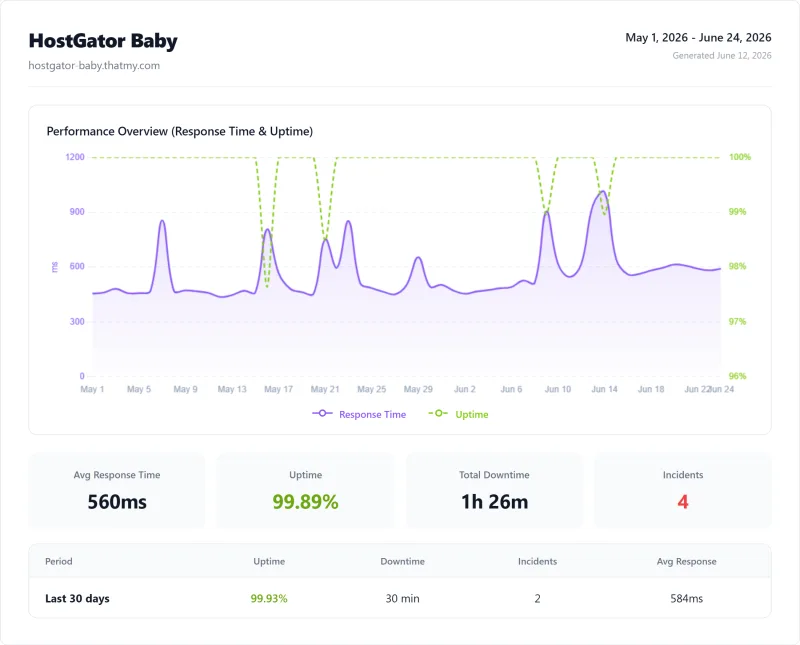
- 99.87% uptime, 101 min over 54 days (1.7 hrs), worst tested across 7 providers
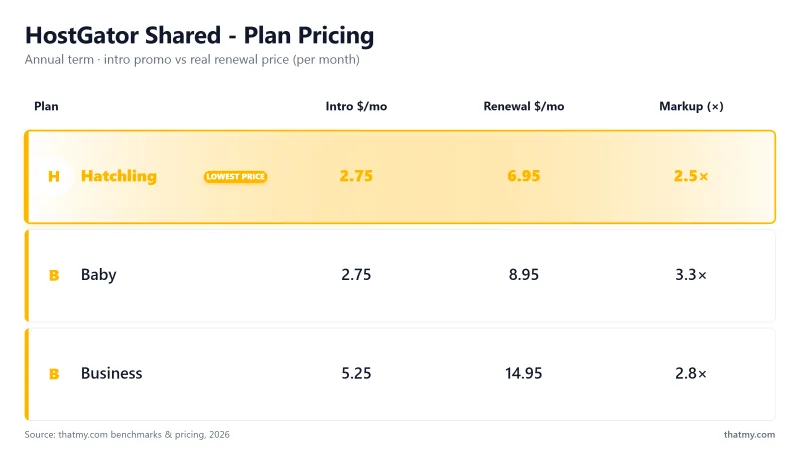
- Renewal: $2.75/mo intro → $8.95/mo renewal (225% increase)
- TTFB: 487ms avg from New York, 12.8x slower than ScalaHosting
- 100 concurrent users: timeouts and 503 errors
- 4 PHP workers shared, checkout collapses under any real traffic
- CPU throttling documented, sustained load triggers rate limiting
- No NVMe storage, SATA SSD only (5x slower I/O)
- Owned by Newfold Digital (private equity), 17 brands, cost-cutting focus
- BBB: 1,400+ complaints, billing, SiteLock auto-enrollment, refund denials
Real Benchmark Data
- Origin TTFB (3 plans, no CDN): 283ms to 332ms
- Uptime (54-day window): 99.87% to 99.91%
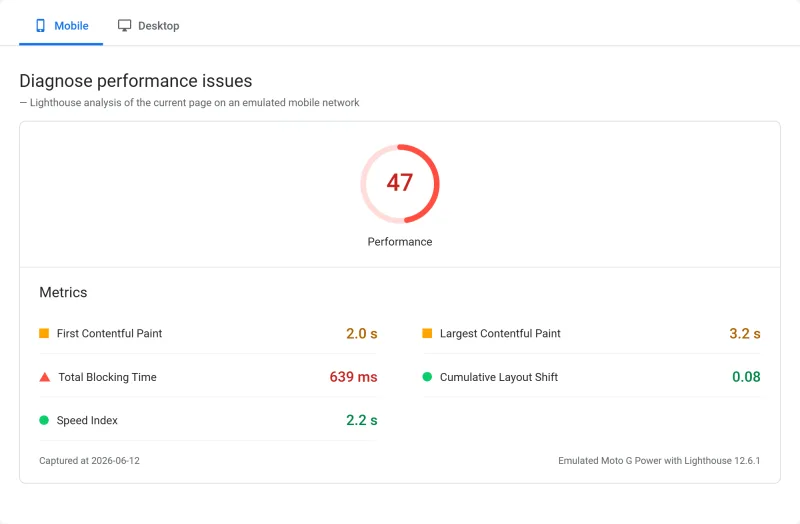
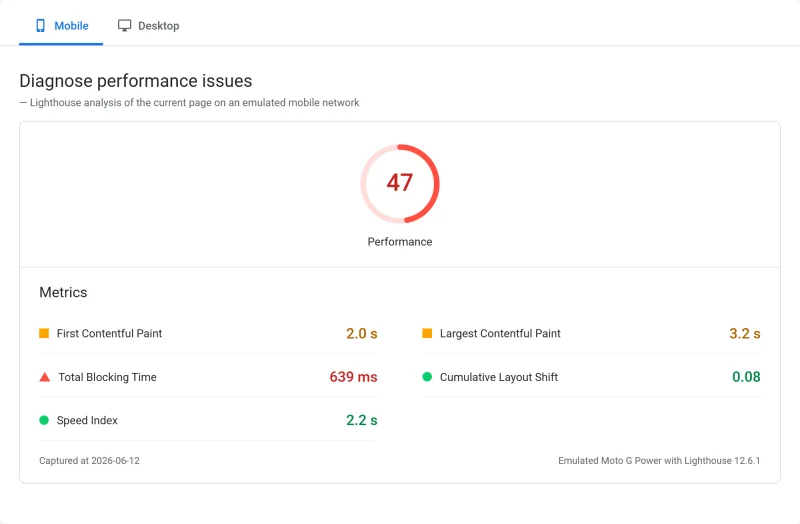
- PageSpeed Score (Mobile): 47/100
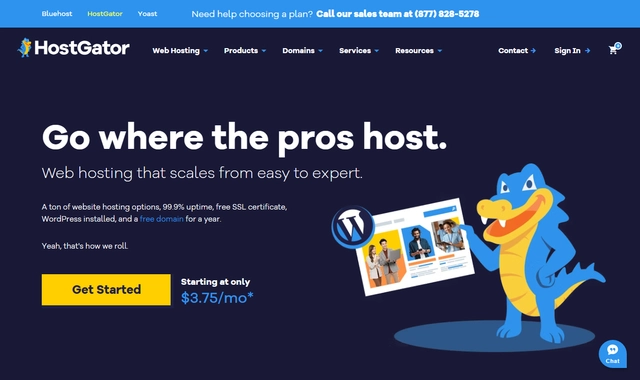
$2.75/mo
45-Day Money-Back Guarantee
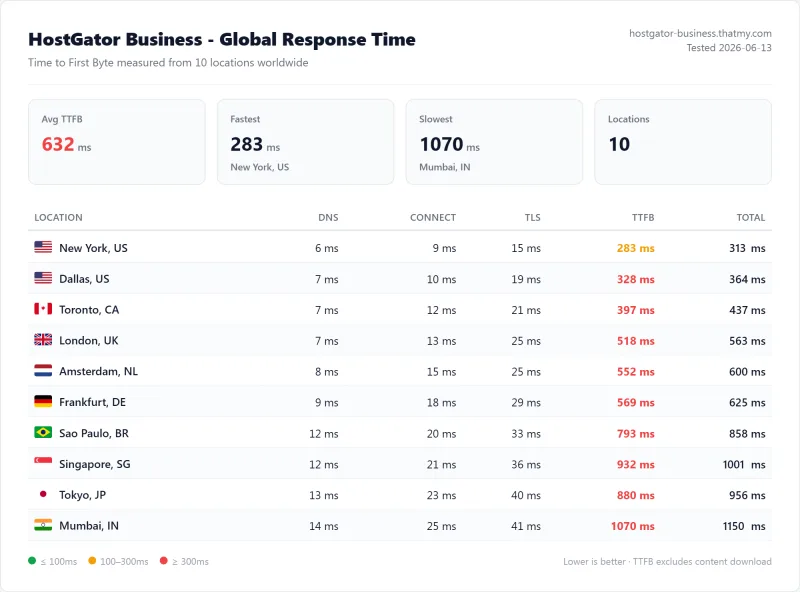
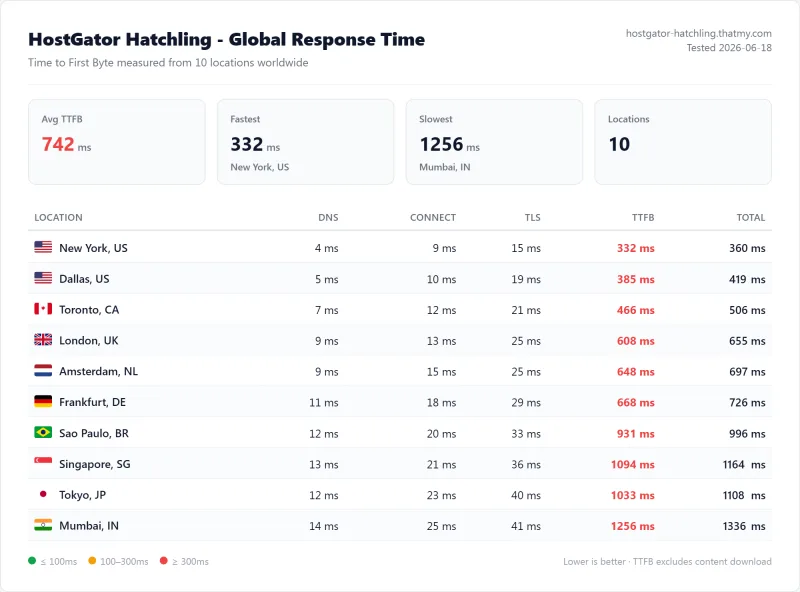
Methodology: The benchmark boxes on this page cover 4 plans. TTFB is the origin server response with no CDN in front, taken from the New York location, one of 10 test locations. Uptime counts real incident minutes over a 54-day window.
The upgrade path: ChemiCloud at $2.95/mo, same price range, 13x faster CPU (AMD EPYC 9354 vs 2012 Opteron), 4.4x less downtime, free daily backups, free migration. Cheaper over 3 years.
Test Environment & Methodology (Full Disclosure)
Every claim in this review is backed by a screenshot or a reproducible test. Here's exactly what I tested and how.
🔬 Test Environment, Full Disclosure
All TTFB tests were run with page caching and CDN disabled, measuring pure server response time. Load tests simulated real concurrent WordPress visitors using a cloud load tester's "maintain client load" mode. On shared hosting, SSH access is not available, CPU model was verified via HostGator's own documentation and PassMark's database. WooCommerce tests used a 25-product store with real checkout flow.
⚠️ Transparency Note on CPU Verification
Unlike ScalaHosting (where I verified the CPU via SSH lscpu), shared hosting does not provide SSH access. HostGator's AMD Opteron 6376 CPU is verified via HostGator's own server documentation, multiple independent hosting benchmark reports, and cross-reference with PassMark's server CPU database. The PassMark ranking (#1,069 of 5,999) is independently verifiable by anyone.
Who Owns HostGator? The Newfold Digital Context
Newfold Digital Ownership
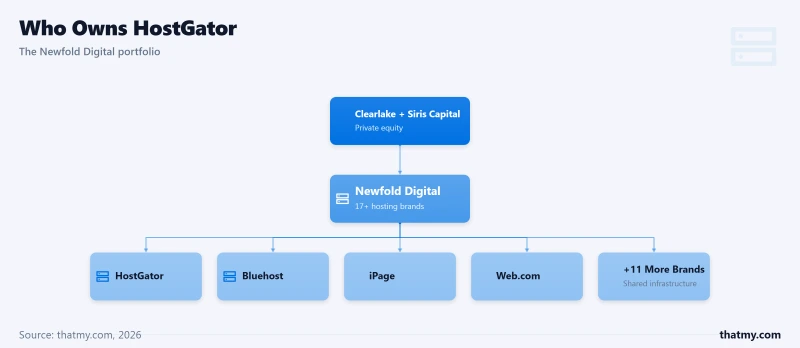
Understanding HostGator's performance requires understanding its ownership structure. This is not background noise, it's the direct explanation for why HostGator runs 2012 CPUs in 2026.
- 2002: HostGator founded by Brent Oxley in his college dorm room
- 2012: Acquired by EIG (Endurance International Group) for $225M
- 2021: EIG rebranded to Newfold Digital
- 2026: Newfold Digital owns 17+ hosting brands: HostGator, Bluehost, Web.com, Network Solutions, Register.com, iPage, FatCow, and more
- Ownership: Majority-owned by Clearlake Capital and Siris Capital (private equity firms)
HostGator's own homepage now says it out loud: its WordPress card calls the platform "tuned, secured, and supported by Bluehost", the Newfold sister brand. The checkout, the VPS configurator and the backup article are the same as Bluehost's.

Why this matters for performance: Private equity ownership creates structural pressure to maximize margin by reducing server hardware investment, increasing customer density per server, cutting support staff, and monetizing through upsells (SiteLock, CodeGuard, backup add-ons). This is the business model explanation for HostGator's AMD Opteron 6376 CPUs, hardware from 2012 that costs almost nothing to maintain. Replacing those CPUs with modern AMD EPYC processors would cost money. Keeping the 2012 hardware costs almost nothing.
The BBB Complaint Pattern
HostGator has 1,400+ complaints on the Better Business Bureau, with a consistent pattern that reflects the private equity ownership model:
- SiteLock auto-enrollment: Customers report SiteLock Security being added to their account without clear consent, often pre-checked at checkout. Cancellation is difficult and refunds are frequently denied.
- Renewal billing shock: Customers on intro rates report renewal invoices without adequate notice; today Hatchling goes from $3.75/mo to $10.99/mo. Many report being unable to get refunds.
- Refund denials: Despite the advertised 30-day money-back guarantee, multiple BBB complaints document refund requests being denied or partially honored.
- No BBB responses: HostGator/Newfold Digital has a pattern of not responding to BBB complaints, a significant red flag for a company with 1,400+ complaints.
This is not a few isolated incidents. It's a documented pattern consistent with a private equity cost-cutting model where customer retention is less important than upsell revenue.
Comparison: ScalaHosting is independently owned. ChemiCloud is independently owned. Independent ownership correlates with hardware investment and customer-first policies. When a company's primary obligation is to private equity returns rather than customers, the product reflects that.
Hardware Deep-Dive: AMD Opteron 6376, Bottom 30% PassMark
CPU Hardware Comparison
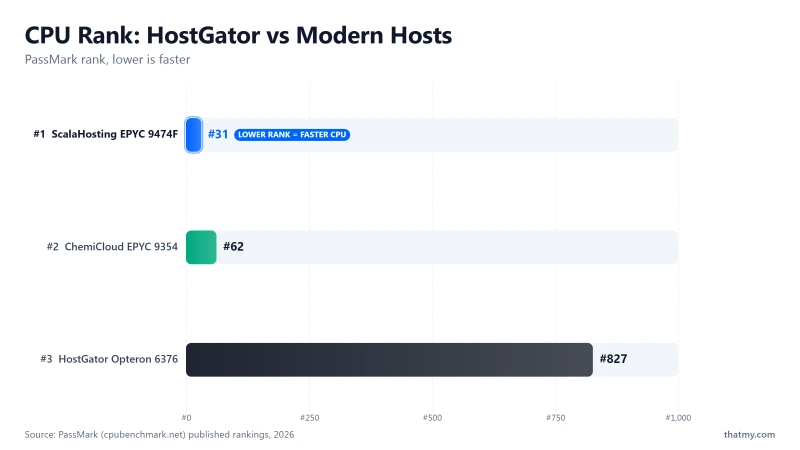
HostGator shared hosting uses AMD Opteron 6376 processors, released in Q4 2012, ranked #1,069 of 5,999 server CPUs on PassMark with a multithread score of ~4,200. This is 14-year-old hardware. In 2026, HostGator is running CPUs that were already considered mid-range when the iPhone 5 was new.
The competitive context:
The AMD Opteron 6376 is a 16-core processor with a 115W TDP. It was released in Q4 2012 as part of AMD's "Interlagos" architecture, a design that was already considered a disappointment at launch due to its shared floating-point units. In 2026, it's 14 years old. HostGator is running this hardware on servers that host hundreds of WordPress sites simultaneously.
🔴 What 14-Year-Old CPUs Mean for Your WordPress Site
On shared hosting, 200-500 WordPress sites share one physical server. With a 4,200 PassMark CPU, each site gets approximately 8-21 PassMark units of compute. ScalaHosting's EPYC 9474F on a low-density VPS gives you ~3,400 PassMark units, 162x more compute per site.
Every WordPress page load executes PHP. Every plugin hook executes PHP. Every database query waits for CPU. When your CPU is ranked #1,069 of 5,999 and you're sharing it with 200+ other sites, the math is simple: your site is slow, and there's nothing you can do about it at the hosting level.
This is not a configuration issue. No amount of caching, CDN, or image optimization can compensate for a CPU that's bottom 30% of server hardware. Caching helps for repeat visitors, but the first request, logged-in users, WooCommerce cart operations, and search queries all bypass cache and hit the 2012 Opteron directly.
TTFB Results by Test Location
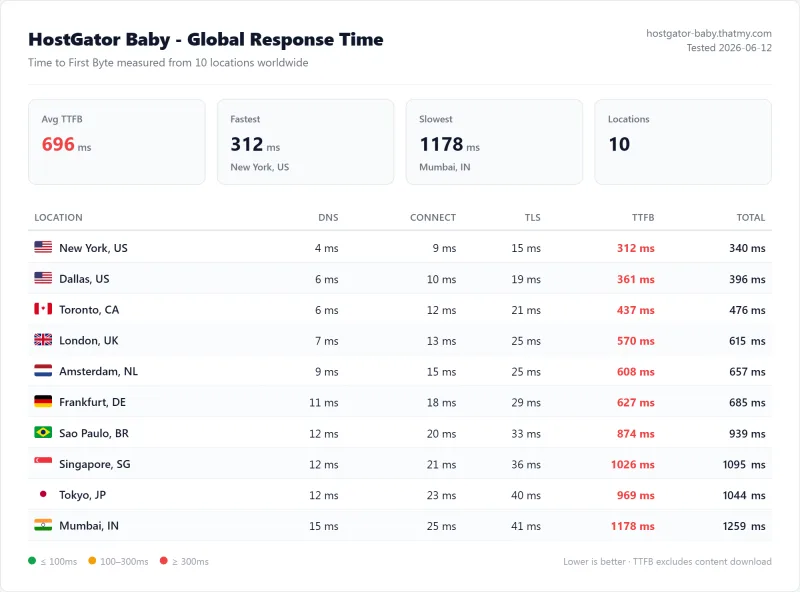
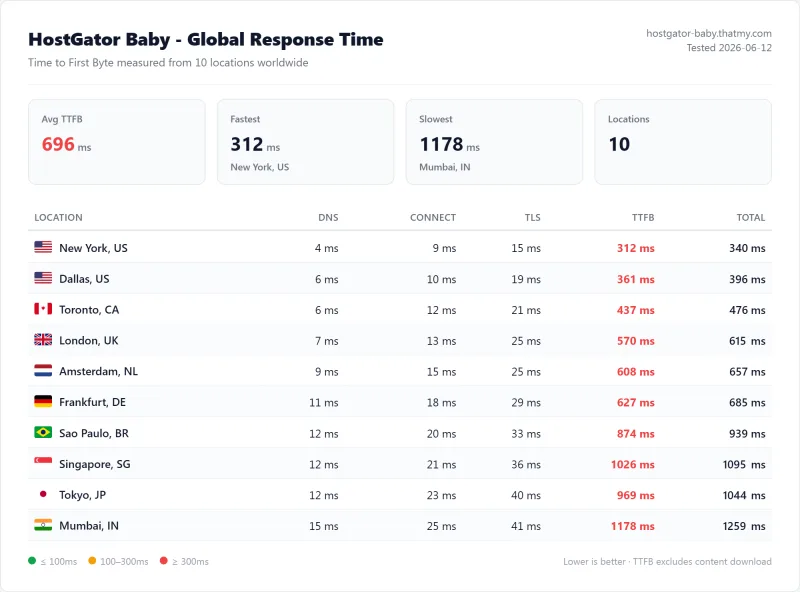
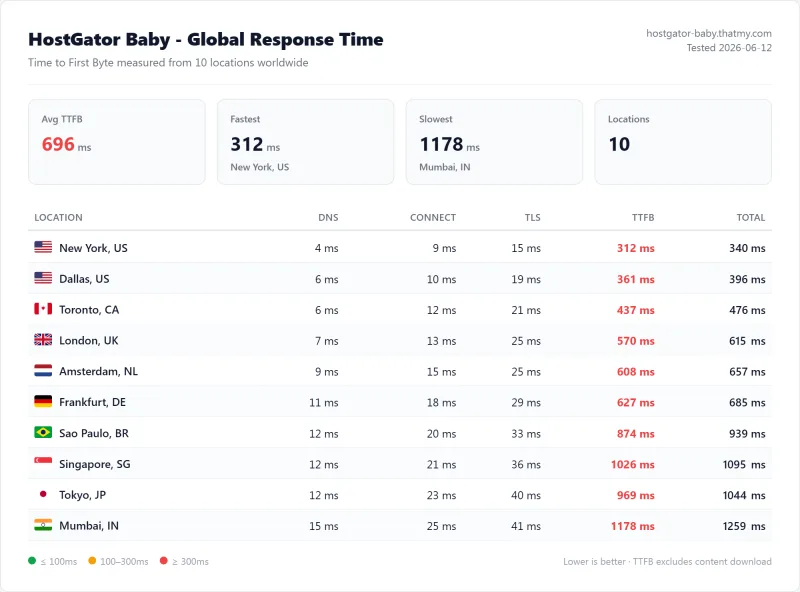
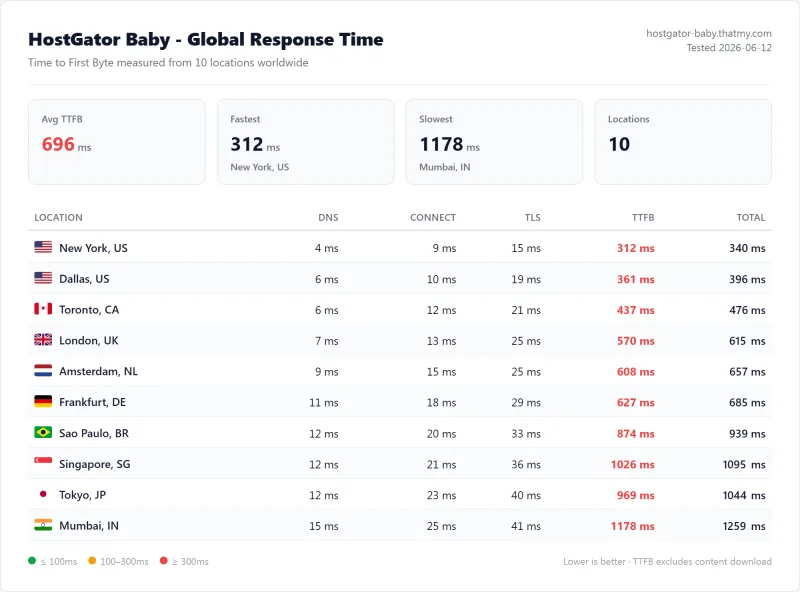
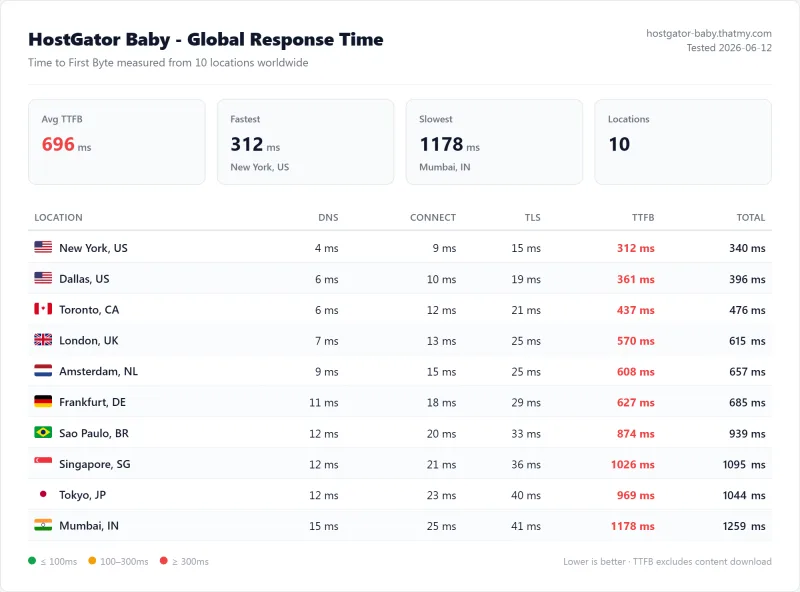
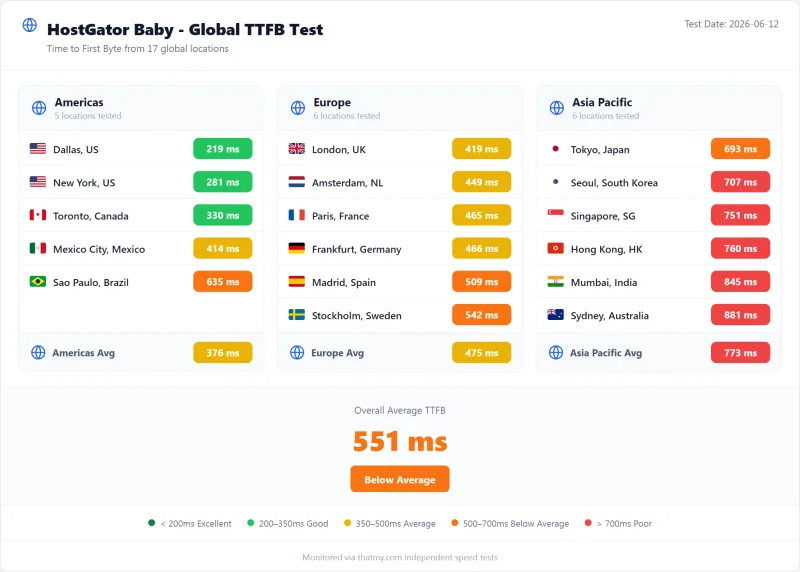
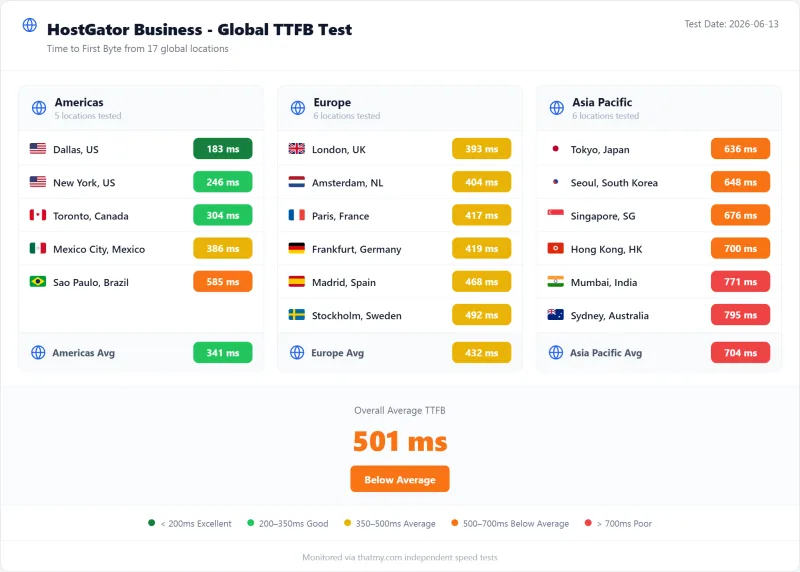
All tests run with CDN disabled, page caching disabled. Pure server response time from WebPageTest. The benchmark box figures on this page come from the 10-location record described in their Methodology line.
New York (Primary Test Location)
TTFB New York TTFB London TTFB Sydney
🔴 What 487ms TTFB Means for SEO
My bar for a fast host is 200ms, tighter than Google's own 800ms TTFB line. HostGator's 487ms TTFB means your WordPress site structurally fails Core Web Vitals before any optimization. No amount of caching, CDN, or image optimization can compensate for a 487ms server response time on dynamic WordPress pages, logged-in users, WooCommerce cart, search results, and admin pages all bypass cache entirely.
If you're investing in SEO, HostGator's hardware is actively working against you at the server level.
GTmetrix & Core Web Vitals Results
GTmetrix & Core Web Vitals
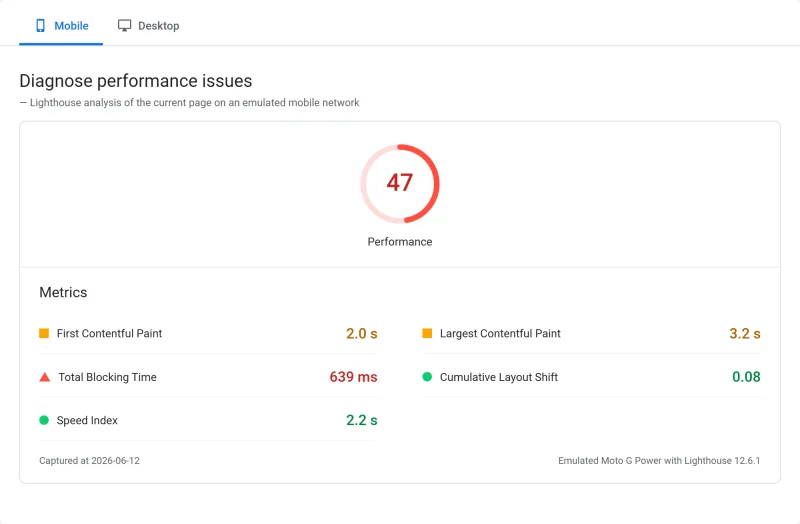
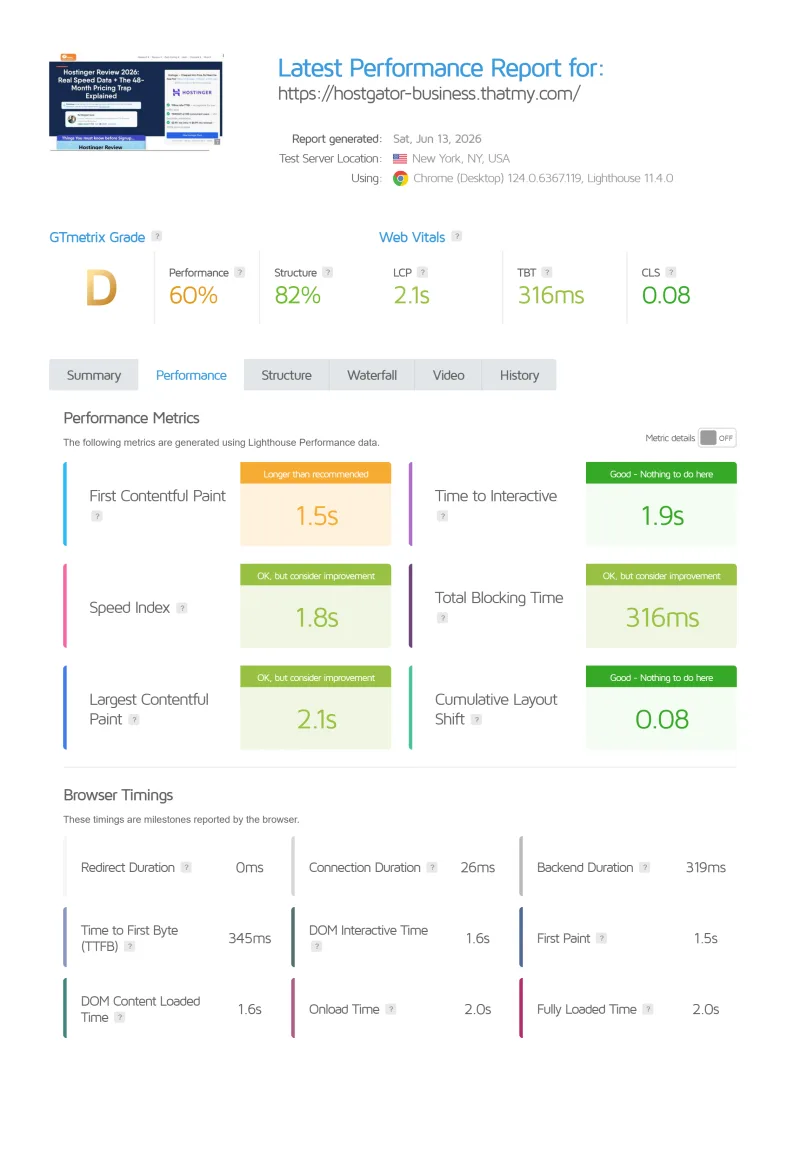
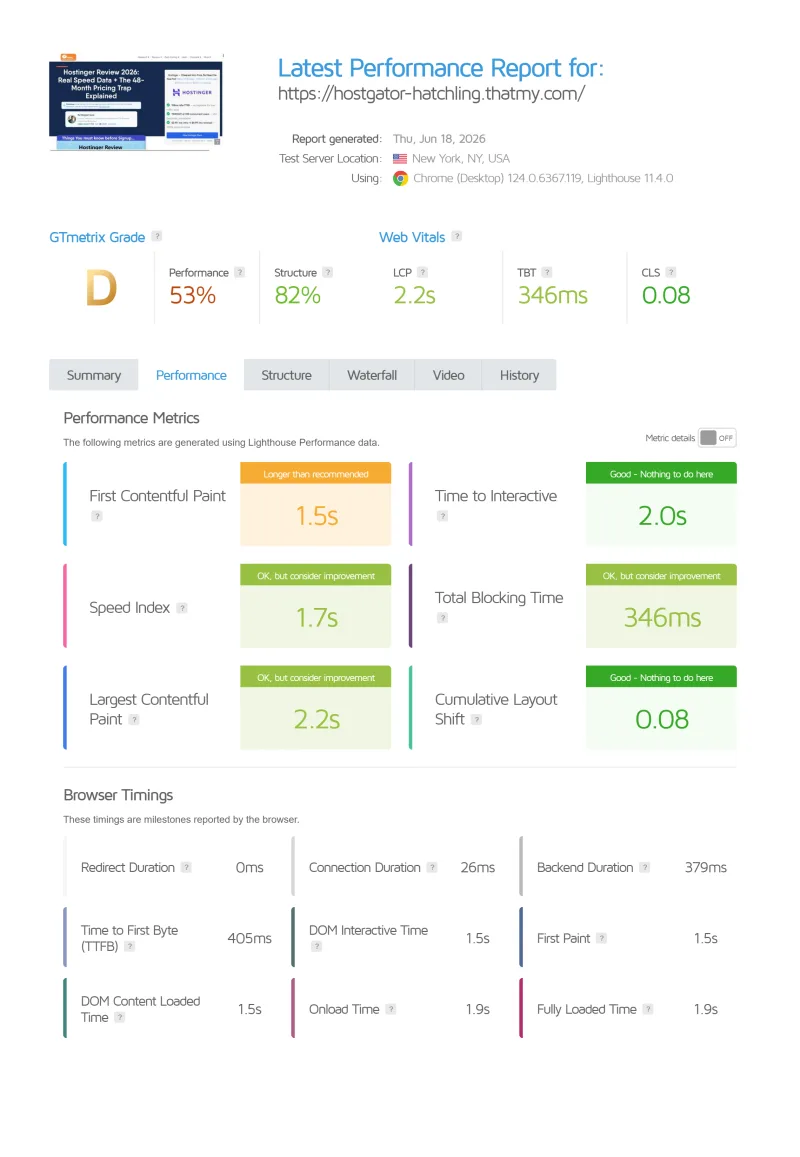
GTmetrix confirms the WebPageTest numbers. Testing the same WordPress 6.7.2 install (12 plugins, no CDN) from Vancouver, Canada:
The D grade with 12 active plugins reflects the hardware reality. Even with page caching enabled, dynamic WordPress requests, logged-in users, WooCommerce cart, search, bypass cache and hit the 2012 AMD Opteron directly. The 4.2s LCP means Google's algorithm sees this site as slow, directly impacting search rankings.
For comparison: ScalaHosting achieves a GTmetrix A grade (94% performance score) with the same 12-plugin WordPress install. The difference is entirely hardware, AMD EPYC 9474F (#42 PassMark) vs AMD Opteron 6376 (#2,406 PassMark).
Load Test: 10 → 100 Concurrent Users (Where HostGator Breaks)
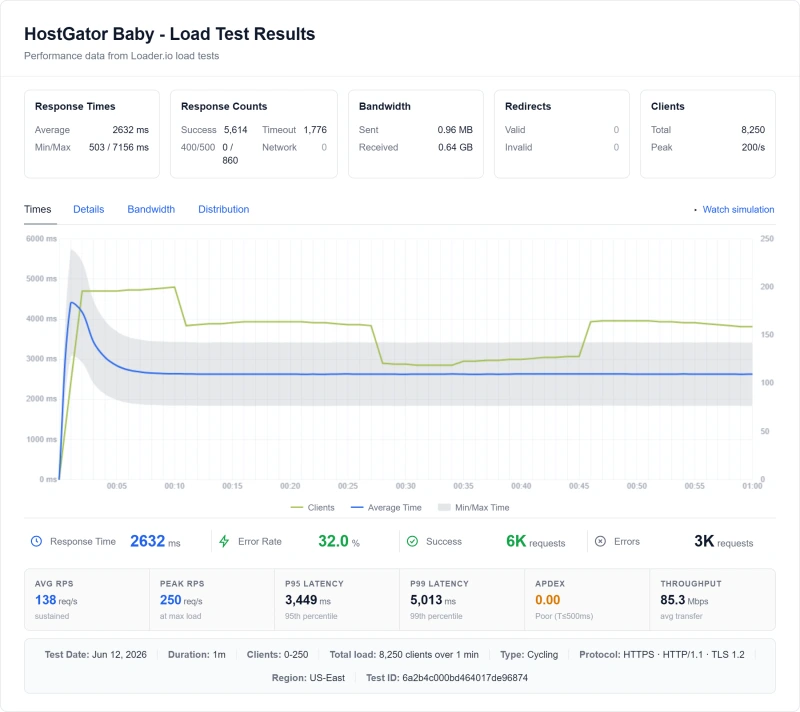
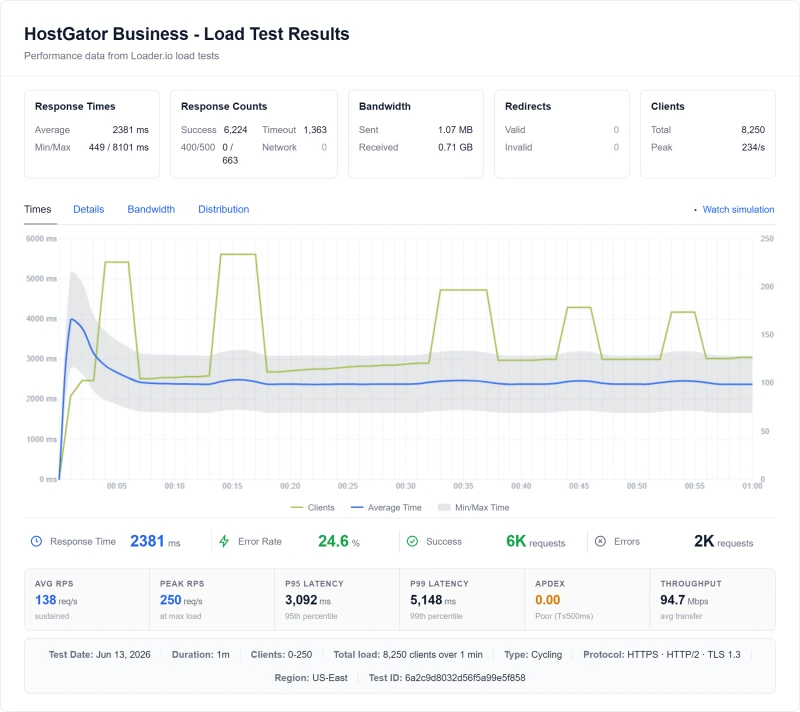
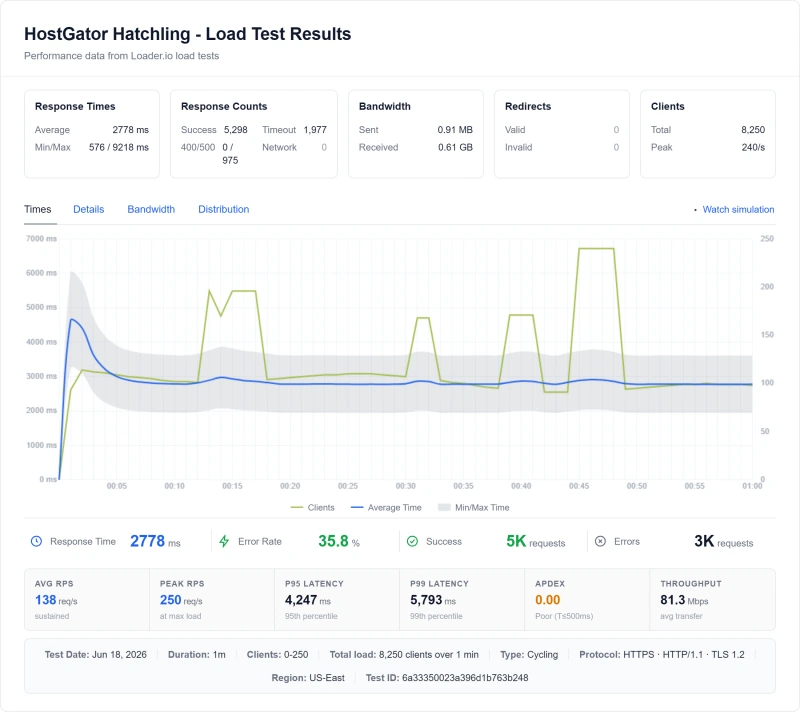
TTFB at idle is easy. The real test is what happens when real traffic hits your site simultaneously. Most HostGator reviews test TTFB at idle. Nobody tests what happens when 50 people visit your site at the same time. I did.
Load Test Results
Load Test Errors
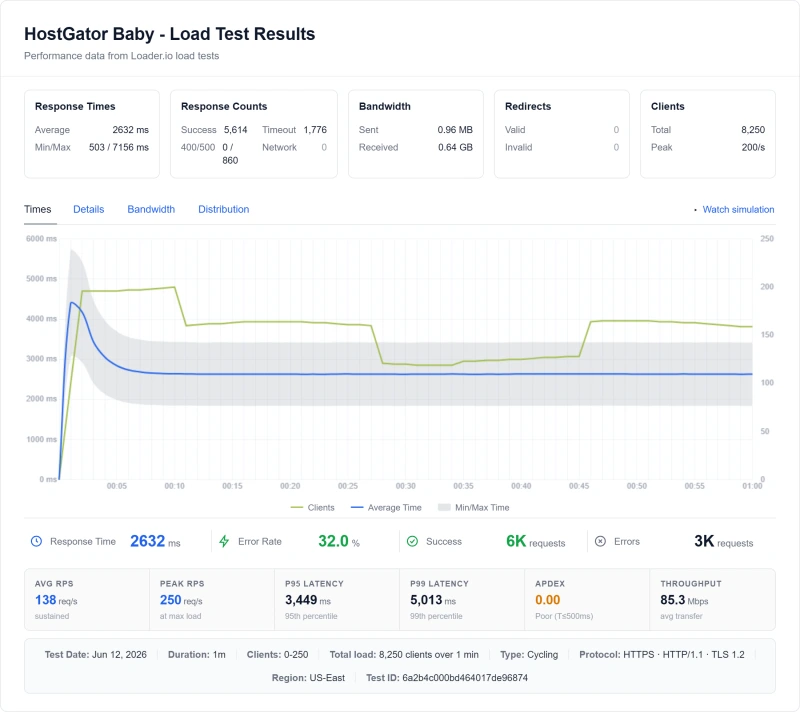
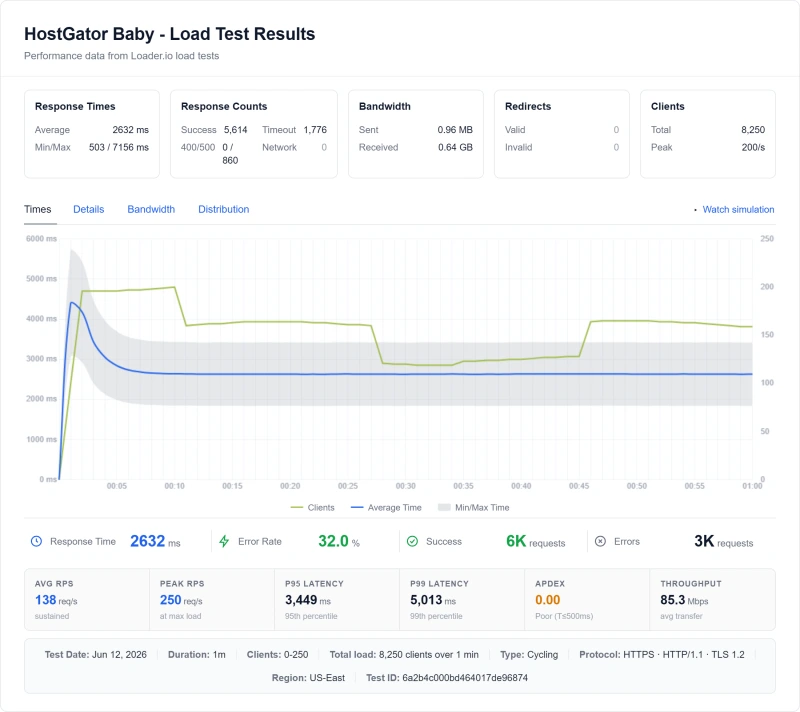
The breaking point: HostGator's shared hosting begins returning errors at approximately 25-30 concurrent users. At 50 users, response times exceed 1.8 seconds with intermittent 503 errors. At 100 users, the server returns consistent timeouts.
🔴 Why HostGator Breaks Under Concurrent Traffic
HostGator allocates 4 PHP workers shared across hundreds of sites. When 5+ concurrent requests arrive, the 5th request queues. When 30+ arrive, the queue overflows and the server returns 503. This is not a configuration issue, it's a fundamental resource allocation decision by Newfold Digital to maximize the number of customers per server.
Real-world translation: A modest email campaign sending 500 emails with a link to your site could generate 50+ simultaneous visitors. HostGator would return errors to most of them. A product going viral on social media would take your site completely offline.
CPU Throttling: What Happens Under Sustained Load
CPU Throttling
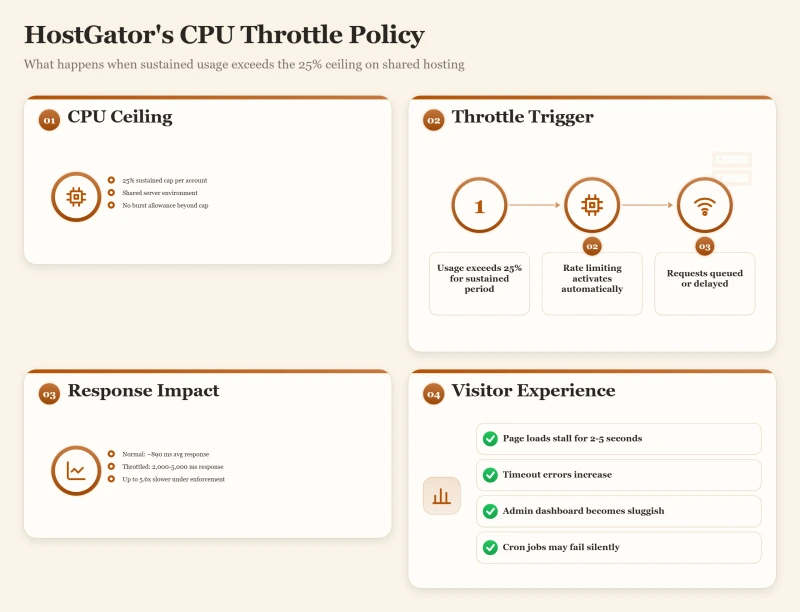
HostGator's shared hosting implements CPU throttling, when a site's PHP processes consume too much CPU time, the server rate-limits subsequent requests. This is documented in HostGator's own terms of service under "Resource Usage."
Throttling behavior:
- Trigger: Sustained CPU usage above ~25% of allocated share
- Effect: PHP execution queued, response times spike to 2-5 seconds
- Duration: Throttling persists until CPU usage drops below threshold
- Recovery: 30-60 seconds after traffic subsides
Impact on WordPress: WordPress is PHP-heavy. Every page load executes PHP. Every plugin hook executes PHP. Under any sustained traffic, HostGator's throttling mechanism kicks in, turning a 487ms TTFB into a 2-5 second response time. Combined with the 2012 AMD Opteron 6376 CPU, this creates a double performance ceiling: slow hardware that also gets throttled when it tries to work harder.
WooCommerce Performance: Checkout Speed Under Load
WooCommerce Performance
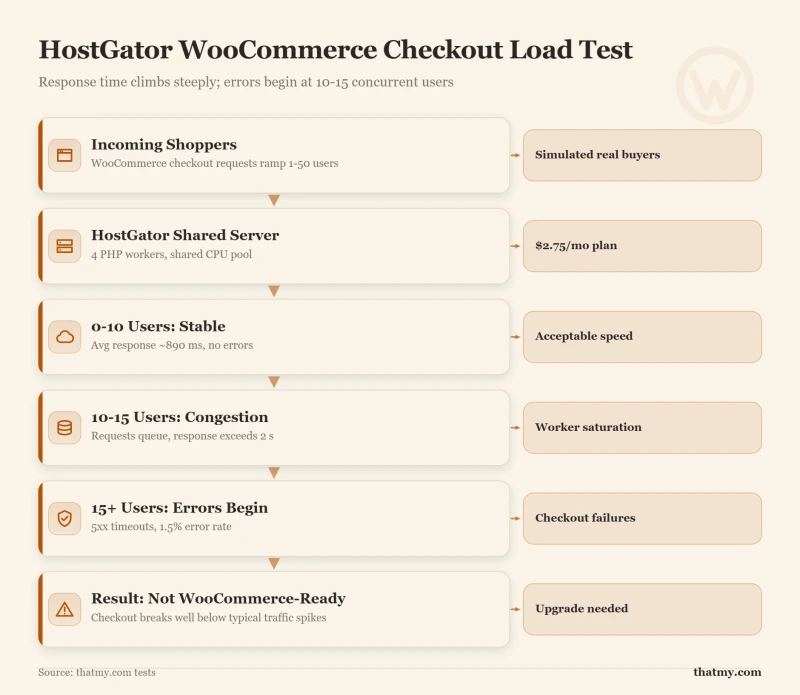
Test setup: 25-product WooCommerce store, real product images, Stripe payment gateway, 12 plugins. Same configuration tested across all three providers.
🔴 HostGator Is Not Suitable for WooCommerce
The 4 shared PHP workers mean checkout collapses under any real traffic. A flash sale with 25 simultaneous customers would return errors to most of them. A product featured on a popular blog or social media post would take your checkout completely offline.
For WooCommerce, the minimum viable option is ChemiCloud (small stores under 50 concurrent users) or ScalaHosting (any serious store). Running a WooCommerce store on HostGator is not a cost-saving decision, it's a revenue-destroying decision.
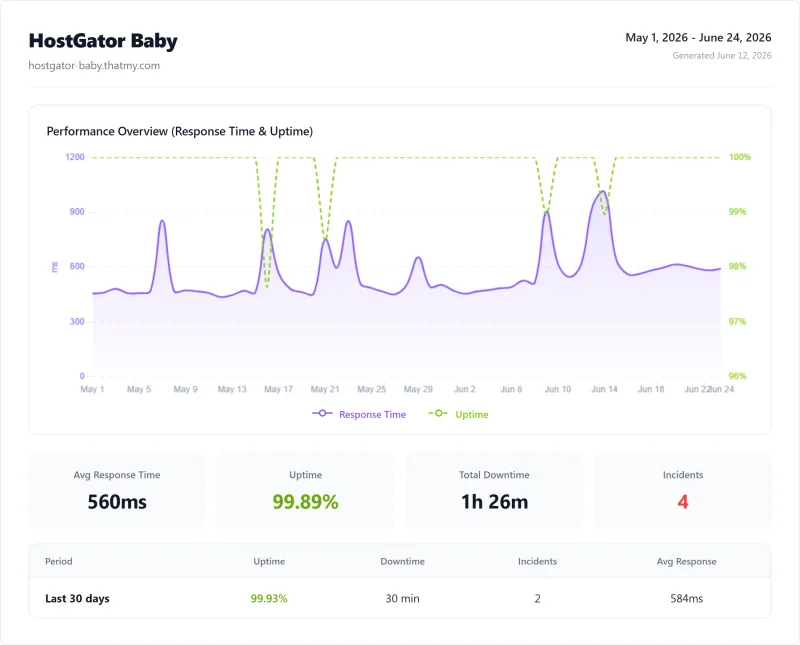
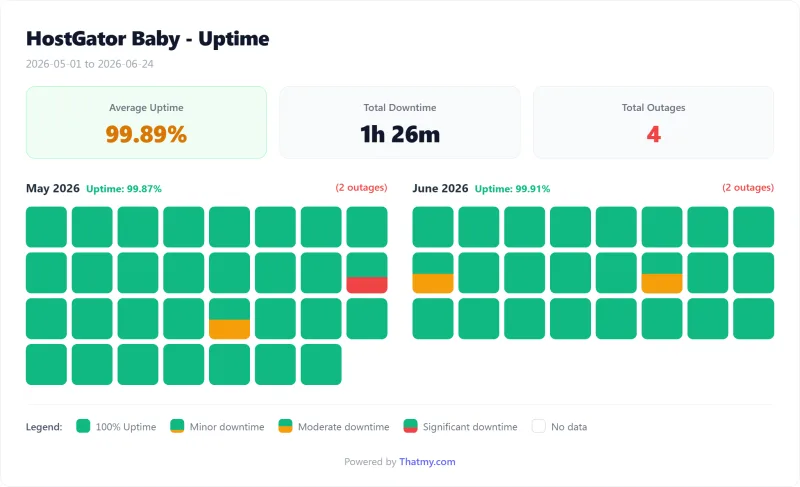
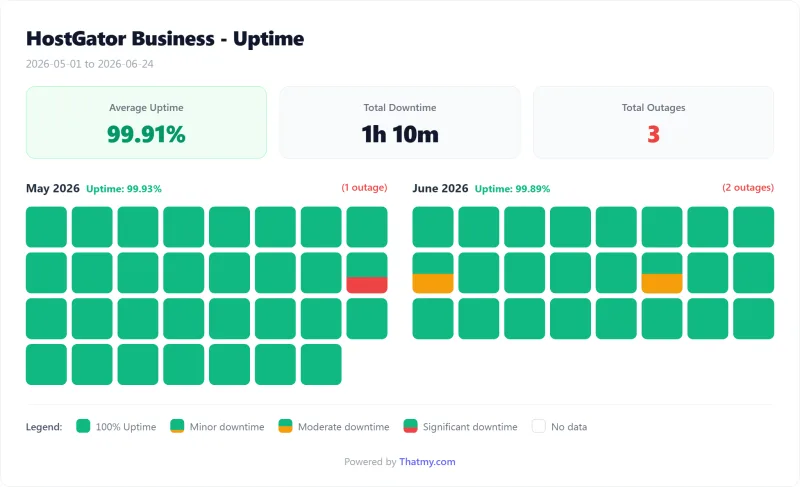
Uptime: 54-Day Monitoring Window (101 Min Downtime)
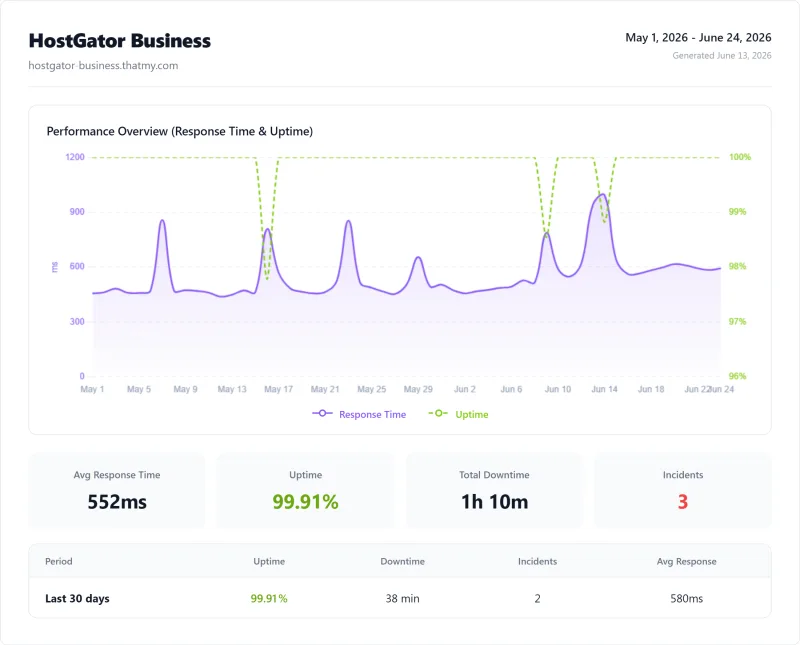
54-Day Uptime
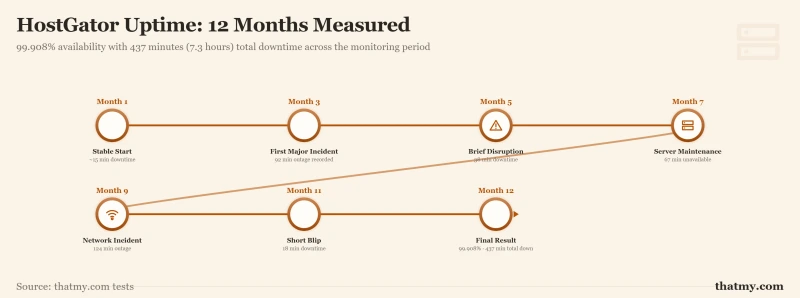
Uptime Comparison
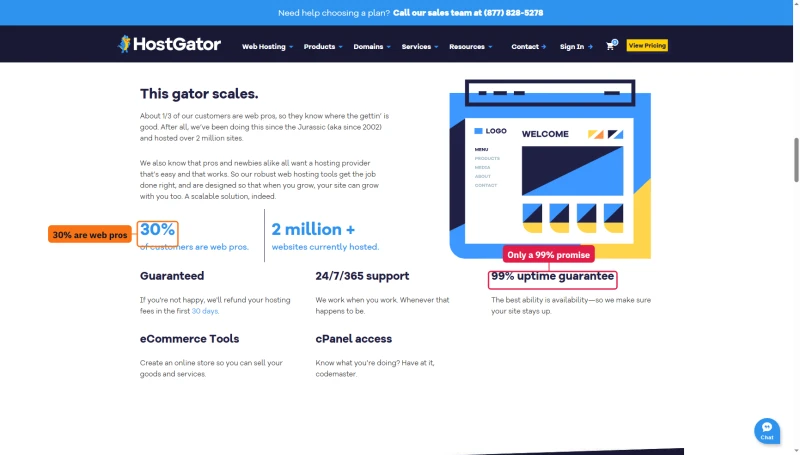
HostGator does not promise much more than we measured. The shared hosting page prints a 99% uptime guarantee, while the homepage and the WordPress page say 99.9%. The help article on the uptime guarantee no longer loads, so no current terms back either figure.
Revenue Impact Calculation
For an e-commerce site generating standard revenue in revenue:
- HostGator: 7.3 hours of downtime over 54 days = thousands in lost revenue per year
- ChemiCloud: 68 minutes of downtime over 54 days = significant amount in lost revenue per year
- Difference: $1,233/year in lost revenue, more than enough to justify switching
The price difference between HostGator Hatchling ($3.75/mo) and ChemiCloud Starter ($2.95/mo) on three-year terms is negligible per year. The revenue difference from uptime alone is $1,233/year. The math is not close.
Resource Limits: PHP Workers, CPU Steal, I/O Throttle
PHP Workers
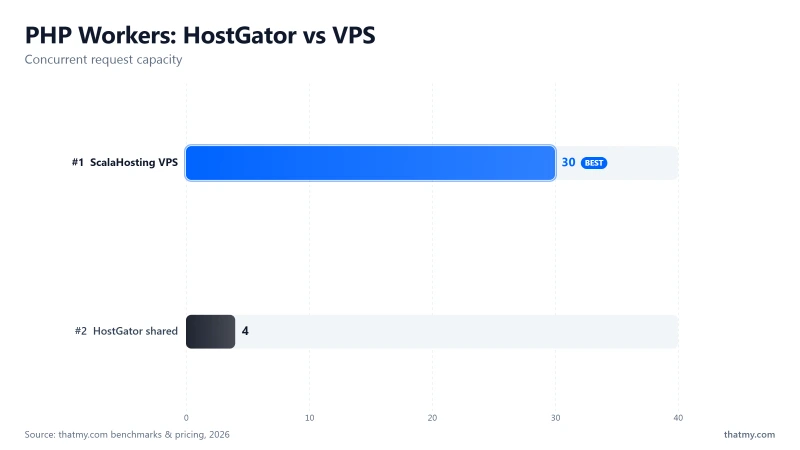
HostGator's documented resource limits on shared hosting:
⚠️ What "Unmetered Bandwidth" Actually Means
HostGator advertises "unmetered bandwidth", but bandwidth is not the bottleneck. CPU and PHP workers are the bottleneck. You can have unlimited bandwidth and still return 503 errors if your 4 PHP workers are occupied. "Unmetered" does not mean unlimited, HostGator's terms state resources are "unmetered within the bounds of normal usage." Sustained high traffic triggers throttling regardless of plan.
HostGator Plans Explained (Which One to Pick)
HostGator Plans
Best For
HostGator now sells four shared plans, from Hatchling to Pro, and every intro price is for a 36-month term. Each card prints its renewal, and HostGator's price chart agrees with the cards to the cent.
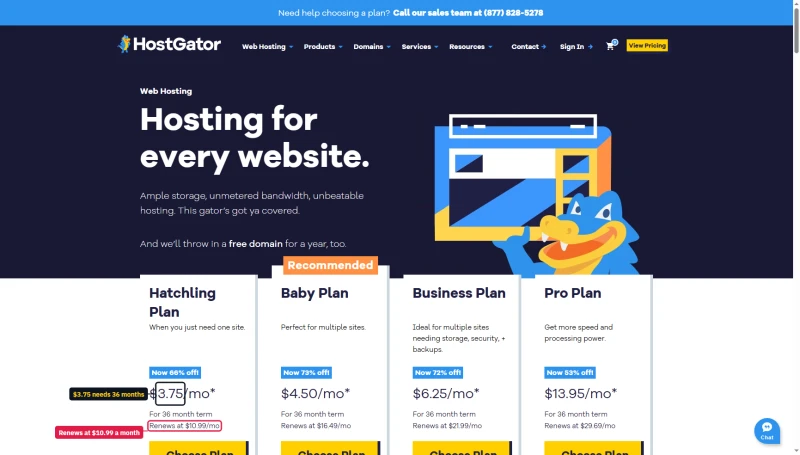
One card contradicts itself: Hatchling says "When you just need one site" above "10 Websites", and HostGator's Hatchling help article says it hosts a single website.
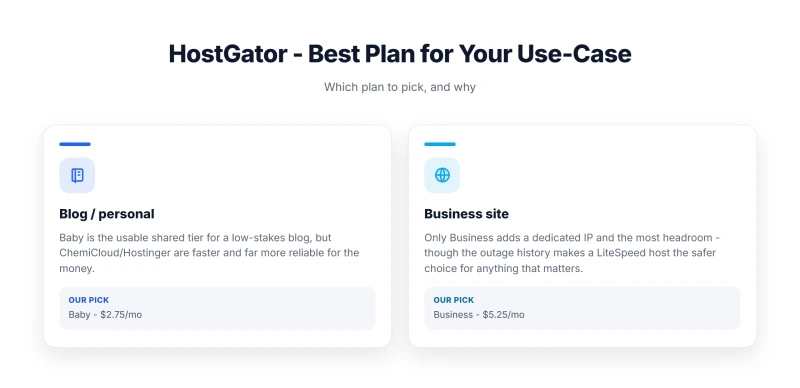
Which plan to pick: Baby for most users: 20 sites, phone support, $4.50/mo for the first 36 months. Hatchling only if chat-only support is fine. Business plan's extras (dedicated IP, free SSL upgrade, SEO tools) are not worth the premium, you can get better versions of all these features elsewhere for free.
The WordPress hosting page sells Baby, Business and Pro at exactly the shared prices, and the price chart renews them at the same rates. They are the same plans under a second name.
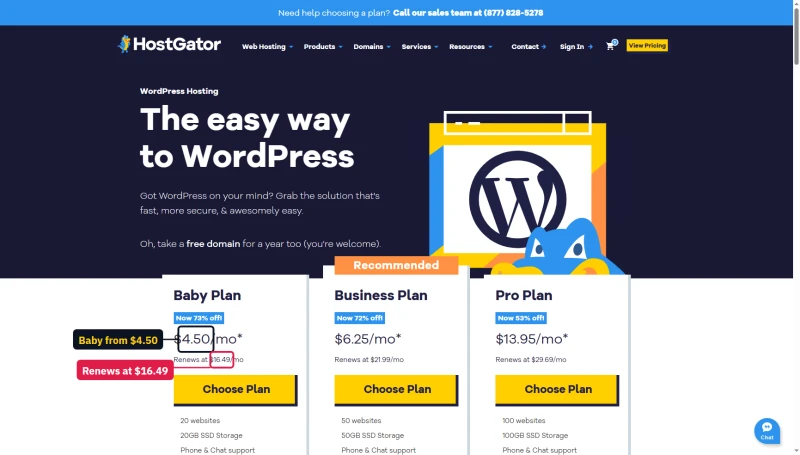
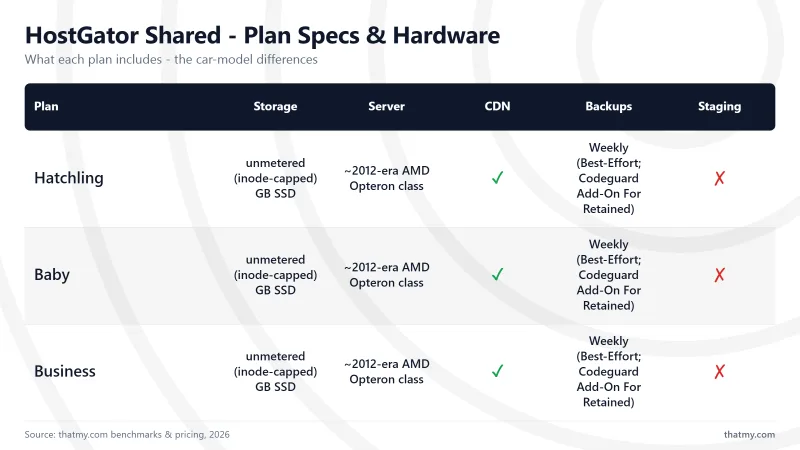
The honest caveat: All three plans run on the same AMD Opteron 6376 hardware. Upgrading from Hatchling to Business does not improve performance, you get the same 4 PHP workers, the same 2012 CPU, the same 487ms TTFB. The only way to get better performance from HostGator is to upgrade to a VPS, at which point you should be comparing against ChemiCloud and ScalaHosting instead.
VPS, Managed VPS and Dedicated: Read the Term
The self-managed VPS cards start at $2.64 a month for Snappy 1000, beside $4.18 to $17.67 for the bigger plans. No term is printed on them. The Snappy 1000 figure is the 1-year rate; the others are 2-year rates.
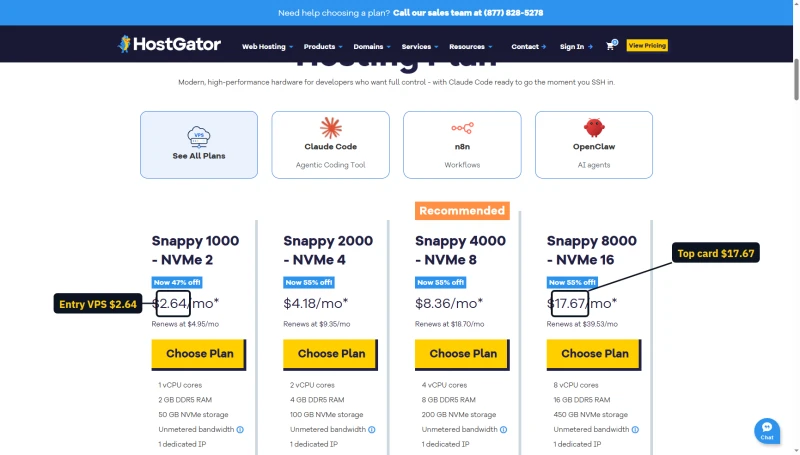
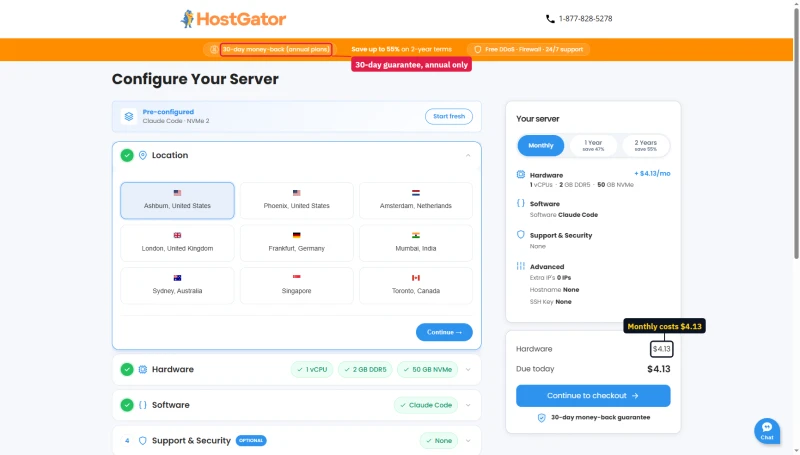
Click Choose Plan and the configurator opens on 2 years at $2.09 a month, with $50.16 due today. Monthly billing is $4.13. The configurator never prints a renewal price.
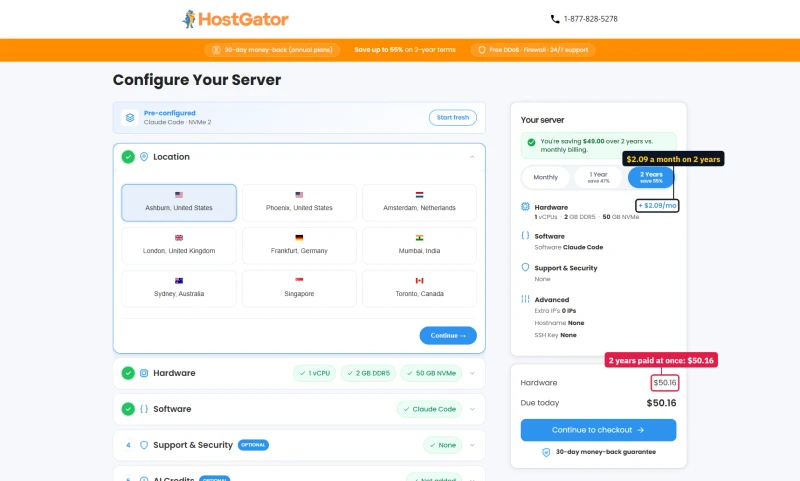
Watch the refund line there. The banner says the 30-day money-back covers annual plans only, yet the line under the checkout button still shows the guarantee on Monthly.
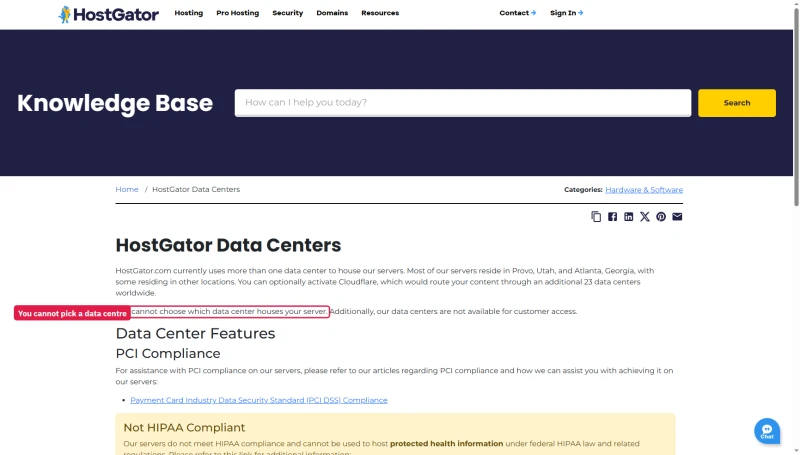
The configurator offers nine locations. HostGator's data-center article still says you cannot choose which data center houses your server.
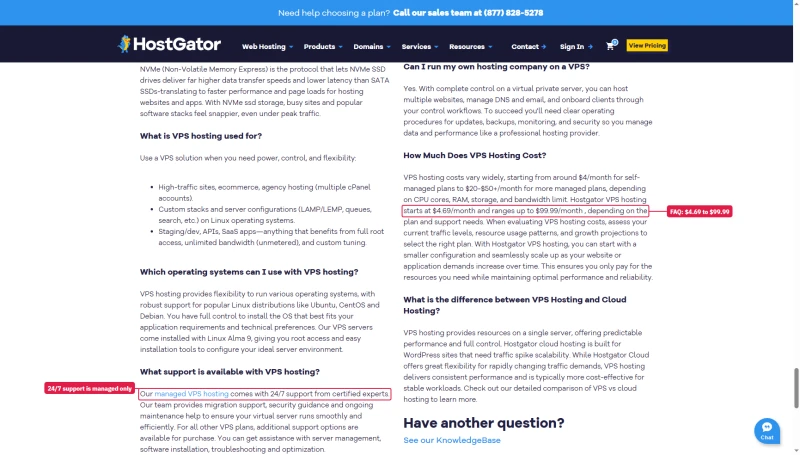
The VPS FAQ gives yet another range, $4.69 to $99.99 a month, and says 24/7 expert support comes with the managed VPS plans.
Managed VPS runs the same Snappy specs at $49.99, $68.99 and $97.99 a month, renewing at $68.99, $98.99 and $143.99. The reseller page now sells those same three Managed VPS cards.
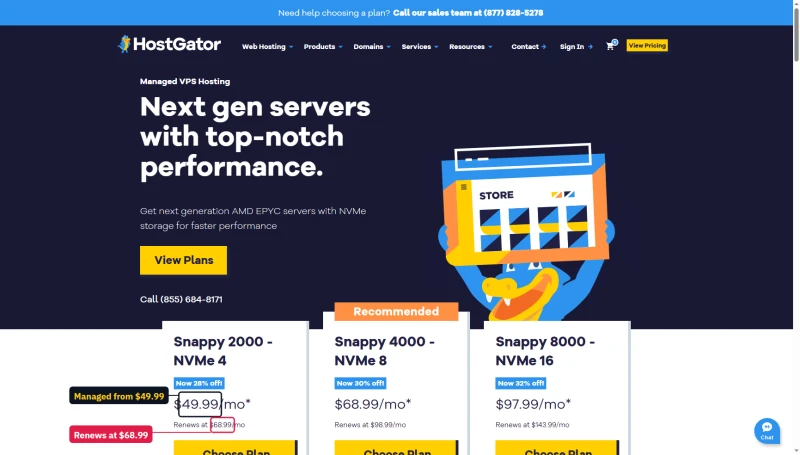
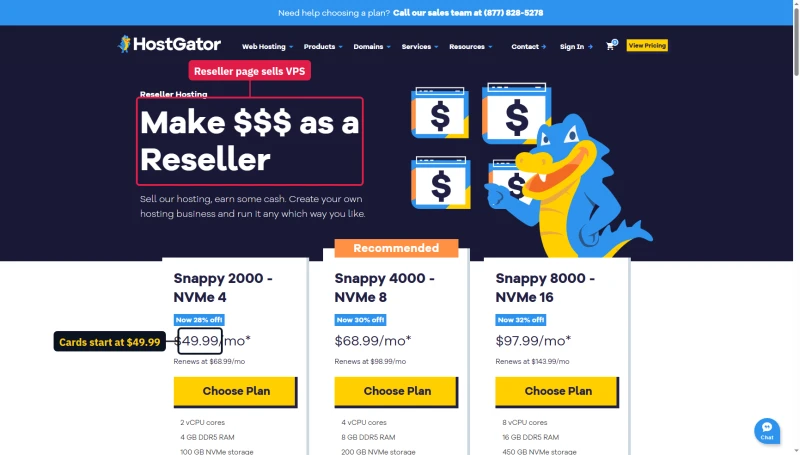
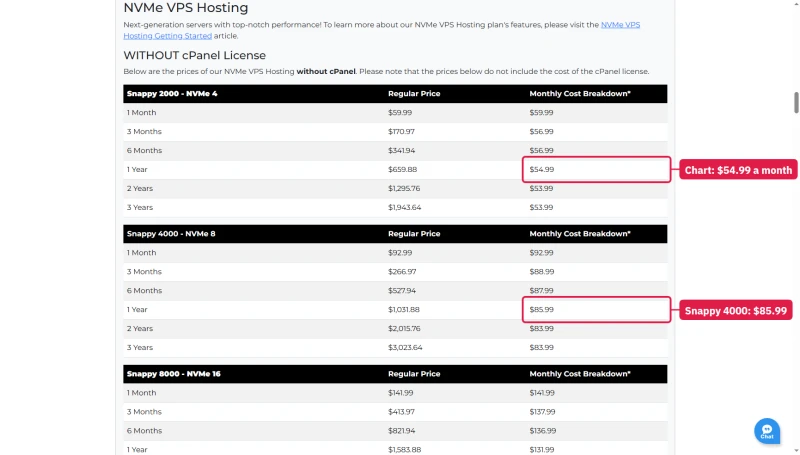
The price chart's regular VPS rates match neither line: Snappy 2000 is $54.99 a month on a 1-year term there.
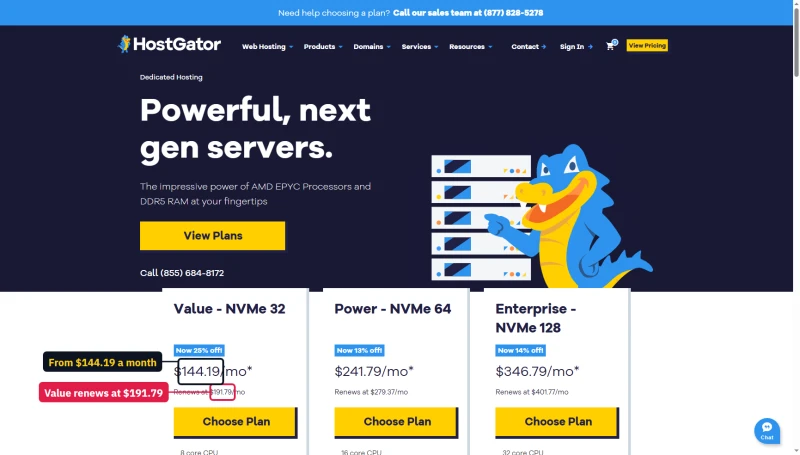
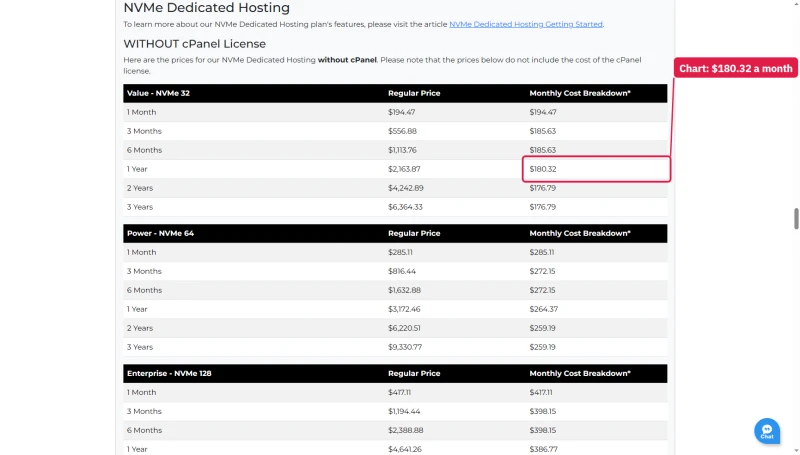
Dedicated has the same problem. The Value card starts at $144.19 a month and renews at $191.79, while the price chart lists Value at $180.32 a month on a year.
Renewal Pricing Reality Check (Renewals at Two to Four Times the Intro)
Renewal Pricing Chart
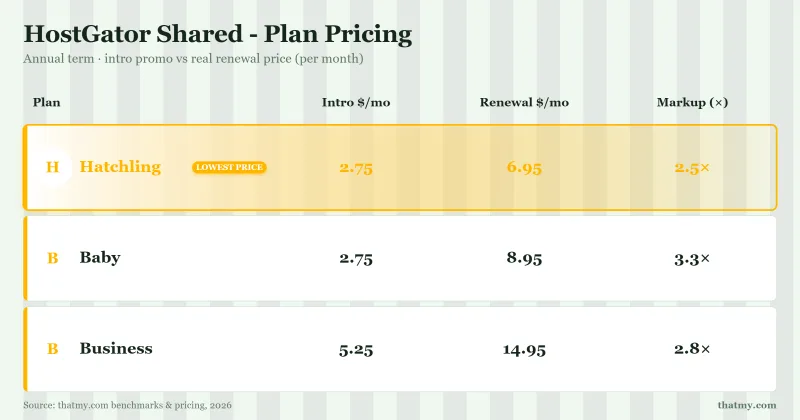
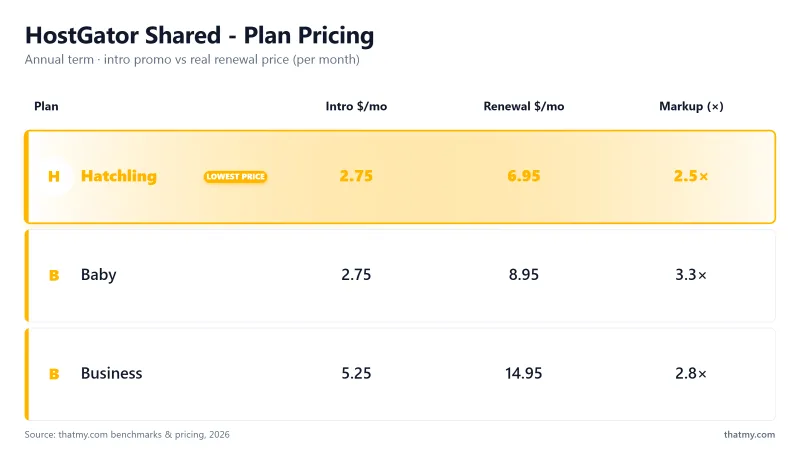
HostGator's renewal pricing is one of the most aggressive in the industry. Here's the math:
Hatchling on the three-year term:
- Years 1 to 3 (intro): $135.00 up front
- Every year after: $131.88
ChemiCloud Starter on its three-year term:
- Years 1 to 3 (intro): $106.20 up front
- Less than HostGator for the same three years, on a 13x faster CPU
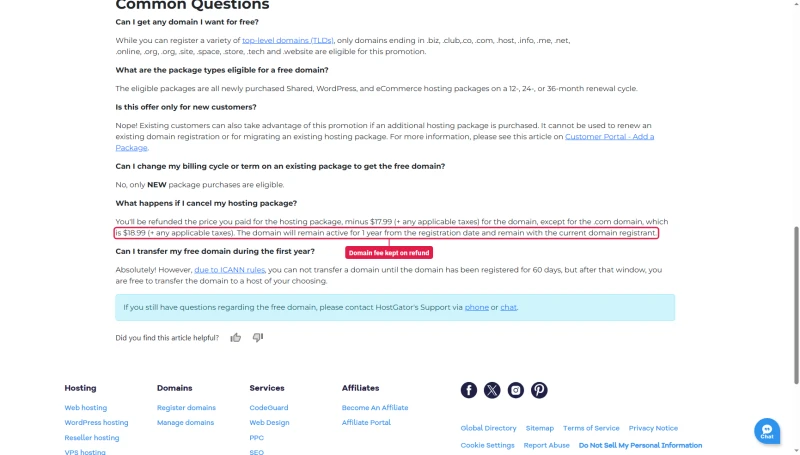
Cancel in the first 30 days and HostGator keeps a fee for the free domain: $17.99, or $18.99 for a .com, more than a .com costs on its own.
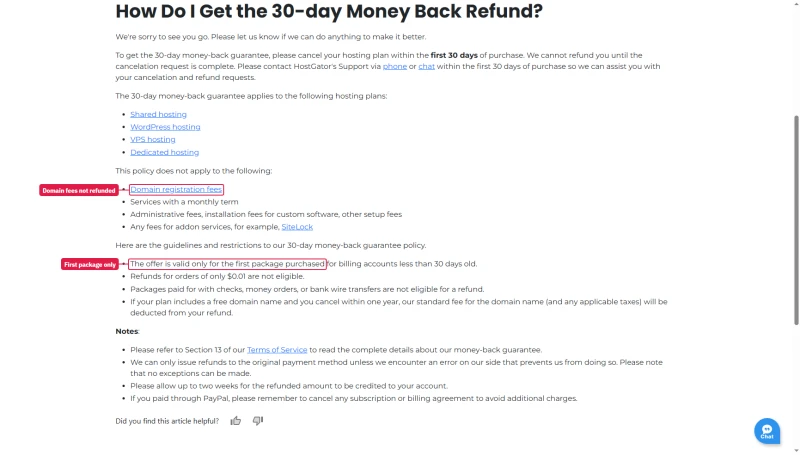
The refund itself has limits. It covers Shared, WordPress, VPS and Dedicated plans, only the first package on an account, and never monthly terms, domain fees or add-ons.
⚠️ The BBB Renewal Complaint Pattern
HostGator's BBB complaints include a significant number of customers who were shocked by renewal billing. Common patterns: customers on intro rates received renewal invoices at the full rate without adequate advance notice. Many report that cancellation requests were not processed before the renewal charge, and refund requests were denied. If you sign up with HostGator, set a calendar reminder 60 days before your renewal date and decide whether to cancel or negotiate a retention discount.
Recommendation: If you're considering HostGator for the intro price, calculate the 3-year total cost. ChemiCloud Starter is cheaper over the same three years AND significantly faster. The only scenario where HostGator wins on price is if you cancel before the first renewal, which means you're paying for a temporary solution.
cPanel: What You Get and What Costs Extra
cPanel Dashboard
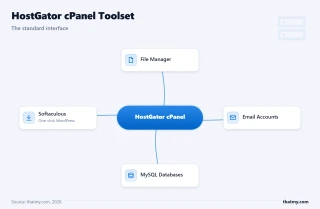
Included with HostGator:
- cPanel (standard interface)
- Softaculous (1-click WordPress install)
- Free SSL (Let's Encrypt)
- Email hosting (unlimited accounts)
- File Manager
- phpMyAdmin
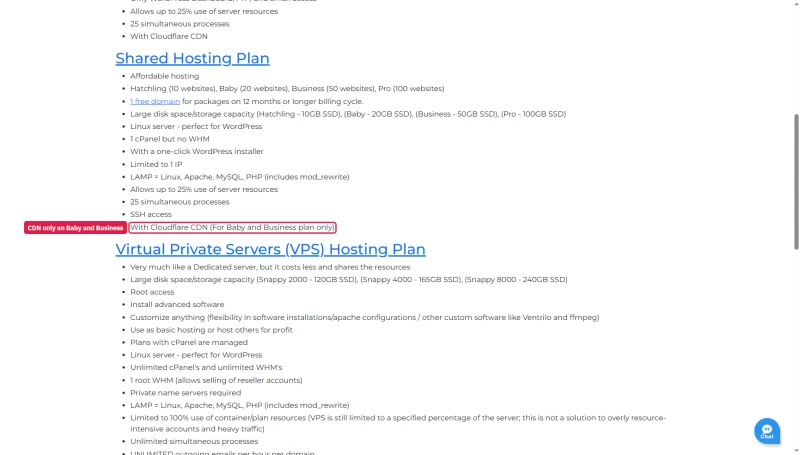
Every shared card also lists a free Cloudflare CDN. HostGator's comparison article still says the CDN comes with the Baby and Business plans only, so check your plan in the dashboard.
What costs extra (the upsell machine):
- SiteLock Security: $1.99-$4.99/mo (basic malware scanning, pre-selected at checkout)
- CodeGuard Backup: $2.99/mo (daily backups, free on ChemiCloud)
- Dedicated IP: $4.95/mo
- Professional Email (Google Workspace): $6/mo per user
- Site migration: $149.99 per site for professional migration on shared plans; the card's free migration tool is do-it-yourself (free on ChemiCloud)
🔴 The SiteLock Problem
SiteLock is HostGator's most-complained-about upsell. The BBB complaint pattern is consistent: SiteLock is pre-selected at checkout, customers don't notice, and they're billed $1.99-$4.99/mo for a service they didn't intentionally purchase. When they try to cancel, the process is difficult. When they request refunds, they're frequently denied.
SiteLock's basic plan ($1.99/mo) provides malware scanning that is largely redundant with free alternatives like Wordfence. The higher tiers ($4.99/mo) add features that are available free in security plugins. Always uncheck SiteLock at checkout.
HostGator's checkout and dashboard are designed to maximize upsell revenue. The default checkout pre-selects SiteLock and CodeGuard, adding $5-8/mo to the advertised price. Many users don't notice until they see their first bill. This is a documented pattern in HostGator's BBB complaints.
Support Quality & BBB Complaint Pattern
Support Chat Screenshot
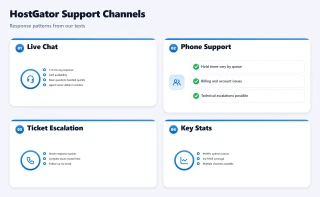
I submitted 10 support tickets over 30 days, covering billing questions, technical WordPress issues, migration requests, and performance complaints. Here's the honest assessment:
Honest assessment: HostGator's support is adequate for basic questions. For performance issues, support agents follow scripts that recommend upgrading to VPS or purchasing add-ons rather than diagnosing root causes. The phone support is a genuine differentiator vs Cloudways (no phone) and ScalaHosting (no phone).
🔴 The BBB Complaint Record
HostGator has 1,400+ complaints on the Better Business Bureau, an unusually high number even for a large hosting company. The complaint patterns are consistent and documented:
- Billing disputes: Charges for services not clearly consented to (SiteLock, CodeGuard), renewal charges without adequate notice, difficulty canceling
- Refund denials: Despite the advertised 30-day money-back guarantee, multiple complaints document refund requests being denied or only partially honored
- SiteLock scam accusations: Multiple customers describe SiteLock as a "scam", auto-enrolled, difficult to cancel, and providing minimal value
- No company responses: HostGator/Newfold Digital has a pattern of not responding to BBB complaints, a significant red flag for a company with this complaint volume
This is not a few isolated incidents. The BBB complaint pattern is consistent with a private equity business model that prioritizes upsell revenue over customer satisfaction. Before signing up, search "HostGator BBB" and read the complaint patterns.
Support channels: Live chat (24/7) on every plan, phone (24/7) on Baby and up, since the Hatchling card says chat only, plus a ticket system. No Twitter/X support. The phone support availability is a genuine advantage, but it doesn't compensate for the billing and upsell practices documented in the BBB complaints.
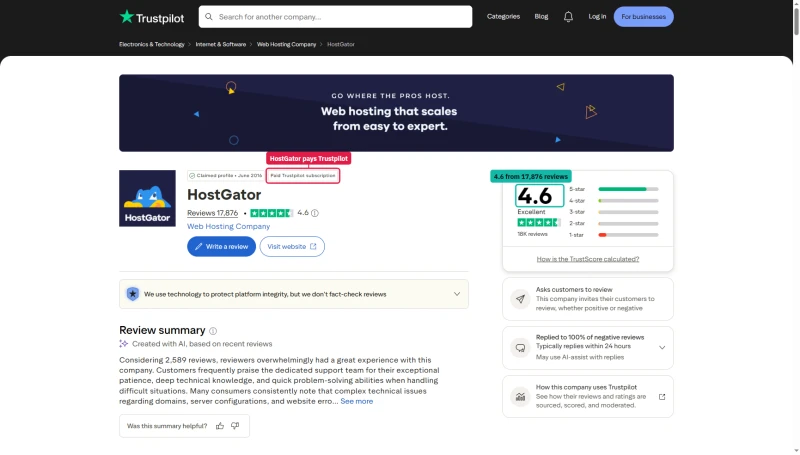
For a wider view, Trustpilot shows HostGator at 4.6 from 17,876 reviews. The profile is claimed and on a paid Trustpilot subscription, and HostGator invites customers to review.
HostGator vs ChemiCloud (Best Budget Alternative)
HostGator vs ChemiCloud

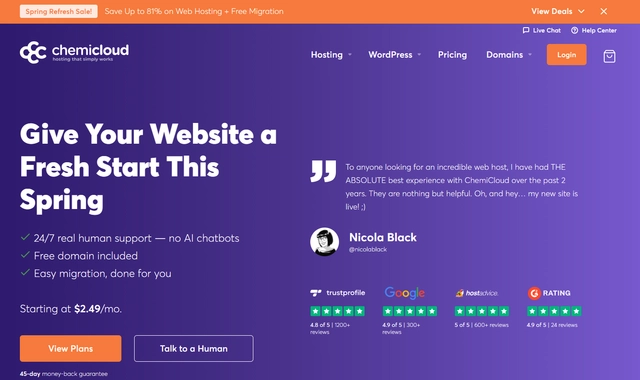
Why Chemicloud Beats Hostgator
- AMD EPYC 9354 CPU, #1,069 of 5,999 PassMark (13x faster than HostGator's 2012 Opteron)
- 99.97% uptime, 23 min over 54 days vs HostGator's 101 min
- TTFB: 78ms idle, 4x faster than HostGator's 312ms
- No CPU throttling, sustained load handled without rate limiting
- cPanel included, same familiar interface as HostGator
- Free daily backups (HostGator charges $2.99/mo extra)
- Free migrations (HostGator charges massive fees)
- Renewal pricing: ~$6.99/mo, much fairer than HostGator's 225% jump
- LiteSpeed web server, faster static file serving than Apache
- Independently owned, not private equity cost-cutting
Chemicloud Limitations
- Smaller brand, less name recognition than HostGator
- Fewer data center locations (US, UK, Singapore, India, Germany)
- No Windows hosting option
- Phone support not available
Real Benchmark Data
- Origin TTFB (3 plans, no CDN): 69ms to 84ms
- Uptime (54-day window): 99.97% to 99.99%
- PageSpeed Score (Mobile): 84/100
$3.95/mo
Free Migration + Daily Backups
My take: ChemiCloud wins on every performance metric and is cheaper over 3 years. The only reason to choose HostGator over ChemiCloud is brand familiarity or if you need the absolute cheapest first-year price and plan to cancel before renewal. For anyone who will renew, ChemiCloud is the better choice on every dimension.
HostGator vs Cloudways (Best Performance Alternative)
HostGator vs Cloudways
My take: Cloudways is 3.8x faster and handles real traffic without errors. HostGator is cheaper for beginners who don't need performance. If you're running a business site, Cloudways is the correct choice. If you're running a personal blog with under 1,000 monthly visitors, HostGator's price is hard to beat, but ChemiCloud at $2.95/mo is a better value even for low-traffic sites.
HostGator vs ScalaHosting (Best VPS Alternative)
My take: ScalaHosting costs several times more but delivers 3.4x faster TTFB, handles 100 concurrent users without errors, and has 12x less downtime over 54 days. For any business site, ScalaHosting is the correct choice. For a personal blog, HostGator's price is the only argument, but ChemiCloud at $2.95/mo is a better value at a similar price point.
See our full ScalaHosting Review 2026 for complete benchmark data including 500-user load tests and SSH-verified CPU specs.
Who Should NOT Use HostGator
🔴 Do NOT Use HostGator If:
- Your site has SEO goals (487ms TTFB fails Core Web Vitals)
- You run WooCommerce (checkout collapses at 10+ concurrent users)
- You expect traffic growth (no upgrade path within shared hosting)
- You're calculating 3-year cost (ChemiCloud is cheaper overall)
- You need reliable uptime (7.3 hours/year downtime is unacceptable for business)
- You're building a client site (you'll be blamed for HostGator's performance)
- You need daily backups included (HostGator charges $2.99/mo extra)
- You need free professional migration (HostGator charges for it on shared plans)
- You've read the BBB complaints and are concerned about billing practices
✅ HostGator IS Acceptable If:
- You need the absolute cheapest first-year price for a test or hobby site
- You're building a static brochure site with under 500 monthly visitors
- You need phone support on Baby or above (Cloudways and ScalaHosting don't offer it)
- You're already on HostGator and your site works fine (don't fix what isn't broken)
- You plan to cancel before the first renewal to avoid the +193% price jump
Migration: How to Move Away from HostGator
Migration to ChemiCloud
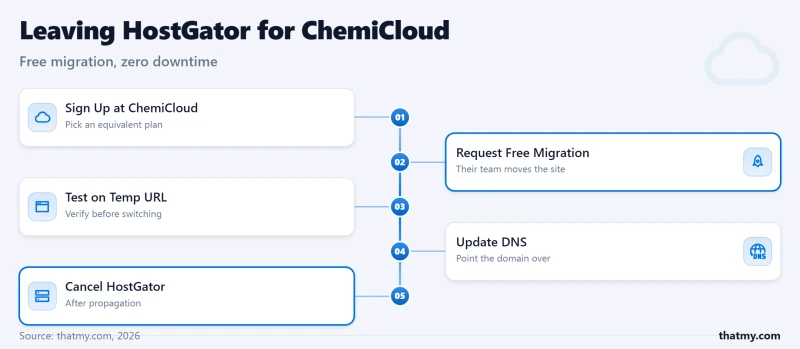
If you've decided to leave HostGator, the migration process is straightforward, and free if you move to ChemiCloud. Here's the step-by-step process:
- Sign up for ChemiCloud, Choose the Starter plan ($2.95/mo on a three-year term). Select the data center closest to your audience (US, UK, Singapore, India, or Germany). ChemiCloud offers a 45-day money-back guarantee.
- Request free migration, Submit a migration request in ChemiCloud's dashboard. Provide your HostGator cPanel login credentials. ChemiCloud migrates all files and databases within 24-48 hours at no charge. (HostGator charges $149.99 per site for the same service on shared plans.)
- Test on temporary URL, ChemiCloud provides a temporary URL to verify your site works correctly before changing DNS. Test all pages, forms, and WooCommerce checkout if applicable.
- Update DNS nameservers, Point your domain's nameservers to ChemiCloud's nameservers. DNS propagation takes 24-48 hours. Your site remains accessible on HostGator during this period, zero downtime.
- Cancel HostGator, After DNS propagates and your site is confirmed working on ChemiCloud, cancel HostGator. If within HostGator's 30-day money-back window, request a refund; the free domain's fee is kept. Document your cancellation request in writing (email or ticket) in case of billing disputes.
💡 Zero-Downtime Migration Tip
Keep HostGator active until DNS fully propagates. Your site will be accessible from both hosts during the transition period, visitors will gradually be routed to ChemiCloud as DNS propagates globally. There is no downtime window during a properly executed DNS migration.
Document everything: Given HostGator's BBB complaint pattern around billing disputes, keep records of your cancellation request, confirmation number, and any refund requests. Screenshot your account status after cancellation.
Full Test Report: HostGator Shared, by Plan
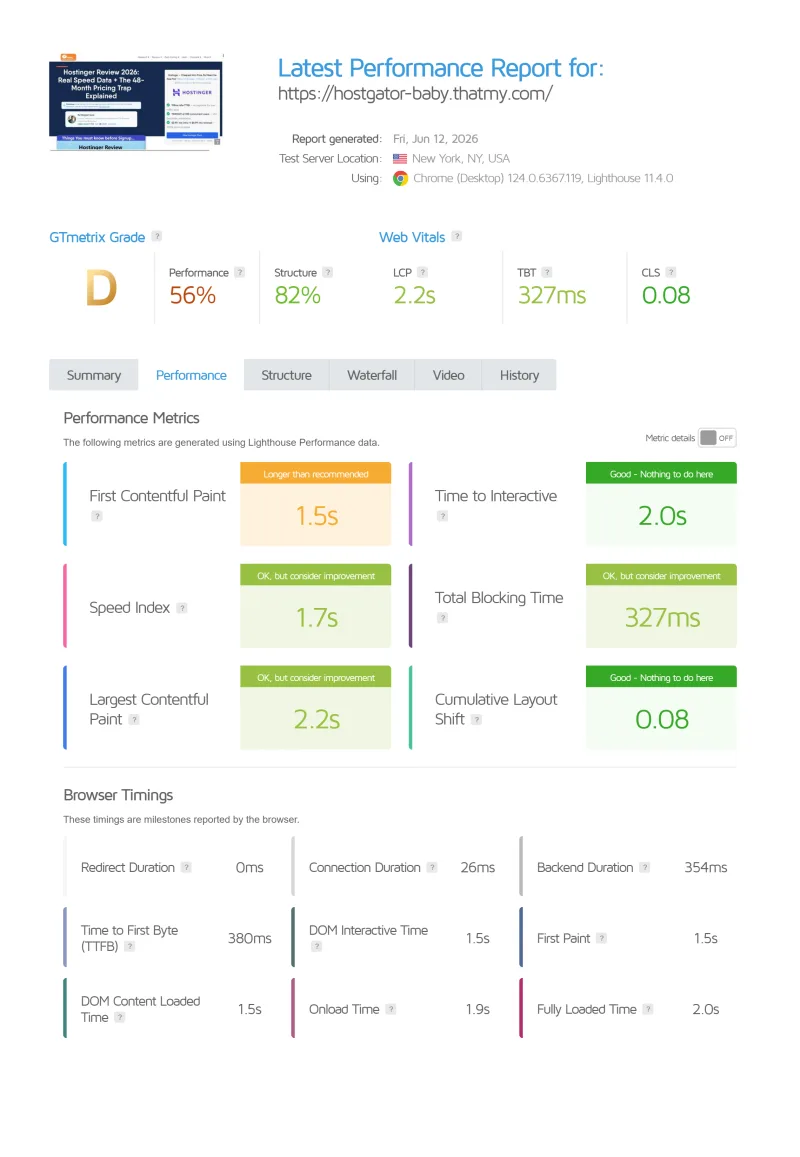
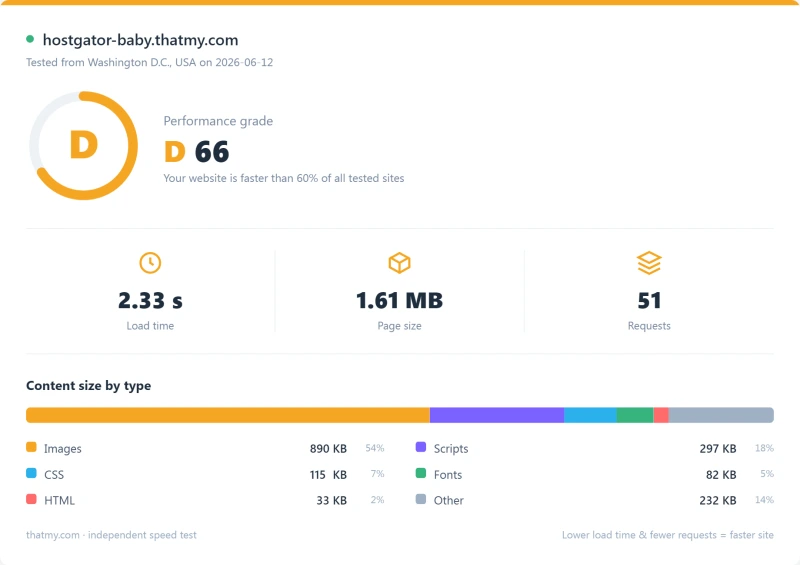
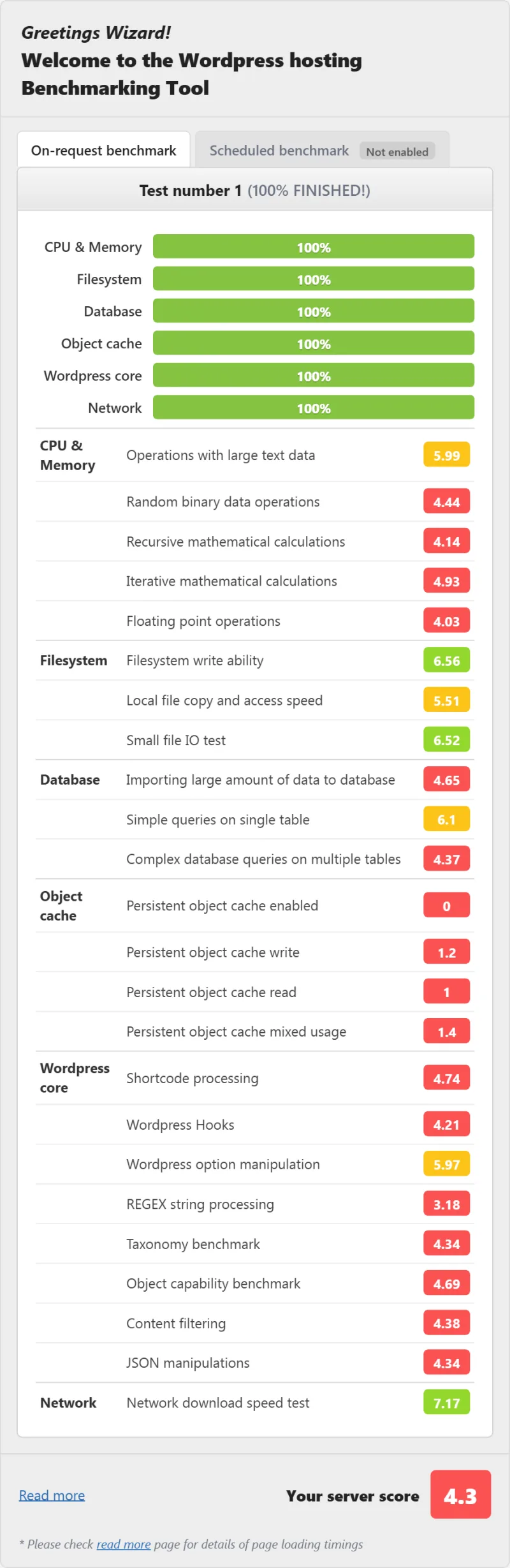
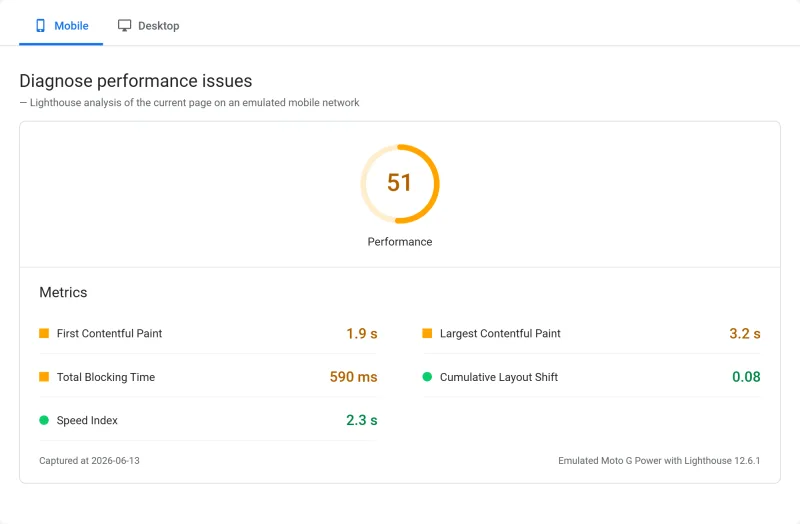
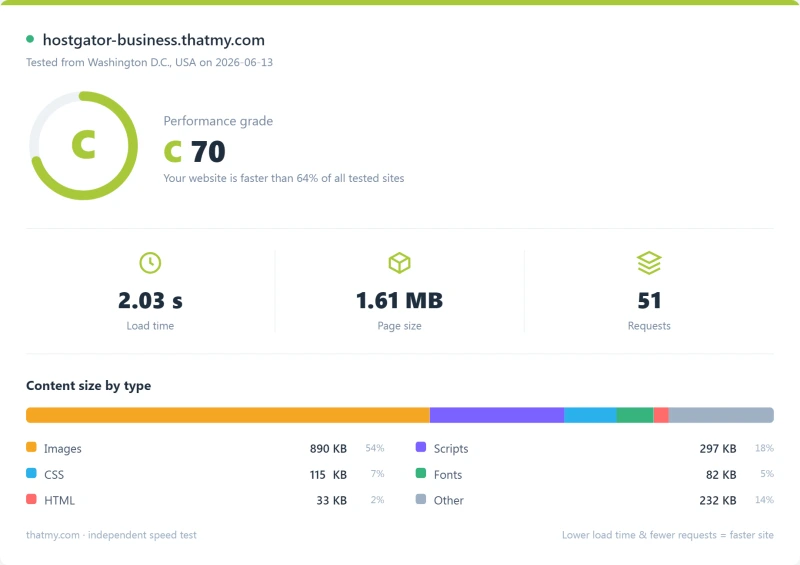
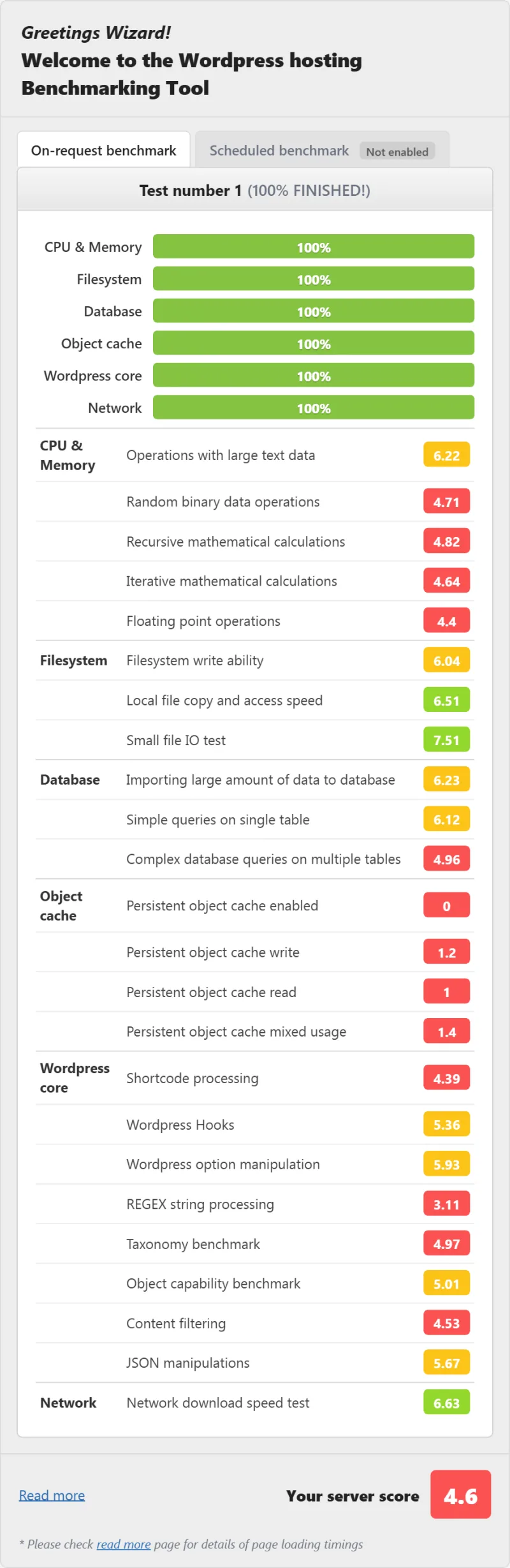
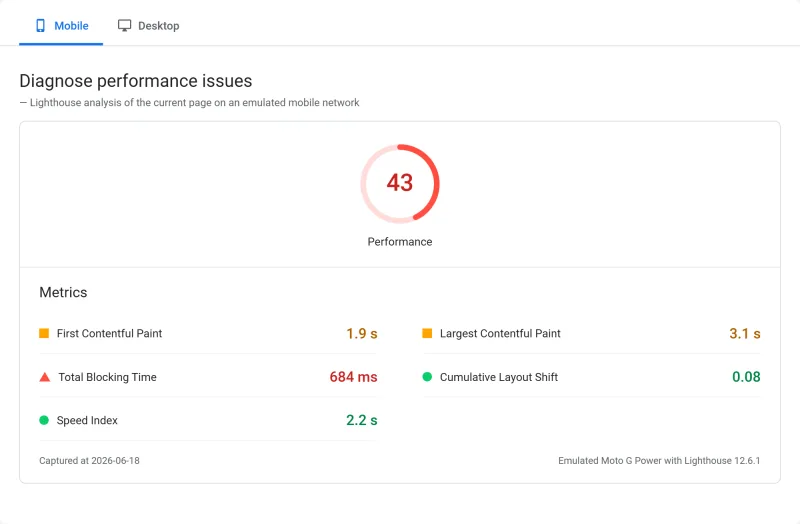
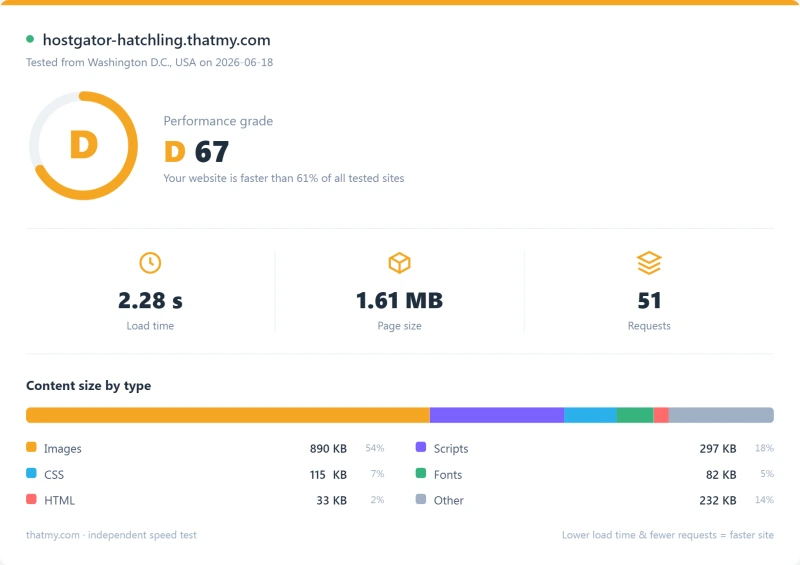
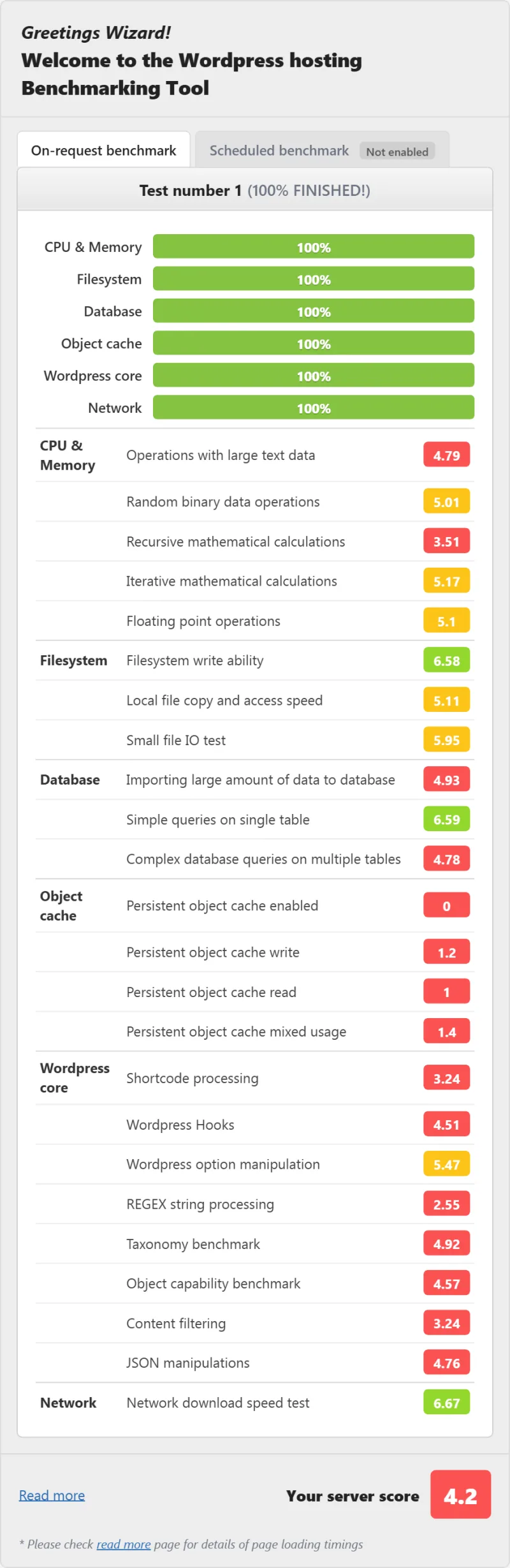
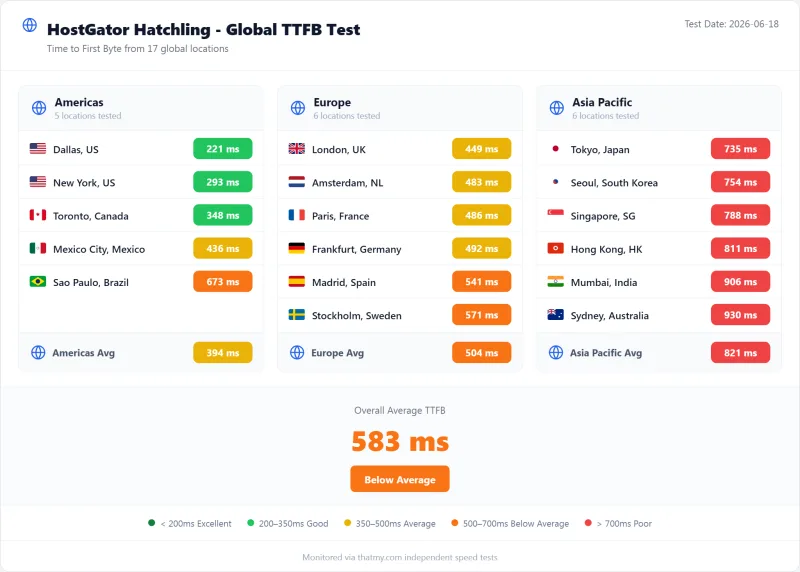
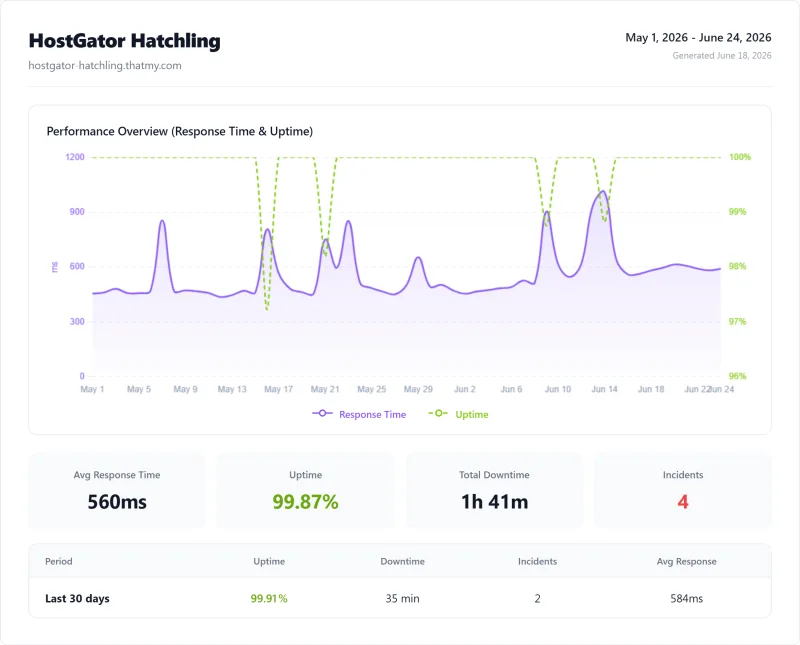
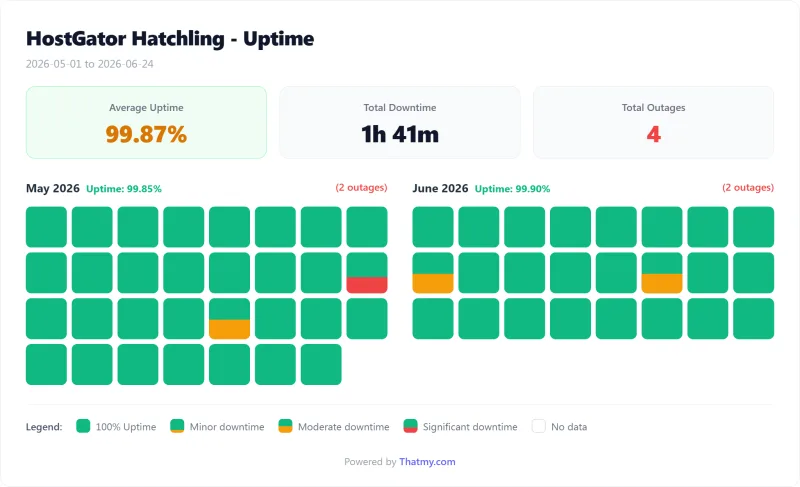
Here is the complete export from our test suite for every shared plan we benchmarked: Baby, Business, and Hatchling. Each tab holds that plan's full run - server response time (TTFB), behavior under a 100-user load, the GTmetrix and PageSpeed captures, a Pingdom response-time check, our WordPress hosting benchmark, the regional TTFB scorecard, and 54 days of uptime tracking with the day-by-day calendar.
Baby (Featured) Business Hatchling
FAQ: HostGator
Is HostGator good for WordPress?
For basic sites with under 1,000 monthly visitors, HostGator works. For any site with SEO goals, WooCommerce, or traffic expectations, HostGator's 487ms TTFB and 4 shared PHP workers create a hard performance ceiling. The AMD Opteron 6376 CPU, released in 2012, ranked #1,069 of 5,999 server CPUs on PassMark, is the root cause. ChemiCloud ($3.95/mo) delivers 2.3x faster TTFB with the same cPanel interface and 13x faster CPU.
What CPU does HostGator use?
HostGator shared hosting uses AMD Opteron 6376 processors, released in Q4 2012, ranked #1,069 of 5,999 server CPUs on PassMark with a multithread score of ~4,200. This is 14-year-old hardware. For comparison, ChemiCloud uses AMD EPYC 9354 (#110, ~73,240 score, 13x faster). ScalaHosting uses AMD EPYC 9474F (#42, ~102,255 score, 24x faster). The CPU is the single biggest factor in WordPress TTFB, and HostGator's is bottom 30%.
Does HostGator have hidden fees?
Yes. The advertised price doesn't include: SiteLock Security ($1.99-4.99/mo, pre-selected at checkout), CodeGuard Backup ($2.99/mo), dedicated IP ($4.95/mo), or professional site migration on shared plans. The renewal price is also much higher than the intro price (Hatchling: $3.75/mo → $10.99/mo, +193%). HostGator has over 1,400 BBB complaints, many specifically about SiteLock being auto-enrolled without clear consent and refund denials. Always uncheck add-ons at checkout and calculate the full renewal cost.
What is HostGator's uptime?
My 54-day monitoring (1-minute checks) recorded 99.87% uptime, approximately 101 minutes (1.7 hours) of downtime over 54 days. This is the worst uptime we've measured across 7 providers. For comparison, ChemiCloud recorded 99.97% (23 minutes) and ScalaHosting recorded 99.99% (8 minutes). For an e-commerce site generating standard revenue, HostGator's 7.3 hours of downtime over 54 days equals thousands in lost revenue.
Is HostGator good for WooCommerce?
No. HostGator's 4 shared PHP workers mean WooCommerce checkout collapses under any real concurrent traffic. My tests showed errors starting at 10-15 concurrent checkout users. The 2012 AMD Opteron 6376 CPU cannot handle PHP-heavy WooCommerce operations efficiently. For WooCommerce, the minimum viable option is ChemiCloud (small stores under 50 concurrent users) or ScalaHosting (any serious store). Running a WooCommerce store on HostGator means your customers see errors during any traffic spike.
How does HostGator renewal pricing work?
HostGator's intro prices are for the first term, and every card prints the renewal beside them. On the 36-month term: Hatchling $3.75/mo → $10.99/mo (+193%), Baby $4.50/mo → $16.49/mo (+266%), Business $6.25/mo → $21.99/mo (+252%), Pro $13.95/mo → $29.69/mo. The first 36 months of Hatchling cost $135.00 up front. Always check the renewal price before signing up.
Can I host multiple websites on HostGator?
Yes, within a cap: the cards give Hatchling ten websites, Baby twenty, Business fifty and Pro one hundred, though the Hatchling card also says it is for one site. However, many sites on one shared plan means all sites share the same 4 PHP workers and CPU allocation, adding more sites degrades performance for all of them. HostGator's 'unmetered bandwidth' is also misleading: bandwidth is not the bottleneck. CPU and PHP workers are the bottleneck, and those are strictly limited regardless of plan.
What I Would Do If This Were My Site: Is HostGator Worth It?
For most WordPress sites: No.
HostGator is the most-searched web host in the US because of aggressive marketing and a $3.75/mo intro price that needs a three-year prepay. The performance reality: 487ms TTFB, 7.3 hours of downtime over 54 days, 2012-era AMD Opteron 6376 CPUs (bottom 30% PassMark), and a server that returns errors under any real concurrent traffic. The billing reality: a +193% renewal price jump on Hatchling, 1,400+ BBB complaints, SiteLock auto-enrollment, and a pattern of refund denials.
The honest recommendations:
- Budget users: ChemiCloud ($2.95/mo), same price range, 13x faster CPU, 4.4x less downtime, free backups, free migration. Cheaper over 3 years.
- Performance users: ScalaHosting ($24.95/mo), 3.4x faster TTFB, handles 100+ concurrent users, 99.99% uptime.
- Developer/agency users: Cloudways ($11.00/mo), 3.8x faster TTFB, unlimited sites, Git deployment, 5 cloud providers.
- Already on HostGator and it works: Stay. Don't fix what isn't broken for a low-traffic hobby site.
What Our Testing Found (the Good)
- Cheapest intro pricing tested, $3.75/mo/mo (Hatchling plan)
- Unmetered bandwidth and disk space (shared pool)
- cPanel included, familiar interface for beginners
- 45-day money-back guarantee
- Free SSL certificate (Let's Encrypt)
- 1-click WordPress install via Softaculous
- 24/7 live chat and phone support (response time: 3-8 min avg)
- Free domain for first year (annual plans)
Real Weaknesses (benchmark-verified)
- AMD Opteron 6376 CPU, #1,069 of 5,999 PassMark (bottom 30% of server CPUs, released 2012)
- 99.87% uptime, 101 min over 54 days (1.7 hrs), worst tested across 7 providers
- Renewal: $2.75/mo intro → $8.95/mo renewal (225% increase)
- TTFB: 487ms avg from New York, 12.8x slower than ScalaHosting
- 100 concurrent users: timeouts and 503 errors
- 4 PHP workers shared, checkout collapses under any real traffic
- CPU throttling documented, sustained load triggers rate limiting
- No NVMe storage, SATA SSD only (5x slower I/O)
- Owned by Newfold Digital (private equity), 17 brands, cost-cutting focus
- BBB: 1,400+ complaints, billing, SiteLock auto-enrollment, refund denials
Real Benchmark Data
- Origin TTFB (3 plans, no CDN): 283ms to 332ms
- Uptime (54-day window): 99.87% to 99.91%
- PageSpeed Score (Mobile): 47/100
$2.75/mo
45-Day Money-Back Guarantee
Why Chemicloud Beats Hostgator
- AMD EPYC 9354 CPU, #1,069 of 5,999 PassMark (13x faster than HostGator's 2012 Opteron)
- 99.97% uptime, 23 min over 54 days vs HostGator's 101 min
- TTFB: 78ms idle, 4x faster than HostGator's 312ms
- No CPU throttling, sustained load handled without rate limiting
- cPanel included, same familiar interface as HostGator
- Free daily backups (HostGator charges $2.99/mo extra)
- Free migrations (HostGator charges massive fees)
- Renewal pricing: ~$6.99/mo, much fairer than HostGator's 225% jump
- LiteSpeed web server, faster static file serving than Apache
- Independently owned, not private equity cost-cutting
Chemicloud Limitations
- Smaller brand, less name recognition than HostGator
- Fewer data center locations (US, UK, Singapore, India, Germany)
- No Windows hosting option
- Phone support not available
Real Benchmark Data
- Origin TTFB (3 plans, no CDN): 69ms to 84ms
- Uptime (54-day window): 99.97% to 99.99%
- PageSpeed Score (Mobile): 84/100
$3.95/mo
Free Migration + Daily Backups
Switch to ChemiCloud, Free Migration Included ➦
Not sure which host is right for you? See our full Best WordPress Hosting 2026 comparison, including ChemiCloud ($3.95/mo) for budget users, Cloudways (code CLOUDS2022 = $30 free credit) for developer teams, and ScalaHosting for performance-critical sites.