

GoDaddy Review 2026: The Short Version
GoDaddy is a fine place to register a domain and a poor place to host WordPress. Buy the domain there if you like; host on ChemiCloud or Cloudways.
GoDaddy sells three Web Hosting (cPanel) plans. Economy is $5.99/mo, Deluxe $7.99/mo and Ultimate $12.99/mo on a 36-month term, so Deluxe costs $2.00 a month more than Economy. Deluxe, the plan GoDaddy features, is the one we tested. See how we test.
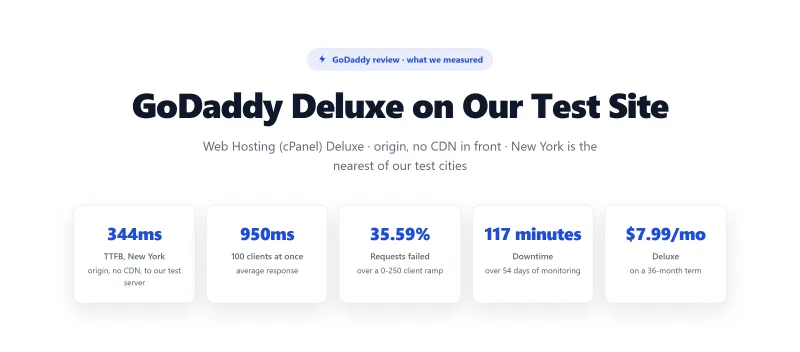
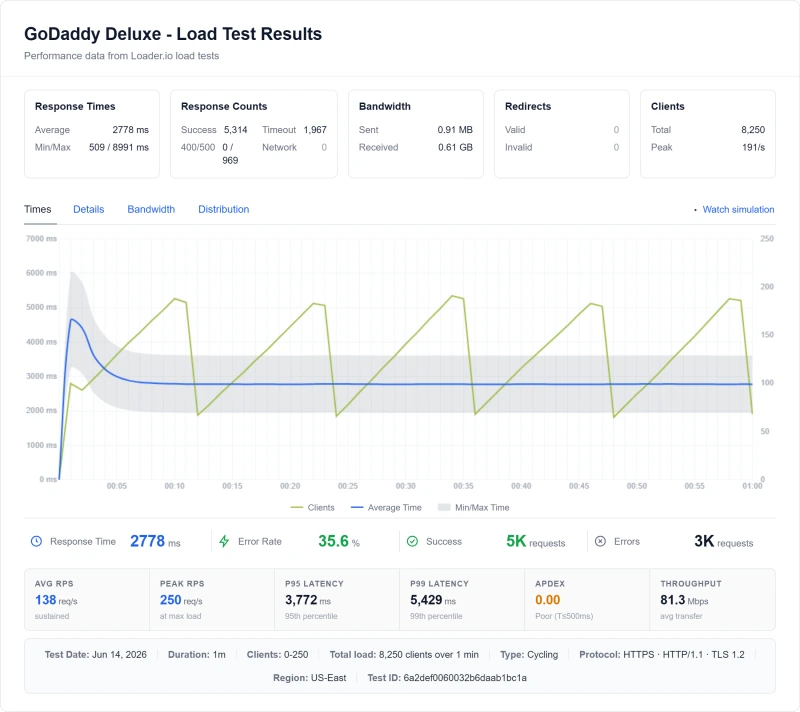
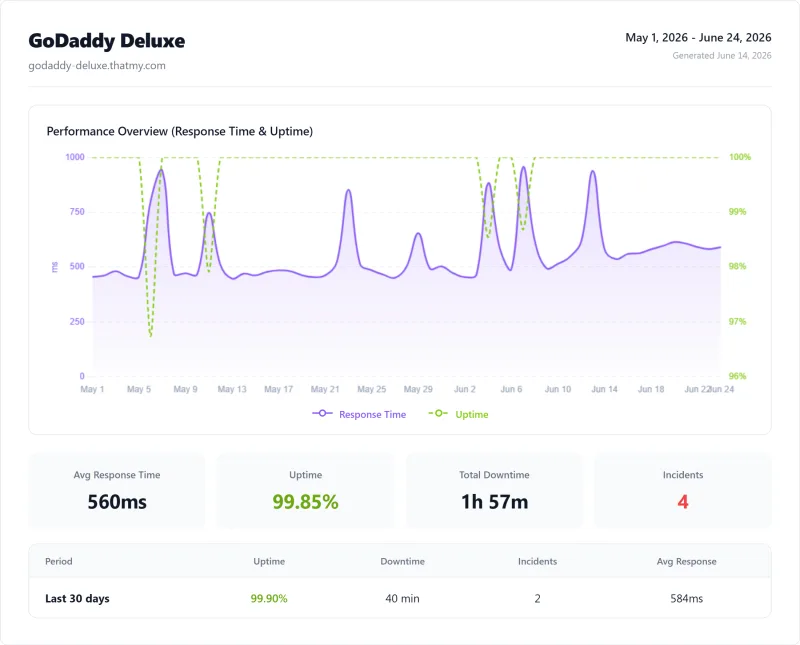
Deluxe answered our New York location in 344ms (origin, no CDN), 4.1x ChemiCloud Starter's 84ms. At 100 concurrent users it took 950ms and failed 35.59% of requests over our 0 to 250 client ramp. Uptime was 99.85% over 54 days: 117 minutes of downtime in 4 incidents.
Two more things to know before you buy. In January 2025 the FTC took action over GoDaddy's hosting security. And free extras in the cart turn paid: Economy's SSL renews at $119.99 a year after year one. Renewal prices on the three-year terms rise by +69% to +113%.
Buy from GoDaddy if you:
- Want a domain registration (the registrar is fine)
- Already host there and your site gets almost no traffic
Buy ChemiCloud or Cloudways instead if you:
- Care about WordPress speed (numbers below)
- Run a WooCommerce store (Ultimate, its best shared plan, failed 28.21% of requests on our ramp)
- Want clear pricing: ChemiCloud Starter is $2.95/mo on 36 months against $5.99/mo for GoDaddy Economy
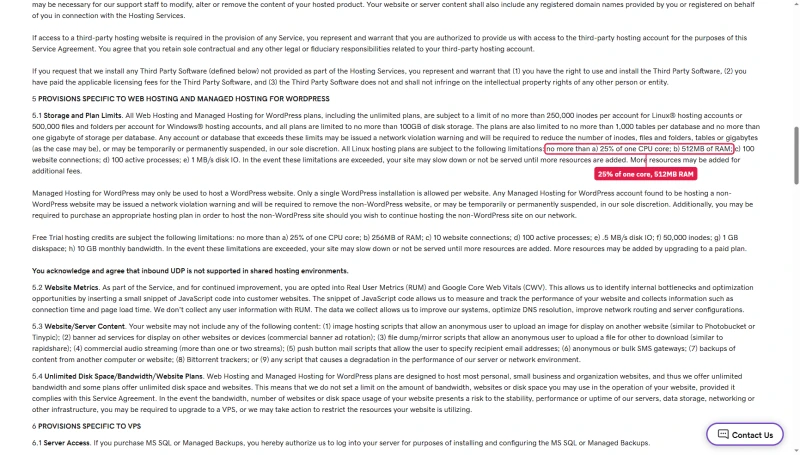
- Need more than 25% of one CPU core, the cap in GoDaddy's agreement

Why Chemicloud Beats Godaddy
- $4.49/mo intro, GoDaddy's equivalent plan is $5.99/mo with worse performance
- LiteSpeed + LSCache, 3x faster than GoDaddy's Apache stack
- Free migration, GoDaddy charges $149.99 for migration
- No upsells at checkout, GoDaddy adds $80-120 in forced extras
- 99.99% uptime SLA, GoDaddy's SLA is 99.9% (10x more downtime allowed)
- cPanel included, no proprietary lock-in
- Free SSL, free domain, free daily backups
- AMD EPYC processors, faster PHP execution than GoDaddy's aging Intel stack
Chemicloud Limitations
- Smaller brand, less name recognition than GoDaddy
- No phone support (live chat + tickets only)
- Shared hosting only, no VPS/dedicated (use Cloudways for that)
- US + EU data centers only (no APAC)
Real Benchmark Data
- Origin TTFB (3 plans, no CDN): 69ms to 84ms
- Uptime (54-day window): 99.97% to 99.99%
- PageSpeed Score (Mobile): 84/100
$3.95/mo
Free Migration from GoDaddy
Methodology: The benchmark boxes on this page cover 5 plans. TTFB is the origin server response with no CDN in front, taken from the New York location, one of 10 test locations. Uptime counts real incident minutes over a 54-day window. Load figures are the average response across a 60-second test ramping 0-250 concurrent clients from US-East.
GoDaddy's Server Hardware
The CPU listed for GoDaddy is the Intel Xeon Silver 4114, PassMark rank #1,468 of 5,999 server CPUs, score 13,167. ScalaHosting's AMD EPYC 9474F scores 7.8x higher.
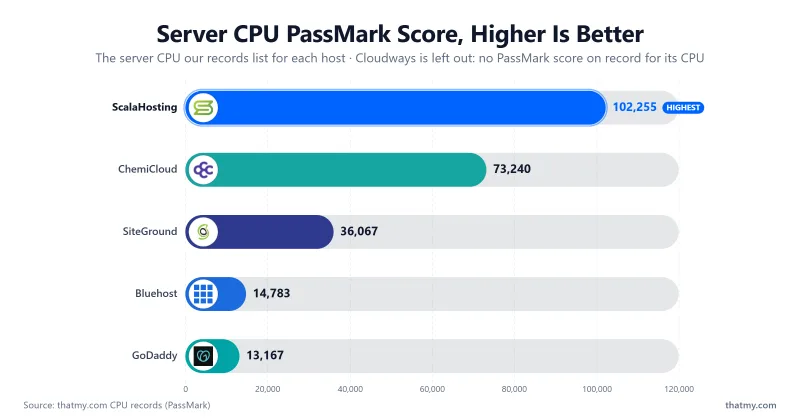
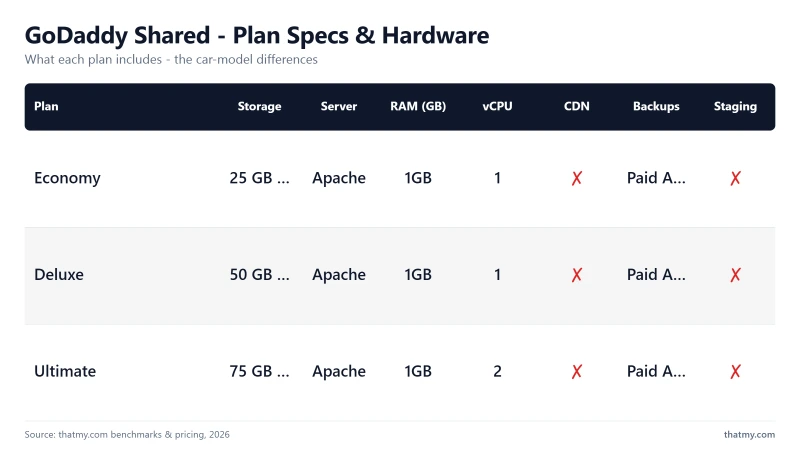
GoDaddy's hosting agreement limits all Linux hosting plans to 25% of one CPU core and 512MB of RAM, while its High Performance cards sell 2 to 16 vCPUs. Shared plans are held to that ceiling whatever the plan card says. A CPU score is not a speed test, but it points the same way as the results below.
TTFB Results by Test Location
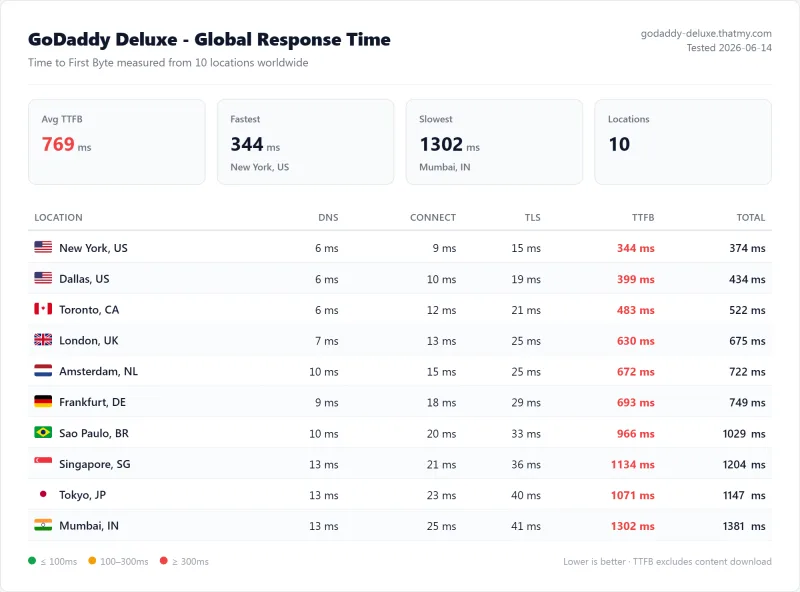
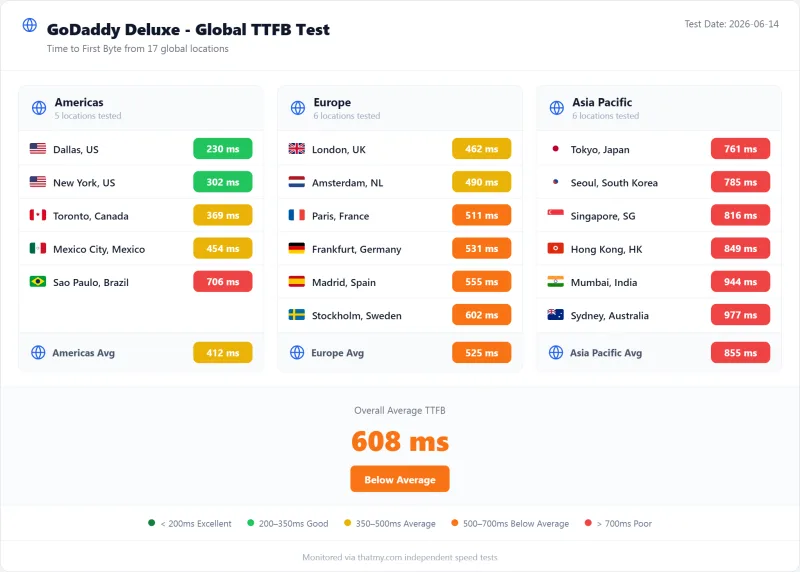
These are GoDaddy Deluxe figures, origin with no CDN, from our measuring locations to our US East test server. New York is the nearest location and Mumbai the farthest.
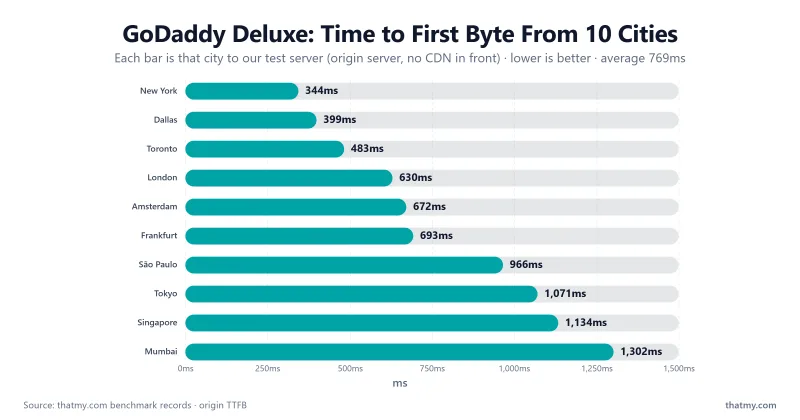
From New York Deluxe is under Google's 800ms line, but 4.1x slower than ChemiCloud, and distance hurts it far more: its average across our 10 locations is 769ms against 187ms for ChemiCloud. Every millisecond of TTFB lands in front of LCP, and front-end work cannot give it back.
See our fastest web hosting benchmark for the full comparison across hosts.
GTmetrix & Core Web Vitals
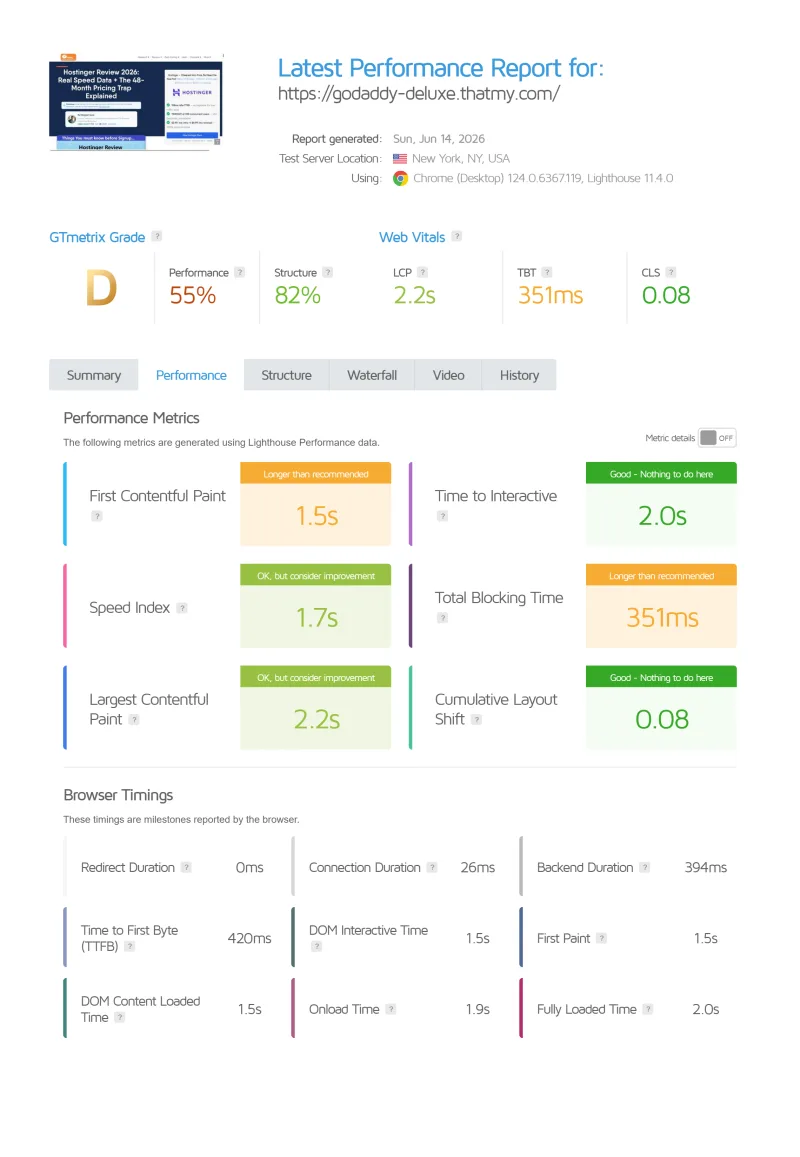
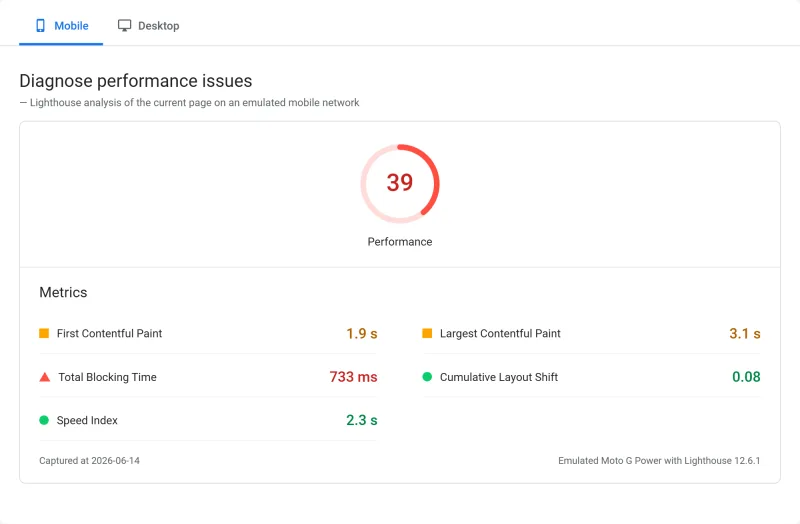
On the same test site, Deluxe's LCP of 6.57s on Lighthouse mobile misses the 2.5s "good" line; its layout shift (0.077) is fine. A slow server is one input to a late LCP. Content and links matter far more than hosting for ranking, but a slow LCP is a drag you can avoid.
Load Test: 0 to 250 Concurrent Clients
A quiet site is only half of it; the test is many visitors at once. We ran the same 0 to 250 client ramp (8,250 requests) against every plan.
The WooCommerce Problem
A store is slowest when it is busiest. Over our ramp GoDaddy Ultimate, its best shared plan, failed 2,327 of 8,250 requests (28.21%), and Deluxe failed 35.59%. ChemiCloud Starter failed 0%.
The ceiling is low because GoDaddy's hosting agreement limits all Linux hosting plans to 25% of one CPU core, 512MB of RAM, 100 website connections and 100 active processes. A hundred visitors arriving together leave little room.
Uptime: 54-Day Monitoring Window
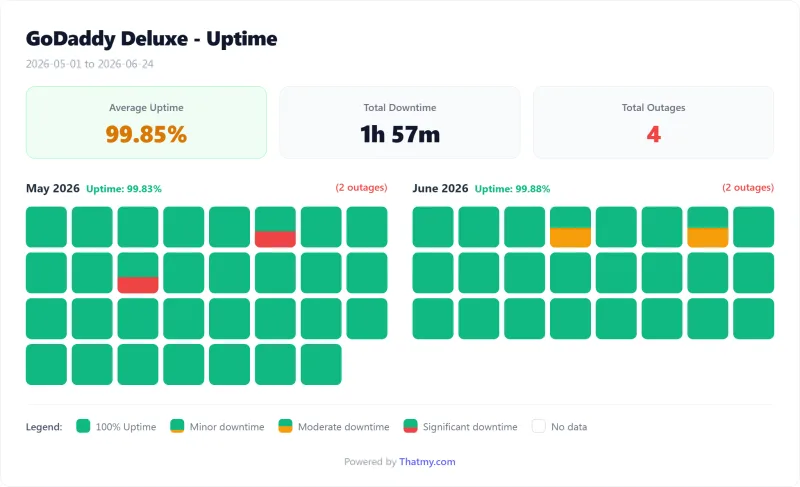
Deluxe's 99.85% is 117 minutes of downtime across 54 days, roughly 13.2 hours a year at the same rate. It recorded more downtime than ChemiCloud, Cloudways and ScalaHosting over the same window.
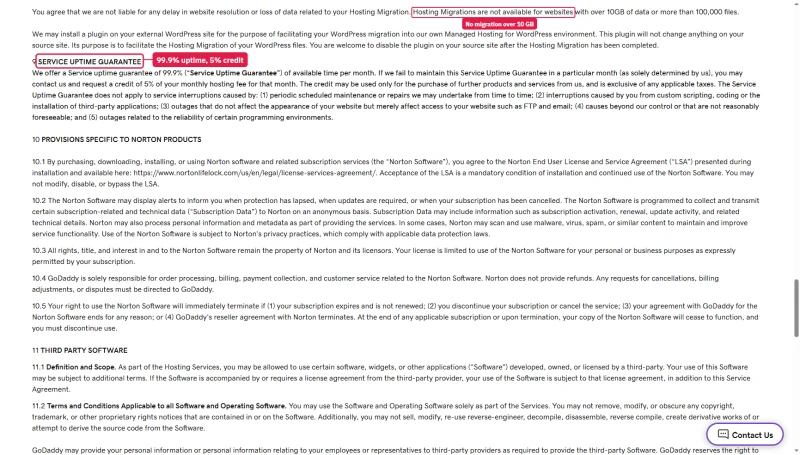
Read the guarantee before you count on it. GoDaddy's hosting agreement promises 99.9% a month "as solely determined by us". The remedy is a credit of 5% of that month's hosting fee, on request, usable only on further GoDaddy purchases. The same agreement rules out hosting migrations for sites over 10GB of data or 100,000 files.
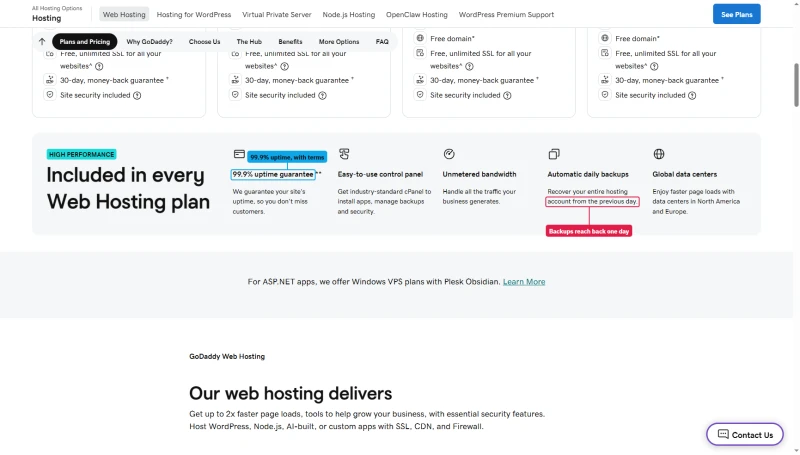
The "automatic daily backups" on every Web Hosting plan mean you can recover the account from the previous day. A longer backup history is a paid add-on.
GoDaddy Security Incidents: A Timeline (2019-2025)
This is what GoDaddy itself disclosed in its SEC filings, as publicly reported, and what the FTC said in January 2025.
2019, SSH Credentials Used (Disclosed 2020)
In 2020 GoDaddy told about 28,000 hosting customers that an attacker had used their credentials to connect over SSH to its hosting servers in October 2019.
2021, Managed WordPress Breach (Disclosed November 2021)
Up to 1.2 million active and inactive Managed WordPress customers were affected by a breach that began with a compromised password. Email addresses and customer numbers were exposed, plus original WordPress admin passwords, sFTP and database credentials of active customers, and SSL private keys for a subset. Source: GoDaddy SEC filing, November 2021.
2022, Malware on cPanel Shared Servers (Disclosed 2023)
In early 2023 GoDaddy said malware on its cPanel shared hosting servers had redirected customer sites in December 2022. That is the same kind of plan reviewed here.
2023, Multi-Year Campaign
GoDaddy said it believed these incidents were part of a multi-year campaign by a sophisticated threat actor group. Source: GoDaddy SEC 10-K filing, February 2023.
2025, FTC Action
On January 15, 2025 the FTC said GoDaddy "failed to implement reasonable and appropriate security measures" to protect and monitor its website-hosting environments since 2018, and misled customers about its security.
What This Means for Your Site
If you host on GoDaddy, weigh this record. Moving to another host does not remove the risk of an attack, but a security record is a fair input to the choice.
The Upsell Audit: Free Extras That Turn Paid
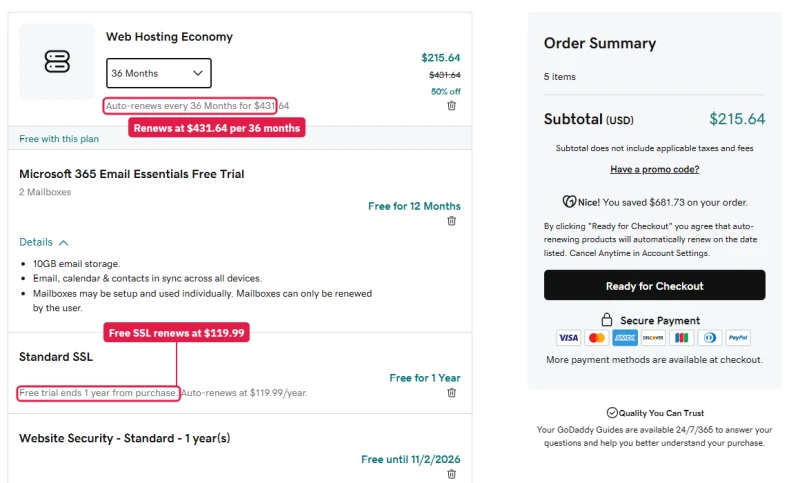
The plan cards promise "Free SSL" and "Site security included". The cart on Economy shows what that means: extras arrive with the hosting, each free for a while, and then they bill.
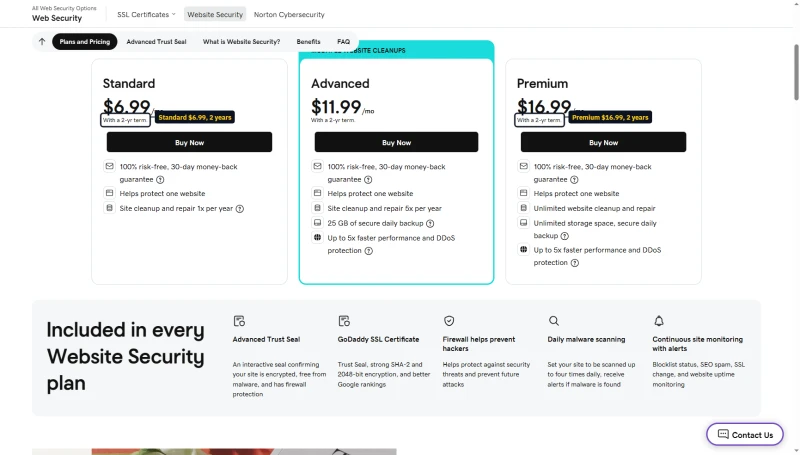
Website Security is sold in three tiers: Standard at $6.99, Advanced at $11.99 and Premium at $16.99 a month on a 2-year term. Standard includes one cleanup a year and no backup.
What Year Two Adds
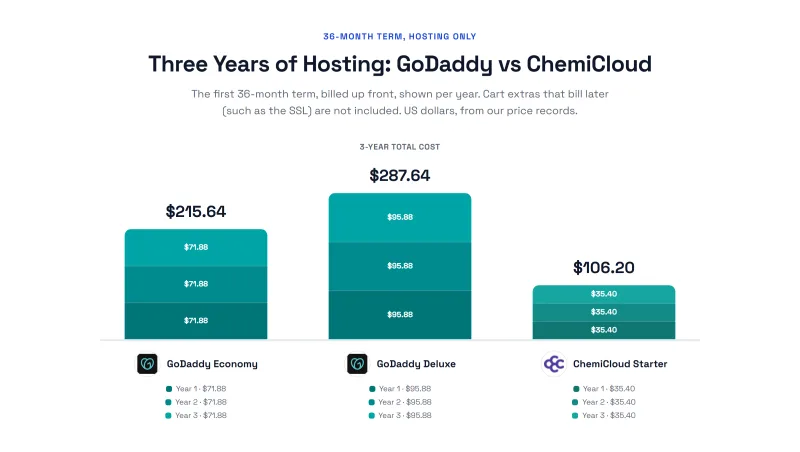
Economy costs $215.64 for the first 36 months, billed up front, then auto-renews at $431.64. Keep the SSL and it adds $119.99 a year from year two. Website Security and email go on top at their paid rates. Take the extras out of the cart, or turn off auto-renew, if you do not want them.
ChemiCloud Starter costs $106.20 for its first 36 months and lists a free SSL certificate, unlimited email accounts and daily backups on its plan page. GoDaddy Economy is $215.64 for the same term before any extra starts to bill.
GoDaddy Renewal Pricing
3-Year True Cost of Ownership
GoDaddy Costs More Than ChemiCloud Over 3 Years
$455.62 against $106.20 over the first three years if you keep the SSL, for a plan that is slower and had more downtime.
The 30-Day Guarantee Depends on the Term
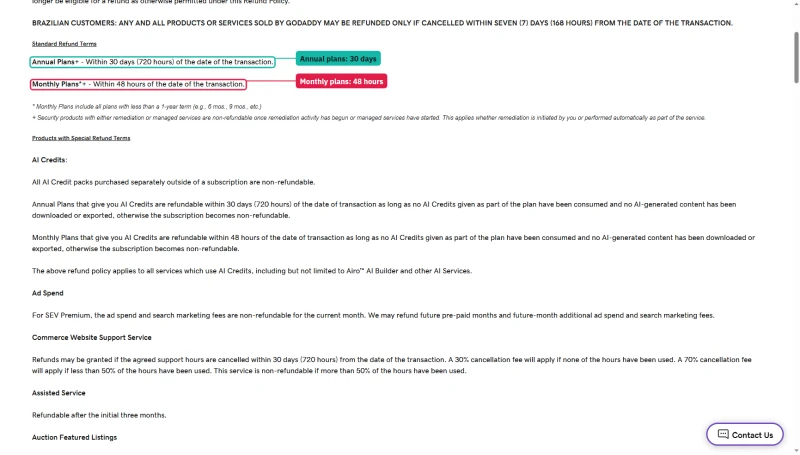
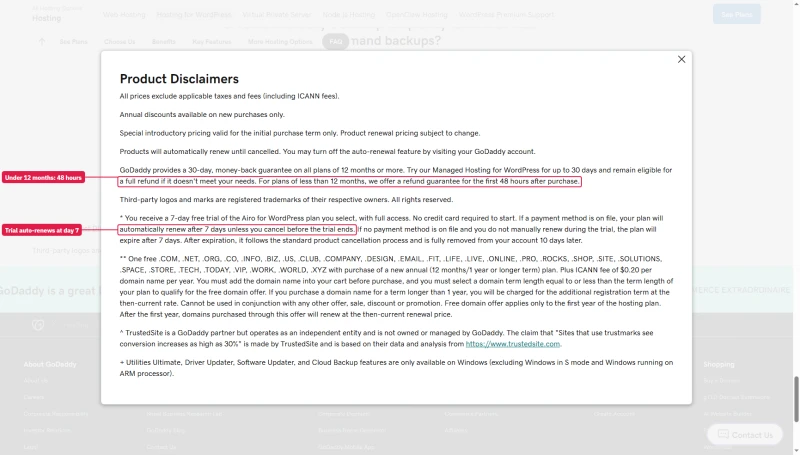
Every card says 30-day money-back guarantee. GoDaddy's refund policy gives 30 days only on annual plans; monthly plans get 48 hours. The WordPress disclaimers say the same, and add that the free trial renews into a paid plan after 7 days if a payment method is on file.
GoDaddy Plans Explained
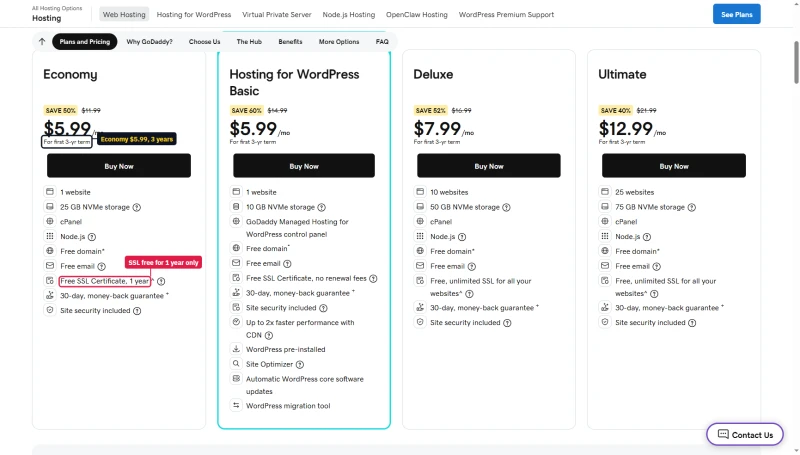
GoDaddy sells two shared lines. Web Hosting runs on cPanel: Economy, Deluxe and Ultimate, priced on a 3-year term. Hosting for WordPress runs on GoDaddy's own panel: Basic, Deluxe and Ultimate, priced on a 1-year term. Economy holds 1 website and 25GB, Deluxe 10 sites and 50GB, Ultimate 25 sites and 75GB.
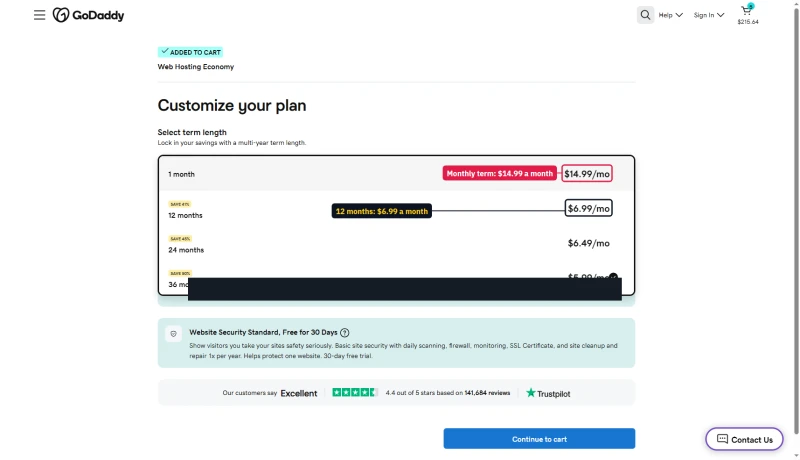
On Economy the term decides the price: $14.99 month to month, $6.99 on 12 months, $6.49 on 24 and $5.99 on 36.
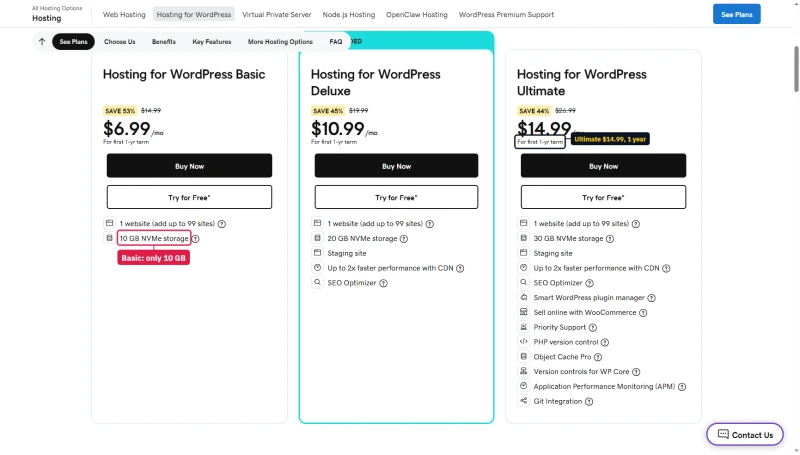
The WordPress cards give Basic 10GB, Deluxe 20GB and Ultimate 30GB, each for one site with up to 99 more. Staging and the CDN start at Deluxe.
Which Plan to Pick, If You Must Use GoDaddy
Ultimate ($21.99/mo renewal on 36 months) is the best of the three cPanel plans, though it still answered New York in 316ms, took 820ms at 100 concurrent users and failed 28.21% of requests on our ramp. If you stay on GoDaddy, choose Ultimate, take the extras out of the cart and turn off auto-renew for the add-ons you do not want.
Web Hosting Plus, VPS and Node.js
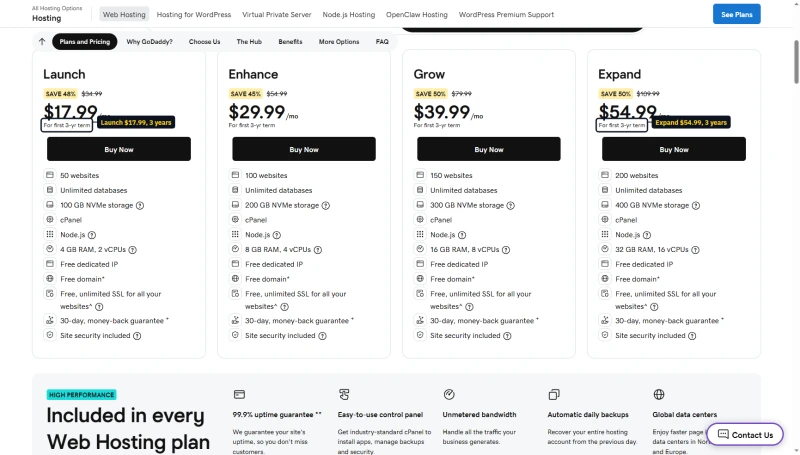
The High Performance switch on the Web Hosting page sells what used to be Web Hosting Plus: Launch at $17.99 a month up to Expand at $54.99, on 3-year terms, with real vCPUs, RAM and a dedicated IP.
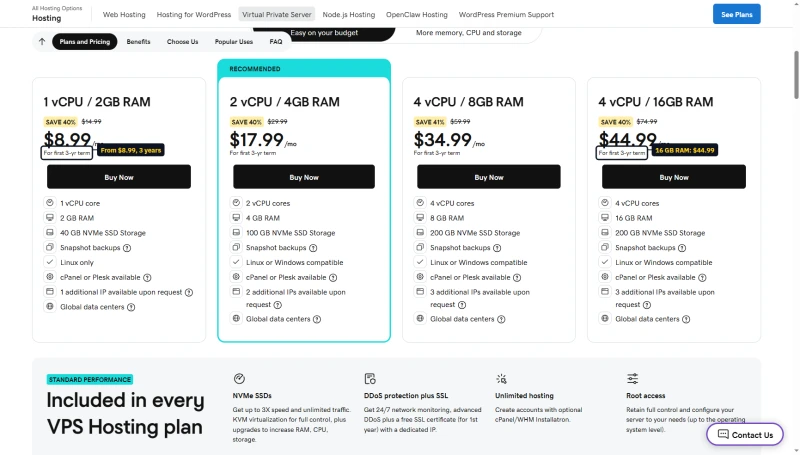
Self-managed VPS starts at $8.99 a month for 1 vCPU and 2GB on a 3-year term, up to $44.99 for 4 vCPU and 16GB.
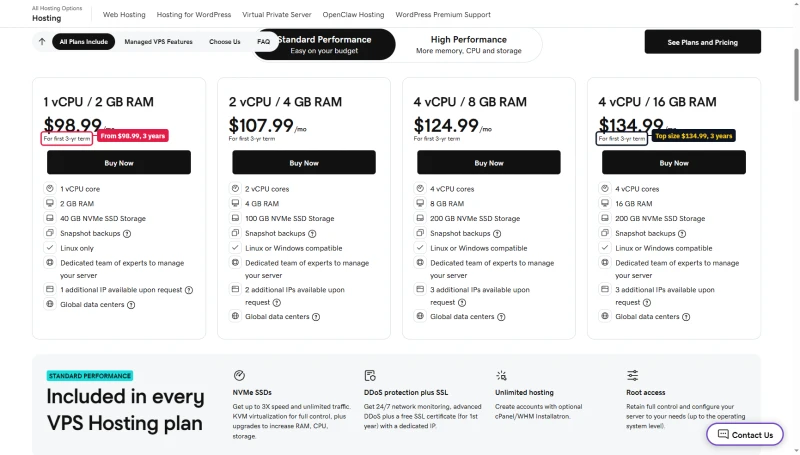
Fully Managed VPS starts at $98.99 a month for the same 1 vCPU server, so management costs about $90 a month.
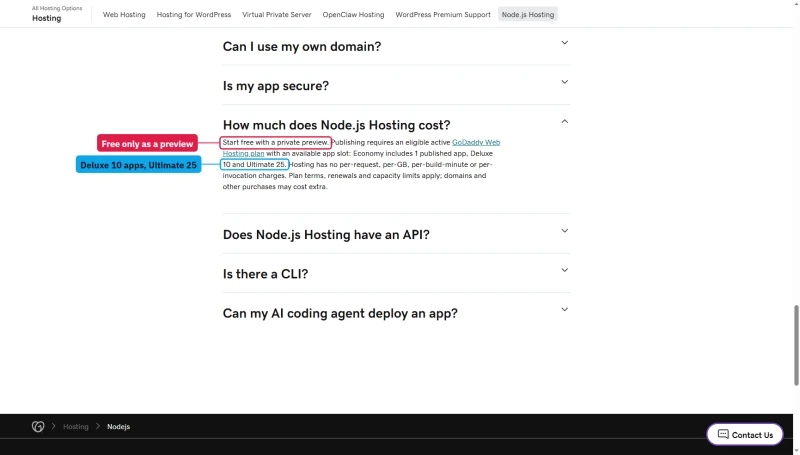
Node.js hosting starts free as a private preview. Publishing needs a Web Hosting plan with an app slot: Economy includes 1 app, Deluxe 10 and Ultimate 25.
GoDaddy Hosting: Resource Limits
GoDaddy's hosting agreement sets a lower ceiling than any plan card. All Linux hosting plans are limited to 25% of one CPU core, 512MB of RAM, 100 website connections, 100 active processes and 1 MB/s of disk IO, while the High Performance cards sell 2 to 16 vCPUs.
Support
GoDaddy's contact page lists phone, text and chat support around the clock.
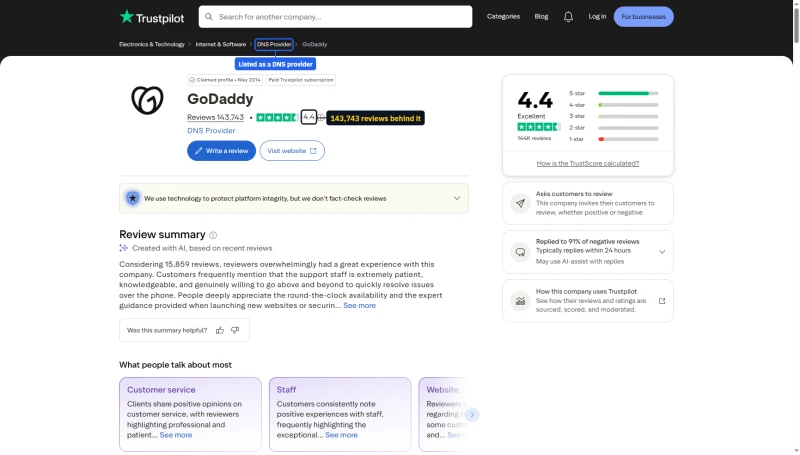
Trustpilot shows GoDaddy at 4.4 from 143,743 reviews, but the profile is filed as a DNS provider and covers the whole company, domains included, not its hosting.
GoDaddy vs ChemiCloud
Why Chemicloud Beats Godaddy
- $4.49/mo intro, GoDaddy's equivalent plan is $5.99/mo with worse performance
- LiteSpeed + LSCache, 3x faster than GoDaddy's Apache stack
- Free migration, GoDaddy charges $149.99 for migration
- No upsells at checkout, GoDaddy adds $80-120 in forced extras
- 99.99% uptime SLA, GoDaddy's SLA is 99.9% (10x more downtime allowed)
- cPanel included, no proprietary lock-in
- Free SSL, free domain, free daily backups
- AMD EPYC processors, faster PHP execution than GoDaddy's aging Intel stack
Chemicloud Limitations
- Smaller brand, less name recognition than GoDaddy
- No phone support (live chat + tickets only)
- Shared hosting only, no VPS/dedicated (use Cloudways for that)
- US + EU data centers only (no APAC)
Real Benchmark Data
- Origin TTFB (3 plans, no CDN): 69ms to 84ms
- Uptime (54-day window): 99.97% to 99.99%
- PageSpeed Score (Mobile): 84/100
$3.95/mo
Free Migration from GoDaddy
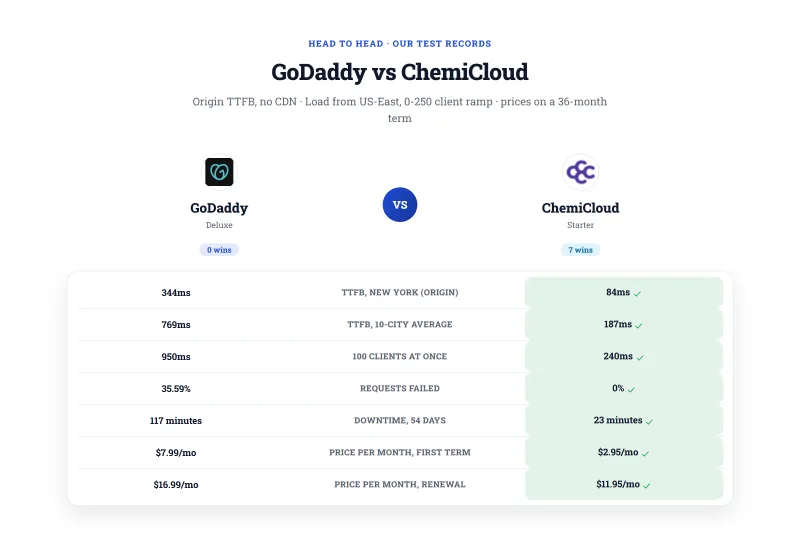
My take: ChemiCloud wins every row. For WordPress hosting there is no row where GoDaddy is the better choice. Check ChemiCloud's renewal price in its cart before you buy.
GoDaddy vs Cloudways

Why Cloudways Beats Godaddy Pro/vps
- 48ms TTFB from New York (origin, no CDN), against 344ms for GoDaddy Deluxe
- 5 cloud providers, Vultr HF, DigitalOcean, AWS, GCE, Linode
- Redis Object Cache Pro included free ($99/yr value)
- Pay-as-you-go, no renewal shock, no lock-in
- Git deployment, SSH, WP-CLI, real developer tooling
- Unlimited WordPress sites on any plan
- No security incidents in 10+ years of operation
Cloudways Limitations
- No email hosting, add $6-12/mo for Google Workspace
- No cPanel, custom Cloudways panel
- More expensive than ChemiCloud for simple sites
- Requires more technical knowledge than GoDaddy
Real Benchmark Data
- Avg response under load (0-250 ramp): 21ms to 32ms
- Uptime (54-day window): 99.979% to 99.99%
- PageSpeed Score (Mobile): 89/100
$16.00/mo
CLOUDS2022 = $30 Free Credit
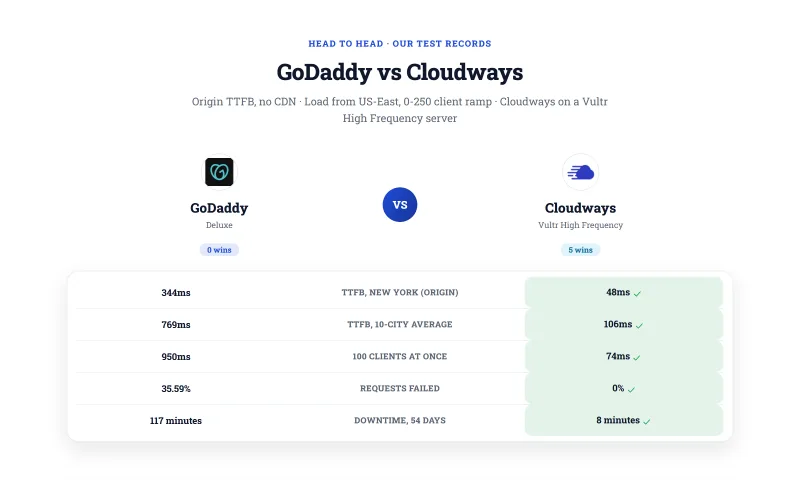
My take: For developers and high-traffic sites, Cloudways is the clear choice. GoDaddy Deluxe is cheaper on paper, but Cloudways answered New York in 48ms against 344ms and failed 0% of requests on our ramp against 35.59%. Cloudways is a managed cloud server, not a shared plan.
Who Should NOT Use GoDaddy
- WooCommerce stores: GoDaddy Ultimate failed 28.21% of requests on our load ramp. Use ChemiCloud or Cloudways.
- Sites with a global audience: Deluxe's average origin TTFB across our 10 locations was 769ms, and 1302ms from Mumbai. A CDN changes this, but you pay for it separately.
- Anyone who weighs a security record: the FTC took action over GoDaddy's hosting security in January 2025.
- Developers: the agreement caps every Linux hosting plan at 25% of one CPU core. Use Cloudways.
- Budget users: GoDaddy's intro price roughly doubles at renewal ($7.99/mo to $16.99/mo on Deluxe).
- Anyone who values transparent pricing: the cart adds free extras that bill later.
The One Good GoDaddy Use
Domain registration. Buy your domain there if you want and host elsewhere. Point your GoDaddy domain to ChemiCloud or Cloudways nameservers; it costs nothing to change.
How to Migrate Away from GoDaddy
Migration to ChemiCloud (Recommended for Most Users)
Step 1: Sign up for ChemiCloud
Choose the Starter plan ($2.95/mo on a 36-month term). Do not transfer your domain yet; keep it at GoDaddy during migration. Note your ChemiCloud nameservers.
Step 2: Request Free Migration
Submit a migration request in the ChemiCloud dashboard with your GoDaddy cPanel credentials (or FTP and a database export). ChemiCloud lists free migrations on every plan.
Step 3: Test on a Temporary URL
Check all pages, forms, WooCommerce checkout and email on the temporary URL before going live.
Step 4: Update DNS
In the GoDaddy domain manager, change the nameservers to ChemiCloud's. DNS changes can take 24 to 48 hours to reach every visitor.
Step 5: Verify and Cancel GoDaddy
Once the site is live on ChemiCloud, cancel GoDaddy hosting (keep the domain registration if you like). Ask for a refund if you are inside GoDaddy's window: 30 days on annual plans, 48 hours on monthly ones.
Migration to Cloudways (For Developers)
Cloudways suits developers and growing sites. See our Cloudways review for how to move a site there.
Full Test Report: GoDaddy Deluxe
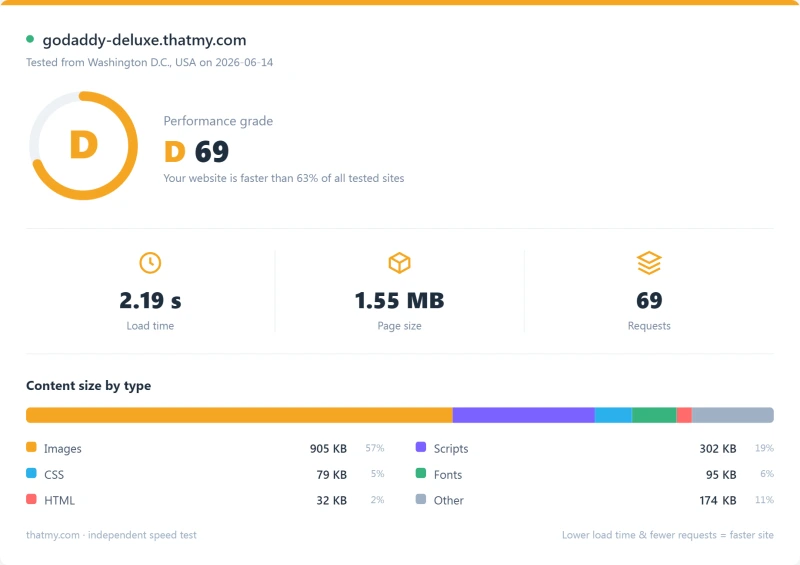
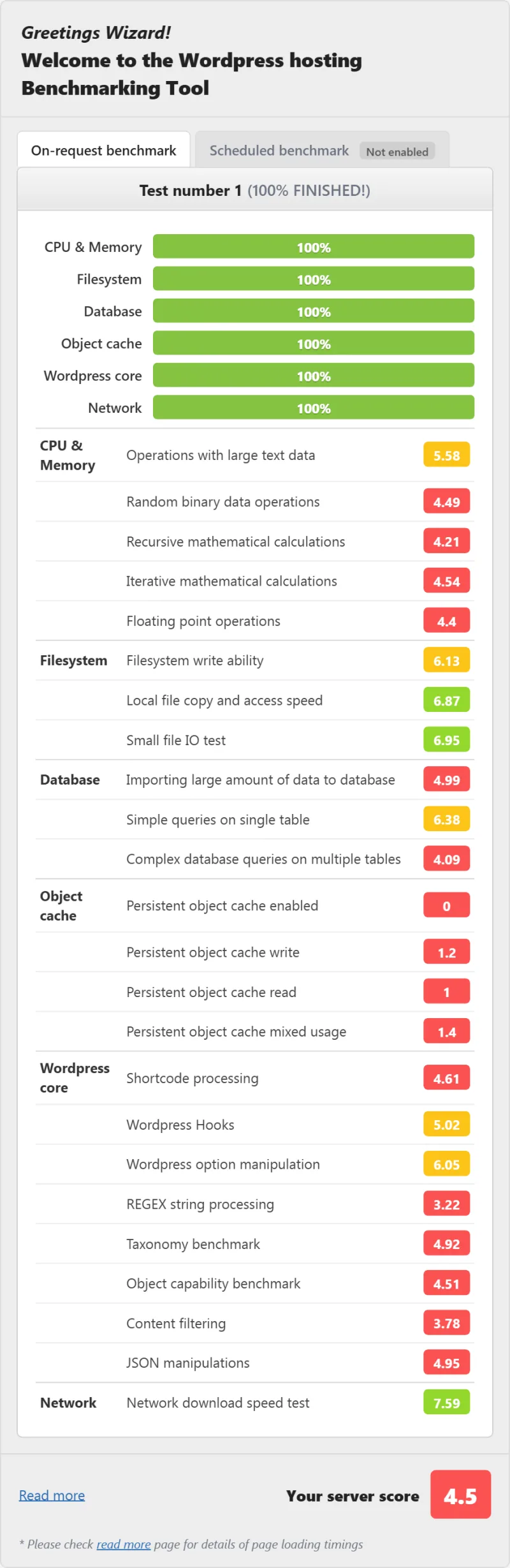
The complete export from our test suite for GoDaddy Deluxe: server response time (TTFB), behavior under a 100-user load, the GTmetrix and PageSpeed captures, a Pingdom response-time check, our WordPress hosting benchmark, the regional TTFB scorecard, and 54 days of uptime tracking with the day-by-day calendar.
Deluxe
FAQ: GoDaddy Hosting
Is GoDaddy good for WordPress hosting?
No. GoDaddy Deluxe, the plan GoDaddy features, answered our New York location in 344ms (origin, no CDN), 4.1x ChemiCloud Starter's 84ms. At 100 concurrent users it took 950ms and failed 35.59% of requests over our 0 to 250 client ramp. Add extras in the cart that bill later and a security record that led to an FTC action, and GoDaddy is a registrar to use for domains, not a host for WordPress.
Why is GoDaddy so slow?
GoDaddy's hosting agreement limits all Linux hosting plans to 25% of one CPU core and 512MB of RAM. The CPU listed for GoDaddy is the Intel Xeon Silver 4114, PassMark rank #1,468 of 5,999 server CPUs, and ScalaHosting's AMD EPYC 9474F scores 7.8x higher. On our load ramp Deluxe failed 35.59% of requests and Ultimate 28.21%.
Has GoDaddy been hacked?
Yes. In 2020 GoDaddy told about 28,000 hosting customers that an attacker had used their credentials to connect over SSH in October 2019. In November 2021 it disclosed that up to 1.2 million active and inactive Managed WordPress customers were affected by a breach that began with a compromised password. In early 2023 it said malware on its cPanel shared hosting servers had redirected customer sites in December 2022, and that it believed the incidents were part of a multi-year campaign. In January 2025 the FTC took action against GoDaddy for failing to secure its hosting since 2018.
What is GoDaddy's renewal price?
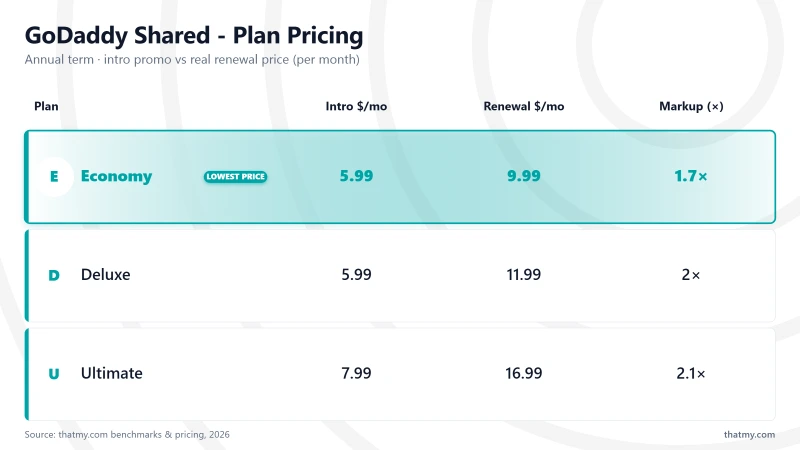
Web Hosting (cPanel) on a three-year term: Economy $5.99/mo then $11.99/mo (+100%), Deluxe $7.99/mo then $16.99/mo (+113%), Ultimate $12.99/mo then $21.99/mo (+69%). Compare hosts on the renewal price, not the intro price.
What are GoDaddy's hidden fees?
The cart adds free extras that later bill. On Economy for 36 months it holds Microsoft 365 Email Essentials free for twelve months, a Standard SSL free for one year that then auto-renews at $119.99 a year, and Website Security free for the first month, then the paid plan. Hosting for those 36 months costs $215.64 up front. Take the extras out of the cart, or turn off auto-renew, if you do not want them.
Is GoDaddy good for WooCommerce?
No. A store is slowest when it is busy, and at 100 concurrent users GoDaddy Ultimate, its best shared plan, took 820ms and failed 2,327 of 8,250 requests over our ramp. ChemiCloud Starter took 240ms with 0% failed, and Cloudways on Vultr High Frequency 74ms.
What is the best GoDaddy alternative?
For most sites: ChemiCloud Starter ($2.95/mo on 36 months, 84ms from New York, free migration, LiteSpeed). For developers and growing sites: Cloudways (from $11.00/mo, billed monthly; 48ms on Vultr High Frequency). For the fastest result in this group: ScalaHosting Entry Cloud ($14.95/mo on 12 months, 38ms, AMD EPYC 9474F).
Where This Leaves You
Register your domain at GoDaddy if you like, and host your site elsewhere.
On Deluxe, the plan GoDaddy features, we measured 344ms TTFB from New York (origin, no CDN) and 950ms at 100 concurrent users, with 35.59% of requests failing over our 0 to 250 client ramp and 99.85% uptime over 54 days. Add the security record above, free extras in the cart that bill later (Economy's SSL at $119.99 a year), and a Deluxe renewal that moves from $7.99/mo to $16.99/mo on the 36-month term. I don't recommend GoDaddy for WordPress hosting.
If you're on GoDaddy now: move to ChemiCloud (most users) or Cloudways (developers). Both were faster and failed fewer requests under load. ChemiCloud lists free migrations, and DNS changes take 24 to 48 hours.
- For most users: ChemiCloud, $2.95/mo, 84ms TTFB from New York, free migration
- For developers: Cloudways, from $16.00/mo, 48ms TTFB from New York, pay-as-you-go
- For the fastest result here: ScalaHosting, $14.95/mo on 12 months, 38ms TTFB from New York, AMD EPYC 9474F
Why Chemicloud Beats Godaddy
- $4.49/mo intro, GoDaddy's equivalent plan is $5.99/mo with worse performance
- LiteSpeed + LSCache, 3x faster than GoDaddy's Apache stack
- Free migration, GoDaddy charges $149.99 for migration
- No upsells at checkout, GoDaddy adds $80-120 in forced extras
- 99.99% uptime SLA, GoDaddy's SLA is 99.9% (10x more downtime allowed)
- cPanel included, no proprietary lock-in
- Free SSL, free domain, free daily backups
- AMD EPYC processors, faster PHP execution than GoDaddy's aging Intel stack
Chemicloud Limitations
- Smaller brand, less name recognition than GoDaddy
- No phone support (live chat + tickets only)
- Shared hosting only, no VPS/dedicated (use Cloudways for that)
- US + EU data centers only (no APAC)
Real Benchmark Data
- Origin TTFB (3 plans, no CDN): 69ms to 84ms
- Uptime (54-day window): 99.97% to 99.99%
- PageSpeed Score (Mobile): 84/100
$3.95/mo
Free Migration from GoDaddy
Why Cloudways Beats Godaddy Pro/vps
- 48ms TTFB from New York (origin, no CDN), against 344ms for GoDaddy Deluxe
- 5 cloud providers, Vultr HF, DigitalOcean, AWS, GCE, Linode
- Redis Object Cache Pro included free ($99/yr value)
- Pay-as-you-go, no renewal shock, no lock-in
- Git deployment, SSH, WP-CLI, real developer tooling
- Unlimited WordPress sites on any plan
- No security incidents in 10+ years of operation
Cloudways Limitations
- No email hosting, add $6-12/mo for Google Workspace
- No cPanel, custom Cloudways panel
- More expensive than ChemiCloud for simple sites
- Requires more technical knowledge than GoDaddy
Real Benchmark Data
- Avg response under load (0-250 ramp): 21ms to 32ms
- Uptime (54-day window): 99.979% to 99.99%
- PageSpeed Score (Mobile): 89/100
$16.00/mo
CLOUDS2022 = $30 Free Credit
Migrate from GoDaddy to ChemiCloud, Free ➦ See our full best WordPress hosting comparison →