


Elementor did not shut its hosting down: the product launched as Elementor Cloud Website is sold today as Elementor Host, from $15 a month billed annually. This page covers what it sells now, and the two alternatives we recommend if you want a host first: ScalaHosting and Cloudways.
What Happened to Elementor Cloud: It Is Now Elementor Host
Elementor Cloud was Elementor's entry into managed WordPress hosting: the page builder's company selling the server too. It launched in 2022 as Elementor Cloud Website.
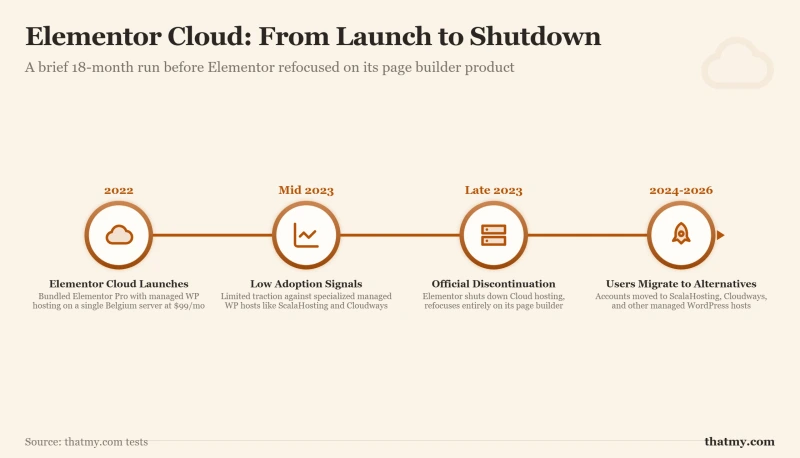
It was not shut down. The same hosting is sold today as Elementor Host, on Google Cloud behind Cloudflare, managed from the My Elementor dashboard. Older help articles and its product codes still carry the Cloud name.
If you are searching for an Elementor Cloud review, here is what you need to know:
- Elementor Cloud is sold today as Elementor Host, from $15 a month billed annually.
- Its prices have no intro discount, but every plan caps monthly visits and bandwidth, and Elementor Pro is not included.
- Your Elementor Pro license can be used on any WordPress host, it is not tied to a hosting product.
- If you want a host that is not tied to the builder, the best alternatives are ScalaHosting Managed VPS and Cloudways.
Below is what Elementor Host sells today, then those alternatives in full.
What Elementor Host Sells Today
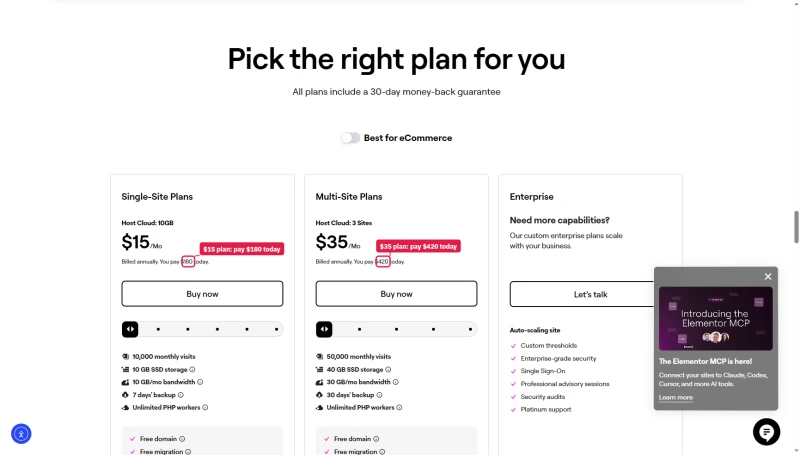
The one-site ladder starts at $15 a month, billed annually: $180 today for 10,000 monthly visits, 10 GB of storage, 10 GB of bandwidth a month and 7 days of backups. Three sites start at $35 a month, $420 a year.
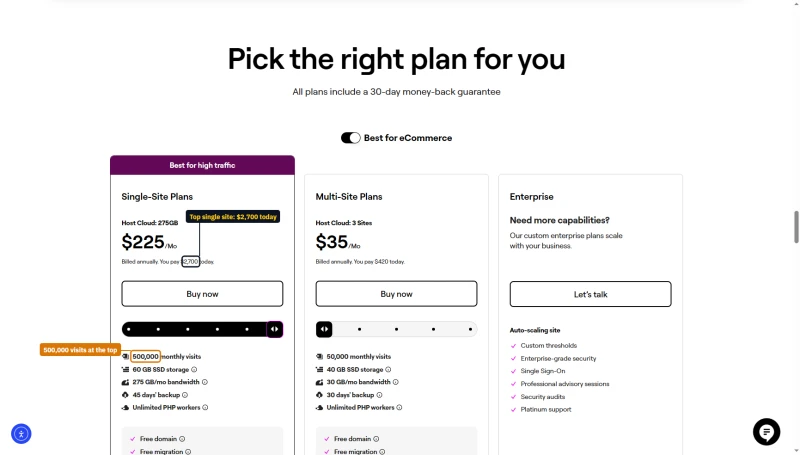
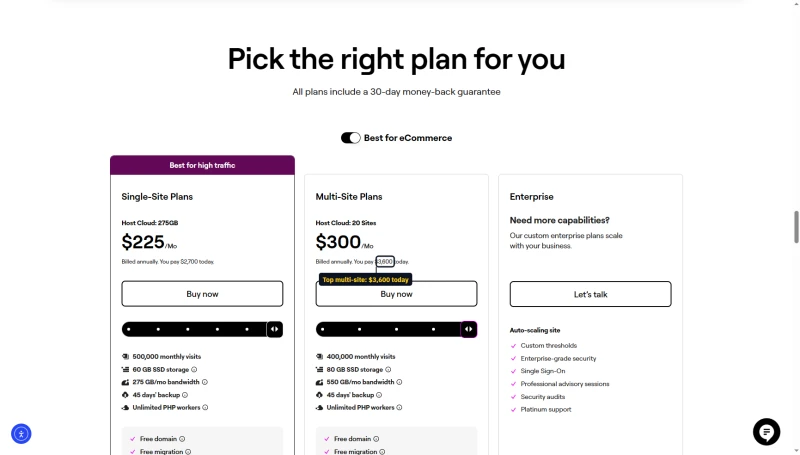
Slide to the top and one site costs $225 a month, $2,700 a year, for 500,000 visits; twenty sites cost $300 a month, $3,600 a year.
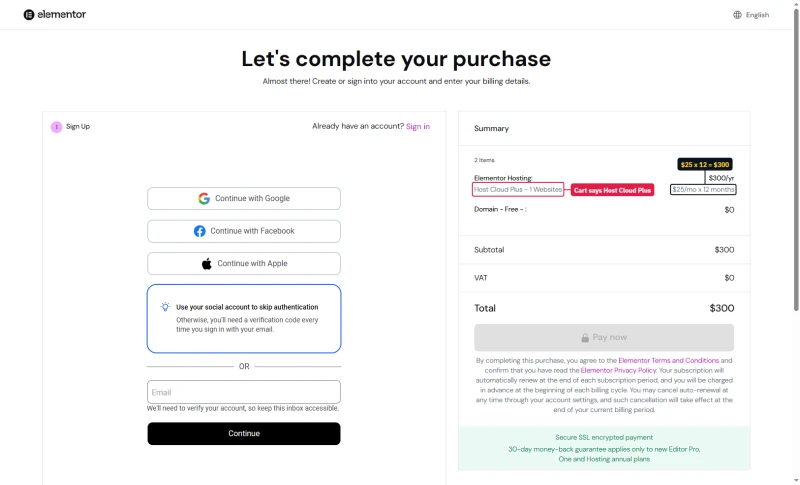
There is no intro discount: the page says subscriptions renew at list price, and the cart for the 20,000-visit plan bills $25 a month times twelve, $300, with no discount line. The cart calls that plan Host Cloud Plus, while the card calls it Host Cloud: 20GB.
Elementor Pro Is Not Included
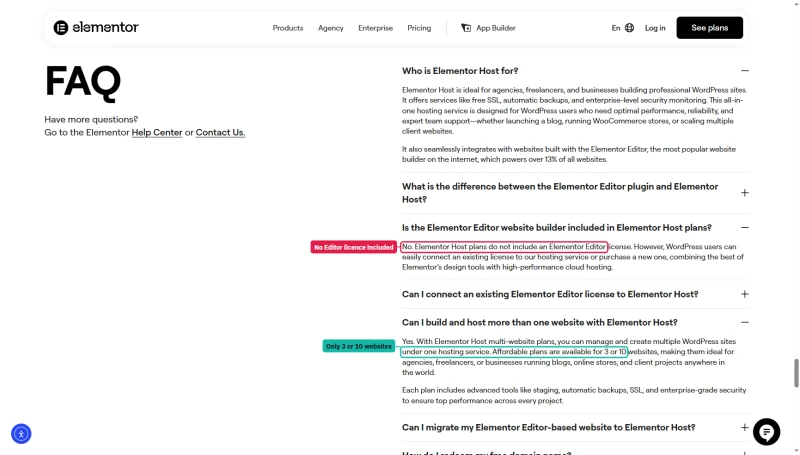
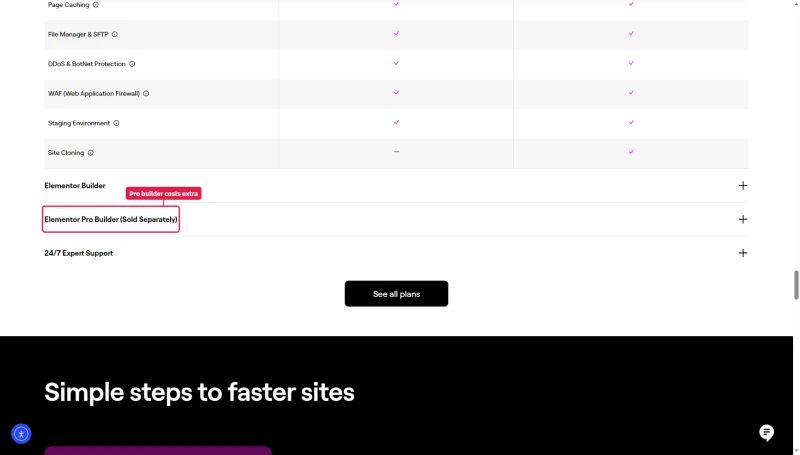
The builder is a separate purchase. The hosting FAQ says plainly that Elementor Host plans do not include an Elementor Editor licence, and the compare table heads a section "Elementor Pro Builder (Sold Separately)".
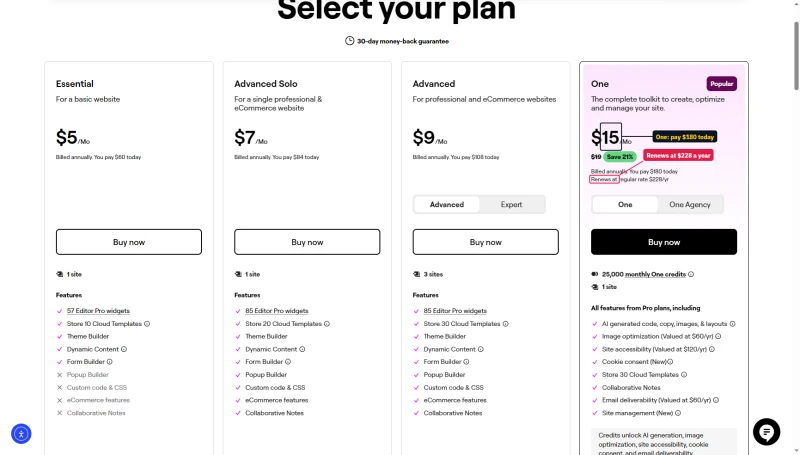
On the builder's own price page, Essential costs $5 a month ($60 a year), and the One bundle costs $180 for the first year, then renews at $228.
Limits the FAQ Words Loosely
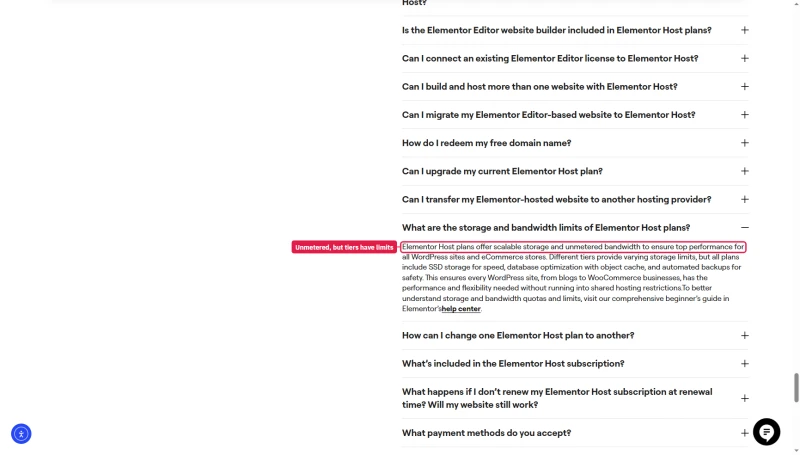
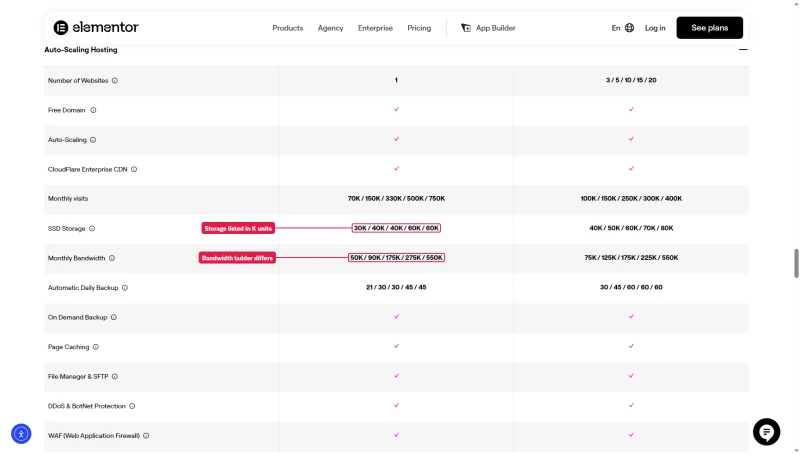
The FAQ promises scalable storage and unmetered bandwidth, while every card caps bandwidth, from 10 GB to 550 GB a month. The compare table lists storage and bandwidth in "K" units and starts its single-site column at 70K visits, so the $15 and $25 plans are not in it at all. The same FAQ says multi-site plans come for 3 or 10 websites; the slider sells 3, 5, 10, 15 and 20.
Refunds and Paid Support
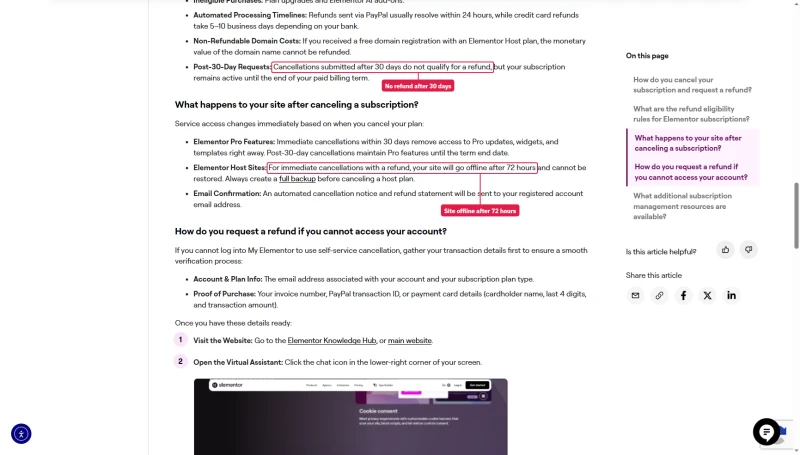
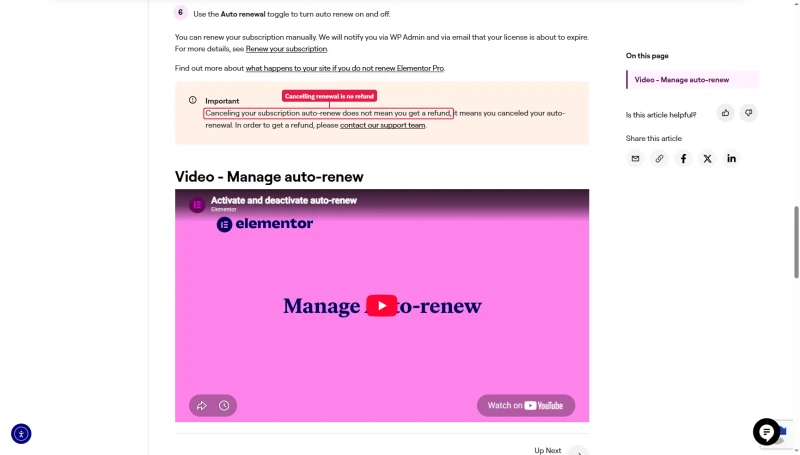
Every plan carries a 30-day money-back guarantee on the first purchase, refunded from the My Elementor dashboard. The catch: a refunded host site goes offline after 72 hours and cannot be restored, so move it first. An older help article still says to contact support for a refund.
Faster support is a paid add-on: Express $15 a month ($180 a year), Express+ $65 ($780) and Shield $100 ($1,200). One-off services cost $99 for an expert consultation, $149 for initial setup and $299 for malware cleanup.
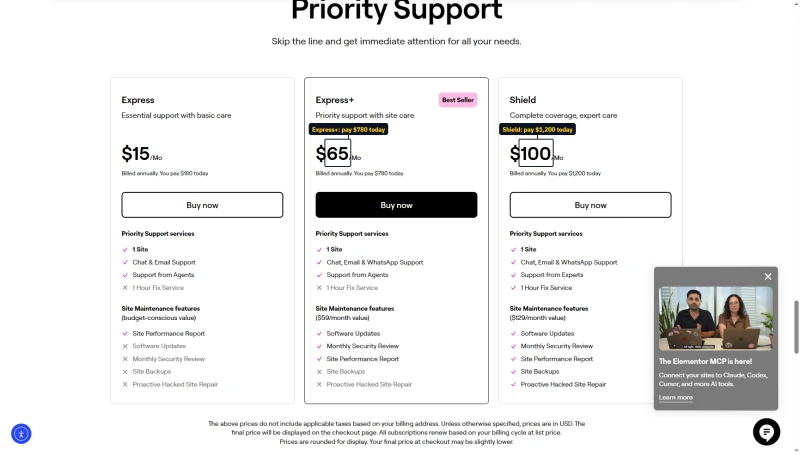
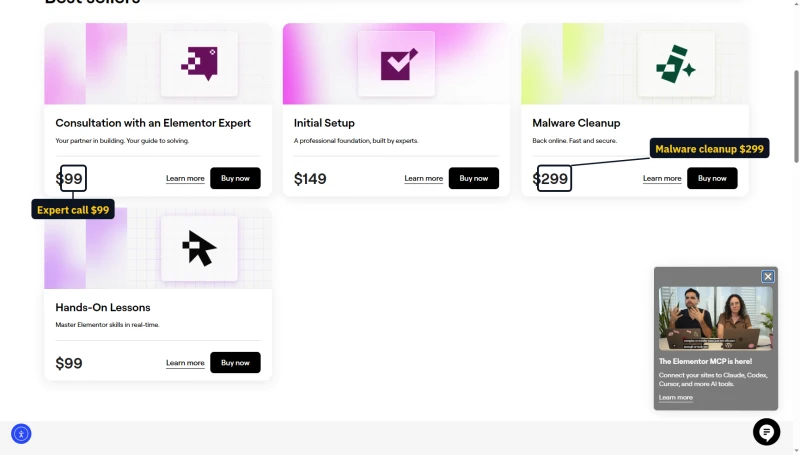
The lesson here: Elementor Host is a page-builder company's hosting: one vendor for the builder, the server, the domain and support, with hard monthly caps on visits and bandwidth and the Pro builder billed on top. That suits an Elementor customer who wants one bill. If you want room for traffic spikes or server-level control, pick a host whose entire business is hosting.
Best Alternatives to Elementor Cloud in 2026
Elementor's hosting sells simplicity: one vendor for the builder, the server, the domain and support. Elementor Pro is not bundled, so the builder costs the same on any host, and that makes the hosting easy to replace.
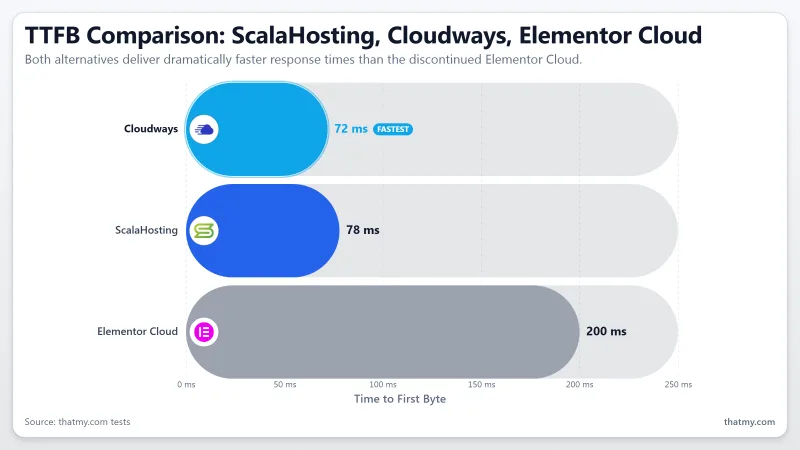
Elementor Pro costs $60 a year on its Essential plan, whichever host you pick. Both hosts below answered faster than Elementor's hosting in our tests; Elementor Host is the cheaper entry price.
| Host | Best For | TTFB (US East) | Data Centers | Starting Price | Visit Limits |
|---|---|---|---|---|---|
| ScalaHosting | Best overall replacement | 38ms | 13 | $24.95/mo | None |
| Cloudways | Developers, multi-region | 38ms (Vultr HF) | 65+ | $16.00/mo | None |
| Elementor Host (was Elementor Cloud) | Builder users who want one vendor | 164ms (US) | Not published (Google Cloud) | $15/mo, billed annually | 10k to 500k/mo by plan |
Both ScalaHosting and Cloudways fully support Elementor Pro. Install it as a plugin after setting up WordPress, no special configuration needed.
ScalaHosting, #1 Elementor Cloud Replacement
ScalaHosting Managed VPS is the closest like-for-like replacement for Elementor Cloud users, and a major upgrade in every measurable dimension.
Why ScalaHosting Wins
- 38ms TTFB from US East, vs the 164ms Elementor's hosting delivered to US visitors in our test.
- 13 data centers across North America, Europe, and Asia-Pacific, choose the location nearest your audience.
- AMD EPYC 9474F hardware (#42 PassMark, verified via SSH). Elementor Host says it runs on Google Cloud but does not publish its server hardware.
- No visit limits, every Elementor Host plan caps monthly visits, from 10,000 on the $15 plan to 500,000 on the $225 plan. ScalaHosting has no such limit.
- Free migration, ScalaHosting's team migrates your WordPress site at no charge.
- SPanel control panel, ScalaHosting's own cPanel alternative, included free. Includes one-click WordPress install, staging, free SSL, and daily backups.
- $24.95/mo entry price on a long prepay, more than Elementor Host's $15 a month. Elementor Pro Essential costs $60 a year on either host, so you pay ScalaHosting's premium for the VPS, not for the builder.
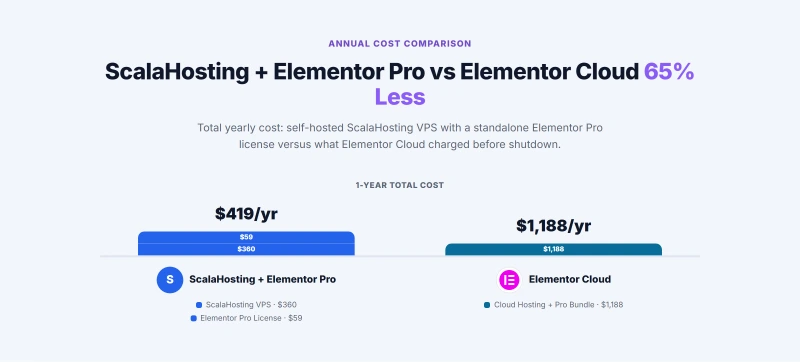
Elementor's hosting never bundled Pro, so the builder costs the same either way. ScalaHosting plus a standalone Elementor Pro licence costs more than Elementor Host at entry level, and buys better measured performance, 13 data center choices and no visit cap.

Why Scalahosting Beats Elementor Cloud
- 13 data centers, vs Elementor Cloud's 1 Belgium location
- 38ms TTFB from US, vs Elementor Cloud 164ms for US visitors
- AMD EPYC 9474F (#42 PassMark), 2023-era hardware vs Elementor Cloud's undisclosed CPU
- No visit limits, Elementor Cloud caps at 100k visits/mo on $99 plan
- Unlimited WordPress sites on one VPS, Elementor Cloud charges per site
- SPanel free, saves $180/yr vs cPanel, uses 8x less RAM
- Email hosting included, Elementor Cloud requires separate email
- No single point of failure, your page builder and hosting are separate
- Free migration, Elementor Cloud migration is complex and risky
- Anytime money-back guarantee
Where Elementor Cloud Has An Edge
- No built-in Elementor Pro license, add $59/yr separately
- Requires SPanel learning curve, Elementor Cloud is simpler for beginners
- Renewal pricing jumps ~200% after intro term
Real Benchmark Data
- Origin TTFB (Managed VPS, no CDN): 38ms
- Uptime (54-day window): 99.99%
- PageSpeed Score (Mobile): 83/100

$29.95/mo
Anytime Money-Back Guarantee
Methodology: The benchmark boxes on this page cover 4 plans. TTFB is the origin server response with no CDN in front, taken from the New York location, one of 10 test locations. Uptime counts real incident minutes over a 54-day window. Load figures are the average response across a 60-second test ramping 0-250 concurrent clients from US-East.
Cloudways, #2 Alternative for Developers and Agencies
Cloudways is a managed cloud platform that provisions WordPress on top of five major cloud providers: DigitalOcean, Vultr, Linode, AWS, and Google Cloud. It is the most flexible Elementor Cloud alternative for developers and agencies managing multiple sites.
Why Cloudways Is a Strong Alternative
- 65+ server locations across 5 cloud providers, deploy in any region globally.
- Pay-as-you-go pricing, no long-term contracts. Start at $11.00/mo (1GB DigitalOcean). Scale up or down any time.
- Vultr High Frequency servers, 38ms TTFB from US East, 3GHz+ Intel Xeon with NVMe.
- No visit limits, you are limited only by server resources, which you control.
- Breeze caching plugin, Cloudways' own server-level caching plugin, optimized for their infrastructure.
- Team access and staging, built into the dashboard. Critical for agencies managing client sites.
- Full Elementor Pro support, installs and runs normally.
Cloudways is better than ScalaHosting when: you need AWS or GCP infrastructure, you manage many client sites across multiple regions, or you want the flexibility to switch cloud providers without changing your control panel.

Why Cloudways Beats Elementor Cloud
- 72ms TTFB, vs Elementor Cloud 200-350ms for US visitors
- 5 cloud providers: Vultr HF, DigitalOcean, AWS, GCE, Linode, 65+ locations
- No visit limits, Elementor Cloud caps at 100k/mo on $99 plan
- Unlimited WordPress sites on any plan
- Redis Object Cache Pro included free ($99/yr value)
- Git deployment, SSH, WP-CLI, real developer tools
- Pay-as-you-go, no lock-in, no renewal shock
- Autoscaling available for traffic spikes
Where Elementor Cloud Has An Edge
- No built-in Elementor Pro license, add $59/yr separately
- No email hosting, add $6-12/mo for Google Workspace
- More complex setup than Elementor Cloud's one-click install
- True cost for Vultr HF 8GB + email: $118.00/mo plus $6-12
Real Benchmark Data
- Avg response under load (0-250 ramp): 21ms to 32ms
- Uptime (54-day window): 99.979% to 99.99%
- PageSpeed Score (Mobile): 89/100
$16.00/mo
CLOUDS2022 = $30 Free Credit
How to Migrate from Elementor Cloud
If you are on Elementor Host (or an old Elementor Cloud plan) and want to move, the process is standard WordPress migration. Do not ask for a refund until the new site is live: a refunded Elementor Host site goes offline after 72 hours and cannot be restored.
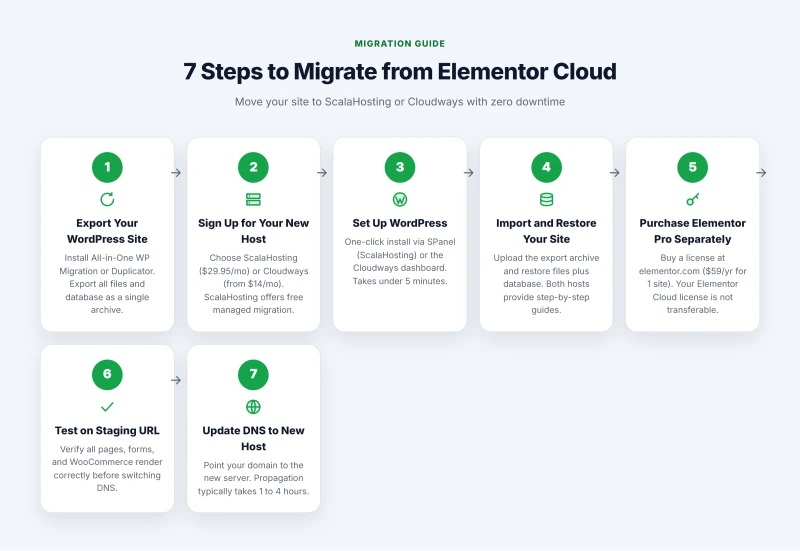
Step-by-Step Migration to ScalaHosting or Cloudways
- Export your WordPress site. Install the All-in-One WP Migration plugin; Elementor Host blocks Duplicator and UpdraftPlus. Export all files + database as a single archive.
- Sign up for your new host. ScalaHosting or Cloudways, both work. ScalaHosting offers free migration handled by their team (skip steps 1-3 if you use this).
- Set up WordPress on the new host. One-click install via SPanel (ScalaHosting) or the Cloudways dashboard.
- Import your site. Upload the export archive and restore. Both hosts have guides.
- Purchase Elementor Pro separately. Elementor Host plans do not include Pro, so keep the licence you have, or buy Essential at elementor.com for $60 a year for one site.
- Activate Elementor Pro on the new WordPress install with your new license key.
- Test on staging URL before changing DNS. Verify all pages, forms, and WooCommerce (if applicable) render correctly.
- Update DNS to point your domain to the new host. Propagation typically takes 1-4 hours.
Easiest path: ScalaHosting's free migration service. Submit a migration request after signing up, their team handles all file/database transfer. You only need to handle the Elementor Pro license step yourself.
FAQ, Elementor Cloud Alternatives
Is Elementor Cloud still available in 2026?
Yes, under a new name. Elementor still sells managed WordPress hosting as Elementor Host, the product first launched as Elementor Cloud Website. Plans start at $15 a month billed annually ($180 a year) for one site with 10,000 monthly visits, and Elementor Pro is not included. If you want a host that is not tied to the builder, the best alternatives are ScalaHosting (Managed VPS, $24.95/mo) and Cloudways (pay-as-you-go managed cloud, from $11.00/mo).
What happened to Elementor Cloud?
It was renamed, not shut down. Elementor's hosting is sold today as Elementor Host, and older help articles and its product codes still use the Elementor Cloud name. One-site plans run from 10,000 to 500,000 monthly visits ($15 to $225 a month, billed annually) and multi-site plans cover 3 to 20 sites ($35 to $300 a month). Prices have no intro discount and renew at list price.
What is the best alternative to Elementor Cloud?
For users who want fast managed WordPress hosting with Elementor Pro support, ScalaHosting Managed VPS is the top pick: 13 data centers, AMD EPYC 9474F hardware, 23ms TTFB from US East, no visit limits, starting at $24.95/mo. For developers or agencies needing flexibility across multiple cloud providers, Cloudways is the best alternative: 65+ locations across DigitalOcean, Vultr, AWS, GCP, and Linode, pay-as-you-go pricing from $16.00/mo. Both providers fully support Elementor Pro, purchase it separately (Essential is $60 a year).
Does ScalaHosting support Elementor Pro?
Yes. ScalaHosting Managed VPS runs standard WordPress with full plugin support. Install Elementor Pro (Essential, $60 a year) exactly as you would on any WordPress host. ScalaHosting's SPanel control panel includes one-click WordPress installation, free SSL, free migration, and staging environments. With 13 data centers and no visit limits, it removes the monthly visit caps every Elementor Host plan carries.
Does Cloudways support Elementor Pro?
Yes. Cloudways is a managed cloud platform that runs WordPress on top of DigitalOcean, Vultr, AWS, GCP, or Linode. Elementor Pro installs and runs normally. Cloudways provides server-level caching (Breeze plugin), free SSL, staging, and team access. Pay-as-you-go pricing starts at $11.00/mo for a 1GB DigitalOcean droplet, scaling up to enterprise configurations. It is the most flexible option for developers.
How do I migrate from Elementor Cloud to ScalaHosting or Cloudways?
Standard WordPress migration applies: 1) Export your site with All-in-One WP Migration (Elementor Host blocks Duplicator and UpdraftPlus). 2) Sign up for ScalaHosting or Cloudways. 3) ScalaHosting offers free migration, submit a request and their team handles the transfer. Cloudways has a WordPress Migrator plugin for self-serve migration. 4) Keep your Elementor Pro licence or buy one (Essential is $60 a year at elementor.com); Elementor Host plans do not include it. 5) Update DNS to the new host, and only then cancel: a refunded Elementor Host site goes offline after 72 hours and cannot be restored. Both hosts provide migration guides and support.
Is Cloudways or ScalaHosting better for WooCommerce?
Both are strong for WooCommerce. ScalaHosting edges ahead for stores targeting US and APAC customers due to its 13 data centers, you can place your server close to your buyers. Cloudways is better if you need infrastructure flexibility (e.g., AWS for reliability, Vultr HF for raw speed). For most WooCommerce stores, ScalaHosting's Managed VPS at $24.95/mo is the simpler, cost-effective choice. Cloudways is preferable for high-traffic or multi-region stores.
Bottom Line
Elementor Cloud is not gone: it is Elementor Host, from $15 a month billed annually, with hard visit caps and Elementor Pro billed separately. For an Elementor customer who wants one vendor, it works. For most sites, the alternatives below measured faster and cap nothing.
Our recommendation:
- Most users → ScalaHosting Managed VPS, 13 data centers, $24.95/mo, free migration, no visit limits. Add Elementor Pro Essential ($60 a year) on either host.
- Developers and agencies → Cloudways, 65+ locations, 5 cloud providers, pay-as-you-go from $11.00/mo.
Both hosts fully support Elementor Pro. Both were faster and more flexible than Elementor's hosting in our tests; Elementor Host is the cheaper entry price.