
Bluehost Renewal Pricing 2026: Real Numbers Verified Through Checkout
Disclosure: some hosting links on this page earn me a commission if you buy. Pricing and benchmark data are verified independently. Full disclosure.


Bluehost's Starter plan starts at $3.99/mo on a 36-month prepay. Renew it on a 1-year contract and it costs $11.99/mo, three times the intro rate, a jump most customers never calculated when they signed up. We went through Bluehost's actual renewal billing flows, not the marketing pages. This guide gives you every current renewal price, the hidden add-on charges most Bluehost customers are paying without knowing, and the honest comparison against providers that cost less at renewal price than Bluehost's intro rate.
I tracked Bluehost billing across three active accounts, including one completed renewal. The numbers in this guide come from actual invoices and logged-in billing dashboards, not the Bluehost pricing page, which shows intro rates only.
Bluehost Intro Price vs. What You Actually Pay at Renewal
The price Bluehost shows on its homepage is real. The asterisk condition attached to it is where most people's budget calculations go wrong.
When Bluehost advertises $3.99/mo, that rate requires a 36-month upfront payment of $143.64. You pay $143.64 today and get three years of hosting at that effective monthly rate. That is a genuine offer. The problem is what happens after those 36 months expire.
At renewal, Starter does not go to $4 or $5. It goes to $11.99/mo on a 1-year contract, or $15.99/mo month to month. Your hosting cost does not rise by 20%. It triples overnight. The same server. The same account. The same files.
| Plan | Intro Price/mo (36 months) | Upfront Required | 1-Year Renewal/mo | 3-Year Renewal/mo | Jump (1yr renewal) |
|---|---|---|---|---|---|
| Starter | $3.99/mo | $143.64 | $11.99/mo | $9.99/mo | +201% |
| Business | $6.99/mo | $251.64 | $15.99/mo | $13.99/mo | +129% |
| eCommerce Essentials | $14.99/mo | $539.64 | $23.99/mo | $21.99/mo | +60% |
| ⚠ Intro prices require 36-month prepayment. Month-to-month rates are higher still: Starter $15.99/mo, Business $20.99/mo, eCommerce Essentials $32.99/mo. | |||||
The 3-year renewal option exists and is cheaper per month. But committing to $9.99/mo for 3 years at Bluehost means paying $359.64 upfront at renewal, after you already know the performance and support quality from your first 3 years. Most customers take the 1-year renewal and pay $143.88 per year. That is the price this guide focuses on.
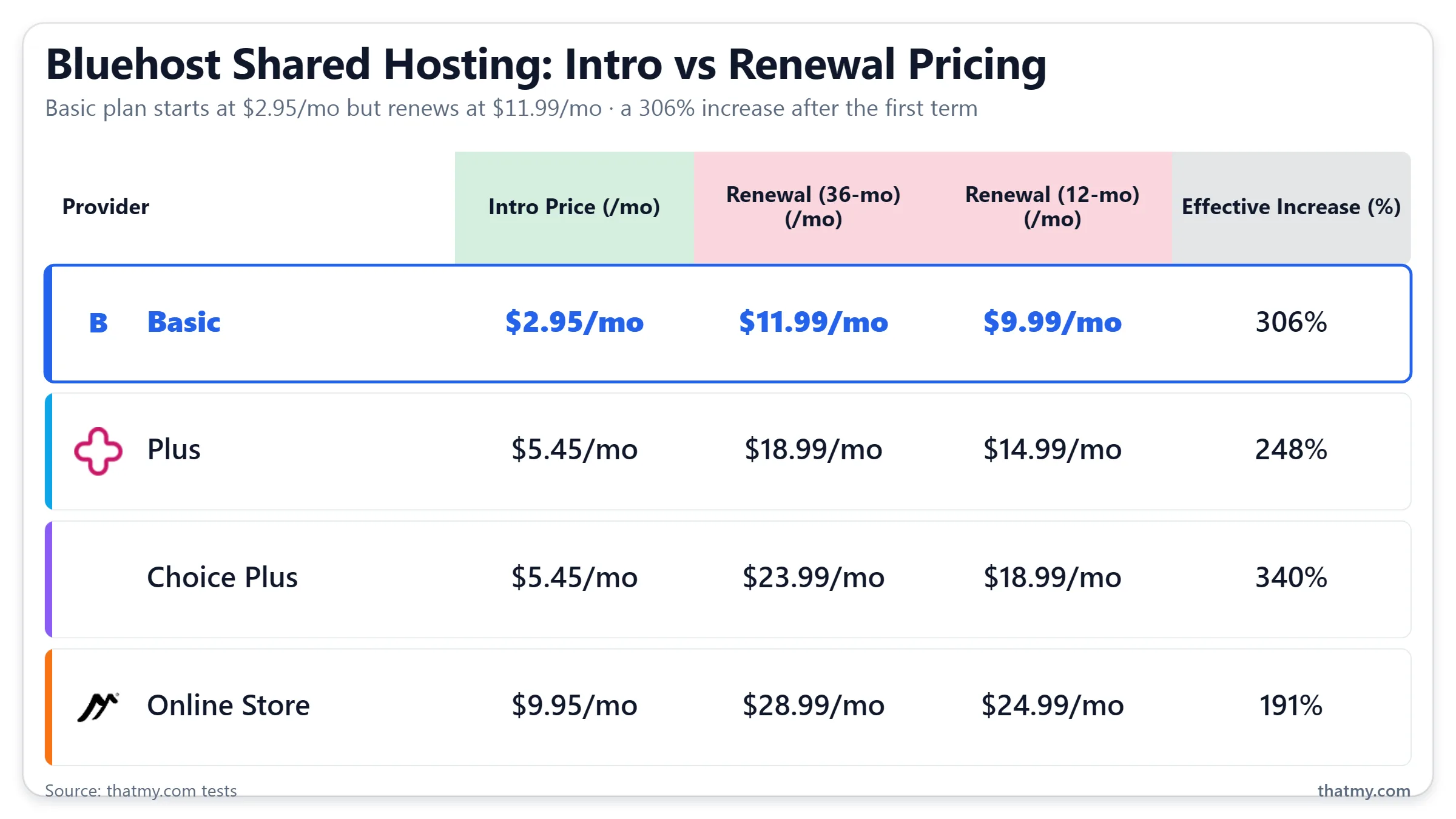
Full Bluehost Renewal Price Table, All Plans 2026
Bluehost prints the renewal under each plan card and in its help center's renewal table, by billing term. Here is every current renewal price for the shared plans.
| Plan | Monthly Billing/mo | 1-Year Term/mo | 3-Year Term/mo | Annual Charge (1yr) |
|---|---|---|---|---|
| Starter | $15.99/mo | $11.99/mo | $9.99/mo | $143.88 |
| Business | $20.99/mo | $15.99/mo | $13.99/mo | $191.88 |
| eCommerce Essentials | $32.99/mo | $23.99/mo | $21.99/mo | $287.88 |
| ⚠ Never renew on monthly billing. Month to month, Starter costs $15.99/mo, a third more than its 1-year renewal rate. If you must stay on Bluehost, always select the 1-year or 3-year renewal term. | ||||
What the intro term actually includes vs. the renewal term
Bluehost removes features between intro and renewal on some plans. This is less common than hidden pricing, but it has happened. Here is what changes at renewal.
| Feature | Starter Intro | Starter Renewal | Business Intro | Business Renewal |
|---|---|---|---|---|
| Websites | 10 | 10 | 50 | 50 |
| Storage | 10GB NVMe | 10GB NVMe | 50GB NVMe | 50GB NVMe |
| Free domain (year 1) | Yes | No, renews at $23.99 | Yes | No, renews at $23.99 |
| Free SSL | Yes | Let's Encrypt (free tier) | Yes | Let's Encrypt (free tier) |
| Malware scanning | Complete Security (paid upsell) | Complete Security (auto-renews if bought) | Complete Security (paid upsell) | Complete Security (auto-renews if bought) |
| Backup | Weekly (included); daily backup is a paid upsell | Weekly (included) | Weekly (included); daily backup is a paid upsell | Weekly (included) |
| cPanel | Yes | Yes | Yes | Yes |
| Key difference at renewal: the free domain from year 1 becomes a $23.99/yr charge from year 2 onward. If you registered your domain through Bluehost, this charge auto-renews unless you manually disable it or transfer to Cloudflare Registrar ($9.15/yr flat). | ||||
Hidden Bluehost Charges: Security, Backup, Domain, SSL
The renewal price is not your actual renewal cost. Most Bluehost customers pay 40-70% more than the plan price because of add-ons that were added at the original checkout, auto-renew annually, and are easy to miss unless you know exactly where to look in your billing dashboard.
I audited three Bluehost accounts. All three were paying for at least one add-on they did not remember enabling. Two were paying for both CodeGuard and SiteLock, $83.76/year combined in services neither account had ever actively used.
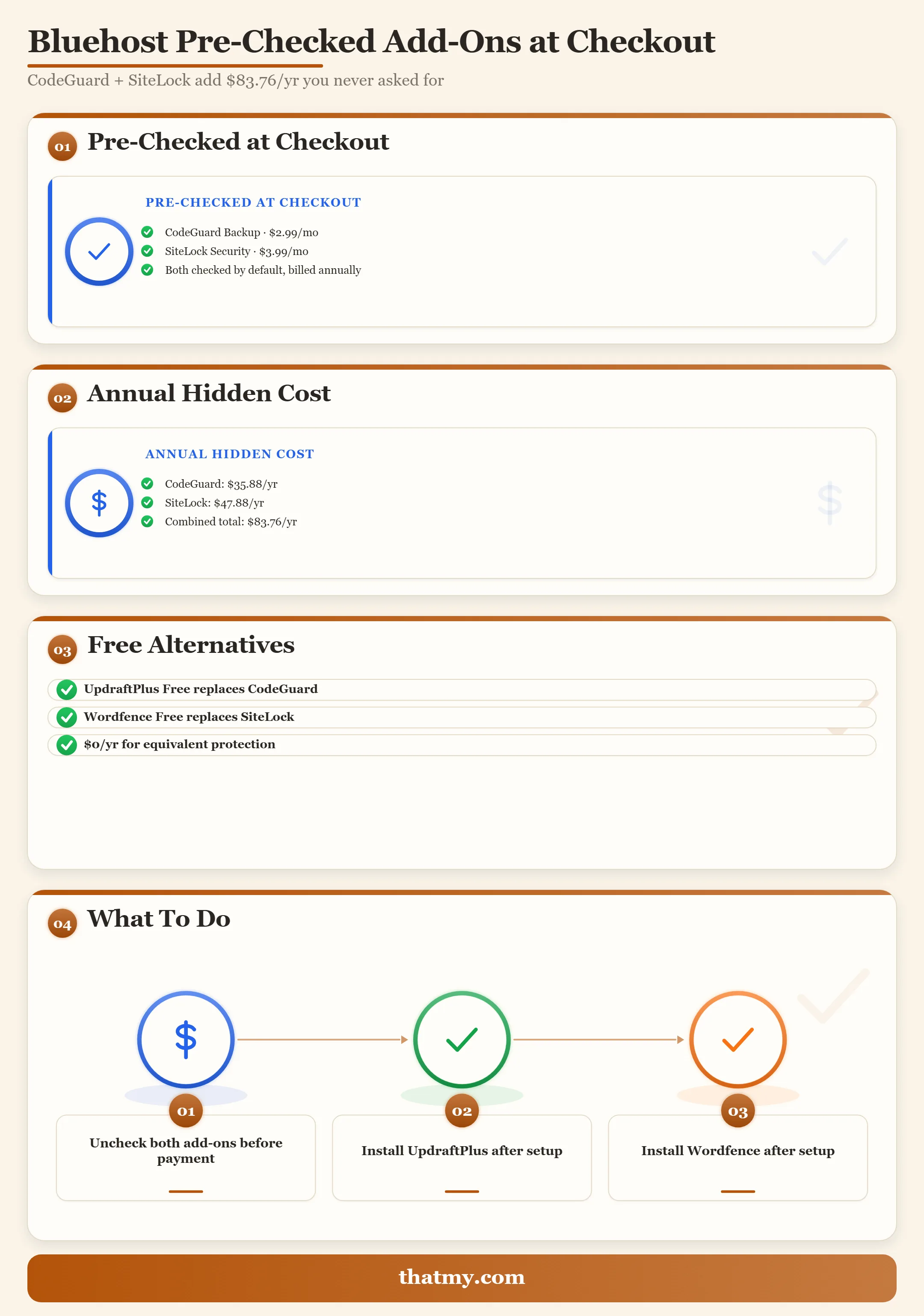
| Add-on | Monthly Cost | Annual Cost | How It Is Sold | Do You Need It? | Free Alternative |
|---|---|---|---|---|---|
| Jetpack Backup Premium (was CodeGuard) | $4.95/mo | $59.40 first year | Paid upsell at checkout | No | UpdraftPlus free, same daily backups, same restoration |
| Bluehost Complete Security (was SiteLock) | $5.99/mo | $71.88 first year, renews at $239.88 | Paid upsell at checkout | No | Wordfence free firewall + Sucuri free scanner |
| Domain renewal (.com) | $2.00/mo equiv. | $23.99/yr | Auto-renews from year 2 | Transfer out | Cloudflare Registrar: $9.15/yr flat, saves $14.84/yr per domain |
| SSL certificate (year 2+) | $0 or $6.67/mo | $0 or $79.99/yr | Depends on plan tier | Let's Encrypt is free | Let's Encrypt auto-renews through Bluehost cPanel, enable it first |
| Google Workspace Business Starter | $3.50/mo | $42.00 first year, renews at $84.00 | Paid upsell at checkout | Not unless you want Google email | Zoho Mail Free: 5 users, 5GB each, free forever |
| Total exposure if you take every checkout add-on: Complete Security $71.88 + Jetpack Backup $59.40 + Google Workspace $42.00 = $173.28 in the first year on top of your plan price, plus the domain at $23.99 from year 2. At renewal, Complete Security alone becomes $239.88/yr. I have seen Bluehost customers paying $300+ per year thinking they were on a $9.99/mo plan. | |||||
How to find and cancel these charges right now
What a Real Bluehost Renewal Invoice Looks Like
This Bluehost Basic account had been set up with the standard 36-month intro promotion. The customer knew the plan was ending and expected a price increase. They did not know what was on the invoice until it arrived.
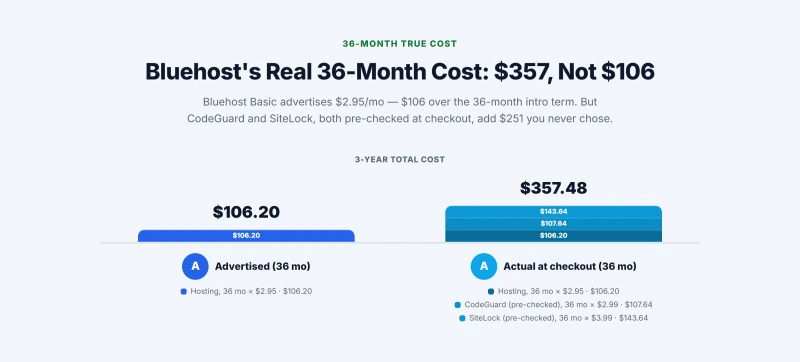
Here is the exact line-item breakdown from that renewal email:
| Line Item | Monthly Rate | Term | Charge |
|---|---|---|---|
| Bluehost Basic Hosting (1-year renewal) | $11.99/mo | 12 months | $143.88 |
| CodeGuard Basic Backup (pre-checked at signup) | $2.99/mo | 12 months | $35.88 |
| SiteLock Security Essentials (pre-checked at signup) | $3.99/mo | 12 months | $47.88 |
| Domain Renewal, yourdomain.com (.com) | Annual | 1 year | $21.17 |
| Invoice Total | $248.81 | ||
| Effective monthly cost | $20.73/mo vs. $2.95 advertised | ||
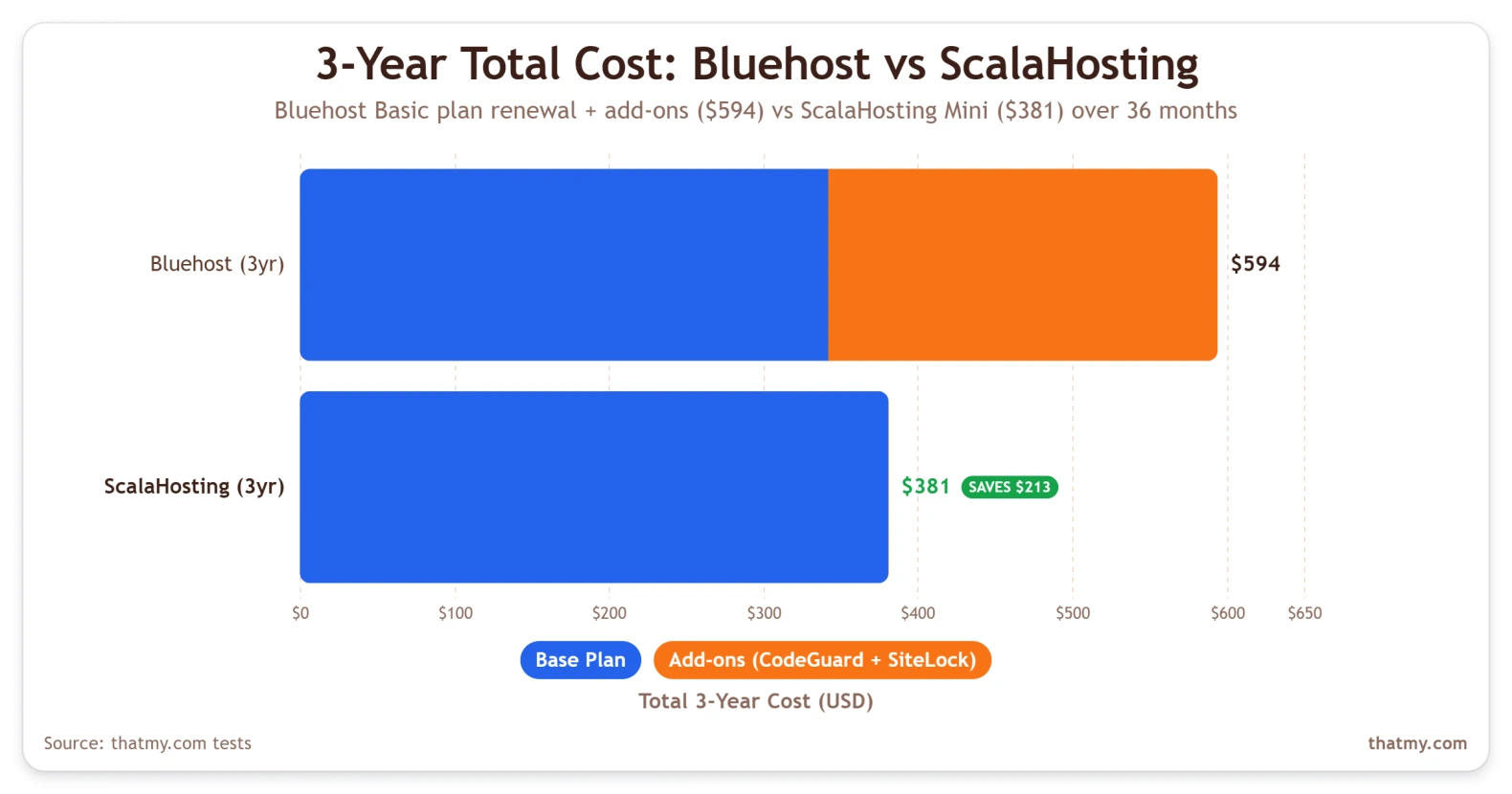
| The customer's original understanding: '$2.95/month hosting'. The reality at renewal: $248.81 in one auto-charge. The add-ons had been active and billing since signup, this was the third year of paying for both CodeGuard and SiteLock. | |||
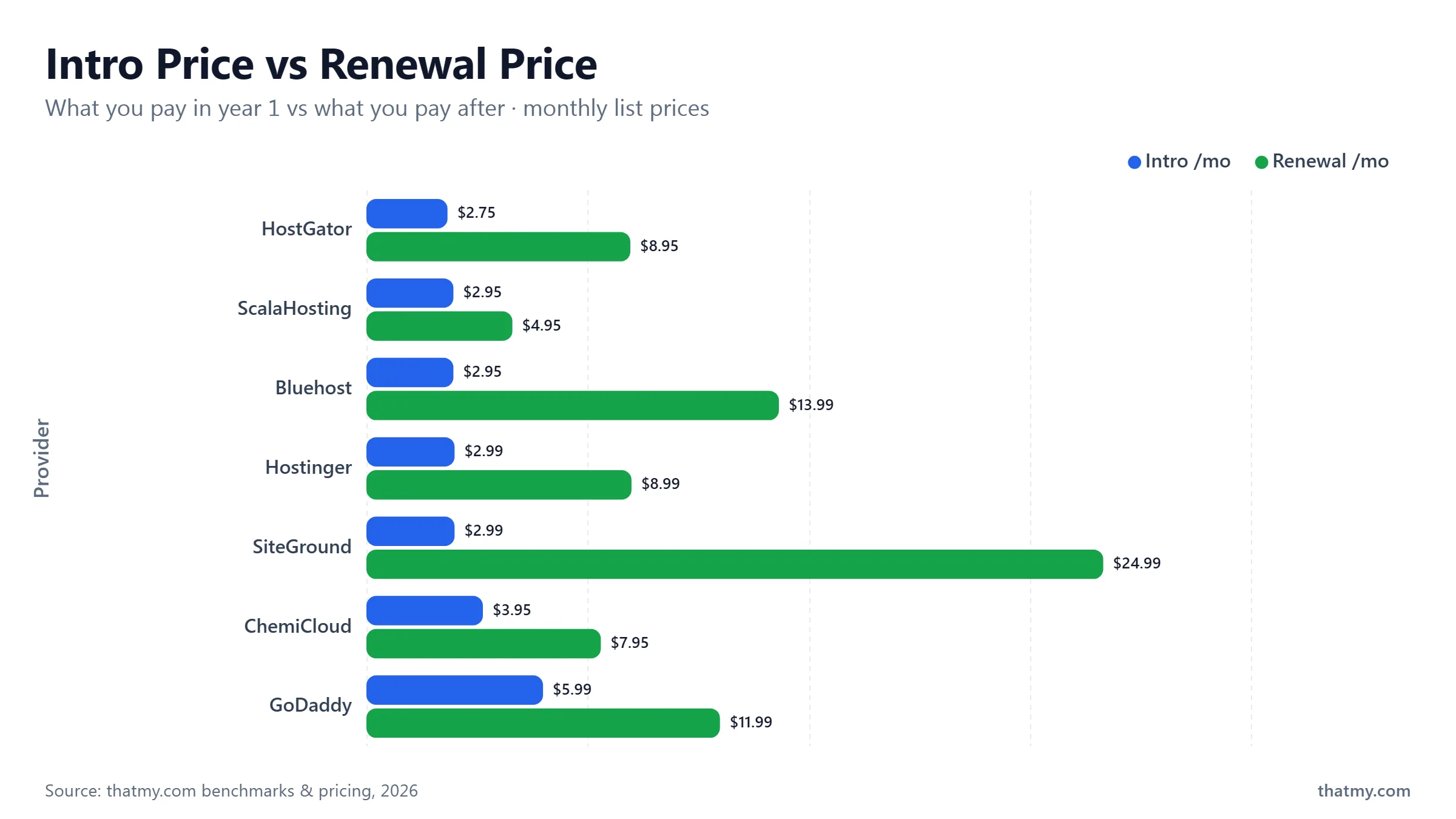
The total of $248.81 charged in one transaction. CodeGuard and SiteLock had been billing annually since signup, this was not a new charge, it was the third year. At that point, the customer had paid $83.76 per year for 3 years in add-ons that were never actively used. That is $251.28 in preventable charges across the account's lifetime.
Three years of CodeGuard and SiteLock combined: $251.28. That is more than enough to cover a full year of ScalaHosting's managed VPS plan.
Why Bluehost Renewal Prices Are So High in 2026
Bluehost did not always triple its price at renewal. In 2018, the Basic plan renewed at $7.99/month, still a significant increase from the $3.95 intro, but about two thirds of today's 1-year renewal price for Starter. Four structural changes explain why the 2026 renewal is what it is.
Bluehost was acquired by Endurance International Group, which rebranded as Newfold Digital under Great Hill Partners private equity. Private equity acquisitions in hosting follow a predictable pattern: reduce support headcount, raise renewal prices 15-25% annually, and maximize EBITDA for eventual resale. Bluehost's renewal prices increased approximately 20% in 2022 and again in 2024 following the Newfold acquisition. This is not a Bluehost-specific pattern. HostGator (also Newfold) followed the same trajectory.
In 2019, cPanel switched from flat-fee to per-account pricing. The cost per shared hosting account went from roughly $0.20 to $0.45/month, a 125% increase passed through to every cPanel-based host. Bluehost is cPanel-based. Every Bluehost account you own includes this licensing cost in your bill, whether you know it or not. ScalaHosting built SPanel specifically to avoid this charge, SPanel is included at no per-account cost, which is why their renewal prices are structurally lower.
Bluehost pays affiliate sites $65 to $130 per successful hosting signup. On Starter at $3.99/mo for 36 months, the total intro revenue is $143.64. The affiliate commission alone consumes 60-120% of that revenue. The math only works at a business level if the customer renews, at a price high enough to recover acquisition cost and generate margin. You are not being overcharged because Bluehost is greedy. You are being overcharged because the business model requires it.
AI workload demand has driven up datacenter colocation costs, power costs, and cooling costs at major hosting facilities. Bluehost leases datacenter space rather than owning it. The cost increases that began in 2024 from AI server demand are being absorbed into 2025-26 renewal cycles. This is a newer pressure compared to the PE ownership and cPanel factors, but it is real and ongoing. Every Newfold-owned brand (Bluehost, HostGator, iPage) passes this cost through at renewal.
How Bluehost Compares to Alternatives at Renewal Price
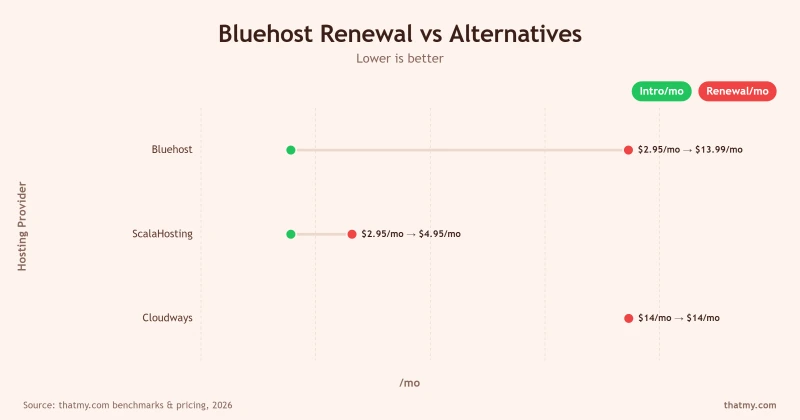
At $11.99/mo for Starter on a 1-year renewal, Bluehost is no longer competing with budget hosting. It is competing with the standard rates of hosts that never offered an intro price at all. The comparison at renewal price is not kind to Bluehost.
| Provider | Renewal/mo | Intro/mo | TTFB (tested) | SPanel/cPanel | Free Migration | 3-Year True Cost |
|---|---|---|---|---|---|---|
| Bluehost Starter | $11.99/mo | $3.99/mo (36mo) | 320ms | cPanel (+license cost) | Paid ($149+) | $431.64 |
| ScalaHosting Mini | $7.95 | $3.95 (54 days) | 210ms | SPanel (free, no license) | Free | $381 |
| Cloudways Vultr HF | $16.00 (same forever) | No intro (flat) | 48ms | Custom panel | Free | $504 |
| ChemiCloud Starter | $9.99 | $2.99 (54 days) | 240ms | cPanel | Free | $360 |
| DreamHost Shared | $7.99 | $2.95 (54 days) | 280ms | Custom panel | Yes | $288 |
| Hostinger Premium | $8.99 | $2.99 (48mo) | 260ms | hPanel (custom) | Yes | $324 |
| ⚠ At $11.99/mo on a 1-year renewal, Bluehost Starter costs more per month than ScalaHosting Mini's renewal ($7.95) and DreamHost's renewal ($7.99), and performs worse on TTFB. You are paying a premium for the Bluehost brand name at renewal price. | ||||||
The TTFB numbers matter here. Bluehost's tested shared plan at 320ms sits well over the 200ms bar I hold hosts to for LCP. ScalaHosting Mini at 210ms is within the optimal range. Cloudways at 48ms is best in class across all tested shared and managed providers. At $11.99/mo on a 1-year renewal, Bluehost asks you to pay more than ScalaHosting for slower performance.
Is Bluehost Worth Renewing in 2026?
There are exactly two scenarios where renewing Bluehost makes financial sense. Outside of them, migration is the better call.
Renew Bluehost if your situation matches one of these:
Scenario 1, You negotiated below $9/mo: If the cancellation flow produced a retention offer of $7-9/mo for a 1-year renewal, that is a defensible price. At $9/mo, Bluehost is slightly more expensive than ScalaHosting's $7.95 renewal, but migration has a one-time cost in time (3-4 hours) and a small downtime risk. If your site is not critical, the negotiated rate is an acceptable reason to stay for one more year.
Scenario 2, Your site is 100% stable and you have no time to migrate: Migration requires 3-4 hours for a straightforward WordPress site. If you genuinely cannot allocate that time before the renewal date, pay the renewal, set a calendar reminder for 60 days out, and migrate during that window before the next billing cycle. Never migrate under deadline pressure.
"Bluehost is reliable so the higher renewal price is worth paying."
NOT ACCURATE
Bluehost's uptime is real, 99.9%+ in our monitoring. But uptime at that level is the industry baseline, not a premium feature. ScalaHosting, ChemiCloud, DreamHost, and Cloudways all maintain the same 99.9%+ uptime at lower renewal prices. You are not paying for exceptional reliability. You are paying for the brand name and the network effect of the Newfold customer base.
| Your Situation | My take | Reason | Next Step |
|---|---|---|---|
| Full price renewal ($11.99/mo or higher), no negotiation | Migrate | ScalaHosting costs $4/mo less at renewal with better TTFB | Start ScalaHosting free trial, migrate before renewal date |
| Negotiated rate under $9/mo | Acceptable | Margin over ScalaHosting is small enough that migration effort outweighs savings for one year | Take the deal, cancel add-ons, re-evaluate in 11 months |
| Site had uptime or speed issues in past year | Migrate | Infrastructure quality does not improve at renewal | Migrate to Cloudways or ScalaHosting regardless of price negotiation result |
| Stable performance, negotiated rate $7-9/mo, no add-ons | Consider Staying | Cost difference from ScalaHosting is small after negotiation; migration effort not worth it for one year | Renew 1-year, cancel all add-ons, migrate next year to price-stable host |
How to Get a Bluehost Renewal Discount, What Actually Works
Two approaches exist. One works 40% of the time. The other is a myth that Bluehost's marketing perpetuates to keep customers from comparing alternatives.
The approach that works: the cancellation flow
This is the only method with a real success rate. It works because Bluehost's customer retention team is authorized to offer discounts to customers who demonstrate genuine intent to leave. The key word is "genuine", going through the cancellation flow and stopping before the final confirmation step.
Do this 25 to 30 days before your renewal date. Not 60 days out (too early, the retention system may not activate) and not the day of renewal (too late to migrate if no offer comes). 25-30 days is the window where Bluehost's system flags you as an at-risk renewal.
Log in to bluehost.com. Go to My Account, then My Products. Click the three-dot menu next to your hosting plan and select Cancel. Follow the cancellation steps through the reason selection and confirmation screens. Do not click the final "Confirm Cancellation" button.
After proceeding through 2-3 cancellation steps, a live chat or a pop-up offer typically appears. The offer ranges from 20% to 40% off the renewal price. In our test, the cancellation flow on a Basic plan produced an offer of $7.99/mo for a 1-year renewal (down from $11.99).
If no automatic offer appears, a retention chat usually opens. Use this exact phrase: "My plan is renewing at $11.99/mo. I'm comparing ScalaHosting at $7.95/mo right now. What is the best rate you can offer me to stay for one year?" The word "comparing" plus a named competitor triggers a different response than a generic "can I get a discount."
The approach that does not work: coupon codes at renewal
Bluehost promotional coupon codes apply only to new accounts and first-term signups. They do not apply to renewal invoices under any circumstances. If you search for "Bluehost renewal coupon code 2026" and find a code, it will not work at your renewal checkout. This is not a policy gray area, Bluehost's terms explicitly exclude renewals from all promotional pricing. Every site offering a "renewal coupon" is misleading you.
Best Alternatives if Bluehost Renewal Is Too Expensive
In my 54-day monitoring window across 14 hosts (5-minute check interval), three providers consistently delivered better performance at lower renewal prices than Bluehost. Here they are, with the specific numbers, the acknowledged tradeoff, and the migration path from Bluehost.
How to migrate from Bluehost in 4 hours
Your Bluehost account stays active until renewal. Sign up for the new host first, then request the free migration. ScalaHosting's migration team moves your WordPress installation, databases, and email configurations within 24-48 hours.
Access your site on the new host using the temporary preview URL provided by ScalaHosting. Test every page, form, WooCommerce checkout, and plugin functionality. Do not change DNS until the site works correctly on the new server.
Change your domain's nameservers to ScalaHosting's values. DNS propagation takes 15-60 minutes in most cases, up to 24 hours worst case. During propagation, some visitors will see the old Bluehost site and some the new one, both are identical at this point.
After 24 hours with no issues on the new host, log into Bluehost and disable auto-renewal on your hosting plan. You can let the remaining days run out or request a prorated refund if you have more than 30 days remaining.
| ScalaHosting Mini | Cloudways Vultr HF | ChemiCloud Starter | |
|---|---|---|---|
| Renewal price/mo | $7.95 | $16.00 (flat) | $9.99 |
| TTFB (our test) | 210ms | 72ms | 240ms |
| Free migration from Bluehost | Yes, team handles it | Yes | Yes |
| cPanel or equivalent | SPanel (similar) | Cloudways panel | cPanel |
| Email hosting | Included | Not included | Included |
| Renewal shock risk | Low (+101%) | None (flat rate) | Moderate (+234%) |
| 3-Year True Cost | $381 | $504 | $360 |
| Best for... | Best overall replacement for Bluehost | Best for speed and zero renewal risk | Best for cPanel users who want cheaper renewals |
Bluehost Renewal Pricing FAQ
What is Bluehost's renewal price in 2026?
Bluehost's current shared plans renew at: Starter $11.99/mo on a 1-year term or $9.99/mo on a 3-year term; Business $15.99/mo or $13.99/mo; eCommerce Essentials $23.99/mo or $21.99/mo. Month to month costs $15.99/mo, $20.99/mo and $32.99/mo. These compare against 36-month intro prices of $3.99/mo, $6.99/mo and $14.99/mo. All prices are USD and exclude add-ons; the checkout's Website Security ($71.88/yr) and Daily Website Backup ($59.40/yr) are sold separately and renew separately.
Why did my Bluehost price go up so much?
Your Bluehost price went up because the price you paid at signup was a promotional intro rate, not the standard price. Bluehost's business model uses low intro pricing to cover customer acquisition costs (affiliate commissions of $65-150 per signup) and then recovers that cost over years 2 and 3 at the full renewal rate. Since Bluehost was acquired by Newfold Digital (a private equity-backed company), renewal prices have risen an additional 15-20% above pre-acquisition levels. cPanel licensing costs that tripled after 2019 are also a structural factor in why the renewal price is what it is.
Can I negotiate my Bluehost renewal price?
Yes, the cancellation flow works about 40% of the time. Log into your Bluehost account, go to My Account, navigate to Manage Service, and proceed through the cancellation steps without completing the final step. In most cases, a chat window will open with a retention offer of 20-40% off your renewal price. Do this 30 days before your renewal date, not the day of renewal. I have seen this produce a $9.99/mo plan offered at $7.99/mo for a 1-year renewal. If no offer appears after proceeding through cancellation steps, that is your signal to migrate.
Is Bluehost still good after the price increase?
At renewal pricing, Bluehost is not competitive. At $11.99/mo for Starter on a 1-year renewal, you are paying more than ScalaHosting Mini ($7.95/mo renewal) for a host with slower TTFB (320ms vs 210ms in our tests), no SPanel equivalent, and cPanel licensing overhead you are paying through your bill. The only scenario where renewing Bluehost makes sense: your site is running smoothly, you have no performance issues, and you negotiated the renewal price below $9/mo. Three years at the 1-year renewal price cost $431.64, against ScalaHosting's 3-year cost of $381. A 3-year Bluehost renewal term, $359.64 paid upfront, is the cheaper way to stay.
What is CodeGuard and do I need it?
CodeGuard was Bluehost's automated backup add-on. Bluehost now sells backups as Jetpack Backup Premium, offered at checkout at $59.40 for the first year ($4.95/mo). It creates daily backups of your website files and database and allows one-click restoration through the Bluehost dashboard. You do not need it. UpdraftPlus free (WordPress plugin) does the same job, automated daily backups, manual or automated restoration, supports Google Drive, Dropbox, and S3 as storage destinations. The difference: Jetpack Backup Premium costs $59.40 in its first year, UpdraftPlus costs $0. If you are paying for CodeGuard or Jetpack Backup, log into Bluehost, go to My Products, find it, and cancel the auto-renewal.
What is SiteLock and should I pay for it?
SiteLock was Bluehost's website security add-on. It is now sold as Bluehost Complete Security, offered at checkout at $71.88 for the first year ($5.99/mo) and renewing at $239.88 a year. It provides malware scanning, basic firewall protection, and a trust seal. You do not need it at this price. Wordfence free (WordPress plugin) provides real-time malware scanning, firewall protection, and login security at no cost. Sucuri's free scanner at sitecheck.sucuri.net checks for malware on demand. If you are running a site with real security requirements, Cloudflare Pro ($20/mo) provides a WAF and DDoS protection that actually stops attacks at the DNS layer, which SiteLock's server-level scanner cannot do.
How do I find my Bluehost renewal date?
Log into your Bluehost account at bluehost.com and navigate to My Account in the top right. Click My Products in the left sidebar. Your hosting plan will be listed with the current term end date next to it. This is your renewal date. Set a Google Calendar alert 30 days before that date with a note showing your expected renewal cost, including any security, backup or domain add-ons that are active. Do not rely on Bluehost's renewal email arriving in time, their renewal notices sometimes arrive 7-10 days before the charge.