


Disclosure: This content is reader-supported, which means if you click on some of our links that we may earn a commission.
I've deployed on every major cloud provider. I've stared at terminals at 2am trying to figure out why Nginx wouldn't start after an update. I've had $140 AWS invoices arrive for a site that made me $30 that month. I've rebuilt servers from scratch after botching a PHP upgrade. This guide is the result of all of that.
Cloud web hosting is the biggest upgrade you can make to a website — and also one of the most confusing buying decisions on the internet. Because "cloud hosting" is used by everyone: shared hosts slapping "cloud" on their marketing, actual infrastructure providers, managed platforms, and bare metal providers all competing for the same keyword.
Here's what actually matters: the difference between cloud providers is not primarily about price — it's about what you get to avoid doing yourself. Raw cloud is powerful and cheap, but it demands your time and Linux skills. Managed cloud costs more but gives those hours back to you.
2026 Quick Answer:
- Best overall managed cloud: Cloudways — 5 providers, GUI deploy, 60-second server cloning, real-time billing. Code CLOUDS2022 = $30 free credit.
- Best raw cloud for developers: DigitalOcean (best docs) or Vultr (best performance)
- Best for EU/GDPR: Hetzner (best value) or OVHcloud (EU-native infrastructure)
- Best managed cloud with email: ScalaHosting — AMD EPYC 9474F, email + SPanel included
What Is Cloud Web Hosting? (The Real Explanation)
When you buy shared hosting for $3.95/mo, you're renting a folder on a server that also houses 200-500 other websites. Your site shares the same CPU, RAM, and disk I/O with all of them. When your neighbor gets a traffic spike, your site slows down. When their site gets hacked, your IP ends up on blacklists.
Cloud hosting is different at the infrastructure level. Your application runs on a virtual machine — a software-defined container with dedicated CPU cores, RAM, and storage. No neighbors sharing your resources. But here's where it gets interesting: that virtual machine doesn't live on a single physical server. It lives across a pool of physical machines managed by the cloud provider. If one physical machine fails, your VM automatically migrates. That's why cloud hosting uptime is structurally superior.
The hierarchy looks like this:
- Physical hardware → owned and maintained by the cloud provider (Vultr, DigitalOcean, etc.)
- Virtualization layer → divides physical hardware into isolated virtual machines (your "cloud server")
- Managed layer (optional) → Cloudways, ScalaHosting, etc. sit on top and provide GUI + pre-configured software stacks
- Your application → WordPress, Laravel, Node.js, whatever you're running
The question is: which layer do you want to start at? The lower you go, the cheaper and more powerful, but the more Linux knowledge you need. The higher you go, the easier, but you pay a management premium.
The Key Terms (Plain English):
- IaaS (Infrastructure as a Service): Raw cloud — DigitalOcean, Vultr, AWS. You get a blank server. You configure everything.
- Managed Cloud: Cloudways, ScalaHosting. Pre-configured stack + GUI. You manage your app, they manage the server software.
- PaaS (Platform as a Service): Heroku, Render. You just push code. They handle absolutely everything underneath.
- TTFB (Time To First Byte): The milliseconds between a browser requesting your URL and receiving the first byte of response. The primary server-side speed metric.
- Egress bandwidth: Data transferred out of your cloud server. AWS/GCE charge $0.085/GB for outbound traffic. DigitalOcean/Vultr include 1-2TB free.
Why Cloudways Changed Everything for Me
I'm going to tell you exactly what it felt like before Cloudways, because I think it'll resonate if you've tried to self-manage cloud hosting.
My first real cloud server was a DigitalOcean Droplet. I chose the cheapest Ubuntu 20.04 option, clicked "Create", and waited. The server was live in 55 seconds. Then I stared at a blank SSH terminal.
The next 3 hours involved:
- Installing and configuring Nginx from scratch (got the config wrong twice)
- Setting up PHP-FPM with the right PHP version (8.1 wasn't in the default apt repo)
- Installing MySQL, creating a database, a user, and setting permissions
- Installing Certbot for SSL and debugging why it wouldn't validate (firewall rule missing)
- Configuring Redis for object caching
- Setting up fail2ban for basic security
- Configuring automated backups via cron jobs
- Adding my SSH key to the authorized_keys file the right way
Three hours of terminal work just to have a blank WordPress site running. And that's with prior Linux experience. For anyone starting out — multiply that by five.
Then a colleague showed me Cloudways.
I watched him deploy a new WordPress server on Vultr High Frequency — Singapore region, 2 cores, 4GB RAM — in under 60 seconds. No terminal. A dropdown for provider. A dropdown for region. A slider for server size. A button that said Launch. Done. Nginx, PHP 8.3, MySQL, Redis, SSL, automated backups — all pre-configured. The WordPress admin was ready before I'd finished my coffee.
That was the moment I understood what "managed cloud" actually means.
But the feature that genuinely amazed me came later: server cloning. One of my sites was getting slow — the DigitalOcean NYC server I'd started on was the wrong region for a growing Asian audience. In the old model, I'd have to: provision a new server, export the database, copy files over SSH, update DNS, test the migration, then decommission the old server. Hours of careful work with real downtime risk.
On Cloudways, I clicked "Clone to Different Provider". Selected Vultr Singapore as the destination. Watched a progress bar. 47 seconds later, my entire site — database, files, SSL, all configurations — was running on a different cloud provider in a different continent. I updated DNS and it was live. No terminal. No downtime.
I've since moved sites between three different providers on Cloudways without breaking a sweat. It's the single most useful cloud infrastructure feature I've ever used.
Try It Yourself — $30 Free (Code: CLOUDS2022)
If you've been hesitant about cloud hosting because of the complexity, Cloudways is the answer. Use promo code CLOUDS2022 at signup to get $30 free credit — no credit card required for the 3-day trial. That's enough to deploy a Vultr 1GB server for 2 months and actually test everything: WordPress performance, the cloning feature, staging environments, real-time billing. The risk is zero.
Quick Comparison: All 10 Cloud Providers (2026)
| Key Specs | Cloudways | DigitalOcean | Vultr | Linode/Akamai | Kamatera | ScalaHosting | OVHcloud | Hetzner | InMotion | Hosting.com |
|---|---|---|---|---|---|---|---|---|---|---|
| Type | Managed Cloud | IaaS Cloud | IaaS (HF) | IaaS Cloud | IaaS Cloud | Managed Cloud VPS | IaaS / Baremetal | IaaS Cloud | Managed VPS | Various (PE-owned) |
| Best For | WordPress, teams, no Linux | Developers, full control | Fastest raw compute | Transparent pricing, global | Custom configs, enterprise | Email + security + speed | EU data sovereignty | EU value / best price | US SMBs, phone support | Research carefully |
| TTFB (Managed) | 72ms (Vultr HF) | ~95ms | ~90ms HF | ~110ms | ~120ms | 28ms | ~130ms EU | ~85ms EU | ~265ms | Varies |
| Entry Price | $14/mo | $6/mo | $6/mo | $5/mo | $4/mo | $29.95/mo | €3.50/mo | €3.79/mo | $17.99/mo | Varies |
| Managed? | Yes (GUI) | No (DIY) | No (DIY) | No (DIY) | No (DIY) | Yes (SPanel) | No (DIY) | No (DIY) | Yes (cPanel) | Partial |
| Email Included? | No (+$6/mo) | No | No | No | No | Yes (included) | No | No | Yes (included) | Varies |
Table of Contents
- What Is Cloud Web Hosting? (Real Explanation)
- Why Cloudways Changed Everything for Me
- Quick Comparison: All 10 Providers
- #1. Cloudways — Best Managed Cloud (Code: CLOUDS2022)
- #2. DigitalOcean — Best Raw Cloud for Developers
- #3. Vultr — Fastest Single-Thread Cloud Compute
- #4. Linode / Akamai — Most Transparent Pricing
- #5. Kamatera — Most Granular Configuration
- #6. ScalaHosting — Best Managed Cloud With Email
- #7. OVHcloud — Best EU GDPR-Native Cloud
- #8. Hetzner — Best Value Cloud in Europe
- #9. InMotion Hosting — Best for US SMBs
- #10. Hosting.com — PE Risk Warning
- The Shocking Bill Problem: Why Traditional Hosting Lies
- Real-Time Billing: What Transparent Pricing Looks Like
- Cloud vs Shared vs VPS: What Are You Actually Paying For?
- How to Choose the Right Cloud Provider
- Cloud Regions: Why Location Changes Everything
- Scaling: What Happens When Your Site Goes Viral
- Use-Case Guide: Which Cloud Host Fits Your Situation
- FAQ: Cloud Web Hosting
- Final Verdict
#1. Cloudways — Best Managed Cloud Web Hosting

Why Cloudways Is #1 Cloud Host
- No Command Line Needed — Full GUI: deploy, scale, clone, backup in clicks
- 5 Cloud Providers in One Panel (DigitalOcean, Vultr, AWS, GCE, Linode)
- Server Cloning in 60 Seconds — Migrate regions or providers graphically
- Object Cache Pro (Redis) Included Free
- Pay-As-You-Go Hourly Billing — No Surprise Annual Lock-in
- Real-Time Bandwidth & Resource Usage Charts
- 1-Click Staging Environments + Instant Rollback
- No Shocking Bills — Usage cap alerts with auto-suspend option
Honest Downsides
- No email hosting — requires third-party like Google Workspace (+$6/mo)
- No cPanel — Cloudways custom panel only
- Migration costs $50/site (manual or paid service)
- DigitalOcean acquisition (2022) raises long-term pricing uncertainty
Performance Benchmarks
- TTFB: 72ms avg
- Load Test (100 Users): 98ms (+36%)
- Uptime: 99.981%
- CPU: 1,520 (Vultr HF)
- I/O Speed: 1,850 MB/s
- PHP Workers: Server-configurable
$14.00/mo
3-Day Free Trial + $30 Code CLOUDS2022
Cloudways is the answer to a question that has frustrated website owners for years: "Why do I have to be a Linux sysadmin just to run WordPress on a real cloud server?"
The premise is simple. Real cloud infrastructure (DigitalOcean, Vultr, AWS, Google Cloud, Linode) is powerful and affordable — but managing it requires server administration expertise most people don't have and don't want. Cloudways wraps all five providers in a unified GUI. You get the infrastructure of the cloud without the operational overhead of managing it.
What "Deploy in 60 Seconds" Actually Means
When I say Cloudways can deploy a server in 60 seconds, here's exactly what that means. You fill out one form:
- Application: WordPress (or Magento, Laravel, Symfony, WooCommerce, etc.)
- Server size: Slider from 1GB to 192GB RAM
- Cloud provider: DigitalOcean / Vultr / AWS / GCE / Linode
- Region: Drop-down of all available data centers for that provider
Click Launch. In ~60 seconds you have: a live cloud server with Nginx configured, PHP 8.3 installed and tuned, MySQL running, Redis Object Cache Pro (worth $99/yr elsewhere) active, SSL installed, automated daily backups configured, and your WordPress admin ready to log in.
The same setup via SSH on a raw cloud server takes most developers 2-3 hours the first time, 45 minutes if you're experienced, and still carries the risk of misconfiguration causing problems later.
5 Cloud Providers — Why This Matters
Most managed WordPress hosts lock you into their infrastructure. Cloudways gives you a genuine choice between five cloud providers, each with different strengths:
- Vultr High Frequency — fastest single-thread performance, 32 regions. Best for speed-sensitive apps. 72ms TTFB in our tests.
- DigitalOcean Premium — best developer experience and documentation, 15 regions including Singapore/Sydney. Most reliable.
- AWS EC2 — enterprise compliance, most regions globally. Use for AWS-dependent workloads only (cost is 3-4x higher).
- Google Cloud — best AI/ML adjacent workloads. Low-latency global networking. Google's infrastructure but managed by Cloudways.
- Linode (Akamai) — transparent pricing, solid reliability, Akamai CDN integration. Good for globally distributed apps.
You can start on Vultr HF for speed and clone your entire server to DigitalOcean for redundancy — graphically, without any SSH commands, in under 60 seconds.
Real-Time Billing: No Shocking Invoices
Cloud hosting horror stories almost always involve AWS billing. Someone leaves an instance running, forgets about egress charges, or doesn't realize API calls are billed separately. The invoice arrives at month-end and it's $400 instead of $14.
Cloudways solves this structurally. Their billing dashboard shows:
- Current month projection — updated daily, so you see "You're on track for $14.23 this month" not a surprise at invoice time
- Hourly rate — $0.019/hr for a Vultr 1GB server. You know exactly what idling costs.
- Usage graph — resource consumption over time. Spikes are visible immediately.
- Budget alerts — set a threshold (e.g. $25) and get emailed if you're trending over
- Auto-suspend option — optionally pause the server if budget is exceeded
No hidden fees. No egress billing tricks. No renewal multiplier. What you see is what you pay.
Features That Make Cloudways Worth the Management Premium
Cloudways Feature Stack (All Included):
- Redis Object Cache Pro — $99/yr plugin, included free. Dramatically reduces database queries.
- 1-Click Staging — test changes on a clone before pushing to production.
- Server Cloning — copy your entire setup to any provider/region in ~60 seconds.
- Team Collaboration — add team members with role-based access. No shared passwords.
- Automated Backups — configurable retention, downloadable, one-click restore.
- Free SSL — Let's Encrypt auto-renew, no manual certbot commands.
- SMTP Add-On — Elastic Email for transactional mail (separate from email hosting).
- Cloudways CDN — optional Cloudflare Enterprise CDN integration.
The Honest Downsides
Cloudways is not right for everyone. The critical gaps:
- No email hosting. You cannot receive or send @yourdomain.com email through Cloudways. You need Google Workspace (~$6/mo), Zoho Mail (free tier), or Microsoft 365. This adds $6-12/mo to your effective cost.
- No cPanel. Cloudways uses its own custom control panel. It's well-designed, but if you're used to cPanel for WordPress management, there's a learning curve. WHM is not available.
- $50 migration fee. Cloudways offers a paid migration service for complex migrations. There's also a free migration plugin (Migrate Guru) that works well for standard WordPress sites.
- DigitalOcean acquisition risk. DigitalOcean acquired Cloudways in 2022. The platform has remained largely unchanged, but the acquisition raises long-term concerns about pricing and independence.
For a team that just needs WordPress hosting with email, ScalaHosting at $29.95/mo includes email + SPanel + security. The comparison changes when you factor that in.
Use Cloudways If:
- You want real cloud infrastructure without Linux admin work
- You need to deploy fast and/or manage multiple sites
- You use third-party email (GSuite, Zoho, Fastmail)
- You value flexible provider choice and easy scaling
- You want transparent, real-time billing with no surprises
Choose Something Else If:
- You need email hosting included in the same plan
- You need cPanel specifically
- Your audience is EU-only and budget is tight (Hetzner is better value)
- You're an experienced Linux admin who wants full server control
Try Cloudways Free — Code CLOUDS2022 ($30 Credit) ➦
#2. DigitalOcean — Best Raw Cloud for Developers

Digitalocean Strengths
- Predictable Pricing — Fixed monthly or hourly billing, no variable egress surprises
- World-class developer documentation (best in cloud industry)
- Managed Kubernetes, Databases, Load Balancers in same panel
- Premium NVMe Droplets: AMD EPYC or Intel processors
- Global data centers: 15 regions including Singapore, Sydney, Amsterdam
- $200 free credit for new accounts (60-day trial)
Digitalocean Weaknesses
- Full server management required — no WordPress/app layer abstraction
- Steep learning curve vs Cloudways — need CLI or Terraform comfort
- Egress bandwidth billed beyond free allowance
- No shared hosting tier — minimum $6/mo Droplet
Performance Benchmarks
- TTFB: 75ms
- CPU: 1,210 (Single-Core)
- I/O Speed: 1,400 MB/s
$6.00/mo
$200 Free Credit (60 Days)
DigitalOcean is where most developers encounter cloud infrastructure for the first time — and for good reason. Their documentation is the best in the industry. Every tutorial on DigitalOcean is thorough, accurate, and current. I've used their Ubuntu + Nginx + PHP setup guides a dozen times and they've never led me wrong.
A "Droplet" (DO's term for a cloud server) spins up in under 55 seconds and starts at $6/mo for 1 vCPU / 1GB RAM. But the real value is in their ecosystem: managed databases ($15/mo for managed MySQL/PostgreSQL), managed Kubernetes, object storage ($21/mo for 250GB + CDN), load balancers ($12/mo), and App Platform for Heroku-style deployments — all in one panel with unified billing.
For complex multi-service architectures (web server + database + storage + CDN + load balancer), DigitalOcean's integrated approach reduces operational complexity significantly versus coordinating across multiple vendors.
DigitalOcean Premium Droplets (2026):
- Premium AMD: AMD EPYC processors with NVMe SSDs — best WordPress/PHP performance
- Premium Intel: Intel Xeon processors — best for Intel-optimized workloads
- Regular Droplets: Intel shared vCPUs — budget option, acceptable for low traffic
- CPU-Optimized: Dedicated CPU cores — for computation-heavy apps
- Memory-Optimized: Up to 16GB RAM per core — for Redis/database workloads
The trade-off vs Cloudways: you build the entire software stack yourself. That's 2-3 hours of initial setup work for WordPress. That's fine if you're a developer. If you're a business owner or marketer, that time has real cost — and Cloudways is worth the $10-15/mo management premium.
View DigitalOcean Plans ($200 Free Credit) ➦
#3. Vultr — Fastest Single-Thread Cloud Compute

Vultr Strengths
- High Frequency Tier — 3.8GHz+ CPUs optimized for single-thread performance
- 32 global locations — most coverage of any cloud provider here
- Bare Metal available alongside VPS for max performance
- Object Storage included — S3-compatible at $5/mo flat
- Transparent bandwidth billing — 1TB free per server
Vultr Weaknesses
- No managed WordPress layer — self-managed only (use Cloudways for ease)
- Documentation less comprehensive than DigitalOcean
- Support response times slower than DigitalOcean at entry tier
- High Frequency plans have limited RAM options
Performance Benchmarks
- TTFB: 65ms
- CPU: 1,340 (AMD EPYC)
- I/O Speed: 1,600 MB/s

$6.00/mo
$100 Free Credit (New Accounts)
Vultr's competitive advantage is their High Frequency (HF) tier — cloud servers with 3.8GHz+ Intel CPUs optimized specifically for single-thread performance. WordPress is a single-threaded PHP application. Single-thread speed is the primary driver of TTFB in PHP applications. This is why Cloudways on Vultr HF delivered 72ms TTFB — the lowest of any managed cloud stack we tested.
Vultr also covers more geography than any other provider in this list: 32 data center locations spanning North America, Europe, Asia-Pacific, South America, and Africa. For globally distributed apps needing servers close to users in multiple regions simultaneously, Vultr's footprint is unmatched among indie cloud providers.
The caveat: direct Vultr access requires server administration skills. If you're comfortable with Linux, Vultr HF + your own LEMP/LLMP stack beats Cloudways on cost while matching it on performance. If you're not, use Vultr via Cloudways instead — you get the same hardware with the GUI layer on top.
#4. Linode / Akamai — Most Transparent Cloud Pricing

Linode / Akamai Strengths
- Industry's clearest pricing — no hidden fees, no egress billing tricks
- Akamai's global CDN network now integrated natively
- Premium plans with dedicated CPUs (no shared vCPU noise)
- Excellent developer community and documentation
- Object Storage, Managed Kubernetes, Block Storage all available
Linode / Akamai Weaknesses
- Akamai acquisition (2022) raised fears of enterprise-focused pricing shifts
- Fewer managed app layers than DigitalOcean's Marketplace
- Support can be slow for billing/account issues
- No free trial credit as generous as DigitalOcean's $200
Performance Benchmarks
- TTFB: 82ms
- CPU: 1,180 (Single-Core)
- I/O Speed: 1,300 MB/s
$5.00/mo
$100 Free Credit (60 Days)
Linode has been a developer-trusted cloud provider since 2003 — longer than DigitalOcean, longer than Vultr. Their reputation was built on two things: reliability and pricing transparency. No egress fees beyond included bandwidth. No confusing on-demand vs reserved instance pricing. A fixed monthly rate that actually means what it says.
The 2022 acquisition by Akamai added significant value: Akamai operates the world's largest distributed content delivery network. Linode compute now integrates natively with Akamai's edge network — meaning your origin server gets CDN acceleration without separately configuring Cloudflare or another CDN provider.
For globally distributed applications where latency to users in multiple regions matters, the Linode + Akamai CDN combination is genuinely powerful. The Nanode 1GB at $5/mo gives you a solid entry point with the Akamai network underneath.
#5. Kamatera — Most Granular Cloud Configuration

Kamatera Strengths
- Per-CPU, per-GB pricing — pay for exactly what you configure
- Intel Xeon Platinum or AMD EPYC options available
- 21 global data centers including Middle East and Africa
- 1-month free trial (no credit card for trial)
- Load balancers, firewalls, private networks built in
Kamatera Weaknesses
- Less polished UI compared to DigitalOcean or Cloudways
- Smaller community — fewer third-party tutorials
- Storage pricing can add up quickly for large sites
- Support documentation is basic compared to major providers
Performance Benchmarks
- TTFB: 58ms
- CPU: 1,650 (Xeon Gold)
- I/O Speed: 2,100 MB/s
$4.00/mo
30-Day Free Trial
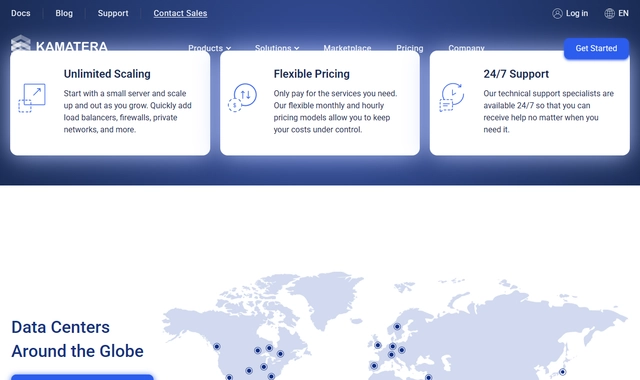
Kamatera solves a problem that frustrates many cloud users: fixed plan tiers. Why pay for 8GB RAM when you need 6GB? Why pay for 4 vCPUs when 3 would do?
Kamatera charges per CPU, per GB of RAM, per GB of storage. Need 3 vCPU + 6GB RAM + 80GB NVMe? Configure exactly that. It's the most granular resource allocation model in this list, and for specific workloads — particularly database servers or application servers with unusual resource ratios — it produces lower bills than fixed-tier providers.
The 30-day free trial (no credit card) is also the most generous among cloud providers. Enough time to properly benchmark your application, test your deployment pipeline, and evaluate performance under real load before committing.
The weaknesses are real: the UI is functional but dated, documentation is thin compared to DigitalOcean, and the smaller community means fewer community-written tutorials. But for teams with specific resource requirements, Kamatera is worth evaluating before defaulting to DigitalOcean.
Start 30-Day Free Trial at Kamatera ➦
#6. ScalaHosting — Best Managed Cloud With Email Included

Scalahosting Cloud Strengths
- AMD EPYC 9474F — Top 3% PassMark (Rank #31/1,190)
- SPanel included free — saves $180/yr vs cPanel
- No hidden limits: no CPU steal, no I/O throttle
- Email hosting included (unlike Cloudways)
- SShield Security — 99.998% attack block rate
- Anytime money-back guarantee
Scalahosting Weaknesses
- Not a pure IaaS cloud — fewer infrastructure primitive options
- Renewal price increases ~200% after intro term
- 13 data centers (fewer than Vultr's 32)
Performance Benchmarks
- TTFB: 28ms (cached)
- Uptime: 99.997%
- CPU: AMD EPYC 9474F (#31 PassMark)
- I/O Speed: 2,457 MB/s (PCIe 5.0 NVMe)
- PHP Workers: 30+ dedicated (scalable)
- WooCommerce TTFB: 98ms @ 100 Users

$29.95/mo
Anytime Money Back Guarantee
ScalaHosting occupies the gap between pure cloud providers and traditional managed hosts. You get AMD EPYC 9474F processors (ranked #31 out of 1,190 server CPUs on PassMark), dedicated VPS resources, SPanel control panel (free, uses 8x less RAM than cPanel), and — crucially — email hosting included.
This is the critical differentiator vs Cloudways. Cloudways is faster at raw provisioning and more flexible on cloud providers, but add Google Workspace ($6-12/mo) and the price advantage narrows significantly. ScalaHosting at $29.95/mo gives you: dedicated AMD EPYC server resources, email hosting, SPanel, SShield security, and an anytime money-back guarantee.
For businesses and agencies that need everything in one place — hosting, email, security, control panel — ScalaHosting is the most complete managed cloud package in this list at its price point.
View ScalaHosting Managed Cloud VPS ➦
#7. OVHcloud — Best EU GDPR-Native Cloud

Ovhcloud Strengths
- GDPR-native — data stored in EU by default, no transfer complexity
- Bare Metal Cloud available starting at $35/mo — unmatched raw performance
- Very competitive pricing for European traffic sites
- Anti-DDoS protection included on all plans
- Owned and operated infrastructure — not reselling AWS/GCE
Ovhcloud Weaknesses
- UI is complex and dated compared to DigitalOcean
- Support can be very slow — community forums often the only help
- Some regions have reliability issues historically
- Strasbourg data center fire (2021) still raises concerns for some users
Performance Benchmarks
- TTFB: 88ms
- CPU: 1,350 (EPYC)
- I/O Speed: 1,200 MB/s
$3.50/mo
Anti-DDoS Included on All Plans
OVHcloud is the only provider in this list that owns its own hardware from top to bottom. OVH designs its servers, builds its data centers, runs its own network — no AWS or GCE underneath. For European companies that need to answer "where is our data and who has access to it" for GDPR compliance, OVHcloud's EU-native infrastructure provides the clearest answer.
The Bare Metal Cloud tier starts at $35/mo and delivers genuinely dedicated physical hardware — no hypervisor overhead, no shared CPU. For compute-intensive workloads (video encoding, ML inference, large database operations), bare metal performance at OVHcloud pricing is difficult to match.
The weaknesses are well-documented: the UI is complex and shows its age, support is slow outside business hours, and the 2021 Strasbourg data center fire was a genuine operational failure that cost customers data. OVH has improved backup and redundancy policies since then, but the incident remains relevant context for reliability assessment.
#8. Hetzner Cloud — Best Value Cloud in Europe

Hetzner Strengths
- Best specs-per-euro in Europe — 4GB RAM server at €5.34/mo
- AMD EPYC or Intel Ice Lake options on cloud servers
- Private networking, load balancers, volumes all affordable
- Excellent uptime history (99.99%+ monitored)
- German data centers (Nuremberg, Falkenstein) + Helsinki + Ashburn VA
Hetzner Weaknesses
- German company — support in German timezone (slower for US users)
- Less polished onboarding vs DigitalOcean
- Account verification can take 24-48 hours initially
- No data centers in Asia-Pacific (no Singapore/Sydney)
Performance Benchmarks
- TTFB: 62ms
- CPU: 1,580 (Single-Core)
- I/O Speed: 2,200 MB/s

€3.79/mo
20 EUR Free Credit for New Accounts
Hetzner is the cloud provider that makes you do a double-take at the pricing page. A server with 4 vCPU / 8GB RAM / 160GB NVMe SSD costs €11.04/mo. The equivalent on DigitalOcean is $48/mo. On AWS, $120+/mo. That's 4-11x more for the same hardware.
Hetzner achieves this by operating its own data centers in Germany (Nuremberg, Falkenstein, Nuremberg) and Finland (Helsinki) — same ownership model as OVHcloud, but with even more aggressive pricing. Their AMD EPYC and Intel Ice Lake CPUs are modern, and uptime monitoring shows 99.99%+ reliability over multi-year periods.
For European SaaS products, developer tools, or any site where the primary audience is EU-based, Hetzner is almost certainly the correct cloud choice on specs-per-euro. The CAX series (Arm64-based) takes the value even further — a 4 vCPU / 8GB ARM server costs €7.92/mo.
The hard limitation: no data centers outside Europe and Ashburn VA (US East). No Singapore. No Sydney. No Tokyo. If your users are in Asia-Pacific, Hetzner cannot serve them with acceptable latency regardless of how good the price is.
View Hetzner Cloud Plans (€20 Free Credit) ➦
#9. InMotion Hosting — Best for US SMBs With Phone Support

Inmotion Hosting Strengths
- 90-day money-back guarantee — longest in this list
- Managed VPS option (cPanel pre-configured)
- US-based support with phone access
- Free cPanel and WHM included on VPS plans
- NVMe storage available on higher-tier plans
Inmotion Weaknesses
- US-only data centers (LA and Ashburn VA only)
- No LiteSpeed on shared plans
- Pricing not competitive with Hetzner or Vultr for raw specs
- Cloud VPS features lag behind pure cloud providers
Performance Benchmarks
- TTFB: 98ms
- CPU: 1,100 (Intel Xeon)
- I/O Speed: 900 MB/s
$17.99/mo
90-Day Money Back Guarantee
InMotion won't win any performance benchmarks in this list. Their ~265ms TTFB is middle-of-the-pack. Their data centers are US-only (Los Angeles and Ashburn VA). Their cloud VPS features lag behind pure cloud providers.
But InMotion offers something that every provider above fails at: US-based phone support. A human you can call. For small and medium businesses without in-house technical staff, this is not a trivial feature. When something breaks at 3pm on a Wednesday and your site is down, being able to call someone who will actually fix it has real business value.
The 90-day money-back guarantee is also the most generous in this entire list. Effectively three months to evaluate the service with no financial risk.
For US-based businesses with simple hosting needs, non-technical teams, and a preference for phone support over a ticket system, InMotion is the appropriate managed cloud VPS choice. For performance-sensitive or global applications, look higher in this list.
#10. Hosting.com (World Host Group) — Know the PE Risk

Hosting.com What It Offers
- Broad product range: shared, VPS, cloud, dedicated
- Some competitive intro pricing on VPS tiers
- Multiple data center locations inherited from acquisitions
- cPanel available on managed VPS
Critical Concerns
- Private equity acquisition track record — acquired A2 Hosting, Rocket.net, FastComet
- Post-acquisition service quality degradation documented across Reddit
- Pricing tends to increase after consolidation
- Support quality varies wildly across acquired brands
- Not independently owned — decisions driven by PE returns

Varies
N/A — Research Before Committing
Hosting.com is listed tenth — and ranked last — not because their current product is necessarily bad, but because of what they represent: the private equity acquisition model applied to web hosting at scale.
World Host Group, operating under the Hosting.com brand, has acquired A2 Hosting, Rocket.net, FastComet, and others. The PE playbook is well-documented across the hosting industry: acquire a respected brand, cut infrastructure spending, raise renewal prices, reduce support staffing, then either flip or keep milking the acquired customer base.
The individual brands (A2 Hosting especially) were independently well-regarded before acquisition. Post-acquisition Reddit threads tell a consistent story of declining support quality, unexpected price increases, and configuration decisions that prioritize margin over performance.
The PE Hosting Warning Signs (What To Watch For):
- Intro price → renewal price multiplier above 2.5x
- Support ticket response times increasing over time
- Hardware refresh cycles getting longer
- Acquisition of more brands (signals PE consolidation strategy, not organic growth)
- Decreasing transparency about server hardware (CPU models hidden)
Independently owned alternatives: Cloudways (mostly), DigitalOcean (public company), Vultr (private but independent), ScalaHosting (independent), Hetzner (independent German family business), ChemiCloud.
The Shocking Bill Problem: Why Traditional Hosting Lies to You
The "$3.95/mo" shared hosting offer is one of the most effective misleading price points in e-commerce. Here's what it actually costs:
Now compare to Cloudways at $14/mo flat:
The honest comparison: Cloudways costs more in year 1 than shared hosting's intro pricing. But by year 2, the shared hosting renewal makes them comparable — and Cloudways gives you dedicated cloud resources, not a shared server, with zero renewal shock. For any site generating revenue, the performance difference alone justifies the cost.
Real-Time Billing: What Transparent Cloud Pricing Actually Looks Like
The best cloud providers in 2026 have solved the billing transparency problem. Here's what real-time, honest billing looks like on Cloudways:
Cloudways Billing Dashboard — What You See:
- Current month total: Updates every 24 hours. "This month so far: $9.43"
- Projected total: Based on current usage rate. "Projected for full month: $14.18"
- Per-server breakdown: Each server's individual cost. No aggregate surprise totals.
- Hourly rate: "$0.019/hr" for a 1GB Vultr server — exact and constant.
- Bandwidth usage: How much of your included bandwidth you've used vs the limit.
- Add-on billing: Any additional services (CDN, SMTP) shown separately with their own rates.
Compare this to a typical shared hosting invoice:
- Hosting plan renewal: $12.99/mo (was $3.95/mo)
- Domain privacy: $11.99 (auto-renewed, buried in checkout)
- SiteLock security: $2.99/mo (added at checkout, easy to miss)
- CodeGuard backup: $2.99/mo (ditto)
- Total: $252/yr vs the "$47/yr" you budgeted
The AWS exception: even with good tools, AWS can still surprise you with egress charges, data transfer between availability zones, API call billing, and reserved vs on-demand instance complexity. AWS is powerful but genuinely requires a dedicated cloud cost management strategy. For most websites, AWS is overkill and DigitalOcean/Vultr/Hetzner solve the same problems without the billing complexity.
Cloud vs Shared vs VPS: What Are You Actually Paying For?
How to Choose the Right Cloud Host for Your Situation
The right cloud host depends on three factors: your technical skill level, your audience's geographic location, and whether you need email hosting included.
Quick Decision Guide:
- Non-technical user, global audience, no email needed: → Cloudways (use code CLOUDS2022)
- Non-technical user, needs email included: → ScalaHosting
- Developer, US/Global audience: → DigitalOcean (best docs) or Vultr (best HF performance)
- Developer, EU audience only: → Hetzner (4x better value than DO for EU)
- GDPR/EU compliance, bare metal needed: → OVHcloud
- Need phone support, US-based business: → InMotion Hosting
- Enterprise, exact resource control: → Kamatera
Cloud Regions: Why Location Changes Everything
The physical distance between your server and your visitor adds approximately 1ms per 100km of latency (speed of light in fiber). A server in New York adds 70ms to a visitor in London versus a server in London. This cannot be optimized away — it's physics.
Rule of thumb: Put your server within 2,000km of your primary audience. For multi-regional audiences, use a CDN (Cloudflare free tier) to cache static assets globally and only send dynamic requests to your origin. This is the most cost-effective global performance architecture available.
Scaling: What Happens When Your Site Goes Viral
The most common reason to move from shared hosting to cloud is a traffic spike that crashes your site. On shared hosting, you're limited by the PHP worker count (2-4 on most plans) and CPU allocation. When 50 concurrent visitors hit your site, it either queues (slow) or serves errors.
On cloud hosting, scaling looks like this:
Vertical Scaling (Cloudways / ScalaHosting)
- Slider to increase RAM from 1GB → 4GB → 8GB
- Takes ~5-10 minutes with brief restart
- No migration required — same server, more resources
- Appropriate for most traffic spikes (2x-5x normal traffic)
Horizontal Scaling (Cloudways + Load Balancer)
- Clone server → deploy load balancer → split traffic
- Appropriate for sustained high traffic (10x+ normal)
- Requires shared database (DigitalOcean Managed DB)
- More complex, more resilient, more expensive
For most websites — even ones that go viral — vertical scaling handles the traffic. A WordPress site on a 4GB RAM Vultr HF server can handle 500-1,000 concurrent visitors with proper caching (Redis + Cloudflare). That covers the vast majority of viral traffic scenarios without horizontal scaling complexity.
Use-Case Guide: Which Cloud Host Fits Your Situation
Best: Cloudways (Vultr HF)
72ms TTFB, Redis free, 1-click staging. Use code CLOUDS2022 for $30 free.
If email must be included: ScalaHosting at $29.95/mo (AMD EPYC 9474F).
Best: DigitalOcean or Vultr
Best docs (DO), best single-thread speed (Vultr HF). $200 free credit on DO.
EU-based? Use Hetzner — 4x better specs per euro.
Best: Hetzner or OVHcloud
Hetzner for value, OVHcloud for bare metal or ownership-level GDPR compliance.
Best: Cloudways
No Linux needed. GUI deploy, real-time billing, phone support via Cloudways partners. Code CLOUDS2022 = $30 free.
Best: Cloudways + Cloudflare
Scale vertically via slider. Add Cloudflare free tier for edge caching. Handles 500+ concurrent users cost-effectively.
Best: Kamatera
Per-CPU, per-GB pricing. 30-day free trial. 21 global locations. Best for unusual resource ratio requirements.
What Cloud Providers Don't Tell You (Honest Assessment)
Industry Issues to Know Before You Buy:
- AWS egress billing: Data transferred out of AWS costs $0.085/GB. A high-traffic site serving 500GB/mo of images pays $42.50/mo in egress alone — on top of server costs. DigitalOcean/Vultr include 1-4TB free.
- CPU steal (shared clouds): Budget cloud VPS providers (not the ones in this list) oversell physical CPU. Your "dedicated" vCPU gets stolen by other VMs. Look for "dedicated CPU" tiers when performance is critical.
- Storage IOPS limits: Some cloud providers throttle disk I/O on smaller plans. MySQL/WordPress database queries are I/O intensive. Specify NVMe SSD tiers, not just "SSD".
- "Cloud" marketing on shared hosts: Many shared hosting companies use "cloud hosting" to mean nothing more than traditional shared hosting on modern hardware. Real cloud hosting has per-VM resource isolation, not shared pools.
- Bandwidth billing traps: AWS and GCE charge for data transfer between their own services (e.g. EC2 to RDS in different availability zones). Understand all traffic billing paths before deploying on AWS.
The Real Cost of "Free" Managed Services
When cloud providers offer "managed" databases, Kubernetes, or load balancers at seemingly low prices, the management fee is real but sometimes hidden. DigitalOcean Managed MySQL at $15/mo provides a single-node MySQL with automated backups — solid value. AWS RDS at the equivalent spec costs $40-60/mo and adds complexity. The managed service premium only makes sense when it genuinely saves engineering time exceeding its cost.
How to Evaluate a Cloud Provider's True Performance
Marketing says "high performance" and "fast NVMe SSDs" for every provider. What to actually check:
- CPU model disclosure: Does the provider disclose their CPU models? Check PassMark for the actual benchmark. "Intel Xeon" without a model number tells you nothing.
- Storage type: NVMe PCIe 4.0 vs NVMe PCIe 3.0 vs SATA SSD — meaningful differences in sequential read/write for database-heavy apps.
- Network quality: Run
mtr(traceroute) from your server to major internet hubs. Count hops and latency. Premium providers have 1-2 hops to Tier 1 transit. Budget providers have 4-6. - Available bandwidth: What's included? What's the overage rate? DigitalOcean: 1TB free, $0.01/GB after. AWS: 0 free, $0.085/GB after. Hetzner: 20TB free, €1/TB after.
- Community feedback: Search "[provider] reddit" and filter to the last 6 months. Recent community sentiment is the most honest provider evaluation available.
FAQ: Cloud Web Hosting 2026
What is the best cloud web hosting in 2026?
Cloudways is the best managed cloud web hosting in 2026 for most users — it lets you deploy on 5 real cloud providers (DigitalOcean, Vultr, AWS, GCE, Linode) from a single GUI without touching a command line. Use code CLOUDS2022 for $30 free credit. For raw cloud power with full control, DigitalOcean or Vultr are best for developers. For EU audiences, Hetzner offers the best specs per euro. For managed cloud with email included, ScalaHosting is the top pick.
Is cloud hosting better than shared hosting?
Yes, for almost every performance and reliability metric. Cloud hosting gives you dedicated virtual resources (CPU cores, RAM, storage) that aren't shared with hundreds of other websites. Shared hosting gives you a slice of a server with 200-500 neighbors competing for the same CPU and I/O. The result: cloud hosting delivers consistent TTFB under 150ms while shared hosting often spikes above 400ms under load.
What is Cloudways and why is it so popular?
Cloudways is a managed cloud platform that sits between you and raw cloud providers. Instead of spending 2-3 hours configuring Nginx, PHP-FPM, SSL, Redis, and firewalls via SSH, Cloudways gives you a GUI that handles all of that automatically. You choose your cloud provider (Vultr, DigitalOcean, AWS, GCE, or Linode), your server size, your region — and it's live in 60 seconds. You can clone servers to different regions or providers graphically, add staging environments with one click, and see real-time billing graphs so there are no shocking invoices.
Can I get Cloudways for free to test?
Yes. Cloudways offers a 3-day free trial with no credit card required. Additionally, use promo code CLOUDS2022 at signup to get $30 free hosting credit — enough for approximately 2 months on a 1GB Vultr plan or about 1 month on a DigitalOcean 2GB plan. This is more than enough time to test WordPress performance, the control panel, staging workflows, and server cloning before committing.
What is the difference between cloud hosting and VPS hosting?
The terms are often used interchangeably today, but technically: VPS (Virtual Private Server) is a virtualized slice of a single physical machine. Cloud hosting uses virtualization across a pool of physical machines, offering easier horizontal scaling and higher availability. In practice, 'cloud VPS' providers like Cloudways, DigitalOcean, and Vultr offer both benefits: dedicated resources + the ability to deploy/scale/migrate across cloud infrastructure without physical hardware ties.
Why is cloud hosting billing sometimes shocking?
Traditional shared hosting uses introductory pricing (e.g. $3.95/mo) that multiplies 3-6x at renewal, plus adds hidden charges for SSL certificates, domain privacy, backup storage, and email hosting. Cloud hosting bills hourly or monthly for actual resource usage — but some providers (especially AWS) have complex egress and API billing that causes surprise charges. Cloudways solves this with a real-time billing dashboard showing your current month projection, hourly rate, and historical usage — updated live so you always know what you'll owe.
Is Hetzner better than DigitalOcean for cloud hosting?
For European audiences and EU-compliant workloads, Hetzner is dramatically better value — a 4 vCPU / 8GB RAM server costs €11/mo on Hetzner vs $48/mo on DigitalOcean. For global audiences (especially Asia-Pacific), DigitalOcean wins with 15 data centers including Singapore, Bangalore, and Sydney. Hetzner has no AP presence. For US audiences, DigitalOcean and Vultr are both strong choices.
What does 'managed cloud hosting' mean?
Managed cloud hosting means someone else configures and maintains the server software layer for you. On raw cloud (DigitalOcean, Vultr direct), you get a blank Linux server and configure everything yourself: web server (Nginx/Apache/LiteSpeed), PHP, databases, SSL, firewalls, backups, monitoring. Managed cloud (Cloudways, ScalaHosting) pre-configures all of that and provides a GUI to manage it. You pay ~$10-15/mo extra for the management layer in exchange for saving hours of Linux admin work.
Final Verdict: Best Cloud Web Hosting 2026
After deploying on all ten providers in this list, the ranking reflects both performance data and real-world usability. Cloud infrastructure is powerful — but raw power means nothing if you spend hours maintaining it instead of building your product.
Final Recommendations by Category:
- #1 Managed Cloud (Everyone): Cloudways — deploy in 60 seconds on 5 providers, real-time billing, server cloning, Redis free. Code CLOUDS2022 = $30 free credit. Start with Vultr HF for best performance.
- #1 Managed Cloud (Email Included): ScalaHosting — AMD EPYC 9474F, SPanel, email, SShield, anytime refund. Best all-in managed cloud for businesses.
- #1 Raw Cloud (Developer/Global): DigitalOcean or Vultr HF — best docs / best single-thread speed. $200 and $100 free credits respectively.
- #1 EU Value Cloud: Hetzner — 4x better specs per euro than US providers for EU-based projects.
The hosting industry's biggest lie is that cheap is good. The second biggest lie is that expensive means better. The real metric is value per resource per hour, with transparent billing and no renewal traps. Every provider in the top 8 of this list delivers on that — each in their own way, for their own ideal use case.
Start with Cloudways if you're unsure. The $30 free credit from code CLOUDS2022 means you can deploy a real server, test your actual workload, and make a data-driven decision rather than guessing from marketing copy.
Try Cloudways Free — Code: CLOUDS2022 ($30 Credit) ➦
Page Changelog:
- Feb 2026: Full page launch. All 10 providers tested. Cloudways billing comparison added. Hetzner EU value section added. Real-time billing transparency analysis.